
OK Ethics The National Police Wellbeing Service Dr
OK Ethics: The National Police Wellbeing Service Dr Ian Hesketh FCMI (CMgr), FRSA, MSET (QTLS) Wellbeing Lead College of Policing www. college. police. uk Ian. Hesketh@college. pnn. police. uk

Ethics
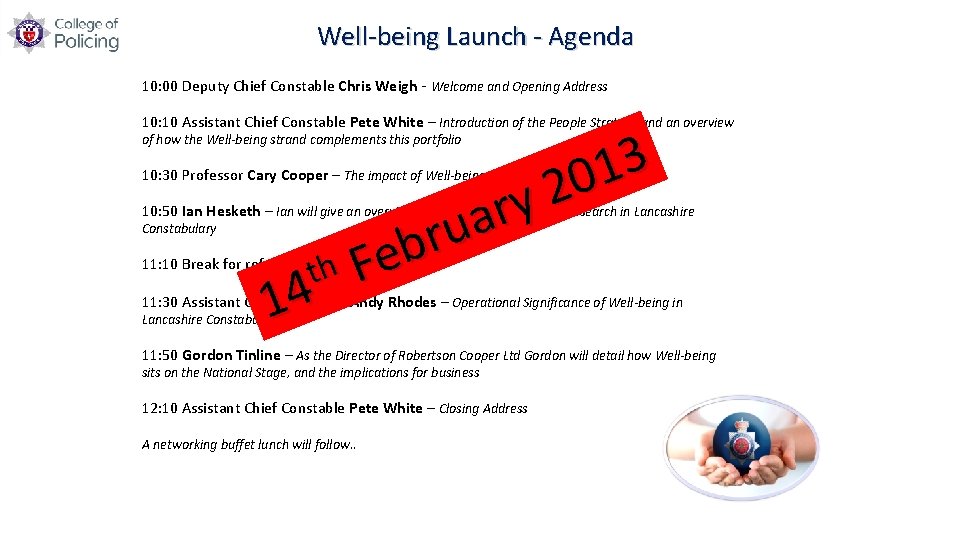
Well-being Launch - Agenda 10: 00 Deputy Chief Constable Chris Weigh - Welcome and Opening Address 10: 10 Assistant Chief Constable Pete White – Introduction of the People Strategy and an overview 3 1 0 2 y r a u r b th Fe 14 of how the Well-being strand complements this portfolio 10: 30 Professor Cary Cooper – The impact of Well-being research in the workplace 10: 50 Ian Hesketh – Ian will give an overview of the ongoing Well-being research in Lancashire Constabulary 11: 10 Break for refreshments 11: 30 Assistant Chief Constable Andy Rhodes – Operational Significance of Well-being in Lancashire Constabulary 11: 50 Gordon Tinline – As the Director of Robertson Cooper Ltd Gordon will detail how Well-being sits on the National Stage, and the implications for business 12: 10 Assistant Chief Constable Pete White – Closing Address A networking buffet lunch will follow. .

… Policing Culture? Bethan Loftus-Police Culture in a Changing World • “Police, it is said, have an exaggerated sense of mission towards their role and crave work that is crime oriented and promises excitement. • They celebrate masculine exploits, show willingness to use force and engage in informal working practices. • Officers are continually suspicious, lead socially isolated lives and display defensive solidarity with colleagues. • They are mainly conservative in politics and morality, and their culture is marked by cynicism and pessimism. • The police world view includes a simplistic, decontextualized understanding of criminality and officers are intolerant towards those who challenge the status quo. ”
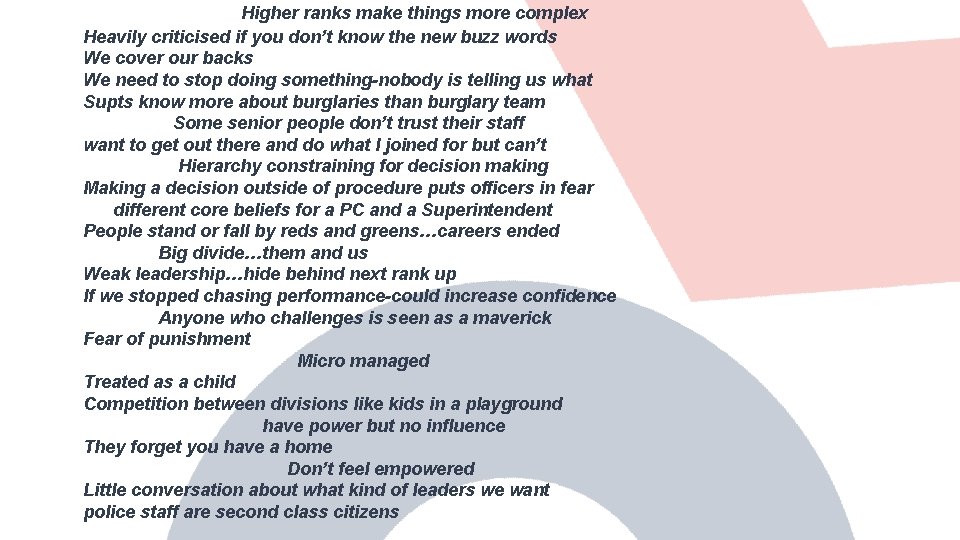
Higher ranks make things more complex Heavily criticised if you don’t know the new buzz words We cover our backs We need to stop doing something-nobody is telling us what Supts know more about burglaries than burglary team Some senior people don’t trust their staff want to get out there and do what I joined for but can’t Hierarchy constraining for decision making Making a decision outside of procedure puts officers in fear different core beliefs for a PC and a Superintendent People stand or fall by reds and greens…careers ended Big divide…them and us Weak leadership…hide behind next rank up If we stopped chasing performance-could increase confidence Anyone who challenges is seen as a maverick Fear of punishment Micro managed Treated as a child Competition between divisions like kids in a playground have power but no influence They forget you have a home Don’t feel empowered Little conversation about what kind of leaders we want police staff are second class citizens

Ethical decision-making requires more than a belief in the importance of ethics. It also requires ethical sensitivity to implications of choices, the ability to evaluate complex, ambiguous and incomplete facts, and the skill to implement ethical decisions effectively. Making Ethical Decisions (Josephson, 2002)
Two aspects to ethically sound decisions Discernment – the ability to judge well Discipline - training people to obey rules or a code of behaviour
• In order to provide these decision makers need to have: ethical sensitivity to implications of choices • the ability to evaluate complex, ambiguous and incomplete facts, and the skill to implement ethical decisions effectively.
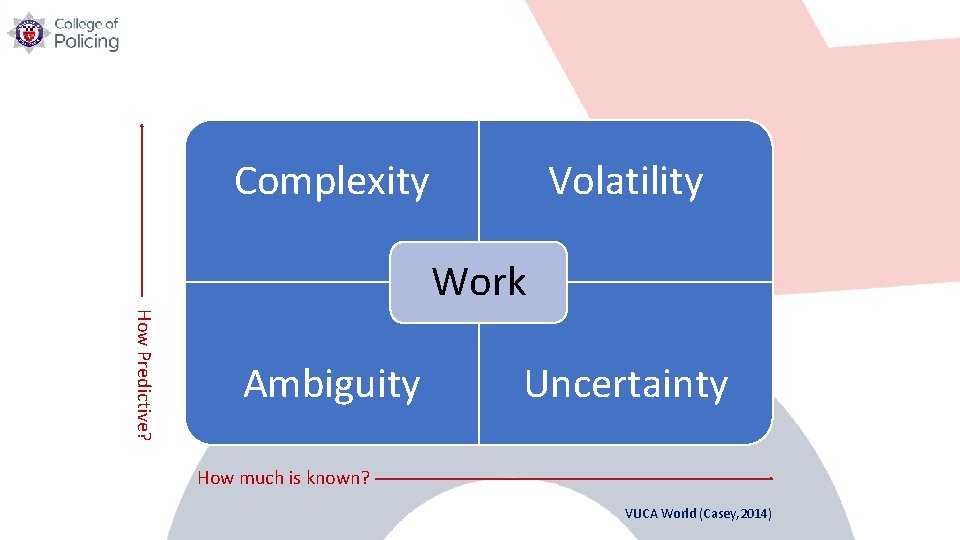
Volatility Complexity Work How Predictive? Ambiguity Uncertainty How much is known? VUCA World (Casey, 2014)
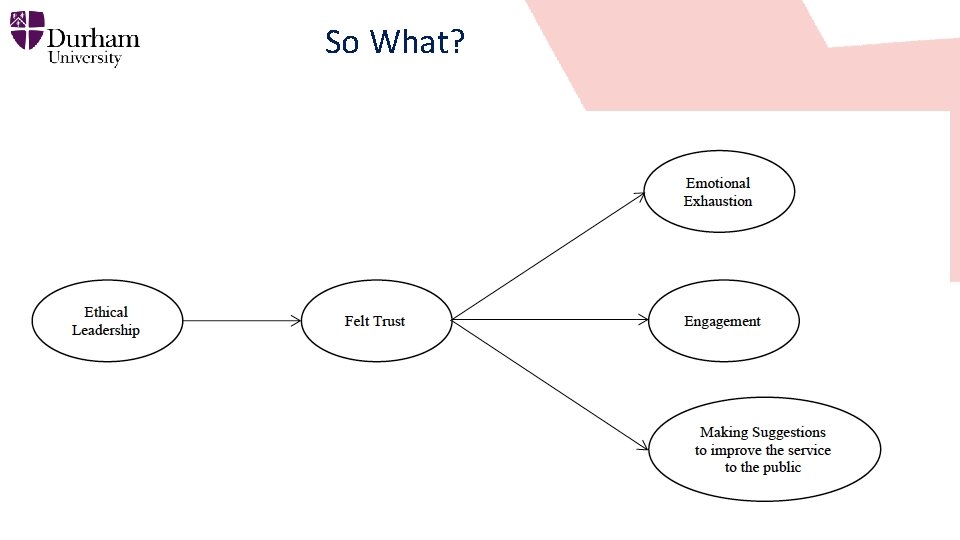
So What?
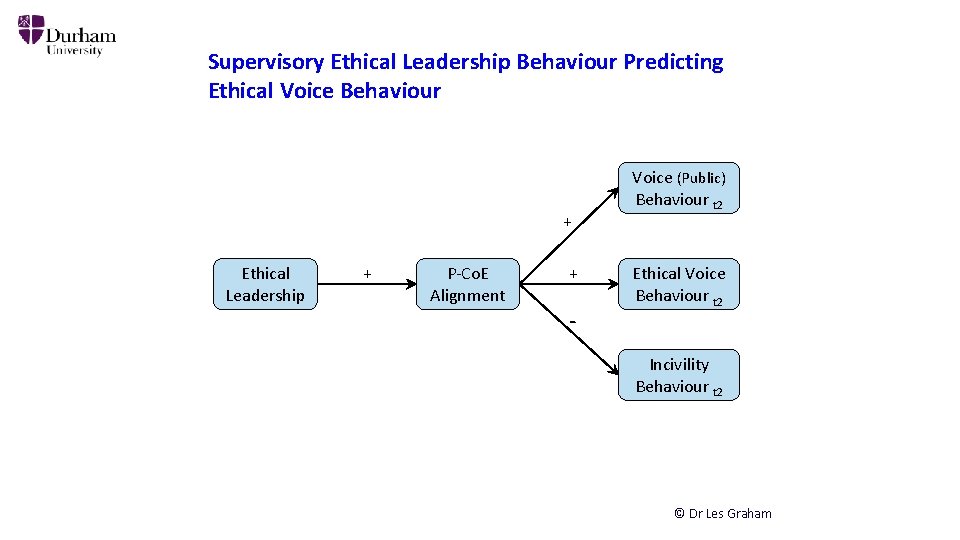
Supervisory Ethical Leadership Behaviour Predicting Ethical Voice Behaviour + Ethical Leadership + P-Co. E Alignment + - Voice (Public) Behaviour t 2 Ethical Voice Behaviour t 2 Incivility Behaviour t 2 © Dr Les Graham
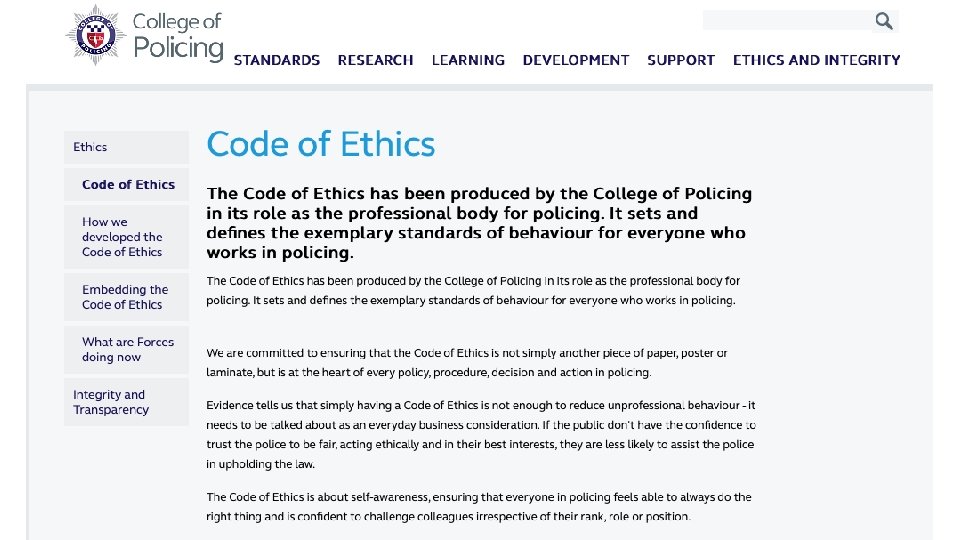
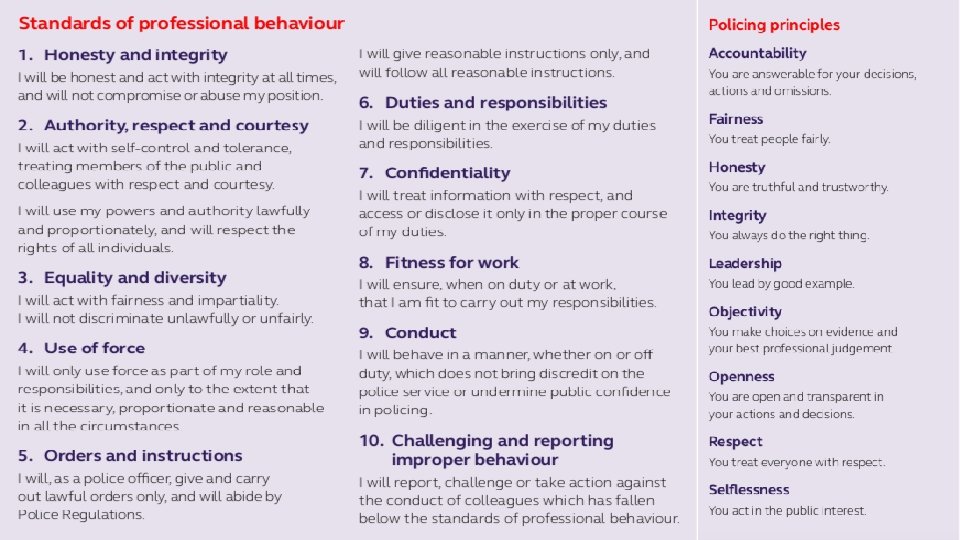
The business case for a national service
• Need is significant and increasing. Psychological wellbeing in policing is significantly worse then for the population as a whole. • Around 600, 000 policing days per year are lost to psychological ill health. The overall cost of poor psychological health is estimated at £ 7 -8 m per year for the average force. • Wellbeing should be at the very heart of policing • A healthy workforce leads to better policing for all – the public, the force and the individual • As an organisation, forces have a responsibility to provide support for both physical and mental health The national police wellbeing service
The National Police Wellbeing Service is a unique service, specifically designed to meet the needs of policing So what do you get from the service?
Our ambition is for all people who work in policing to understand how to build personal resilience, feel confident they can speak up when things aren’t going well, and to get the best personalised support possible when they do The national police wellbeing service

What do we want to achieve?
We want: • every member of the police service to feel confident that their wellbeing is taken seriously and is properly supported by their organisation • to make sure that every force has access to the best guidance and support to provide top class wellbeing services for everyone who works for them • to help everyone to understand more about wellbeing, what it means for them and what support and advice should be available if you need it. What do we want to achieve?

How will we do it?
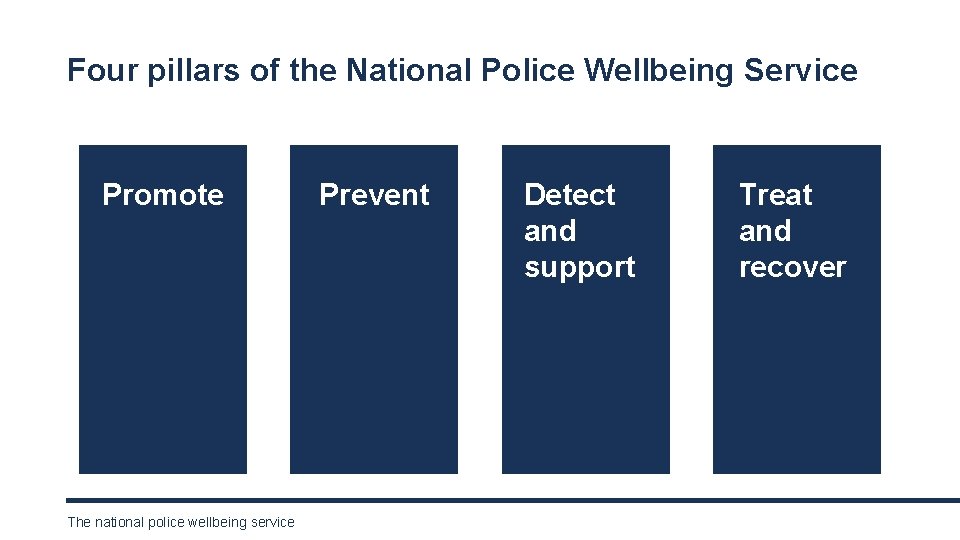
Four pillars of the National Police Wellbeing Service Promote The national police wellbeing service Prevent Detect and support Treat and recover
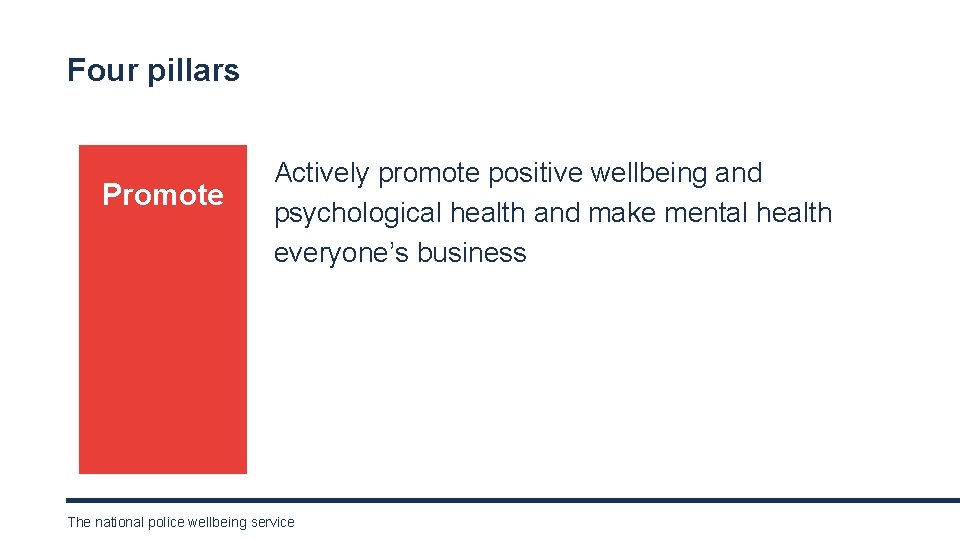
Four pillars Promote Actively promote positive wellbeing and psychological health and make mental health everyone’s business The national police wellbeing service
Four pillars Prevent Building robust resilience for officers and staff. Acting to mitigate the stressors which will inevitably be encountered by officers, staff and their families. The national police wellbeing service
Four pillars Detect and support Effectively detect the early signs of psychological problems. Provide effective support and signposting. The national police wellbeing service
Four pillars Treat and recover Swift access to evidence-based treatment. Provided by teams skilled in the particular needs of police officers and staff. Clear end-to-end support or treatment to return to work or, where appropriate, retirement with joined up care. The national police wellbeing service
The National Police Wellbeing Service is based on three strategic programmes, under which sit ten key areas of focus
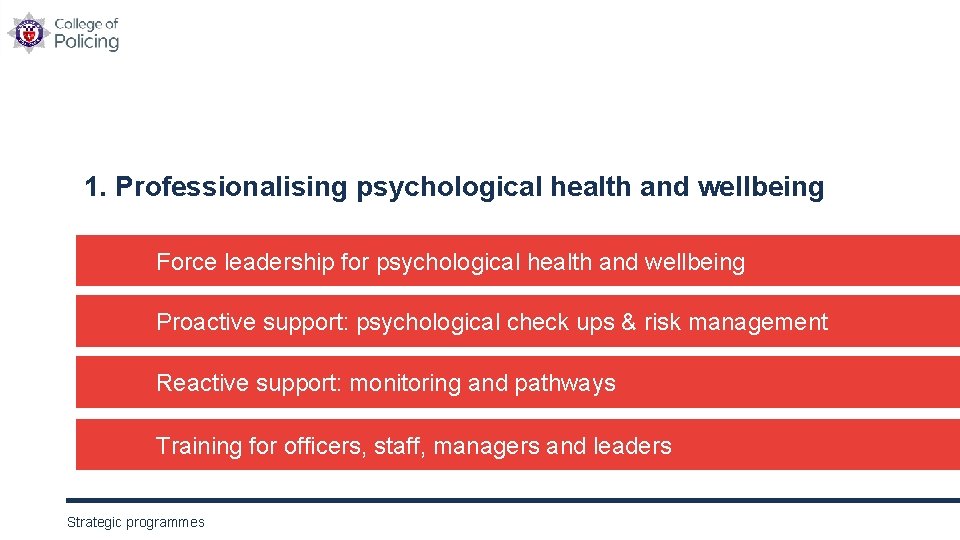
1. Professionalising psychological health and wellbeing Force leadership for psychological health and wellbeing Proactive support: psychological check ups & risk management Reactive support: monitoring and pathways Training for officers, staff, managers and leaders Strategic programmes
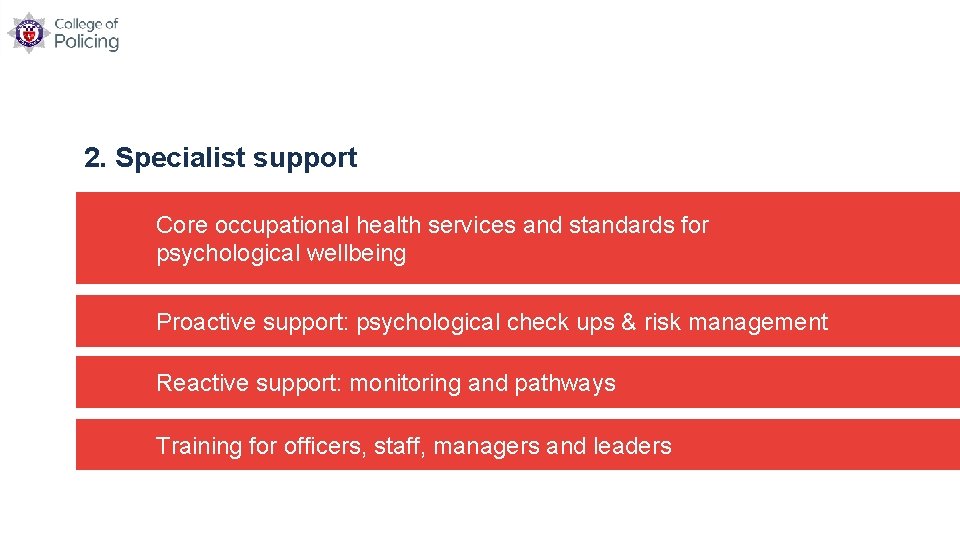
2. Specialist support Core occupational health services and standards for psychological wellbeing Proactive support: psychological check ups & risk management Reactive support: monitoring and pathways Training for officers, staff, managers and leaders
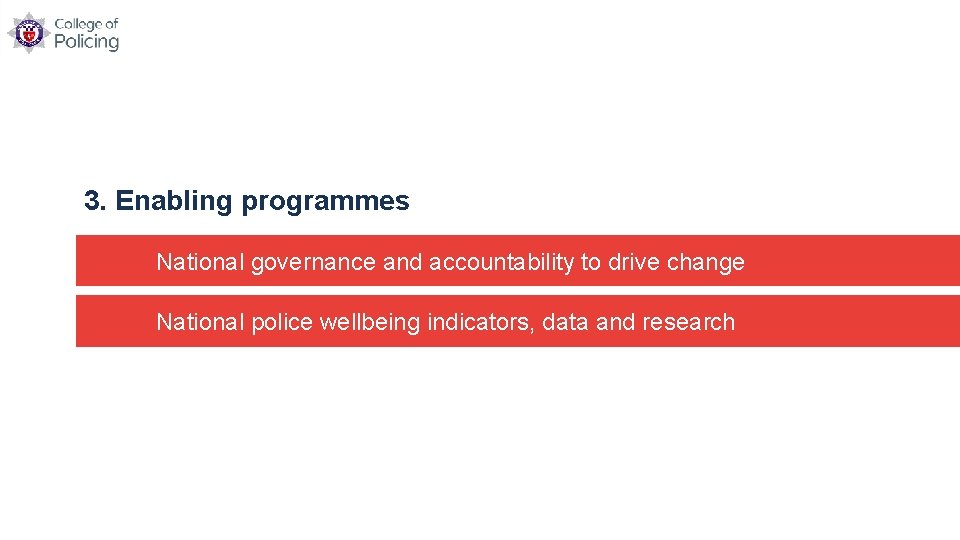
3. Enabling programmes National governance and accountability to drive change National police wellbeing indicators, data and research
What does this mean in reality? • The National Police Wellbeing Service will provide practical support to help you build your wellbeing offer • You’ll get access to the tools and resources to embed some key facets into your forces daily business practices • You’ll getting evidence based practices that are cost effective So what?
What are the operational risks to not getting wellbeing ‘right’? • By not getting this right, you are risking your operational resilience • You’ll risk losing discretionary effort, the lifeblood of policing • You’ll have less people in work and those that are at work may not be well (absenteeism / presenteeism) • You will not have an accurate picture of your resources available (leaveism) So what?
What does better look like? • A more engaged workforce who are confident that support is available • More people in work and who are well at work • A resilient workforce that is equipped to deal with the difficult job that they do • A better service to the public So what?
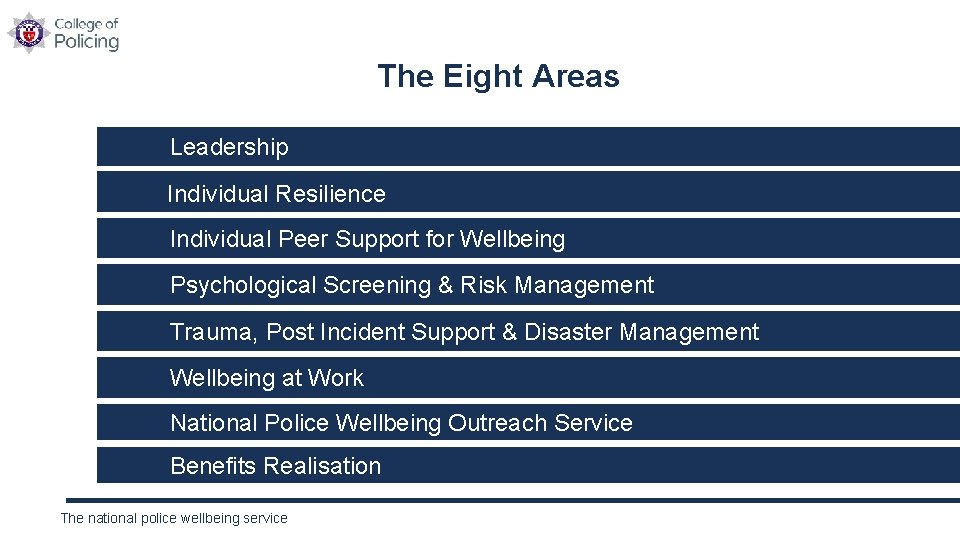
The Eight Areas Leadership Promote Prevent Individual Resilience Detect and Individual Peer Support for Wellbeing support Psychological Screening & Risk Management Treat and recover Trauma, Post Incident Support & Disaster Management Wellbeing at Work National Police Wellbeing Outreach Service Benefits Realisation The national police wellbeing service
Under each of these eight areas we will provide: • Toolkits • Guidance • Workshops • Training • Materials • Online learning • Online communities • Wellbeing Vans – Outreach Service

Progress so far
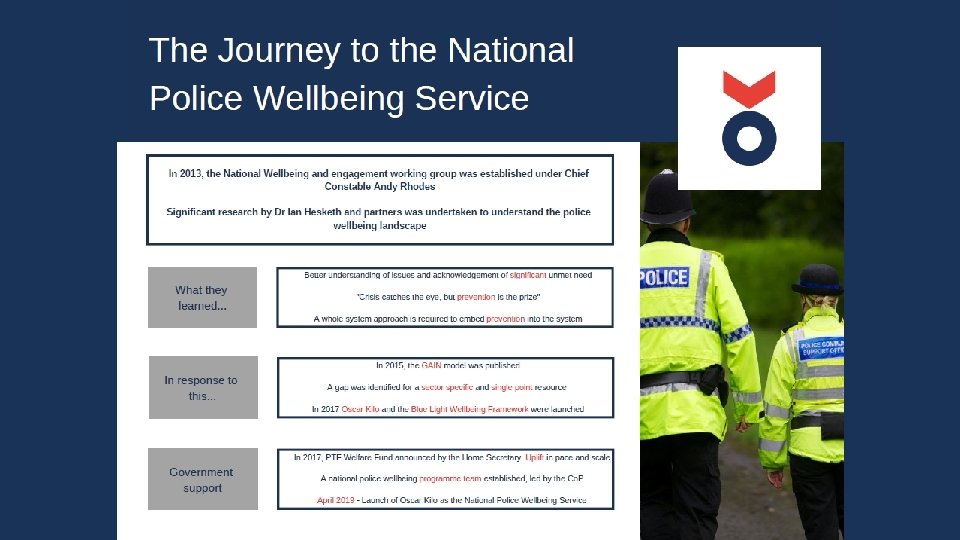
The full service went live on the 30 th April 2019 However, some areas of the live service were already in action…
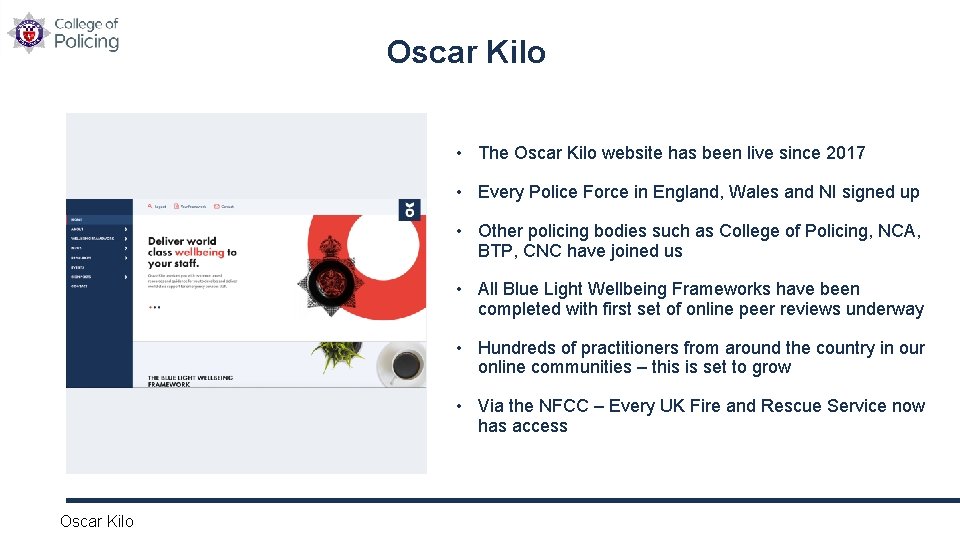
Oscar Kilo • The Oscar Kilo website has been live since 2017 • Every Police Force in England, Wales and NI signed up • Other policing bodies such as College of Policing, NCA, BTP, CNC have joined us • All Blue Light Wellbeing Frameworks have been completed with first set of online peer reviews underway • Hundreds of practitioners from around the country in our online communities – this is set to grow • Via the NFCC – Every UK Fire and Rescue Service now has access Oscar Kilo
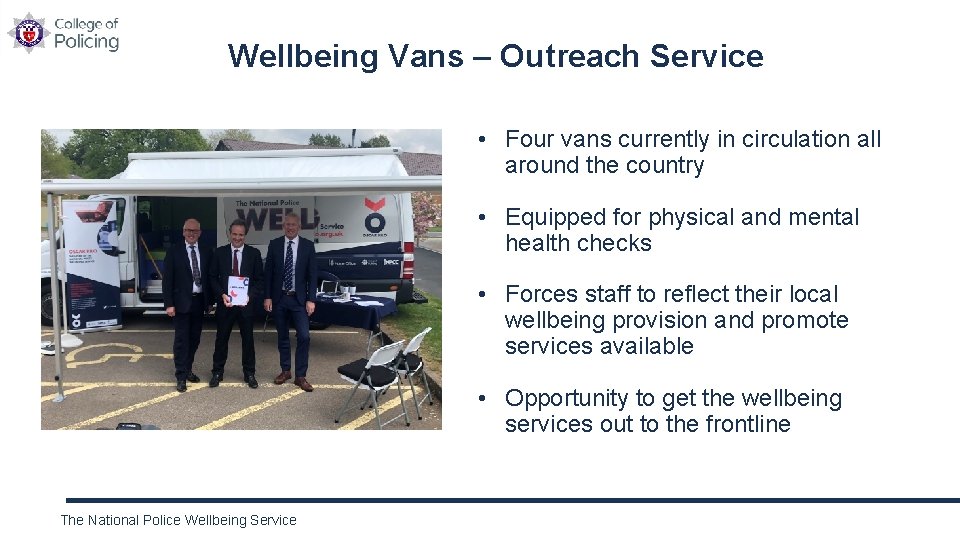
Wellbeing Vans – Outreach Service • Four vans currently in circulation all around the country • Equipped for physical and mental health checks • Forces staff to reflect their local wellbeing provision and promote services available • Opportunity to get the wellbeing services out to the frontline The National Police Wellbeing Service
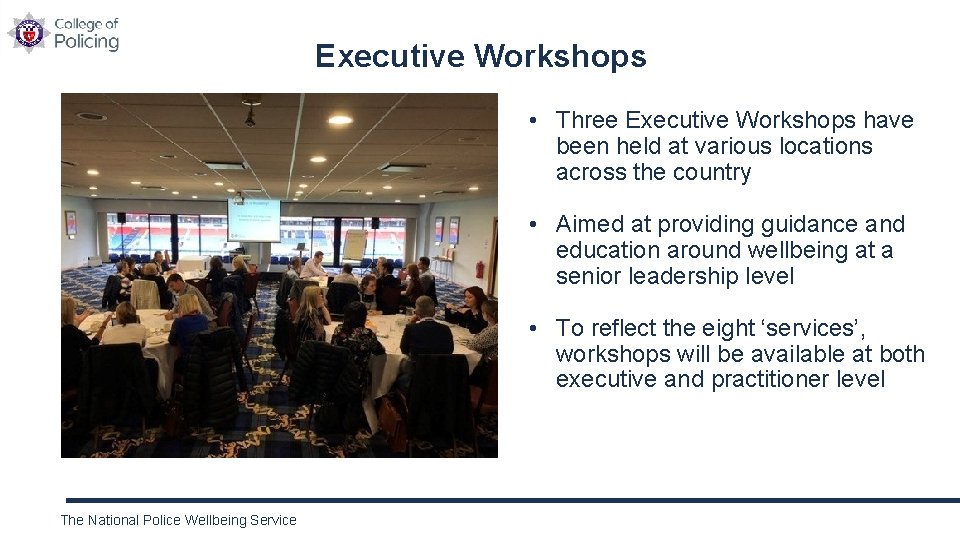
Executive Workshops • Three Executive Workshops have been held at various locations across the country • Aimed at providing guidance and education around wellbeing at a senior leadership level • To reflect the eight ‘services’, workshops will be available at both executive and practitioner level The National Police Wellbeing Service
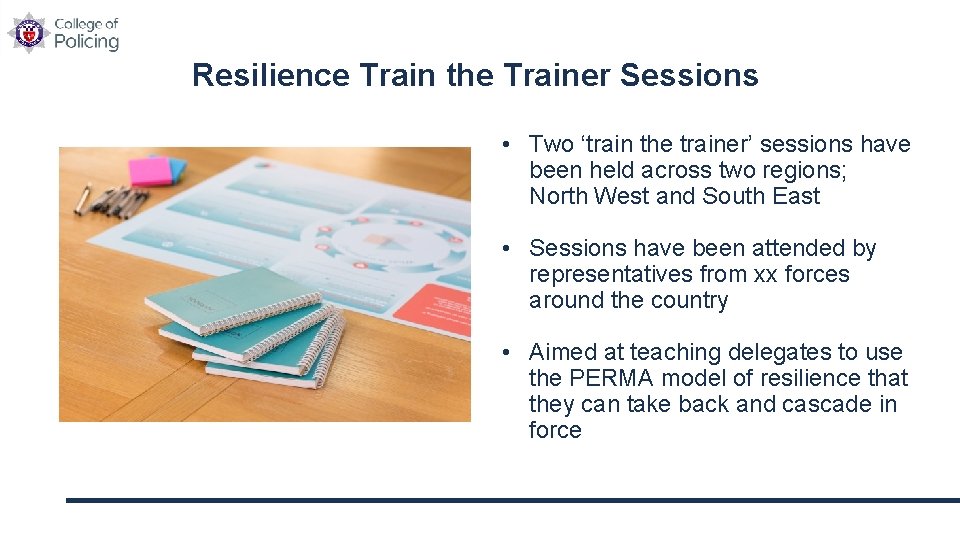
Resilience Train the Trainer Sessions • Two ‘train the trainer’ sessions have been held across two regions; North West and South East • Sessions have been attended by representatives from xx forces around the country • Aimed at teaching delegates to use the PERMA model of resilience that they can take back and cascade in force
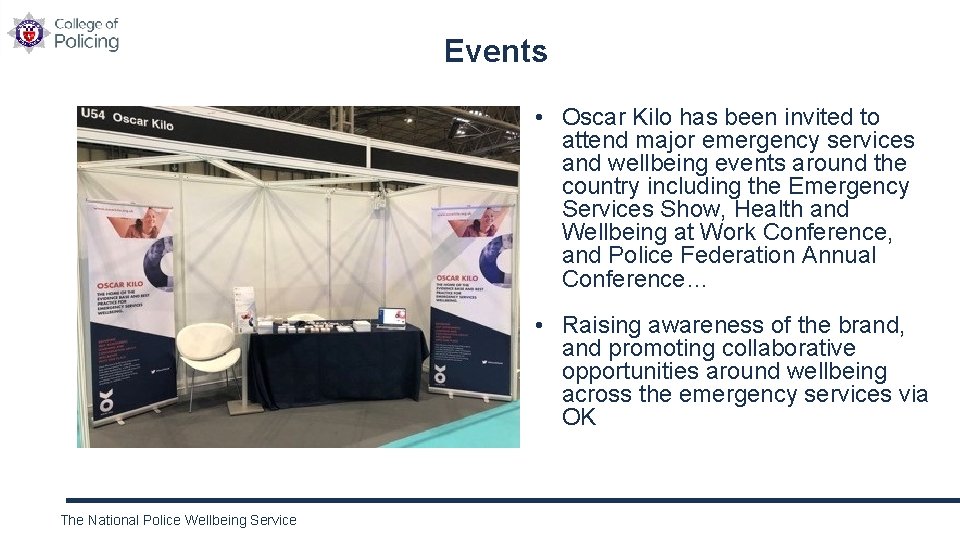
Events • Oscar Kilo has been invited to attend major emergency services and wellbeing events around the country including the Emergency Services Show, Health and Wellbeing at Work Conference, and Police Federation Annual Conference… • Raising awareness of the brand, and promoting collaborative opportunities around wellbeing across the emergency services via OK The National Police Wellbeing Service
More information: twitter: @Oscar. Kilo. UK Linked. In & Youtube: Oscar Kilo UK www. oscarkilo. org. uk
- Slides: 45