
OIE Global Conference on Veterinary Legislation Djerba Tunisia
OIE Global Conference on Veterinary Legislation Djerba, Tunisia 7 -9 December 2010 Bruce Plotkin Department of International Health Regulations Coordination 1| Departments of Food Safety and Zoonoses and International Health Regulations Presentation of WHO: OIE Global Conference on Veterinary Coordination Legislation | 03 November 2020 Health Security and Environment Cluster
Outline of Presentation l Codex Alimentarius: – What is it? What does it do? – Importance for national legislation l International Health Regulations (2005): – Background, overview, scope – Key elements – Importance of intersectoral collaboration l Legislative assessment and revision: – Lessons learned and practical suggestions Presentation of WHO: OIE Global Conference on Veterinary | 03 November 2020 2 | Legislation
Codex Alimentarius Commission - what is it? l Codex Alimentarius Commission (CAC) is an intergovernmental body operating within the United Nations l Joint initiative of FAO and WHO (since 1963) – FAO/WHO Food Standards Programme l 180 member governments, including the European Community as a member organization l Approximately 20 technical committees l Product is Codex Alimentarius (Latin for "food code") Presentation of WHO: OIE Global Conference on Veterinary | 03 November 2020 3 | Legislation
Codex Alimentarius Commission - what does it do? l Creates harmonized international food standards with a dual purpose: – “to protect the health of consumers” – “to ensure fair practices in the food trade” l Also promotes coordination of all food standards work undertaken by international governmental and non-governmental organizations l Standards, when introduced into national legislation, contribute to ensure safety of foods l Commission meets annually - discuss and adopt international food standards, guidelines l For examples, at its recent 33 rd session, the commission considered: – guidelines on controlling bacteria in seafood throughout the food-chain; and – setting maximum residues level for ractopamine in meat Presentation of WHO: OIE Global Conference on Veterinary | 03 November 2020 4 | Legislation
Codex standards l Voluntary / Non-mandatory l Reference for policy & decision-makers l Since 1995, international standards references under the SPS and TBT Agreements of the World Trade Organization (WTO) l International standards in SPS a. for food safety → Codex standards b. for animal health → OIE (World Organisation for Animal Health) c. for plant health → IPPC (Int'l Plant Protection Convention) Presentation of WHO: OIE Global Conference on Veterinary | 03 November 2020 5 | Legislation
FAO/WHO Guidelines for strengthening national food control systems (2003) l ANNEX 6 – Guidelines for Developing a National Food Law l A set of guiding principles as a general approach to the drafting of food legislation l Applicable to different legal systems l Complement an in-depth analysis of the legal and institutional framework that govern food production, import, export, distribution, handling and sale in a particular country l Prompt countries to take full advantage of Codex standards and food safety & quality lessons learned in other countries Presentation of WHO: OIE Global Conference on Veterinary | 03 November 2020 6 | Legislation
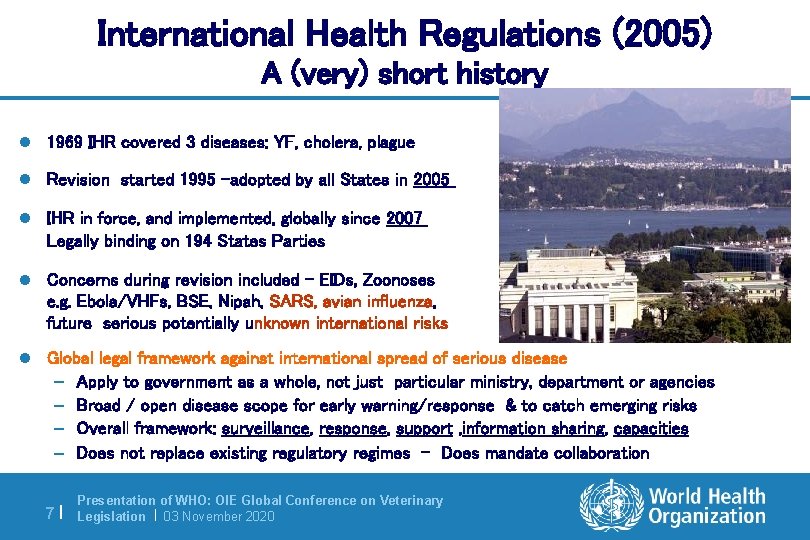
International Health Regulations (2005) A (very) short history l 1969 IHR covered 3 diseases: YF, cholera, plague l Revision started 1995 –adopted by all States in 2005 l IHR in force, and implemented, globally since 2007 Legally binding on 194 States Parties l Concerns during revision included - EIDs, Zoonoses e. g. Ebola/VHFs, BSE, Nipah, SARS, avian influenza, future serious potentially unknown international risks l Global legal framework against international spread of serious disease – Apply to government as a whole, not just particular ministry, department or agencies – Broad / open disease scope for early warning/response & to catch emerging risks – Overall framework: surveillance, response, support , information sharing, capacities – Does not replace existing regulatory regimes – Does mandate collaboration Presentation of WHO: OIE Global Conference on Veterinary | 03 November 2020 7 | Legislation
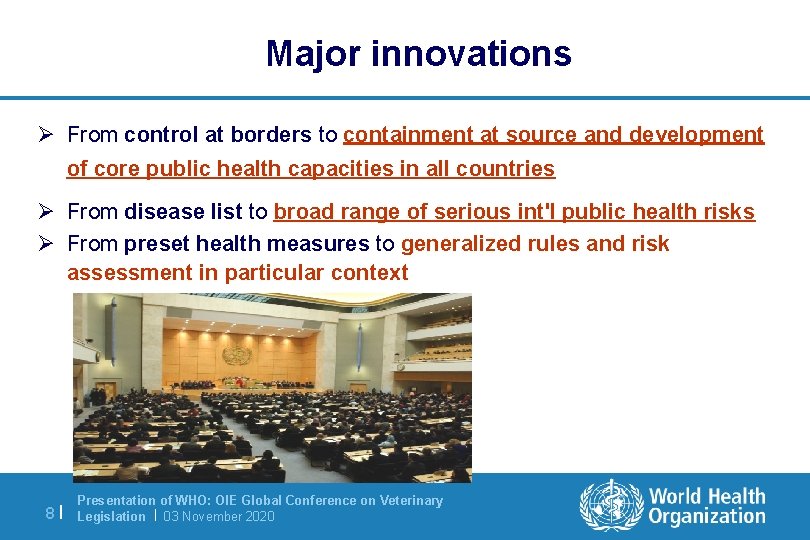
Major innovations Ø From control at borders to containment at source and development of core public health capacities in all countries Ø From disease list to broad range of serious int'l public health risks Ø From preset health measures to generalized rules and risk assessment in particular context Presentation of WHO: OIE Global Conference on Veterinary | 03 November 2020 8 | Legislation
Purpose and Scope of IHR l "to prevent, protect against, control and respond to the international spread of disease… l "in ways that are commensurate with and restricted to public health risks l "and which avoid unnecessary interference with international traffic and trade" (Article 2) Presentation of WHO: OIE Global Conference on Veterinary | 03 November 2020 9 | Legislation
Broad scope and coverage of IHR (2005) l “Disease”: “an Illness or medical condition, irrespective of origin or source, that presents or could present significant harm to humans” l “Event”: “a manifestation of disease or an occurrence that creates the potential for disease” l "Public health risk": "the likelihood of an event that may adversely affect the health of human populations, …" l Events/risks may be: – – – Biological/infectious, chemical, radionuclear Known or unknown, emerging or re-emerging Transmissible by persons, transport conveyances, cargo/goods food/animals/products), vectors, environment, etc. Presentation of WHO: OIE Global Conference on Veterinary | 03 November 2020 10 | Legislation
Government areas and functions affected by International Health Regulations l Public health l Agriculture (and animal health) l Environment l International ports, airports, ground crossings l Radio-nuclear and chemical activities / safety l Customs l Food safety l Borders / immigration l Transportation (including dangerous goods) l Collection, use and disclosure of public health information l Activities of authorities at national, state/provincial/district, local levels. Presentation of WHO: OIE Global Conference on Veterinary | 03 November 2020 11 | Legislation
Animals / products References to animals in the IHR arise in mainly 2 contexts: l "Goods" – part of provisions throughout the IHR Defined as: "tangible products, including animals and plants, transported on an international journey, including for utilization aboard a conveyance" l "Animals" – additionally referenced separately (examples): l Definitions: infection/disinfection, contamination/decontamination, reservoir/vector l Port/airport authorities responsible for removal and safe disposal of animal dejecta and other contaminated items on conveyances l Designated ports/airports must have capacities to assess and care for affected animals by arrangements with local veterinary facilities for isolation, treatment l Ship Sanitation Inspections / certificates include animal reservoirs l Maritime Declaration of Health includes disclosure of sick animals Presentation of WHO: OIE Global Conference on Veterinary | 03 November 2020 12 | Legislation
Key structures & mechanism National IHR Focal Point WHO IHR Contact Point In all countries available 24/7 for urgent communications with WHO IHR Contact Point on urgent events under the IHR (for e. g. notification/verification/follow-up) involving any covered risks Located in each of WHO’s 6 regional offices – for communications with the National IHR Focal Points Responsible for obtaining information from all government sectors on IHR-covered events (should include animal health), and for disseminating information to them. Works with WHO HQ, Country office and National government – on IHR events, technical support, capacity building Potential focus for intersectoral collaboration Has access to restricted IHR Event Information Site – information on selected (also OIE/FAO) Presentation of WHO: OIE Global Conference on Veterinary | 03 November 2020 13 | Legislation
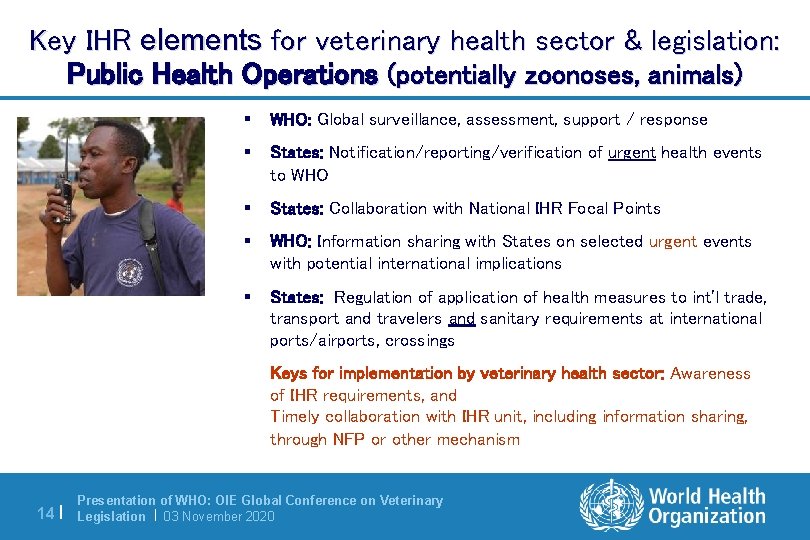
Key IHR elements for veterinary health sector & legislation: Public Health Operations (potentially zoonoses, animals) § WHO: Global surveillance, assessment, support / response § States: Notification/reporting/verification of urgent health events to WHO § States: Collaboration with National IHR Focal Points § WHO: Information sharing with States on selected urgent events with potential international implications § States: Regulation of application of health measures to int'l trade, transport and travelers and sanitary requirements at international ports/airports, crossings Keys for implementation by veterinary health sector: Awareness of IHR requirements, and Timely collaboration with IHR unit, including information sharing, through NFP or other mechanism Presentation of WHO: OIE Global Conference on Veterinary | 03 November 2020 14 | Legislation
Development of core public health capacities for surveillance and response l All States Parties must develop/maintain national minimum public health capacities, including surveillance, assessment & response l Required capacities: Detect, assess, control and report internally on public health events – according to specified criteria – At all levels and throughout national territory – Deadline for development: 2012/2014 l Efforts to achieve these capacities ongoing worldwide – Development monitored with States and WHO support – Report on progress to the WHO World Health Assembly l Includes your areas: Zoonoses and food-related risks – Critical area for intersectoral collaboration Presentation of WHO: OIE Global Conference on Veterinary | 03 November 2020 15 | Legislation
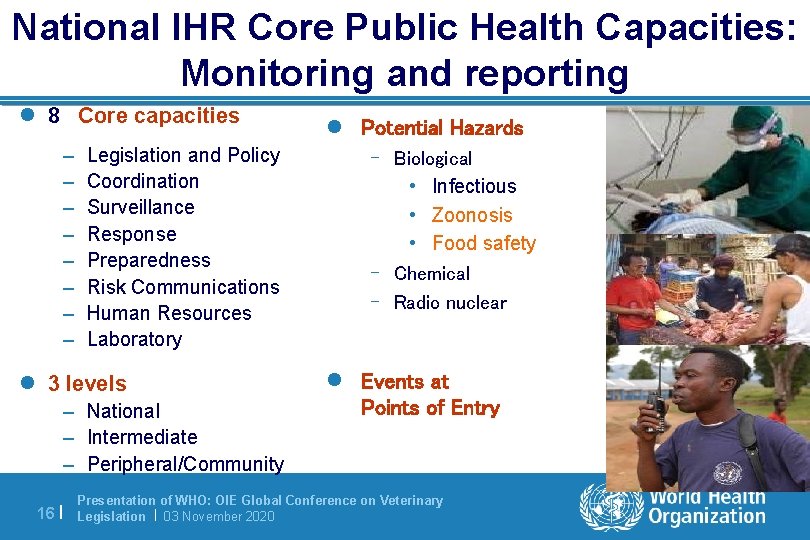
National IHR Core Public Health Capacities: Monitoring and reporting l 8 Core capacities – – – – Legislation and Policy Coordination Surveillance Response Preparedness Risk Communications Human Resources Laboratory l 3 levels – National – Intermediate – Peripheral/Community l Potential Hazards – Biological • Infectious • Zoonosis • Food safety – Chemical – Radio nuclear l Events at Points of Entry Presentation of WHO: OIE Global Conference on Veterinary | 03 November 2020 16 | Legislation
The requirements for intersectoral collaboration l Required directly, and effectively indirectly under IHR (2005) l Relevant mechanisms and provisions under the IHR (2005): – National IHR Focal Point in all countries: • Veterinary health sector a key authority with relevant public health information • May also be other IHR coordinating authority – National programme for meeting IHR Core capacity requirements – including zoonoses and food safety – These are subjects of national/WHO monitoring & reporting to World Health Assembly l Coordination with National IHR authorities: – National veterinary legislation should be consistent with national organization for IHR implementation – Ongoing legislative assessment and revision process regarding IHR (2005) rights and obligations – presents an opportunity for synergies and efficiencies Presentation of WHO: OIE Global Conference on Veterinary | 03 November 2020 17 | Legislation
Assessment and revision of legislation l Potential benefits: – Enable veterinary health sector to carry out its necessary specific tasks – Facilitate more efficient and effective functioning to achieve objectives – Enable or facilitate implementation of country’s rights and obligations under the range of relevant international laws – Empower the veterinary health sector – Institutionalize the role and activities of the sector within the government – Facilitate important inter-sectoral collaboration within government in activities relevant to veterinary health sector’s – Good governance l Potential challenges include: institutional, technical, informational, resource Presentation of WHO: OIE Global Conference on Veterinary | 03 November 2020 18 | Legislation
Lessons learned in context of public health legislative assessment and revision l Others in your government are probably also doing assessments / revision of legislation, some of which may relate to your intended legislation l Legislation must be specific to domestic legal and governance systems, sociopolitical context l Prioritize: – What may need to be done most urgently – What are most important elements for each State – Consider options to expedite the legislative process if urgently needed l Process needs to involve all relevant sectors, offices, levels – May well save time / avoid obstacles later l Process needs to involve not only options for high level legislation, but also regulations, rules, procedures that implement legislation operationally Presentation of WHO: OIE Global Conference on Veterinary | 03 November 2020 19 | Legislation
Practical suggestions – Preparations l Contact relevant government legal advisors for appropriate procedures – if needed l Consider developing awareness materials such as cabinet papers to facilitate support l Start early to identify / mobilize governmental, technical, financial, other resources l Contact other States (particularly those with similar national contexts) who are doing, or have done, similar assessments and revisions for their lessons learned, collaboration l Contact your country's national authorities concerned with implementing the IHR (2005) rights and obligations and other relevant national/international obligations (e. g. WTO/Trade): l l Facilitates awareness of full legislative landscape relevant to veterinary legislation l Can ensure consistency and effective implementation in areas of mutual concern Start early to identify existing legislation, regulations, rules relating to your proposed legislation - can take surprising time, and if are problems better to know early Presentation of WHO: OIE Global Conference on Veterinary | 03 November 2020 20 | Legislation
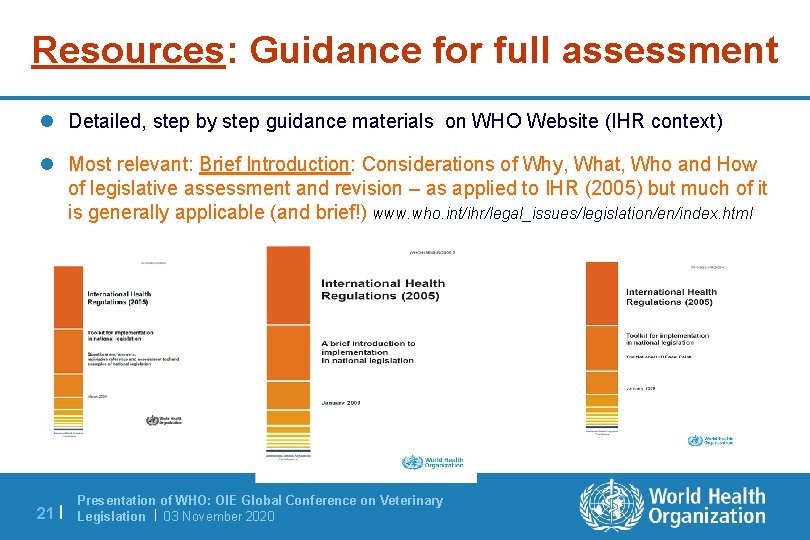
Resources: Guidance for full assessment l Detailed, step by step guidance materials on WHO Website (IHR context) l Most relevant: Brief Introduction: Considerations of Why, What, Who and How of legislative assessment and revision – as applied to IHR (2005) but much of it is generally applicable (and brief!) www. who. int/ihr/legal_issues/legislation/en/index. html Presentation of WHO: OIE Global Conference on Veterinary | 03 November 2020 21 | Legislation

www. who. int/ih Thank you Presentation of WHO: OIE Global Conference on Veterinary | 03 November 2020 22 | Legislation
- Slides: 22