
OHT 7 1 Product anatomy Brassington and Pettitt
OHT 7. 1 Product anatomy Brassington and Pettitt: Principles of Marketing, 3 rd Edition © Pearson Education Limited 2003
OHT 7. 2 Product definition A product is a physical good, service, idea, person or place that is capable of offering tangible and intangible attributes that individuals or organisations regard as so necessary, worthwhile, or satisfying that they are prepared to exchange money, patronage or some other unit of value in order to acquire it. Brassington and Pettitt: Principles of Marketing, 3 rd Edition © Pearson Education Limited 2003

OHT 7. 3 The anatomy of a product Figure 7. 1 Brassington and Pettitt: Principles of Marketing, 3 rd Edition © Pearson Education Limited 2003

OHT 7. 4 Product layers All four layers of a product contribute to the buyer’s satisfaction. The outer two depend on the core product to determine how they are realised. Brassington and Pettitt: Principles of Marketing, 3 rd Edition © Pearson Education Limited 2003
OHT 7. 5 Product based classifications • Durable products - last for many uses and over a long period before having to be replaced. • Non-durable products - can be used once or a few times before having to be replaced. • Service products - intangible products comprising activities, benefits or satisfactions that are not embodied in physical products, e. g. financial services, holidays, etc. Brassington and Pettitt: Principles of Marketing, 3 rd Edition © Pearson Education Limited 2003
OHT 7. 6 User based classifications: consumer goods/services • Convenience goods - relatively inexpensive, frequent purchases which respond to routine response buying situations. • Shopping goods - represent more of a risk and an adventure to consumers. • Speciality goods - high risk, expensive and infrequently purchased products. • Unsought goods - e. g. sudden emergencies. Brassington and Pettitt: Principles of Marketing, 3 rd Edition © Pearson Education Limited 2003
OHT 7. 7 User based classifications: B 2 B goods/services • Capital goods - buildings and fixed equipment that contribute to production. • Accessory goods - items that give peripheral support to the production process. • Raw materials. • Semi-finished goods. • Components and parts. • Supplies and services. Brassington and Pettitt: Principles of Marketing, 3 rd Edition © Pearson Education Limited 2003
OHT 7. 8 The product mix The sum of all the products and variants offered by an organisation. The product mix can be split into the following: • Product lines. • Product items. • Product line length. • Product line depth. • Product mix width. Brassington and Pettitt: Principles of Marketing, 3 rd Edition © Pearson Education Limited 2003
OHT 7. 9 Importance of branding A brand is any name, design, style, words or symbols, singly or in combination that distinguish one product from another in the eyes of the customer. Brands are used by people to establish their status far more than religion or political party. Brassington and Pettitt: Principles of Marketing, 3 rd Edition © Pearson Education Limited 2003
OHT 7. 10 Branding • An important element of the tangible product. • In consumer markets can link items within a product line. • Can help in the development of a new product. • Creates and communicates a three dimensional character of a product that is not easily duplicated by competitors. Brassington and Pettitt: Principles of Marketing, 3 rd Edition © Pearson Education Limited 2003
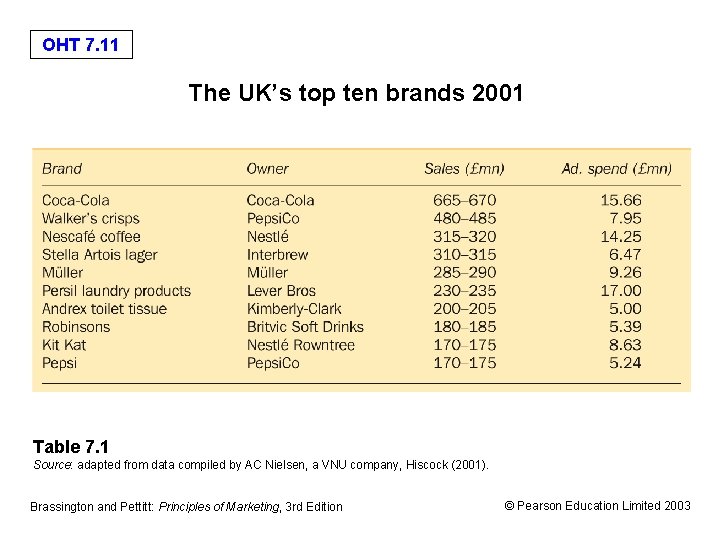
OHT 7. 11 The UK’s top ten brands 2001 Table 7. 1 Source: adapted from data compiled by AC Nielsen, a VNU company, Hiscock (2001). Brassington and Pettitt: Principles of Marketing, 3 rd Edition © Pearson Education Limited 2003
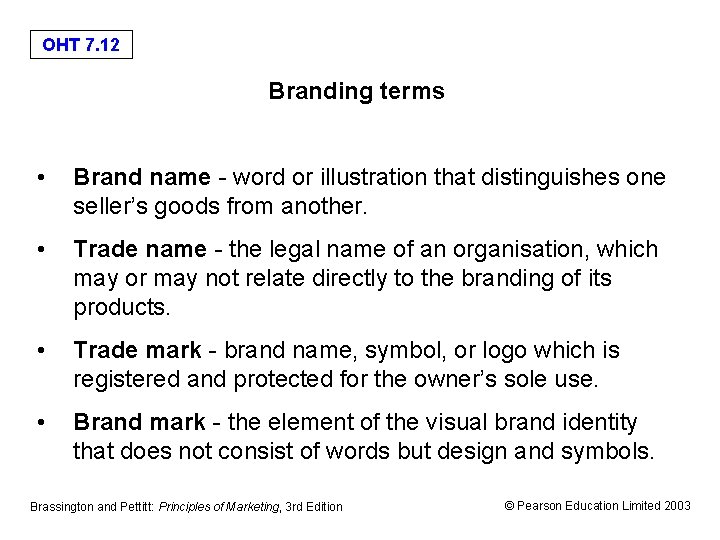
OHT 7. 12 Branding terms • Brand name - word or illustration that distinguishes one seller’s goods from another. • Trade name - the legal name of an organisation, which may or may not relate directly to the branding of its products. • Trade mark - brand name, symbol, or logo which is registered and protected for the owner’s sole use. • Brand mark - the element of the visual brand identity that does not consist of words but design and symbols. Brassington and Pettitt: Principles of Marketing, 3 rd Edition © Pearson Education Limited 2003

OHT 7. 13 Benefits of branding Figure 7. 4 Brassington and Pettitt: Principles of Marketing, 3 rd Edition © Pearson Education Limited 2003
OHT 7. 14 Types of brands • Manufacturer brands. • Retailer and wholesaler brands. Brassington and Pettitt: Principles of Marketing, 3 rd Edition © Pearson Education Limited 2003
OHT 7. 15 The rules for good brand naming • Distinctive. • Supportive. • Acceptable. • Available. Brassington and Pettitt: Principles of Marketing, 3 rd Edition © Pearson Education Limited 2003
OHT 7. 16 Packaging Serves a functional purpose and a means of promotional communication about the product or brand. A container or wrapping in which a product is offered for sale. Effective and thoughtful packaging can increase sales. Brassington and Pettitt: Principles of Marketing, 3 rd Edition © Pearson Education Limited 2003
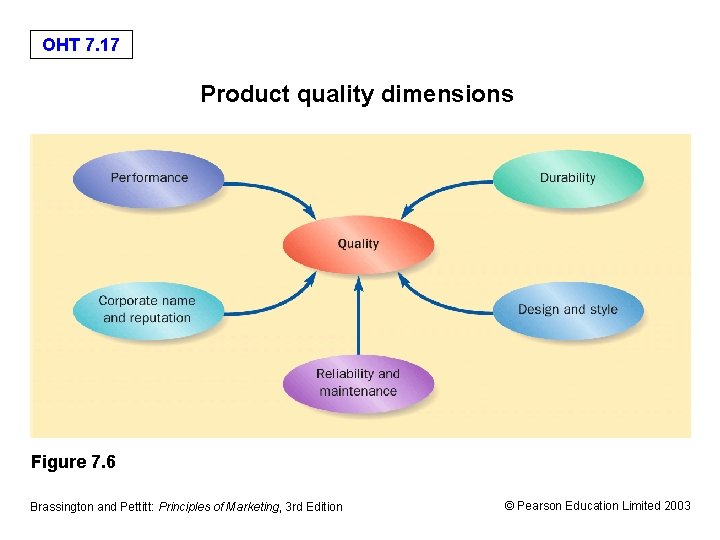
OHT 7. 17 Product quality dimensions Figure 7. 6 Brassington and Pettitt: Principles of Marketing, 3 rd Edition © Pearson Education Limited 2003
- Slides: 17