
OHT 2 1 Internationalisation Process Wall and Rees
- Slides: 5
OHT 2. 1 Internationalisation Process Wall and Rees: International Business, 2 nd edition © Pearson Education Limited 2004
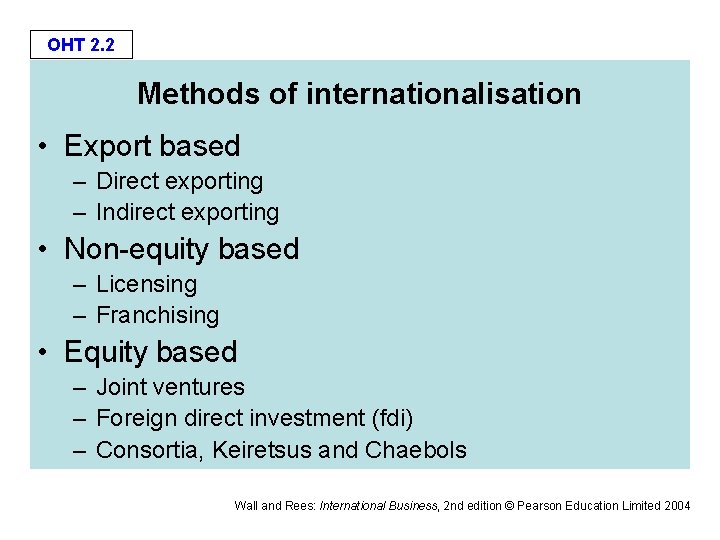
OHT 2. 2 Methods of internationalisation • Export based – Direct exporting – Indirect exporting • Non-equity based – Licensing – Franchising • Equity based – Joint ventures – Foreign direct investment (fdi) – Consortia, Keiretsus and Chaebols Wall and Rees: International Business, 2 nd edition © Pearson Education Limited 2004
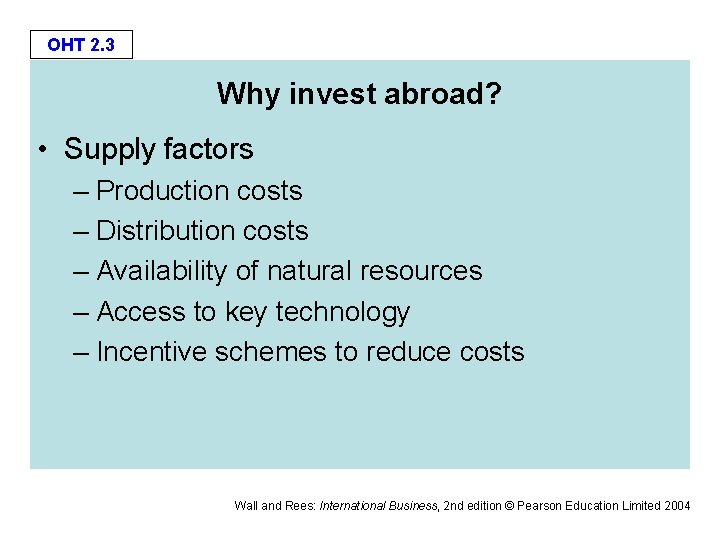
OHT 2. 3 Why invest abroad? • Supply factors – Production costs – Distribution costs – Availability of natural resources – Access to key technology – Incentive schemes to reduce costs Wall and Rees: International Business, 2 nd edition © Pearson Education Limited 2004
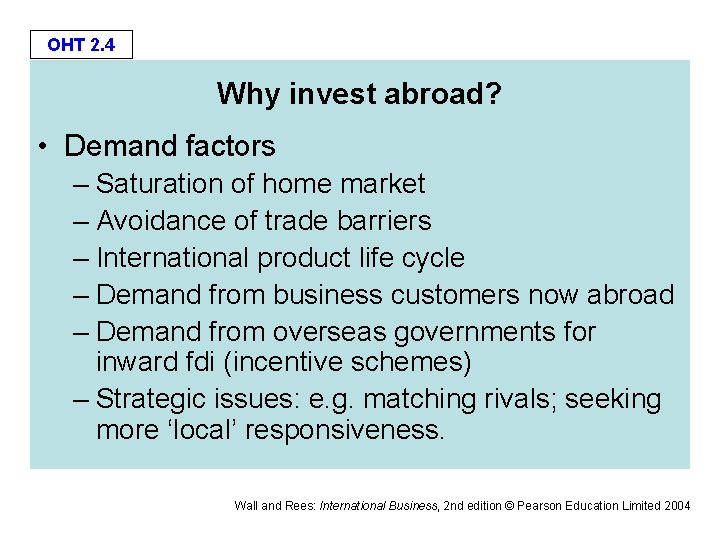
OHT 2. 4 Why invest abroad? • Demand factors – Saturation of home market – Avoidance of trade barriers – International product life cycle – Demand from business customers now abroad – Demand from overseas governments for inward fdi (incentive schemes) – Strategic issues: e. g. matching rivals; seeking more ‘local’ responsiveness. Wall and Rees: International Business, 2 nd edition © Pearson Education Limited 2004
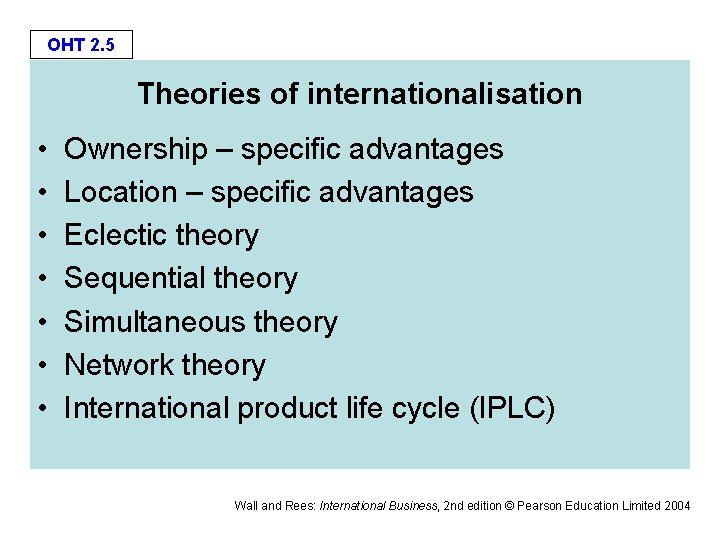
OHT 2. 5 Theories of internationalisation • • Ownership – specific advantages Location – specific advantages Eclectic theory Sequential theory Simultaneous theory Network theory International product life cycle (IPLC) Wall and Rees: International Business, 2 nd edition © Pearson Education Limited 2004