
OHSLA SCOREKEEPERS TIMEKEEPERS TRAINING 2020 Course Instructor Tom


- Slides: 22
OHSLA SCOREKEEPERS & TIMEKEEPERS TRAINING 2020
Course Instructor Tom Hoffert OLOA President, NILOA/NFHS Official laxreftomhoffert@gmail. com A big “THANK YOU” to Coach Mike Marcott and the Lake Oswego Lacrosse club for hosting us today!
Agenda Introduction Purpose / Objectives Lacrosse Terminology Role of Timekeeper Role of Scorekeeper Field Layout Practical Application Questions? ? ?
PURPOSE / OBJECTIVES 1 st Item of Business: PLEASE SIGN-IN to the attendance sheet What goals do we want to achieve from this training class? 1. 2. 3. 4. 5. 6. 7. Consistency equals Integrity. Legitimacy - Uniformity of scorekeeping. Clear volunteer expectations. Create proper “table atmosphere” Don’t know the Official’s hand signals? DON’T WORRY – LISTEN! There is no test – Do your best! Each team received a rulebook at the Annual All-Coaches meeting (if your team does not have a rule book, please reach out to OHSLA Commissioner Paul Schlesinger). 8. Each team will receive one (1) official league-issued scorebook for use in Varsity games today, for use in the 2020 season
OVERVIEW – PART I 1. Officials are in charge of field, sideline, and spectators. 2. You are an important part of proper game management and are volunteering to assist the officiating crew and teams. 3. Properly ask for officials’ help when needed, at the correct time, in the correct manner. 4. No responsibility for administering or enforcing rules – partner with the officiating crew. 5. As the on-field officials are a team and rely on each other, so must the scorers, timers, and spotters. 6. Coaches will expect help with certain situations and may inquire during the game – answer with what you know as quickly as possible, but at the proper time (usually time in game or penalty). If busy, “I’ll get you that information shortly coach. ” 7. Enjoy the best seat in the house!
OVERVIEW – PART II Home team table crew is responsible for recording scores and penalties. 1. Home team Scorekeeper and Timer have the official OHSLA stats. 2. Please drop allegiance to your child, team, or coaches – you are a professional volunteer. 3. The table volunteers cannot and must not serve as a rooting section for either team. 4. Not a time for chatting it up with friends, texting, or social media. You are there to “work” in the best seat in the stadium. 5. While you may inside be cheering for your team, your exterior is professional and courteous. 6. The OHSLA requests you wear neutral colors – no team jackets or hats. This may not be reality, but it is requested.
LACROSSE TERMINOLOGY A Shot – Goal – ect Assist – A being thrown from a crosse, kicked, or otherwise physically directed legally. Ball is propelled by offensive player into goal. than goalie in crease. ONLY ONE ASSIST per goal. No hockey rule (2 assists). Goalie Save – Ball is stopped or deflected by goalkeeper using crosse or any body part when that ball would have or may have otherwise enter goal. (Don’t be too good) Ground Ball – Ball comes into possession of player contested by an opponent and the player controls ball for passing, shooting, or cradling. During a FO, credit the player gaining possession of the ball with a GB, and the Team with a FO win. Faceoff – Ball comes into possession of the team which first gains possession of the ball. faceoff A statistic is awarded to faceoff specialist regardless of himself or a teammate gaining possession. Fouls – Technical – 30 seconds Personal – 1 to 3 minutes Releasable – Ends when other team scores Non-Releasable – Player serves full time Team Clears - Player gains possession of the ball in his defensive zone & successfully transitions the ball into his team’s attack box, while keeping the ball in his team’s possession.
REVIEW: SHOT RULE A shot that has released from a player’s crosse PRIOR to time expiring remains a “live” shot, even after the horn has sounded to end a period. (Think “shot” at end of time quarter/half in basketball – was shot released prior to end of quarter/half) That shot remains “live” until one of the following occurs: • Shot is completely out of crosse and enters the cage legally – Good Goal • Deflects off a defensive team’s body, helmet, stick – Good Goal • Deflects off a fellow offensive teammate – Kills play • Shot NOT released completely from the stick when time expires – Kills play
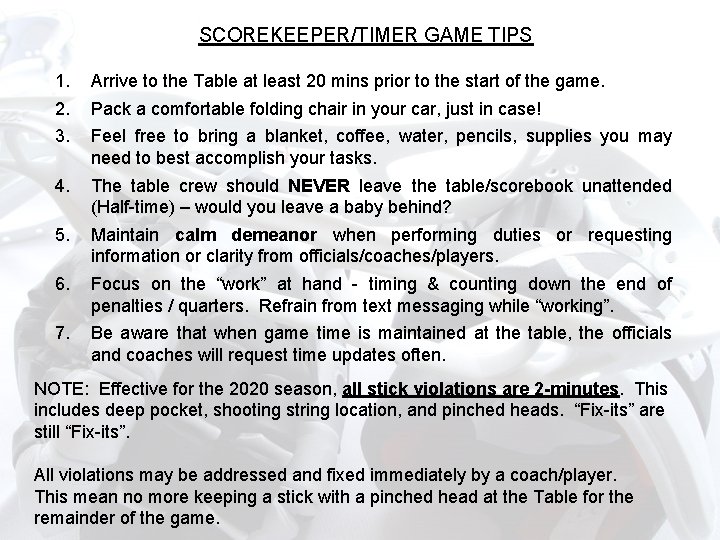
SCOREKEEPER/TIMER GAME TIPS 1. 2. 3. Arrive to the Table at least 20 mins prior to the start of the game. 4. The table crew should NEVER leave the table/scorebook unattended (Half-time) – would you leave a baby behind? 5. Maintain calm demeanor when performing duties or requesting information or clarity from officials/coaches/players. 6. Focus on the “work” at hand - timing & counting down the end of penalties / quarters. Refrain from text messaging while “working”. 7. Be aware that when game time is maintained at the table, the officials and coaches will request time updates often. Pack a comfortable folding chair in your car, just in case! Feel free to bring a blanket, coffee, water, pencils, supplies you may need to best accomplish your tasks. NOTE: Effective for the 2020 season, all stick violations are 2 -minutes. This includes deep pocket, shooting string location, and pinched heads. “Fix-its” are still “Fix-its”. All violations may be addressed and fixed immediately by a coach/player. This mean no more keeping a stick with a pinched head at the Table for the remainder of the game.
TIMEKEEPER ROLE – PART I Keep an accurate account of game time. (Varsity: 12 minute stop time, JV: 15 minute running time) Keep an accurate account of penalty time. Inform the penalized player when penalty time expires. (Announce “ 10 seconds”, and then countdown the last 5 seconds verbally so BOTH benches can hear – “ 5, 4, 3, 2, 1, RELEASE!”) Notify officials 30 seconds before the end of each period. Keep an accurate account of intermission time (10 minutes). Sound Horn at exactly 4 -minutes left in Halftime – This notifies teams of conclusion of halftime. If not run by a grandstand/booth, sound a horn at end of each period when the game clock reaches zero. Call over an official or sound a horn twice at the next DEAD BALL should an early penalty release violation occur.
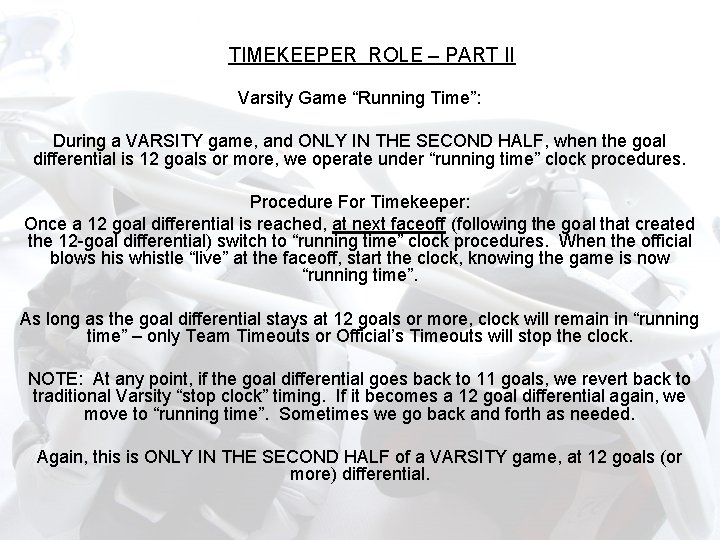
TIMEKEEPER ROLE – PART II Varsity Game “Running Time”: During a VARSITY game, and ONLY IN THE SECOND HALF, when the goal differential is 12 goals or more, we operate under “running time” clock procedures. Procedure For Timekeeper: Once a 12 goal differential is reached, at next faceoff (following the goal that created the 12 -goal differential) switch to “running time” clock procedures. When the official blows his whistle “live” at the faceoff, start the clock, knowing the game is now “running time”. As long as the goal differential stays at 12 goals or more, clock will remain in “running time” – only Team Timeouts or Official’s Timeouts will stop the clock. NOTE: At any point, if the goal differential goes back to 11 goals, we revert back to traditional Varsity “stop clock” timing. If it becomes a 12 goal differential again, we move to “running time”. Sometimes we go back and forth as needed. Again, this is ONLY IN THE SECOND HALF of a VARSITY game, at 12 goals (or more) differential.
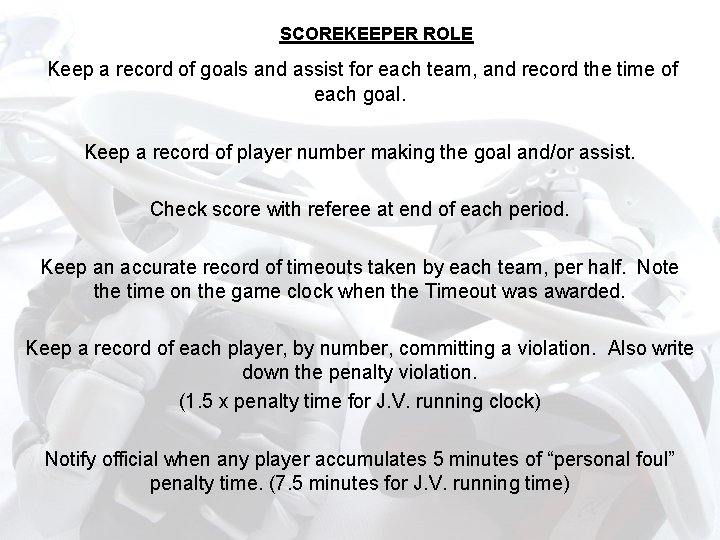
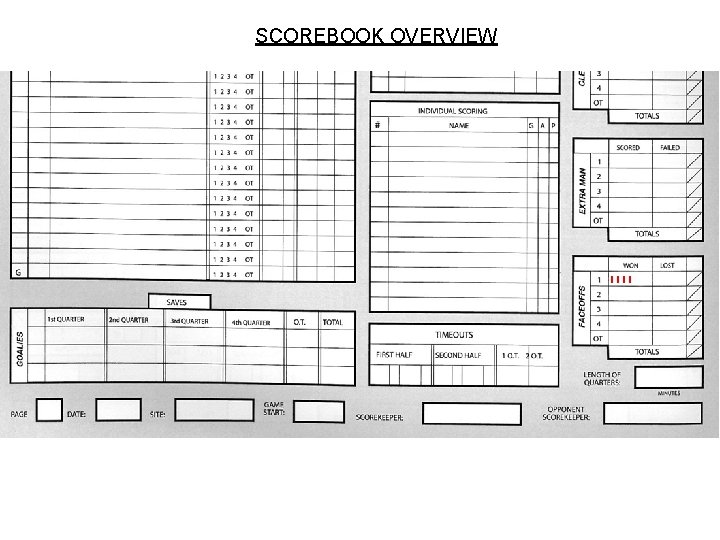
SCOREKEEPER ROLE Keep a record of goals and assist for each team, and record the time of each goal. Keep a record of player number making the goal and/or assist. Check score with referee at end of each period. Keep an accurate record of timeouts taken by each team, per half. Note the time on the game clock when the Timeout was awarded. Keep a record of each player, by number, committing a violation. Also write down the penalty violation. (1. 5 x penalty time for J. V. running clock) Notify official when any player accumulates 5 minutes of “personal foul” penalty time. (7. 5 minutes for J. V. running time)
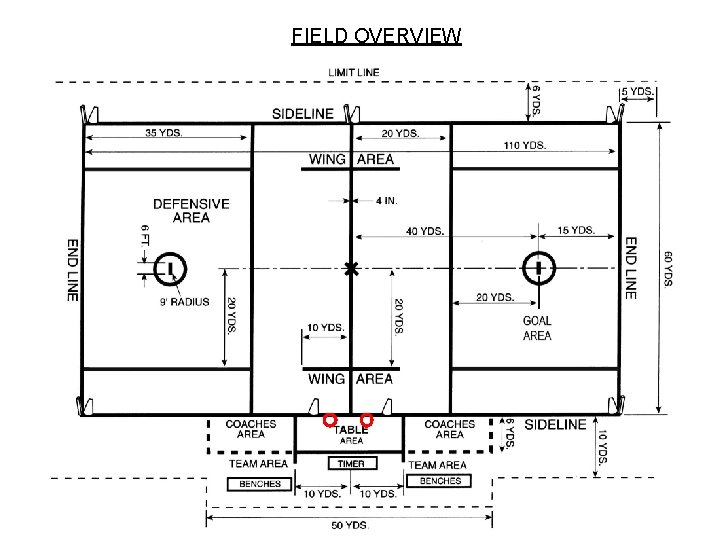
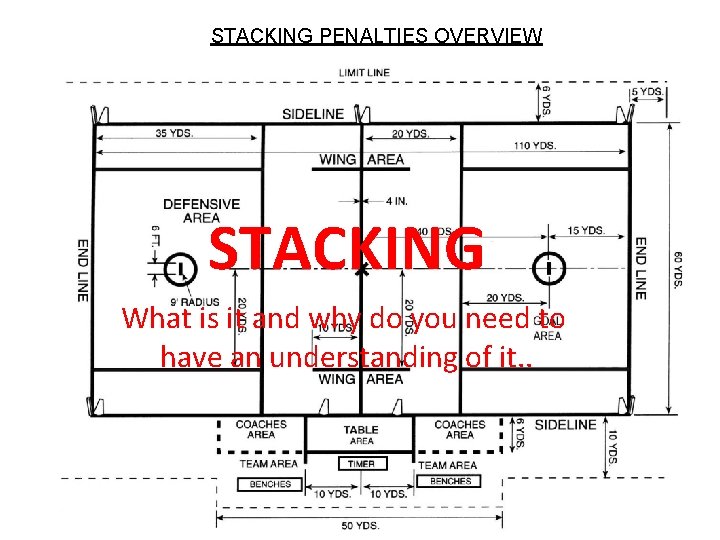
FIELD OVERVIEW
STACKING PENALTIES OVERVIEW STACKING What is it and why do you need to have an understanding of it. .
ITEMS THE OHSLA REQUIRES IN THE SCOREBOOK • Goal: Player # who scored, by Quarter, by Time on the Clock • Penalty: Player # penalized, name of Offence, Amount of Time Served, and Time on the clock when Penalty Occurred (Varsity) or when Penalty Starts (JV) • Timeouts: Team awarded Timeout, by Quarter, and Time on the Clock when Timeout was called • NOTE: Clears, Saves, Shots, GBs – this is all extra and NOT required for the official scorebook game summary. But many coaching staffs may ask for these statistics
SCORESHEET OVERVIEW
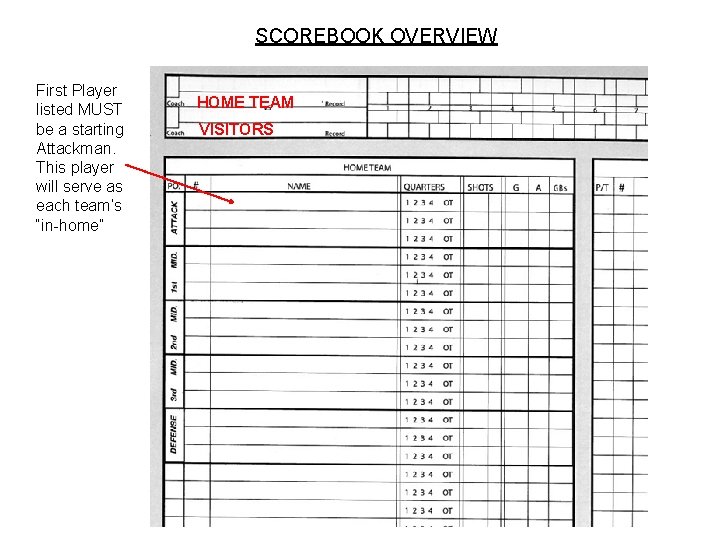
SCOREBOOK OVERVIEW First Player listed MUST be a starting Attackman. This player will serve as each team’s “in-home” HOME TEAM VISITORS
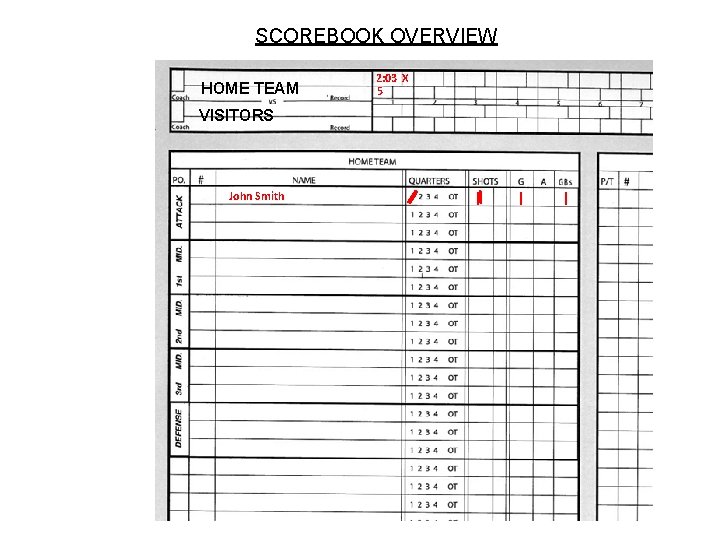
SCOREBOOK OVERVIEW HOME TEAM VISITORS John Smith 2: 03 X 5
SCOREBOOK OVERVIEW
SUMMARY 1. Home Team Scorer and Timer have the official OHSLA stats/scorebook and are part of the officiating crew. 2. The table is not a rooting section for your child or team. 3. Not a time for chatting it up with friends or texting. You are there to “work” in the best seat in the house. 4. Keep an accurate game and penalty time – it’s important! 5. Inform the penalized player when penalty time expires. (Announce when “ 10 seconds” remains LOUDLY. Countdown last 5 seconds verbally, loud enough so that BOTH benches hear – “ 5, 4, 3, 2, 1, RELEASE!”) 6. Sound a horn at end of each period. 7. Keep a record of goals, assists, and penalties by player number for both teams. 8. Arrive at least 20 minutes prior to the start of the game. 9. Table crew should NEVER leave the table / book unattended (Half-time) 10. Maintain calm demeanor when requesting or delivering information / clarity to and from officials & coaches.
QUESTIONS & ANSWERS
THANK YOU for your partnership and assistance in smooth game management! Have a great season!