
Ohms Law The relationship between Current Voltage and
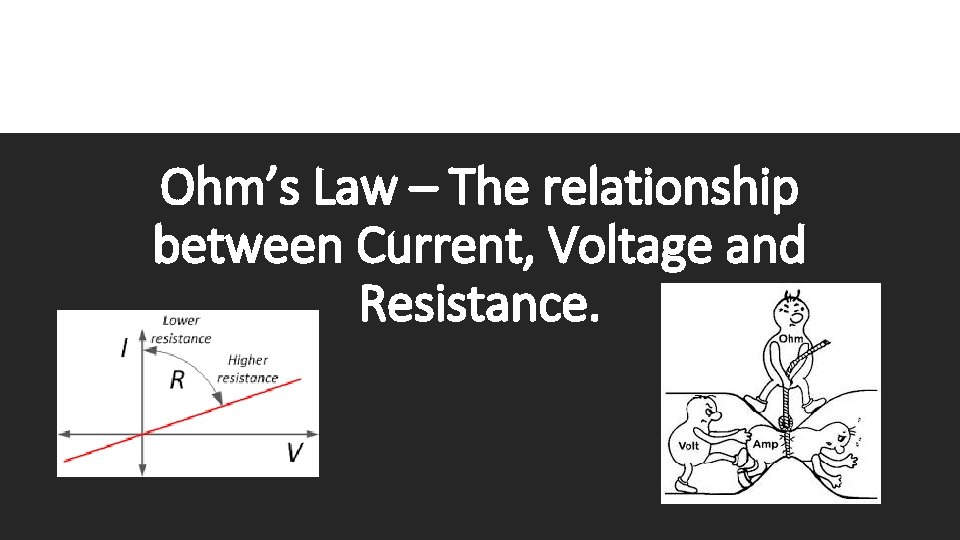
Ohm’s Law – The relationship between Current, Voltage and Resistance.

Starter Decode the information from the sheet. Write the solution in your book.
Solution - Resistance Electrons carry current around a circuit. Sometimes the electrons collide with the atoms that the wire is made out of. This is what causes resistance. There are more collisions in a long wire than a short wire and more in a thin wire than a thick one. This means the wire with the least resistance is a short thick one.
Ohm’s Law • Today we’re going to investigate the relationship between current and voltage. • We will carry out a practical where we will change the voltage of our power supply and measure the resulting change in current.
Make a prediction! • Write the title “Investigating Ohm’s Law” in your book…this is a lab report! • Make a sub-heading “Prediction” • Under this you need to make your own prediction – what do you think will happen in the experiment? How do you think the current will change as we increase the voltage?

Equipment list • Make a new sub-heading “Equipment list” • Make a list using bullet-points of the equipment we will use: • Power supply • Connecting wires • 1 bulb • 1 variable resistor • 2 multimeters • 1 switch Write a short note to describe what each piece of equipment is used for.
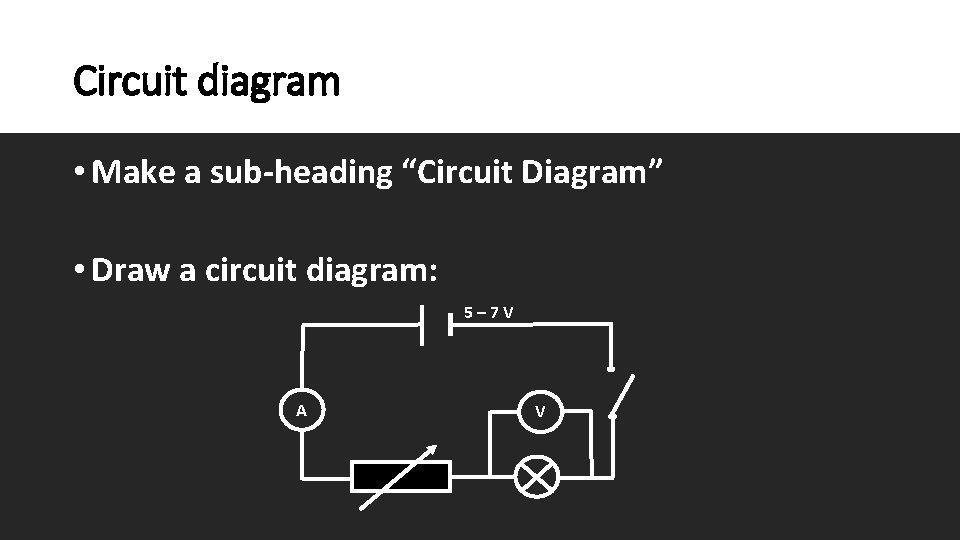
Circuit diagram • Make a sub-heading “Circuit Diagram” • Draw a circuit diagram: 5– 7 V A V
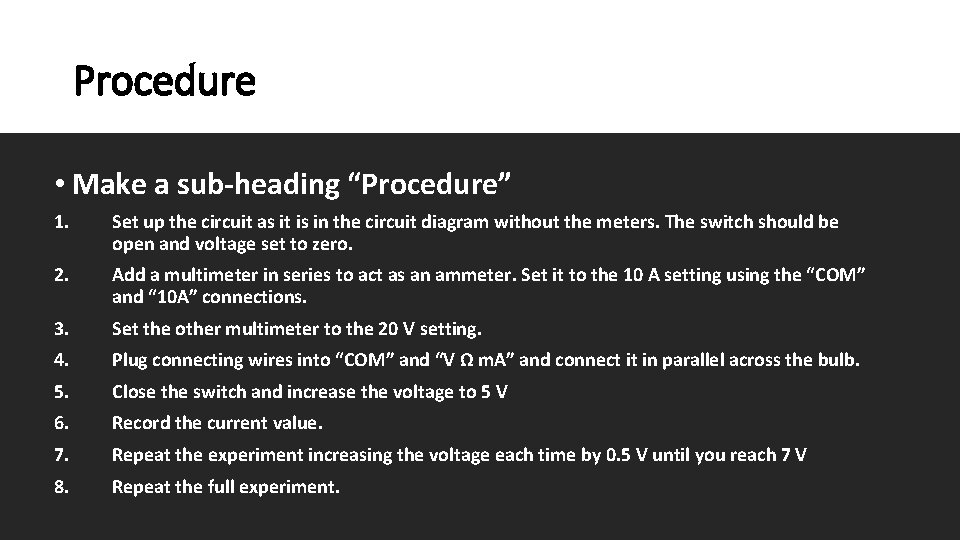
Procedure • Make a sub-heading “Procedure” 1. Set up the circuit as it is in the circuit diagram without the meters. The switch should be open and voltage set to zero. 2. Add a multimeter in series to act as an ammeter. Set it to the 10 A setting using the “COM” and “ 10 A” connections. 3. Set the other multimeter to the 20 V setting. 4. Plug connecting wires into “COM” and “V Ω m. A” and connect it in parallel across the bulb. 5. Close the switch and increase the voltage to 5 V 6. Record the current value. 7. Repeat the experiment increasing the voltage each time by 0. 5 V until you reach 7 V 8. Repeat the full experiment.
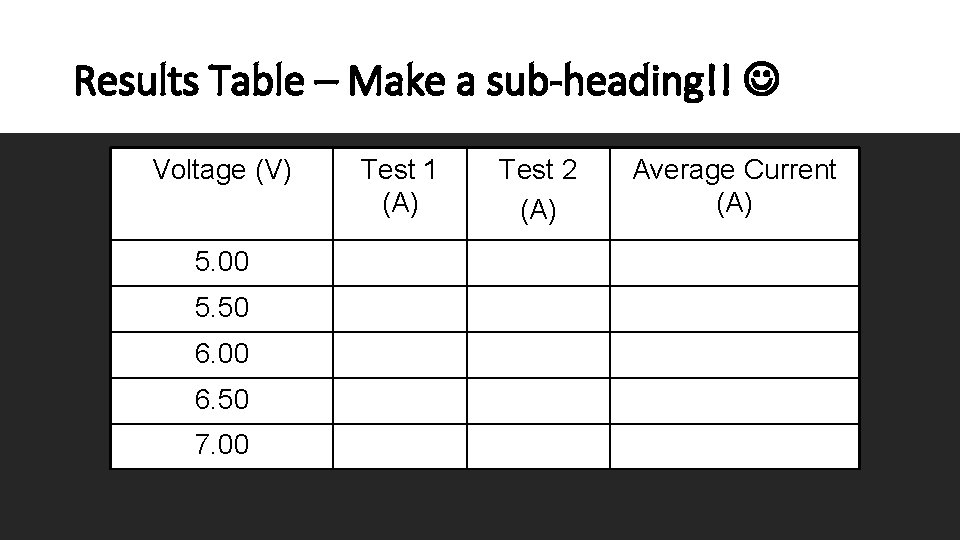
Results Table – Make a sub-heading!! Voltage (V) 5. 00 5. 50 6. 00 6. 50 7. 00 Test 1 (A) Test 2 (A) Average Current (A)
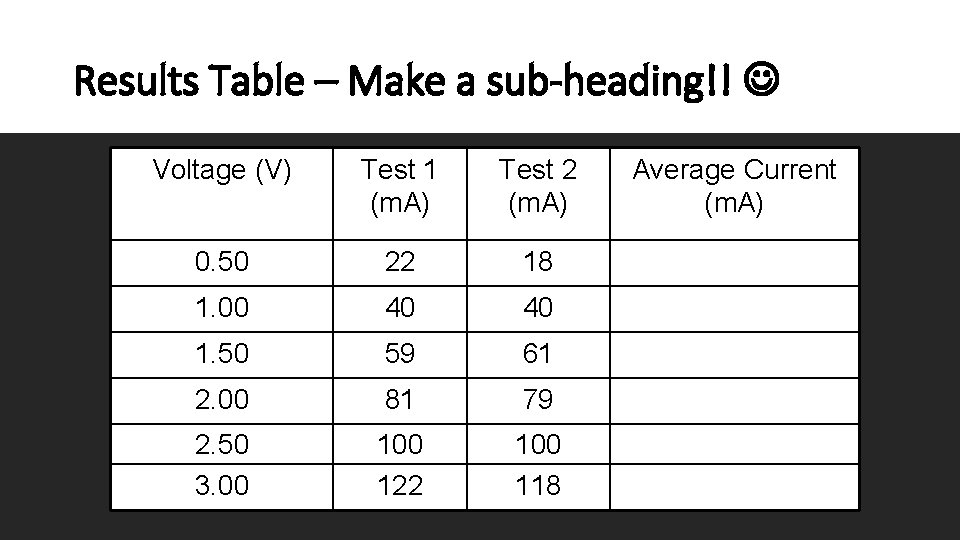
Results Table – Make a sub-heading!! Voltage (V) Test 1 (m. A) Test 2 (m. A) 0. 50 22 18 1. 00 40 40 1. 50 59 61 2. 00 81 79 2. 50 3. 00 122 100 118 Average Current (m. A)
Graph • Make a sub-heading “Graph” We will plot a graph with “Voltage (V)” on the xaxis and “Average Current (A)” on the y-axis.
- Slides: 11