
Ohm laws in closed electrical circuit KIRCHHOFFS LAWS
- Slides: 11
Ohm laws in closed electrical circuit KIRCHHOFF’S LAWS
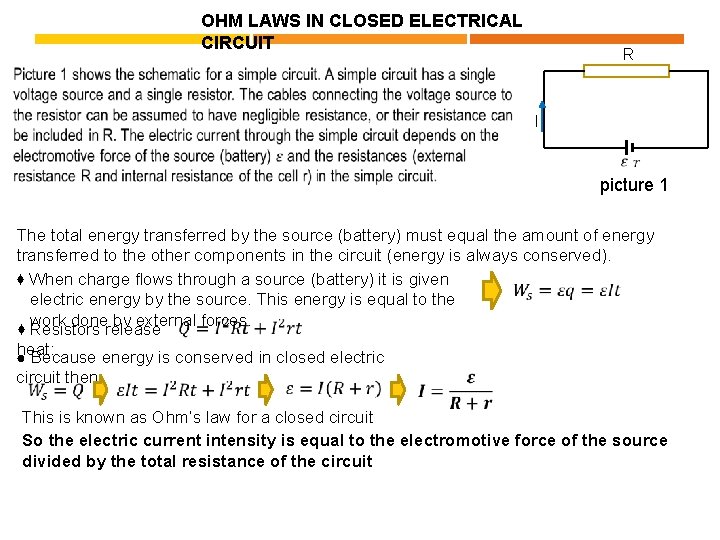
OHM LAWS IN CLOSED ELECTRICAL CIRCUIT R I picture 1 The total energy transferred by the source (battery) must equal the amount of energy transferred to the other components in the circuit (energy is always conserved). ♦ When charge flows through a source (battery) it is given electric energy by the source. This energy is equal to the work done by external forces. ♦ Resistors release heat: ● Because energy is conserved in closed electric circuit then: This is known as Ohm’s law for a closed circuit So the electric current intensity is equal to the electromotive force of the source divided by the total resistance of the circuit
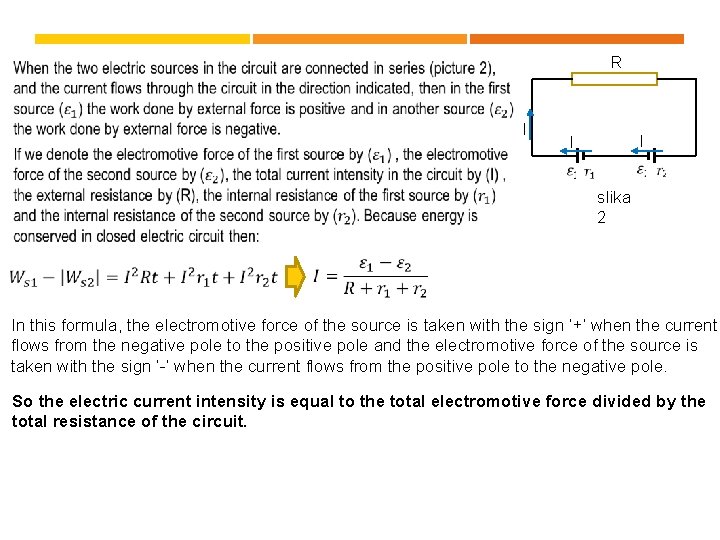
R I I I slika 2 In this formula, the electromotive force of the source is taken with the sign ‘+’ when the current flows from the negative pole to the positive pole and the electromotive force of the source is taken with the sign ‘-’ when the current flows from the positive pole to the negative pole. So the electric current intensity is equal to the total electromotive force divided by the total resistance of the circuit.
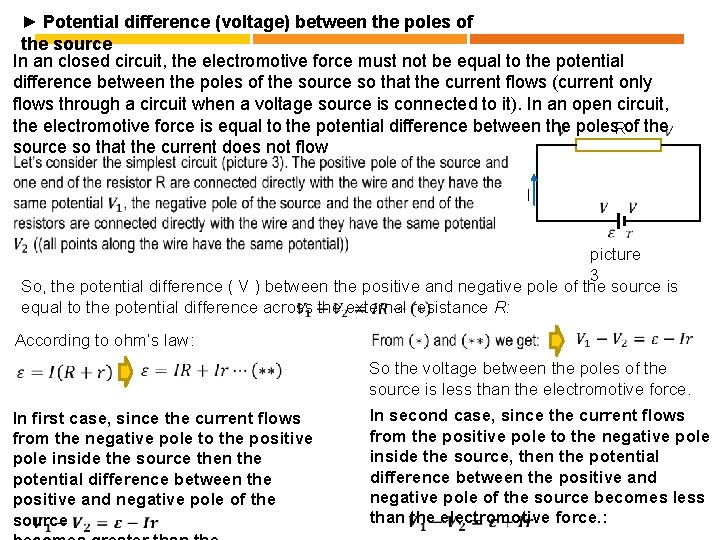
► Potential difference (voltage) between the poles of the source In an closed circuit, the electromotive force must not be equal to the potential difference between the poles of the source so that the current flows (current only flows through a circuit when a voltage source is connected to it). In an open circuit, the electromotive force is equal to the potential difference between the poles. Rof the source so that the current does not flow I picture 3 So, the potential difference ( V ) between the positive and negative pole of the source is equal to the potential difference across the external resistance R: According to ohm’s law: So the voltage between the poles of the source is less than the electromotive force. In first case, since the current flows from the negative pole to the positive pole inside the source then the potential difference between the positive and negative pole of the source In second case, since the current flows from the positive pole to the negative pole inside the source, then the potential difference between the positive and negative pole of the source becomes less than the electromotive force. :
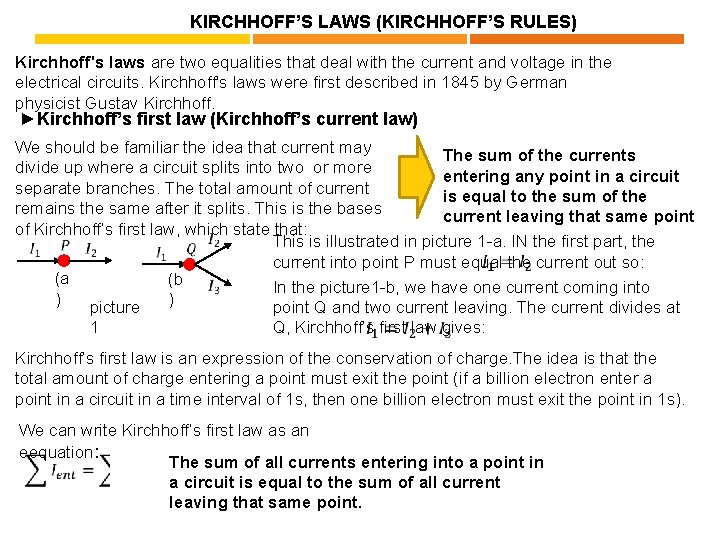
KIRCHHOFF’S LAWS (KIRCHHOFF’S RULES) Kirchhoff's laws are two equalities that deal with the current and voltage in the electrical circuits. Kirchhoff's laws were first described in 1845 by German physicist Gustav Kirchhoff. ►Kirchhoff’s first law (Kirchhoff’s current law) We should be familiar the idea that current may The sum of the currents divide up where a circuit splits into two or more entering any point in a circuit separate branches. The total amount of current is equal to the sum of the remains the same after it splits. This is the bases current leaving that same point of Kirchhoff’s first law, which state that: This is illustrated in picture 1 -a. IN the first part, the current into point P must equal the current out so: (a (b In the picture 1 -b, we have one current coming into ) ) picture point Q and two current leaving. The current divides at 1 Q, Kirchhoff’s first law gives: Kirchhoff’s first law is an expression of the conservation of charge. The idea is that the total amount of charge entering a point must exit the point (if a billion electron enter a point in a circuit in a time interval of 1 s, then one billion electron must exit the point in 1 s). We can write Kirchhoff’s first law as an eequation: The sum of all currents entering into a point in a circuit is equal to the sum of all current leaving that same point.
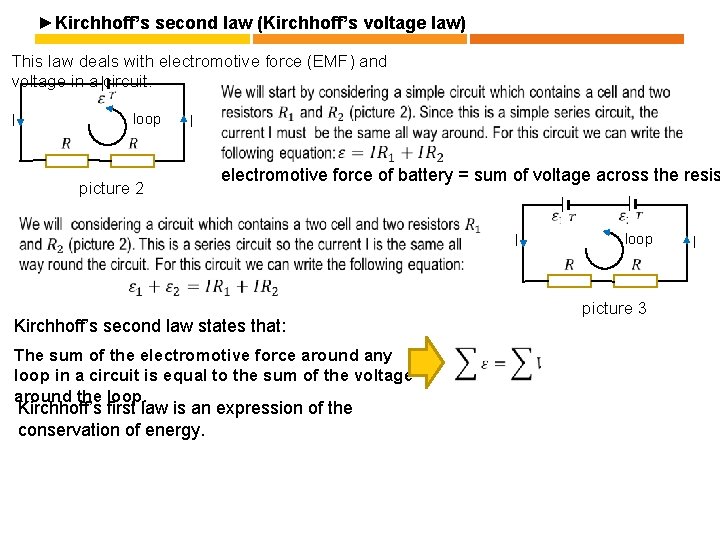
►Kirchhoff’s second law (Kirchhoff’s voltage law) This law deals with electromotive force (EMF) and voltage in a circuit. I loop picture 2 I electromotive force of battery = sum of voltage across the resis I Kirchhoff’s second law states that: The sum of the electromotive force around any loop in a circuit is equal to the sum of the voltage around the loop. Kirchhoff’s first law is an expression of the conservation of energy. loop picture 3 I
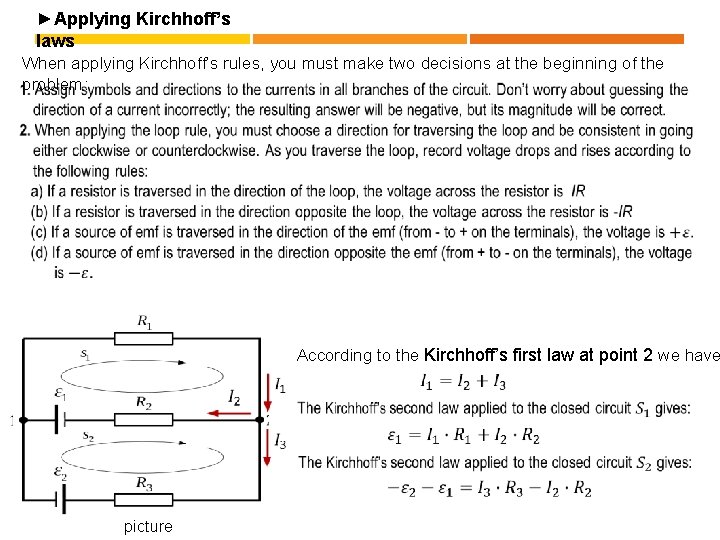
►Applying Kirchhoff’s laws When applying Kirchhoff’s rules, you must make two decisions at the beginning of the problem: According to the Kirchhoff’s first law at point 2 we have picture
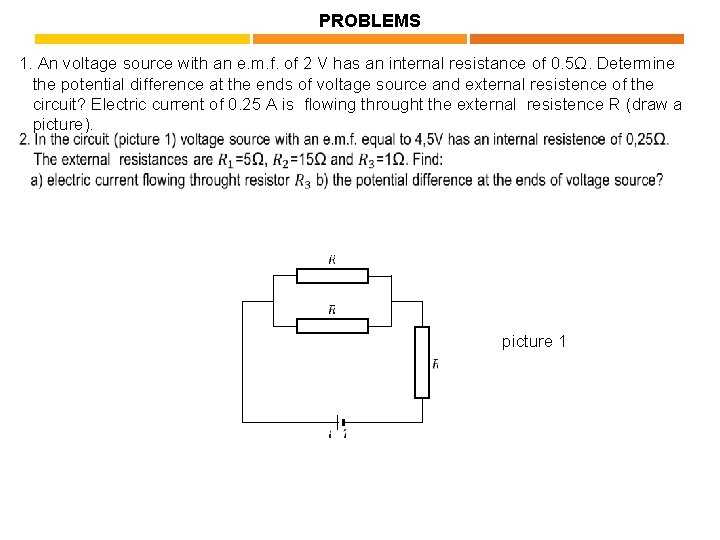
PROBLEMS 1. An voltage source with an e. m. f. of 2 V has an internal resistance of 0. 5Ω. Determine the potential difference at the ends of voltage source and external resistence of the circuit? Electric current of 0. 25 A is flowing throught the external resistence R (draw a picture). picture 1
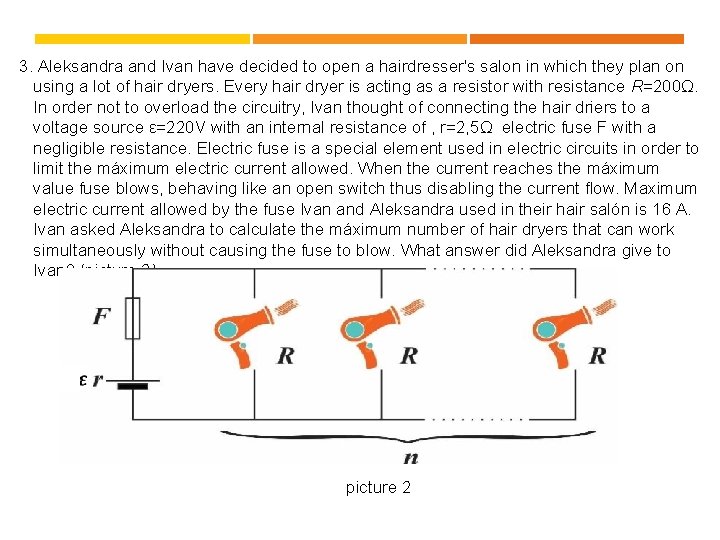
3. Aleksandra and Ivan have decided to open a hairdresser's salon in which they plan on using a lot of hair dryers. Every hair dryer is acting as a resistor with resistance R=200Ω. In order not to overload the circuitry, Ivan thought of connecting the hair driers to a voltage source ε=220 V with an internal resistance of , r=2, 5Ω electric fuse F with a negligible resistance. Electric fuse is a special element used in electric circuits in order to limit the máximum electric current allowed. When the current reaches the máximum value fuse blows, behaving like an open switch thus disabling the current flow. Maximum electric current allowed by the fuse Ivan and Aleksandra used in their hair salón is 16 A. Ivan asked Aleksandra to calculate the máximum number of hair dryers that can work simultaneously without causing the fuse to blow. What answer did Aleksandra give to Ivan? (picture 2) picture 2
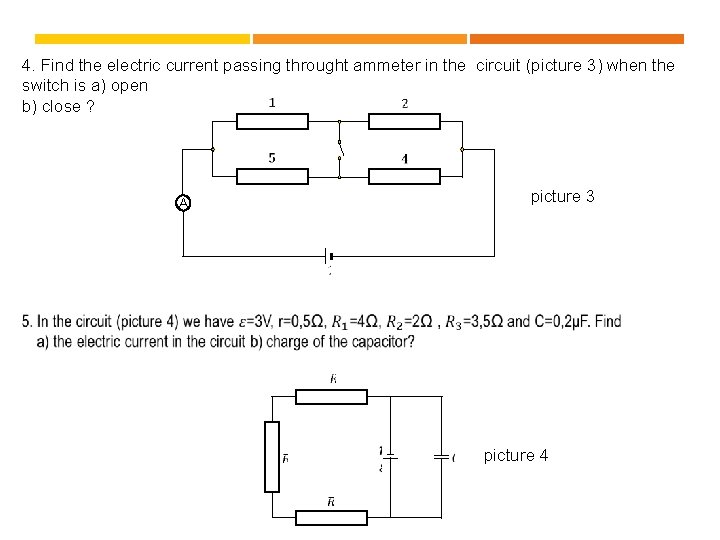
4. Find the electric current passing throught ammeter in the circuit (picture 3) when the switch is a) open b) close ? A picture 3 picture 4
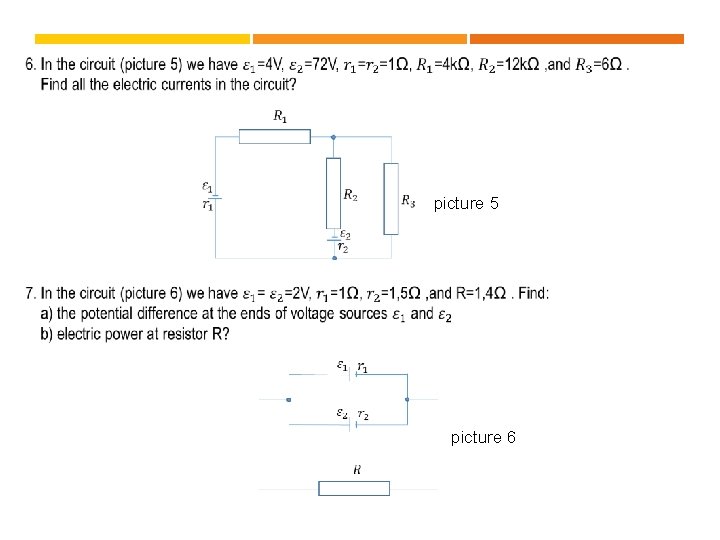
picture 5 picture 6