
Ohio Test of English Language Acquisition OTELA Administration
- Slides: 35
Ohio Test of English Language Acquisition (OTELA) Administration 2010 Speaking Sample Scoring Materials Terms of Use: This Document is only authorized for use in Ohio School Districts, in conjunction with the Ohio Test of English Language Acquisition (OTELA). Duplication or dissemination for other purposes is not permitted
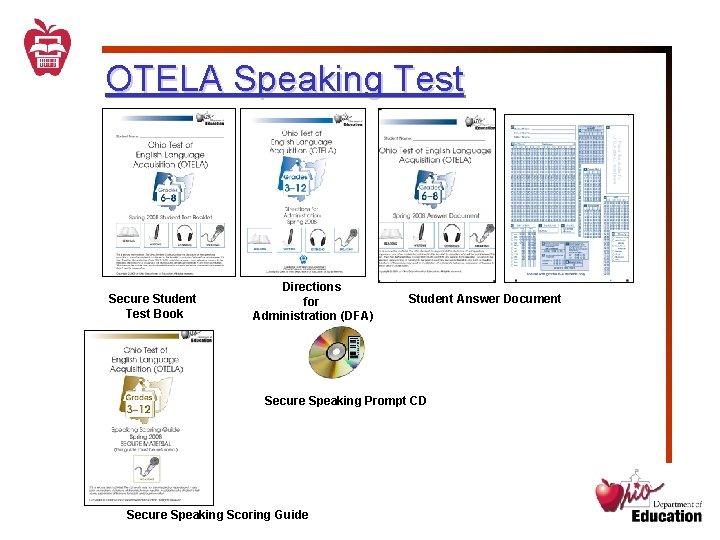
OTELA Speaking Test Secure Student Test Book Directions for Administration (DFA) Student Answer Document Secure Speaking Prompt CD Secure Speaking Scoring Guide
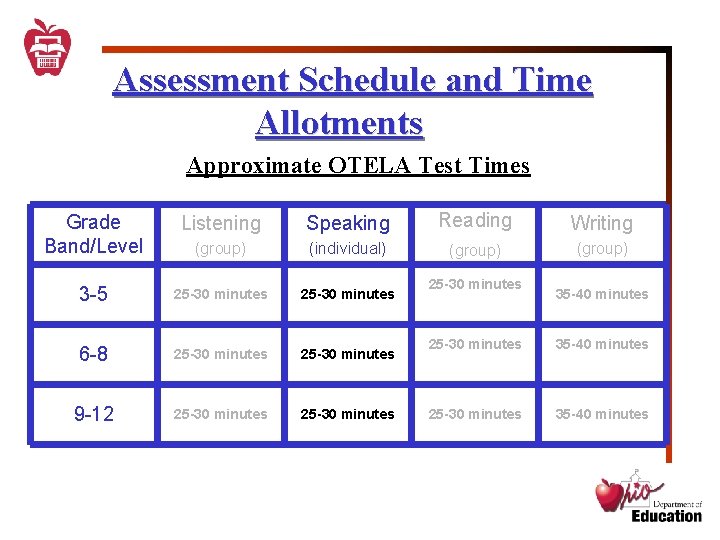
Assessment Schedule and Time Allotments Approximate OTELA Test Times Grade Band/Level Listening Speaking Reading Writing (group) (individual) (group) 3 -5 25 -30 minutes 6 -8 25 -30 minutes 9 -12 25 -30 minutes 35 -40 minutes 25 -30 minutes 35 -40 minutes
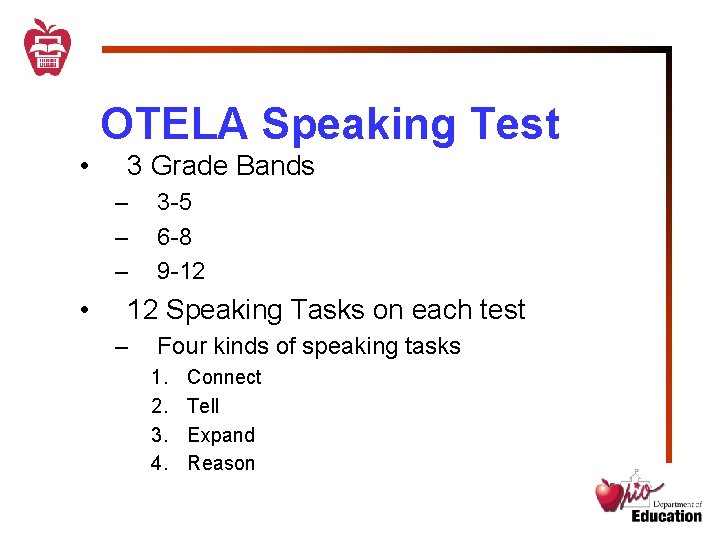
OTELA Speaking Test • 3 Grade Bands – – – • 3 -5 6 -8 9 -12 12 Speaking Tasks on each test – Four kinds of speaking tasks 1. 2. 3. 4. Connect Tell Expand Reason
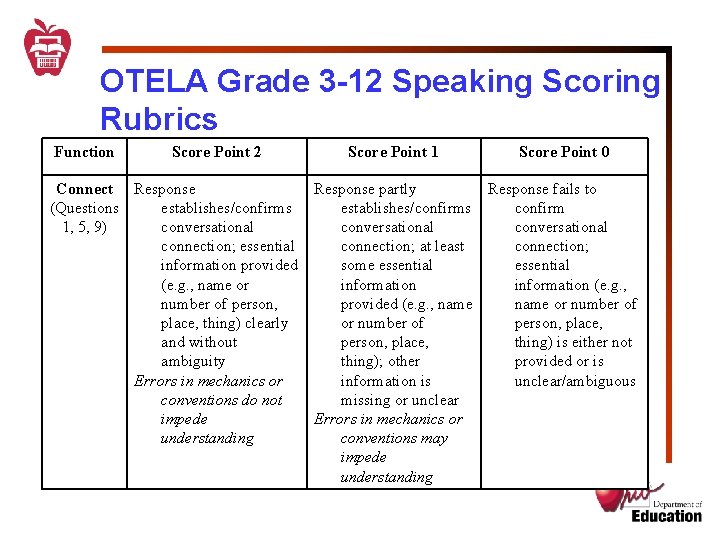
OTELA Grade 3 -12 Speaking Scoring Rubrics Function Score Point 2 Connect Response (Questions establishes/confirms 1, 5, 9) conversational connection; essential information provided (e. g. , name or number of person, place, thing) clearly and without ambiguity Errors in mechanics or conventions do not impede understanding Score Point 1 Score Point 0 Response partly Response fails to establishes/confirms confirm conversational connection; at least connection; some essential information (e. g. , provided (e. g. , name or number of person, place, thing) is either not thing); other provided or is information is unclear/ambiguous missing or unclear Errors in mechanics or conventions may impede understanding
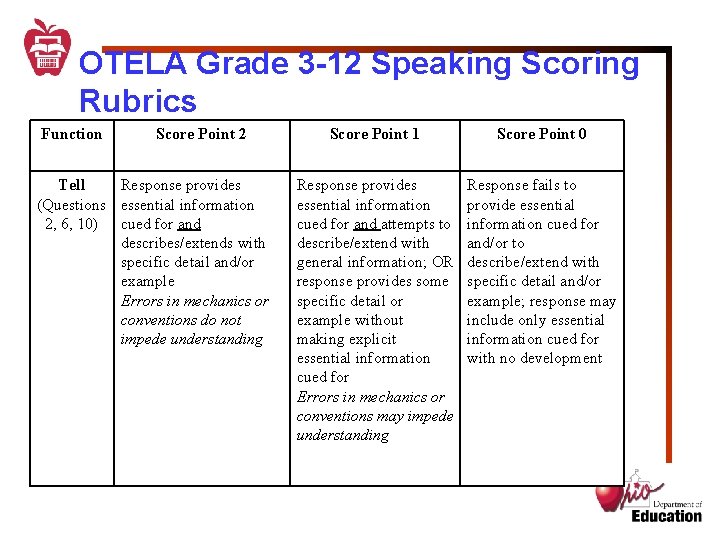
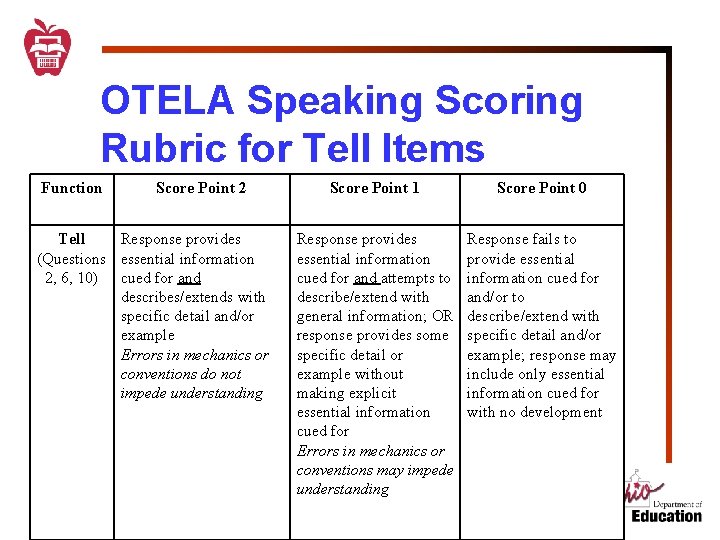
OTELA Grade 3 -12 Speaking Scoring Rubrics Function Score Point 2 Tell Response provides (Questions essential information 2, 6, 10) cued for and describes/extends with specific detail and/or example Errors in mechanics or conventions do not impede understanding Score Point 1 Score Point 0 Response provides essential information cued for and attempts to describe/extend with general information; OR response provides some specific detail or example without making explicit essential information cued for Errors in mechanics or conventions may impede understanding Response fails to provide essential information cued for and/or to describe/extend with specific detail and/or example; response may include only essential information cued for with no development
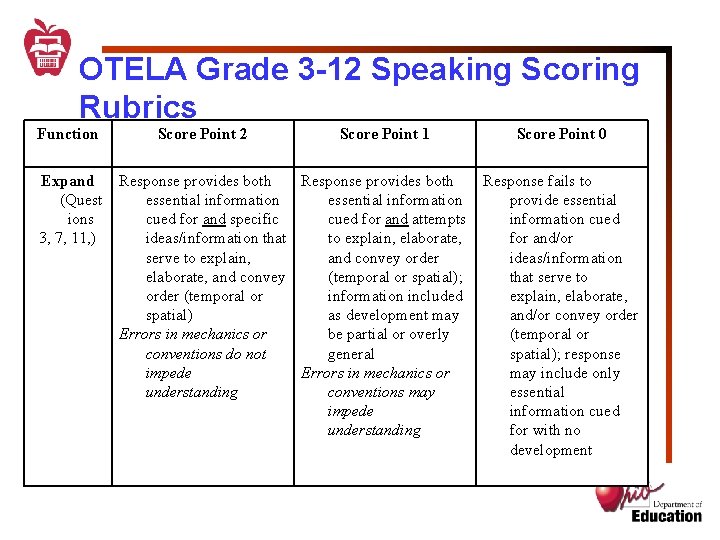
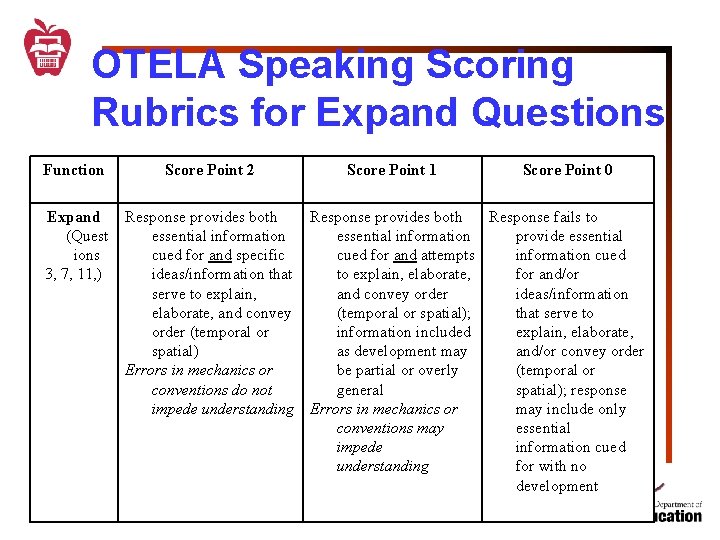
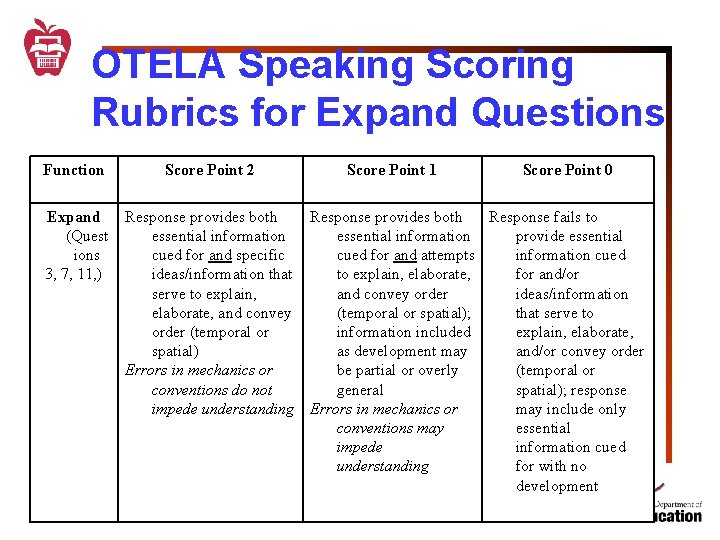
OTELA Grade 3 -12 Speaking Scoring Rubrics Function Expand (Quest ions 3, 7, 11, ) Score Point 2 Score Point 1 Response provides both essential information cued for and specific cued for and attempts ideas/information that to explain, elaborate, serve to explain, and convey order elaborate, and convey (temporal or spatial); order (temporal or information included spatial) as development may Errors in mechanics or be partial or overly conventions do not general impede Errors in mechanics or understanding conventions may impede understanding Score Point 0 Response fails to provide essential information cued for and/or ideas/information that serve to explain, elaborate, and/or convey order (temporal or spatial); response may include only essential information cued for with no development
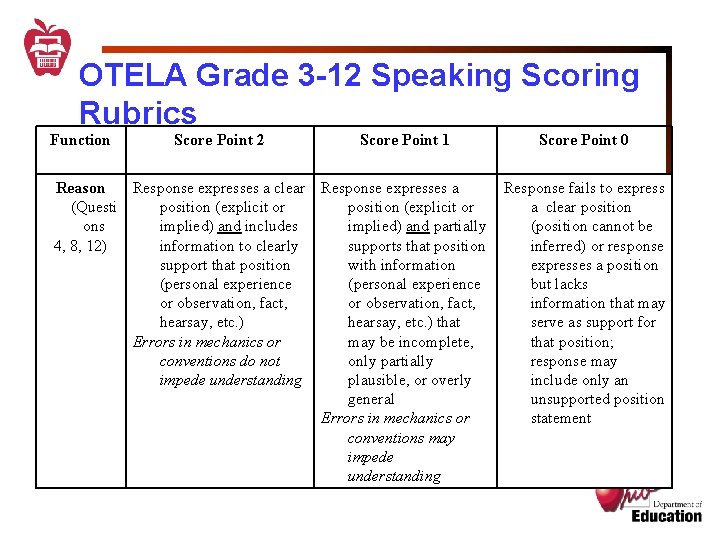
OTELA Grade 3 -12 Speaking Scoring Rubrics Function Score Point 2 Score Point 1 Reason Response expresses a clear Response expresses a (Questi position (explicit or ons implied) and includes implied) and partially 4, 8, 12) information to clearly supports that position support that position with information (personal experience or observation, fact, hearsay, etc. ) that Errors in mechanics or may be incomplete, conventions do not only partially impede understanding plausible, or overly general Errors in mechanics or conventions may impede understanding Score Point 0 Response fails to express a clear position (position cannot be inferred) or response expresses a position but lacks information that may serve as support for that position; response may include only an unsupported position statement
Sample Speaking Tasks • Connect type question
SAMPLE SPEAKING QUESTIONS, ANSWERS, and SCORES • Sample Connect Question • “Some students like to listen to music in their free time. Others like to read books. Tell me in a sentence what you like to do in your free time. For example, you can talk about watching movies, listening to music, or playing with your sister or brother. Try to speak in a sentence. Tell me what you like to do in your free time. ”
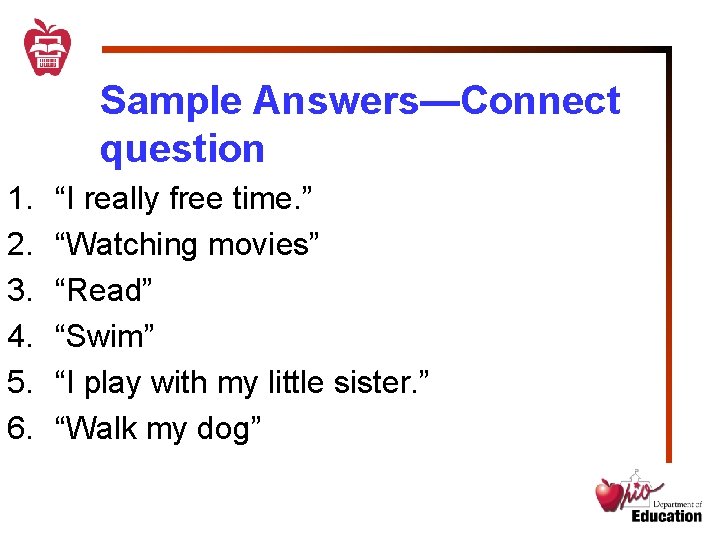
Sample Answers—Connect question 1. 2. 3. 4. 5. 6. “I really free time. ” “Watching movies” “Read” “Swim” “I play with my little sister. ” “Walk my dog”
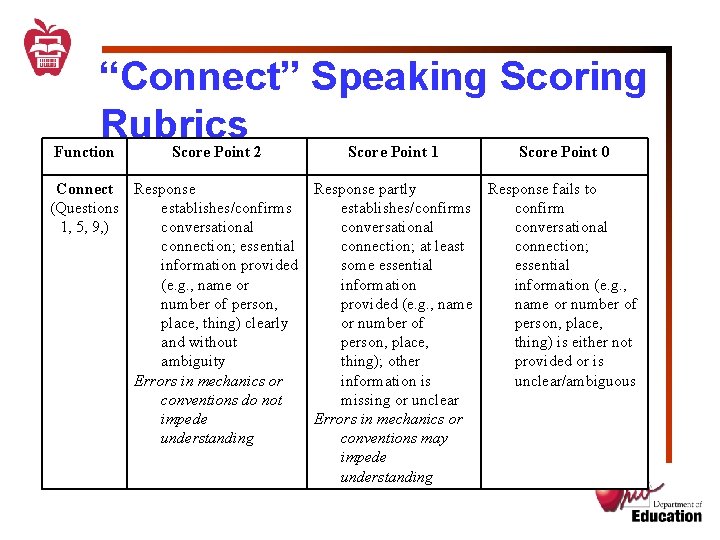
“Connect” Speaking Scoring Rubrics Function Score Point 2 Connect Response (Questions establishes/confirms 1, 5, 9, ) conversational connection; essential information provided (e. g. , name or number of person, place, thing) clearly and without ambiguity Errors in mechanics or conventions do not impede understanding Score Point 1 Score Point 0 Response partly Response fails to establishes/confirms confirm conversational connection; at least connection; some essential information (e. g. , provided (e. g. , name or number of person, place, thing) is either not thing); other provided or is information is unclear/ambiguous missing or unclear Errors in mechanics or conventions may impede understanding
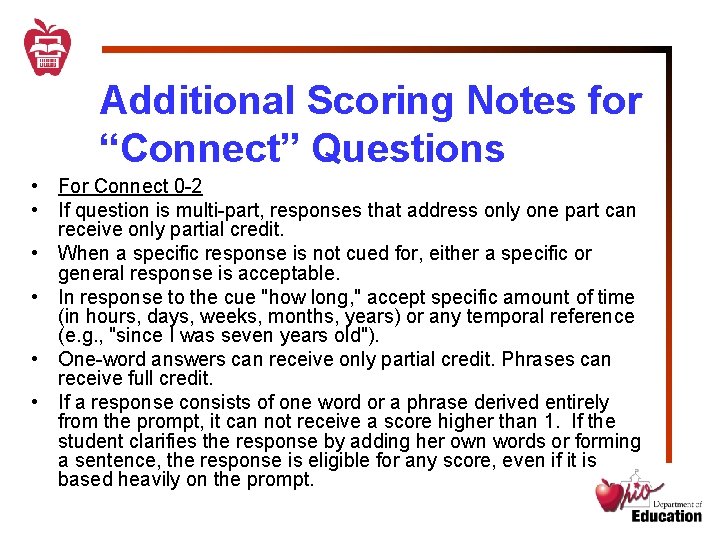
Additional Scoring Notes for “Connect” Questions • For Connect 0 -2 • If question is multi-part, responses that address only one part can receive only partial credit. • When a specific response is not cued for, either a specific or general response is acceptable. • In response to the cue "how long, " accept specific amount of time (in hours, days, weeks, months, years) or any temporal reference (e. g. , "since I was seven years old"). • One-word answers can receive only partial credit. Phrases can receive full credit. • If a response consists of one word or a phrase derived entirely from the prompt, it can not receive a score higher than 1. If the student clarifies the response by adding her own words or forming a sentence, the response is eligible for any score, even if it is based heavily on the prompt.
Sample Speaking Tasks • Tell type question
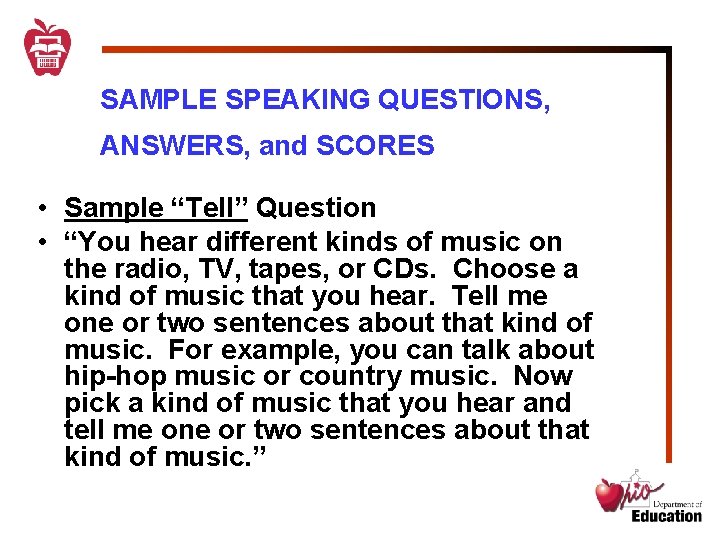
SAMPLE SPEAKING QUESTIONS, ANSWERS, and SCORES • Sample “Tell” Question • “You hear different kinds of music on the radio, TV, tapes, or CDs. Choose a kind of music that you hear. Tell me one or two sentences about that kind of music. For example, you can talk about hip-hop music or country music. Now pick a kind of music that you hear and tell me one or two sentences about that kind of music. ”
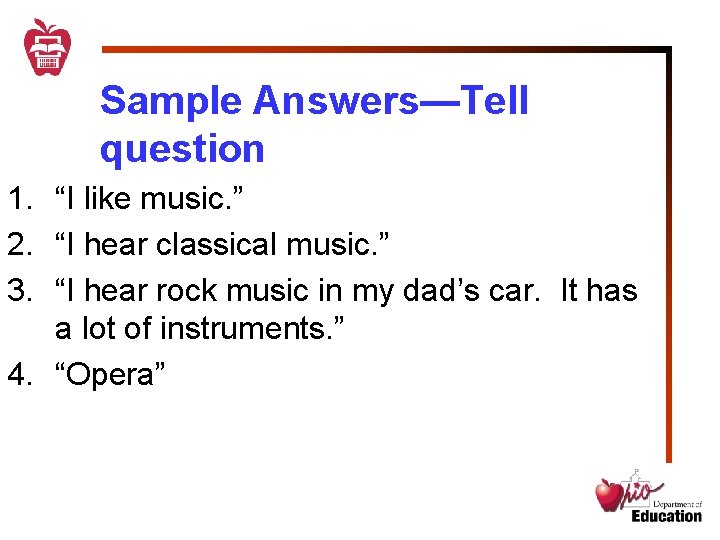
Sample Answers—Tell question 1. “I like music. ” 2. “I hear classical music. ” 3. “I hear rock music in my dad’s car. It has a lot of instruments. ” 4. “Opera”
OTELA Speaking Scoring Rubric for Tell Items Function Score Point 2 Tell Response provides (Questions essential information 2, 6, 10) cued for and describes/extends with specific detail and/or example Errors in mechanics or conventions do not impede understanding Score Point 1 Score Point 0 Response provides essential information cued for and attempts to describe/extend with general information; OR response provides some specific detail or example without making explicit essential information cued for Errors in mechanics or conventions may impede understanding Response fails to provide essential information cued for and/or to describe/extend with specific detail and/or example; response may include only essential information cued for with no development
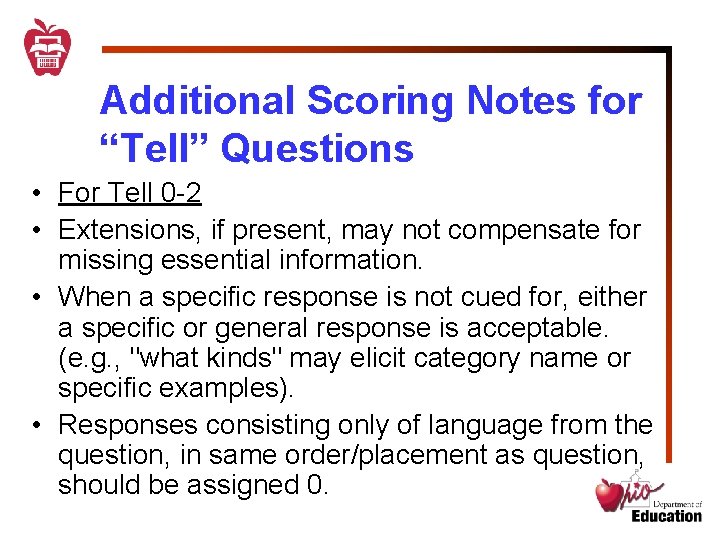
Additional Scoring Notes for “Tell” Questions • For Tell 0 -2 • Extensions, if present, may not compensate for missing essential information. • When a specific response is not cued for, either a specific or general response is acceptable. (e. g. , "what kinds" may elicit category name or specific examples). • Responses consisting only of language from the question, in same order/placement as question, should be assigned 0.
Sample Speaking Tasks • Expand type question
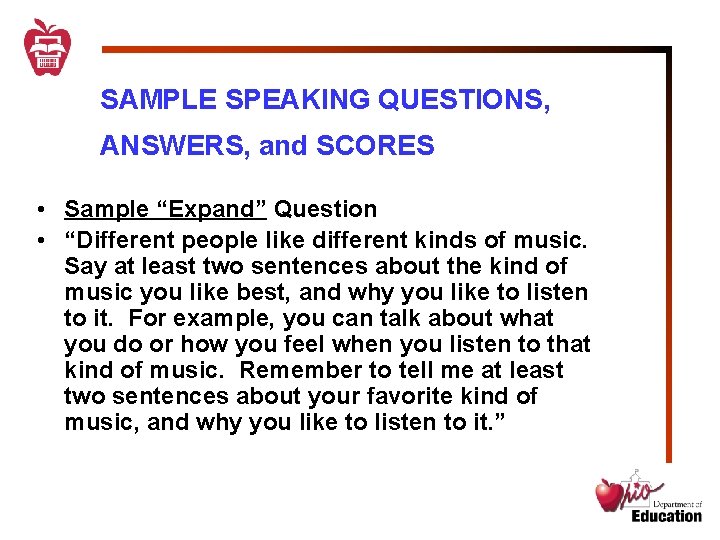
SAMPLE SPEAKING QUESTIONS, ANSWERS, and SCORES • Sample “Expand” Question • “Different people like different kinds of music. Say at least two sentences about the kind of music you like best, and why you like to listen to it. For example, you can talk about what you do or how you feel when you listen to that kind of music. Remember to tell me at least two sentences about your favorite kind of music, and why you like to listen to it. ”
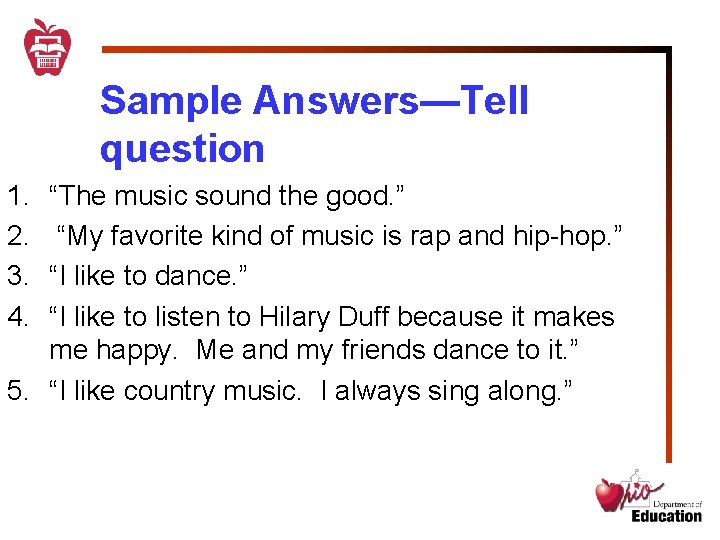
Sample Answers—Tell question 1. 2. 3. 4. “The music sound the good. ” “My favorite kind of music is rap and hip-hop. ” “I like to dance. ” “I like to listen to Hilary Duff because it makes me happy. Me and my friends dance to it. ” 5. “I like country music. I always sing along. ”
OTELA Speaking Scoring Rubrics for Expand Questions Function Expand (Quest ions 3, 7, 11, ) Score Point 2 Score Point 1 Score Point 0 Response provides both Response fails to essential information provide essential cued for and specific cued for and attempts information cued ideas/information that to explain, elaborate, for and/or serve to explain, and convey order ideas/information elaborate, and convey (temporal or spatial); that serve to order (temporal or information included explain, elaborate, spatial) as development may and/or convey order Errors in mechanics or be partial or overly (temporal or conventions do not general spatial); response impede understanding Errors in mechanics or may include only conventions may essential impede information cued understanding for with no development
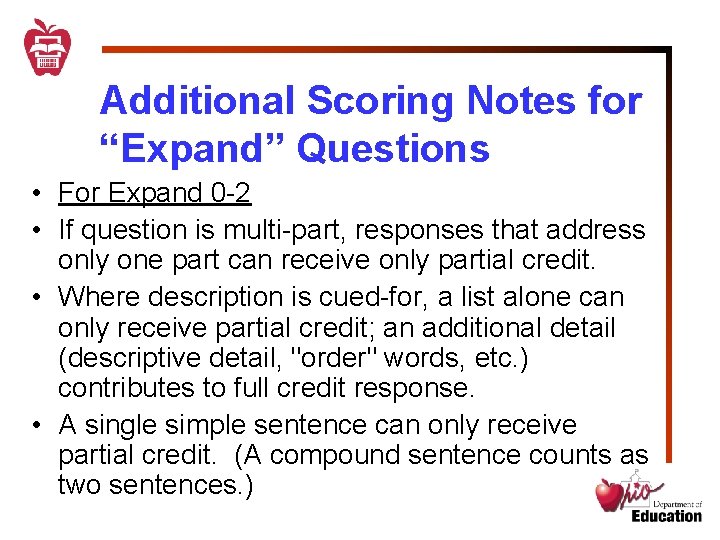
Additional Scoring Notes for “Expand” Questions • For Expand 0 -2 • If question is multi-part, responses that address only one part can receive only partial credit. • Where description is cued-for, a list alone can only receive partial credit; an additional detail (descriptive detail, "order" words, etc. ) contributes to full credit response. • A single simple sentence can only receive partial credit. (A compound sentence counts as two sentences. )
Sample Speaking Tasks • Reason type question
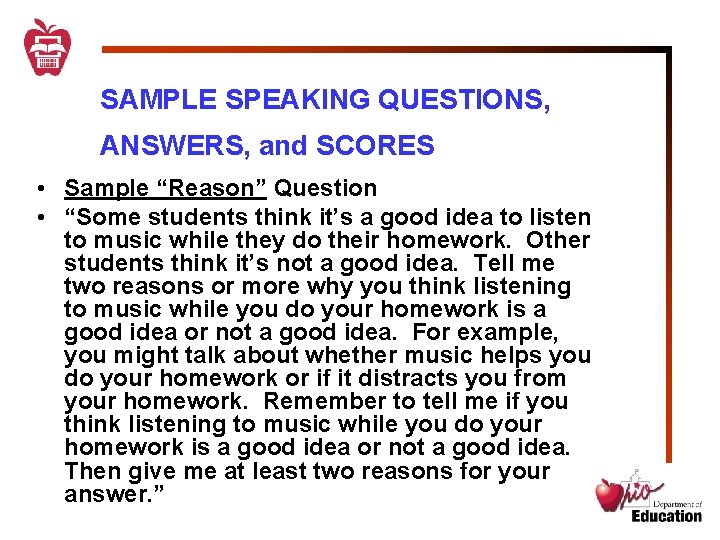
SAMPLE SPEAKING QUESTIONS, ANSWERS, and SCORES • Sample “Reason” Question • “Some students think it’s a good idea to listen to music while they do their homework. Other students think it’s not a good idea. Tell me two reasons or more why you think listening to music while you do your homework is a good idea or not a good idea. For example, you might talk about whether music helps you do your homework or if it distracts you from your homework. Remember to tell me if you think listening to music while you do your homework is a good idea or not a good idea. Then give me at least two reasons for your answer. ”
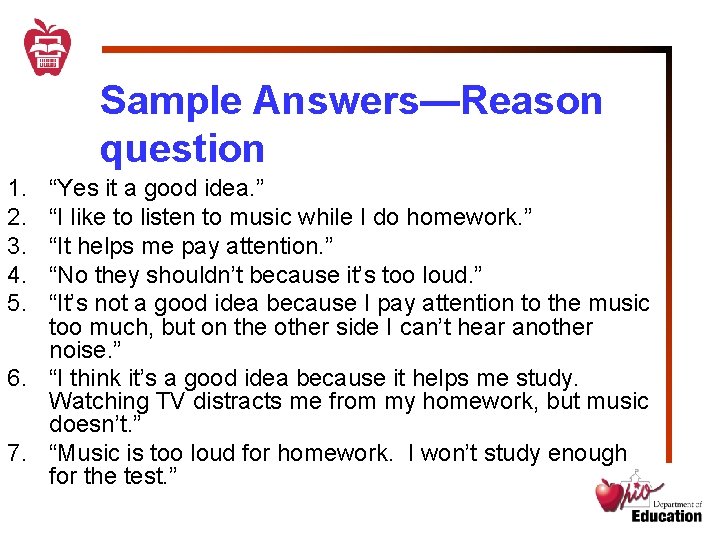
Sample Answers—Reason question 1. 2. 3. 4. 5. “Yes it a good idea. ” “I like to listen to music while I do homework. ” “It helps me pay attention. ” “No they shouldn’t because it’s too loud. ” “It’s not a good idea because I pay attention to the music too much, but on the other side I can’t hear another noise. ” 6. “I think it’s a good idea because it helps me study. Watching TV distracts me from my homework, but music doesn’t. ” 7. “Music is too loud for homework. I won’t study enough for the test. ”
OTELA Speaking Scoring Rubrics for Expand Questions Function Expand (Quest ions 3, 7, 11, ) Score Point 2 Score Point 1 Score Point 0 Response provides both Response fails to essential information provide essential cued for and specific cued for and attempts information cued ideas/information that to explain, elaborate, for and/or serve to explain, and convey order ideas/information elaborate, and convey (temporal or spatial); that serve to order (temporal or information included explain, elaborate, spatial) as development may and/or convey order Errors in mechanics or be partial or overly (temporal or conventions do not general spatial); response impede understanding Errors in mechanics or may include only conventions may essential impede information cued understanding for with no development
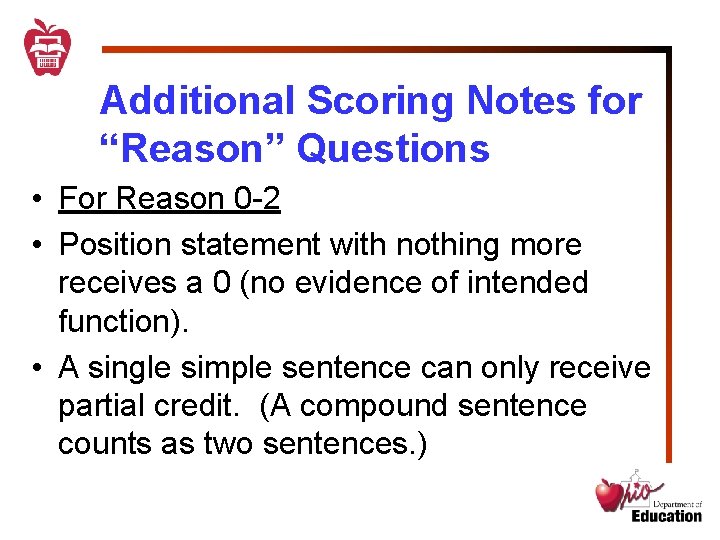
Additional Scoring Notes for “Reason” Questions • For Reason 0 -2 • Position statement with nothing more receives a 0 (no evidence of intended function). • A single simple sentence can only receive partial credit. (A compound sentence counts as two sentences. )
Scoring Anchors • These are the scoring keys for each type of question
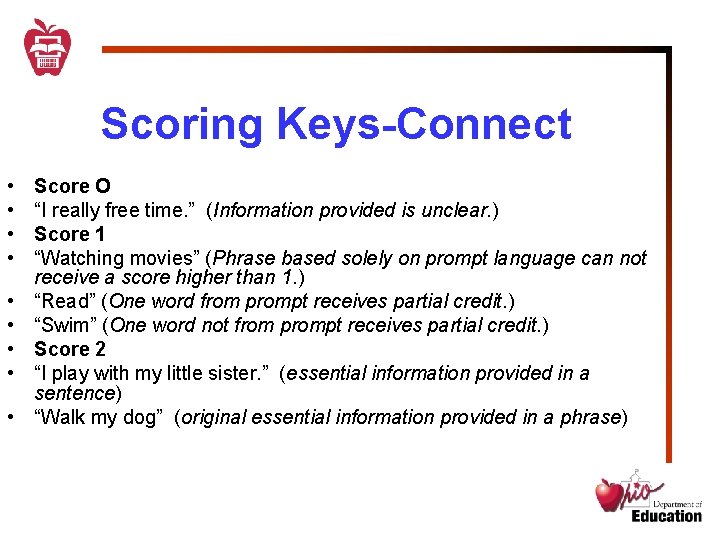
Scoring Keys-Connect • • • Score O “I really free time. ” (Information provided is unclear. ) Score 1 “Watching movies” (Phrase based solely on prompt language can not receive a score higher than 1. ) “Read” (One word from prompt receives partial credit. ) “Swim” (One word not from prompt receives partial credit. ) Score 2 “I play with my little sister. ” (essential information provided in a sentence) “Walk my dog” (original essential information provided in a phrase)
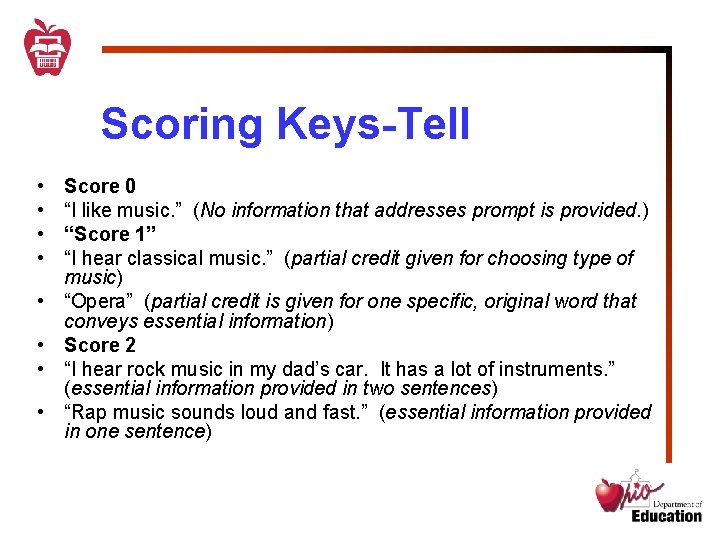
Scoring Keys-Tell • • Score 0 “I like music. ” (No information that addresses prompt is provided. ) “Score 1” “I hear classical music. ” (partial credit given for choosing type of music) “Opera” (partial credit is given for one specific, original word that conveys essential information) Score 2 “I hear rock music in my dad’s car. It has a lot of instruments. ” (essential information provided in two sentences) “Rap music sounds loud and fast. ” (essential information provided in one sentence)
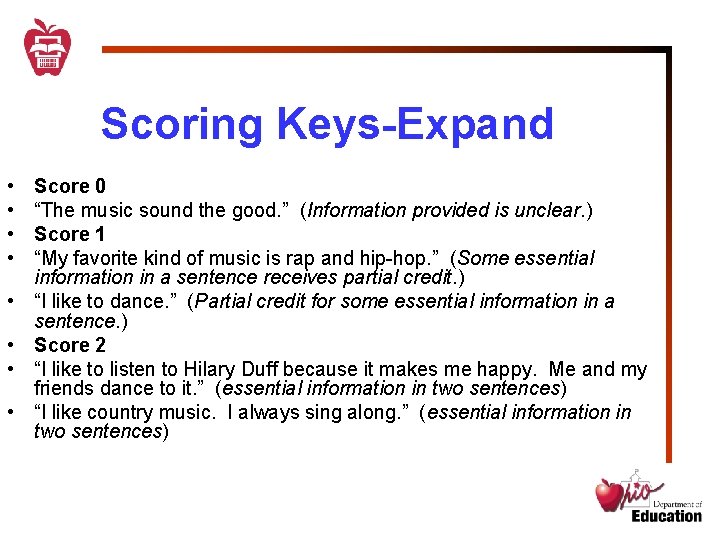
Scoring Keys-Expand • • Score 0 “The music sound the good. ” (Information provided is unclear. ) Score 1 “My favorite kind of music is rap and hip-hop. ” (Some essential information in a sentence receives partial credit. ) “I like to dance. ” (Partial credit for some essential information in a sentence. ) Score 2 “I like to listen to Hilary Duff because it makes me happy. Me and my friends dance to it. ” (essential information in two sentences) “I like country music. I always sing along. ” (essential information in two sentences)
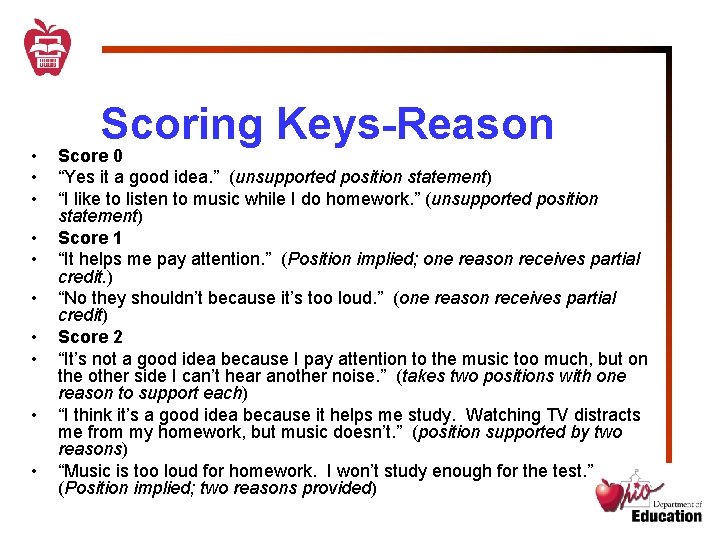
• • • Scoring Keys-Reason Score 0 “Yes it a good idea. ” (unsupported position statement) “I like to listen to music while I do homework. ” (unsupported position statement) Score 1 “It helps me pay attention. ” (Position implied; one reason receives partial credit. ) “No they shouldn’t because it’s too loud. ” (one reason receives partial credit) Score 2 “It’s not a good idea because I pay attention to the music too much, but on the other side I can’t hear another noise. ” (takes two positions with one reason to support each) “I think it’s a good idea because it helps me study. Watching TV distracts me from my homework, but music doesn’t. ” (position supported by two reasons) “Music is too loud for homework. I won’t study enough for the test. ” (Position implied; two reasons provided)
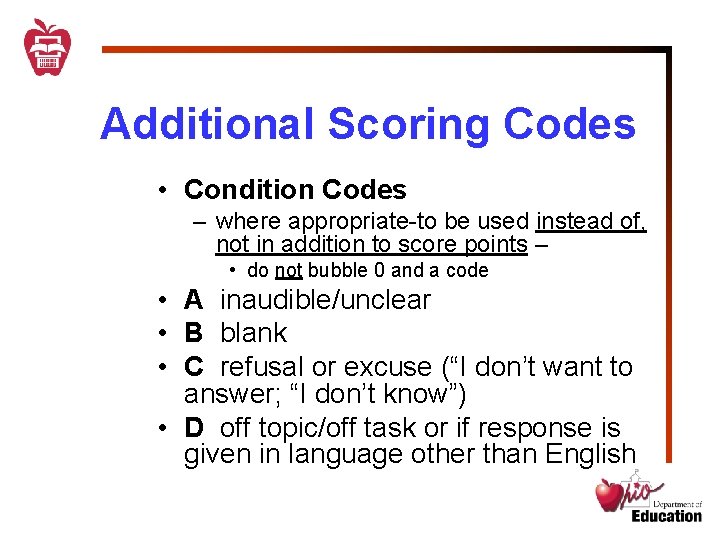
Additional Scoring Codes • Condition Codes – where appropriate-to be used instead of, not in addition to score points – • do not bubble 0 and a code • A inaudible/unclear • B blank • C refusal or excuse (“I don’t want to answer; “I don’t know”) • D off topic/off task or if response is given in language other than English
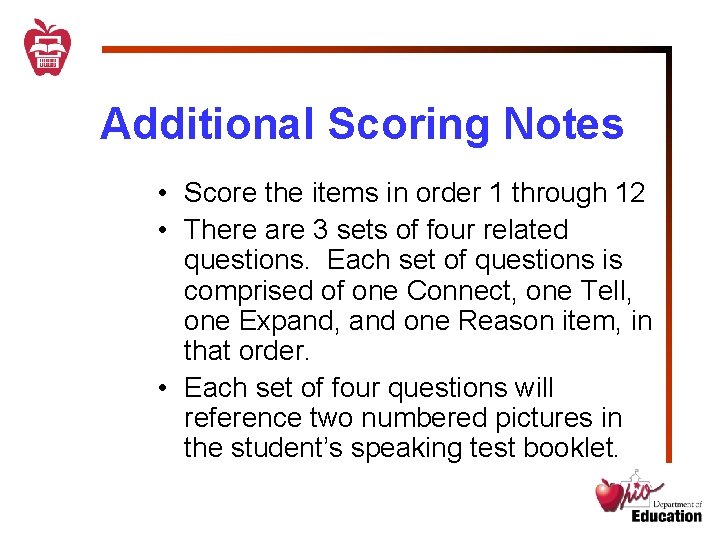
Additional Scoring Notes • Score the items in order 1 through 12 • There are 3 sets of four related questions. Each set of questions is comprised of one Connect, one Tell, one Expand, and one Reason item, in that order. • Each set of four questions will reference two numbered pictures in the student’s speaking test booklet.