
OHIO STATE UNIVERSITY EXTENSION OHIO STATE UNIVERSITY EXTENSION


- Slides: 47
OHIO STATE UNIVERSITY EXTENSION
OHIO STATE UNIVERSITY EXTENSION Adolescent Learners Grades 7 -9 Bobbilyn Kasson MS Ed EFNEP, Program Specialist.
OHIO STATE UNIVERSITY EXTENSION Overview • Understanding the Teen Brain • Creating a Learning Environment • Engaging/Motivating the Adolescent Learner • Closing the Lesson • Identifying Common Scenarios in the Classroom • Review/Questions 3
OHIO STATE UNIVERSITY EXTENSION Think back to being a middle school student or a parent to a middle school student. Write down a memory of middle school or how you felt during that time in your life, or how you felt watching your child go through these years. Now Turn and Share with a partner. 4
OHIO STATE UNIVERSITY EXTENSION Understanding the Teen Brain
OHIO STATE UNIVERSITY EXTENSION According to Frances E. Jensen, professor of neurology at the University of Pennsylvania, “the teenage brain is not just an adult brain with fewer miles on it- it’s a paradoxical time of development. These are people with very sharp brains, but they’re not quite sure what to do with them. ”
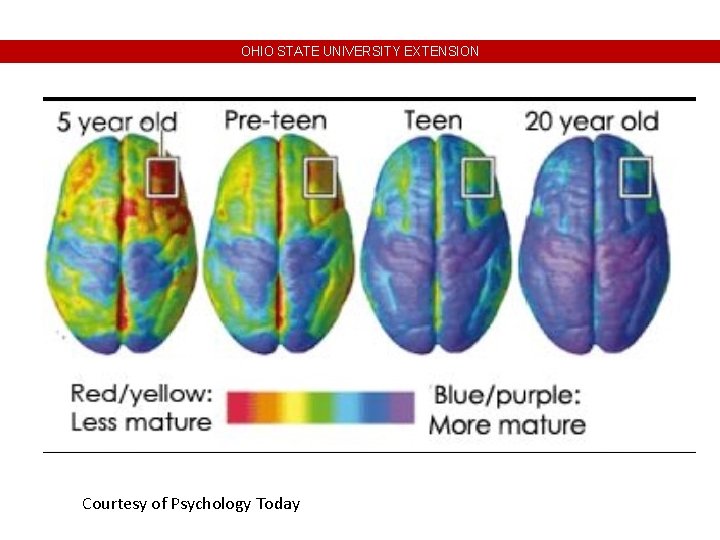
OHIO STATE UNIVERSITY EXTENSION Courtesy of Psychology Today
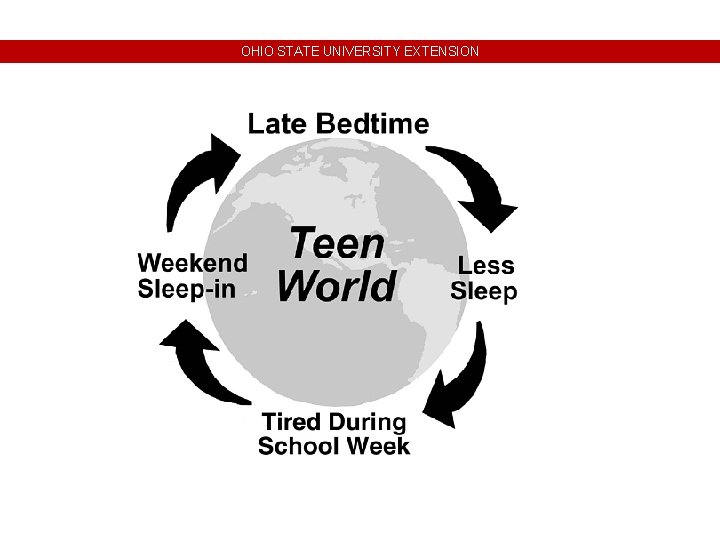
OHIO STATE UNIVERSITY EXTENSION
OHIO STATE UNIVERSITY EXTENSION
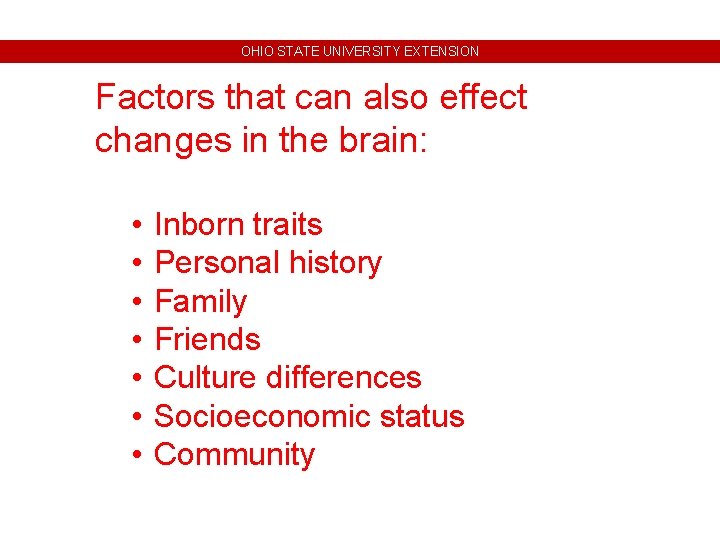
OHIO STATE UNIVERSITY EXTENSION Factors that can also effect changes in the brain: • • Inborn traits Personal history Family Friends Culture differences Socioeconomic status Community
OHIO STATE UNIVERSITY EXTENSION Creating a Learning Environment
OHIO STATE UNIVERSITY EXTENSION According to William H. Parrett and Kathleen M. Budge, authors of the book Turning High -Poverty Schools into High-Performing Schools, “the most critical part of your job is creating a healthy, safe, and supportive learning environment for ALL students to learn. ”
OHIO STATE UNIVERSITY EXTENSION
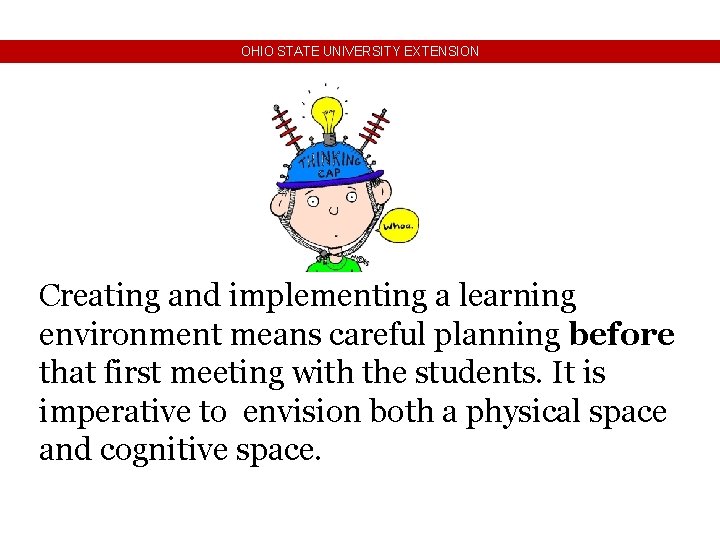
OHIO STATE UNIVERSITY EXTENSION Creating and implementing a learning environment means careful planning before that first meeting with the students. It is imperative to envision both a physical space and cognitive space.
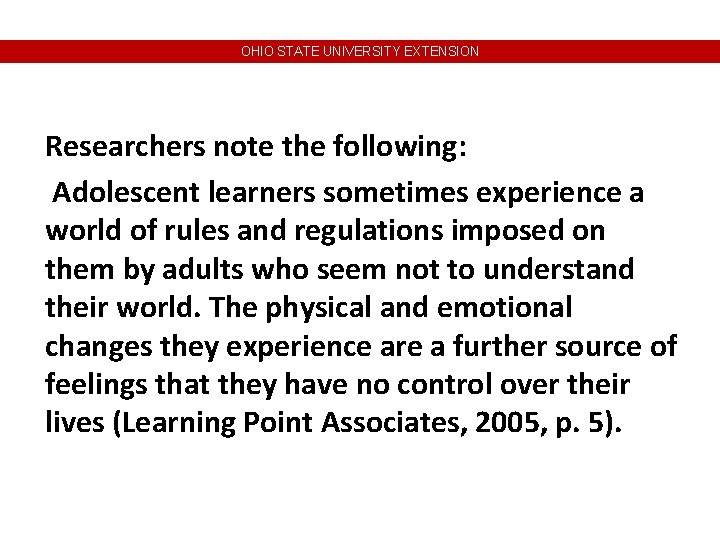
OHIO STATE UNIVERSITY EXTENSION Researchers note the following: Adolescent learners sometimes experience a world of rules and regulations imposed on them by adults who seem not to understand their world. The physical and emotional changes they experience are a further source of feelings that they have no control over their lives (Learning Point Associates, 2005, p. 5).
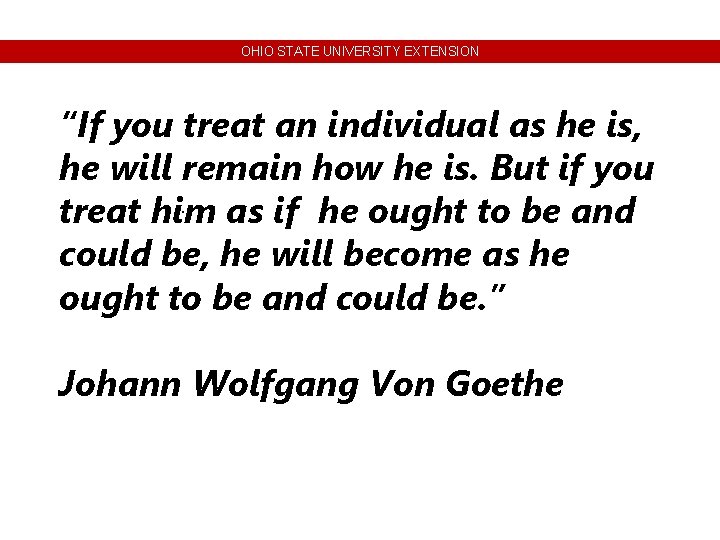
OHIO STATE UNIVERSITY EXTENSION “If you treat an individual as he is, he will remain how he is. But if you. treat him as if he ought to be and could be, he will become as he ought to be and could be. ” Johann Wolfgang Von Goethe
OHIO STATE UNIVERSITY EXTENSION Engaging/Motivating the Middle-Level Learner
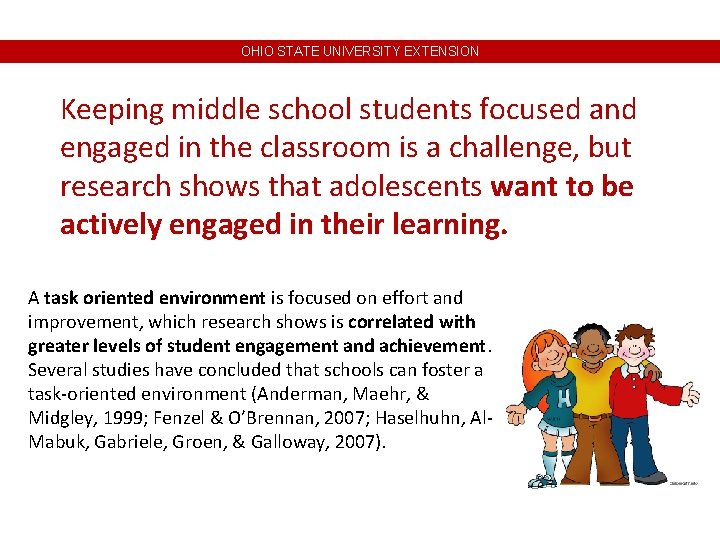
OHIO STATE UNIVERSITY EXTENSION Keeping middle school students focused and engaged in the classroom is a challenge, but research shows that adolescents want to be actively engaged in their learning. A task oriented environment is focused on effort and improvement, which research shows is correlated with greater levels of student engagement and achievement. Several studies have concluded that schools can foster a task-oriented environment (Anderman, Maehr, & Midgley, 1999; Fenzel & O’Brennan, 2007; Haselhuhn, Al. Mabuk, Gabriele, Groen, & Galloway, 2007).
OHIO STATE UNIVERSITY EXTENSION Kids Speak Out on Student Engagement by Heather Wolpert-Gawron ORIGINALLY PUBLISHED: APRIL 26, 2012 | UPDATED: FEBRUARY 24, 2015 http: //www. edutopia. org/blog/studentengagement-stories-heather-wolpert-gawron
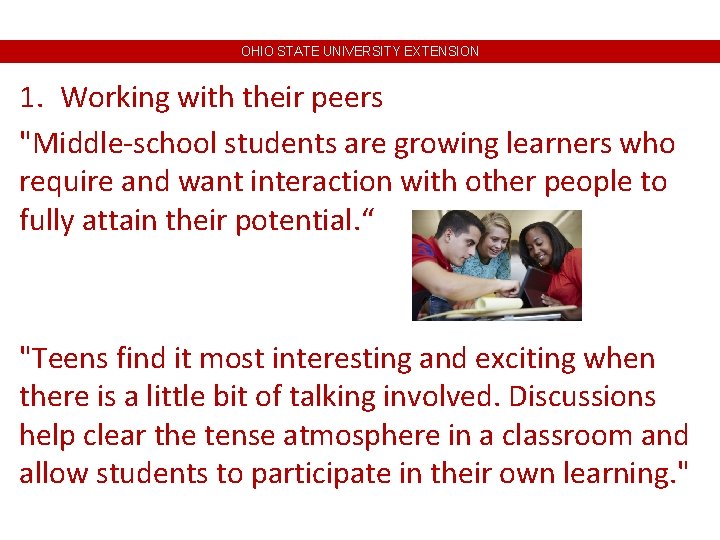
OHIO STATE UNIVERSITY EXTENSION 1. Working with their peers "Middle-school students are growing learners who require and want interaction with other people to fully attain their potential. “ "Teens find it most interesting and exciting when there is a little bit of talking involved. Discussions help clear the tense atmosphere in a classroom and allow students to participate in their own learning. "
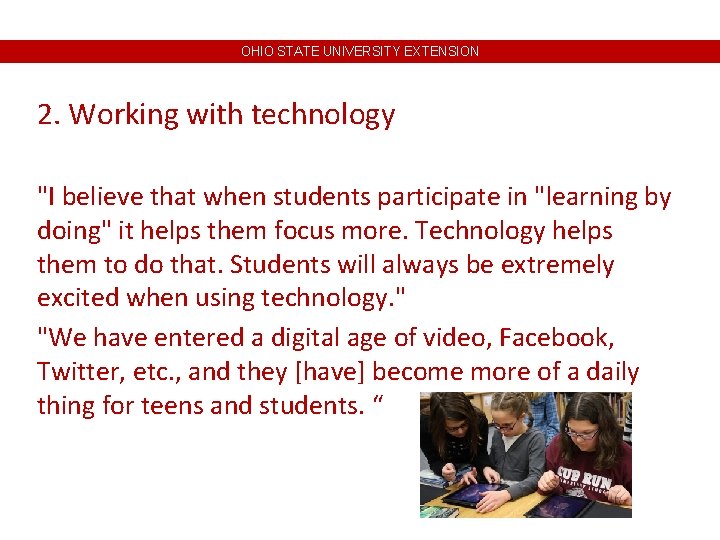
OHIO STATE UNIVERSITY EXTENSION 2. Working with technology "I believe that when students participate in "learning by doing" it helps them focus more. Technology helps them to do that. Students will always be extremely excited when using technology. " "We have entered a digital age of video, Facebook, Twitter, etc. , and they [have] become more of a daily thing for teens and students. “
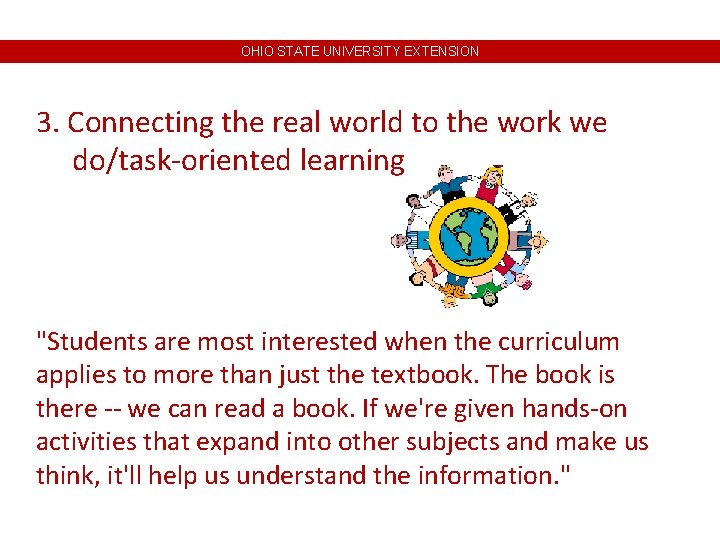
OHIO STATE UNIVERSITY EXTENSION 3. Connecting the real world to the work we do/task-oriented learning "Students are most interested when the curriculum applies to more than just the textbook. The book is there -- we can read a book. If we're given hands-on activities that expand into other subjects and make us think, it'll help us understand the information. "
OHIO STATE UNIVERSITY EXTENSION 4. Clearly love what you do "It isn't necessarily the subject or grades that really engage students but the teacher. When teachers are truly willing to teach students, not only because it is their job, but because they want to educate them, students benefit. It's about passion. That extra effort to show it will apply to our own future. "
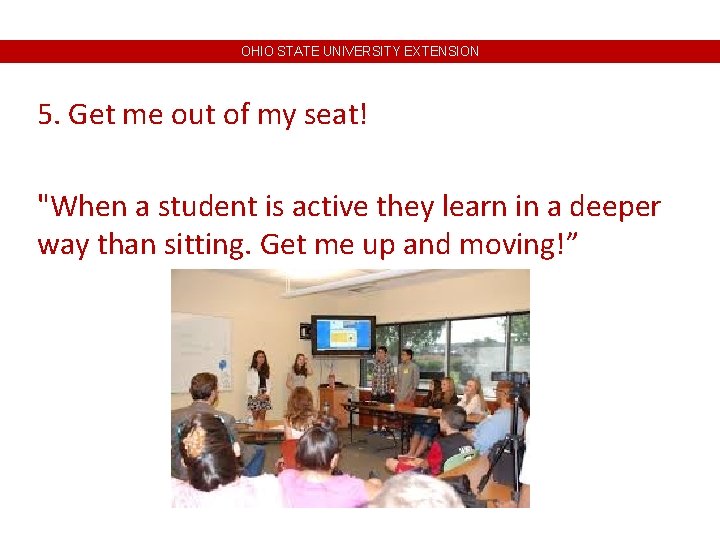
OHIO STATE UNIVERSITY EXTENSION 5. Get me out of my seat! "When a student is active they learn in a deeper way than sitting. Get me up and moving!”
OHIO STATE UNIVERSITY EXTENSION 6. Bring in visuals I like to see pictures because it makes my understanding on a topic clearer. It gives me an image in my head to visualize. " "I am interested when there are lots of visuals to go with the lesson. Power Points are often nice, but they get boring if there are too many bullet points. Pictures and cartoons usually are the best way to get attention. "
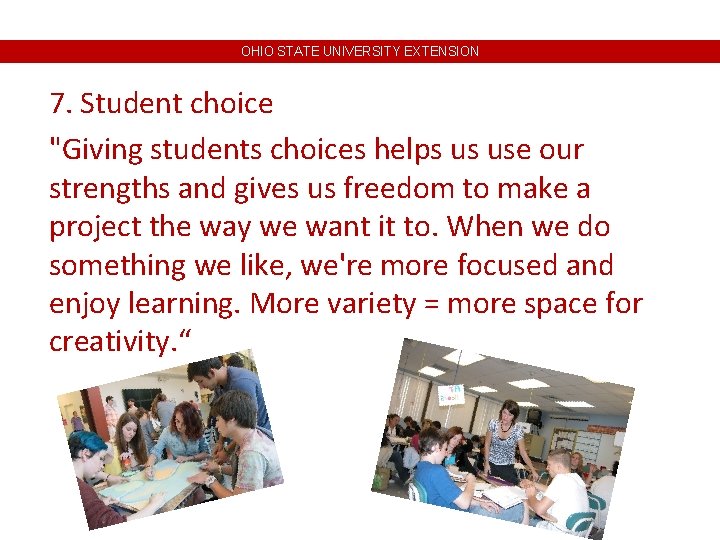
OHIO STATE UNIVERSITY EXTENSION 7. Student choice "Giving students choices helps us use our strengths and gives us freedom to make a project the way we want it to. When we do something we like, we're more focused and enjoy learning. More variety = more space for creativity. “
OHIO STATE UNIVERSITY EXTENSION 8. Understand your clients -- the kids "Students are engaged in learning when they are taught by teachers who really connect with their students and make the whole class feel like one big family. Teachers should understand how the mind of a teenager works and should be able to connect with them because everyone should feel comfortable so that they are encouraged to raise their hands to ask questions or ask for help. "
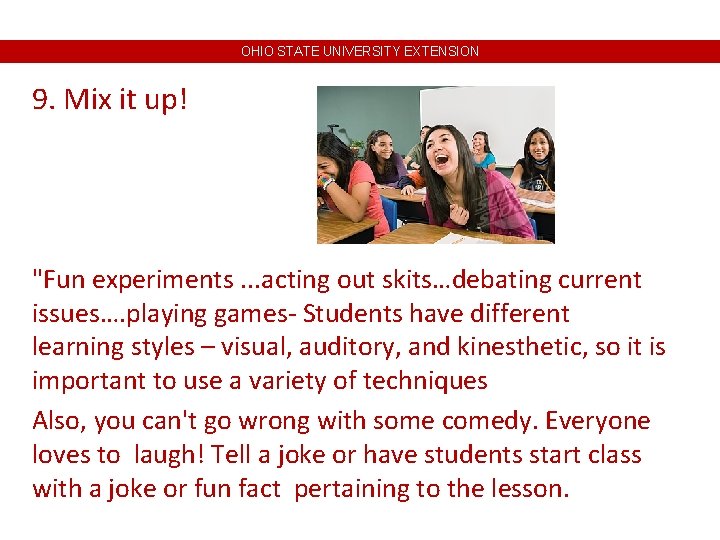
OHIO STATE UNIVERSITY EXTENSION 9. Mix it up! "Fun experiments. . . acting out skits…debating current issues…. playing games- Students have different learning styles – visual, auditory, and kinesthetic, so it is important to use a variety of techniques Also, you can't go wrong with some comedy. Everyone loves to laugh! Tell a joke or have students start class with a joke or fun fact pertaining to the lesson.
OHIO STATE UNIVERSITY EXTENSION 10. Be human "Don't forget to have a little fun yourself! And it’s ok to ask for some help from your students. Ask Them! Get the students input on how they learn-
OHIO STATE UNIVERSITY EXTENSION Closing your Daily Lessons
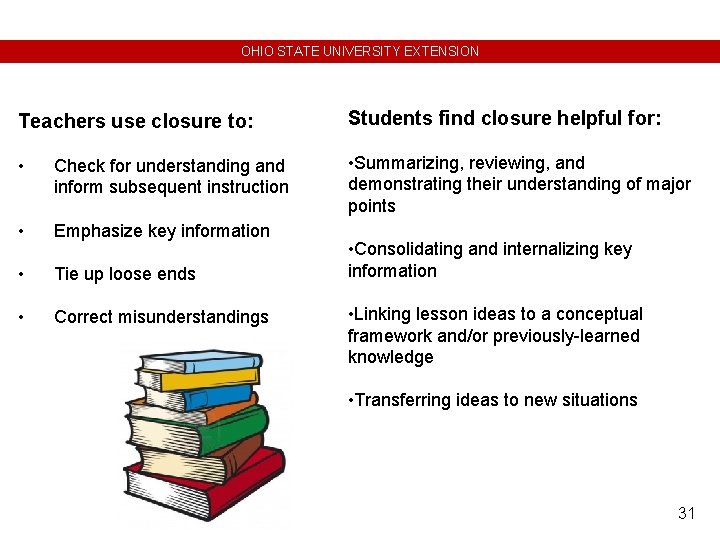
OHIO STATE UNIVERSITY EXTENSION Teachers use closure to: Students find closure helpful for: • Check for understanding and inform subsequent instruction • Summarizing, reviewing, and demonstrating their understanding of major points • Emphasize key information • Tie up loose ends • Correct misunderstandings • Consolidating and internalizing key information • Linking lesson ideas to a conceptual framework and/or previously-learned knowledge • Transferring ideas to new situations 31
OHIO STATE UNIVERSITY EXTENSION 22 Powerful Closure Activities by Todd Finley DECEMBER 15, 2015 http: //www. edutopia. org/blog/22 -powerful-closure-activities-todd-finley 32
OHIO STATE UNIVERSITY EXTENSION Snowstorm Students write down what they learned on a piece of scratch paper and wad it up. Given a signal, they throw their paper snowballs in the air. Then each learner picks up a nearby response and reads it aloud. High-Five Hustle Ask students to stand up, raise their hands and high-five a peer -- their short-term hustle buddy. When there are no hands left, ask a question for them to discuss. Solicit answers. Then play "Do the Hustle" as a signal for them to raise their hands and high-five a different partner for the next question. (Source: Gretchen Bridgers) 33
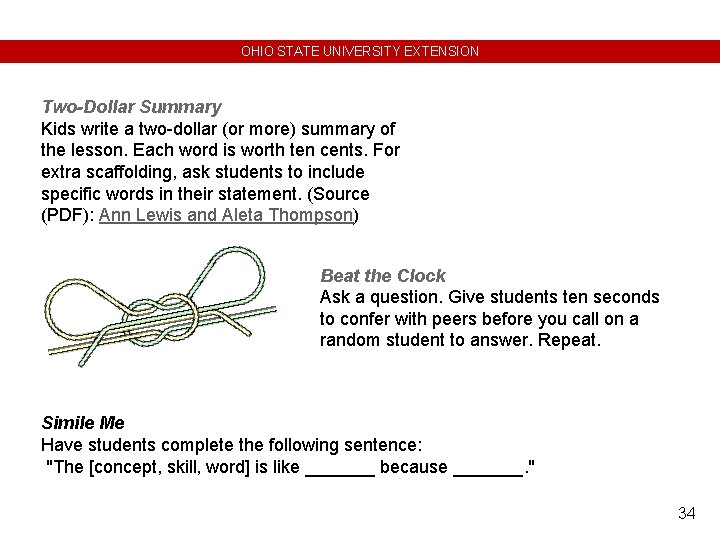
OHIO STATE UNIVERSITY EXTENSION Two-Dollar Summary Kids write a two-dollar (or more) summary of the lesson. Each word is worth ten cents. For extra scaffolding, ask students to include specific words in their statement. (Source (PDF): Ann Lewis and Aleta Thompson) Beat the Clock Ask a question. Give students ten seconds to confer with peers before you call on a random student to answer. Repeat. Simile Me Have students complete the following sentence: "The [concept, skill, word] is like _______ because _______. " 34
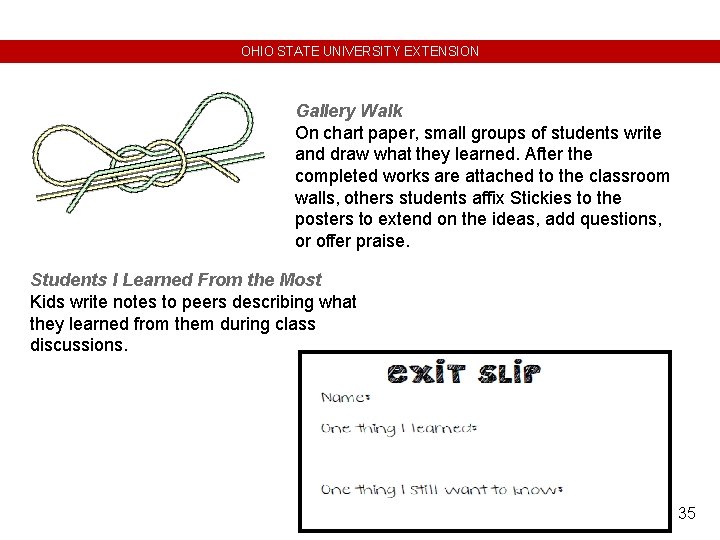
OHIO STATE UNIVERSITY EXTENSION Gallery Walk On chart paper, small groups of students write and draw what they learned. After the completed works are attached to the classroom walls, others students affix Stickies to the posters to extend on the ideas, add questions, or offer praise. Students I Learned From the Most Kids write notes to peers describing what they learned from them during class discussions. 35
OHIO STATE UNIVERSITY EXTENSION Common Scenarios
OHIO STATE UNIVERSITY EXTENSION Directions for Scenarios At your tables you will find 6 different situations that you might encounter while teaching your daily lesson. Choose 1 scenario and read it with a partner. Then share your thoughts by writing down the steps that you would take to handle this situation. After 5 minutes, We will go over each one, and you will have the opportunity to share your ideas.
OHIO STATE UNIVERSITY EXTENSION Scenario 1: Tommy is a likeable student with lots of friends in the classroom. He calls out answers in class without first raising his hand waiting to be recognized. In addition, he also tends to be out of his seat frequently, sharpening his pencil, getting a tissue, throwing paper away, and wandering around the room disrupting others. Any Ideas?
OHIO STATE UNIVERSITY EXTENSION Scenario 2: Sabrina is consistently on her cell phone and does not participate in the group activity. When you ask her to put her phone away and join the class, she becomes angry and unresponsive. Any Ideas?
OHIO STATE UNIVERSITY EXTENSION Scenario 3: Mrs. Lucas, the classroom teacher tries to sabotage the message of your lesson. She often sits in the corner drinking Mountain Dew eating potato chips, and making phone calls on her cell phone when you are trying to teach. Any ideas?
OHIO STATE UNIVERSITY EXTENSION Scenario 4: Mr. Campbell often waits until you start your lesson, and then he leaves the class to grab some coffee -leaving you alone with the students. While he is out of the room, the students often act out. Any ideas?
OHIO STATE UNIVERSITY EXTENSION Scenario 5: Charlie is an inclusion student who is often pulled during your nutrition lessons for tutoring. He has missed several classes, but is still supposed to do the survey. He struggles while doing it and looks very frustrated. Any ideas?
OHIO STATE UNIVERSITY EXTENSION Review
OHIO STATE UNIVERSITY EXTENSION Remember to use the 4 A’s Anchor Add Apply Away
OHIO STATE UNIVERSITY EXTENSION Turn to the person on your left and share one thing that you learned in this presentation that you will try with your students.
OHIO STATE UNIVERSITY EXTENSION What Questions do you have for me?
OHIO STATE UNIVERSITY EXTENSION I’ve come to the frightening conclusion that I am the decisive element in the classroom. It is my daily mood that makes the weather. As a teacher, I possess a tremendous power to make a child’s life miserable or joyous. I can be a tool of torture or an instrument of inspiration. I can humiliate or humor, hurt or heal. In all situations, it is my response that decides whether a crisis will be escalated or de-escalated and a child humanized or de-humanized Dr. Haim Ginott