
OH BROTHER WHERE ART OUR LOCATIONS HEARING CONSERVATION
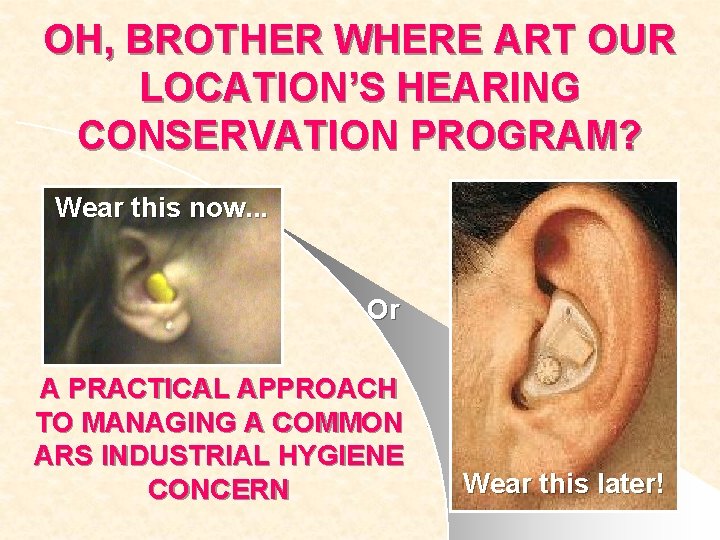
OH, BROTHER WHERE ART OUR LOCATION’S HEARING CONSERVATION PROGRAM? Wear this now. . . Or A PRACTICAL APPROACH TO MANAGING A COMMON ARS INDUSTRIAL HYGIENE CONCERN Wear this later!
SHOULD WE BE CONCERNED ABOUT HEARING CONSERVATION IN THE ARS WORKPLACE? 30 MILLION PEOPLE ARE OCCUPATIONALLY EXPOSED TO HAZARDOUS NOISE. 10 MILLION PEOPLE HAVE NOISE INDUCED HEARING LOSS (NIHL) – NEARLY ALL FROM OCCUPATIONAL EXPOSURES. NIHL IS ONE OF THE MOST COMMON OCCUPATIONAL DISEASES AND THE SECOND MOST SELF-REPORTED OCCUPATIONAL ILLNESS OR INJURY.
ARE THERE SIGNS THAT YOU SHOULD BE ADDRESSING HEARING CONSERVATION AT YOUR LOCATION(S)? As you conduct your baseline IH surveys or visit employee work areas during compliance inspections, have you noted that the noise level is so loud that you must raise your voice significantly for employees located an arm's length away to hear you?
ARE THERE SIGNS THAT YOU SHOULD BE ADDRESSING HEARING CONSERVATION AT YOUR LOCATION(S)? Do employees comment that when they exit noisy work areas or cease operation of loud equipment and are in a quieter environment, that their ears feel plugged? Or do they comment about mild ringing or whooshing noise that goes away after an hour or two?
ARE THERE SIGNS THAT YOU SHOULD BE ADDRESSING HEARING CONSERVATION AT YOUR LOCATION(S)? Are Standard Threshold Hearing Shifts (STS) being discovered on your OMSP audiometric screening for employees that work in noise hazardous areas or operate noise hazardous equipment?
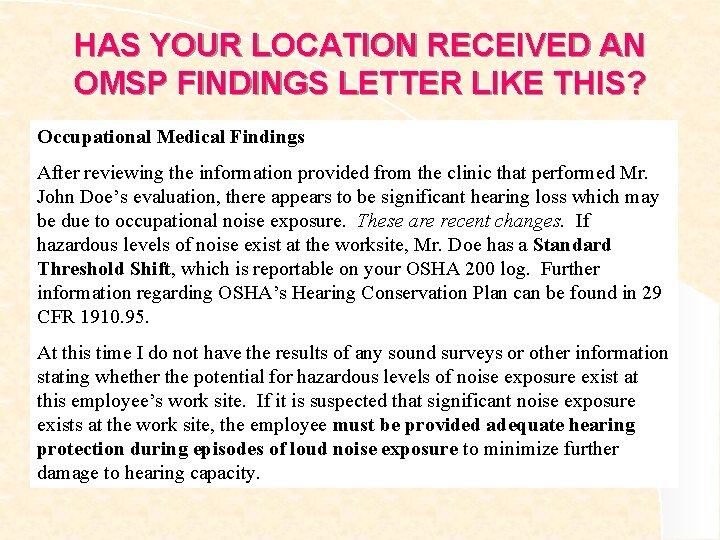
HAS YOUR LOCATION RECEIVED AN OMSP FINDINGS LETTER LIKE THIS? Occupational Medical Findings After reviewing the information provided from the clinic that performed Mr. John Doe’s evaluation, there appears to be significant hearing loss which may be due to occupational noise exposure. These are recent changes. If hazardous levels of noise exist at the worksite, Mr. Doe has a Standard Threshold Shift, which is reportable on your OSHA 200 log. Further information regarding OSHA’s Hearing Conservation Plan can be found in 29 CFR 1910. 95. At this time I do not have the results of any sound surveys or other information stating whether the potential for hazardous levels of noise exposure exist at this employee’s work site. If it is suspected that significant noise exposure exists at the work site, the employee must be provided adequate hearing protection during episodes of loud noise exposure to minimize further damage to hearing capacity.
WHAT STEPS HAVE WE TAKEN TO ADDRESS THESE ISSUES IN THE NAA? * FOLLOW UP ON STS CASES IDENTIFIED UNDER THE OMSP TO ASSESS WORKSITE NOISE IMPACT * CONTINUAL ASSESSMENT TO DETERMINE IF HAZARDOUS NOISE EXISTS AT ARS LOCATIONS (NOISE SURVEY, PERSONAL NOISE DOSIMETRY) * ENSURE THAT WRITTEN HEARING CONSERVATION PLANS ARE PROVIDED TO OUR LOCATIONS * PROVIDE RECOMMENDATIONS FOR ELIMINATING HAZARDOUS NOISE FROM THE WORKPLACE * ASSIST IN SELECTING HEARING PROTECTORS APPROPRIATE FOR THE WORK ENVIRONMENT

WHAT CONSTITUTES A HEARING CONSERVATION PROGRAM? OSHA OCCUPATIONAL NOISE EXPOSURE STANDARD (29 CFR 1910. 95) • Noise monitoring • Controlling excessive noise • Individually fitted protection • Record Keeping • Education/Training • Baseline & annual audiometry • Procedures for preventing additional hearing loss
WHAT WE NEED TO KNOW ABOUT HAZARDOUS NOISE * The louder the noise, the more hazardous it is. Also, the longer the exposure time, the more hazardous the noise is. * The two factors that determine how hazardous noise is are: – Intensity (Loudness) measured in d. BA – Time of Exposure measured in Hours and Minutes * A “Noise Dose” combines both loudness and time and is a convenient way of describing the relative hazard of the noise.
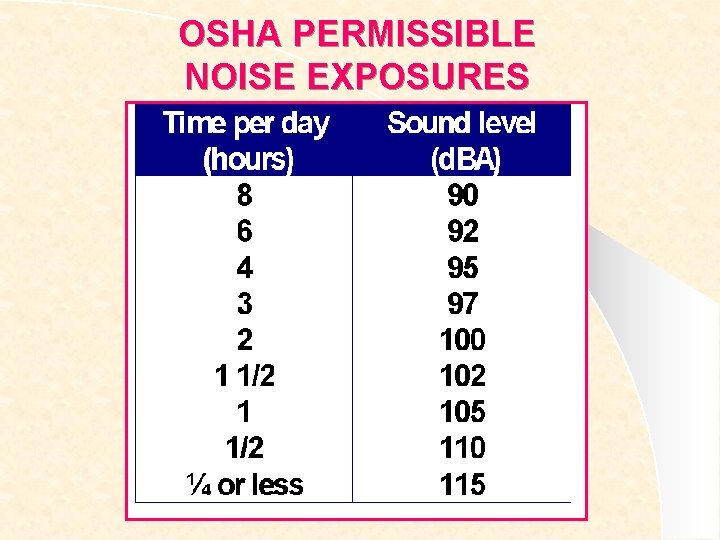
OSHA PERMISSIBLE NOISE EXPOSURES
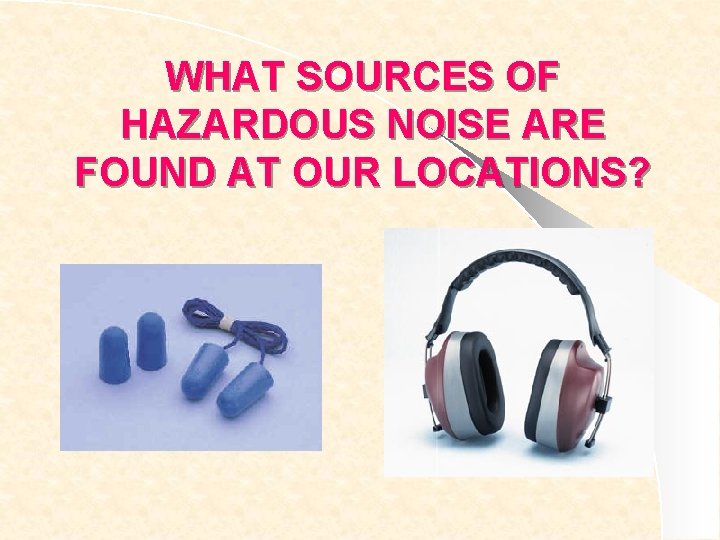
WHAT SOURCES OF HAZARDOUS NOISE ARE FOUND AT OUR LOCATIONS?
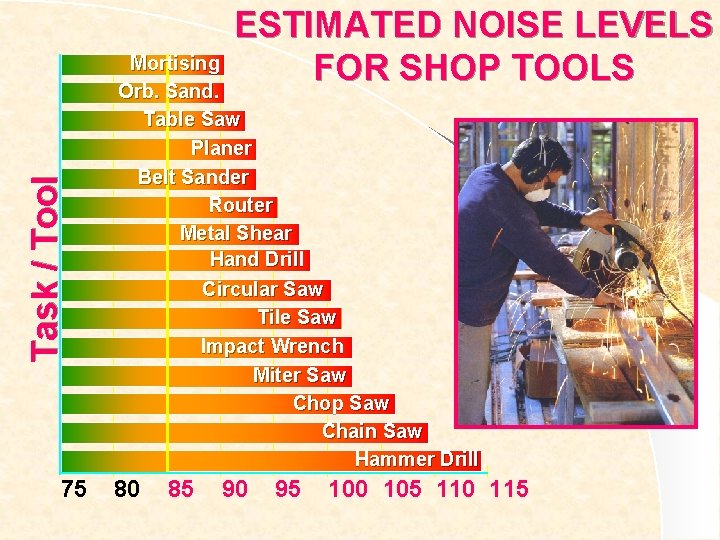
Task / Tool ESTIMATED NOISE LEVELS FOR SHOP TOOLS 75 Mortising Orb. Sand. Table Saw Planer Belt Sander Router Metal Shear Hand Drill Circular Saw Tile Saw Impact Wrench Miter Saw Chop Saw Chain Saw Hammer Drill 80 85 90 95 100 105 110 115
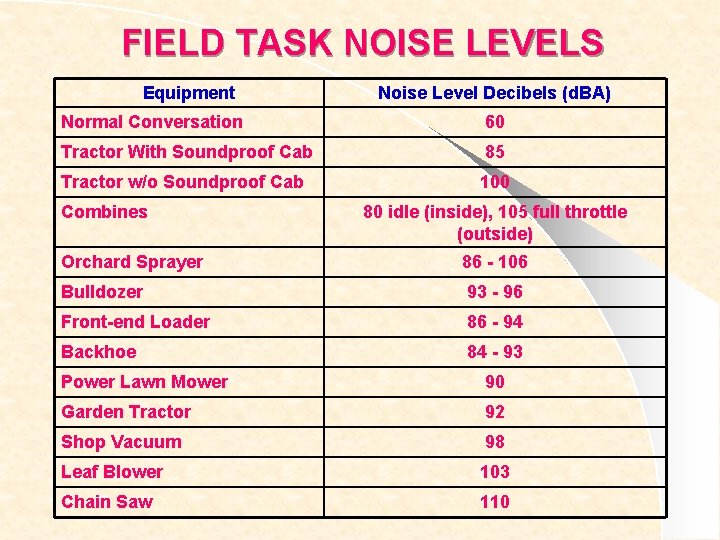
FIELD TASK NOISE LEVELS Equipment Noise Level Decibels (d. BA) Normal Conversation 60 Tractor With Soundproof Cab 85 Tractor w/o Soundproof Cab 100 Combines 80 idle (inside), 105 full throttle (outside) Orchard Sprayer 86 - 106 Bulldozer 93 - 96 Front-end Loader 86 - 94 Backhoe 84 - 93 Power Lawn Mower 90 Garden Tractor 92 Shop Vacuum 98 Leaf Blower 103 Chain Saw 110
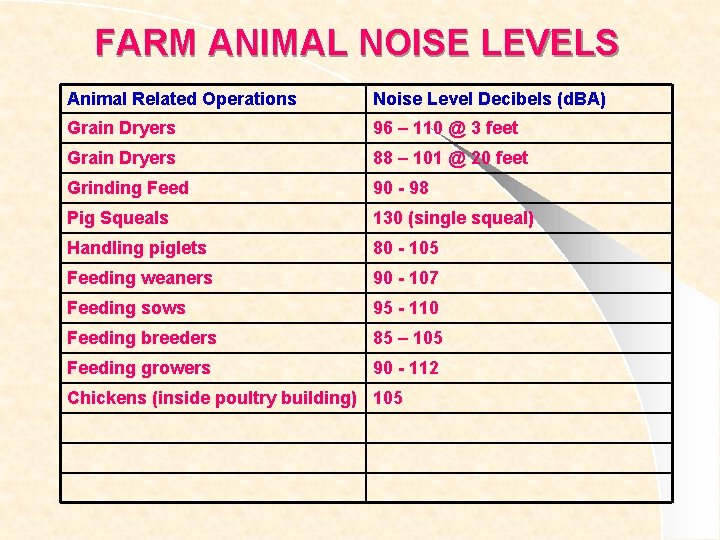
FARM ANIMAL NOISE LEVELS Animal Related Operations Noise Level Decibels (d. BA) Grain Dryers 96 – 110 @ 3 feet Grain Dryers 88 – 101 @ 20 feet Grinding Feed 90 - 98 Pig Squeals 130 (single squeal) Handling piglets 80 - 105 Feeding weaners 90 - 107 Feeding sows 95 - 110 Feeding breeders 85 – 105 Feeding growers 90 - 112 Chickens (inside poultry building) 105
WHAT NOISE MONITORING DATA DO YOU HAVE ON FILE TO SUPPORT YOUR CLAIM THAT YOU AND YOUR EMPLOYEES ARE AWARE OF NOISE HAZARDOUS EQUIPMENT OR NOISE HAZARDOUS WORK AREAS?
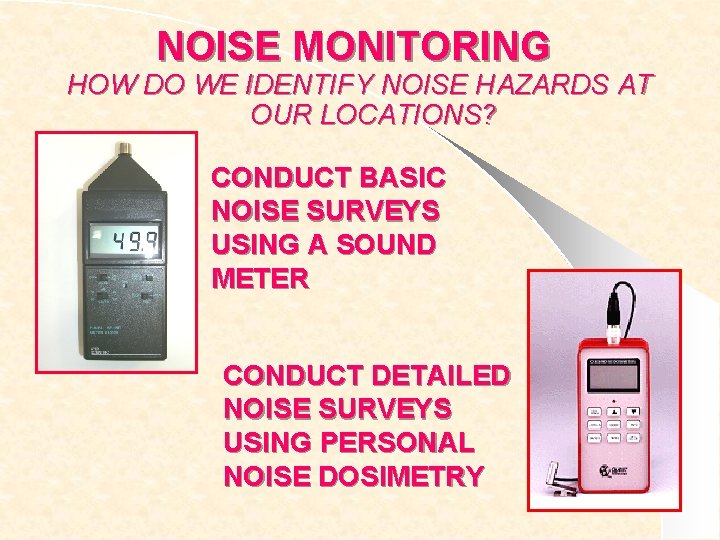
NOISE MONITORING HOW DO WE IDENTIFY NOISE HAZARDS AT OUR LOCATIONS? CONDUCT BASIC NOISE SURVEYS USING A SOUND METER CONDUCT DETAILED NOISE SURVEYS USING PERSONAL NOISE DOSIMETRY
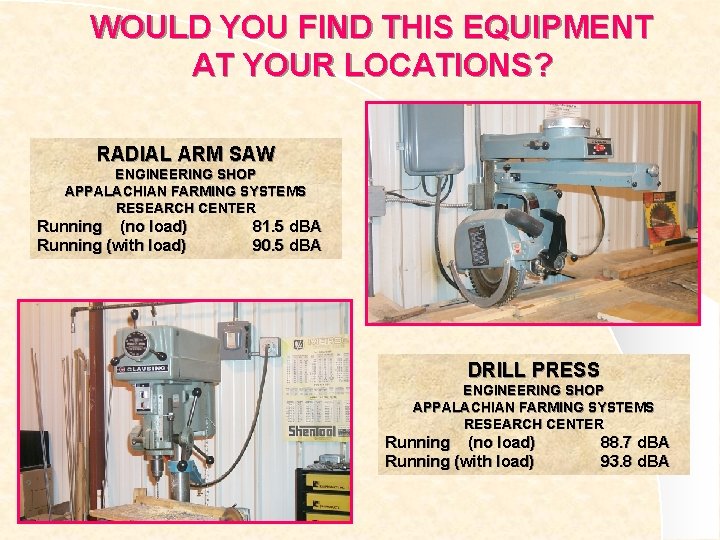
WOULD YOU FIND THIS EQUIPMENT AT YOUR LOCATIONS? RADIAL ARM SAW ENGINEERING SHOP APPALACHIAN FARMING SYSTEMS RESEARCH CENTER Running (no load) Running (with load) 81. 5 d. BA 90. 5 d. BA DRILL PRESS ENGINEERING SHOP APPALACHIAN FARMING SYSTEMS RESEARCH CENTER Running (no load) Running (with load) 88. 7 d. BA 93. 8 d. BA
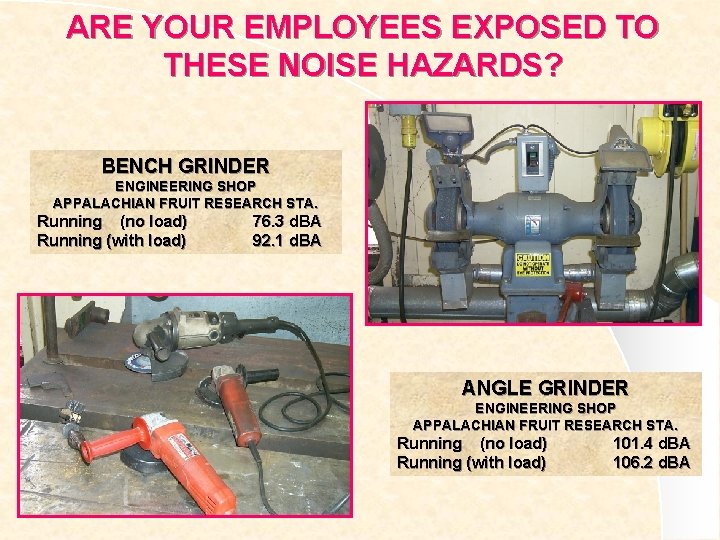
ARE YOUR EMPLOYEES EXPOSED TO THESE NOISE HAZARDS? BENCH GRINDER ENGINEERING SHOP APPALACHIAN FRUIT RESEARCH STA. Running (no load) Running (with load) 76. 3 d. BA 92. 1 d. BA ANGLE GRINDER ENGINEERING SHOP APPALACHIAN FRUIT RESEARCH STA. Running (no load) Running (with load) 101. 4 d. BA 106. 2 d. BA
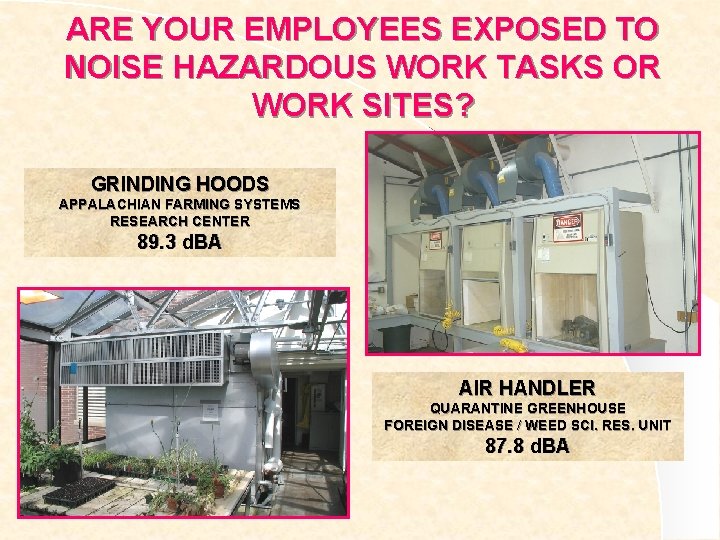
ARE YOUR EMPLOYEES EXPOSED TO NOISE HAZARDOUS WORK TASKS OR WORK SITES? GRINDING HOODS APPALACHIAN FARMING SYSTEMS RESEARCH CENTER 89. 3 d. BA AIR HANDLER QUARANTINE GREENHOUSE FOREIGN DISEASE / WEED SCI. RES. UNIT 87. 8 d. BA
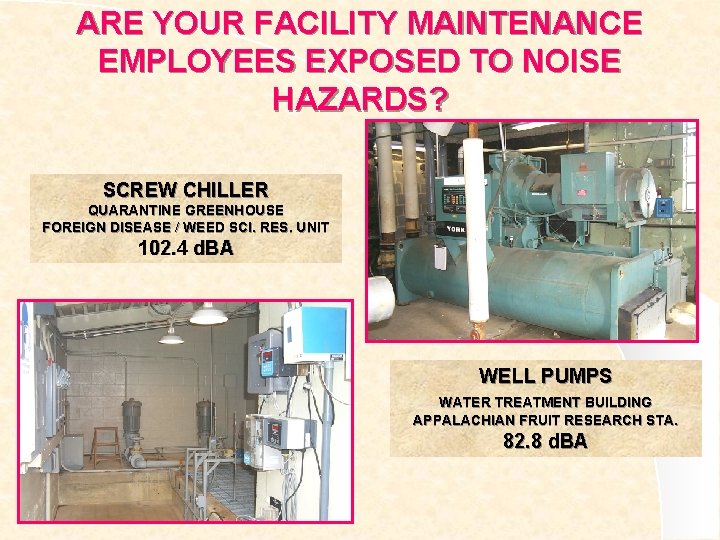
ARE YOUR FACILITY MAINTENANCE EMPLOYEES EXPOSED TO NOISE HAZARDS? SCREW CHILLER QUARANTINE GREENHOUSE FOREIGN DISEASE / WEED SCI. RES. UNIT 102. 4 d. BA WELL PUMPS WATER TREATMENT BUILDING APPALACHIAN FRUIT RESEARCH STA. 82. 8 d. BA
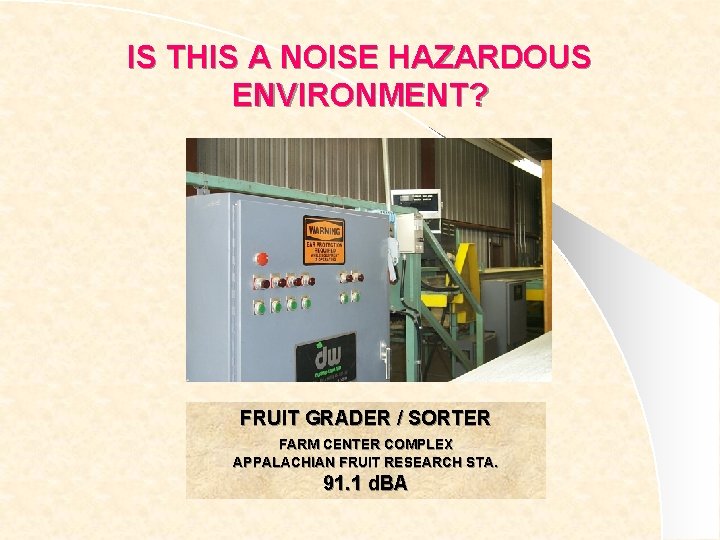
IS THIS A NOISE HAZARDOUS ENVIRONMENT? FRUIT GRADER / SORTER FARM CENTER COMPLEX APPALACHIAN FRUIT RESEARCH STA. 91. 1 d. BA
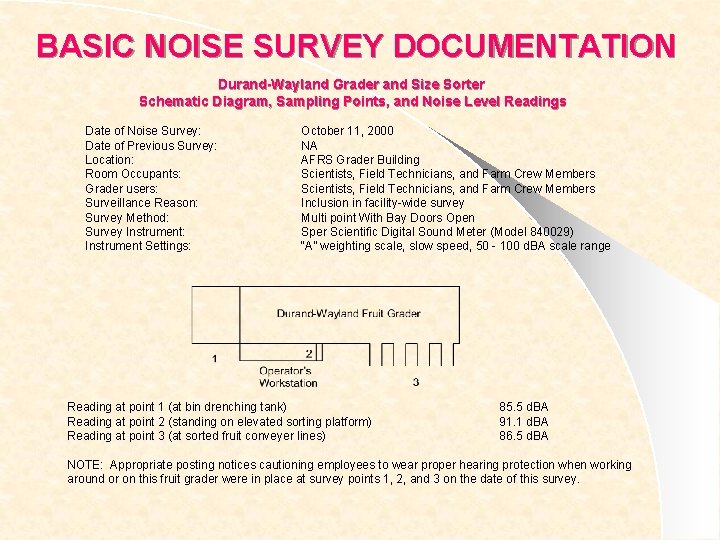
BASIC NOISE SURVEY DOCUMENTATION Durand-Wayland Grader and Size Sorter Schematic Diagram, Sampling Points, and Noise Level Readings Date of Noise Survey: Date of Previous Survey: Location: Room Occupants: Grader users: Surveillance Reason: Survey Method: Survey Instrument: Instrument Settings: October 11, 2000 NA AFRS Grader Building Scientists, Field Technicians, and Farm Crew Members Inclusion in facility-wide survey Multi point With Bay Doors Open Sper Scientific Digital Sound Meter (Model 840029) “A” weighting scale, slow speed, 50 - 100 d. BA scale range Reading at point 1 (at bin drenching tank) Reading at point 2 (standing on elevated sorting platform) Reading at point 3 (at sorted fruit conveyer lines) 85. 5 d. BA 91. 1 d. BA 86. 5 d. BA NOTE: Appropriate posting notices cautioning employees to wear proper hearing protection when working around or on this fruit grader were in place at survey points 1, 2, and 3 on the date of this survey.
- Slides: 22