
OGC Indoor GML Aug 12 2019 KiJoune Li

- Slides: 24
OGC Indoor. GML Aug. 12, 2019 Ki-Joune Li Pusan National University, South Korea
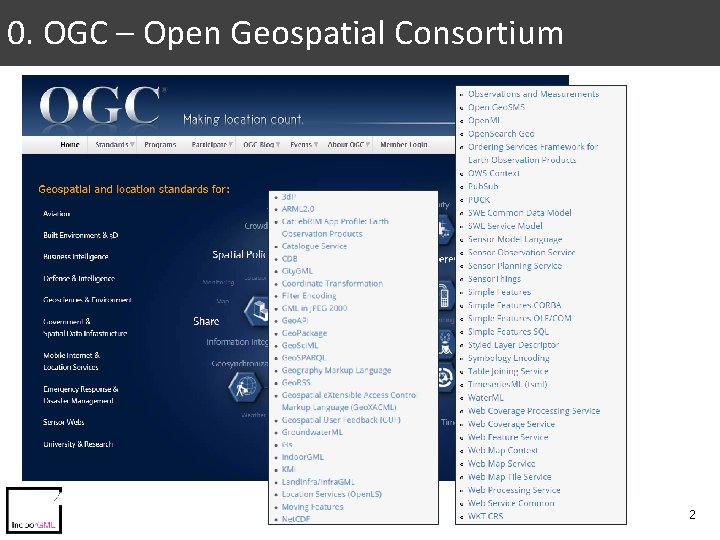
0. OGC – Open Geospatial Consortium 2
0. Previous Standards for Indoor Spatial Model IFC/City. GML: Feature Modeling 3
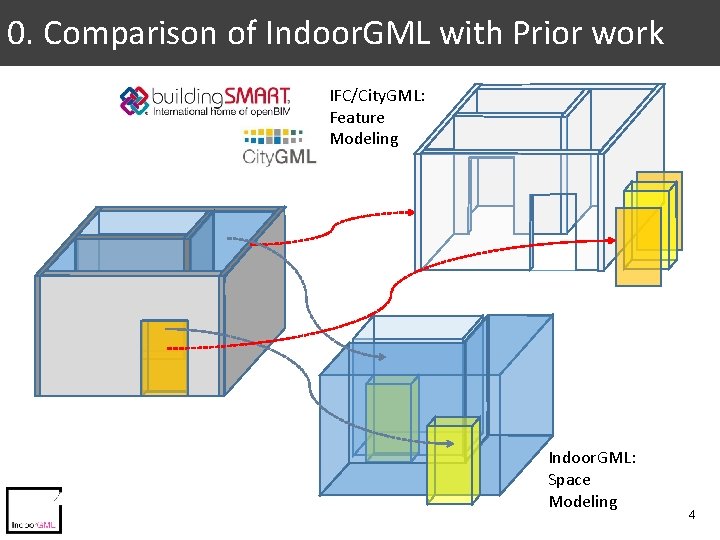
0. Comparison of Indoor. GML with Prior work IFC/City. GML: Feature Modeling Indoor. GML: Space Modeling 4
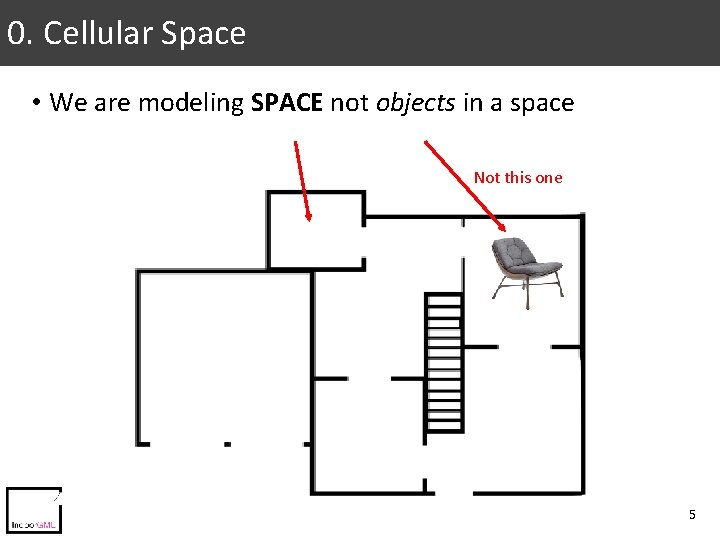
0. Cellular Space • We are modeling SPACE not objects in a space Not this one 5
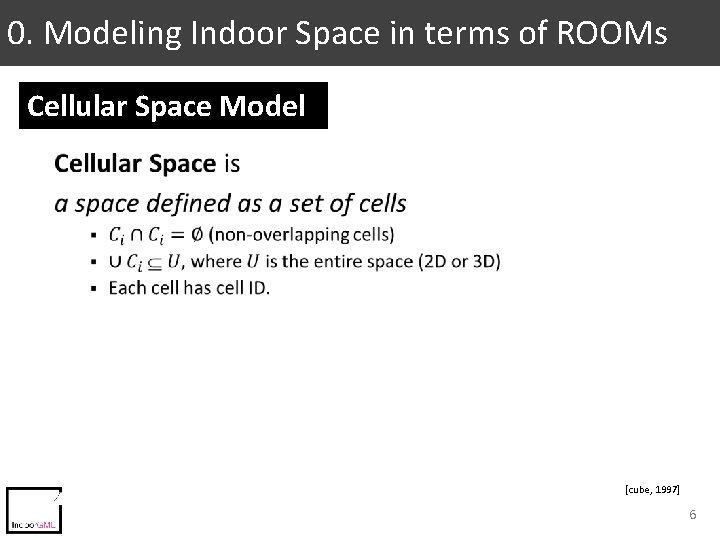
0. Modeling Indoor Space in terms of ROOMs Cellular Space Model [cube, 1997] 6
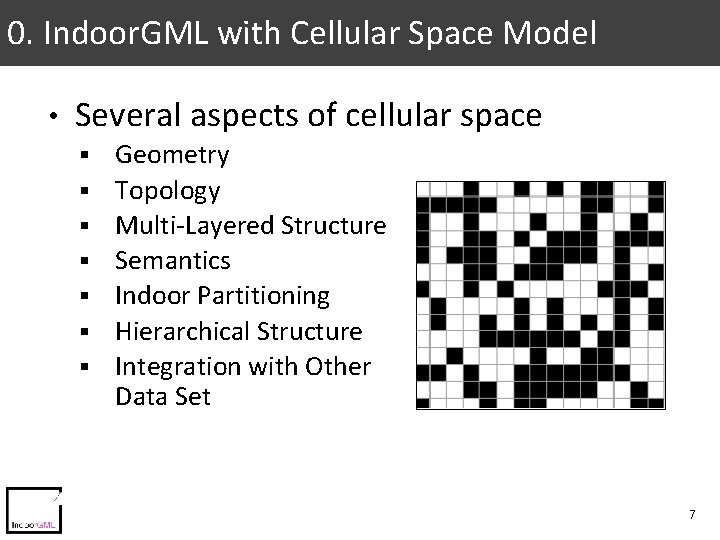
0. Indoor. GML with Cellular Space Model • Several aspects of cellular space § § § § Geometry Topology Multi-Layered Structure Semantics Indoor Partitioning Hierarchical Structure Integration with Other Data Set 7
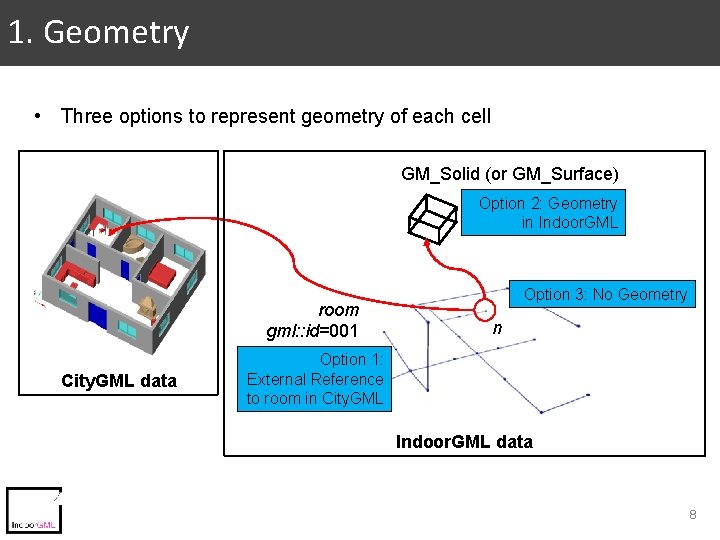
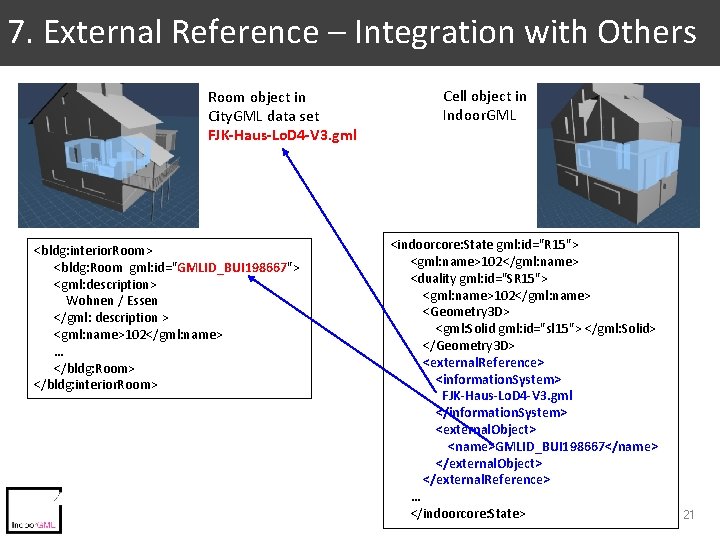
1. Geometry • Three options to represent geometry of each cell GM_Solid (or GM_Surface) ` room gml: : id=001 City. GML data Option 2: Geometry in Indoor. GML Option 3: No Geometry n Option 1: External Reference to room in City. GML Indoor. GML data 8
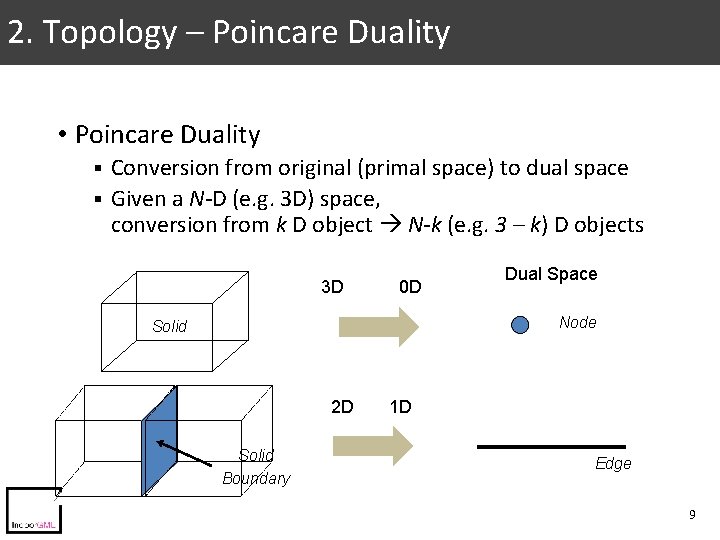
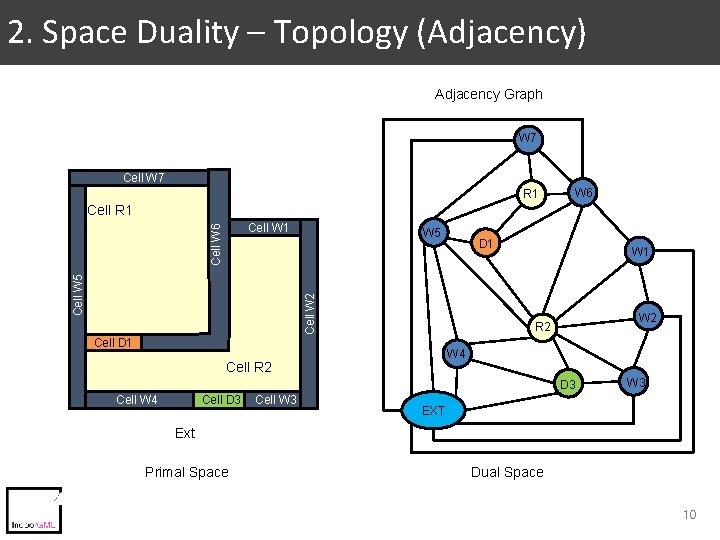
2. Topology – Poincare Duality • Poincare Duality Conversion from original (primal space) to dual space § Given a N-D (e. g. 3 D) space, conversion from k D object N-k (e. g. 3 – k) D objects § 3 D 0 D Dual Space Node Solid 2 D Solid Boundary 1 D Edge 9
2. Space Duality – Topology (Adjacency) Adjacency Graph W 7 Cell W 7 R 1 W 6 Cell R 1 W 5 D 1 Cell W 2 Cell W 5 Cell W 6 Cell W 1 W 2 R 2 Cell D 1 W 4 Cell R 2 D 3 Cell W 4 Cell W 3 EXT Ext Primal Space Dual Space 10
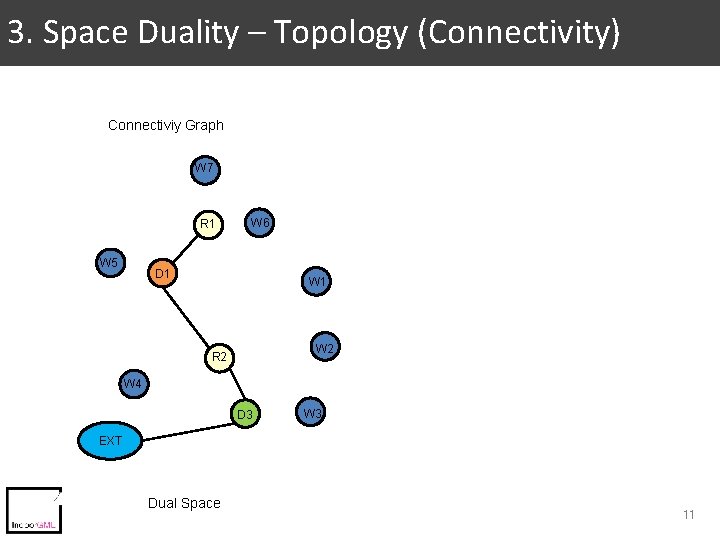
3. Space Duality – Topology (Connectivity) Connectiviy Graph W 7 R 1 W 5 W 6 D 1 W 2 R 2 W 4 D 3 W 3 EXT Dual Space 11
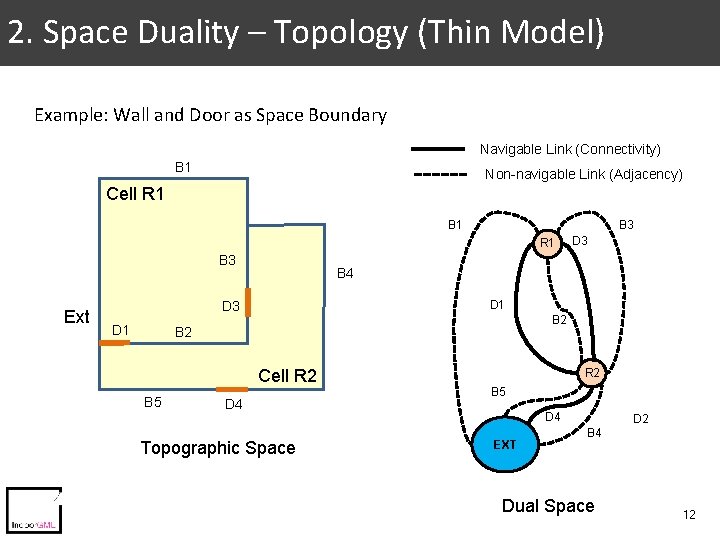
2. Space Duality – Topology (Thin Model) Example: Wall and Door as Space Boundary Navigable Link (Connectivity) B 1 Non-navigable Link (Adjacency) Cell R 1 B 3 Ext B 4 D 1 D 3 D 1 B 2 Cell R 2 B 5 D 3 D 4 Topographic Space R 2 B 5 D 4 EXT B 4 Dual Space D 2 12
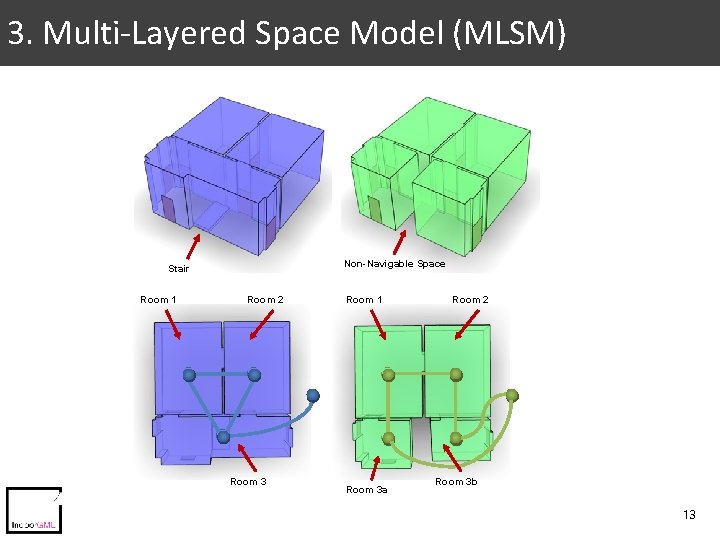
3. Multi-Layered Space Model (MLSM) Non-Navigable Space Stair Room 1 Room 2 Room 3 Room 1 Room 3 a Room 2 Room 3 b 13
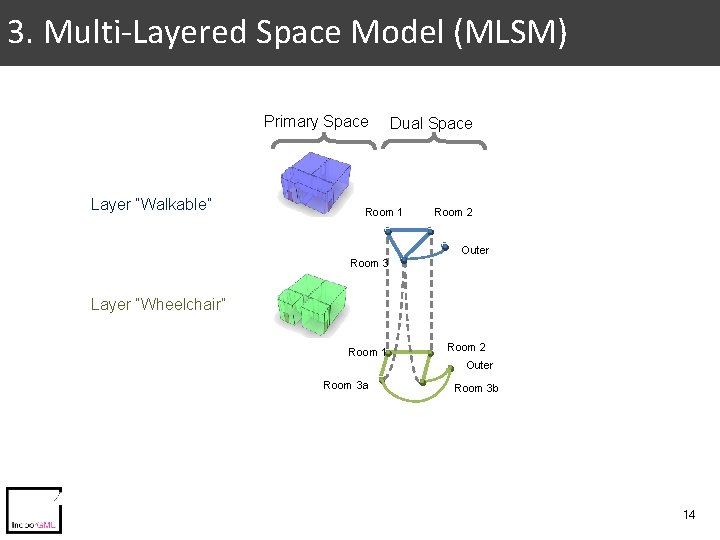
3. Multi-Layered Space Model (MLSM) Primary Space Layer “Walkable” Dual Space Room 1 Room 2 Outer Room 3 Layer “Wheelchair” Room 1 Room 2 Outer Room 3 a Room 3 b 14
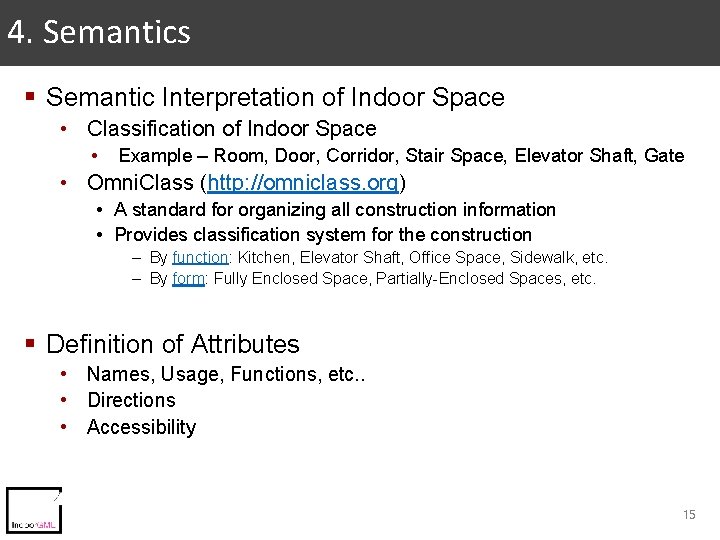
4. Semantics § Semantic Interpretation of Indoor Space • Classification of Indoor Space • Example – Room, Door, Corridor, Stair Space, Elevator Shaft, Gate • Omni. Class (http: //omniclass. org) • A standard for organizing all construction information • Provides classification system for the construction – By function: Kitchen, Elevator Shaft, Office Space, Sidewalk, etc. – By form: Fully Enclosed Space, Partially-Enclosed Spaces, etc. § Definition of Attributes • Names, Usage, Functions, etc. . • Directions • Accessibility 15
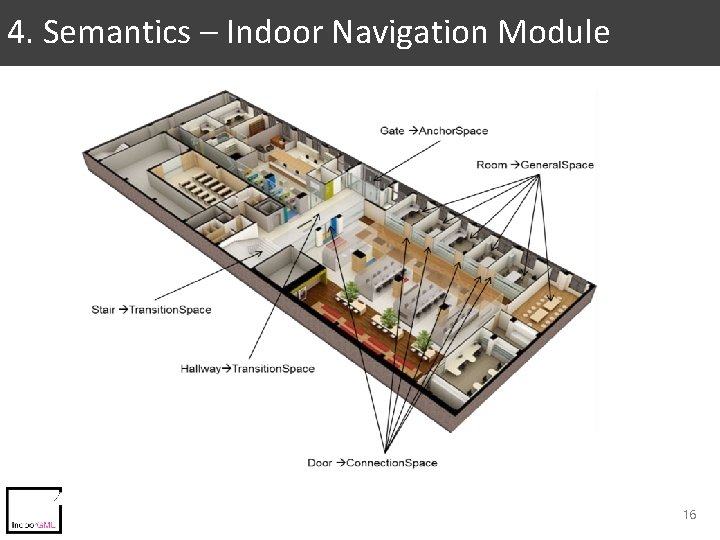
4. Semantics – Indoor Navigation Module 16
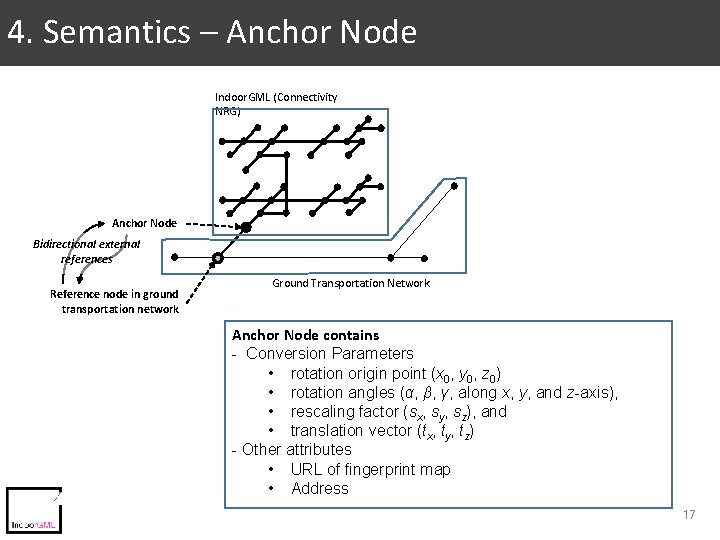
4. Semantics – Anchor Node Indoor. GML (Connectivity NRG) Anchor Node Bidirectional external references Reference node in ground transportation network Ground Transportation Network Anchor Node contains - Conversion Parameters • rotation origin point (x 0, y 0, z 0) • rotation angles (α, β, γ, along x, y, and z-axis), • rescaling factor (sx, sy, sz), and • translation vector (tx, ty, tz) - Other attributes • URL of fingerprint map • Address 17
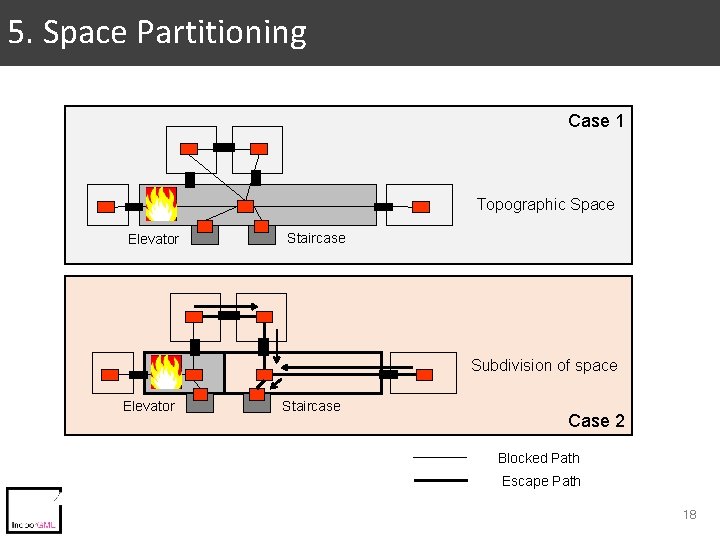
5. Space Partitioning Case 1 Topographic Space Elevator Staircase Subdivision of space Elevator Staircase Case 2 Blocked Path Escape Path 18
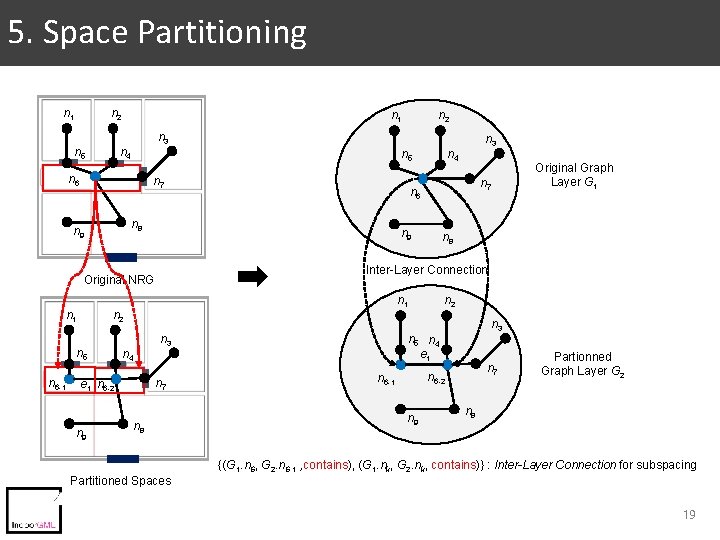
V. Space Partitioning and MLSM 5. n 2 n 1 n 5 n 3 n 4 n 5 n 6 n 7 n 8 n 2 n 1 n 3 n 4 n 7 e 1 n 6 -2 n 9 n 7 Original Graph Layer G 1 Inter-Layer Connection n 2 n 5 n 4 n 9 Original NRG n 1 n 3 n 6 n 8 n 9 n 6 -1 n 2 n 1 n 8 n 3 n 5 n 4 e 1 n 7 n 6 -2 n 6 -1 n 9 Partionned Graph Layer G 2 n 8 {(G 1. n 6, G 2. n 6 -1 , contains), (G 1. nk, G 2. nk, contains)} : Inter-Layer Connection for subspacing Partitioned Spaces 19
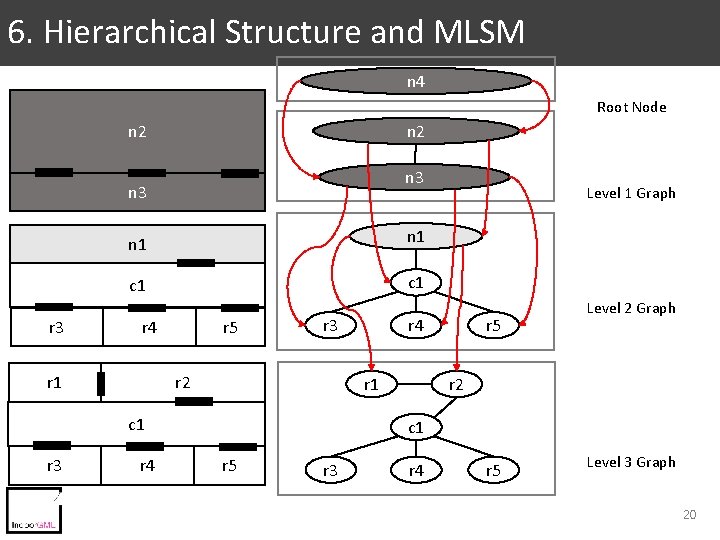
6. Hierarchical Structure and MLSM n 4 Root Node n 2 n 3 r 3 n 1 c 1 r 4 r 1 r 5 r 3 r 2 r 3 r 4 r 1 c 1 Level 1 Graph r 5 Level 2 Graph r 2 c 1 r 5 r 3 r 4 r 5 Level 3 Graph 20
7. External Reference – Integration with Others Room object in City. GML data set FJK-Haus-Lo. D 4 -V 3. gml <bldg: interior. Room> <bldg: Room gml: id="GMLID_BUI 198667"> <gml: description> Wohnen / Essen </gml: description > <gml: name>102</gml: name> … </bldg: Room> </bldg: interior. Room> Cell object in Indoor. GML <indoorcore: State gml: id="R 15"> <gml: name>102</gml: name> <duality gml: id="SR 15"> <gml: name>102</gml: name> <Geometry 3 D> <gml: Solid gml: id="sl 15"> </gml: Solid> </Geometry 3 D> <external. Reference> <information. System> FJK-Haus-Lo. D 4 -V 3. gml </information. System> <external. Object> <name>GMLID_BUI 198667</name> </external. Object> </external. Reference> … </indoorcore: State> 21
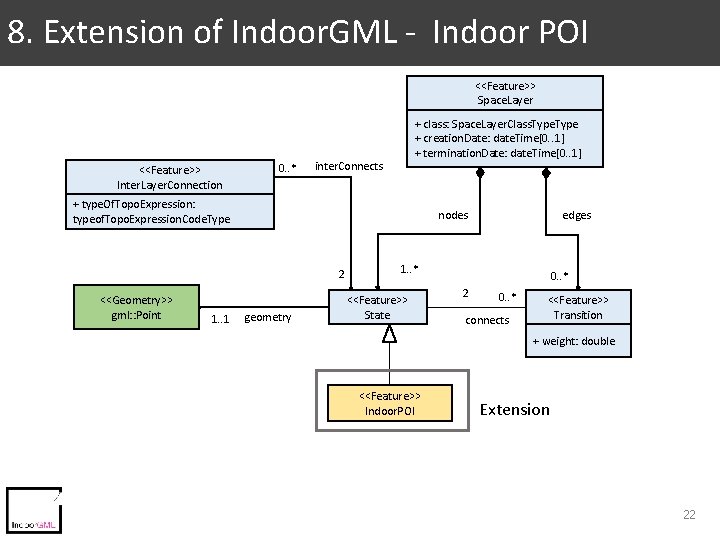
8. Extension of Indoor. GML - Indoor POI <<Feature>> Space. Layer <<Feature>> Inter. Layer. Connection 0. . * + class: Space. Layer. Class. Type + creation. Date: date. Time[0. . 1] + termination. Date: date. Time[0. . 1] inter. Connects + type. Of. Topo. Expression: typeof. Topo. Expression. Code. Type nodes 2 <<Geometry>> gml: : Point 1. . 1 geometry edges 1. . * <<Feature>> State 0. . * 2 0. . * connects <<Feature>> Transition + weight: double <<Feature>> Indoor. POI Extension 22
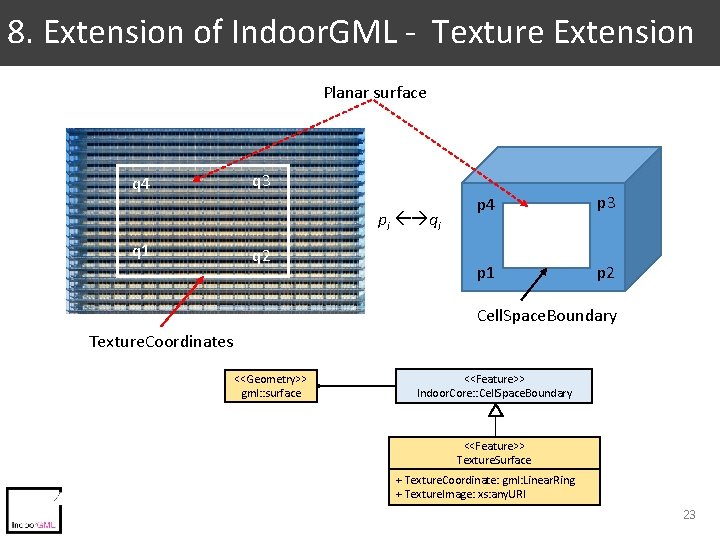
8. Extension of Indoor. GML - Texture Extension Planar surface q 4 q 3 pi qi q 1 q 2 p 4 p 3 p 1 p 2 Cell. Space. Boundary Texture. Coordinates <<Geometry>> gml: : surface <<Feature>> Indoor. Core: : Cell. Space. Boundary <<Feature>> Texture. Surface + Texture. Coordinate: gml: Linear. Ring + Texture. Image: xs: any. URI 23
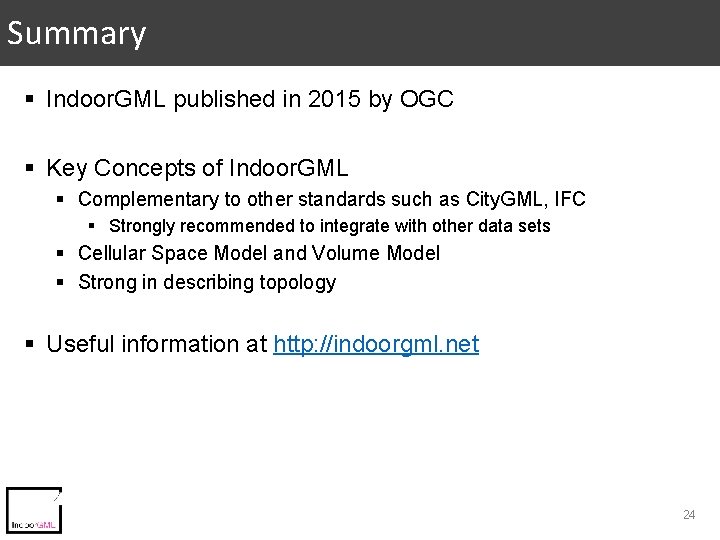
Summary § Indoor. GML published in 2015 by OGC § Key Concepts of Indoor. GML § Complementary to other standards such as City. GML, IFC § Strongly recommended to integrate with other data sets § Cellular Space Model and Volume Model § Strong in describing topology § Useful information at http: //indoorgml. net 24