
OGC Geo Package Format A Container to support

- Slides: 8
OGC Geo. Package Format A Container to support the integration of Statistical and Geospatial Data Marcus Blake Assistant Director, Geospatial Solutions Australian Bureau of Statistics
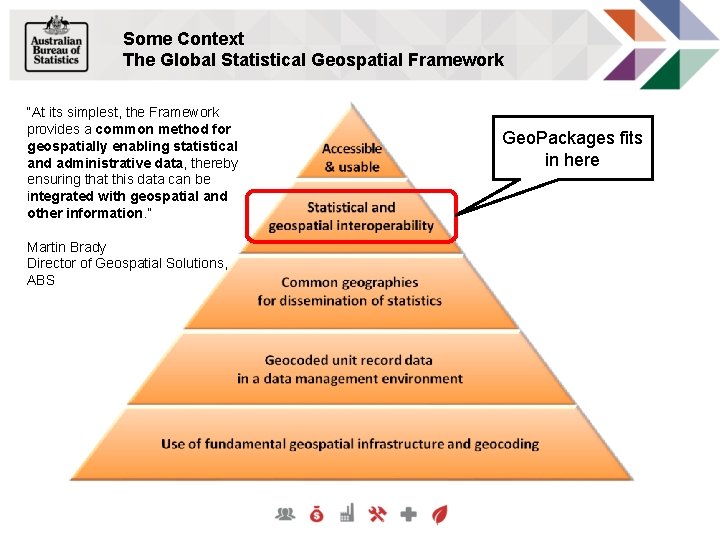
Some Context The Global Statistical Geospatial Framework “At its simplest, the Framework provides a common method for geospatially enabling statistical and administrative data, thereby ensuring that this data can be integrated with geospatial and other information. ” Martin Brady Director of Geospatial Solutions, ABS Geo. Packages fits in here
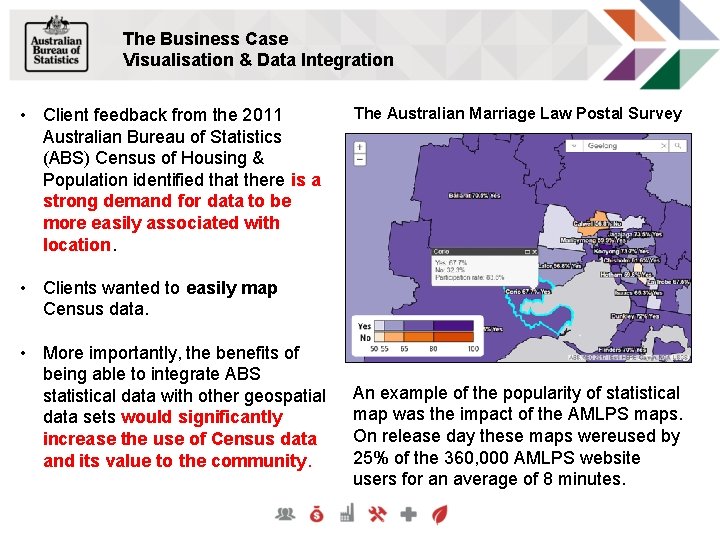
The Business Case Visualisation & Data Integration • Client feedback from the 2011 Australian Bureau of Statistics (ABS) Census of Housing & Population identified that there is a strong demand for data to be more easily associated with location. The Australian Marriage Law Postal Survey • Clients wanted to easily map Census data. • More importantly, the benefits of being able to integrate ABS statistical data with other geospatial data sets would significantly increase the use of Census data and its value to the community. An example of the popularity of statistical map was the impact of the AMLPS maps. On release day these maps wereused by 25% of the 360, 000 AMLPS website users for an average of 8 minutes.
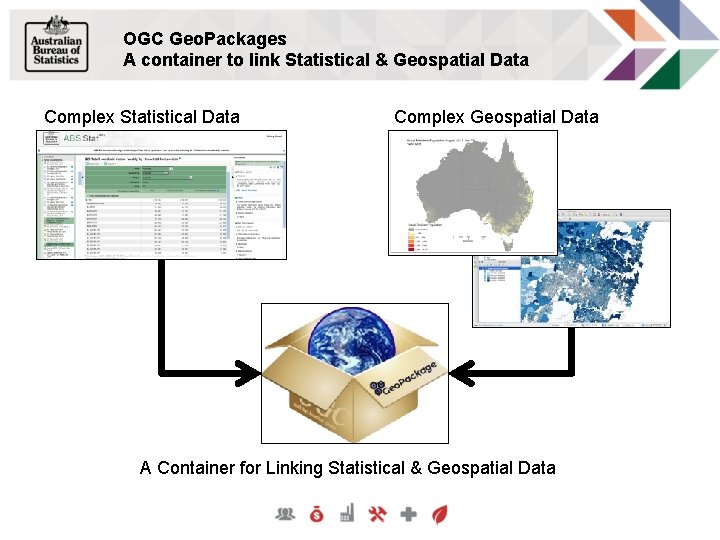
OGC Geo. Packages A container to link Statistical & Geospatial Data Complex Statistical Data Complex Geospatial Data A Container for Linking Statistical & Geospatial Data
OGC Geo. Packages Advantages of Geo. Package to a Statistical Organisation • • • Provides a well-defined and accurate linkage between statistical boundaries and their associated data (including complex special purpose codes associated with the Census classifications). Provides a simpler, more flexible and cheaper, publishing mechanism for bulk geospatial and statistical data in a format that is more structured and therefore easier for external information systems to consume (i. e. a fully functional database). This provides a more consistent and maintainable point-of-truth for external information systems. Provides a mechanism to publish large static complex data sets e. g. Census Data. Packs. Simple, small, rapidly changing data are better published as a service. Provides the capacity for developers to extend the initial product by creating specific purpose statistical and geospatial queries and tables using the database Standard Querying Language (SQL). Provides the capacity for clients to add their own geospatial and/or statistical data and link them to ABS statistical boundaries and data. Provides the capacity to add Grid/Raster data e. g. the ABS Population Grid or remotely sensed data. Provides the capacity to publish data together with their relationships structured as data models. Instead of publishing simplified extractions of internal databases, data can be published as fully functional databases. This would provide users will an a more flexible, consistent and coherent product of storing integrating and manipulating ABS data. Provides the capacity to store descriptive metadata and provenance information as required. It can be read by all the major GIS software solutions, and as a standards based SQLite relational database, Geo. Package files can be read and queried by a large number of database applications.
OGC Geo. Packages Advantages of Geo. Package to a Statistical Organisation • • • Provides a well-defined and accurate linkage between statistical boundaries and their associated data (including complex special purpose codes associated with the Census classifications). Provides a simpler, more flexible and cheaper, publishing mechanism for bulk geospatial and statistical data in a format that is more structured and therefore easier for external information systems to consume (i. e. a fully functional database). This provides a more consistent and maintainable point-of-truth for external information systems. Provides a mechanism to publish large static complex data sets e. g. Census Data. Packs. Simple, small, rapidly changing data are better published as a service. Provides the capacity for developers to extend the initial product by creating specific purpose statistical and geospatial queries and tables using the database Standard Querying Language (SQL). Provides the capacity for clients to add their own geospatial and/or statistical data and link them to ABS statistical boundaries and data. Provides the capacity to add Grid/Raster data e. g. the ABS Population Grid or remotely sensed data. Provides the capacity to publish data together with their relationships structured as data models. Instead of publishing simplified extractions of internal databases, data can be published as fully functional databases. This would provide users will an a more flexible, consistent and coherent product of storing integrating and manipulating ABS data. Provides the capacity to store descriptive metadata and provenance information as required. It can be read by all the major GIS software solutions, and as a standards based SQLite relational database, Geo. Package files can be read and queried by a large number of database applications.
OGC Geo. Packages Advantages of Geo. Package to a Statistical Organisation • • • Provides a well-defined and accurate linkage between statistical boundaries and their associated data (including complex special purpose codes associated with the Census classifications). Provides a simpler, more flexible and cheaper, publishing mechanism for bulk geospatial and statistical data in a format that is more structured and therefore easier for external information systems to consume (i. e. a fully functional database). This provides a more consistent and maintainable point-of-truth for external information systems. Provides a mechanism to publish large static complex data sets e. g. Census Data. Packs. Simple, small, rapidly changing data are better published as a service. Provides the capacity for developers to extend the initial product by creating specific purpose statistical and geospatial queries and tables using the database Standard Querying Language (SQL). Provides the capacity for clients to add their own geospatial and/or statistical data and link them to ABS statistical boundaries and data. Provides the capacity to add Grid/Raster data e. g. the ABS Population Grid or remotely sensed data. Provides the capacity to publish data together with their relationships structured as data models. Instead of publishing simplified extractions of internal databases, data can be published as fully functional databases. This would provide users will an a more flexible, consistent and coherent product of storing integrating and manipulating ABS data. Provides the capacity to store descriptive metadata and provenance information as required. It can be read by all the major GIS software solutions, and as a standards based SQLite relational database, Geo. Package files can be read and queried by a large number of database applications.
An ABS Example The 2016 Australian Census Geo. Packages http: //abs. gov. au/census