
OGC CDB Geo Package Mashup Sam Chambers Joint
OGC CDB & Geo. Package Mash-up Sam Chambers, Joint Staff J 7 Glen Quesenberry, AGC Jay Freeman, CAE USA 25 April 2018 UNCLASSIFIED GEOINT 2018 1
Agenda • Joint Staff J 7 – Mr. Chambers • Mandate for Change • JS J 7 Direction • CDB Entry into the DISR • AGC – Mr. Quesenberry • AGC Engagement and Activities • Improving AGE Interoperability, Consistency by Streamlining AGE SSGF Standards, Formats and Services • CAE USA – Mr. Freeman • Why should there be a OGC CDB & Geo. Package Mash-up? • Proposed CDB & Geo. Package Mash-up Methodology • Solutions Under Consideration for Utilizing Geo. Package within CDB • Summary • Acknowledgements & Others Collaborators • Kevin Bentley, Cognitics • Ron Moore, Leidos • Jeffrey Clinger, Leidos UNCLASSIFIED GEOINT 2018 2
Mr. Sam Chambers, EAD Data Lead Joint Staff J 7 UNCLASSIFIED GEOINT 2018 3
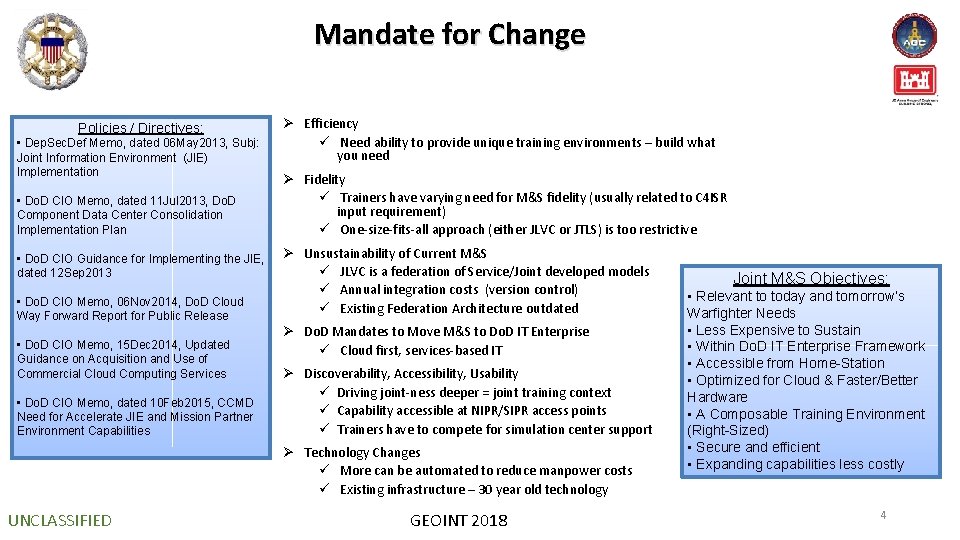
Mandate for Change Policies / Directives: • Dep. Sec. Def Memo, dated 06 May 2013, Subj: Joint Information Environment (JIE) Implementation • Do. D CIO Memo, dated 11 Jul 2013, Do. D Component Data Center Consolidation Implementation Plan • Do. D CIO Guidance for Implementing the JIE, dated 12 Sep 2013 • Do. D CIO Memo, 06 Nov 2014, Do. D Cloud Way Forward Report for Public Release • Do. D CIO Memo, 15 Dec 2014, Updated Guidance on Acquisition and Use of Commercial Cloud Computing Services • Do. D CIO Memo, dated 10 Feb 2015, CCMD Need for Accelerate JIE and Mission Partner Environment Capabilities Ø Efficiency ü Need ability to provide unique training environments – build what you need Ø Fidelity ü Trainers have varying need for M&S fidelity (usually related to C 4 ISR input requirement) ü One-size-fits-all approach (either JLVC or JTLS) is too restrictive Ø Unsustainability of Current M&S ü JLVC is a federation of Service/Joint developed models ü Annual integration costs (version control) ü Existing Federation Architecture outdated Ø Do. D Mandates to Move M&S to Do. D IT Enterprise ü Cloud first, services-based IT Ø Discoverability, Accessibility, Usability ü Driving joint-ness deeper = joint training context ü Capability accessible at NIPR/SIPR access points ü Trainers have to compete for simulation center support Ø Technology Changes ü More can be automated to reduce manpower costs ü Existing infrastructure – 30 year old technology UNCLASSIFIED GEOINT 2018 Joint M&S Objectives: • Relevant to today and tomorrow’s Warfighter Needs • Less Expensive to Sustain • Within Do. D IT Enterprise Framework • Accessible from Home-Station • Optimized for Cloud & Faster/Better Hardware • A Composable Training Environment (Right-Sized) • Secure and efficient • Expanding capabilities less costly 4

JS J 7 Direction UNCLASSIFIED The JS J 7 vision is to adopt OGC standards when possible, evolve OGC standards to meet the mission needs when necessary, and create new standards as a last resort. GEOINT 2018 5
CDB Entry into the DISR • What: • Nomination of Open Geospatial Consortium, Inc. ® (OGC®) CDB v 1. 0 as an “emerging” standard for the Do. D IT Standards Registry (DISR) • Who: • Joint Staff J 7 • Why: • First step in establishing a Joint Training Technical Standards Profile. • JS J 7, USMC, and USSOCOM utilize CDB as their synthetic environment data standard for modeling and simulation. • CDB also possesses attributes that make it a strong enterprise standard candidate for Joint training • Approach: • JTSE WG established a writing team for developing/coordinating the draft CDB Citation. • Joint Staff J 7, USSOCOM, USMC, USAF, NRO, NGA • DMSCO—mentored through the process; OGC—CDB SWG Chair • After JTSE WG approval, JS J 7 submitted the citation CR to the JESC via the M&S Tech Working Group (M&S TWG) as primary & Geospatial Working Group (GWG) as secondary. • Outcome: • CDB v 1. 0 was accepted into the DISR as an emerging standard. • During the process, GWG and M&S WG raised concerns with the CDB due to its use of Feature Attribute Coding Catalogue (FACC)-based data model and ESRI Shapefiles. • The Joint Staff is working with the US Army to address the vector format concerns. UNCLASSIFIED GEOINT 2018 6
Mr. Glen Quesenberry, M&S SME Army Geospatial Center UNCLASSIFIED GEOINT 2018 7
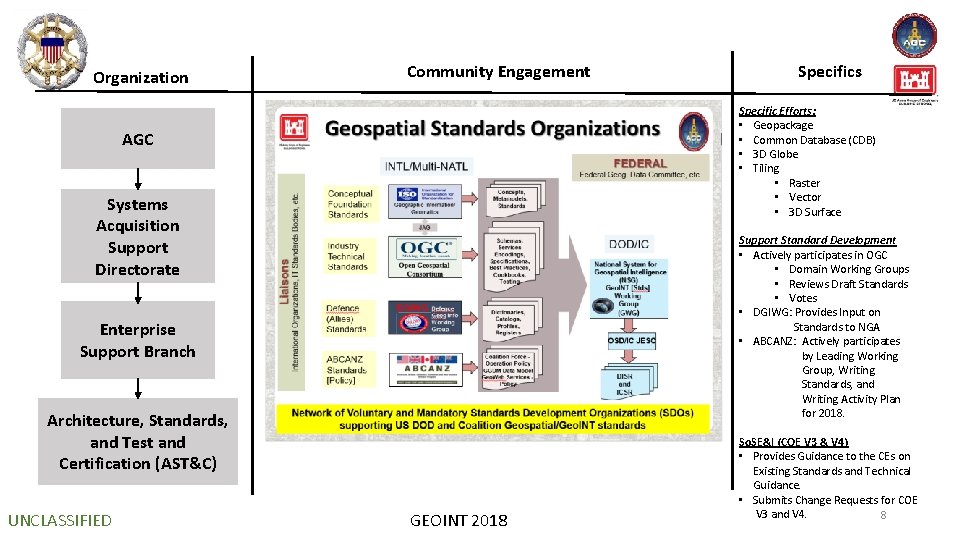
Organization Community Engagement Specific Efforts: • Geopackage • Common Database (CDB) • 3 D Globe • Tiling • Raster • Vector • 3 D Surface AGC Systems Acquisition Support Directorate Support Standard Development • Actively participates in OGC • Domain Working Groups • Reviews Draft Standards • Votes • DGIWG: Provides Input on Standards to NGA • ABCANZ: Actively participates by Leading Working Group, Writing Standards, and Writing Activity Plan for 2018. Enterprise Support Branch Architecture, Standards, and Test and Certification (AST&C) UNCLASSIFIED Specifics GEOINT 2018 So. SE&I (COE V 3 & V 4) • Provides Guidance to the CEs on Existing Standards and Technical Guidance. • Submits Change Requests for COE V 3 and V 4. 8
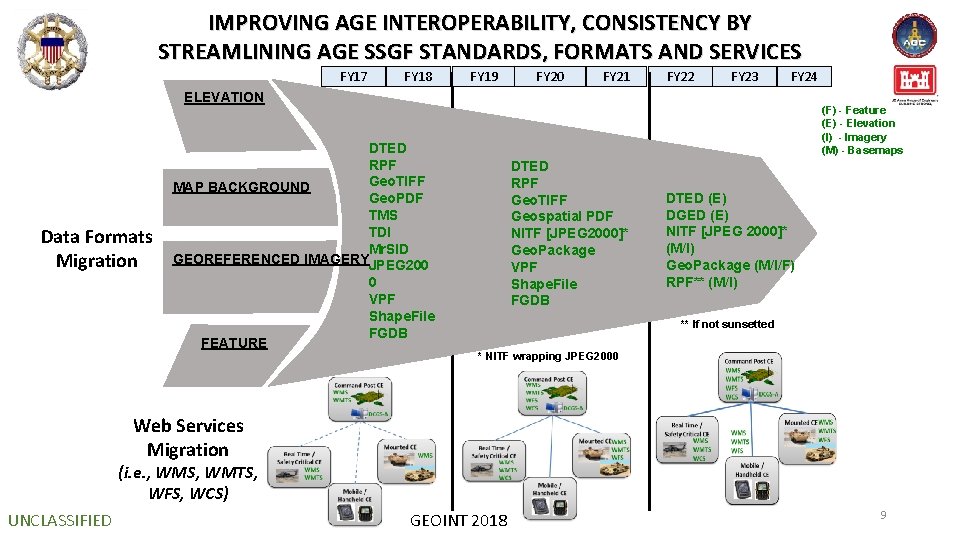
IMPROVING AGE INTEROPERABILITY, CONSISTENCY BY STREAMLINING AGE SSGF STANDARDS, FORMATS AND SERVICES FY 17 FY 18 FY 19 FY 20 FY 21 FY 22 FY 23 FY 24 ELEVATION Data Formats Migration DTED RPF Geo. TIFF MAP BACKGROUND Geo. PDF TMS TDI Mr. SID GEOREFERENCED IMAGERYJPEG 200 0 VPF Shape. File FGDB FEATURE (F) - Feature (E) - Elevation (I) - Imagery (M) - Basemaps DTED RPF Geo. TIFF Geospatial PDF NITF [JPEG 2000]* Geo. Package VPF Shape. File FGDB DTED (E) DGED (E) NITF [JPEG 2000]* (M/I) Geo. Package (M/I/F) RPF** (M/I) ** If not sunsetted * NITF wrapping JPEG 2000 Web Services Migration (i. e. , WMS, WMTS, WFS, WCS) UNCLASSIFIED GEOINT 2018 9
Jay Freeman, Software Architect CAE USA UNCLASSIFIED GEOINT 2018 10
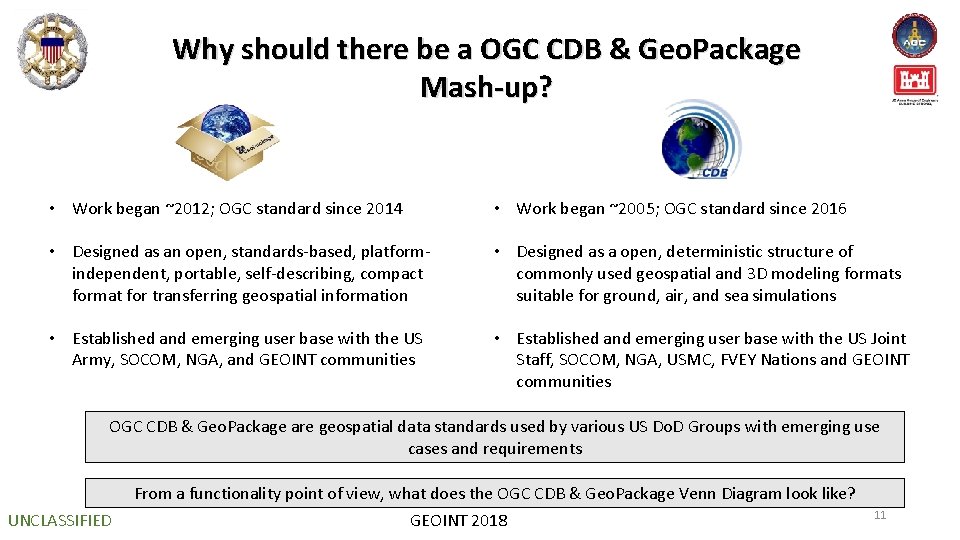
Why should there be a OGC CDB & Geo. Package Mash-up? • Work began ~2012; OGC standard since 2014 • Work began ~2005; OGC standard since 2016 • Designed as an open, standards-based, platformindependent, portable, self-describing, compact format for transferring geospatial information • Designed as a open, deterministic structure of commonly used geospatial and 3 D modeling formats suitable for ground, air, and sea simulations • Established and emerging user base with the US Army, SOCOM, NGA, and GEOINT communities • Established and emerging user base with the US Joint Staff, SOCOM, NGA, USMC, FVEY Nations and GEOINT communities OGC CDB & Geo. Package are geospatial data standards used by various US Do. D Groups with emerging use cases and requirements From a functionality point of view, what does the OGC CDB & Geo. Package Venn Diagram look like? UNCLASSIFIED GEOINT 2018 11
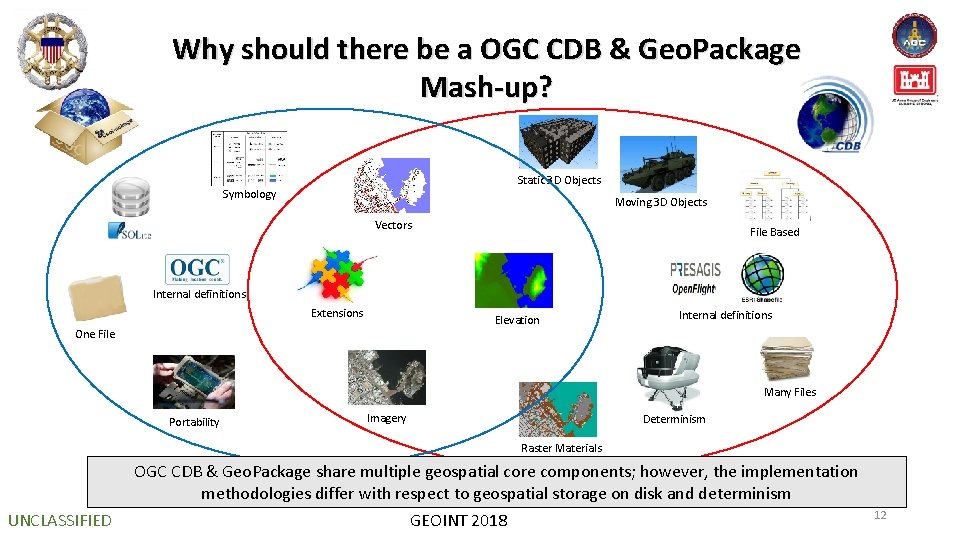
Why should there be a OGC CDB & Geo. Package Mash-up? Static 3 D Objects Symbology Moving 3 D Objects Vectors File Based Internal definitions Extensions Elevation One File Internal definitions Many Files Portability Imagery Determinism Raster Materials OGC CDB & Geo. Package share multiple geospatial core components; however, the implementation methodologies differ with respect to geospatial storage on disk and determinism UNCLASSIFIED GEOINT 2018 12
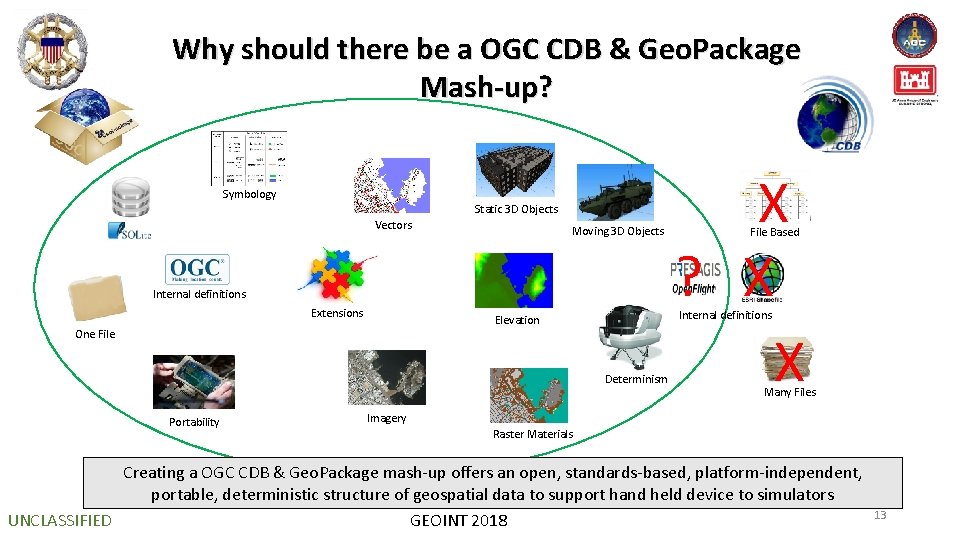
Why should there be a OGC CDB & Geo. Package Mash-up? Symbology Static 3 D Objects Vectors Moving 3 D Objects Internal definitions Extensions Internal definitions Elevation One File Determinism Portability X ? X X File Based Many Files Imagery Raster Materials Creating a OGC CDB & Geo. Package mash-up offers an open, standards-based, platform-independent, portable, deterministic structure of geospatial data to support hand held device to simulators UNCLASSIFIED GEOINT 2018 13
Why should there be a OGC CDB & Geo. Package Mash-up? • Improves OGC CDB standard by: • Supplements the existing Shapefile Best Practice with a new Best Practice based on other OGC approved standards • Removes limitations found in Shapefiles (e. g. DBF character limits for column names) • Leveraging new technology to improve the representation of feature relationships (e. g. supporting Spatial Lite relationship tables) • Improving data distribution by reducing file counts (e. g. storing multiple geometry types and CDB tiles in single file) • Continues the effort to align the U. S. Army’s Modeling and Simulation geospatial terrain data representation with the U. S. Army’s Operation Mission Command geospatial terrain data representation • Begins to converge common geospatial data interests between AGC and J 7 Evolving and converging terrain standards will improve data reuse, runtime terrain database correlation, innovation, and system interoperability UNCLASSIFIED GEOINT 2018 14
Proposed Methodology • OGC Geo. Package Standards Working Group (SWG) continues its current course • AGC will work with the OGC CDB SWG to define CDB’s usage of Geo. Package in lieu of ESRI Shapefiles • Proposed plan of action is to: 1. Develop an approach to apply the CDB Conceptual Model (Volume 11) and CDB Model and Physical Data Store Structure (Volume 1) to Geo. Package for Vectors • The objective is to work within the constraints of Volume 1 & 11 • Section 4 of Volume 1 states “… CDB structured data store supports other file types. For example, an OGC Geo. Package file could be stored in the CDB structure. ” 2. Create a Geo. Package draft equivalent to CDB Volume 4: Use of Shapefiles for Vector Data Storage Best Practice 3. Develop an open source capability to migrate OGC CDB 1. 1 using the ESRI Shapefile Best Practice to OGC CDB 1. 1 using the draft Geo. Package Best Practice 4. Perform unit and performance testing of CDB using the draft Geo. Package Best Practice 5. Present material to the CDB SWG for incorporation into the standard The design of using Geo. Package in CDB must maintain a suitable level of performance for runtime applications UNCLASSIFIED GEOINT 2018 15
Solutions Under Consideration for Utilizing Geo. Package within CDB • • Design #1 – Replace each Shapefile in CDB with a Geo. Package è Benefits: Least disruptive to current CDB adopters; reduces files for vectors by a factor of 4: 1; No performance issues (opening/reading content is less than 10 ms) è Drawbacks: Leverages very few of Geo. Package’s capabilities Design #2 – For each CDB data layer per geotile, make each CDB tile a table in Geo. Package è Benefits: Minor level of disruptive to current CDB adopters; significant file reduction by a factor of 1000’s: 1 (depends on CDB fidelity level) è Drawbacks: Performance issues opening a GPKG as the number of tables becomes large (more information on a subsequent chart) Design #3 – For each CDB data layer per geotile CDB tiles are consolidated in a table by LOD è Benefits: Significant file reduction by a factor of 1000’s: 1 (depends on CDB fidelity level); No performance issues (opening/reading content is less than 10 ms) è Drawbacks: Medium level of disruption to current CDB adopters (to find data for a particular CDB tile requires a UREF SQL query) Design #4 – For each geotile, CDB tiles are consolidated in a table by data layers è Benefits: Significant file reduction by a factor of 1000’s: 1 (depends on CDB fidelity level); No performance issues (opening/reading content is less than 10 ms) è Drawbacks: High level of disruption to current CDB adopters (to find data for a particular CDB tile requires a LOD & UREF SQL query) UNCLASSIFIED GEOINT 2018 16
Summary • OGC CDB & Geo. Package are geospatial data standards used by various US Do. D Groups with emerging use cases and requirements • OGC CDB & Geo. Package share multiple geospatial core components; however, the implementation methodologies differ with respect to geospatial storage on disk • The existing OGC CDB and Geo. Package standards, from a requirements point of view, support a technology mashup • Preliminary experimentation demonstrates substantial gains in data access, transfer, and file storage of CDB data by using “Geo. CDB” – an OGC CDB & Geo. Package mash-up offers a open, standards-based, platform-independent, portable, deterministic structure of geospatial data to support hand held device to simulators UNCLASSIFIED GEOINT 2018 17
- Slides: 17