
Offshore Wind Farms and Bald Head Island By
Offshore Wind Farms and Bald Head Island By: Mary Martin Conservation Intern 2015 S
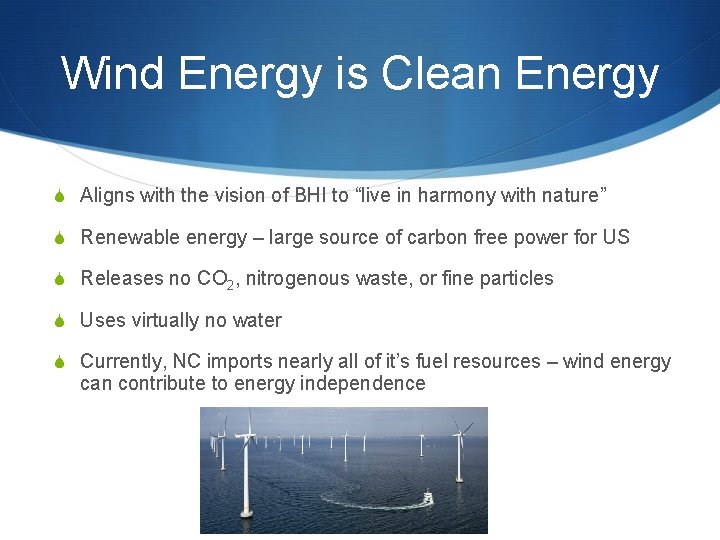
Wind Energy is Clean Energy S Aligns with the vision of BHI to “live in harmony with nature” S Renewable energy – large source of carbon free power for US S Releases no CO 2, nitrogenous waste, or fine particles S Uses virtually no water S Currently, NC imports nearly all of it’s fuel resources – wind energy can contribute to energy independence
Location S North Carolina’s waters provide the greatest source of offshore-wind on the East Coast S Bureau of Ocean Energy Management (BOEM) has defined the locations of 3 Wind Energy Areas (WEAs) according to the “Smart from the Start” Atlantic Offshore Wind Initiative S WEAs are the lowest conflict, highest potential areas
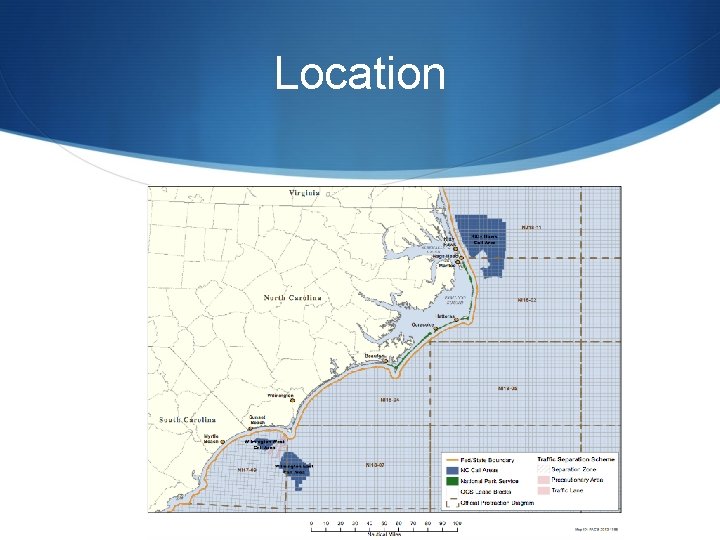
Location
Economic Impacts S North Carolina’s coastal economy is driven by the tourism industry S Development of offshore wind farms will supplement already booming economy by creating jobs from construction, maintenance, and operation S Infrastructure is located close to highly populated areas, leading to reduction in expensive costs of power
Tourism S People are curious about the technology behind wind farms and may intentionally visit an area simply to see these wind farms S A study conducted exclusively on residents within North Carolina’s 20 coastal counties, examined impacts of wind turbine presence on coastal tourism S > 90% of respondents indicated that wind farms would have no affect on their future trips to the beach
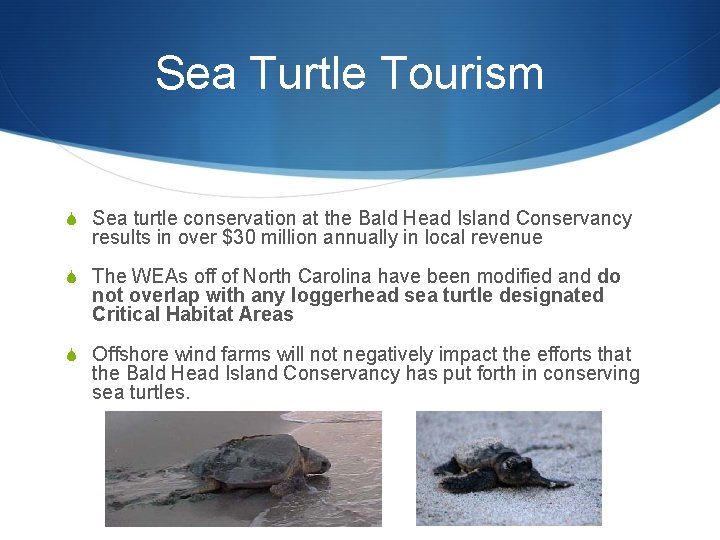
Sea Turtle Tourism S Sea turtle conservation at the Bald Head Island Conservancy results in over $30 million annually in local revenue S The WEAs off of North Carolina have been modified and do not overlap with any loggerhead sea turtle designated Critical Habitat Areas S Offshore wind farms will not negatively impact the efforts that the Bald Head Island Conservancy has put forth in conserving sea turtles.
Visual Impacts S WEAs off of BHI designed to minimize effects on view shed and recreation resources S Far enough away so that nighttime lighting would be indistinguishable from existing vessel traffic and be inaudible once the wind farms are established (EA)
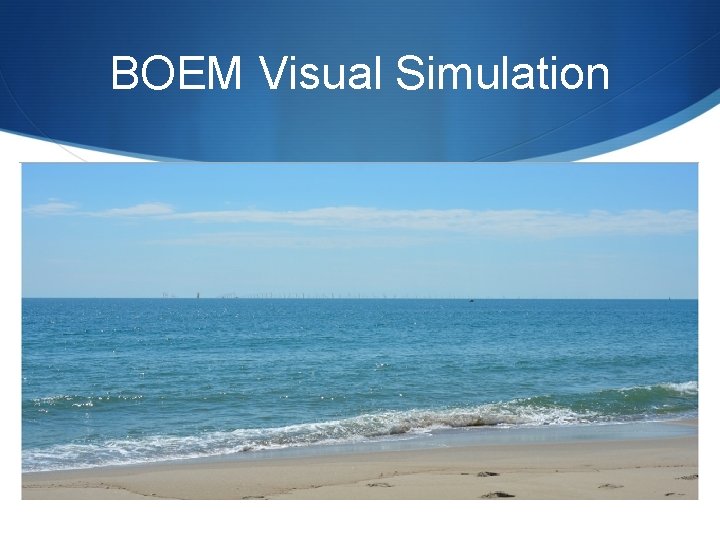
BOEM Visual Simulation
Property Values S There is no experimental evidence that suggests that property values decrease with the presence of an offshore wind farm. S Sterzinger et al. found that the value of 80% of properties in view of an offshore wind farm increased compared to the control properties (Snyder and Kaiser, 2009).
Wildlife Impacts S Current reliance on fossil fuels directly impacts wildlife S Habitat destruction from fuel exploration and extraction S Contamination from nitrogenous waste, CO 2, heavy metals, etc S Offshore wind has significantly less impacts on coastal and marine wildlife than alternatives, such as oil and gas exploration
Wildlife Impacts- Birds and Bats Potential Impacts Mitigation Strategies • Only red flashing strobe lights • Collisions, habitat loss, and will be used to reduce potential effects to migratory and to disorient birds (EA) breeding pathways are a • Any additional lights (i. e. work concern lights) will only be on when • No federally listed bird necessary and hooded species will be jeopardized downward when possible, to • Birds and bats will exert more reduce illumination (EA) energy to avoid collisions with • Meteorological towers should be wind turbines designed so they will not use guy wires (tension cables) which • Impacts from vessel and birds have potential to collide equipment noise will be with because they are difficult to negligible see (EA)
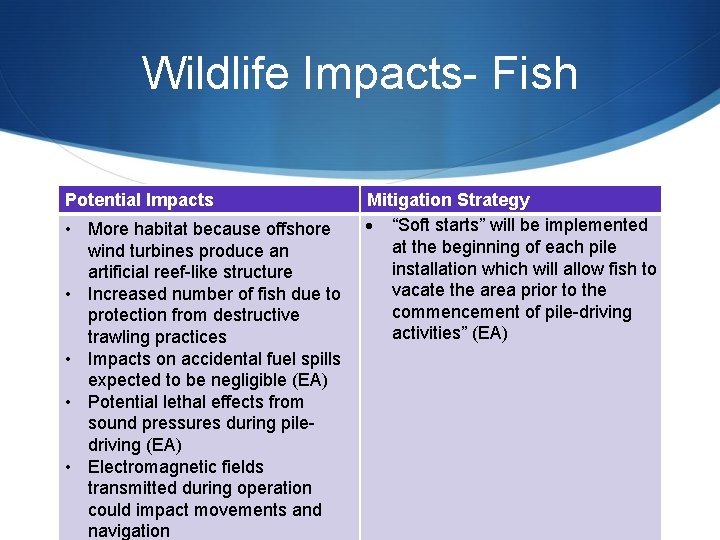
Wildlife Impacts- Fish Potential Impacts • More habitat because offshore wind turbines produce an artificial reef-like structure • Increased number of fish due to protection from destructive trawling practices • Impacts on accidental fuel spills expected to be negligible (EA) • Potential lethal effects from sound pressures during piledriving (EA) • Electromagnetic fields transmitted during operation could impact movements and navigation Mitigation Strategy “Soft starts” will be implemented at the beginning of each pile installation which will allow fish to vacate the area prior to the commencement of pile-driving activities” (EA)
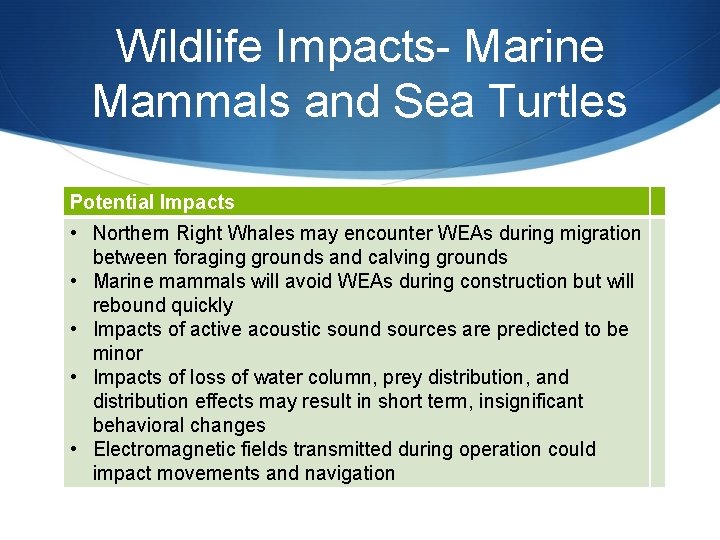
Wildlife Impacts- Marine Mammals and Sea Turtles Potential Impacts • Northern Right Whales may encounter WEAs during migration between foraging grounds and calving grounds • Marine mammals will avoid WEAs during construction but will rebound quickly • Impacts of active acoustic sound sources are predicted to be minor • Impacts of loss of water column, prey distribution, and distribution effects may result in short term, insignificant behavioral changes • Electromagnetic fields transmitted during operation could impact movements and navigation
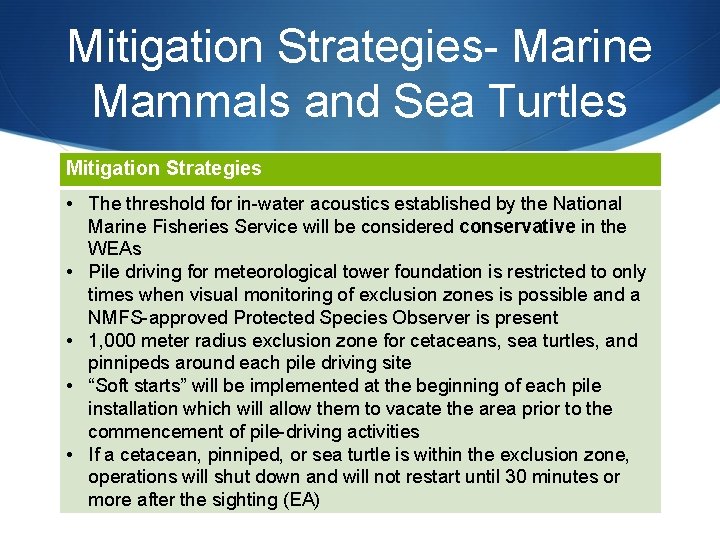
Mitigation Strategies- Marine Mammals and Sea Turtles Mitigation Strategies • The threshold for in-water acoustics established by the National Marine Fisheries Service will be considered conservative in the WEAs • Pile driving for meteorological tower foundation is restricted to only times when visual monitoring of exclusion zones is possible and a NMFS-approved Protected Species Observer is present • 1, 000 meter radius exclusion zone for cetaceans, sea turtles, and pinnipeds around each pile driving site • “Soft starts” will be implemented at the beginning of each pile installation which will allow them to vacate the area prior to the commencement of pile-driving activities • If a cetacean, pinniped, or sea turtle is within the exclusion zone, operations will shut down and will not restart until 30 minutes or more after the sighting (EA)
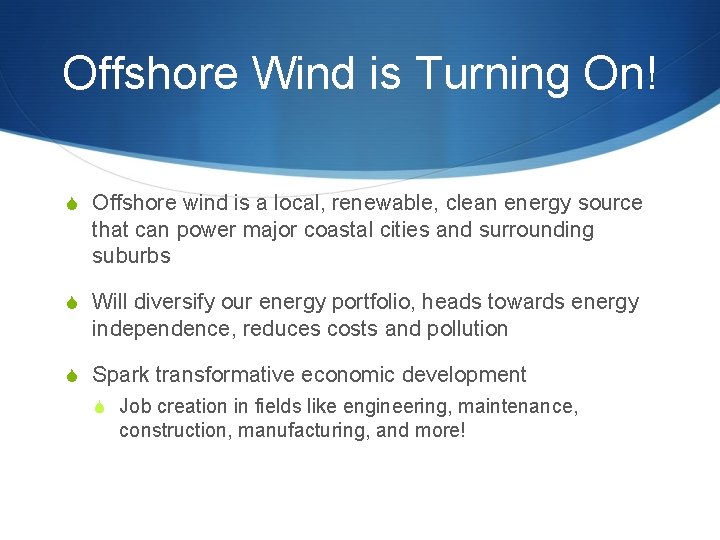
Offshore Wind is Turning On! S Offshore wind is a local, renewable, clean energy source that can power major coastal cities and surrounding suburbs S Will diversify our energy portfolio, heads towards energy independence, reduces costs and pollution S Spark transformative economic development S Job creation in fields like engineering, maintenance, construction, manufacturing, and more!
- Slides: 16