
Offshore wind and wave power rigs Systems description
- Slides: 18
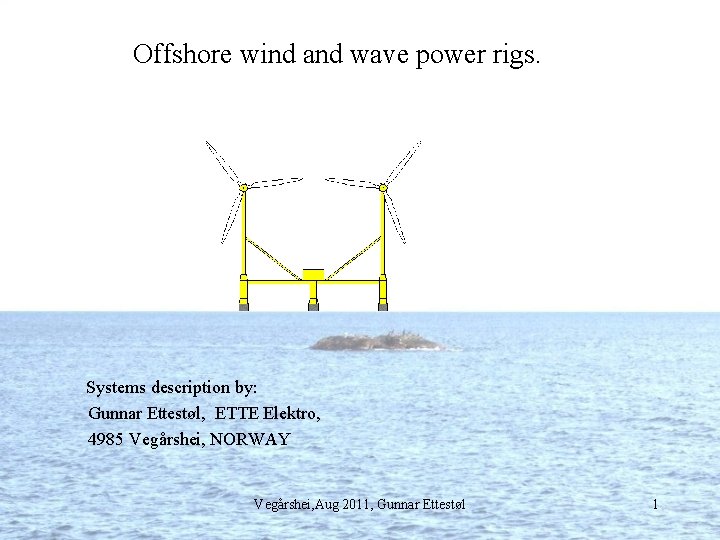
Offshore wind and wave power rigs. Systems description by: Gunnar Ettestøl, ETTE Elektro, 4985 Vegårshei, NORWAY Vegårshei, Aug 2011, Gunnar Ettestøl 1
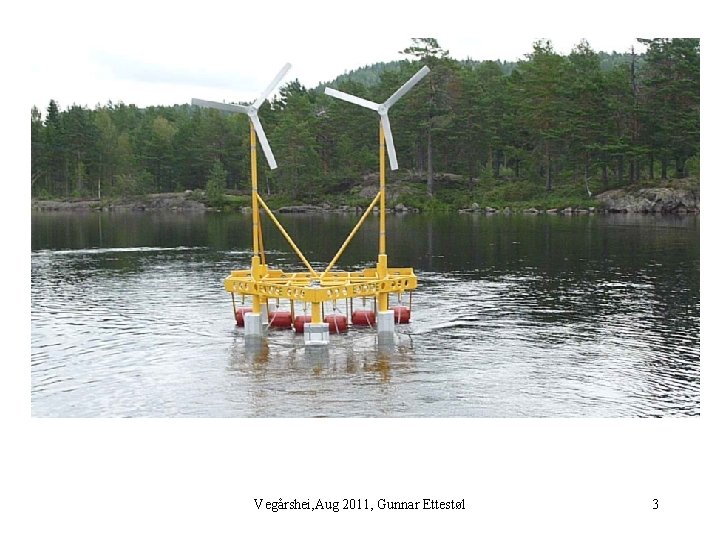
Offshore wind and wave power rigs. • The wind and wave rigs must be designed for survival. • Rigs with only wind turbines can be built rigid. 6 or 14 MW rigid rigs must be built to withstand wave heights from 30 to 45 m • Wave energy pickups in combined rigs must be lifted up before they are hit by dangerous waves. Usable wave height, max 10 m. • The use of 2 contra rotating wind turbines in combined rigs must give necessary vertical load for the wave energy pickup system. • Combined wind and wave rigs must be built to withstand movements within the construction, with the use of plastic bearings in the rig joints. Max wave height 30 m. • A small model of a combined wind and wave rig has been built in 2009. This rig will undergo further testing in 2011. • The model was built in 1: 3 size of the 4. 6 k. W unit shown here. Vegårshei, Aug 2011, Gunnar Ettestøl 2
Vegårshei, Aug 2011, Gunnar Ettestøl 3
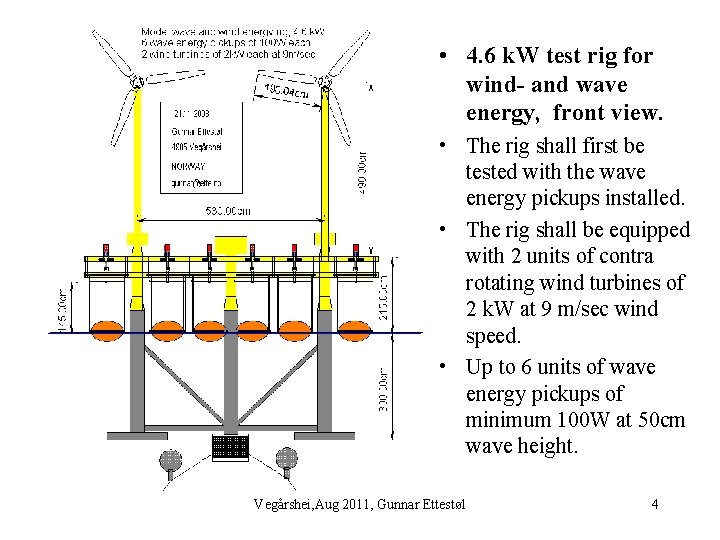
• 4. 6 k. W test rig for wind- and wave energy, front view. • The rig shall first be tested with the wave energy pickups installed. • The rig shall be equipped with 2 units of contra rotating wind turbines of 2 k. W at 9 m/sec wind speed. • Up to 6 units of wave energy pickups of minimum 100 W at 50 cm wave height. Vegårshei, Aug 2011, Gunnar Ettestøl 4
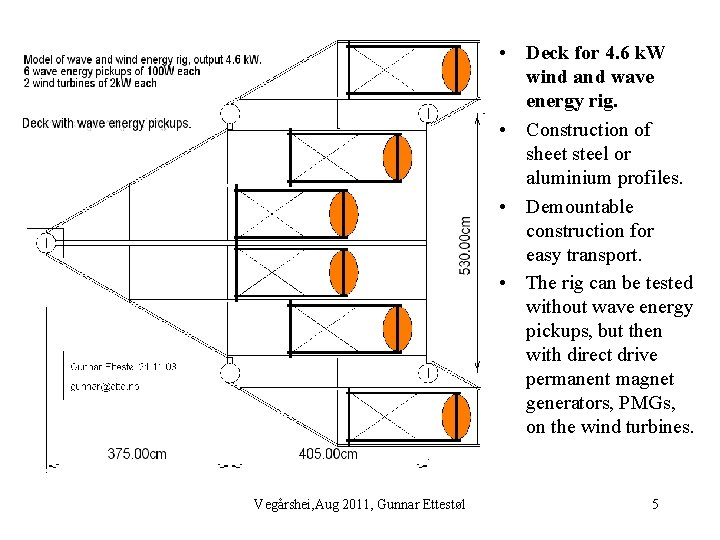
• Deck for 4. 6 k. W wind and wave energy rig. • Construction of sheet steel or aluminium profiles. • Demountable construction for easy transport. • The rig can be tested without wave energy pickups, but then with direct drive permanent magnet generators, PMGs, on the wind turbines. Vegårshei, Aug 2011, Gunnar Ettestøl 5
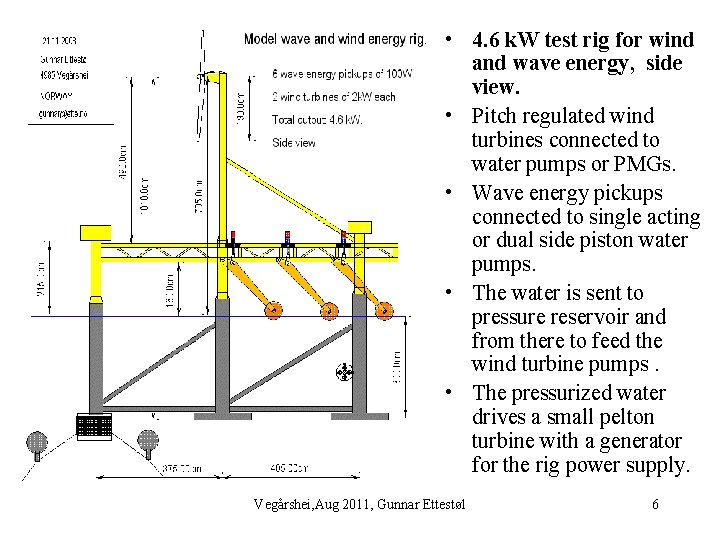
• 4. 6 k. W test rig for wind and wave energy, side view. • Pitch regulated wind turbines connected to water pumps or PMGs. • Wave energy pickups connected to single acting or dual side piston water pumps. • The water is sent to pressure reservoir and from there to feed the wind turbine pumps. • The pressurized water drives a small pelton turbine with a generator for the rig power supply. Vegårshei, Aug 2011, Gunnar Ettestøl 6
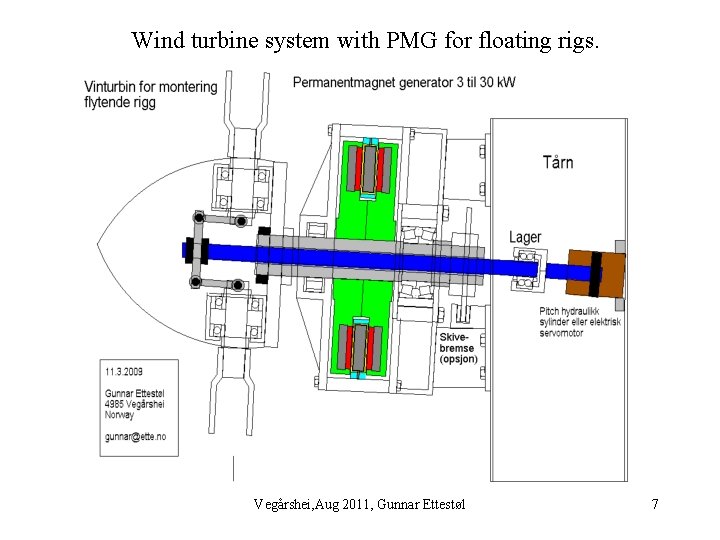
Wind turbine system with PMG for floating rigs. Vegårshei, Aug 2011, Gunnar Ettestøl 7
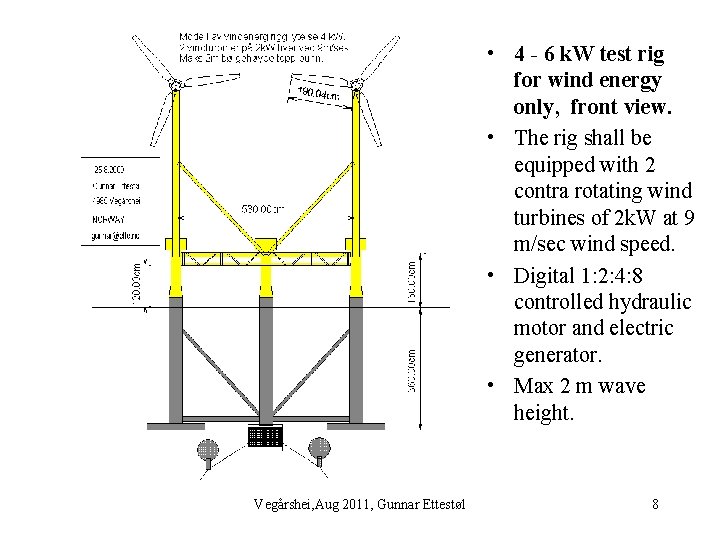
• 4 - 6 k. W test rig for wind energy only, front view. • The rig shall be equipped with 2 contra rotating wind turbines of 2 k. W at 9 m/sec wind speed. • Digital 1: 2: 4: 8 controlled hydraulic motor and electric generator. • Max 2 m wave height. Vegårshei, Aug 2011, Gunnar Ettestøl 8
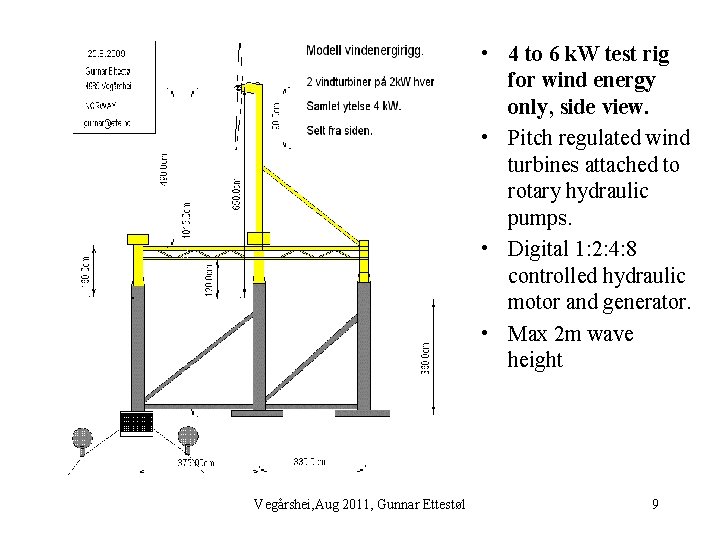
• 4 to 6 k. W test rig for wind energy only, side view. • Pitch regulated wind turbines attached to rotary hydraulic pumps. • Digital 1: 2: 4: 8 controlled hydraulic motor and generator. • Max 2 m wave height Vegårshei, Aug 2011, Gunnar Ettestøl 9
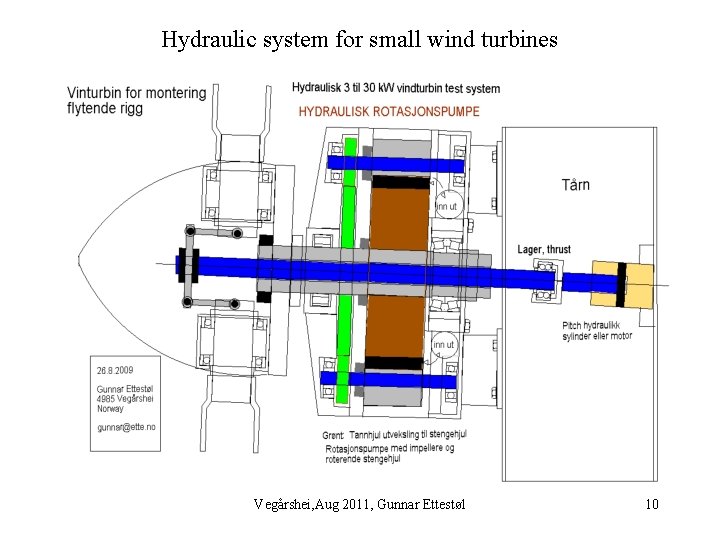
Hydraulic system for small wind turbines Vegårshei, Aug 2011, Gunnar Ettestøl 10
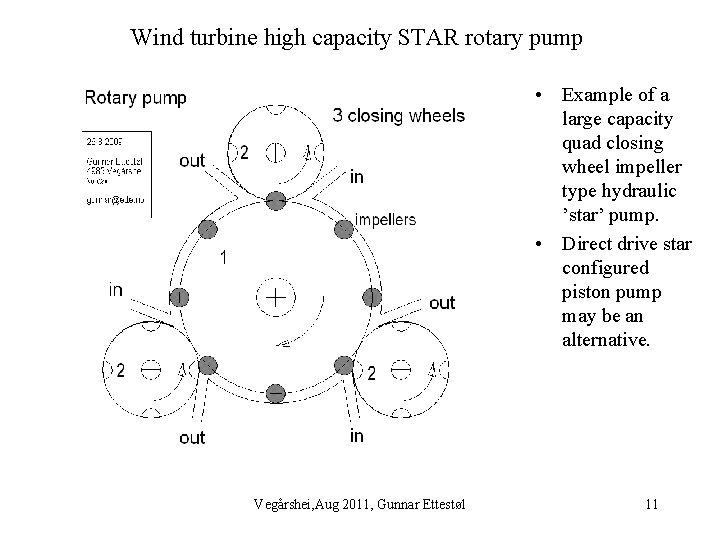
Wind turbine high capacity STAR rotary pump • Example of a large capacity quad closing wheel impeller type hydraulic ’star’ pump. • Direct drive star configured piston pump may be an alternative. Vegårshei, Aug 2011, Gunnar Ettestøl 11
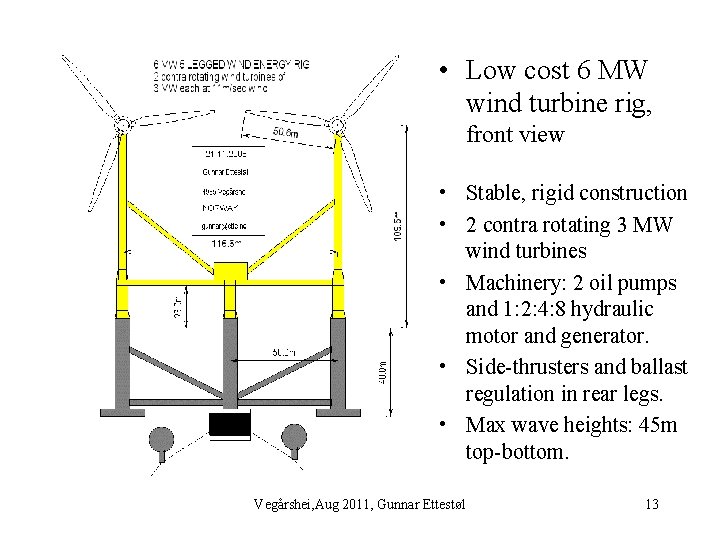
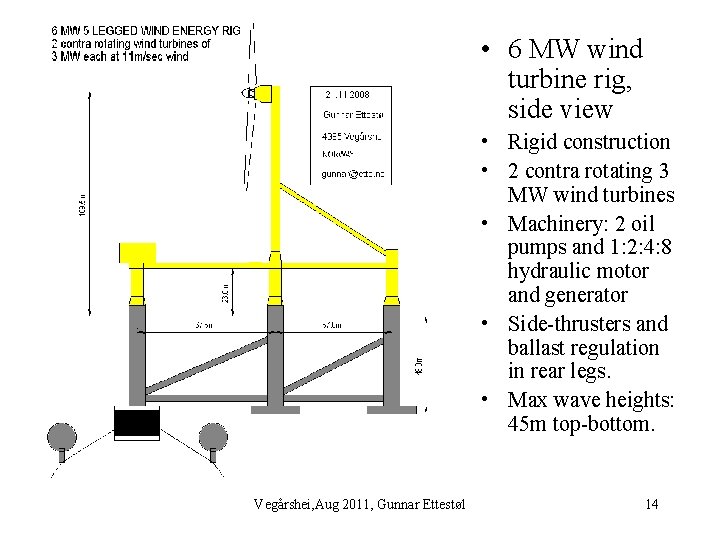
Large offshore floating wind turbines: • Rigs with 2 pitch controlled contra rotating wind turbines. • The small 4 - 6 k. W model can be enlarged to small models for inshore use, then in sizes 6 to 60 k. W. • The construction can be brought further, to large rigid and stable floating offshore wind rigs that can be built in sizes from 6 to 14 MW. The rigs must be built to withstand wave heights from 30 to 45 m. • Rigs with 2 wind turbines can use 2 oil pumps, rotation type, and 1: 2: 4: 8 hydraulic motor and generator Vegårshei, Aug 2011, Gunnar Ettestøl 12
• Low cost 6 MW wind turbine rig, front view • Stable, rigid construction • 2 contra rotating 3 MW wind turbines • Machinery: 2 oil pumps and 1: 2: 4: 8 hydraulic motor and generator. • Side-thrusters and ballast regulation in rear legs. • Max wave heights: 45 m top-bottom. Vegårshei, Aug 2011, Gunnar Ettestøl 13
• 6 MW wind turbine rig, side view • Rigid construction • 2 contra rotating 3 MW wind turbines • Machinery: 2 oil pumps and 1: 2: 4: 8 hydraulic motor and generator • Side-thrusters and ballast regulation in rear legs. • Max wave heights: 45 m top-bottom. Vegårshei, Aug 2011, Gunnar Ettestøl 14
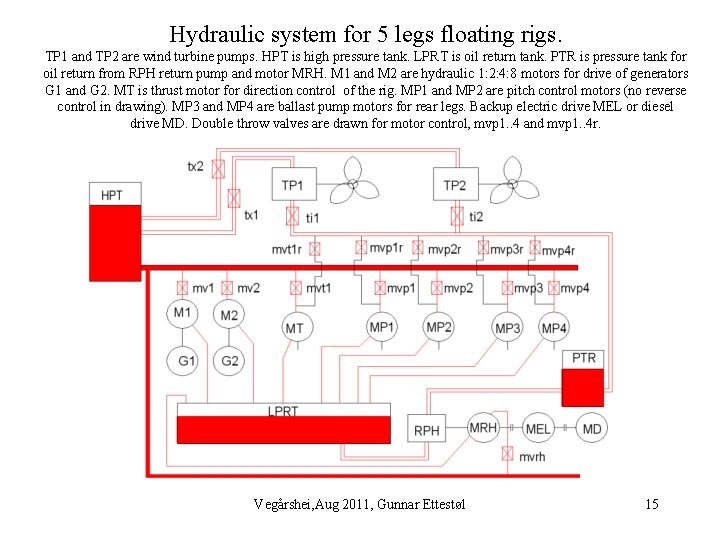
Hydraulic system for 5 legs floating rigs. TP 1 and TP 2 are wind turbine pumps. HPT is high pressure tank. LPRT is oil return tank. PTR is pressure tank for oil return from RPH return pump and motor MRH. M 1 and M 2 are hydraulic 1: 2: 4: 8 motors for drive of generators G 1 and G 2. MT is thrust motor for direction control of the rig. MP 1 and MP 2 are pitch control motors (no reverse control in drawing). MP 3 and MP 4 are ballast pump motors for rear legs. Backup electric drive MEL or diesel drive MD. Double throw valves are drawn for motor control, mvp 1. . 4 and mvp 1. . 4 r. Vegårshei, Aug 2011, Gunnar Ettestøl 15
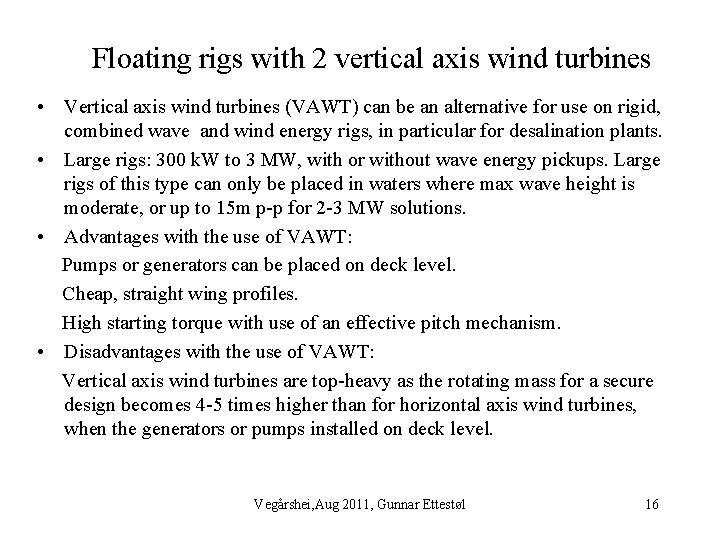
Floating rigs with 2 vertical axis wind turbines • Vertical axis wind turbines (VAWT) can be an alternative for use on rigid, combined wave and wind energy rigs, in particular for desalination plants. • Large rigs: 300 k. W to 3 MW, with or without wave energy pickups. Large rigs of this type can only be placed in waters where max wave height is moderate, or up to 15 m p-p for 2 -3 MW solutions. • Advantages with the use of VAWT: Pumps or generators can be placed on deck level. Cheap, straight wing profiles. High starting torque with use of an effective pitch mechanism. • Disadvantages with the use of VAWT: Vertical axis wind turbines are top-heavy as the rotating mass for a secure design becomes 4 -5 times higher than for horizontal axis wind turbines, when the generators or pumps installed on deck level. Vegårshei, Aug 2011, Gunnar Ettestøl 16
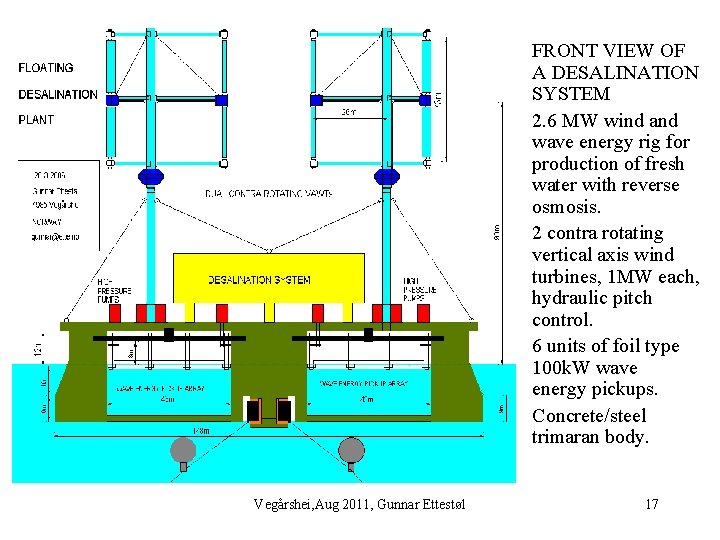
• FRONT VIEW OF A DESALINATION SYSTEM • 2. 6 MW wind and wave energy rig for production of fresh water with reverse osmosis. • 2 contra rotating vertical axis wind turbines, 1 MW each, hydraulic pitch control. • 6 units of foil type 100 k. W wave energy pickups. • Concrete/steel trimaran body. Vegårshei, Aug 2011, Gunnar Ettestøl 17
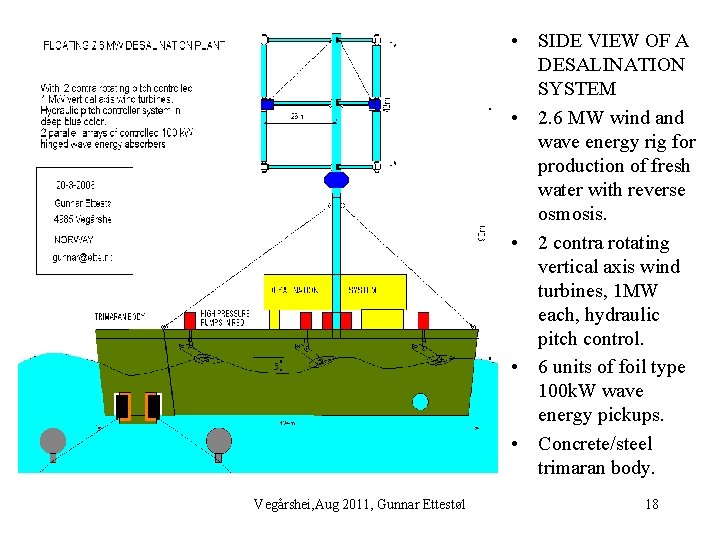
• SIDE VIEW OF A DESALINATION SYSTEM • 2. 6 MW wind and wave energy rig for production of fresh water with reverse osmosis. • 2 contra rotating vertical axis wind turbines, 1 MW each, hydraulic pitch control. • 6 units of foil type 100 k. W wave energy pickups. • Concrete/steel trimaran body. Vegårshei, Aug 2011, Gunnar Ettestøl 18