
OffsetTimeBased Qo S Scheme Extend JET to achieve
Offset-Time-Based Qo. S Scheme • Extend JET to achieve isolation of traffic classes – The burst blocking probability of a priority class is independent of the offered load from the lower-priority classes • Basic idea: give a larger extra offset time to a higher priority class – Reservation for a higher priority burst has a better chance to succeed. • Burst assembly: multiple IP packets are assembled into a burst based on their destination address and priority class 1
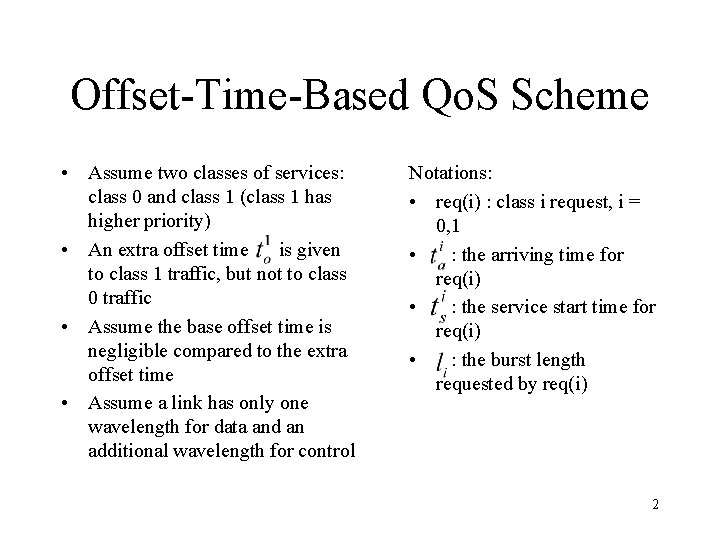
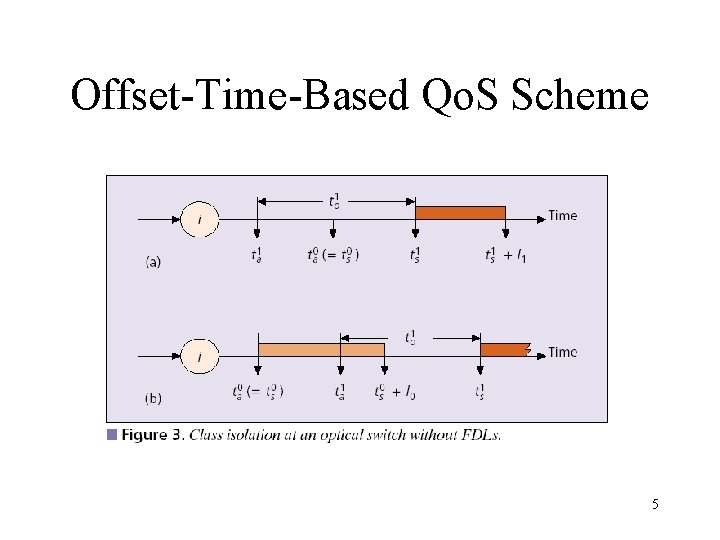
Offset-Time-Based Qo. S Scheme • Assume two classes of services: class 0 and class 1 (class 1 has higher priority) • An extra offset time is given to class 1 traffic, but not to class 0 traffic • Assume the base offset time is negligible compared to the extra offset time • Assume a link has only one wavelength for data and an additional wavelength for control Notations: • req(i) : class i request, i = 0, 1 • : the arriving time for req(i) • : the service start time for req(i) • : the burst length requested by req(i) 2
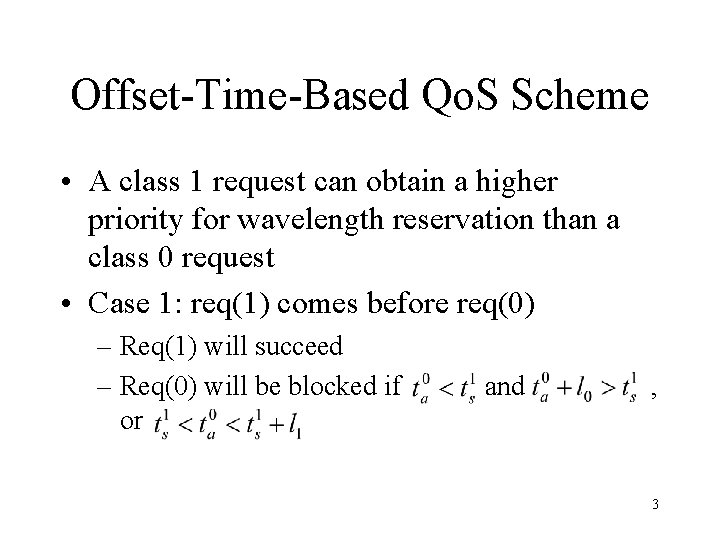
Offset-Time-Based Qo. S Scheme • A class 1 request can obtain a higher priority for wavelength reservation than a class 0 request • Case 1: req(1) comes before req(0) – Req(1) will succeed – Req(0) will be blocked if or and , 3
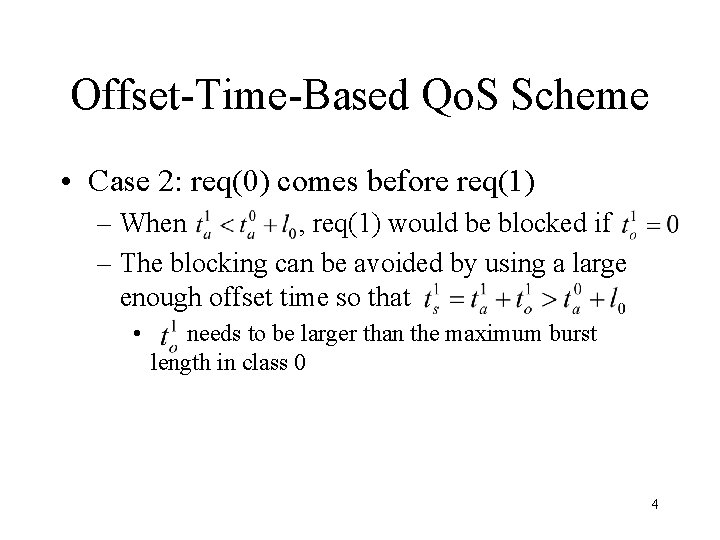
Offset-Time-Based Qo. S Scheme • Case 2: req(0) comes before req(1) – When , req(1) would be blocked if – The blocking can be avoided by using a large enough offset time so that • needs to be larger than the maximum burst length in class 0 4
Offset-Time-Based Qo. S Scheme 5
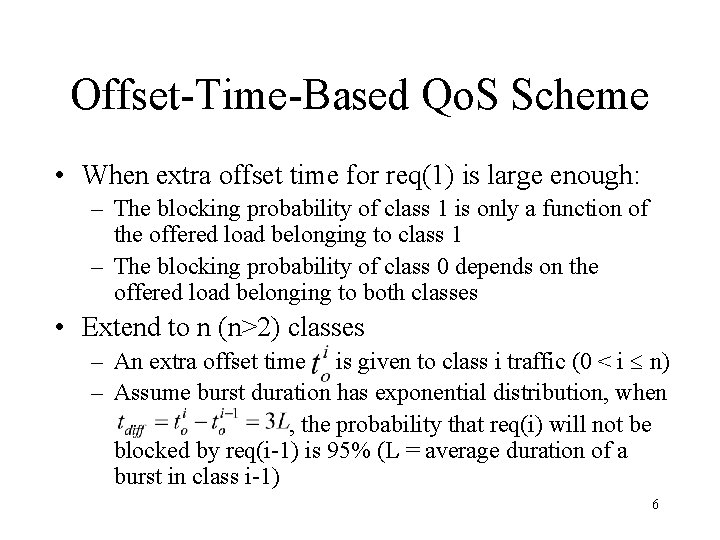
Offset-Time-Based Qo. S Scheme • When extra offset time for req(1) is large enough: – The blocking probability of class 1 is only a function of the offered load belonging to class 1 – The blocking probability of class 0 depends on the offered load belonging to both classes • Extend to n (n>2) classes – An extra offset time is given to class i traffic (0 < i n) – Assume burst duration has exponential distribution, when , the probability that req(i) will not be blocked by req(i-1) is 95% (L = average duration of a burst in class i-1) 6
Other Qo. S Schemes: Intentional Dropping • Problems of offset-time-based Qo. S scheme – The extra offset time introduces an additional delay at the edge – Performance of differentiation depends on the burst length – Unfair to long bursts belonging to low priority classes • Intentional dropping [Chen et al, Globecom 01] – Address the problems of offset-time-based Qo. S scheme – Bursts are selectively dropped according to loss rate measurement to achieve proportional burst loss probability 7
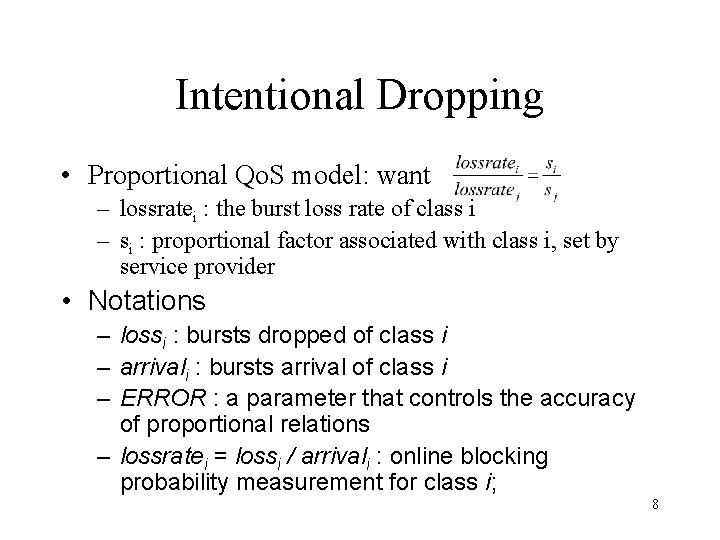
Intentional Dropping • Proportional Qo. S model: want – lossratei : the burst loss rate of class i – si : proportional factor associated with class i, set by service provider • Notations – lossi : bursts dropped of class i – arrivali : bursts arrival of class i – ERROR : a parameter that controls the accuracy of proportional relations – lossratei = lossi / arrivali : online blocking probability measurement for class i; 8
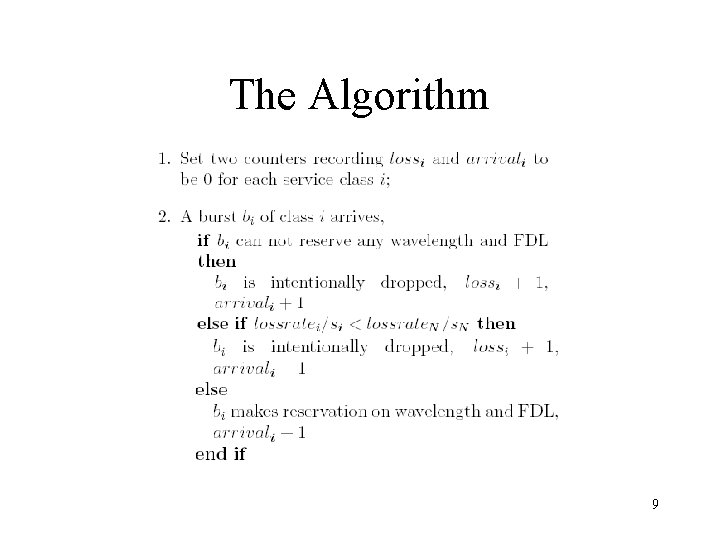
The Algorithm 9
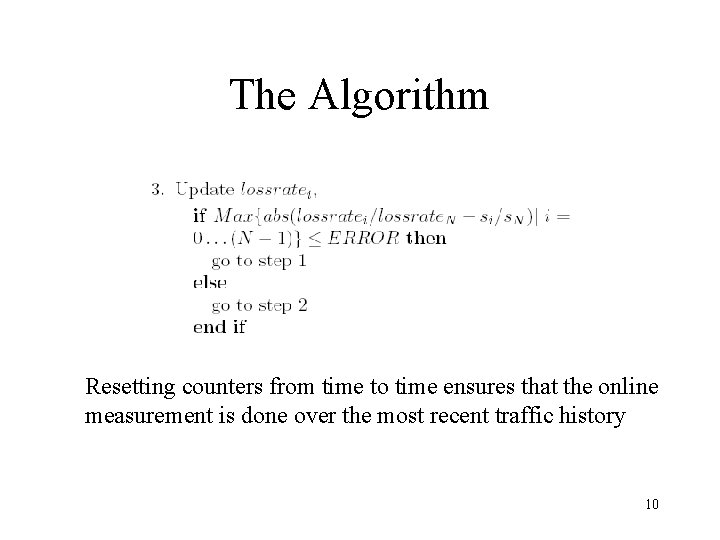
The Algorithm Resetting counters from time to time ensures that the online measurement is done over the most recent traffic history 10
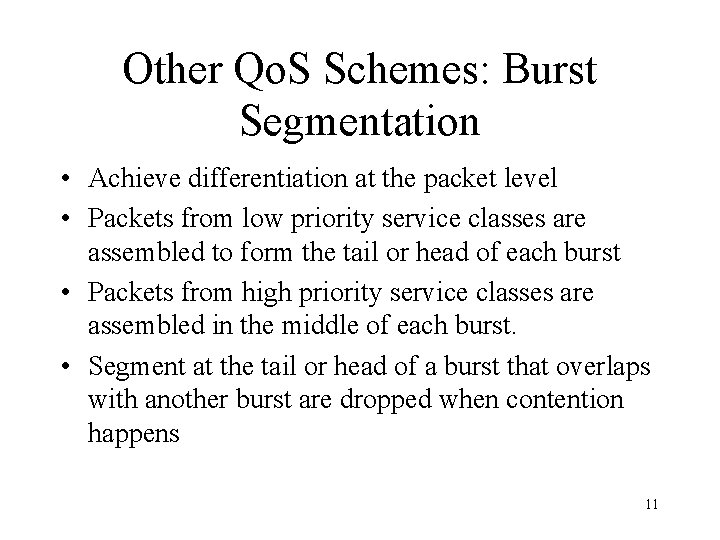
Other Qo. S Schemes: Burst Segmentation • Achieve differentiation at the packet level • Packets from low priority service classes are assembled to form the tail or head of each burst • Packets from high priority service classes are assembled in the middle of each burst. • Segment at the tail or head of a burst that overlaps with another burst are dropped when contention happens 11
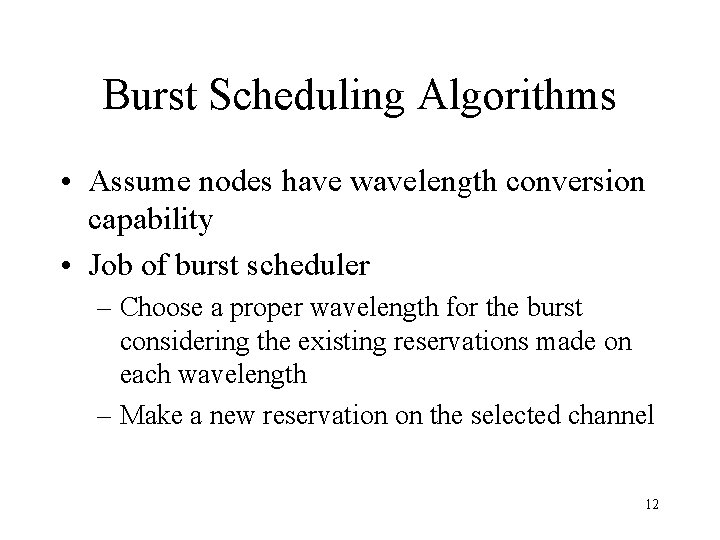
Burst Scheduling Algorithms • Assume nodes have wavelength conversion capability • Job of burst scheduler – Choose a proper wavelength for the burst considering the existing reservations made on each wavelength – Make a new reservation on the selected channel 12
Horizon • Also called LAUC (latest available unscheduled channel) • For each wavelength, the scheduling horizon is maintained – Scheduling horizon: the latest time at which the wavelength is currently scheduled to be in use • The channels whose scheduling horizon precede the new burst’s arrival time are considered available • An available channel with the latest scheduling horizon is chosen – Minimize the gap created • Drawback: waste gaps between two existing reservations 13
LAUC with Void Filing (LAUCVF) • Given a data burst with arrival time t and duration L – Find the outgoing channels that are available for the time period of (t, t+L). – If there is at least one such channel, select the latest available channel, i. e. , the channel having the smallest gap between t and the end of last data burst before t • Minimize the void generated between the start of new reservation and an existing reservation 14
Variants of LAUC-VF • Min-EV (Ending Void): try to maximize the new void generated between the end of new reservation and an existing reservation • Best Fit: try to minimize the total length of starting and ending voids generated after the reservation • LAUC-VF and its variants have comparable bandwidth utilization that is much higher than Horizon 15
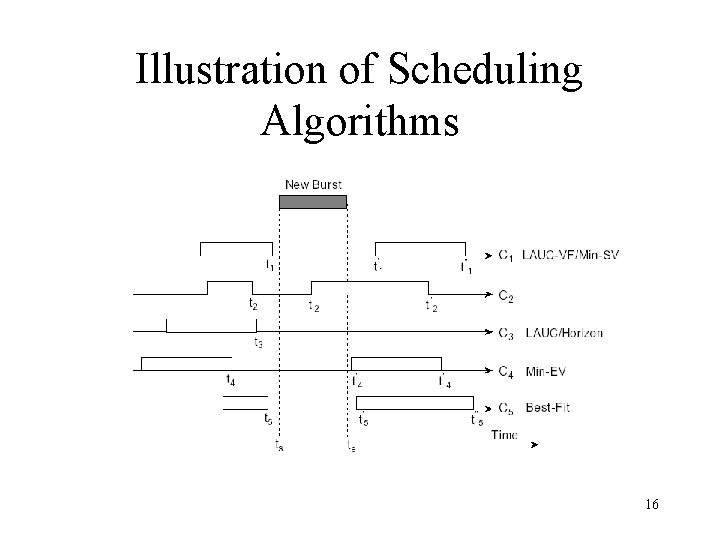
Illustration of Scheduling Algorithms 16
Contention Resolution • Contention occurs when burst scheduler can’t find an available channel for the new burst • Ways to resolve contention – Deflection – Dropping – Preemption – Burst segmentation 17
Deflection • A burst is sent to a different output channel instead of the preferred one • Deflection can be applied in wavelength, space, and time domains – Wavelength domain: the burst is sent on another wavelength through wavelength conversion – Space domain: the burst is sent to a different output port – Time domain: the burst is delayed for a fixed time by passing through an FDL 18
Dropping/Preemption/Burst Segmentation • If a burst can’t be deflected, it can be dropped • An incoming burst can preempt an existing burst • Burst segmentation: segment at the tail or head of a burst that overlaps with another burst is dropped or deflected 19
- Slides: 19