
Offline and Realtime signal processing on fusion signals


- Slides: 22
Offline and Real-time signal processing on fusion signals R. Coelho, D. Alves Associação EURATOM/IST, Instituto de Plasmas e Fusão Nuclear Outline 1 – The Fourier space methods 2 – Empirical mode decomposition 3 – (k, ω) space methods - Coherency spectrum and SVD 4 – Beyond the Fourier paradigm Real-time based techniques. – Motional Stark Effect data processing. Signal processing tools Lisbon 18/02/09 R Coelho 1/29
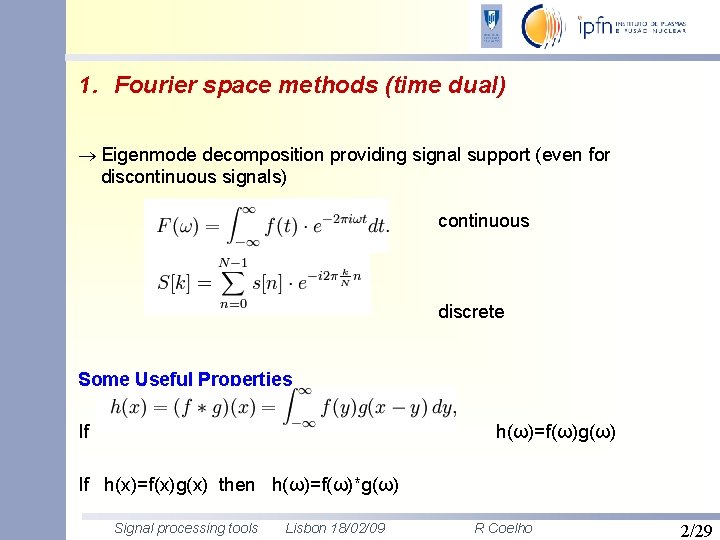
1. Fourier space methods (time dual) Eigenmode decomposition providing signal support (even for discontinuous signals) continuous discrete Some Useful Properties If h(ω)=f(ω)g(ω) If h(x)=f(x)g(x) then h(ω)=f(ω)*g(ω) Signal processing tools Lisbon 18/02/09 R Coelho 2/29
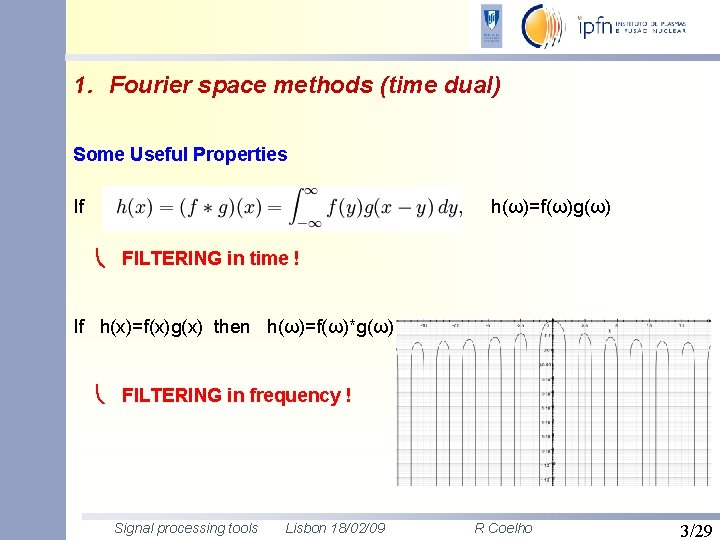
1. Fourier space methods (time dual) Some Useful Properties If h(ω)=f(ω)g(ω) FILTERING in time ! If h(x)=f(x)g(x) then h(ω)=f(ω)*g(ω) FILTERING in frequency ! Signal processing tools Lisbon 18/02/09 R Coelho 3/29
1. Fourier space methods Time-frequency analysis • Sliding FFT method : S(t, ω) where midpoint of time window corresponds to a FFT. • Windowed spectrogram : same as above but with window function to reduce noise and enhance time localization • Spectrogram with zero padding : same as above but zero padding to each time window shadow frequency resolution enhancement Signal processing tools Lisbon 18/02/09 R Coelho 4/29
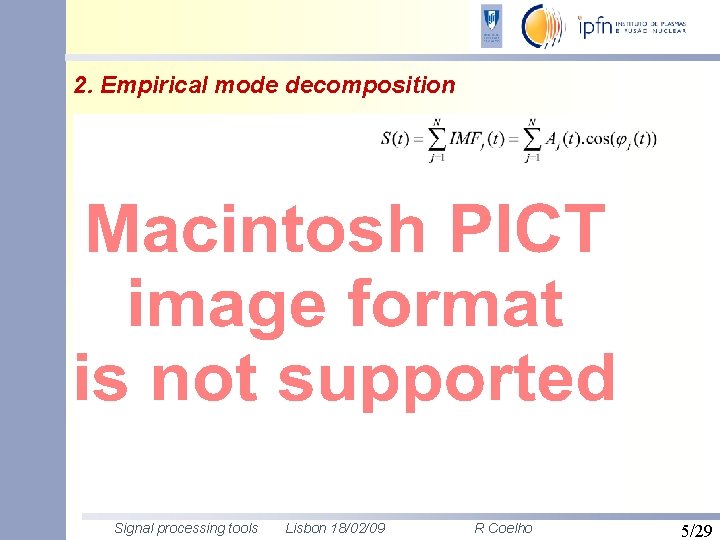
2. Empirical mode decomposition Signal processing tools Lisbon 18/02/09 R Coelho 5/29
2. Empirical mode decomposition Mirnov signal spectra, # 11672 using EMD 3 dominant IMF (signals + frequencies) Signal processing tools Lisbon 18/02/09 R Coelho 6/29
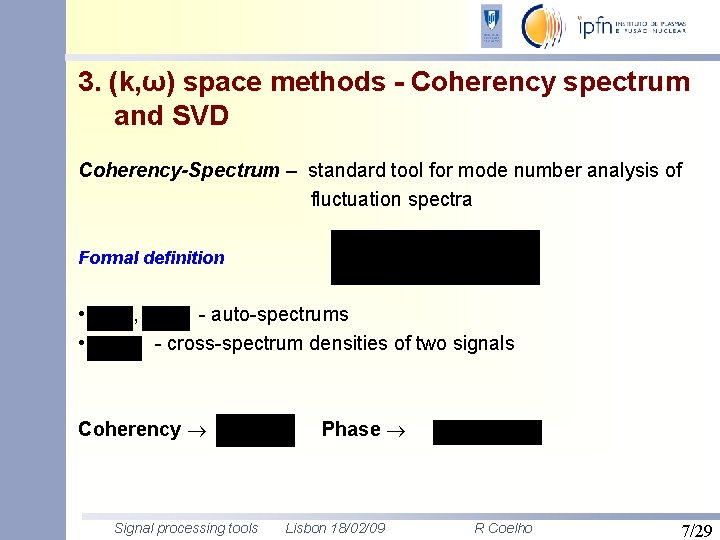
3. (k, ω) space methods - Coherency spectrum and SVD Coherency-Spectrum – standard tool for mode number analysis of fluctuation spectra Formal definition • • , - auto-spectrums - cross-spectrum densities of two signals Coherency Signal processing tools Phase Lisbon 18/02/09 R Coelho 7/29
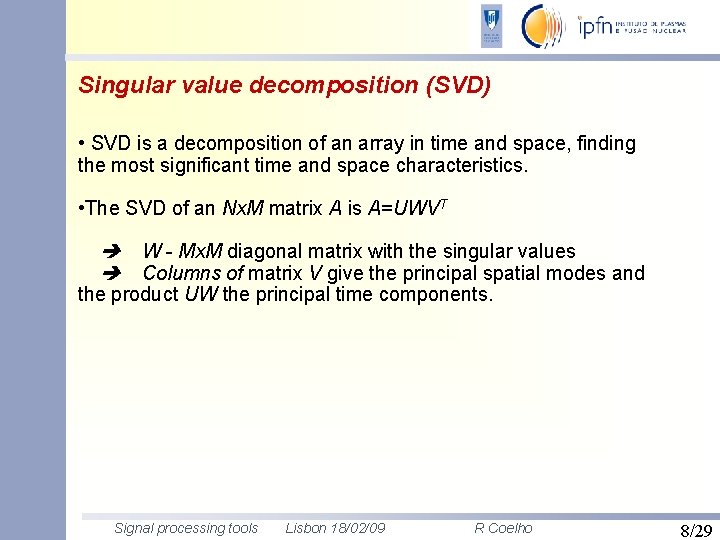
Singular value decomposition (SVD) • SVD is a decomposition of an array in time and space, finding the most significant time and space characteristics. • The SVD of an Nx. M matrix A is A=UWVT W - Mx. M diagonal matrix with the singular values Columns of matrix V give the principal spatial modes and the product UW the principal time components. Signal processing tools Lisbon 18/02/09 R Coelho 8/29
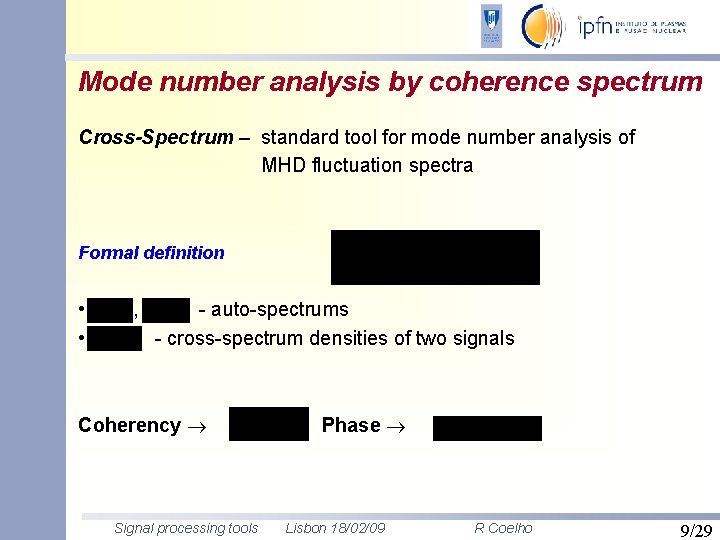
Mode number analysis by coherence spectrum Cross-Spectrum – standard tool for mode number analysis of MHD fluctuation spectra Formal definition • • , - auto-spectrums - cross-spectrum densities of two signals Coherency Signal processing tools Phase Lisbon 18/02/09 R Coelho 9/29
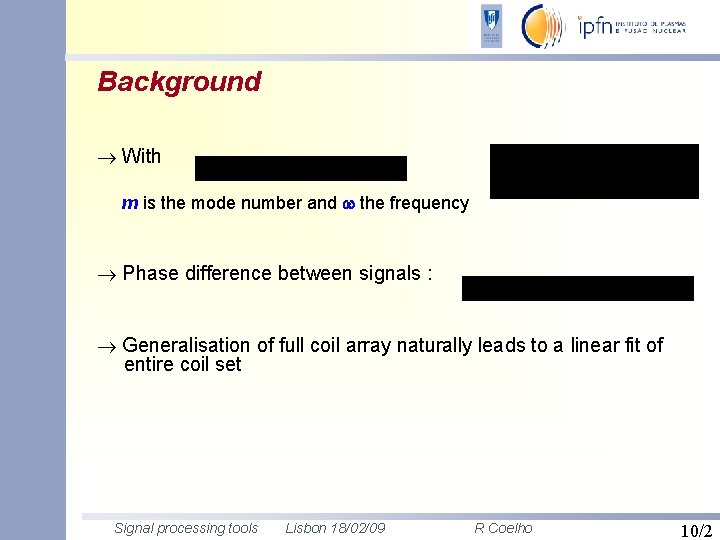
Background With m is the mode number and the frequency Phase difference between signals : Generalisation of full coil array naturally leads to a linear fit of entire coil set Signal processing tools Lisbon 18/02/09 R Coelho 10/2
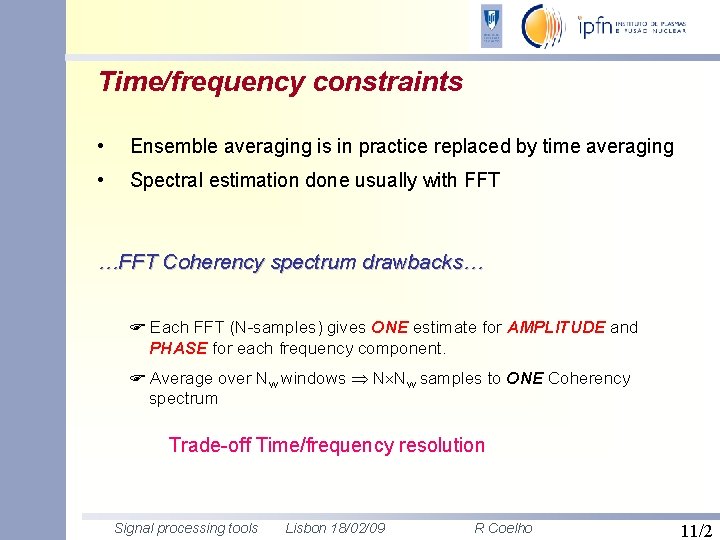
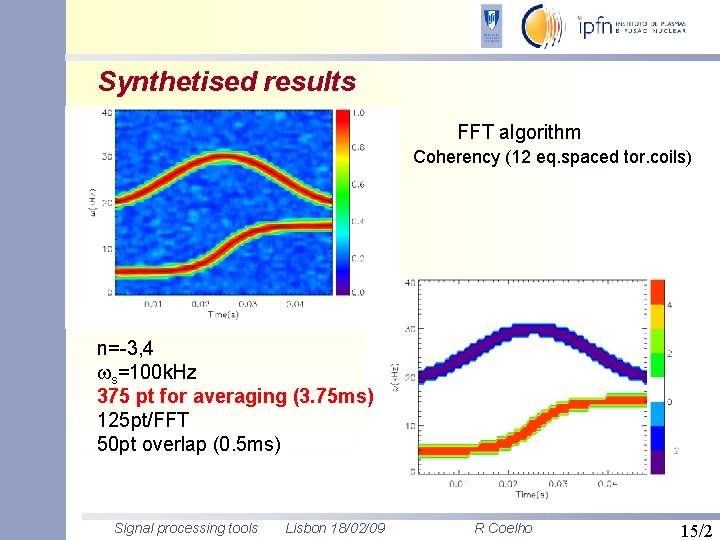
Time/frequency constraints • Ensemble averaging is in practice replaced by time averaging • Spectral estimation done usually with FFT …FFT Coherency spectrum drawbacks… Each FFT (N-samples) gives ONE estimate for AMPLITUDE and PHASE for each frequency component. Average over Nw windows N Nw samples to ONE Coherency spectrum Trade-off Time/frequency resolution Signal processing tools Lisbon 18/02/09 R Coelho 11/2
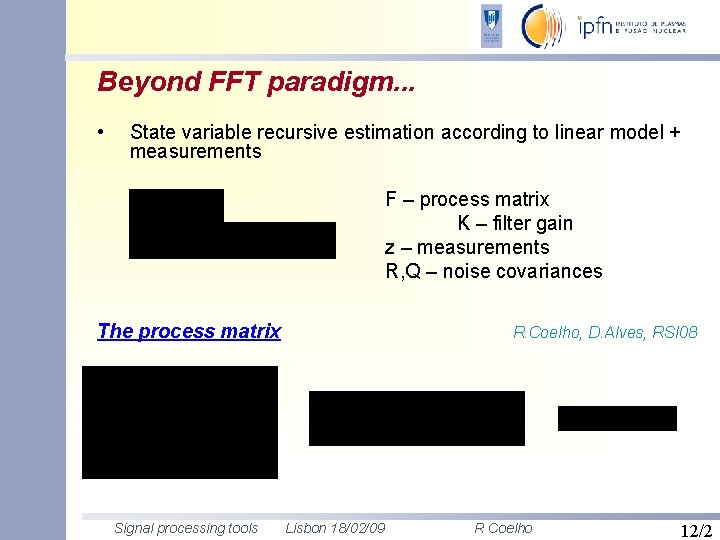
Beyond FFT paradigm. . . • State variable recursive estimation according to linear model + measurements F – process matrix K – filter gain z – measurements R, Q – noise covariances The process matrix Signal processing tools R. Coelho, D. Alves, RSI 08 Lisbon 18/02/09 R Coelho 12/2
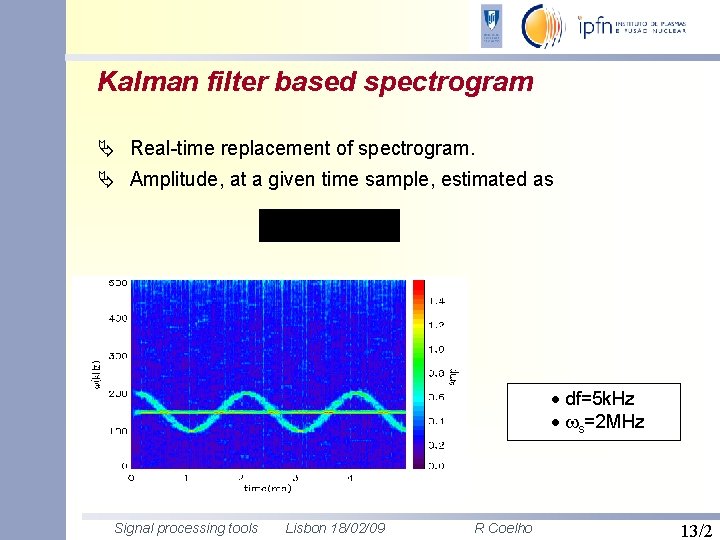
Kalman filter based spectrogram Ä Real-time replacement of spectrogram. Ä Amplitude, at a given time sample, estimated as · df=5 k. Hz · s=2 MHz Signal processing tools Lisbon 18/02/09 R Coelho 13/2
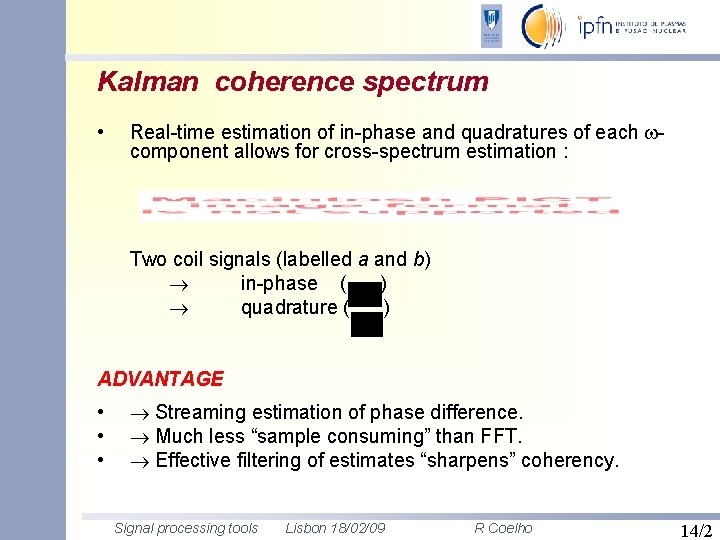
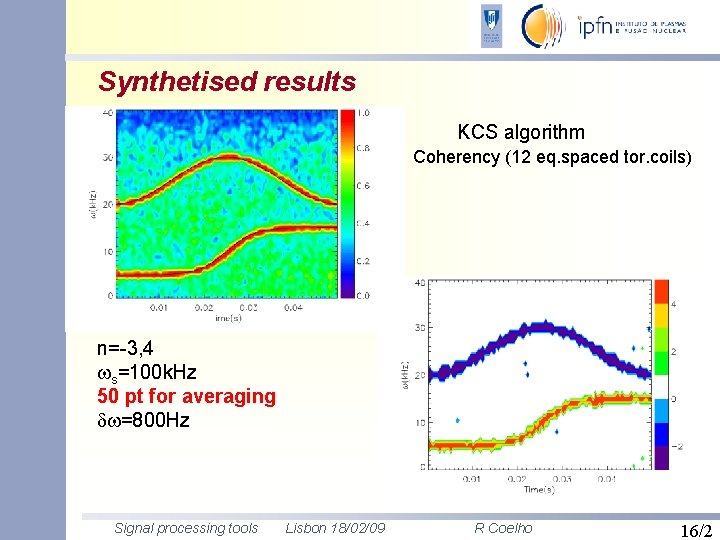
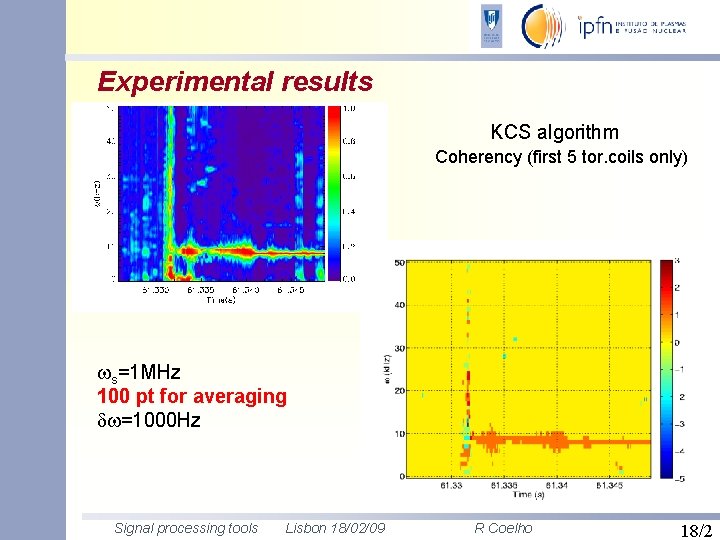
Kalman coherence spectrum • Real-time estimation of in-phase and quadratures of each component allows for cross-spectrum estimation : Two coil signals (labelled a and b) in-phase ( ) quadrature ( ) ADVANTAGE • • • Streaming estimation of phase difference. Much less “sample consuming” than FFT. Effective filtering of estimates “sharpens” coherency. Signal processing tools Lisbon 18/02/09 R Coelho 14/2
Synthetised results FFT algorithm Coherency (12 eq. spaced tor. coils) n=-3, 4 s=100 k. Hz 375 pt for averaging (3. 75 ms) 125 pt/FFT 50 pt overlap (0. 5 ms) Signal processing tools Lisbon 18/02/09 R Coelho 15/2
Synthetised results KCS algorithm Coherency (12 eq. spaced tor. coils) n=-3, 4 s=100 k. Hz 50 pt for averaging =800 Hz Signal processing tools Lisbon 18/02/09 R Coelho 16/2
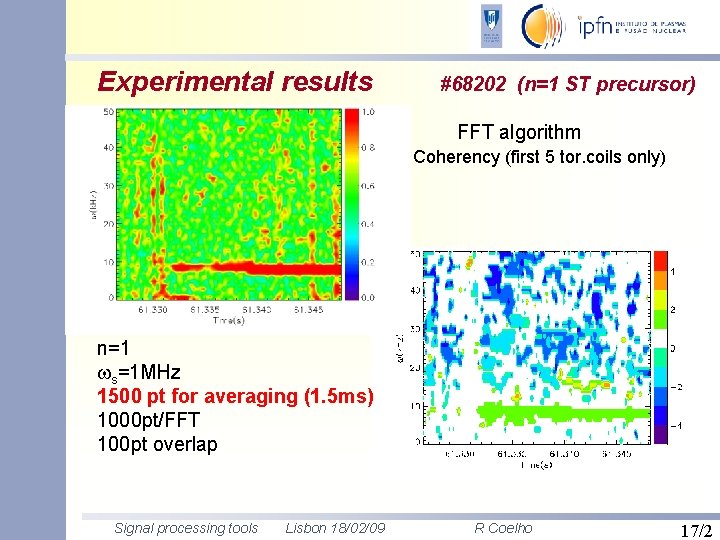
Experimental results #68202 (n=1 ST precursor) FFT algorithm Coherency (first 5 tor. coils only) n=1 s=1 MHz 1500 pt for averaging (1. 5 ms) 1000 pt/FFT 100 pt overlap Signal processing tools Lisbon 18/02/09 R Coelho 17/2
Experimental results KCS algorithm Coherency (first 5 tor. coils only) s=1 MHz 100 pt for averaging =1000 Hz Signal processing tools Lisbon 18/02/09 R Coelho 18/2
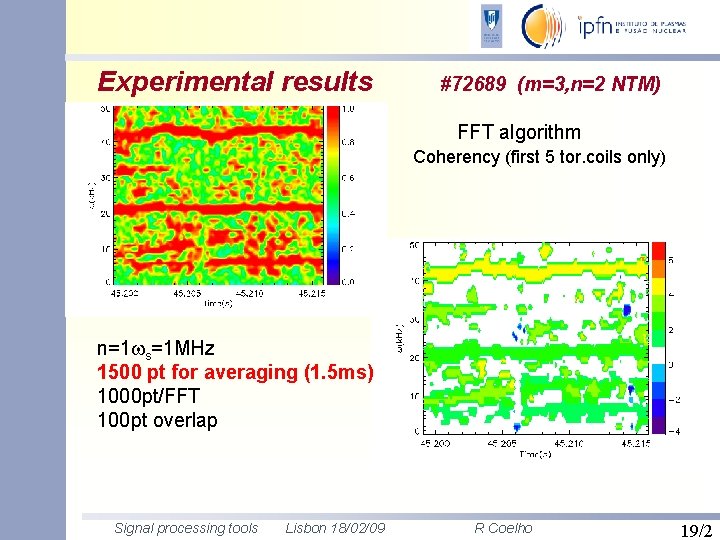
Experimental results #72689 (m=3, n=2 NTM) FFT algorithm Coherency (first 5 tor. coils only) n=1 s=1 MHz 1500 pt for averaging (1. 5 ms) 1000 pt/FFT 100 pt overlap Signal processing tools Lisbon 18/02/09 R Coelho 19/2
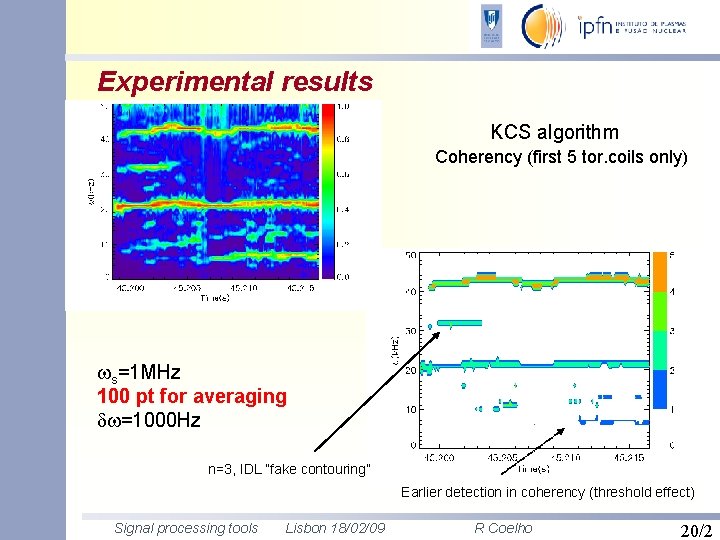
Experimental results KCS algorithm Coherency (first 5 tor. coils only) s=1 MHz 100 pt for averaging =1000 Hz n=3, IDL “fake contouring” Earlier detection in coherency (threshold effect) Signal processing tools Lisbon 18/02/09 R Coelho 20/2
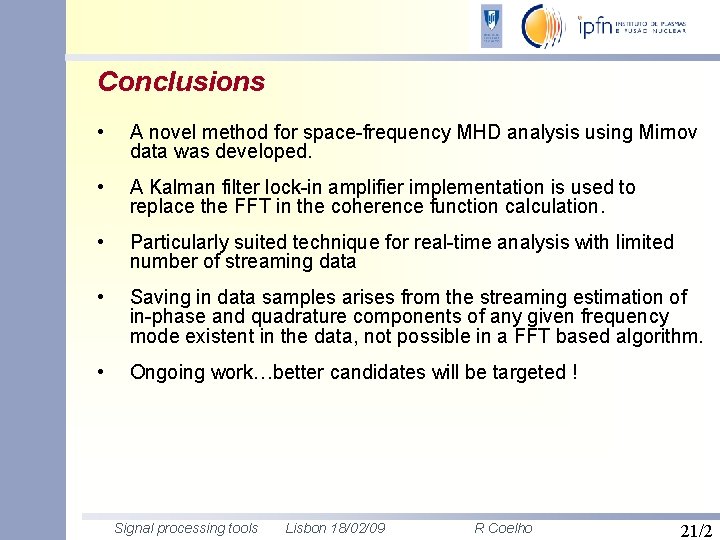
Conclusions • A novel method for space-frequency MHD analysis using Mirnov data was developed. • A Kalman filter lock-in amplifier implementation is used to replace the FFT in the coherence function calculation. • Particularly suited technique for real-time analysis with limited number of streaming data • Saving in data samples arises from the streaming estimation of in-phase and quadrature components of any given frequency mode existent in the data, not possible in a FFT based algorithm. • Ongoing work…better candidates will be targeted ! Signal processing tools Lisbon 18/02/09 R Coelho 21/2
Signal processing tools Lisbon 18/02/09 R Coelho 22/2