
Official statistics and mobile network operators A business
Official statistics and mobile network operators A business model for partnerships Marc Debusschere, Statistics Belgium Albrecht Wirthmann, Eurostat Freddy De Meersman, Proximus Brussels, NTTS 2017, 15 March 2017 Statbel. fgov. be
Overview 1. 2. 3. 4. Context: the challenge of big data Exploiting mobile phone data: the issues How this might work in practice: a project Conclusion: a business model?
Context: the challenge of big data � Data explosion: big data v Immense increase in volume, velocity, variety (complexity) v ‘Digital footprint’ of persons and ‘things’ � Specifically: mobile phone data v ‘Exhaust’: by-product of operating mobile networks v Investment needed to ‘create’ data v ‘Owned’ by mobile network operators: private & profit-oriented! � Challenge: from data to information! v Official statistics: the ‘third data revolution’ surveys => administrative data => big data v Network operators: for network optimisation & high-value commercialisation
Exploiting mobile phone data: the issues � What’s in it for statistics? v Faster, more detailed, cheaper official statistics v Entry to phenomena inaccessible until now v At a cost, however: unknown territory and new limitations! � What’s in it for mobile network operators? v Commercial potential – but high investment requiring high return v Network operators lack expertise (but often are unaware of this …) v Network operators lack potentially valuable extra data (ditto …) � Challenge: joining assets for mutual benefit v Statistics: domain and methodological expertise and (geocoded) datasets v Network operators: mobile phone data and technical expertise
How this might work in practice: a project � � Statistics Belgium, Proximus, Eurostat, JRC Objective Jointly explore mobile phone data, focus on modest but concrete and quick results, with the ultimate aim of developing statistical and commercial use cases combining mobile phone and statistical data � Timing v v Start December 2015, ongoing First results foreseen and delivered end of April 2016 Eight papers published in 2016 Second stage kicked off December 2016: new datasets, developing statistical and commercial use cases
A collaboration project (continued) � Step by step approach v Focus first on actual present population v Next resident population (via ‘usual place of residence’), commuting, v � labour mobility, labour migration (adding ‘work place’), tourism, migration, time use, … (adding ‘usual environment’), … Finally: ‘real’ statistical and commercial use cases Innovative v Using network signals rather than CDRs: observations x 10 ! v Combining mobile phone data and statistical datasets � No data handling or privacy issues (yet) v Aggregates resulting from queries in Proximus datawarehouse v Coupled via geocoding
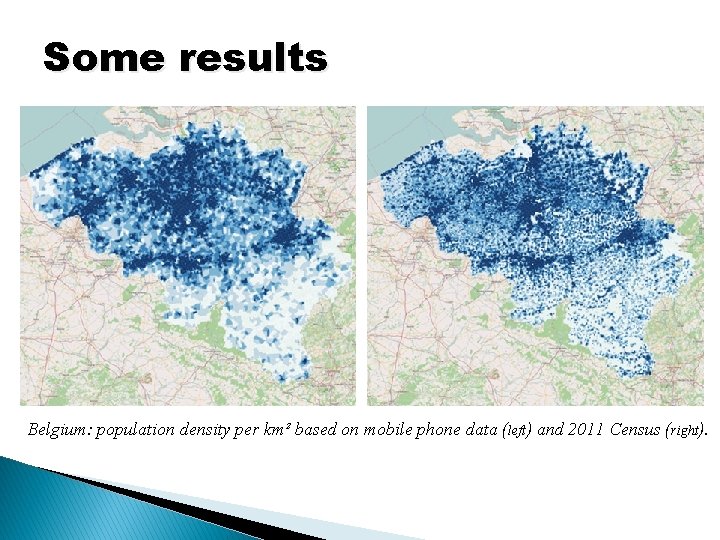
Some results Belgium: population density per km² based on mobile phone data (left) and 2011 Census (right).
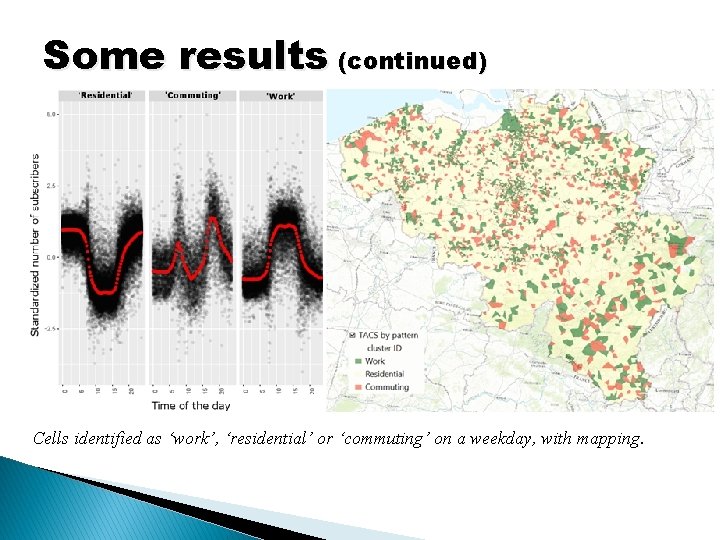
Some results (continued) Cells identified as ‘work’, ‘residential’ or ‘commuting’ on a weekday, with mapping.
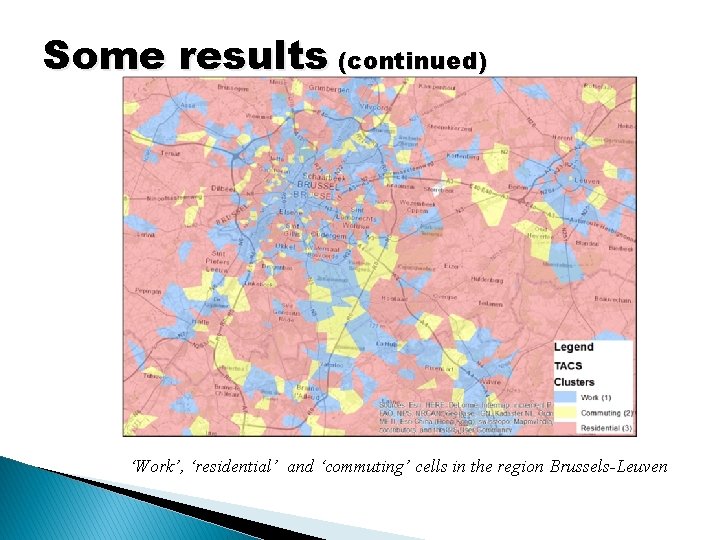
Some results (continued) ‘Work’, ‘residential’ and ‘commuting’ cells in the region Brussels-Leuven
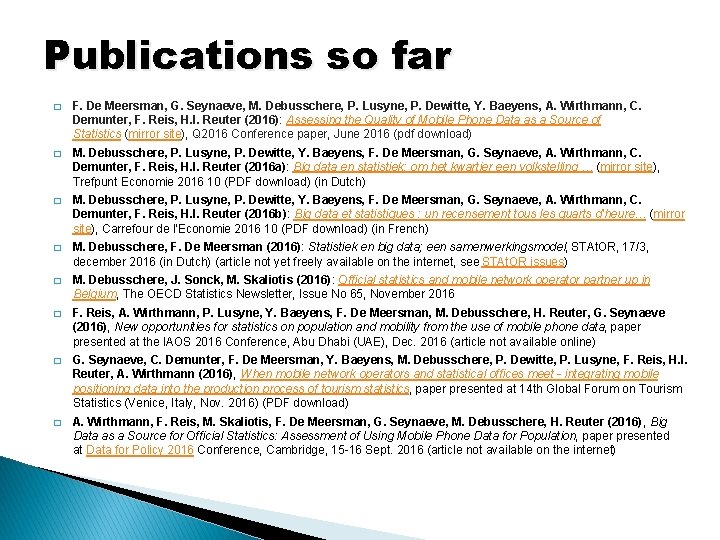
Publications so far � F. De Meersman, G. Seynaeve, M. Debusschere, P. Lusyne, P. Dewitte, Y. Baeyens, A. Wirthmann, C. Demunter, F. Reis, H. I. Reuter (2016): Assessing the Quality of Mobile Phone Data as a Source of Statistics (mirror site), Q 2016 Conference paper, June 2016 (pdf download) � M. Debusschere, P. Lusyne, P. Dewitte, Y. Baeyens, F. De Meersman, G. Seynaeve, A. Wirthmann, C. Demunter, F. Reis, H. I. Reuter (2016 a): Big data en statistiek: om het kwartier een volkstelling … (mirror site), Trefpunt Economie 2016 10 (PDF download) (in Dutch) � M. Debusschere, P. Lusyne, P. Dewitte, Y. Baeyens, F. De Meersman, G. Seynaeve, A. Wirthmann, C. Demunter, F. Reis, H. I. Reuter (2016 b): Big data et statistiques : un recensement tous les quarts d'heure… (mirror site), Carrefour de l'Economie 2016 10 (PDF download) (in French) � M. Debusschere, F. De Meersman (2016): Statistiek en big data; een samenwerkingsmodel, STAt. OR, 17/3, december 2016 (in Dutch) (article not yet freely available on the internet, see STAt. OR issues) � M. Debusschere, J. Sonck, M. Skaliotis (2016): Official statistics and mobile network operator partner up in Belgium, The OECD Statistics Newsletter, Issue No 65, November 2016 � F. Reis, A. Wirthmann, P. Lusyne, Y. Baeyens, F. De Meersman, M. Debusschere, H. Reuter, G. Seynaeve (2016), New opportunities for statistics on population and mobility from the use of mobile phone data, paper presented at the IAOS 2016 Conference, Abu Dhabi (UAE), Dec. 2016 (article not available online) � G. Seynaeve, C. Demunter, F. De Meersman, Y. Baeyens, M. Debusschere, P. Dewitte, P. Lusyne, F. Reis, H. I. Reuter, A. Wirthmann (2016), When mobile network operators and statistical offices meet - integrating mobile positioning data into the production process of tourism statistics, paper presented at 14 th Global Forum on Tourism Statistics (Venice, Italy, Nov. 2016) (PDF download) � A. Wirthmann, F. Reis, M. Skaliotis, F. De Meersman, G. Seynaeve, M. Debusschere, H. Reuter (2016), Big Data as a Source for Official Statistics: Assessment of Using Mobile Phone Data for Population, paper presented at Data for Policy 2016 Conference, Cambridge, 15 -16 Sept. 2016 (article not available on the internet)
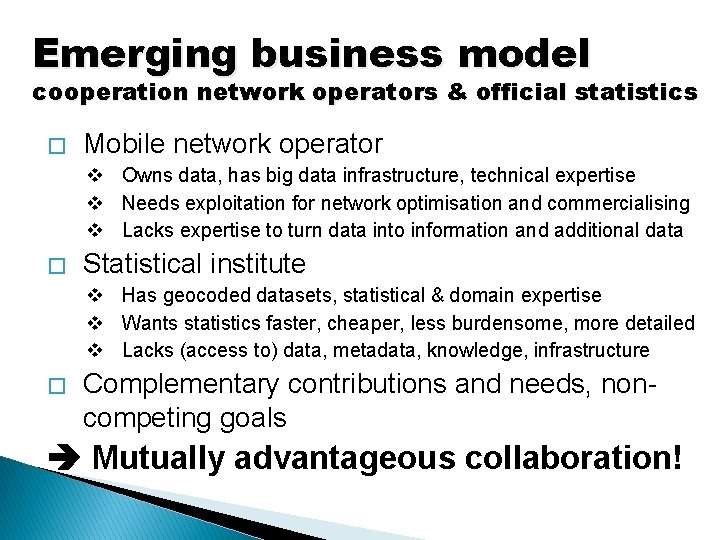
Emerging business model cooperation network operators & official statistics � Mobile network operator v Owns data, has big data infrastructure, technical expertise v Needs exploitation for network optimisation and commercialising v Lacks expertise to turn data into information and additional data � Statistical institute v Has geocoded datasets, statistical & domain expertise v Wants statistics faster, cheaper, less burdensome, more detailed v Lacks (access to) data, metadata, knowledge, infrastructure � Complementary contributions and needs, noncompeting goals Mutually advantageous collaboration!
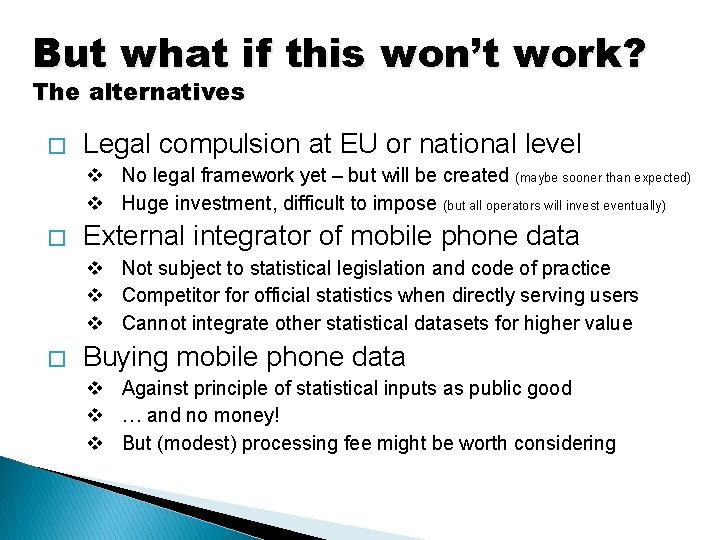
But what if this won’t work? The alternatives � Legal compulsion at EU or national level v No legal framework yet – but will be created (maybe sooner than expected) v Huge investment, difficult to impose (but all operators will invest eventually) � External integrator of mobile phone data v Not subject to statistical legislation and code of practice v Competitor for official statistics when directly serving users v Cannot integrate other statistical datasets for higher value � Buying mobile phone data v Against principle of statistical inputs as public good v … and no money! v But (modest) processing fee might be worth considering
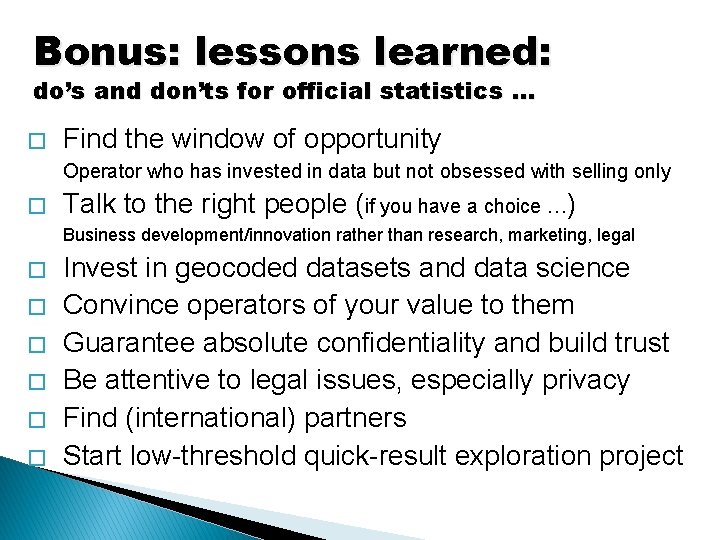
Bonus: lessons learned: do’s and don’ts for official statistics … � Find the window of opportunity Operator who has invested in data but not obsessed with selling only � Talk to the right people (if you have a choice …) Business development/innovation rather than research, marketing, legal � � � Invest in geocoded datasets and data science Convince operators of your value to them Guarantee absolute confidentiality and build trust Be attentive to legal issues, especially privacy Find (international) partners Start low-threshold quick-result exploration project

Questions? Comments?
- Slides: 14