
Office Performance Commitment Review OPCR Form All heads




- Slides: 50
Office Performance & Commitment Review (OPCR) Form
• All heads of offices shall accomplish their respective OPCRs • OPCRs must officially identify and declare the targets for the rating period • OPCRs must be in accordance with the over-all strategy map and commitments of the agency • Once these are reviewed and finalized by the PMT, all OPCRs must be signed and approved by the contracting parties
Categories of Functions • Strategic Priorities – these are outputs that implement and deliver the mandates of the agency as identified its strategy roadmap, OPIF, etc. • Core Functions – these are functions that deliver the main services and products of the agency • Support Functions – these are functions that provide necessary resources to enable the agency - its offices and units - to effectively perform its mandate
• Upon approval of the OPCRs, these shall be cascaded to all employees for their reference in the preparation of the Individual Performance Commitment Review (IPCR) forms • All OPCRs must also detail the Success Indicators (SI) for all strategic/core/support objectives targeted for specific rating period
SIs are pre-set standards of work outputs or accomplishments consisting of: • (1) performance measures (key performance indicators, key performance measures) • (2) performance targets for each performance measure • (3) possible scenarios of outputs/accomplishments pertinent to tasks, initiatives, projects and programs to be undertaken • (4) corresponding scores/marks for these predicted scenarios As much as possible, all possible scenarios must be considered and given equivalent score/mark in the determination of the SIs.
General Rules • In OPCR, the office shall compute the budget per program/project by expense account to ensure that budget allocation is strategy driven • The Office shall also identify specific division/unit/group and individual as primarily accountable for producing a particular target output per program/project/activity • Amendments to the OPCR may be allowed during the rating period to accommodate legitimate intervening tasks/ad hoc tasks and other superseding tasks subject to review of the concerned PMT and approval of top management
Determining Performance Measures Quantity – percentage, quota, number of reports, number of MOAs signed, amount of collections, number of employees oriented Timeliness – turnaround time (in minutes, hours, days, months, etc. ), cycle time, claim processing time, response time, target date or deadline, product development rate, delivery time, etc. Effectiveness – customer satisfaction rate, employee engagement index, capability index, customer positive feedback, quality hire, ARTA compliance
General Rule on Performance Measures • Performance Measures need not be many. Only those that contribute to or support the outcomes that the organization aims to achieve shall be included in the OPCR
Determining Targets • Address the need of the identified customer/s (internal or external) of the office and/or equivalent to (if not exceeding) the customer’s expectations • Be aligned and synchronized with the strategic goals and objectives of the agency • Be higher than what was achieved during the previous appraisal period (for previous achievements which were not yet the highest targets to be possibly achieved
• Be challenging enough to raise the bar of agency’s performance excellence • Consider the resources available and the geographical, environmental and cultural/societal limitations of the office • Reinforce and foster the culture of teamwork among individuals and work units
Sources of Targeting • Historical data • Benchmarking • Client Demand • Targets from past PMS (OPES, etc) • Management Instructions • Future Trend
Individual Performance & Commitment Review (IPCR) Form
• All employees shall accomplish their respective IPCR to establish the individual performance commitments for the rating period in accordance with the targets contained in their respective OPCRs • The IPCRs must contain the SIs for all strategic/core/support targeted for the rating period by the employee corresponding to the parameters of his/her respective supervisor’s OPCR
• These SIs shall serve as basis for the individual employee’s scoring of performance outputs and accomplishments • Upon finalization of the IPCR, the employee and the supervisor shall sign the document to establish that the performance targets indicated therein were discussed and mutually agreed upon • The employee shall only sign the IPCR when prior discussions and agreements with his/her supervisor have been made
Categories of Functions • Strategic Priorities – these are outputs that implement and deliver the mandates of the agency as identified its strategy roadmap, OPIF, etc. • Core Functions – these are functions that deliver the main services and products of the agency • Support Functions – these are functions that provide necessary resources to enable the agency - its offices and units - to effectively perform its mandate
General Rules • All employees must submit their respective IPCRs within the timeline set by PMT, specifically before the start of a particular rating period • Non-submission of IPCR carries administrative sanctions pursuant to provisions of CSC-MC 6, 2012
Ratings Dimensions & Ratings Matrix
”What gets measured gets done” - Peter Drucker
What is Rating Dimension? • Under SPMS, there are 3 dimensions that must be used to measure each and every Success Indicator. • These 3 dimensions are Efficiency, Timeliness and Quality (E -T-Q) • However, some agencies also use the dimension of Quantity (Q) as accepted and independent dimension especially for some targets
DEFINITION OF DIMENSIONS • Quality or Effectiveness – means getting the right things done. It refers to the degree to which objectives are achieved as intended and the extent to which issues are addressed with a certain degree of excellence.
• Timeliness – measures if the targeted deliverable was done within the scheduled or expected timeframe. • Efficiency – is the extent to which targets are accomplished using the minimum amount of time or resources.
General Rules • Under SPMS, not all SIs have to be measured using all the available dimensions • The use and appropriate application of rating dimension for each SI depends on the nature of the targets, to be reviewed and approved by the Head of Office and concurred by the PMT • Thus, there are SIs that carry only 1 dimension or 2 dimensions or all dimensions depending on the final discussions and agreements of concerned parties, including PMT
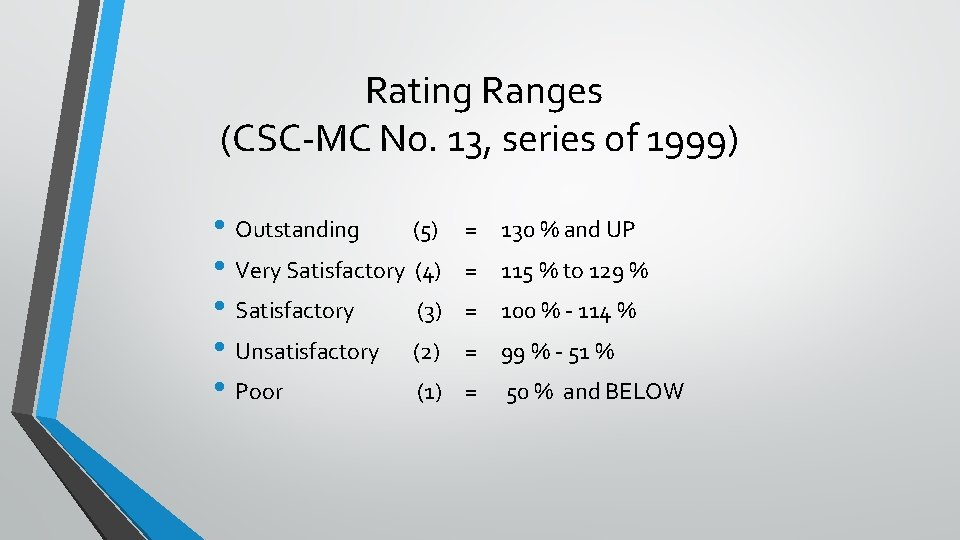
Rating Ranges (CSC-MC No. 13, series of 1999) • Outstanding (5) • Very Satisfactory (4) • Satisfactory (3) • Unsatisfactory (2) • Poor (1) = 130 % and UP = 115 % to 129 % = 100 % - 114 % = 99 % - 51 % = 50 % and BELOW
General Rules • • Historically used and validated in past CSC performance management systems Harmonized with the rating ranges of the Results-Based Performance Management System (RBPMS) as adopted by the Inter -Agency Task Force on RBPMS This may not be applied as “absolute” rule (hard and fast rule) for all SIs especially for targets adhering to existing laws, rules, regulations and guidelines At the end of the day, the determination of rating ranges per SI depends on the appreciation and decisions by PMT to protect the integrity, validity and sanctity of each performance target
Monitoring & Coaching Journal (MCJ)
• Regular monitoring of employee’s performance is mandatory under SPMS • It is the responsibility of every Head of Office, the Planning Office, the Human Resource Department as well as the whole PMT to ensure that a sustainable monitoring mechanism is in place and functional during the SPMS implementation • This could be done on a weekly, monthly or quarterly prior to the 3 rd cycle of the SPMS to protect the integrity and sanctity of the accomplishments • This facilitates easy tracking of progress on all identified targets vis-àvis the performance of individual employee
Role of the Manager/Leader • Monitors the work activities or accomplishments of employees on regular basis (monthly, quarterly, semi-annually, etc) • Addresses the factors that either help or hinder effective work performance • Designs tracking tools or monitoring strategies • Acts as enabler/coach/mentor rather than a mere evaluator
Purpose • Timely steps are taken to keep targets on track • Office goals are met in the most effective manner • Necessary support systems and resources are provided • Enabling environment is fostered to improve team performance • Employees’ potentials are managed, developed and maximized
Monitoring/Coaching Journal • All supervisors must maintain a journal using the MCJ Form to record the conduct of monitoring and coaching which shall contain the following: Ø Date of the monitoring/coaching moment ØBrief Statement or Purpose of the monitoring/coaching ØName of person/coachee ØCritical incidents discussed ØAgreements/actions taken/next steps ØBoth the coach and the coachee shall affix their signatures in the space provided by the form
Best Practice in CSC • Established Monitoring Tool per each SI • Regular quarterly assessment meeting among Directors & Division Chiefs • Monthly submission of A Coaching Journal
Staff Development Plan
• The SDP - or the Professional Development Plan as termed in SPMS - serves as a guide in documenting and surfacing the strengths and areas for development of employees in terms of knowledge, skills and attitude (KSA) • The SDP is essential form that must accomplished by the supervisor especially for those employees who underperform during a specific rating period • Heads of offices must ensure that SDP provides timely and appropriate developmental interventions for those employees getting unsatisfactory/poor performances
• The SDP aims to improve or correct performances of employees with Unsatisfactory and Poor performance ratings which must be outlined clearly, including timelines, and monitored to track progress • The results of the performance evaluation shall serve as vital inputs to Heads of Offices in identifying and providing the kind of interventions needed, based on developmental/competency gaps identified
Best Practices at CSC • Formation of Individual Development Plan (IDP) • Completion of Competency Assessment per employee • Identification of Core, Organizational, Leadership & Technical Competencies • Online Competency Assessment Report (thru the support of PAHRODF) • Online Leadership Assessment Report (thru the support of PAHRODF)
Competency-Based IDP of CSC • Uses 4 Scaling Levels – Basic, Intermediate, Advanced and Superior • Surfaces the strengths as well as the gaps and areas for improvement of employees • Identifies customized intervention programs for employees • Meant to assist the employee meet the required competency level of current position • Meant to prepare the employee meet the required competency level of the next higher position
On Performance Management Team (PMT) Pursuant to CSC-MC No. 6, Series of 2012
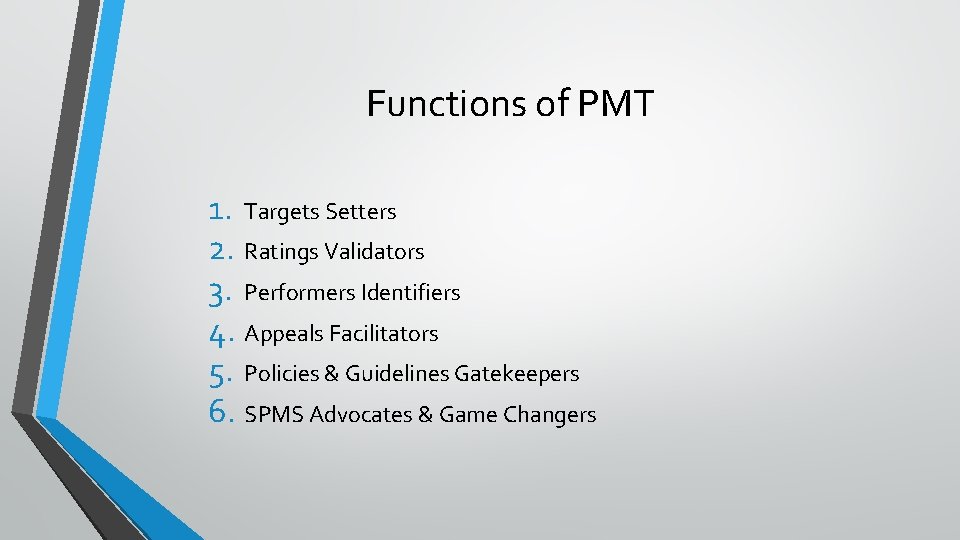
Functions of PMT 1. Targets Setters 2. Ratings Validators 3. Performers Identifiers 4. Appeals Facilitators 5. Policies & Guidelines Gatekeepers 6. SPMS Advocates & Game Changers
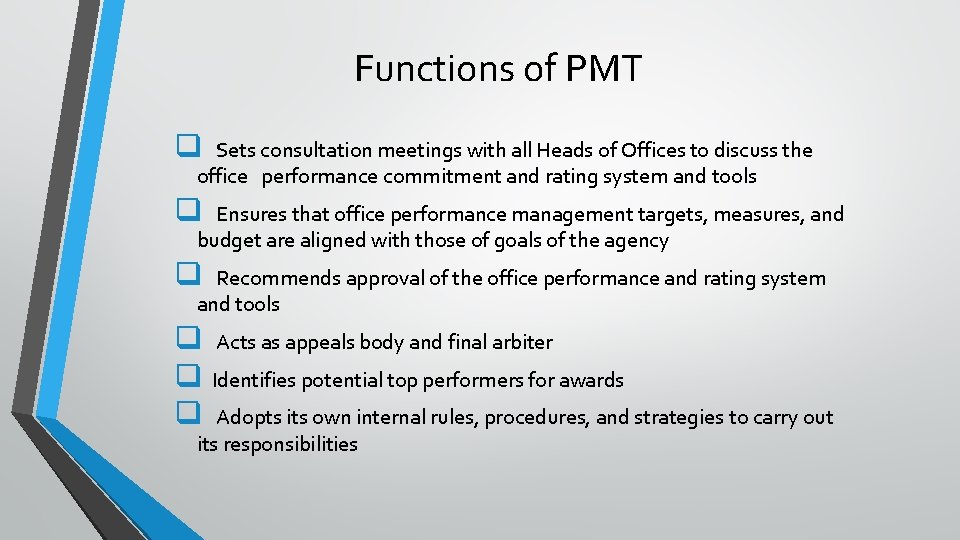
Functions of PMT q Sets consultation meetings with all Heads of Offices to discuss the office performance commitment and rating system and tools q Ensures that office performance management targets, measures, and budget are aligned with those of goals of the agency q Recommends approval of the office performance and rating system and tools q Acts as appeals body and final arbiter q Identifies potential top performers for awards q Adopts its own internal rules, procedures, and strategies to carry out its responsibilities
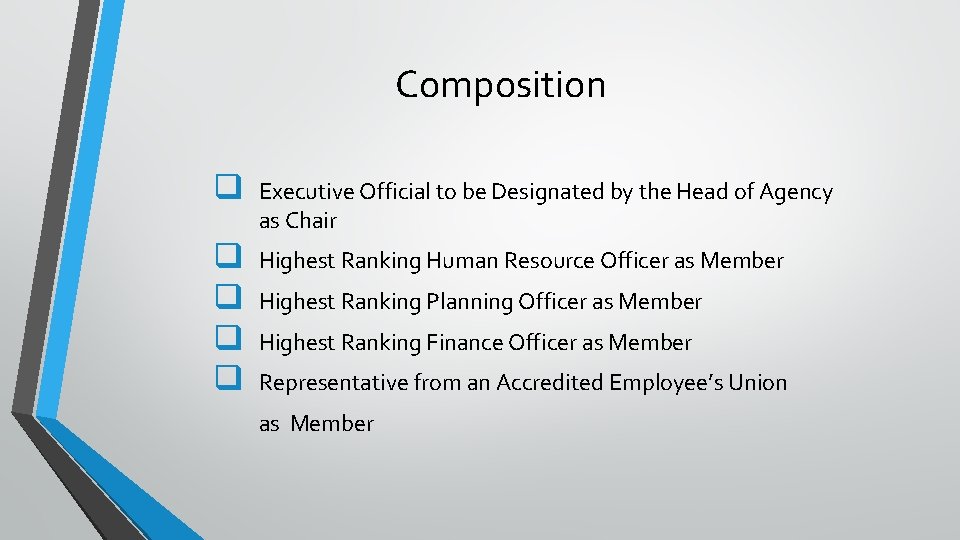
Composition q Executive Official to be Designated by the Head of Agency as Chair q q Highest Ranking Human Resource Officer as Member Highest Ranking Planning Officer as Member Highest Ranking Finance Officer as Member Representative from an Accredited Employee’s Union as Member
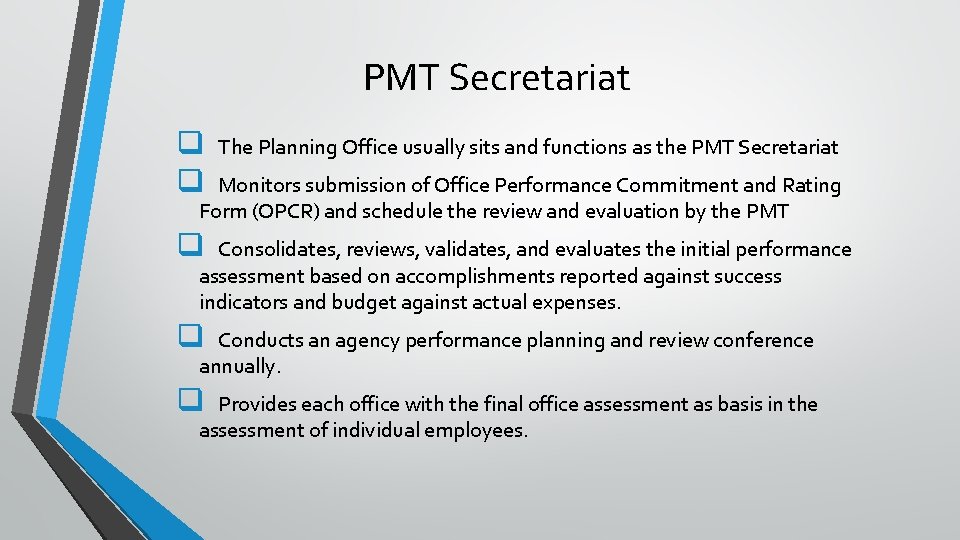
PMT Secretariat q q The Planning Office usually sits and functions as the PMT Secretariat Monitors submission of Office Performance Commitment and Rating Form (OPCR) and schedule the review and evaluation by the PMT q Consolidates, reviews, validates, and evaluates the initial performance assessment based on accomplishments reported against success indicators and budget against actual expenses. q Conducts an agency performance planning and review conference annually. q Provides each office with the final office assessment as basis in the assessment of individual employees.
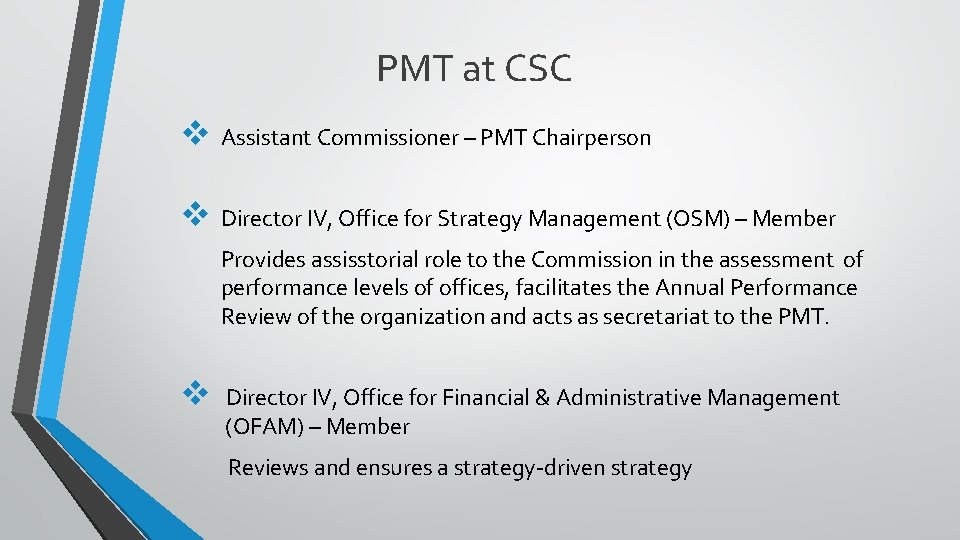
PMT at CSC v Assistant Commissioner – PMT Chairperson v Director IV, Office for Strategy Management (OSM) – Member Provides assisstorial role to the Commission in the assessment of performance levels of offices, facilitates the Annual Performance Review of the organization and acts as secretariat to the PMT. v Director IV, Office for Financial & Administrative Management (OFAM) – Member Reviews and ensures a strategy-driven strategy
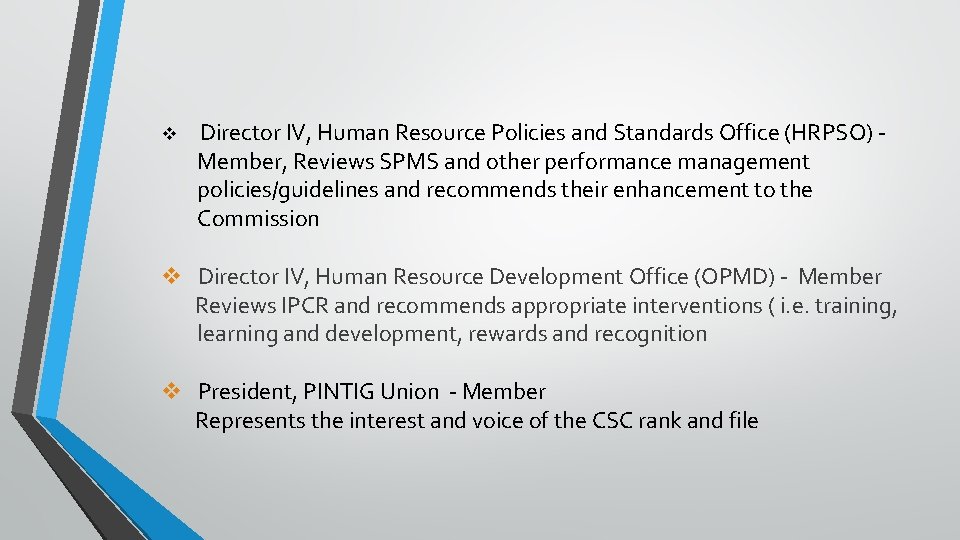
v Director IV, Human Resource Policies and Standards Office (HRPSO) Member, Reviews SPMS and other performance management policies/guidelines and recommends their enhancement to the Commission v Director IV, Human Resource Development Office (OPMD) - Member Reviews IPCR and recommends appropriate interventions ( i. e. training, learning and development, rewards and recognition v President, PINTIG Union - Member Represents the interest and voice of the CSC rank and file
On Target Setting ØOffices submit targets to Office for Strategic Management (OSM) ØOSM reviews, analyzes and aligns submitted targets ØOSM recommends changes, if necessary, and alignment of measures and even standardizes targets applicable to offices
ØOSM ensures that performance targets and measures as well as the budget are aligned with those of the organization and that work distribution among offices is rationalized. Should modification be necessary in the submitted OPCRs, the PMT shall inform the concerned head of office of the proposed changes ØPMT reviews thru panel deliberation. Invites concerned office to justify the targets and enlighten their proposed targets ØPMT votes on what to recommend for final approval of the Commission
On Rating Offices ØOSM consolidates monthly reports and quarterly assessment tools regularly submitted by offices ØOSM makes initial rating per office ØOSM recommends to PMT the initial ratings of offices ØPMT issues provisional rating to each office ØOffices are given a reasonable time to either validate, accept or make counter-comments on the initial rating of each office thru submission of verifiable output/documents/evidences
ØPMT may call office for calibration of initial ratings ØPMT conducts voting and final grading/ranking of offices ØPMT makes recommendation to the Commission/Head of Agency for approval of office ranking
PMT as Appeals Body • Non-submission of OPCR & IPCR to PMT within the specified time period will be ground for: q Employee’s disqualification for performance-based personnel actions q Administrative sanction for violation of reasonable office rules and regulations and simple neglect of duty for supervisors or employees responsible for delay or non-submission of the office and individual performance commitment and rating report q An Office/Unit or individual employee can file an appeal with the PMT within ten (10) days from the date of receipt of their performance evaluation rating
q The PMT shall decide on the appeals within one (1) month from receipt of such appeal q Officials or employees who are separated from the service on the basis of Unsatisfactory or Poor performance rating can appeal their separation to the CSC or its Regional Office within fifteen (15) days from receipt of the order or notice of separation
THANK YOU ! DIRECTOR NOEL V. SALUMBIDES Civil Service Commission Office of the President Field Office