
Office of Safety Health Consultation presents Health Hazards
- Slides: 44
Office of Safety & Health Consultation presents Health Hazards in Construction
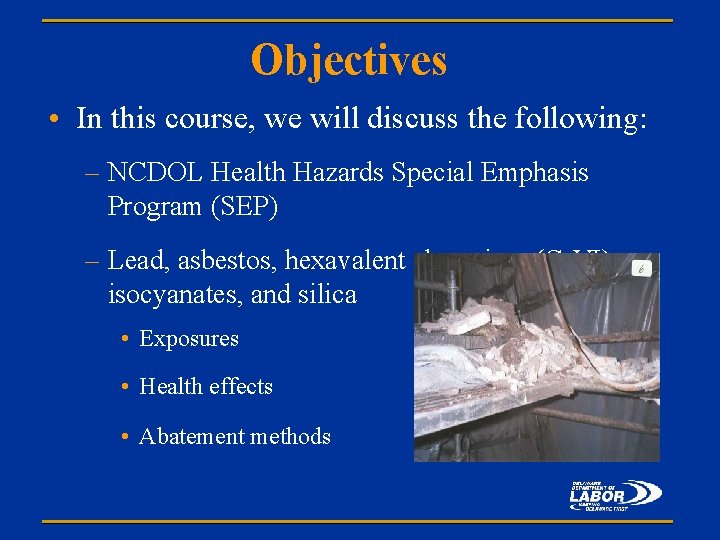
Objectives • In this course, we will discuss the following: – NCDOL Health Hazards Special Emphasis Program (SEP) – Lead, asbestos, hexavalent chromium (Cr. VI), isocyanates, and silica • Exposures • Health effects • Abatement methods
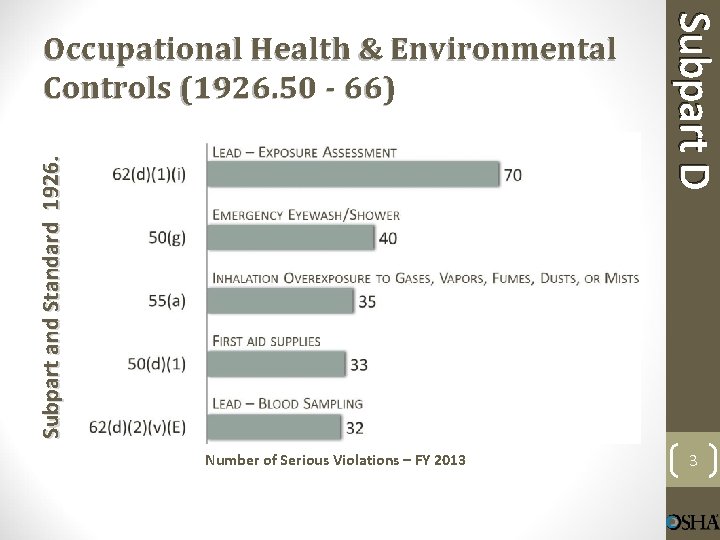
Subpart and Standard 1926. Number of Serious Violations – FY 2013 Subpart D Occupational Health & Environmental Controls (1926. 50 - 66) 3
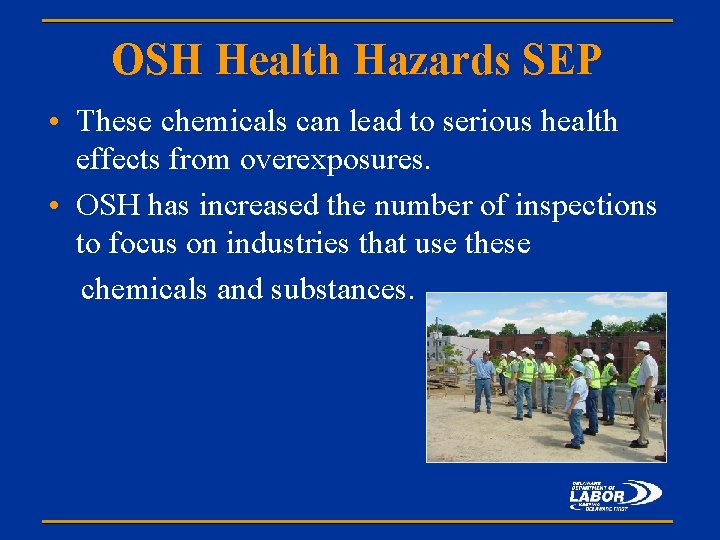
OSH Health Hazards SEP • These chemicals can lead to serious health effects from overexposures. • OSH has increased the number of inspections to focus on industries that use these chemicals and substances.
Health Hazards SEP Lead 29 CFR 1910. 1025 29 CFR 1926. 62
Lead Standard • Lead means metallic lead, all inorganic lead compounds, and organic lead soaps. – Excluded from this definition are all other organic lead compounds • Lead exposure sources – Lead-based paint, batteries, battery recycling, foundries, welding/cutting and brazing – Lead shot, indoor/outdoor shooting ranges – Contamination from work environment to hands, food, drinks, cosmetics, clothing, tobacco products 1910. 1025 1926. 62
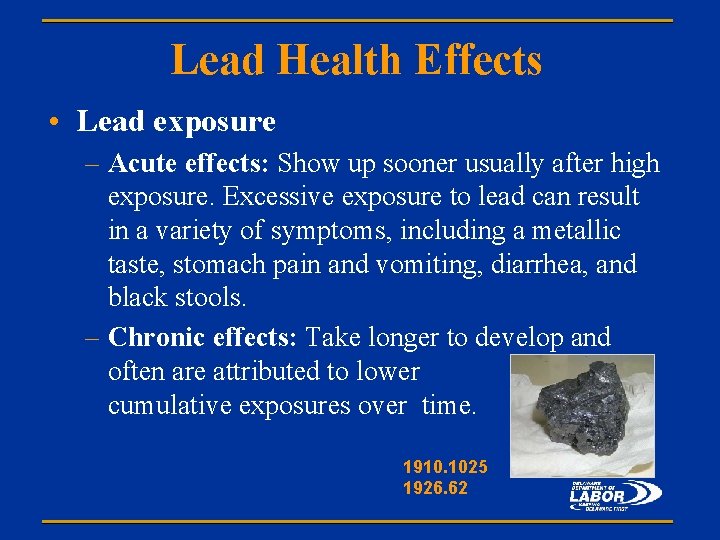
Lead Health Effects • Lead exposure – Acute effects: Show up sooner usually after high exposure. Excessive exposure to lead can result in a variety of symptoms, including a metallic taste, stomach pain and vomiting, diarrhea, and black stools. – Chronic effects: Take longer to develop and often are attributed to lower cumulative exposures over time. 1910. 1025 1926. 62
Lead Exposure Limits • Permissible exposure limit (PEL) = 50 µg/m³ as an 8 hour time-weighted average (TWA) – Employers shall implement engineering controls and safe work practices to prevent exposure. – Employers shall provide protective clothing and where necessary, and respiratory protection in accordance with 29 CFR 1910. 134. • Action Limit (AL) = 30 µg/m³ as an 8 hour TWA 1910. 1025 1926. 62
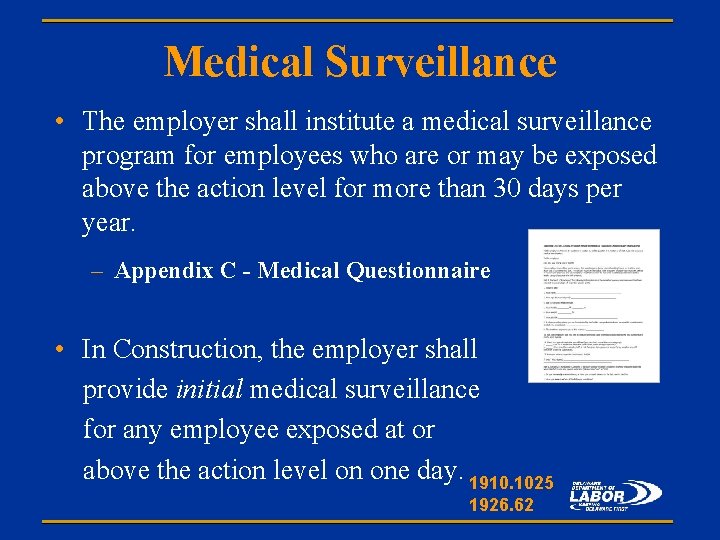
Medical Surveillance • The employer shall institute a medical surveillance program for employees who are or may be exposed above the action level for more than 30 days per year. – Appendix C - Medical Questionnaire • In Construction, the employer shall provide initial medical surveillance for any employee exposed at or above the action level on one day. 1910. 1025 1926. 62
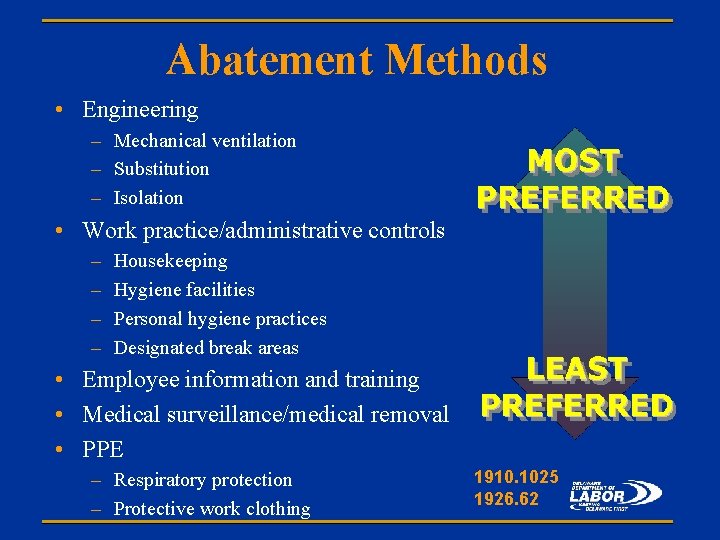
Abatement Methods • Engineering – Mechanical ventilation – Substitution – Isolation • Work practice/administrative controls – – Housekeeping Hygiene facilities Personal hygiene practices Designated break areas • Employee information and training • Medical surveillance/medical removal • PPE – Respiratory protection – Protective work clothing 1910. 1025 1926. 62
Health Hazards SEP Asbestos 29 CFR 1910. 1001 29 CFR 1926. 1101
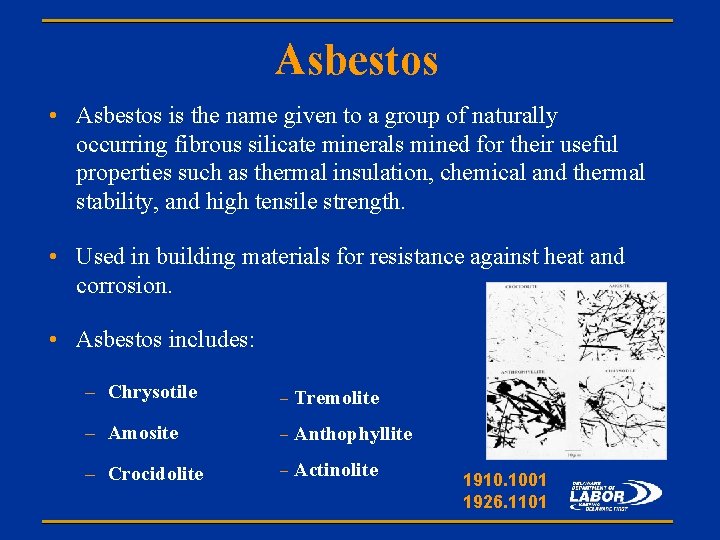
Asbestos • Asbestos is the name given to a group of naturally occurring fibrous silicate minerals mined for their useful properties such as thermal insulation, chemical and thermal stability, and high tensile strength. • Used in building materials for resistance against heat and corrosion. • Asbestos includes: – Chrysotile - Tremolite – Amosite - Anthophyllite – Crocidolite - Actinolite 1910. 1001 1926. 1101
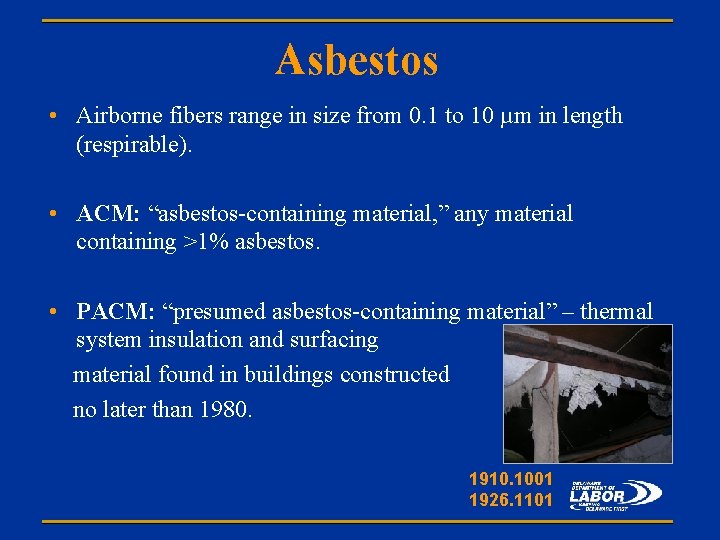
Asbestos • Airborne fibers range in size from 0. 1 to 10 µm in length (respirable). • ACM: “asbestos-containing material, ” any material containing >1% asbestos. • PACM: “presumed asbestos-containing material” – thermal system insulation and surfacing material found in buildings constructed no later than 1980. 1910. 1001 1926. 1101
Asbestos Health Effects • Asbestosis: A serious, progressive, long-term non-cancer disease of the lungs. • Lung cancer: Causes the largest number of deaths related to asbestos exposure. The most common symptoms of lung cancer are coughing and a change in breathing. • Mesothelioma: A rare form of cancer found in the thin lining (membrane) of the lung, chest, abdomen, and heart. Most cases are linked to asbestos exposure. 1910. 1001 1926. 1101
Exposure Limits • Permissible Exposure Limit (PEL) – 0. 1 fiber per cubic centimeter (f/cc) of air as an 8 hour TWA • Excursion Limit – Not more than 1 f/cc averaged over 30 minutes • Monitoring – Initially for workers who may be exposed at or above the PEL or above the excursion limit – Periodic if above PEL or excursion limit 1910. 1001 1926. 1101
Responsibility • Building/facility owner • Removal/abatement of asbestos is covered by 1926 • The following must be adhered to: – Multi-employer worksite • • Inform others of measures to control exposures Hazards abated by contractor who created Adjacent employer will check containment GC requires compliance – Competent person 1910. 1001 1926. 1101
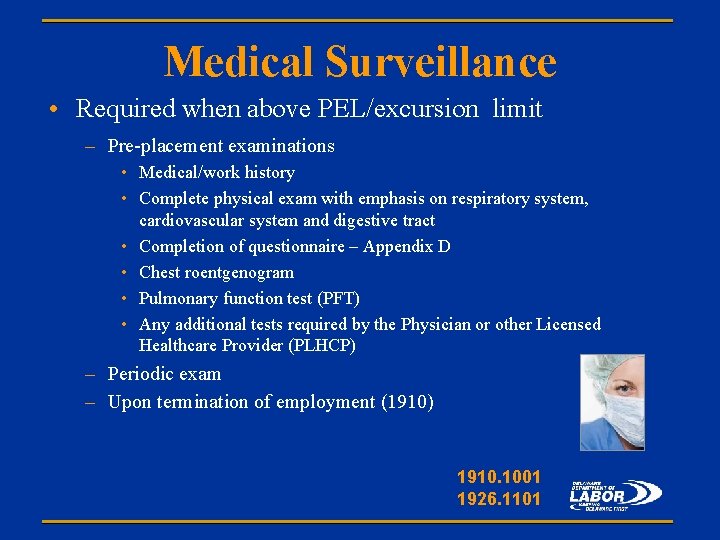
Medical Surveillance • Required when above PEL/excursion limit – Pre-placement examinations • Medical/work history • Complete physical exam with emphasis on respiratory system, cardiovascular system and digestive tract • Completion of questionnaire – Appendix D • Chest roentgenogram • Pulmonary function test (PFT) • Any additional tests required by the Physician or other Licensed Healthcare Provider (PLHCP) – Periodic exam – Upon termination of employment (1910) 1910. 1001 1926. 1101
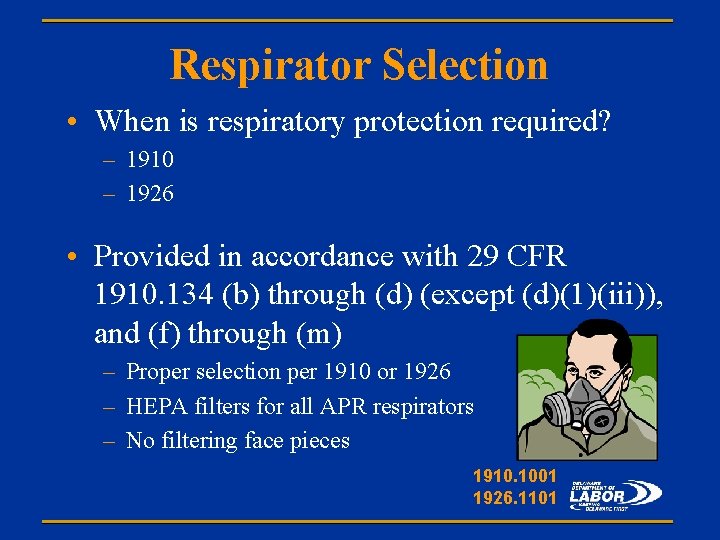
Respirator Selection • When is respiratory protection required? – 1910 – 1926 • Provided in accordance with 29 CFR 1910. 134 (b) through (d) (except (d)(1)(iii)), and (f) through (m) – Proper selection per 1910 or 1926 – HEPA filters for all APR respirators – No filtering face pieces 1910. 1001 1926. 1101
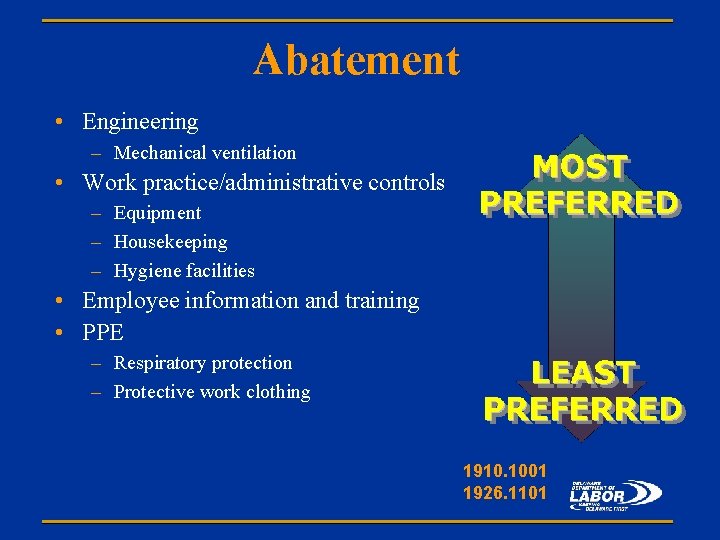
Abatement • Engineering – Mechanical ventilation • Work practice/administrative controls – Equipment – Housekeeping – Hygiene facilities • Employee information and training • PPE – Respiratory protection – Protective work clothing 1910. 1001 1926. 1101
Health Hazards SEP Hexavalent Chromium 29 CFR 1910. 1026 29 CFR 1926. 1126
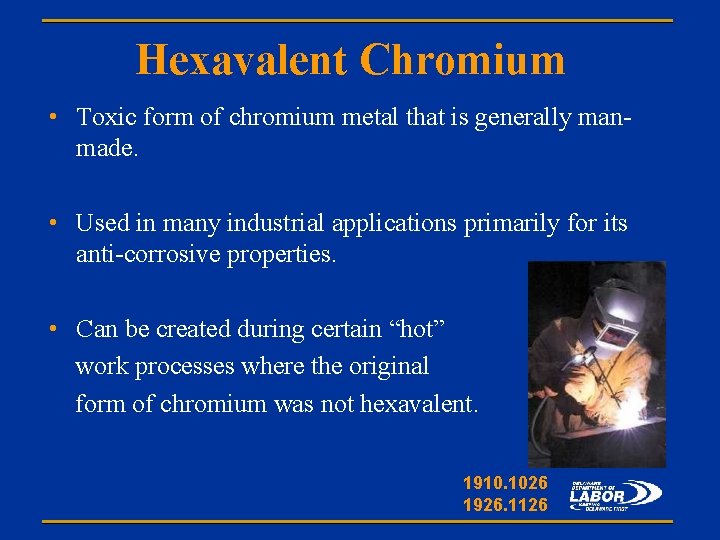
Hexavalent Chromium • Toxic form of chromium metal that is generally manmade. • Used in many industrial applications primarily for its anti-corrosive properties. • Can be created during certain “hot” work processes where the original form of chromium was not hexavalent. 1910. 1026 1926. 1126
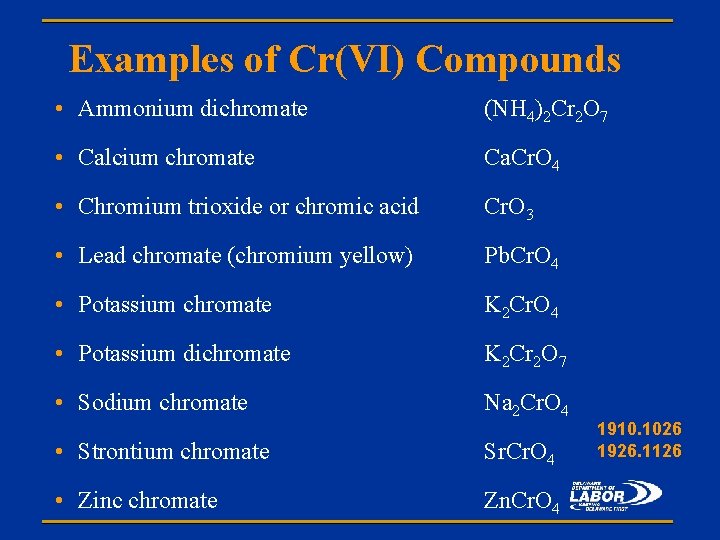
Examples of Cr(VI) Compounds • Ammonium dichromate (NH 4)2 Cr 2 O 7 • Calcium chromate Ca. Cr. O 4 • Chromium trioxide or chromic acid Cr. O 3 • Lead chromate (chromium yellow) Pb. Cr. O 4 • Potassium chromate K 2 Cr. O 4 • Potassium dichromate K 2 Cr 2 O 7 • Sodium chromate Na 2 Cr. O 4 • Strontium chromate Sr. Cr. O 4 • Zinc chromate Zn. Cr. O 4 1910. 1026 1926. 1126
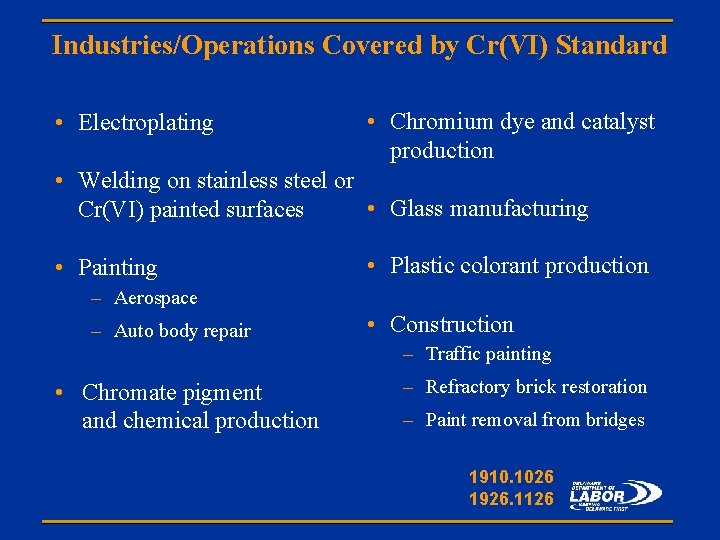
Industries/Operations Covered by Cr(VI) Standard • Electroplating • Chromium dye and catalyst production • Welding on stainless steel or • Glass manufacturing Cr(VI) painted surfaces • Painting • Plastic colorant production – Aerospace – Auto body repair • Construction – Traffic painting • Chromate pigment and chemical production – Refractory brick restoration – Paint removal from bridges 1910. 1026 1926. 1126
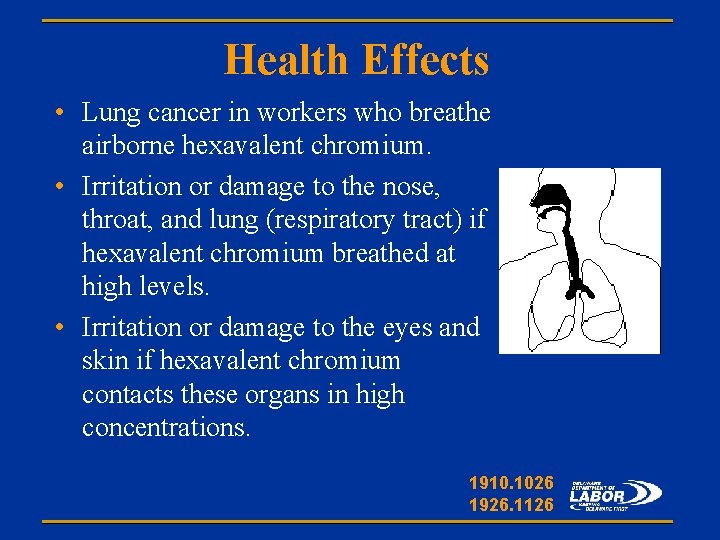
Health Effects • Lung cancer in workers who breathe airborne hexavalent chromium. • Irritation or damage to the nose, throat, and lung (respiratory tract) if hexavalent chromium breathed at high levels. • Irritation or damage to the eyes and skin if hexavalent chromium contacts these organs in high concentrations. 1910. 1026 1926. 1126
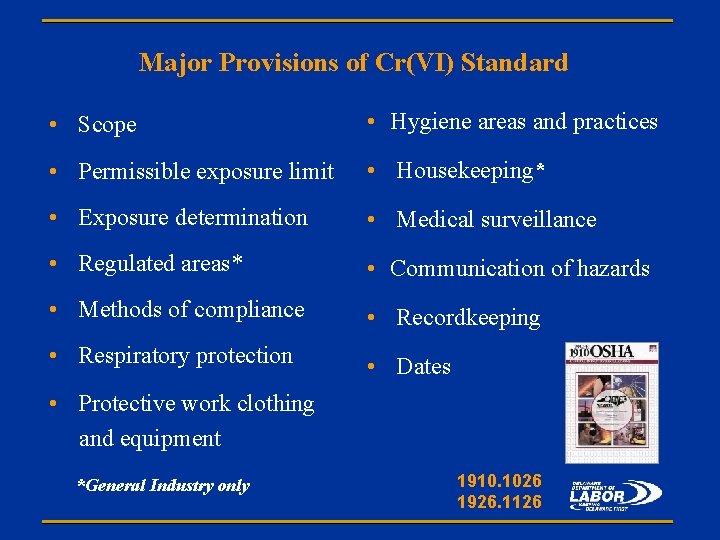
Major Provisions of Cr(VI) Standard • Scope • Hygiene areas and practices • Permissible exposure limit • Housekeeping* • Exposure determination • Medical surveillance • Regulated areas* • Communication of hazards • Methods of compliance • Recordkeeping • Respiratory protection • Dates • Protective work clothing and equipment *General Industry only 1910. 1026 1926. 1126
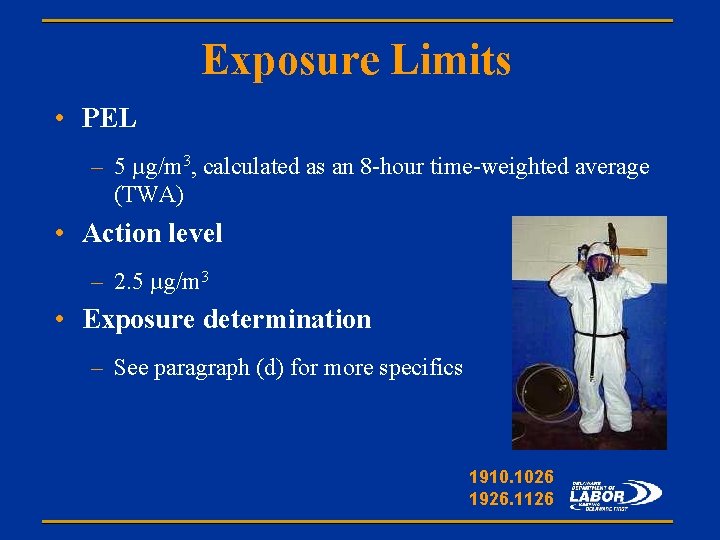
Exposure Limits • PEL – 5 µg/m 3, calculated as an 8 -hour time-weighted average (TWA) • Action level – 2. 5 µg/m 3 • Exposure determination – See paragraph (d) for more specifics 1910. 1026 1926. 1126
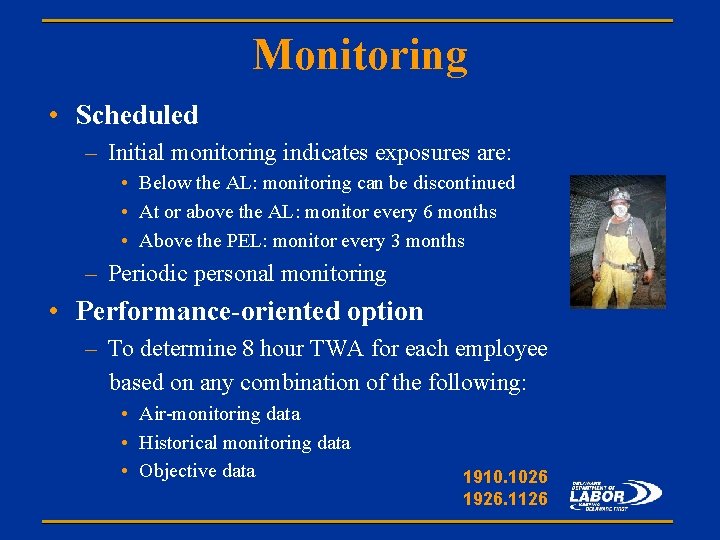
Monitoring • Scheduled – Initial monitoring indicates exposures are: • Below the AL: monitoring can be discontinued • At or above the AL: monitor every 6 months • Above the PEL: monitor every 3 months – Periodic personal monitoring • Performance-oriented option – To determine 8 hour TWA for each employee based on any combination of the following: • Air-monitoring data • Historical monitoring data • Objective data 1910. 1026 1926. 1126
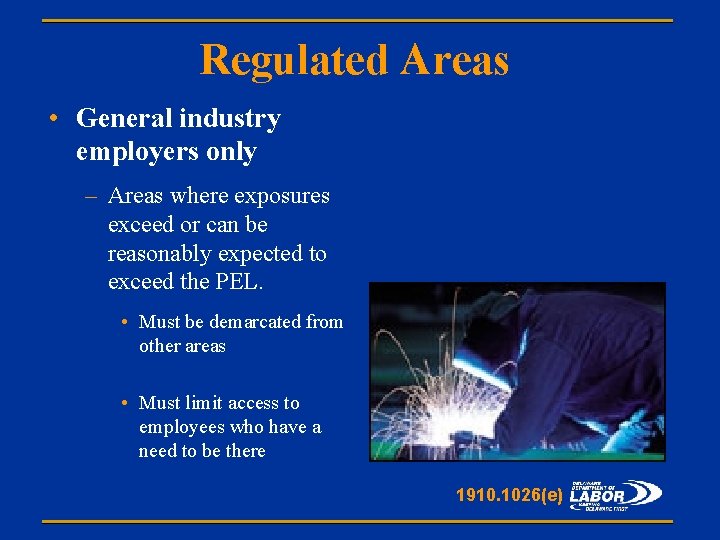
Regulated Areas • General industry employers only – Areas where exposures exceed or can be reasonably expected to exceed the PEL. • Must be demarcated from other areas • Must limit access to employees who have a need to be there 1910. 1026(e)
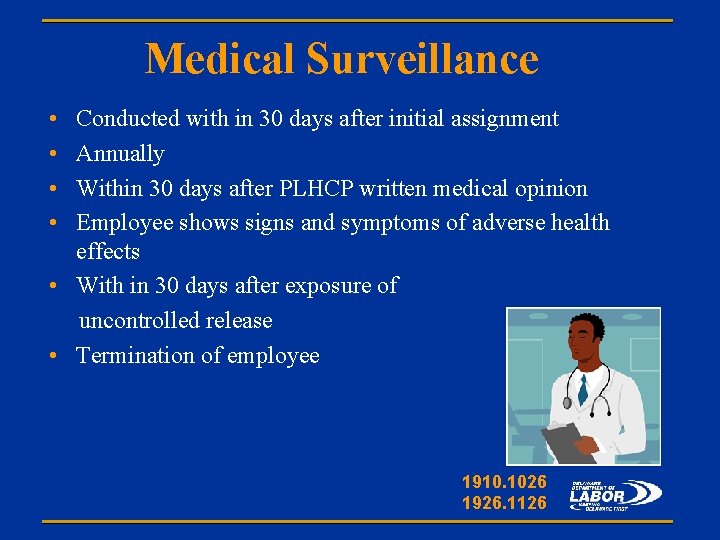
Medical Surveillance • • Conducted with in 30 days after initial assignment Annually Within 30 days after PLHCP written medical opinion Employee shows signs and symptoms of adverse health effects • With in 30 days after exposure of uncontrolled release • Termination of employee 1910. 1026 1926. 1126
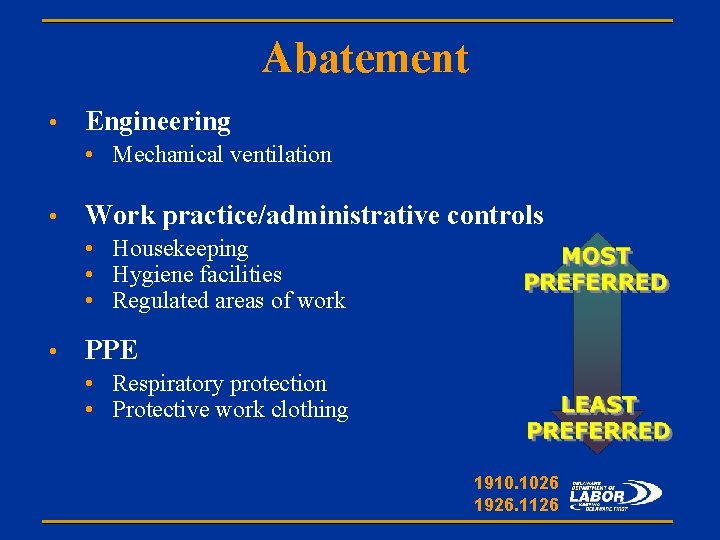
Abatement • Engineering • Mechanical ventilation • Work practice/administrative controls • Housekeeping • Hygiene facilities • Regulated areas of work • PPE • Respiratory protection • Protective work clothing 1910. 1026 1926. 1126
Health Hazards SEP Isocyanates 29 CFR 1910. 1000 29 CFR 1926. 55
Isocyanates • Compounds containing the isocyanate group (-NCO) – They react with compounds containing alcohol (hydroxyl) groups to produce polyurethane polymers, which are components of polyurethane foams, thermoplastic elastomers, spandex fibers, and polyurethane paints. • Are the raw materials that make up all polyurethane products • PELs/TLVs are very low (<1 ppm) 1910. 1000 1926. 55
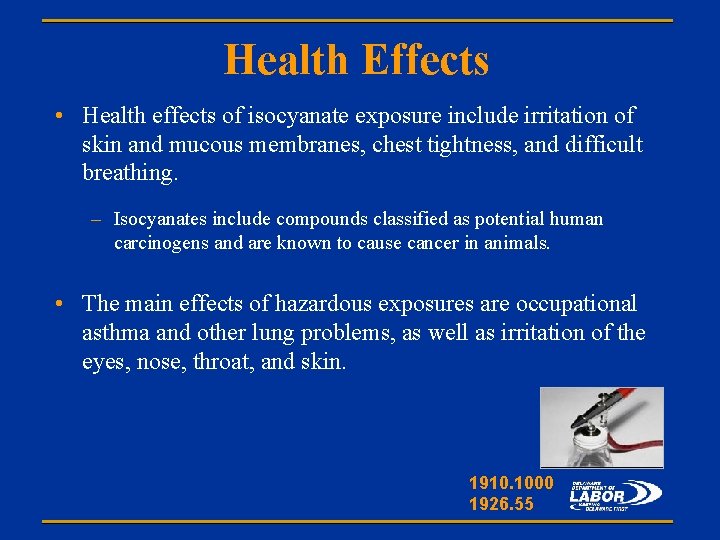
Health Effects • Health effects of isocyanate exposure include irritation of skin and mucous membranes, chest tightness, and difficult breathing. – Isocyanates include compounds classified as potential human carcinogens and are known to cause cancer in animals. • The main effects of hazardous exposures are occupational asthma and other lung problems, as well as irritation of the eyes, nose, throat, and skin. 1910. 1000 1926. 55
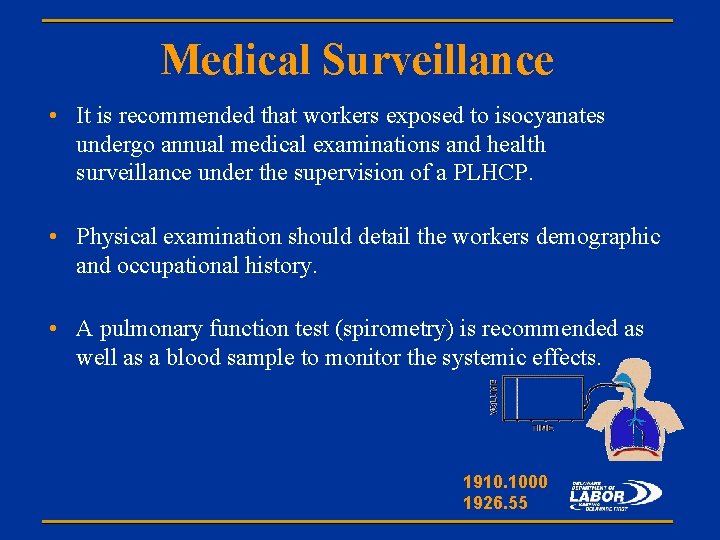
Medical Surveillance • It is recommended that workers exposed to isocyanates undergo annual medical examinations and health surveillance under the supervision of a PLHCP. • Physical examination should detail the workers demographic and occupational history. • A pulmonary function test (spirometry) is recommended as well as a blood sample to monitor the systemic effects. 1910. 1000 1926. 55
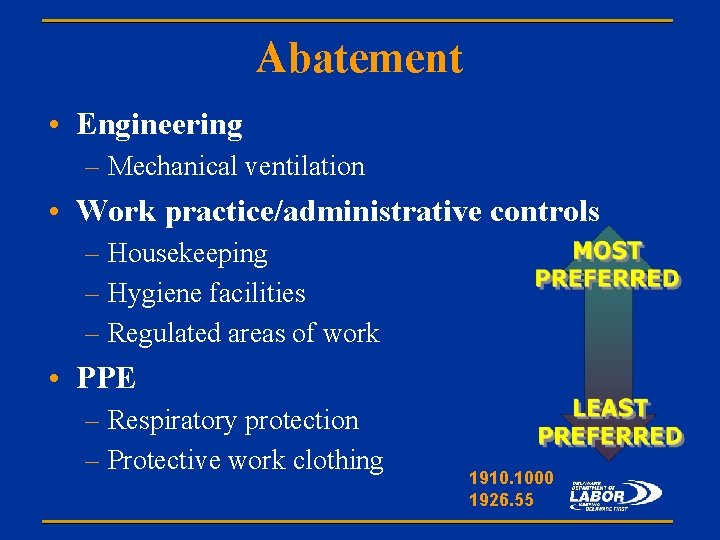
Abatement • Engineering – Mechanical ventilation • Work practice/administrative controls – Housekeeping – Hygiene facilities – Regulated areas of work • PPE – Respiratory protection – Protective work clothing 1910. 1000 1926. 55
Health Hazards SEP Silica 29 CFR 1910. 1000 29 CFR 1926. 55
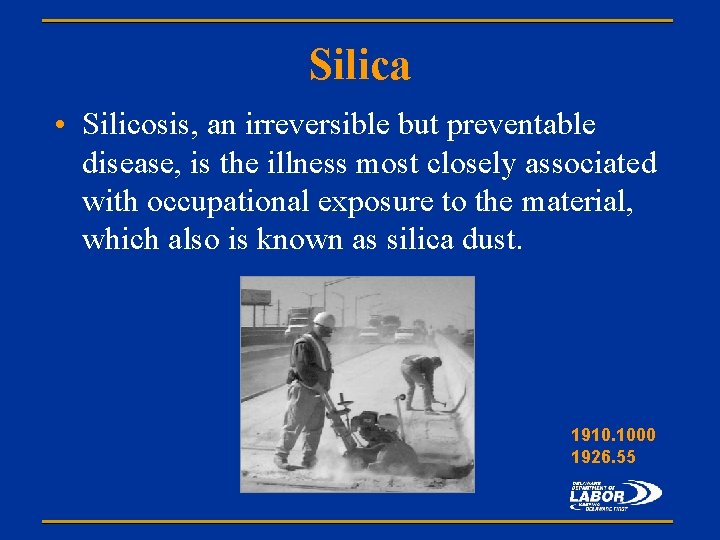
Silica • Silicosis, an irreversible but preventable disease, is the illness most closely associated with occupational exposure to the material, which also is known as silica dust. 1910. 1000 1926. 55
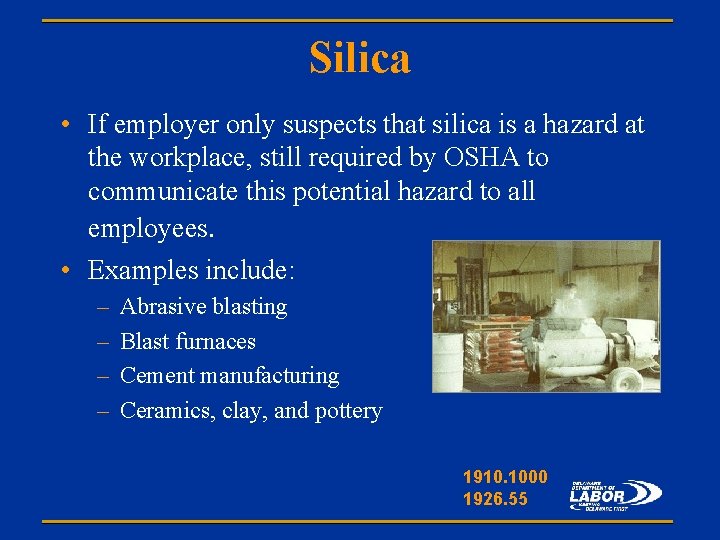
Silica • If employer only suspects that silica is a hazard at the workplace, still required by OSHA to communicate this potential hazard to all employees. • Examples include: – – Abrasive blasting Blast furnaces Cement manufacturing Ceramics, clay, and pottery 1910. 1000 1926. 55
Silica – – – Concrete mixing Demolition Electronics industry Foundry industry: grinding, molding, shakeout, core room (high risk) Hand molding, casting, and forming Jack hammer operations Manufacturing abrasives, paints, soaps, and glass Mining Rolling and finishing mills 1910. 1000 1926. 55 Sandblasting (high risk) Setting, laying, and repairing railroad track
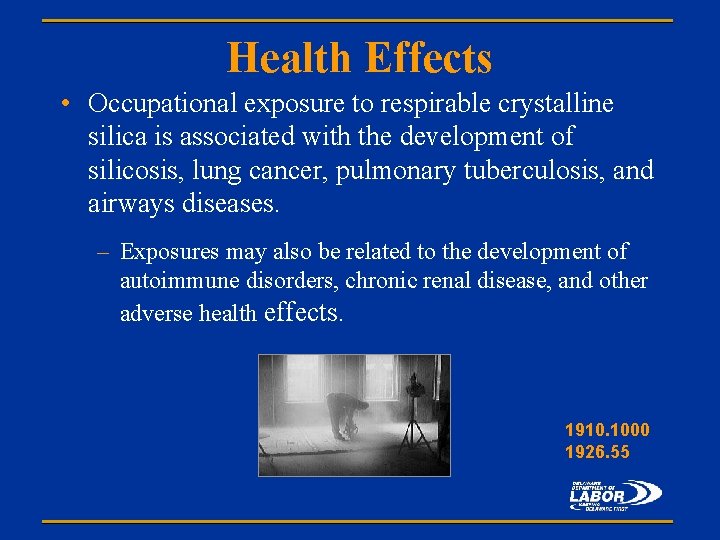
Health Effects • Occupational exposure to respirable crystalline silica is associated with the development of silicosis, lung cancer, pulmonary tuberculosis, and airways diseases. – Exposures may also be related to the development of autoimmune disorders, chronic renal disease, and other adverse health effects. 1910. 1000 1926. 55
OSHA PEL’s for Silica • Silica: – Crystalline quartz (respirable) PEL = 10 mg/m³ ÷ % silica + 2 – Crystalline quartz (total dust) PEL = 30 mg/m³ ÷ % silica + 2 • For cristobalite and tridymite, use 1/2 the value calculated from the formula for quartz. 1910. 1000 1926. 55
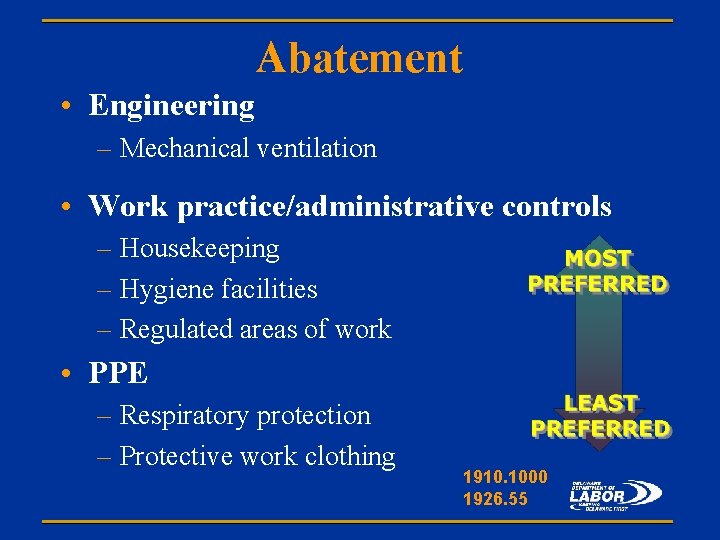
Abatement • Engineering – Mechanical ventilation • Work practice/administrative controls – Housekeeping – Hygiene facilities – Regulated areas of work • PPE – Respiratory protection – Protective work clothing 1910. 1000 1926. 55
Summary • In this course, we have discussed the following: – NCDOL Health Hazards Special Emphasis Program – Lead, asbestos, hexavalent chromium , isocyanates, and silica • Exposures • Health effects • Abatement methods
Your Questions?