
Office of Public Health Environmental Hazards Why Military
Office of Public Health & Environmental Hazards Why Military Culture Matters: The Military Member’s Experience Maria Falca-Dodson, Maj Gen Assistant Director, Outreach
Objectives § Understand military structure and processes § Describe the demographics of today’s military § Understand military acronyms § Describe stresses by mission and conflict § Identify implications for civilians and especially the clinician
What is the Military? “Not just a job, a way of life. ” Duty ▪ Honor ▪ Courage A Vet is a Vet History and Purpose Governed by Civilians
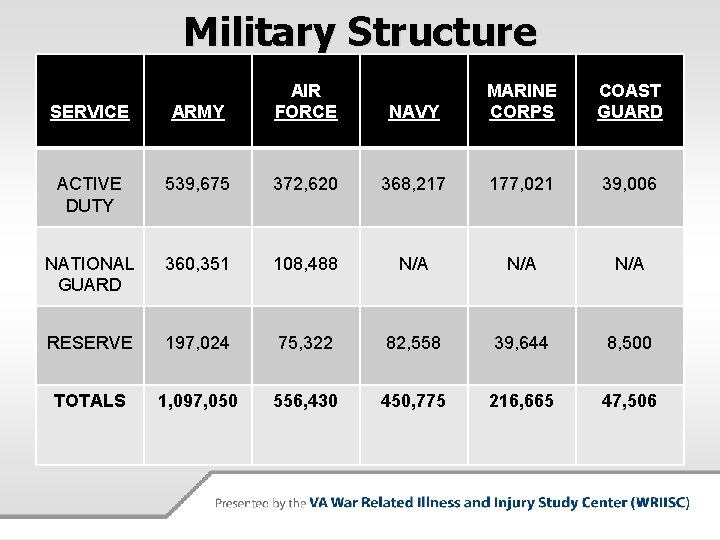
Military Structure SERVICE ARMY AIR FORCE NAVY MARINE CORPS COAST GUARD ACTIVE DUTY 539, 675 372, 620 368, 217 177, 021 39, 006 NATIONAL GUARD 360, 351 108, 488 N/A N/A RESERVE 197, 024 75, 322 82, 558 39, 644 8, 500 TOTALS 1, 097, 050 556, 430 450, 775 216, 665 47, 506

Military Structure § Military Rank/Chain of Command: Officer, Warrant Officer, Enlisted/NCO § Specialty: MOS, AFSC, Navy Ratings § Unique Identifiers: All Insignia, Dog Tags, Customs and Courtesies

Core Values Duty ▪ Honor ▪ Country § Army: Loyalty, Duty, Respect, Selfless Service, Honor, Integrity, Personal Courage § Navy and Marine Corps: Honor, Courage, Commitment § Air Force: Integrity, Service before Self, Excellence § Coast Guard: Honor, Respect, Devotion to Duty
Military Operational Organization § Status: § Active Duty § National Guard § Reserve § Doctrine and Regulations
MILITARY OPERATIONAL ORGANIZATION § Organizations: § Army: Corps, Division, Brigade, Battalion, Company, Platoon, Squad § AF: Wing, Group, Squadron, Flight § Navy: The Fleet, Task Forces § Marine Corps: Fleet Marine Force, Marine Air Ground Task Force, Marine Expeditionary Unit

Today’s Military Demographics § Specifics vary by service § All volunteer force for 37 years § 2. 2 M total serving in uniform today vs. 15 M in WWII § Racial integration in 1948 § 15% are women

Today’s Military Demographics in Comparison to the Draft Population § Average is older § Educational backgrounds higher—percent college graduates, high school/GED requirement, ASVAB scores § Marital status higher than civilian § Heritage: “military brat”
Training Basic Principles of Recruit Training § Marines: Rise at 0500, train until 2000 § Army: Rise at 0600, train until 1900 § Navy: Rise at 0900, train until 1100, lunch until 1300, train until 1600 § Air Force: Rise at 1000, breakfast in bed, lunch at 1200, nap at 1400, training ceases at 1500
Training § Basic military training-more similarities between the services now § Advanced/Technical: differs by service and specialty § Ancillary Training: OPSEC, COMSEC, ATSO, Sexual Harassment § Professional Military Education: differs by service and rank (officer/enlisted)
Common Reasons Why Members Join § Defined in Terms of Values with Both Personal and Social Significance § Challenge § Service/Sacrifice § Education/Training Opportunities § Economic Issues—Bonus § Sense of Adventure/Escape Life Situation
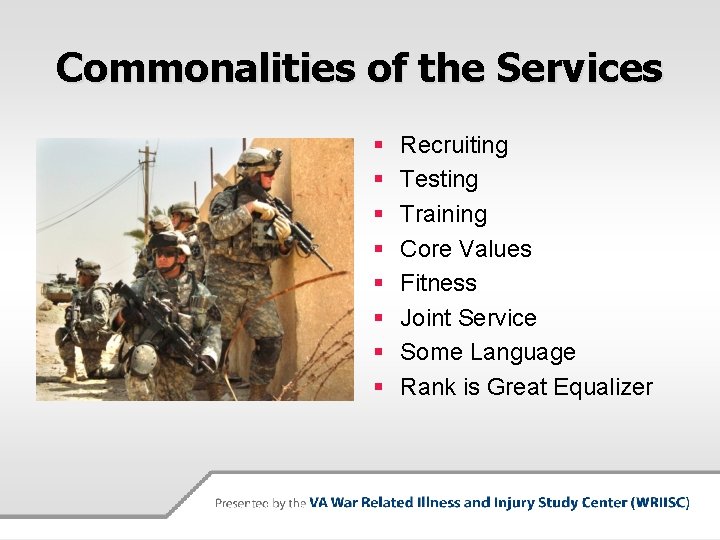
Commonalities of the Services § § § § Recruiting Testing Training Core Values Fitness Joint Service Some Language Rank is Great Equalizer
Differences of the Services § Mission § Individual Service Culture § How to grow leaders § Uniforms—ABUs, ACUs, service & mess § Rank Insignia: Army/Air Force vs. Navy § Language: § “Down range, ” Post/Base § Acronyms—AMC, APC, TAG, CBT, BOG, TDY, PCS, AOR, FOB
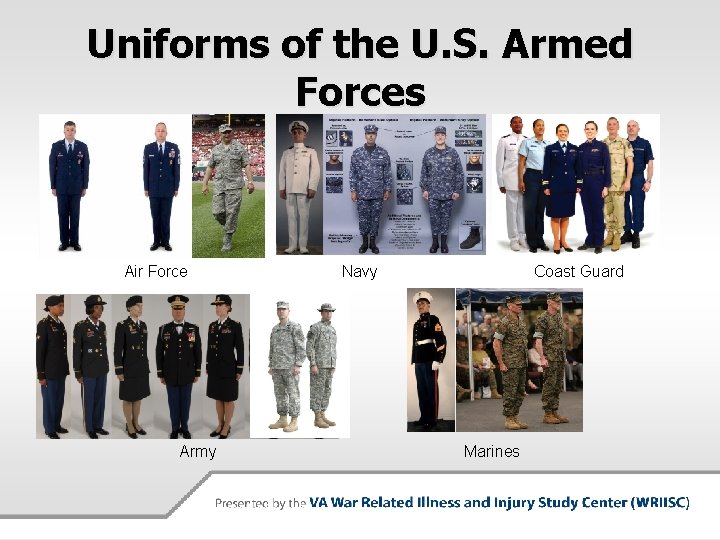
Uniforms of the U. S. Armed Forces Air Force Army Navy Coast Guard Marines
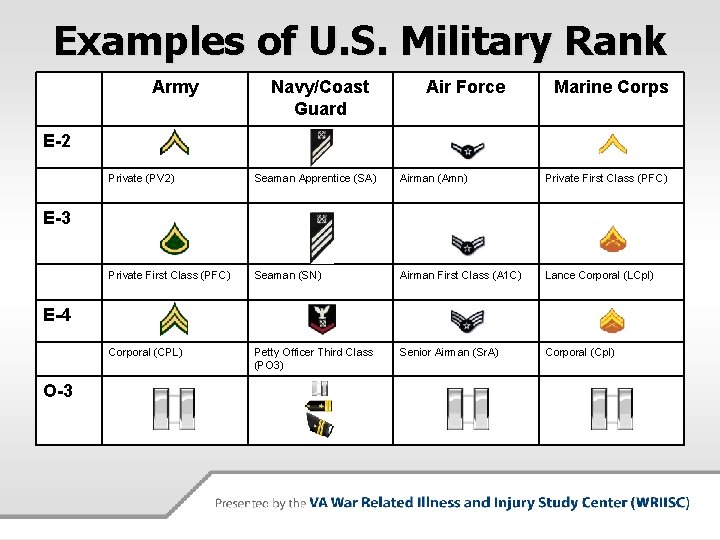
Examples of U. S. Military Rank Army Navy/Coast Guard Air Force Marine Corps E-2 Private (PV 2) Seaman Apprentice (SA) Airman (Amn) Private First Class (PFC) Seaman (SN) Airman First Class (A 1 C) Lance Corporal (LCpl) Corporal (CPL) Petty Officer Third Class (PO 3) Senior Airman (Sr. A) Corporal (Cpl) E-3 E-4 O-3
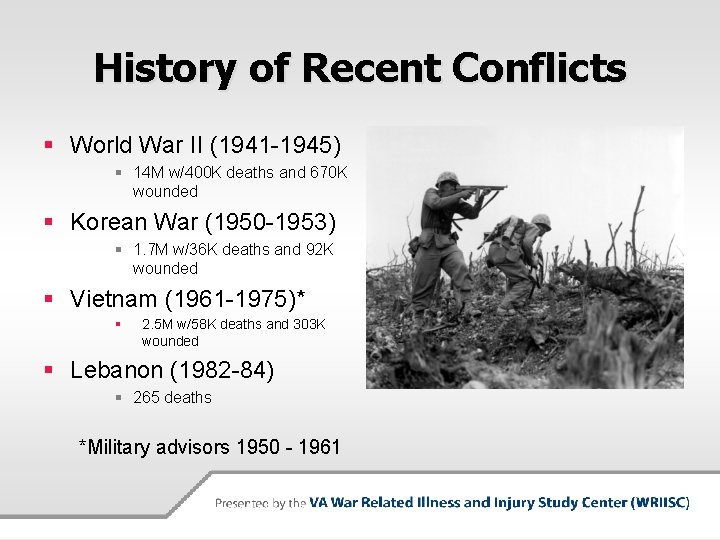
History of Recent Conflicts § World War II (1941 -1945) § 14 M w/400 K deaths and 670 K wounded § Korean War (1950 -1953) § 1. 7 M w/36 K deaths and 92 K wounded § Vietnam (1961 -1975)* § 2. 5 M w/58 K deaths and 303 K wounded § Lebanon (1982 -84) § 265 deaths *Military advisors 1950 - 1961
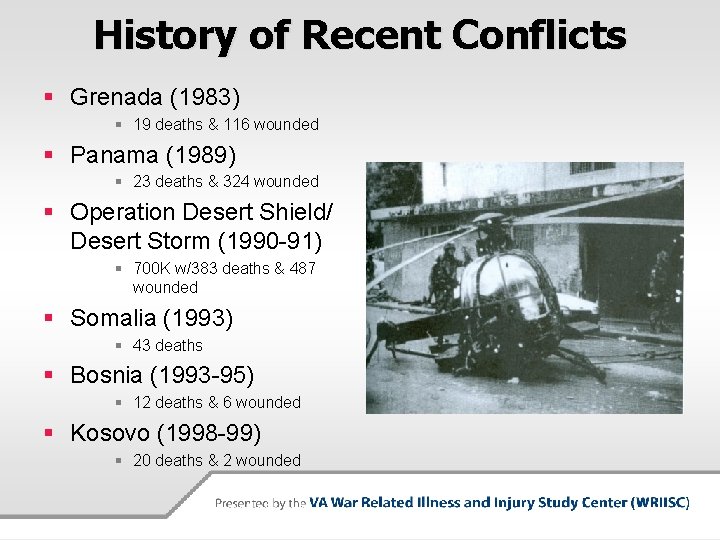
History of Recent Conflicts § Grenada (1983) § 19 deaths & 116 wounded § Panama (1989) § 23 deaths & 324 wounded § Operation Desert Shield/ Desert Storm (1990 -91) § 700 K w/383 deaths & 487 wounded § Somalia (1993) § 43 deaths § Bosnia (1993 -95) § 12 deaths & 6 wounded § Kosovo (1998 -99) § 20 deaths & 2 wounded
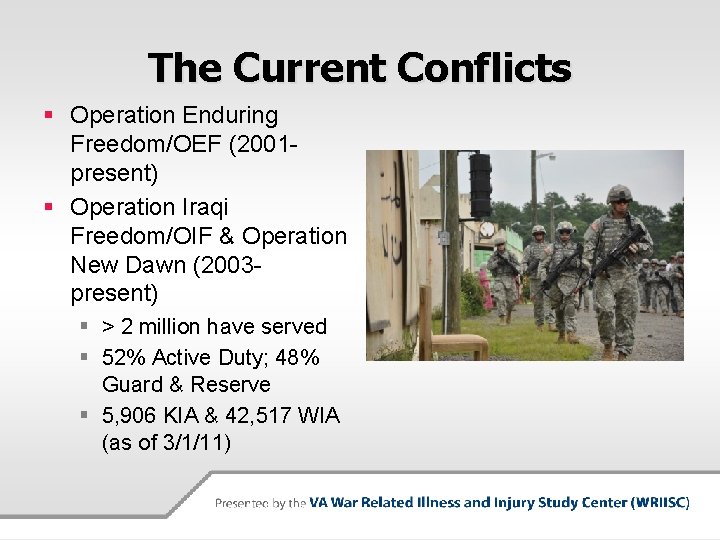
The Current Conflicts § Operation Enduring Freedom/OEF (2001 present) § Operation Iraqi Freedom/OIF & Operation New Dawn (2003 present) § > 2 million have served § 52% Active Duty; 48% Guard & Reserve § 5, 906 KIA & 42, 517 WIA (as of 3/1/11)
Commonality in Conflict. Stressors § High Risk Occupation § Harsh, Lethal Environment (Personal Threat/Loss of Life) § Number and Length of Deployments § Personal History/Experience Prior to Deployment § Perception of Expectations Fulfilled § Separation from Family
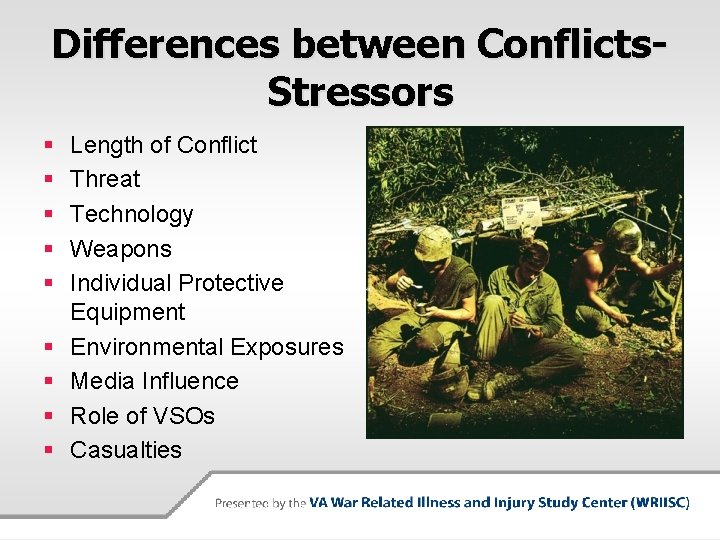
Differences between Conflicts. Stressors § § § § § Length of Conflict Threat Technology Weapons Individual Protective Equipment Environmental Exposures Media Influence Role of VSOs Casualties
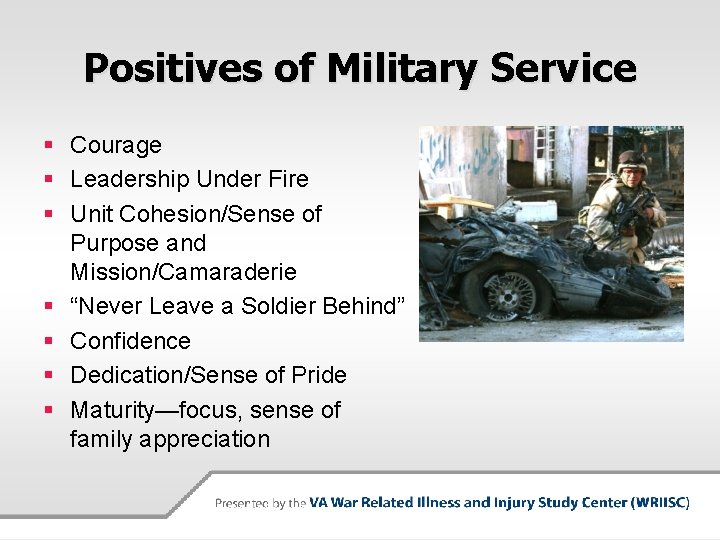
Positives of Military Service § Courage § Leadership Under Fire § Unit Cohesion/Sense of Purpose and Mission/Camaraderie § “Never Leave a Soldier Behind” § Confidence § Dedication/Sense of Pride § Maturity—focus, sense of family appreciation
QUESTIONS?
Resources § DOD DICTIONARY OF MILITARY TERMS: www. dtic. mil/doctrine/dod_dictionary § OFFICER AND ENLISTED RANKS: www. defense. gov/specials/insignias
- Slides: 26