
Office of Firefighter Training Firefighter I II Laws
- Slides: 65
Office of Firefighter Training Firefighter I & II Laws, Rules, and Standards Michigan Office of Firefighter Training 1
Objectives Demonstrate an understanding of federal laws and rules Demonstrate an understanding of State of Michigan laws and rules Demonstrate an understanding of National Fire Protection Association consensus standards Michigan Office of Firefighter Training 2
Introduction All aspects of fire department operations now have laws, rules, and standards governing what we do Michigan Office of Firefighter Training 3
Laws, Rules, Standards Affect Training Apparatus – Construction – Maintenance – Operation Equipment – Use – Maintenance Michigan Office of Firefighter Training 4
Laws, Rules, Standards Affect Fire Fighter Safety Protective Clothing – Construction – Design – Use Emergency Scene Operations Incident Command Michigan Office of Firefighter Training 5
Define the Terms Laws Rules Standards Michigan Office of Firefighter Training 6
Define the Terms Law – – A principle prescribed by the governing authority imposing a conduct, procedure, or action upon people who have an obligation of obedience Michigan Office of Firefighter Training 7
Define the Terms Rule – – A guide or directive issued by an agent or agency of the governing authority regulating the practice(s) of affected parties Michigan Office of Firefighter Training 8
Rules Can you give examples of governmental rules that affect the fire service? – Federal Environmental Protection Agency (Hazardous Materials) Michigan Office of Firefighter Training 9
Rules – State DELEG/MIOSHA General Industry Safety Division – Firefighter safety relating to tools, apparatus, protective clothing, etc; Items found in MIOSHA part 74 firefighting. DELEG/MIOSHA Occupational Health Division – SCBA use and face piece fit testing, 2 in/ 2 out guidelines, firefighter medical evaluations, Employee Right to Know, etc. MDCH Emergency Medical Services (EMS) Division – EMS licensing DELEG/Bureau of Fire Services – State Fire Safety Board, fire safety inspections of hospitals, adult foster care homes, etc. Michigan Office of Firefighter Training 10
Define the Terms Standard – – A degree or level of requirements, excellence, or attainment established by a general consent of the members of a recognized and accepted non-governmental group or organization Michigan Office of Firefighter Training 11
Standards NFPA - National Fire Protection Association – Most familiar standards agency to the fire service – Has developed several standards that affect the fire service and industry – Reviews and revises standards every 5 years Michigan Office of Firefighter Training 12
NFPA Standards Two most common standards we will deal with in the class are: NFPA 1500 – Fire Department Occupational Safety and Health Program NFPA 1001 – Standard for Firefighter Professional Qualifications Michigan Office of Firefighter Training 13
Definition Code – Simply brings together several requirements (laws, rules, standards) which have a common factor, into a single document – Examples: Code of Ordinances Vehicle Code Fire Prevention Code Michigan Office of Firefighter Training 14
Reasons for Laws, Rules & Standards New requirements are usually made because we fail to effectively or safely deal with a particular situation Michigan Office of Firefighter Training 15
Reasons for Laws, Rules & Standards Examples – NFPA 1500 Fire Department Safety Originally adopted in 1987 because of the fire service’s exceedingly poor record of occupational death and injury statistics – DELEG/MIOSHA General Industry Safety & Health – Part 74 Fire Fighting Safety Rule First developed and adopted in 1977 Michigan’s fire services first attempt to reduce firefighter injuries and deaths Michigan Office of Firefighter Training 16
Reasons for Laws, Rules & Standards Under Michigan law, there is no legal obligation to provide fire protection to the residents of cities, villages, or townships HOWEVER, Once the community decides to provide fire protection ALL of the laws, rules, etc. , MUST BE FOLLOWED Michigan Office of Firefighter Training 17
Act 207 of 1941 as amended Michigan Fire Prevention Code First passed in 1941 and amended many time since Basic State law establishing the duties and powers of: – The State Fire Safety Board – The State Fire Marshal – The local fire chief/officials Michigan Office of Firefighter Training 18
Bureau of Fire Services Conduct plan reviews, construction inspections, and periodic inspections of State regulated facilities Certify fire inspectors according to qualifications of the Fire Safety Board State Fire Safety Board – Make rules enforced by BFS and local inspectors – Hear appeals on the enforcement of the rules Michigan Office of Firefighter Training 19
State Fire Marshal Has primary enforcement responsibility for Act 207 as well as: – Implementing and operating the Fire Incident Reporting System – Abatement of virtually any dangerous condition found to exist within the state May order whatever actions are necessary to correct or make the situations safe Michigan Office of Firefighter Training 20
Local Fire Chief Act 207 gives the chief or firefighter in uniform acting under orders of the chief the authority and duty to: – Investigate dangerous conditions in local communities and take necessary steps to protect persons and property until the dangerous condition is abated – Conduct inspections for the discovery of fire hazards Michigan Office of Firefighter Training 21
Local Fire Chief Authority and duty, continued – – Cause fire drills in schools, colleges and dormitories – Report immediately to the State Fire Marshal any hazardous materials incident – Make and file NFIRS reports monthly Michigan Office of Firefighter Training 22
Personnel Safety and Operations Safety Laws and Rules Michigan Office of Firefighter Training 23
OSHA Act of 1970 Under this act, OSHA was created within the US Department of Labor to accomplish three goals: – Encourage employers and employees to reduce workplace hazards and implement new or improve existing safety and health programs – Develop mandatory job safety and health rules and enforce them effectively – Establish training programs to increase the number and competence of occupational safety and health personnel Michigan Office of Firefighter Training 24
OSHA Act of 1970 States have the option of enforcing their own “OSHA” programs. State standards must be at least as stringent as the federal standards Michigan Office of Firefighter Training 25
Michigan OSHA Act of 1974 (Act 154) MIOSHA – Enacted in Michigan because the state chose to operate its own OSHA program Fire departments MUST comply with the rules developed under the authority of Act 154 – All departments whether paid, part paid, or volunteer are subject to the provisions of the law – All members whether paid, part paid, or volunteer are considered employees and are subject to the provisions of the law Michigan Office of Firefighter Training 26
Michigan OSHA Act of 1974 (Act 154) 5 key elements firefighters need to know: – DELEG/MIOSHA – Part 451. Respiratory Protection Part 433. Personal Protective Equipment Michigan Office of Firefighter Training 27
Michigan OSHA Act of 1974 (Act 154) – DELEG: General Industry Safety & Health – Part 74. Fire Fighting (Fire Fighter Safety) Safety rules for fire departments and firefighters in emergency and non emergency situations MIOSHA can and does enforce their rules for fire departments Employers – City, village, township, or fire district board through the fire department MUST comply with rules developed by DELEG/MIOSHA. The employer must provide training for all employees and assure that all employees follow the provisions of the rules Firefighters, as employees, must by law comply with the provisions of the law and are OBLIGATED to follow safety rules. Michigan Office of Firefighter Training 28
MIOSHA Part 74. Fire Fighting Applicability – Rule 7402. A person who is functioning as a municipal firefighter and who is exposed to the hazards of an emergency operation shall comply with this part. Michigan Office of Firefighter Training 29
MIOSHA Part 74. Fire Fighting Duties of employer – Rule 7411. PROVIDE TRAINING TO AN EMPLOYEE COMMENSURATE WITHTHOSE DUTIES AND FUNCTIONS THAT THE EMPLOYEE IS EXPECTED TO PERFORM. Assure that prospective personnel are physically fit and have the ability to perform assigned emergency operations Assure that job-related equipment and tools are maintained free of recognized defects which could cause an injury The employer shall prepare and maintain a statement or written policy which establishes its basic organizational structure and which establishes the type, amount, and frequency of training to be provided to fire service personnel Michigan Office of Firefighter Training 30
MIOSHA Part 74. Fire Fighting Duties of employee – Rule 7412 Use personal protective equipment as prescribed by this part Report defective equipment, tools, and hazardous conditions to a supervisor Not remove safeguards from equipment except when necessary to service. The safeguard or equivalent shall be replaced before returning the equipment to operation Not use equipment and tools unless trained in their use and authorized to do so Michigan Office of Firefighter Training 31
MIOSHA Part 74. Fire Fighting Personal protective equipment – Rule 7431 An employer shall assure that all emergency service personnel use PPE appropriate for the exposure involved while performing emergency operations PPE shall be provided by the employer at no cost to the employee and shall comply with the requirements of this part PPE that is used by more than 1 employee shall be cleaned or sanitized before reassignment PPE shall be inspected after each use Michigan Office of Firefighter Training 32
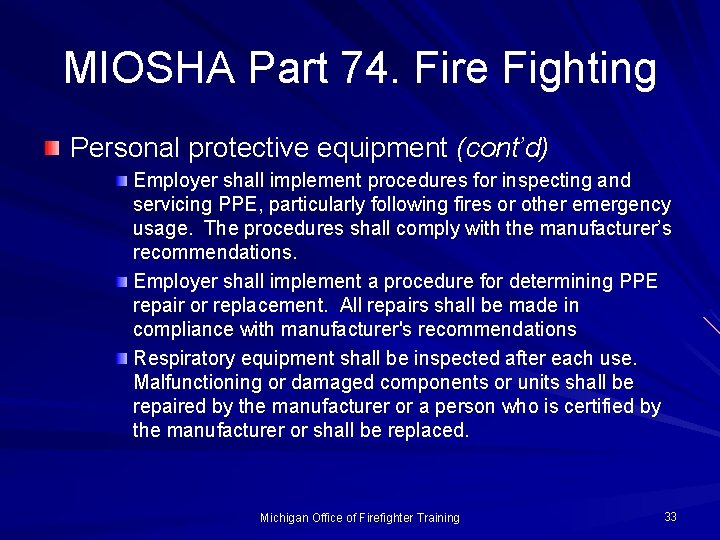
MIOSHA Part 74. Fire Fighting Personal protective equipment (cont’d) Employer shall implement procedures for inspecting and servicing PPE, particularly following fires or other emergency usage. The procedures shall comply with the manufacturer’s recommendations. Employer shall implement a procedure for determining PPE repair or replacement. All repairs shall be made in compliance with manufacturer's recommendations Respiratory equipment shall be inspected after each use. Malfunctioning or damaged components or units shall be repaired by the manufacturer or a person who is certified by the manufacturer or shall be replaced. Michigan Office of Firefighter Training 33
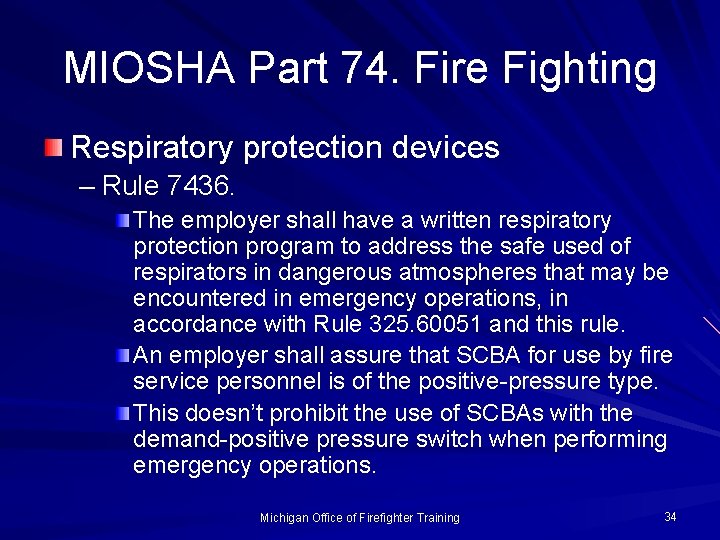
MIOSHA Part 74. Fire Fighting Respiratory protection devices – Rule 7436. The employer shall have a written respiratory protection program to address the safe used of respirators in dangerous atmospheres that may be encountered in emergency operations, in accordance with Rule 325. 60051 and this rule. An employer shall assure that SCBA for use by fire service personnel is of the positive-pressure type. This doesn’t prohibit the use of SCBAs with the demand-positive pressure switch when performing emergency operations. Michigan Office of Firefighter Training 34
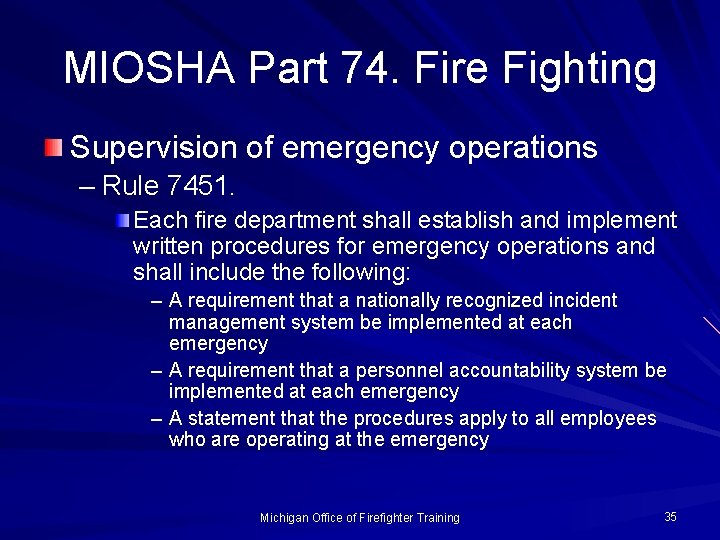
MIOSHA Part 74. Fire Fighting Supervision of emergency operations – Rule 7451. Each fire department shall establish and implement written procedures for emergency operations and shall include the following: – A requirement that a nationally recognized incident management system be implemented at each emergency – A requirement that a personnel accountability system be implemented at each emergency – A statement that the procedures apply to all employees who are operating at the emergency Michigan Office of Firefighter Training 35
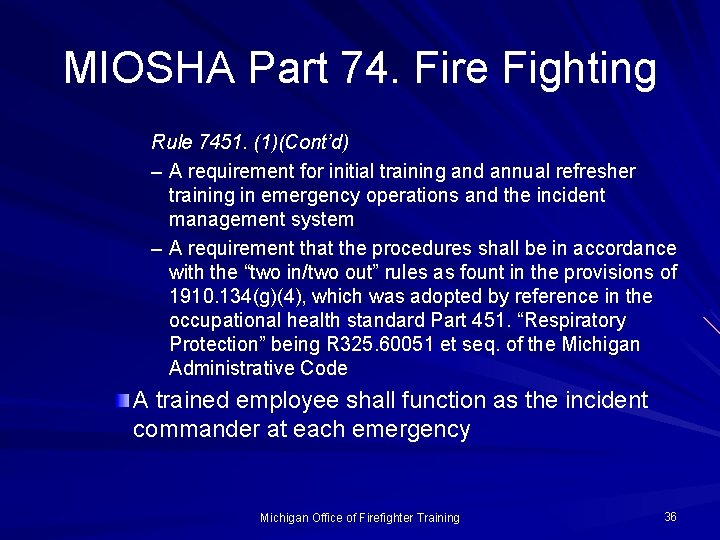
MIOSHA Part 74. Fire Fighting Rule 7451. (1)(Cont’d) – A requirement for initial training and annual refresher training in emergency operations and the incident management system – A requirement that the procedures shall be in accordance with the “two in/two out” rules as fount in the provisions of 1910. 134(g)(4), which was adopted by reference in the occupational health standard Part 451. “Respiratory Protection” being R 325. 60051 et seq. of the Michigan Administrative Code A trained employee shall function as the incident commander at each emergency Michigan Office of Firefighter Training 36
Part 33. Personal Protective Equipment Rule 3301 General Provisions – Shall apply to all places of employment in this state and includes requirements by the employer and use by the employee of PPE and provides adequate means, ways, and methods for the proper selection and safe use of this equipment Michigan Office of Firefighter Training 37
Part 33. Personal Protective Equipment Rule 3310. Employer’s and employee’s responsibilities – The employer shall provide to an employee, at no expense to the employee, the initial issue of the type of PPE which is suitable for the work to be performed as required by this standard or any general industry safety standard. – An employee shall use all of the PPE provided by the employer Michigan Office of Firefighter Training 38
Part 451. Respiratory Protection Rule 1 Scope and Application (R 325. 60051) – In the control of occupational diseases caused by breathing contaminated air, the primary objective shall be to prevent the atmospheric contamination – Prevention of atmospheric contamination shall be accomplished, as far as feasible, by accepted engineering control measures – When engineering controls are not feasible, or while being instituted, appropriate respirators shall be used pursuant to these rules. Michigan Office of Firefighter Training 39
Part 451. Respiratory Protection 1910. 134 – Respiratory Protection – Section (a)(2) Respirators shall be provided by the employer when such equipment is necessary to protect the employee. Respirators shall be applicable and suitable for the intended purpose – Section (c) 1. Where respirators are required, the employer shall establish and implement a written respiratory program with worksite-specific procedures – Section (d) Selection of respirators: requires the employer to evaluate the respiratory hazards, identify work place and user factors, and base selection on these factors Michigan Office of Firefighter Training 40
Part 451. Respiratory Protection – Section (e) specifies the minimum requirements for medical evaluation that employers must implement to determine the employee’s ability to use a respirator – Section (f) Fit testing: requires that before an employee may be required to use any respirator with a tight-fitting face piece, the employee must be fit tested with the same make, model, style, and size of respirator that will be used Michigan Office of Firefighter Training 41
Part 451. Respiratory Protection – Section (g) Use of respirators: requires employers to establish and implement procedures for the proper use of respirators (g)(1) Face piece seal protection (g)(1)(i) The employer shall not permit respirators with tight fitting face pieces to be worn by employees who have: (g)(1)(i)(A) Facial hair that comes between the sealing surface of the face piece and the face or interferes with the valve function; or (g)(1)(i)(B) Any condition that interferes with the face to face piece seal or valve function Michigan Office of Firefighter Training 42
Part 451. Respiratory Protection (g)(4) The employer shall ensure that: (g)(4)(i) At least two employees enter the IDLH atmosphere and remain in voice contact with one another at all times (g)(4)(ii) At least two employees are located outside the IDLH atmosphere, and (g)(4)(iii) All employees engaged in interior structural fire fighting use SCBAs Michigan Office of Firefighter Training 43
Part 451. Respiratory Protection Note 1 to paragraph (g). One of the two individuals located outside the IDLH atmosphere may be assigned an additional role (IC, Safety Officer, etc) so long as the individual is able to fill the assistance or rescue activities without jeopardizing the safety and health of any firefighter working at the incident Note 2 to paragraph (g). Nothing in this section is meant to preclude firefighters from performing emergency rescue activities before an entire team is assembled. Michigan Office of Firefighter Training 44
Part 451. Respiratory Protection – Section (h) Maintenance and care of respirators: Requires the employers to provide for the cleaning and disinfecting, storage, inspection, and repair of respirators used by employees – Section (k) Training and information: Required the employer to provide for effective training to their employees who are required to used respirators Michigan Office of Firefighter Training 45
Respiratory Protection Note Respirators shall not be worn when conditions prevent a good face seal. Examples: – beards, long sideburns, scull cap that projects under the face piece, temple pieces on glasses – Absence of dentures To assure a proper seal, the fit shall be checked each time the wearer puts on the face piece using manufacturer’s fitting instructions Michigan Office of Firefighter Training 46
Respiratory Protection Note DELEG/MIOSHA is enforcing the facial hair rule, therefore: OFFT will not allow a firefighter to participate in FF I or II training or testing if he/she has facial hair that can interfere with the face piece seal Michigan Office of Firefighter Training 47
Additional DELEG/MIOSHA Rules DELEG/MIOSHA: General Health & Safety Part 90. Confined Space Entry MDCH Part 554. Bloodborne Infectious Diseases (Rule 325. 7001 -. 7007) DELEG/MIOSHA: General Health & Safety Part 38. Hand Power Tools These rules contain mandates for employer and employee actions including training, maintenance, equipment, safety precautions, and record keeping. Michigan Office of Firefighter Training 48
Act 300 of 1949, Michigan Vehicle Code The basic state law regulating and defining our duties and responsibilities as drivers of emergency vehicles Key provisions firefighters need to know: – MCL 257. 2 “Authorized Emergency Vehicle” Defined Sec. 2 a. Vehicles of the fire department, police vehicles, ambulances, or privately owned motor vehicles of volunteer or paid firefighters if authorized by the chief of an organized fire department or privately owned motor vehicles of a volunteer or paid members of a life support agency licensed by the Michigan Department of Community Health if authorized by the life support agency. Michigan Office of Firefighter Training 49
Act 300 of 1949, Michigan Vehicle Code – NOTE: Any department which authorizes its personnel to operate their personal vehicles as emergency vehicles should consider the following: Sole authority and responsibility for authorization now rests with the chief or agency director The department or agency should adopt a policy regarding the use of lights and siren, specify who may use them, under what conditions, and what training must be accomplished first. (recommended minimum: OFFT Driver Training Course) The policy should also include a mandatory inspection on a periodic basis by the chief/director or his/her designee to make certain that the vehicle is properly equipped (red light on the roof when in use and a siren) and in safe operating condition. Michigan Office of Firefighter Training 50
Act 300 of 1949, Michigan Vehicle Code Act 300 grants certain privileges to emergency vehicles but imposes additional responsibilities on the driver relating to safe operation, covered fully in the driver’s training course It is recommended all departments require personnel to complete the driver’s training course prior to operating any vehicle, including personal vehicles, as emergency vehicles. Michigan Office of Firefighter Training 51
Act 300 of 1949, Michigan Vehicle Code A firefighter does not have to carry his/her operator’s license, registration, proof of insurance, etc while responding to or returning from an alarm A valid operator’s license is required If operating vehicles over 26, 001 pounds, a Commercial Driver License OR completion of the OFFT Driver Training Class is required. Michigan Office of Firefighter Training 52
Act 300 of 1949, Michigan Vehicle Code Michigan motor vehicle and licensing laws are quite explicit in terms of identifying responsibilities and privileges. Emergency response driving requires constant care and vigilance; Firefighters remain potentially liable if they injure or kill someone while operating an emergency vehicle. Michigan Office of Firefighter Training 53
Hazardous Materials SARA/HAZWOPER Three primary emergency planning requirements regarding hazardous materials: – Firefighter Right to Know – Hazardous Waste Operations and Emergency Response (HAZWOPER) – Superfund Amendment and Reauthorization Act (SARA Title I & III) Michigan Office of Firefighter Training 54
Hazardous Materials SARA/HAZWOPER Fire Chief’s responsibility and authority regarding hazardous materials in PA 207 The fire chief must: – Develop site specific safety plans for all sites within the fire district which use or produce hazmat at or above the quantity specified – Establish good SOPs for the department – Participate with the LEPC developing site specific procedures for Title III sites – Ensure that all plans are consistent with their department’s Emergency Operations Plan – Retain copies of the survey form for all sites Michigan Office of Firefighter Training 55
Hazardous Materials SARA/HAZWOPER Requirements are summarized in DELEG/BFS Bulletin 09 “Fire Department Hazardous Material Emergency Planning Responsibilities” available at www. michigan. gov/bfs Michigan Office of Firefighter Training 56
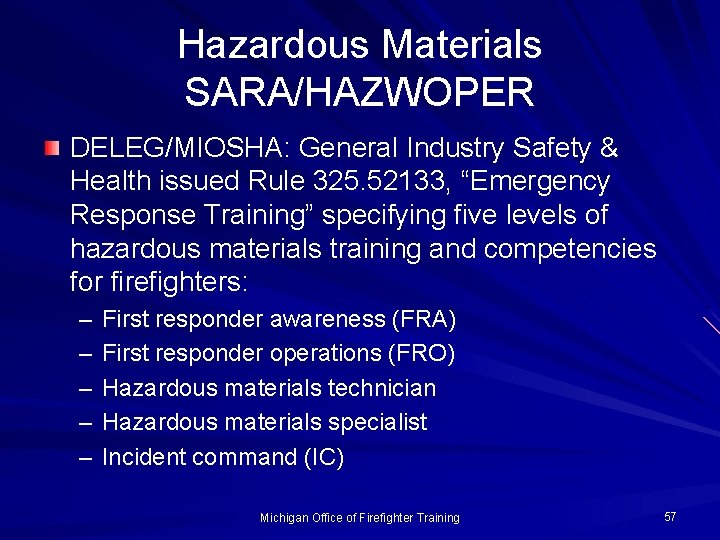
Hazardous Materials SARA/HAZWOPER DELEG/MIOSHA: General Industry Safety & Health issued Rule 325. 52133, “Emergency Response Training” specifying five levels of hazardous materials training and competencies for firefighters: – – – First responder awareness (FRA) First responder operations (FRO) Hazardous materials technician Hazardous materials specialist Incident command (IC) Michigan Office of Firefighter Training 57
Hazardous Materials SARA/HAZWOPER FRA is taught in conjunction with Firefighter I FRO is taught in conjunction with Firefighter II Rule 325. 52133 specifies that it is the employer (usually the fire chief) that certifies competency of firefighters at the FRA, FRO, Technician, and IC levels Michigan Office of Firefighter Training 58
Hazardous Materials SARA/HAZWOPER The fire chief and municipal governing body determine the response level of the department DELEG/MIOSHA rules require firefighters, EMS, and law enforcement personnel to be trained to the minimum of the Awareness level DELEG/MIOSHA strongly recommends firefighters be trained to the Operations level Refresher training on an ANNUAL basis is required to the level selected by the governing body and the fire chief Michigan Office of Firefighter Training 59
Emergency Medical Law Estimated that 50% of organized fire departments in Michigan provide some level of emergency medical response Act 368 – “Emergency Medical Law”, as amended by PA 179 of 1990 – Is specific in establishing training for EMS personnel/providers – Levels: MFR, Medical First Responder EMT, Emergency Medical Technician EMT-S, EMT Specialist EMT-P, EMT Paramedic I/C, Instructor/Coordinator Michigan Office of Firefighter Training 60
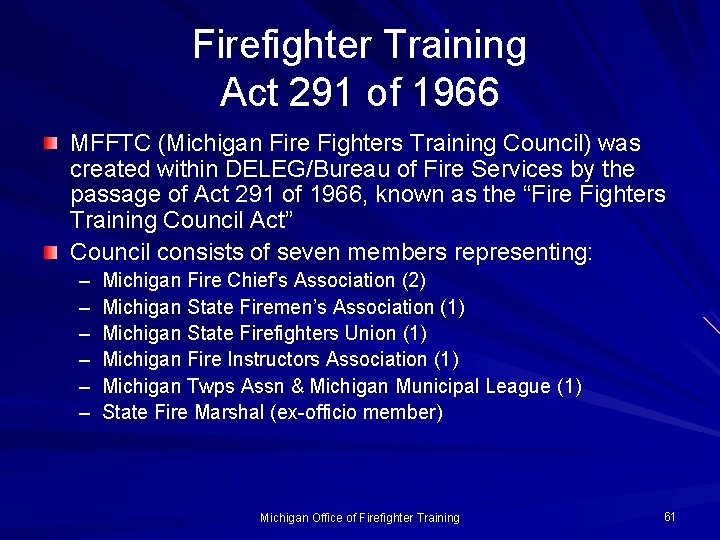
Firefighter Training Act 291 of 1966 MFFTC (Michigan Fire Fighters Training Council) was created within DELEG/Bureau of Fire Services by the passage of Act 291 of 1966, known as the “Fire Fighters Training Council Act” Council consists of seven members representing: – – – Michigan Fire Chief’s Association (2) Michigan State Firemen’s Association (1) Michigan State Firefighters Union (1) Michigan Fire Instructors Association (1) Michigan Twps Assn & Michigan Municipal League (1) State Fire Marshal (ex-officio member) Michigan Office of Firefighter Training 61
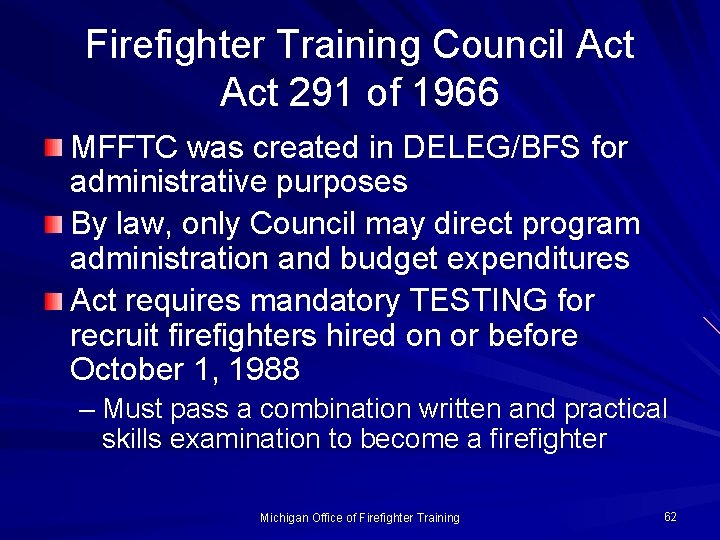
Firefighter Training Council Act 291 of 1966 MFFTC was created in DELEG/BFS for administrative purposes By law, only Council may direct program administration and budget expenditures Act requires mandatory TESTING for recruit firefighters hired on or before October 1, 1988 – Must pass a combination written and practical skills examination to become a firefighter Michigan Office of Firefighter Training 62
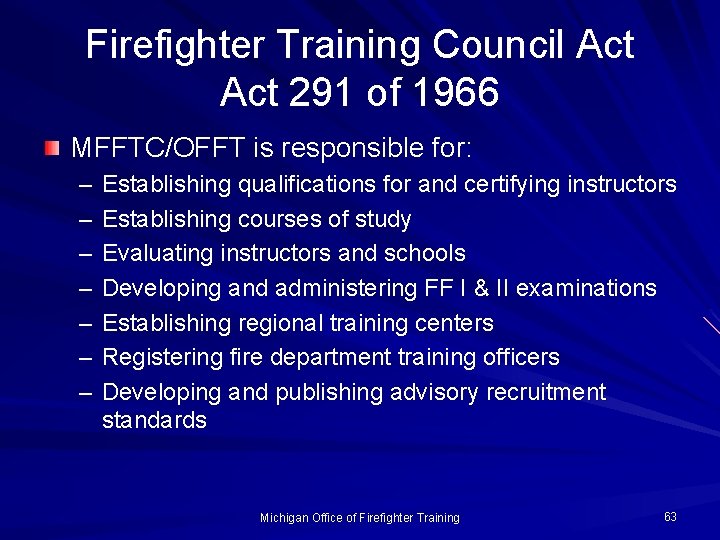
Firefighter Training Council Act 291 of 1966 MFFTC/OFFT is responsible for: – – – – Establishing qualifications for and certifying instructors Establishing courses of study Evaluating instructors and schools Developing and administering FF I & II examinations Establishing regional training centers Registering fire department training officers Developing and publishing advisory recruitment standards Michigan Office of Firefighter Training 63
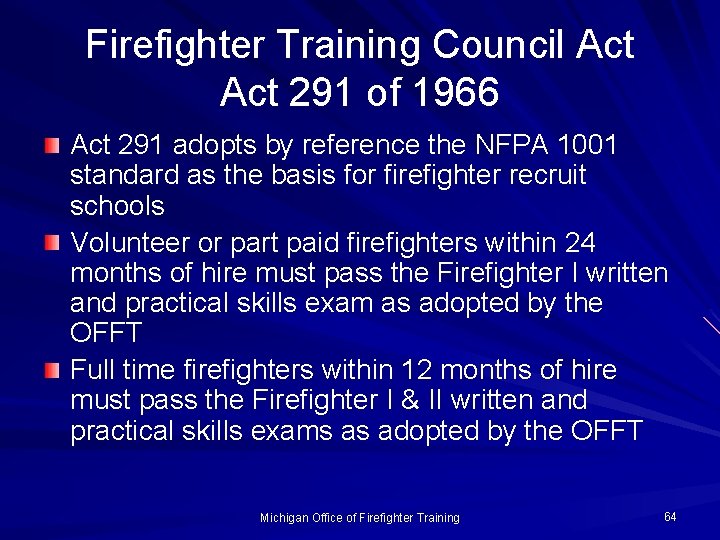
Firefighter Training Council Act 291 of 1966 Act 291 adopts by reference the NFPA 1001 standard as the basis for firefighter recruit schools Volunteer or part paid firefighters within 24 months of hire must pass the Firefighter I written and practical skills exam as adopted by the OFFT Full time firefighters within 12 months of hire must pass the Firefighter I & II written and practical skills exams as adopted by the OFFT Michigan Office of Firefighter Training 64
Conclusion Our profession is becoming highly regulated The requirements of our job are based on demonstrated needs and should be professional standards to aspire to Firefighters need to understand comply with the laws, rules, and standards that affect the fire service The information in this unit is designed to reduce and control threats to our well being Michigan Office of Firefighter Training 65