
Office of Aviation Safety Emergency Medical Services EMS
- Slides: 31
Office of Aviation Safety Emergency Medical Services (EMS) Aviation Operations Jeff Guzzetti Deputy Director for Regional Operations
Introduction: EMS Operations • Provide important service to public • Inherently dangerous due to pressures and environment • Increasing number of accidents • Strategies and technologies to ensure flight safety
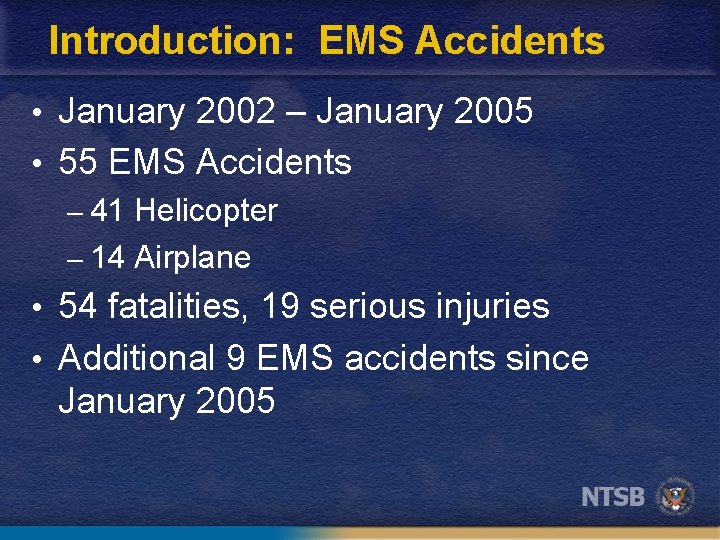
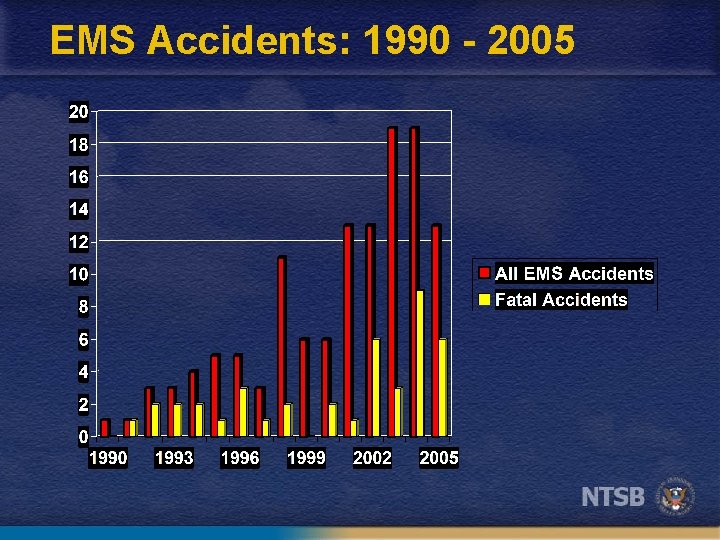
Introduction: EMS Accidents • January 2002 – January 2005 • 55 EMS Accidents – 41 Helicopter – 14 Airplane • 54 fatalities, 19 serious injuries • Additional 9 EMS accidents since January 2005
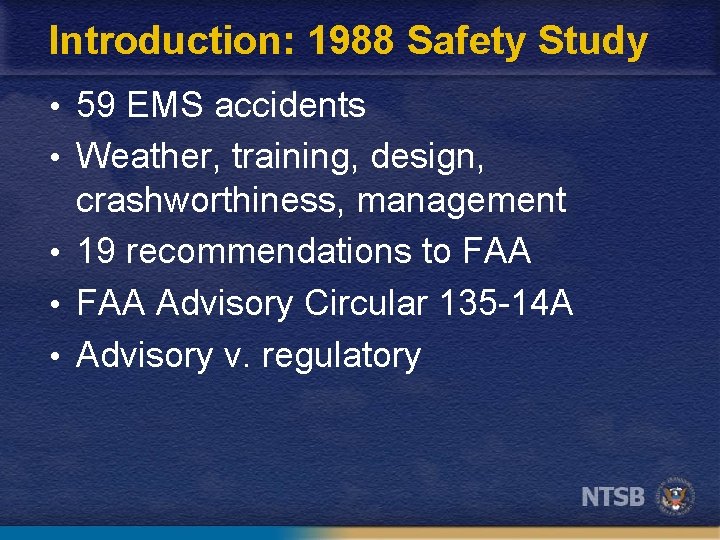
Introduction: 1988 Safety Study • 59 EMS accidents • Weather, training, design, crashworthiness, management • 19 recommendations to FAA • FAA Advisory Circular 135 -14 A • Advisory v. regulatory
EMS Accidents: 1990 - 2005
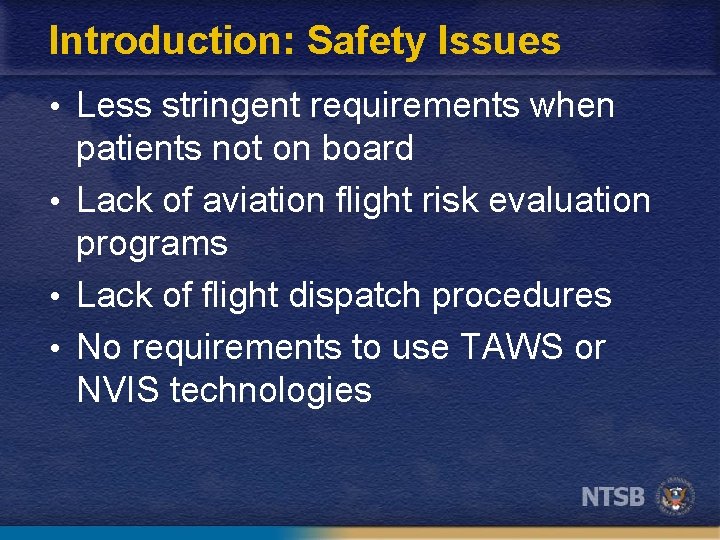
Introduction: Safety Issues • Less stringent requirements when patients not on board • Lack of aviation flight risk evaluation programs • Lack of flight dispatch procedures • No requirements to use TAWS or NVIS technologies
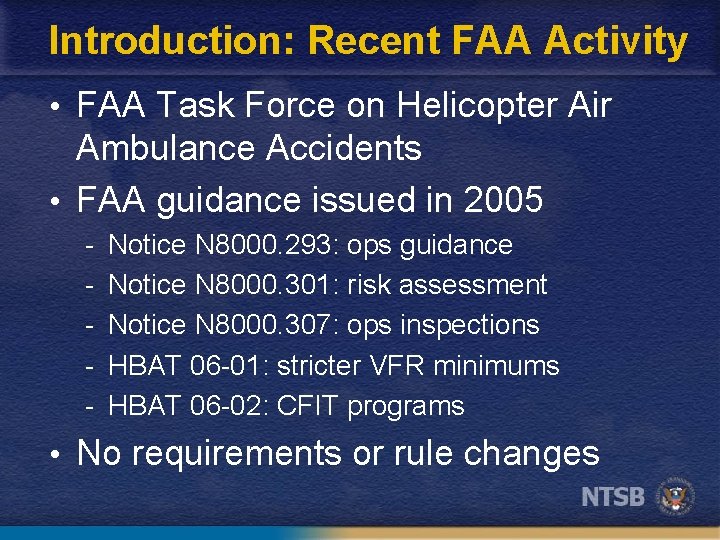
Introduction: Recent FAA Activity • FAA Task Force on Helicopter Air Ambulance Accidents • FAA guidance issued in 2005 - Notice N 8000. 293: ops guidance - Notice N 8000. 301: risk assessment - Notice N 8000. 307: ops inspections - HBAT 06 -01: stricter VFR minimums - HBAT 06 -02: CFIT programs • No requirements or rule changes
Introduction: Regional Investigations • 7 regional aviation investigations presented as examples • 3, 500 man hours • Probable causes submitted for Board’s consideration
Introduction: Part 91 v. Part 135 • Part 91 prescribes rules for all aircraft • Part 135 prescribes rules for commuter or on-demand operations
Office of Aviation Safety Issue: EMS Operations Without Patients On Board
Safety Issue: Operations Without Patients Onboard • While carrying patients or organs, Part 135 • Less stringent requirements without patients on board (Part 91) • Medical crewmembers primarily responsible for patient care • 35 of 55 accidents Part 91
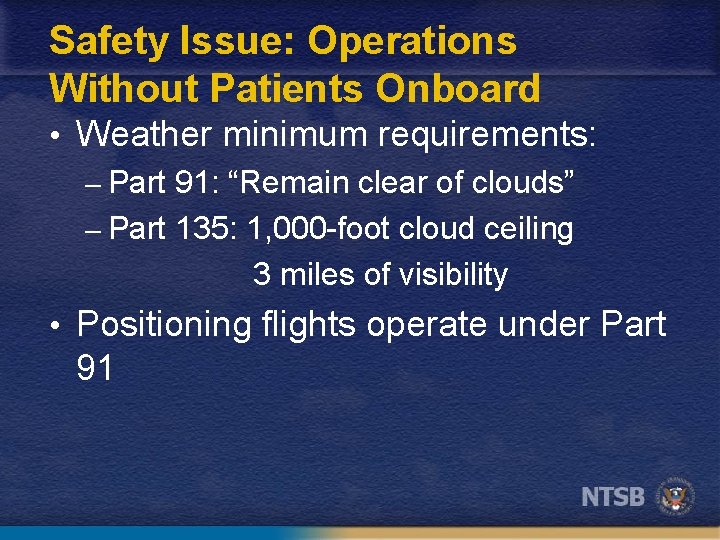
Safety Issue: Operations Without Patients Onboard • Weather minimum requirements: – Part 91: “Remain clear of clouds” – Part 135: 1, 000 -foot cloud ceiling 3 miles of visibility • Positioning flights operate under Part 91
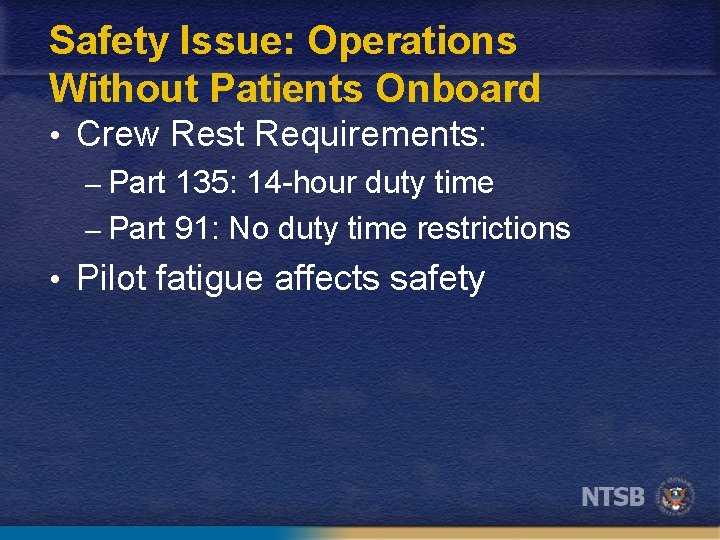
Safety Issue: Operations Without Patients Onboard • Crew Rest Requirements: – Part 135: 14 -hour duty time – Part 91: No duty time restrictions • Pilot fatigue affects safety
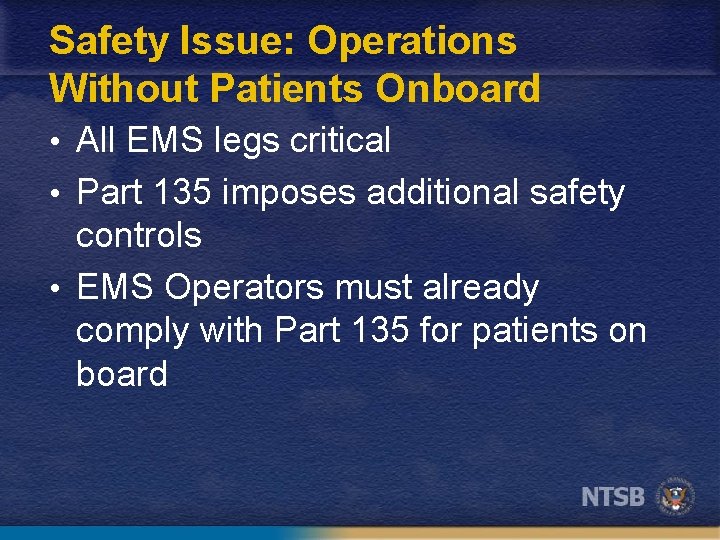
Safety Issue: Operations Without Patients Onboard • All EMS legs critical • Part 135 imposes additional safety controls • EMS Operators must already comply with Part 135 for patients on board
Office of Aviation Safety Issue: Flight Risk Evaluation Programs
Safety Issue: Risk Evaluation • Risks include pressure, weather, environment, spatial disorientation, and human factors • Risk evaluation requires pilot to assess situation without influence of urgency • Most operators had no formal risk evaluation process
Safety Issue: Risk Evaluation • Salt Lake City: weather, route, night would have raised flight risk rating • Risk evaluation may have prevented 13 of 55 accidents
Safety Issue: Risk Evaluation • FAA Notice N 8000. 301: Operational Risk Assessment Programs for Helicopter EMS • Not required • Flight risk evaluation programs would enhance safety
Office of Aviation Safety Issue: Flight Dispatch Procedures for EMS
Safety Issue: Flight Dispatch • Many EMS operators lack flight dispatch procedures • 911 and hospital dispatchers – Not required to have aviation-specific knowledge – Provide minimal information regarding route, landing, or weather • Participate in risk assessment
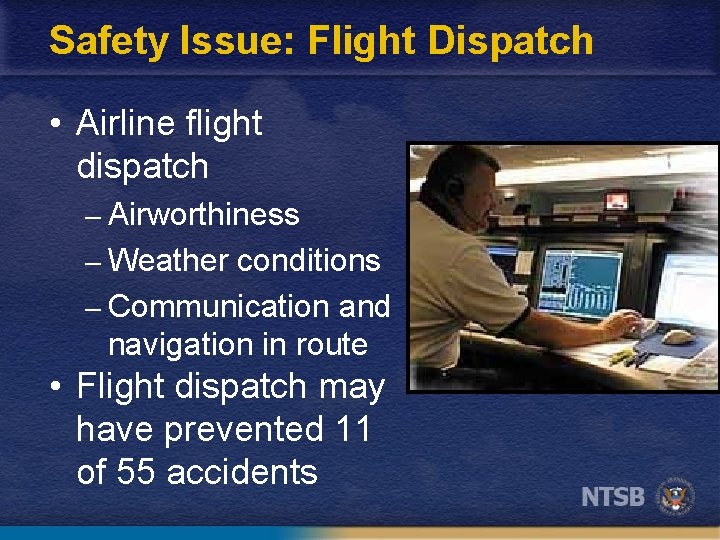
Safety Issue: Flight Dispatch • Airline flight dispatch – Airworthiness – Weather conditions – Communication and navigation in route • Flight dispatch may have prevented 11 of 55 accidents
Office of Aviation Safety Issue: Use of Technology in EMS Flight Operations
Safety Issue: Night Vision Imaging Systems • Night accidents over represented • Benefits – Enhance ability to see and avoid obstacles – Reduce stress and spatial disorientation – Increase safety • Not widely used by EMS – Recent introduction – Cost – Cannot be used in ambient light
Safety Issue: Night Vision Imaging Systems • 13 of 55 accidents may have benefited from use of NVIS • FAA encourages use of NVIS • Feasibility of NVIS • Staff to monitor effectiveness
Safety Issue: Terrain Awareness and Warning System • CFIT common in EMS operations • Increases safety margin in poor visibility • Battle Mountain, Nevada
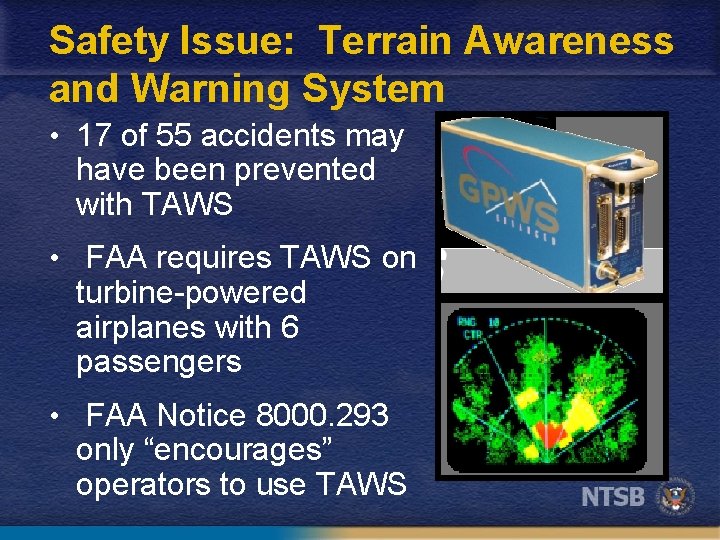
Safety Issue: Terrain Awareness and Warning System • 17 of 55 accidents may have been prevented with TAWS • FAA requires TAWS on turbine-powered airplanes with 6 passengers • FAA Notice 8000. 293 only “encourages” operators to use TAWS