
Office for a Safe and Respectful Learning Environment
- Slides: 22
Office for a Safe and Respectful Learning Environment Research shows that when schools and districts effectively focus on creating a safe, healthy, and supportive environment (positive school climate), students are more likely to engage in the curriculum, achieve academically, and develop positive relationships; students are less likely to exhibit problem behaviors; and teacher turnover is lower and teacher satisfaction is higher— National Center on Safe Supportive Learning Environments
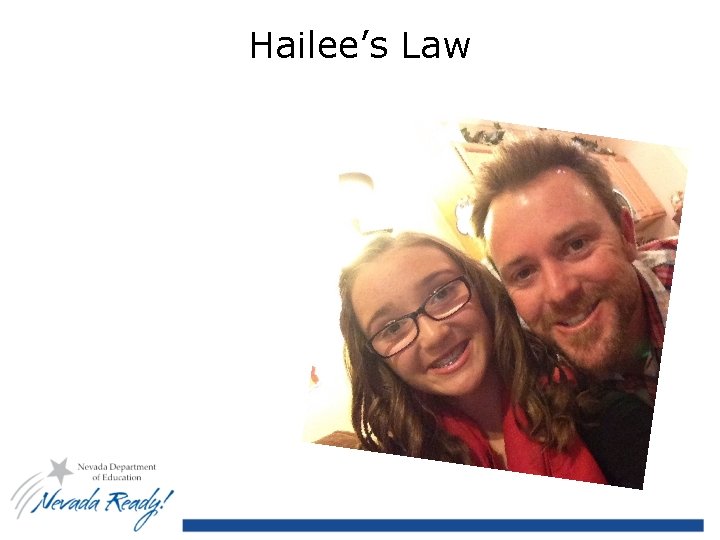
Hailee’s Law
Office for a Safe and Respectful Learning Environment • The Nevada Department of Education’s Office for a Safe and Respectful Learning Environment was created during the 78 th (2015) session of the Nevada State Legislature • Included within a bipartisan bill (SB 504, 2015) that amended the state’s anti-bullying laws in order to highlight the importance of safe and respectful learning environments in supporting the health and wellbeing of all students within the school • The Governor’s final budget (SB 515, 2015) appropriated just under $17 million for supporting those efforts through the Social Workers in Schools Grant and assigned administration of that program to the newly created office • Language in statute included 10 professional licenses or degrees that could be utilized for the purposes of hiring • SB 533 (2017) maintained funding for the 2017 -19 biennium at $11. 2 million/year
Applicable State Laws • Provision of a Safe and Respectful Learning Environment • NRS 388. 121 -388. 1327: bullying defined, duties of Director including investigations • NRS 388. 133 -388. 1342: policies, informational pamphlet, and program of training • NRS 388. 135 -388. 137: anti-bullying laws, reporting, investigation, appeals, training, and compliance • NRS 388. 138 -388. 145: Week of Respect requirements and duties • NRS 388. 1451 -1458: operation of Safe. Voice program, including investigation and prevention • Crisis and Emergency Response in Public Schools • NRS 388. 229 -388. 261: crisis, emergency, and suicide response plan certification, training, and annual conference • School Bus Transportation and Traffic • NRS 386. 790 – 845 and NRS 484 B
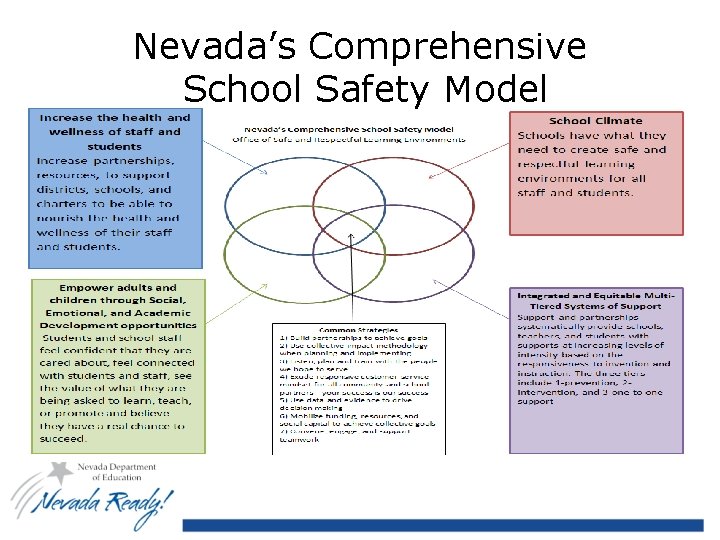
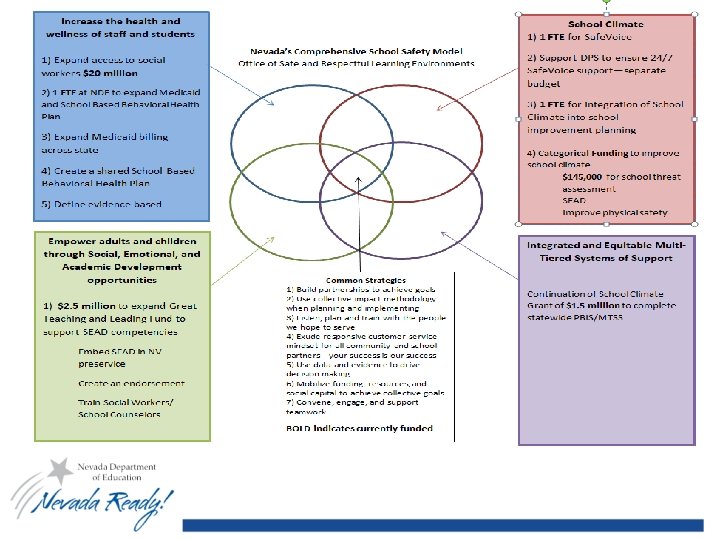
Nevada’s Comprehensive School Safety Model
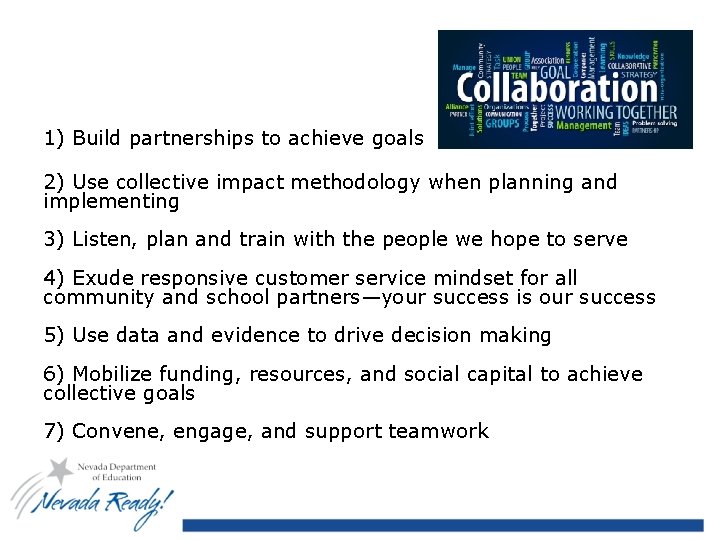
Collaboration 1) Build partnerships to achieve goals 2) Use collective impact methodology when planning and implementing 3) Listen, plan and train with the people we hope to serve 4) Exude responsive customer service mindset for all community and school partners—your success is our success 5) Use data and evidence to drive decision making 6) Mobilize funding, resources, and social capital to achieve collective goals 7) Convene, engage, and support teamwork
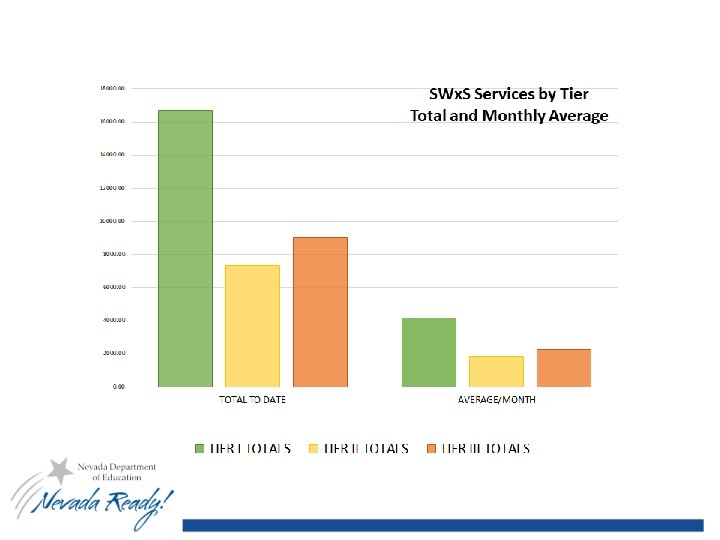
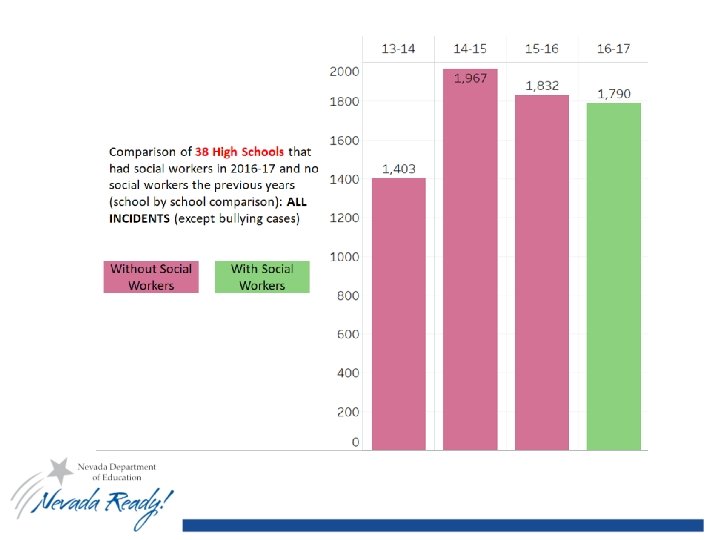
Increase the Health and Wellness of Staff and Students Current $22. 4 million NV Social Work funds and $350, 000 from federal sources expiring 18/19 2016/17 Social workers in 165 schools w/225 social workers 2017/18 Social workers in 201 schools w/275 social workers—increase due to internships Over 200 hours per month spent on individual suicide and safety assessments and interventions. Medicaid billing pilots in Clark, Washoe, Carson , and Humboldt (Sept. 2018) Funded through Safe and Healthy Schools $6000. Submitted a shared grant w/ DHHS and NDE around improving access to student health in Nevada for $5, 000 Next Steps 2019/20 -2020/21 Expand access to social workers • Budget: $20 million 275 to 550 with goal of 947 by 2021 (1/500 ratio) using Medicaid, partnerships, and other funding • Expand Medicaid billing across state; Infrastructure and support w/ 1 FTE at NDE – 18/19 Pilot (Nov 2018 predictions of Medicaid funding) – 19/20 Expansion to all Districts – 20/21 Integrated system of funding to ensure access • Create a shared School Based Behavioral Health Plan between NDE, DPBH, and DCFS. – Increase partnerships for services for wrap-around family services and staff support • Policy: Define evidence-based for School Safety and Behavioral Health interventions
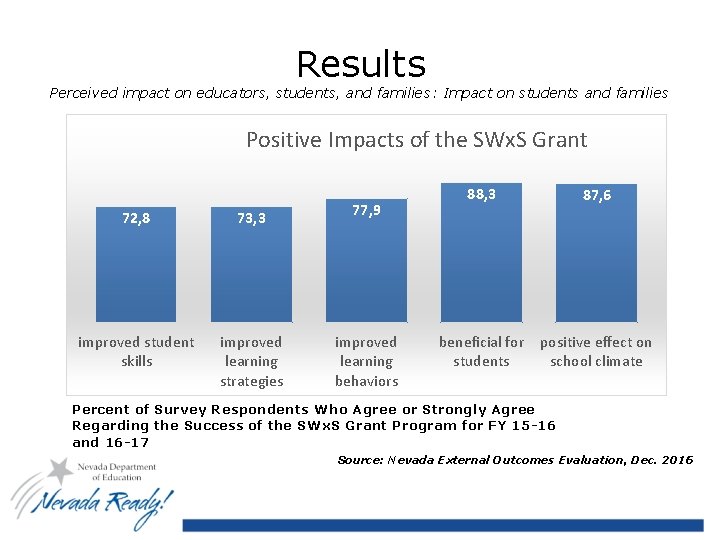
Results Perceived impact on educators, students, and families: Impact on students and families Positive Impacts of the SWx. S Grant 72, 8 73, 3 77, 9 improved student skills improved learning strategies improved learning behaviors 88, 3 87, 6 beneficial for positive effect on students school climate Percent of Survey Respondents Who Agree or Strongly Agree Regarding the Success of the SWx. S Grant Program for FY 15 -16 and 16 -17 Source: Nevada External Outcomes Evaluation, Dec. 2016
Add table from Gunes
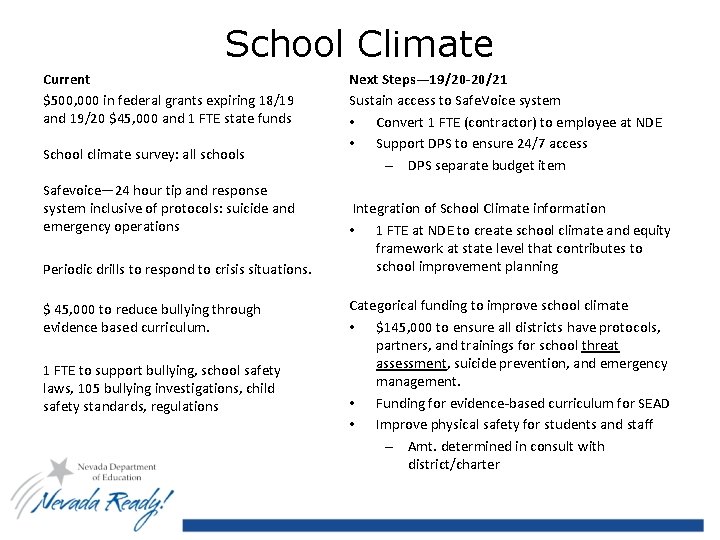
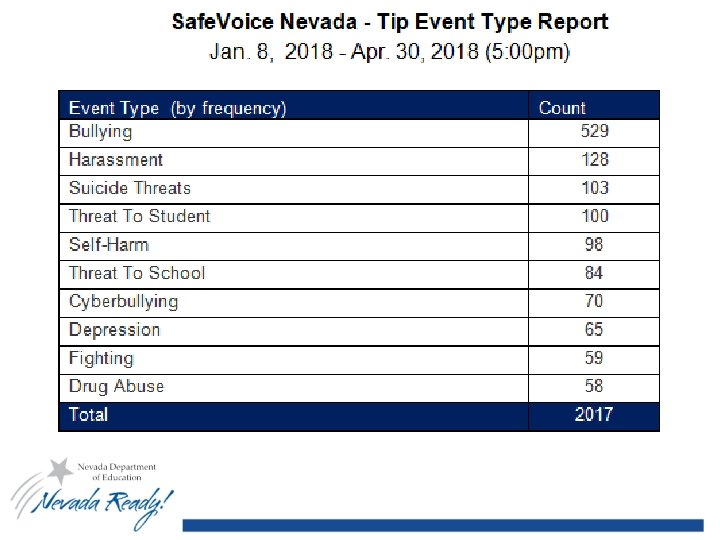
School Climate Current $500, 000 in federal grants expiring 18/19 and 19/20 $45, 000 and 1 FTE state funds School climate survey: all schools Safevoice— 24 hour tip and response system inclusive of protocols: suicide and emergency operations Periodic drills to respond to crisis situations. $ 45, 000 to reduce bullying through evidence based curriculum. 1 FTE to support bullying, school safety laws, 105 bullying investigations, child safety standards, regulations Next Steps— 19/20 -20/21 Sustain access to Safe. Voice system • Convert 1 FTE (contractor) to employee at NDE • Support DPS to ensure 24/7 access – DPS separate budget item Integration of School Climate information • 1 FTE at NDE to create school climate and equity framework at state level that contributes to school improvement planning Categorical funding to improve school climate • $145, 000 to ensure all districts have protocols, partners, and trainings for school threat assessment, suicide prevention, and emergency management. • Funding for evidence-based curriculum for SEAD • Improve physical safety for students and staff – Amt. determined in consult with district/charter
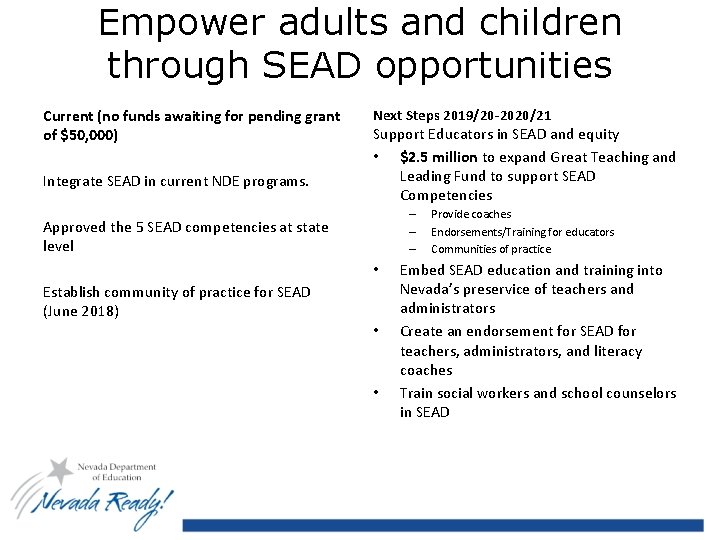
Empower adults and children through SEAD opportunities Current (no funds awaiting for pending grant of $50, 000) Integrate SEAD in current NDE programs. Next Steps 2019/20 -2020/21 Support Educators in SEAD and equity • $2. 5 million to expand Great Teaching and Leading Fund to support SEAD Competencies – – – Approved the 5 SEAD competencies at state level • Establish community of practice for SEAD (June 2018) • • Provide coaches Endorsements/Training for educators Communities of practice Embed SEAD education and training into Nevada’s preservice of teachers and administrators Create an endorsement for SEAD for teachers, administrators, and literacy coaches Train social workers and school counselors in SEAD
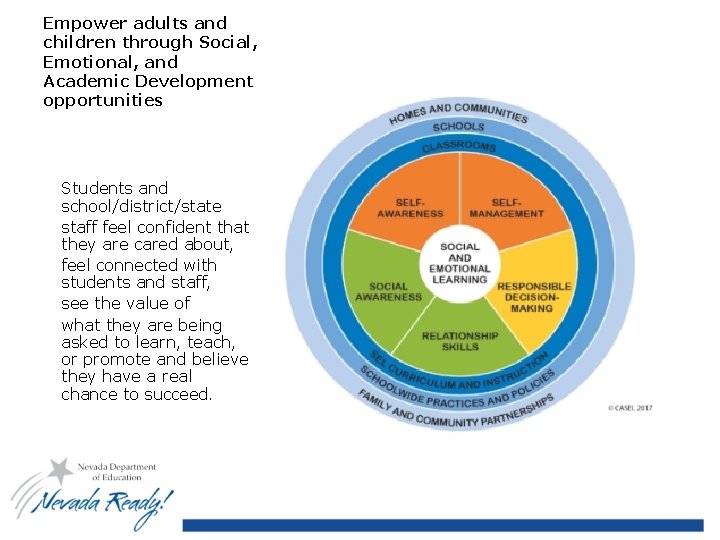
Empower adults and children through Social, Emotional, and Academic Development opportunities Students and school/district/state staff feel confident that they are cared about, feel connected with students and staff, see the value of what they are being asked to learn, teach, or promote and believe they have a real chance to succeed.
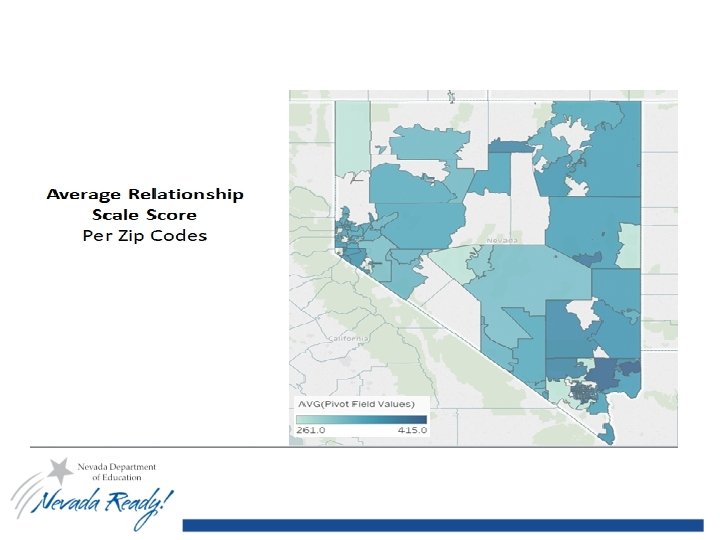
Average Relationship Scale Score
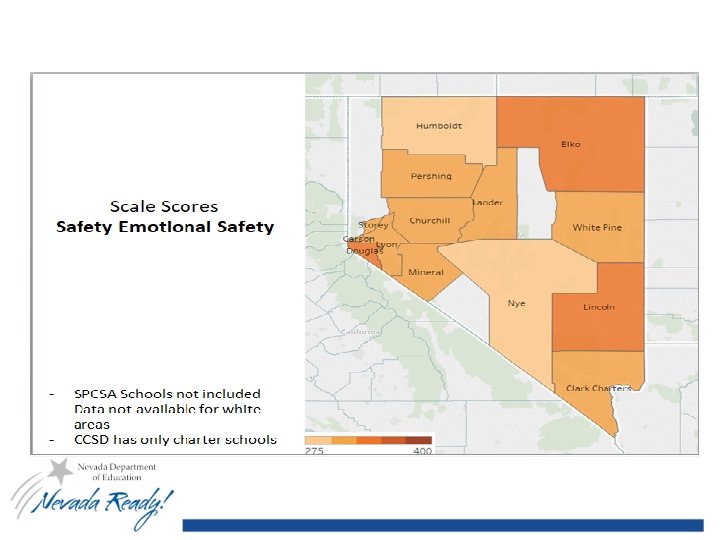
Scale Scores
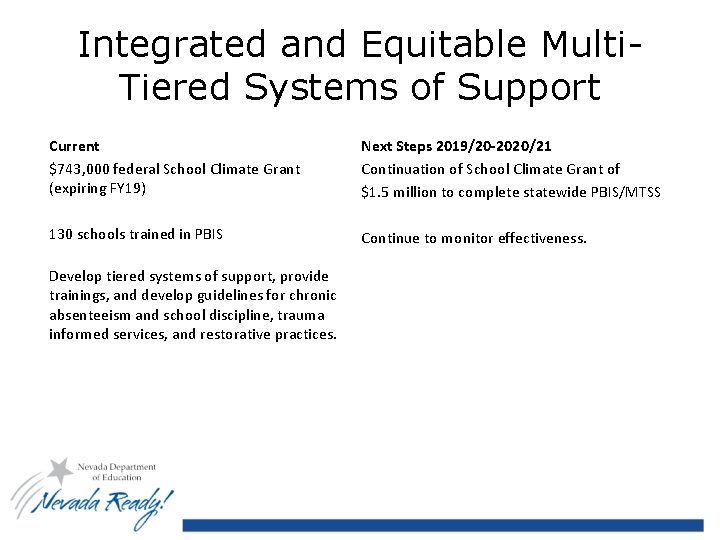
Integrated and Equitable Multi. Tiered Systems of Support Current $743, 000 federal School Climate Grant (expiring FY 19) Next Steps 2019/20 -2020/21 Continuation of School Climate Grant of $1. 5 million to complete statewide PBIS/MTSS 130 schools trained in PBIS Continue to monitor effectiveness. Develop tiered systems of support, provide trainings, and develop guidelines for chronic absenteeism and school discipline, trauma informed services, and restorative practices.
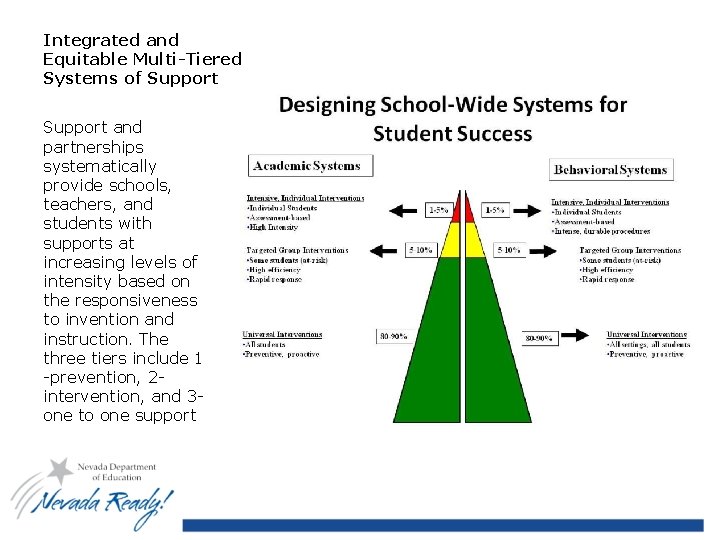
Integrated and Equitable Multi-Tiered Systems of Support and partnerships systematically provide schools, teachers, and students with supports at increasing levels of intensity based on the responsiveness to invention and instruction. The three tiers include 1 -prevention, 2 intervention, and 3 one to one support
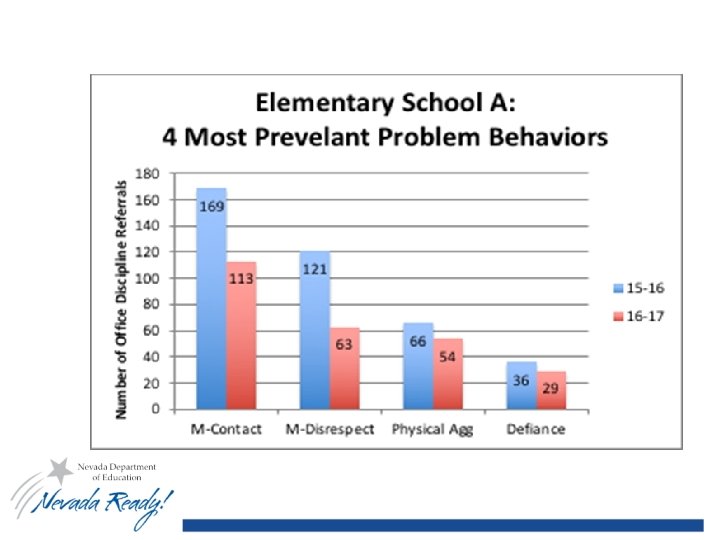
Elementary School A
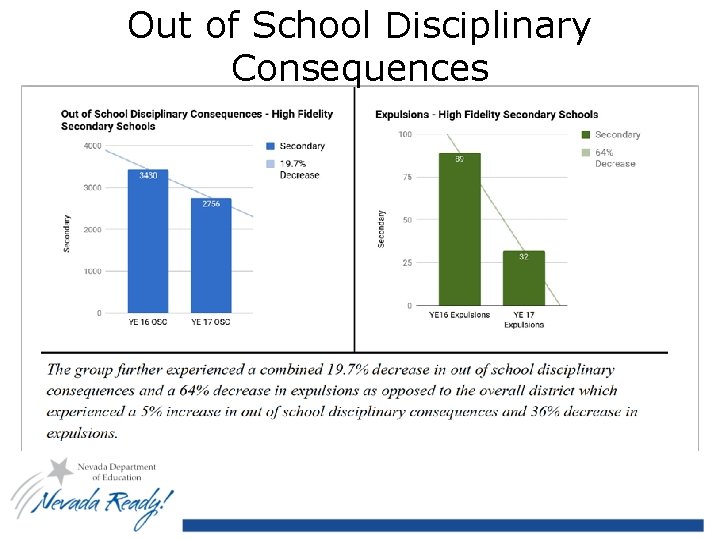
Out of School Disciplinary Consequences