
OFFICE CORRESPONDENCE IN ENGLISH Kumar Raj Kharel Joint

- Slides: 24
OFFICE CORRESPONDENCE IN ENGLISH Kumar Raj Kharel Joint Secretary Ministry of Foreign Affairs 7 November 2019, NASC, Jwalakhel Source: NASC Resources, Diplomatic Dealings
Presentation Outline Part 1: Conceptual Background Part 2: Simulation Exercise Part 3: Q & Session
1. Introduction to Communication is an essential part of individual, community (group), organizational, national (bilateral/multilateral) and international (multilateral/regional) life. It is used to share the interests, desires and needs of one side to the recipient side. Generally, communication is initiated to understand fulfill the needs , desires and concerns of parties engaged. Communication undertaken between the parties without any written records/in unwritten form is informal communication (and sometimes letter written to friends, relatives or e-mails, twitter, face book etc ) which can be helpful in creating the environment formal communication through official correspondence.
2. Official Correspondence: A Formal Mode of Communication In the rapidly changing national political and administrative responsibilities of the public institutions along with the full-fledged implementation of federal state structure, it is natural for us all to follow the changes. Unlike the traditional arrangements, government institutions at all levels tend to engage and communicate with their counterparts both at home and abroad (Frequency and volume has increased). And in doing so, they often use the formal mode of communication which is called formal official correspondences.
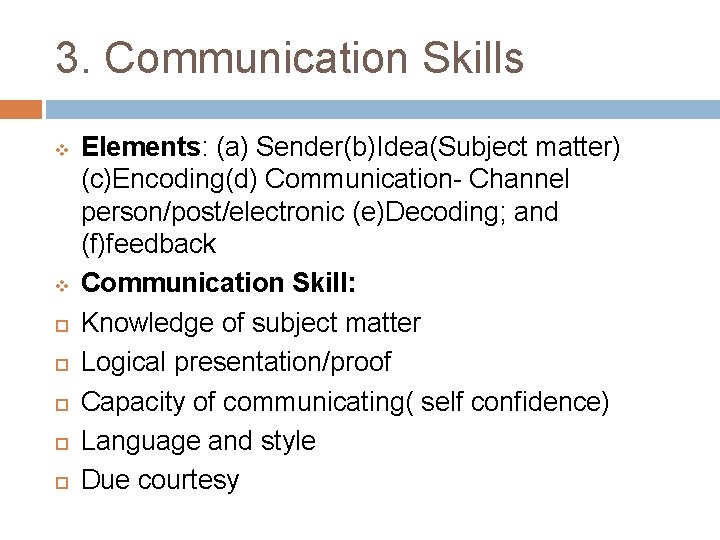
3. Communication Skills v v Elements: (a) Sender(b)Idea(Subject matter) (c)Encoding(d) Communication- Channel person/post/electronic (e)Decoding; and (f)feedback Communication Skill: Knowledge of subject matter Logical presentation/proof Capacity of communicating( self confidence) Language and style Due courtesy
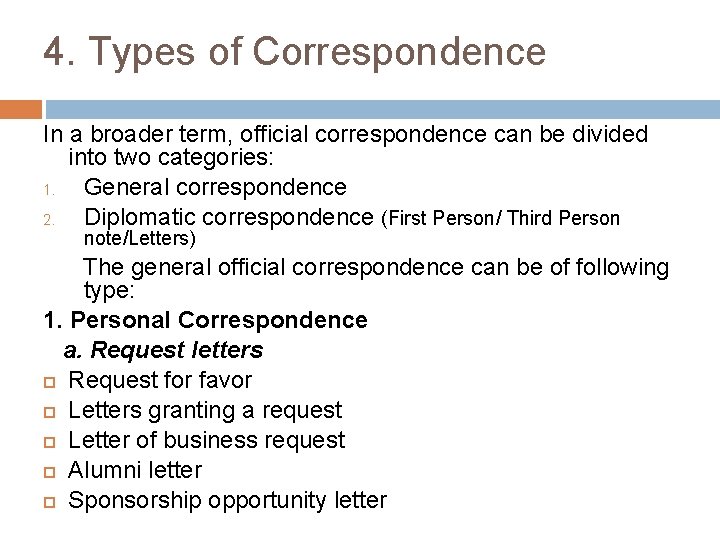
4. Types of Correspondence In a broader term, official correspondence can be divided into two categories: 1. General correspondence 2. Diplomatic correspondence (First Person/ Third Person note/Letters) The general official correspondence can be of following type: 1. Personal Correspondence a. Request letters Request for favor Letters granting a request Letter of business request Alumni letter Sponsorship opportunity letter
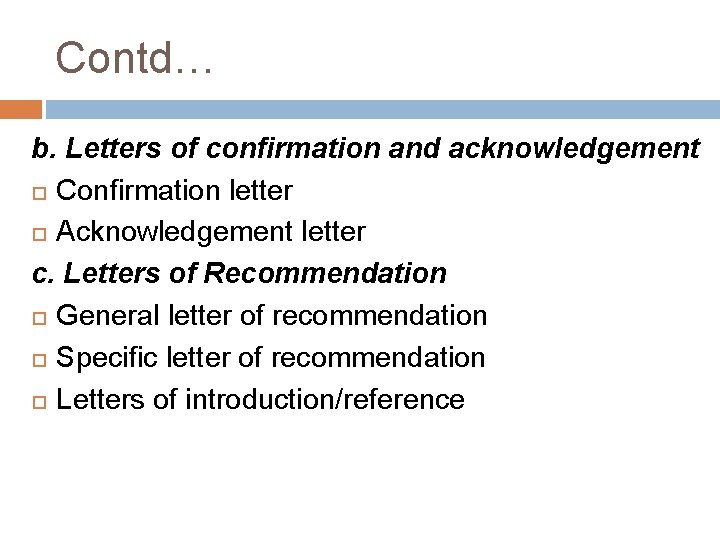
Contd… b. Letters of confirmation and acknowledgement Confirmation letter Acknowledgement letter c. Letters of Recommendation General letter of recommendation Specific letter of recommendation Letters of introduction/reference
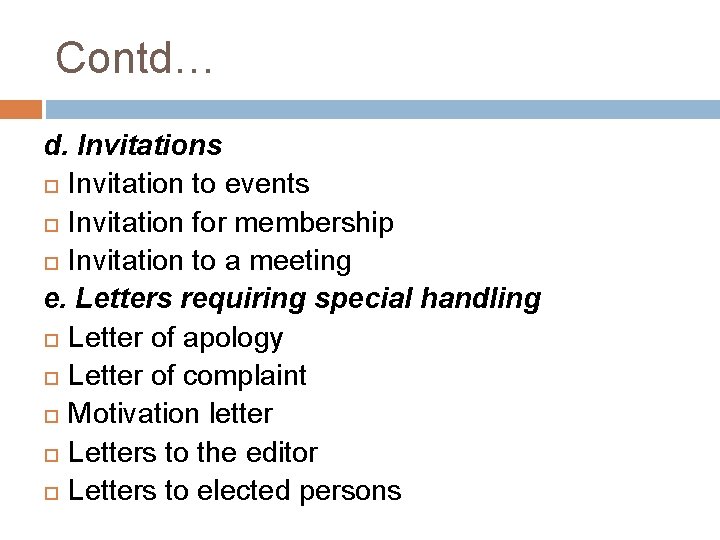
Contd… d. Invitations Invitation to events Invitation for membership Invitation to a meeting e. Letters requiring special handling Letter of apology Letter of complaint Motivation letter Letters to the editor Letters to elected persons
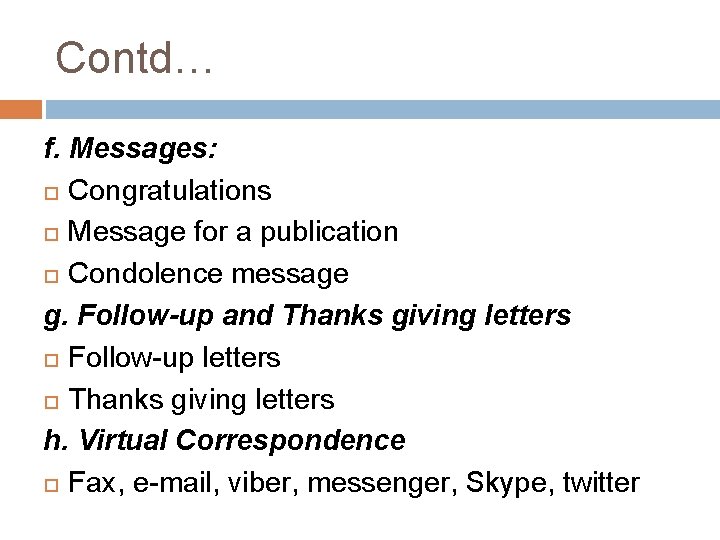
Contd… f. Messages: Congratulations Message for a publication Condolence message g. Follow-up and Thanks giving letters Follow-up letters Thanks giving letters h. Virtual Correspondence Fax, e-mail, viber, messenger, Skype, twitter
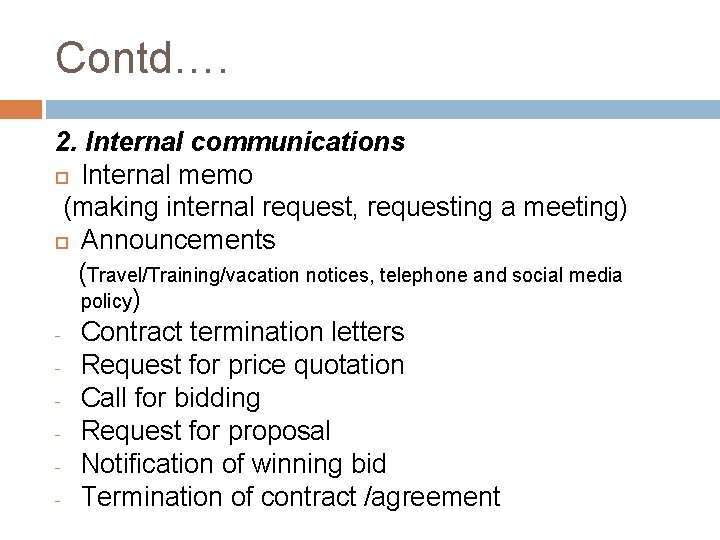
Contd…. 2. Internal communications Internal memo (making internal request, requesting a meeting) Announcements (Travel/Training/vacation notices, telephone and social media policy) - Contract termination letters - Request for price quotation - Call for bidding - Request for proposal - Notification of winning bid - Termination of contract /agreement
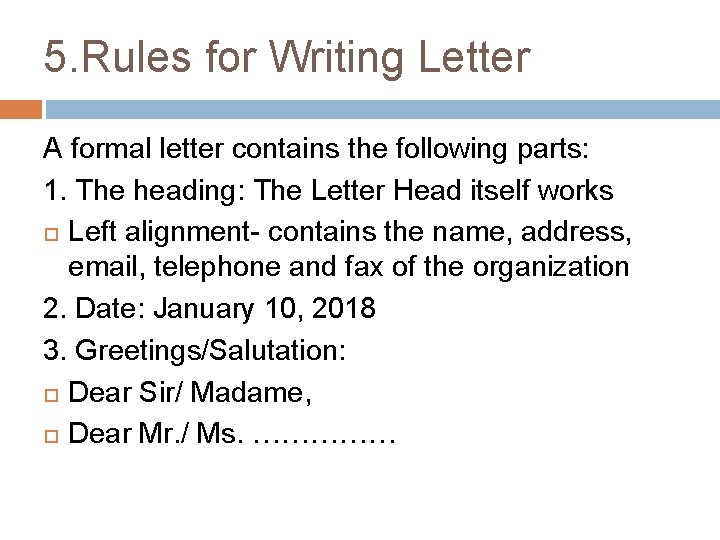
5. Rules for Writing Letter A formal letter contains the following parts: 1. The heading: The Letter Head itself works Left alignment- contains the name, address, email, telephone and fax of the organization 2. Date: January 10, 2018 3. Greetings/Salutation: Dear Sir/ Madame, Dear Mr. / Ms. ……………
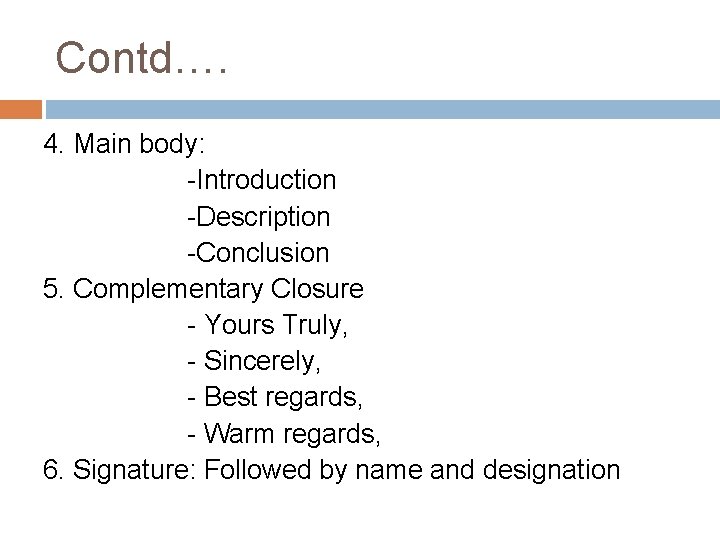
Contd…. 4. Main body: -Introduction -Description -Conclusion 5. Complementary Closure - Yours Truly, - Sincerely, - Best regards, - Warm regards, 6. Signature: Followed by name and designation
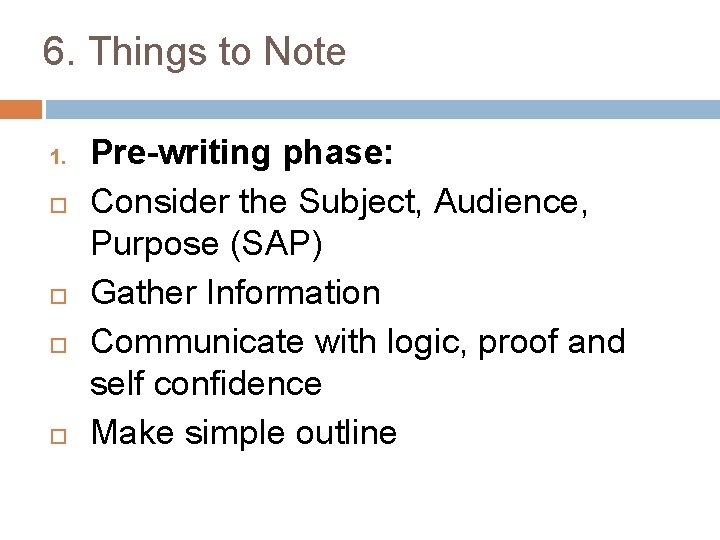
6. Things to Note 1. Pre-writing phase: Consider the Subject, Audience, Purpose (SAP) Gather Information Communicate with logic, proof and self confidence Make simple outline
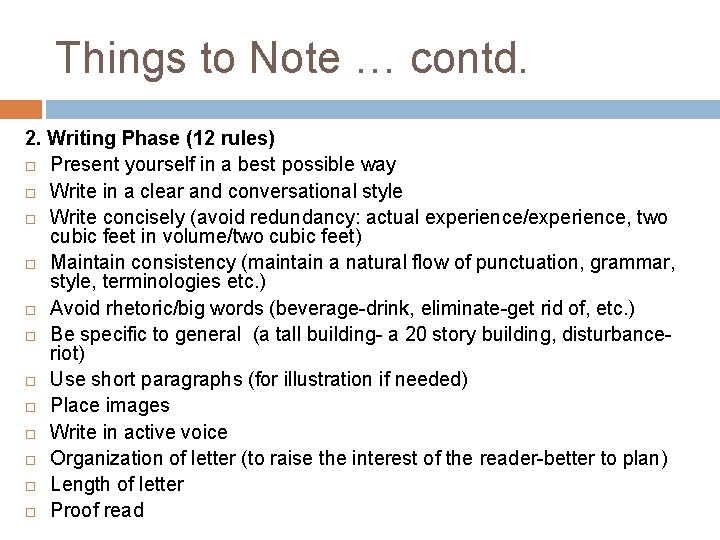
Things to Note … contd. 2. Writing Phase (12 rules) Present yourself in a best possible way Write in a clear and conversational style Write concisely (avoid redundancy: actual experience/experience, two cubic feet in volume/two cubic feet) Maintain consistency (maintain a natural flow of punctuation, grammar, style, terminologies etc. ) Avoid rhetoric/big words (beverage-drink, eliminate-get rid of, etc. ) Be specific to general (a tall building- a 20 story building, disturbanceriot) Use short paragraphs (for illustration if needed) Place images Write in active voice Organization of letter (to raise the interest of the reader-better to plan) Length of letter Proof read
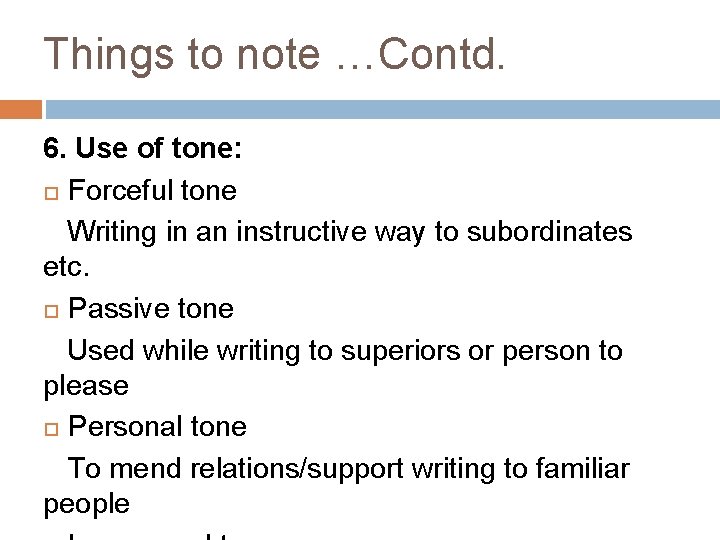
Things to note …Contd. 6. Use of tone: Forceful tone Writing in an instructive way to subordinates etc. Passive tone Used while writing to superiors or person to please Personal tone To mend relations/support writing to familiar people
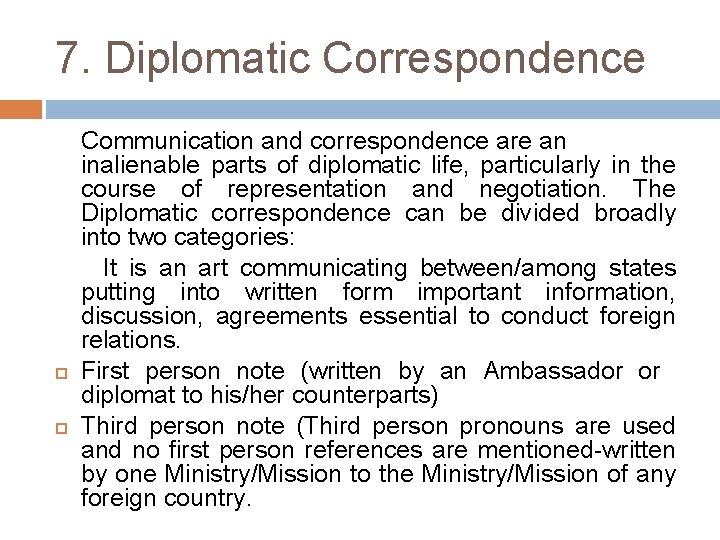
7. Diplomatic Correspondence Communication and correspondence are an inalienable parts of diplomatic life, particularly in the course of representation and negotiation. The Diplomatic correspondence can be divided broadly into two categories: It is an art communicating between/among states putting into written form important information, discussion, agreements essential to conduct foreign relations. First person note (written by an Ambassador or diplomat to his/her counterparts) Third person note (Third person pronouns are used and no first person references are mentioned-written by one Ministry/Mission to the Ministry/Mission of any foreign country.
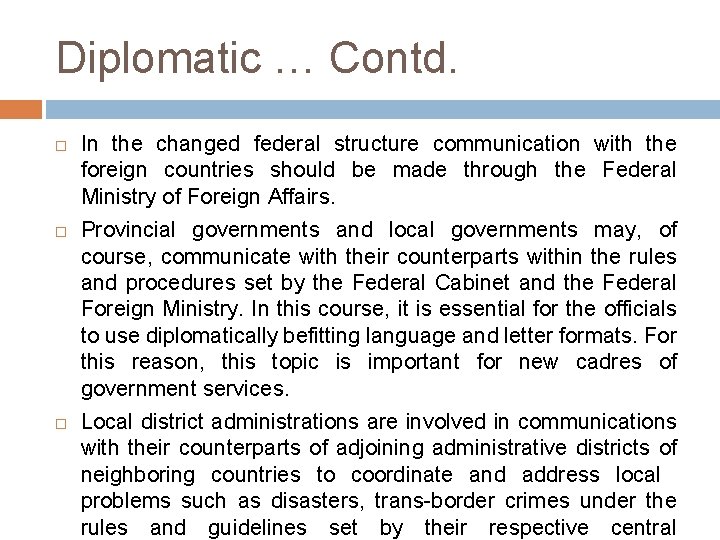
Diplomatic … Contd. In the changed federal structure communication with the foreign countries should be made through the Federal Ministry of Foreign Affairs. Provincial governments and local governments may, of course, communicate with their counterparts within the rules and procedures set by the Federal Cabinet and the Federal Foreign Ministry. In this course, it is essential for the officials to use diplomatically befitting language and letter formats. For this reason, this topic is important for new cadres of government services. Local district administrations are involved in communications with their counterparts of adjoining administrative districts of neighboring countries to coordinate and address local problems such as disasters, trans-border crimes under the rules and guidelines set by their respective central
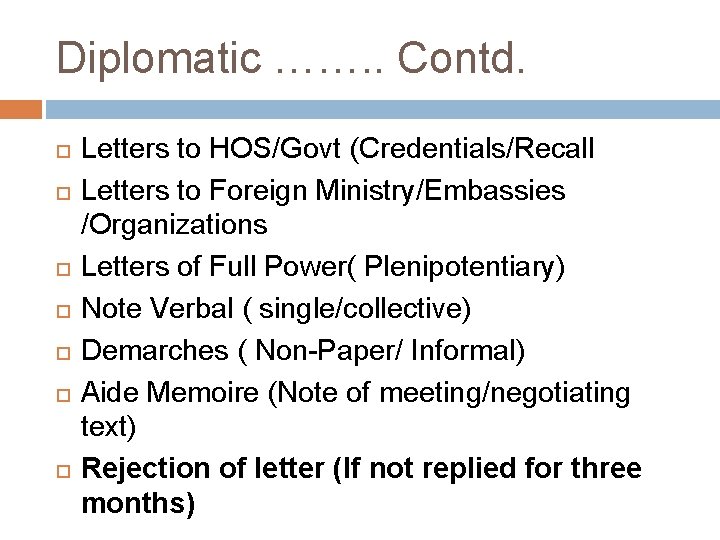
Diplomatic ……. . Contd. Letters to HOS/Govt (Credentials/Recall Letters to Foreign Ministry/Embassies /Organizations Letters of Full Power( Plenipotentiary) Note Verbal ( single/collective) Demarches ( Non-Paper/ Informal) Aide Memoire (Note of meeting/negotiating text) Rejection of letter (If not replied for three months)
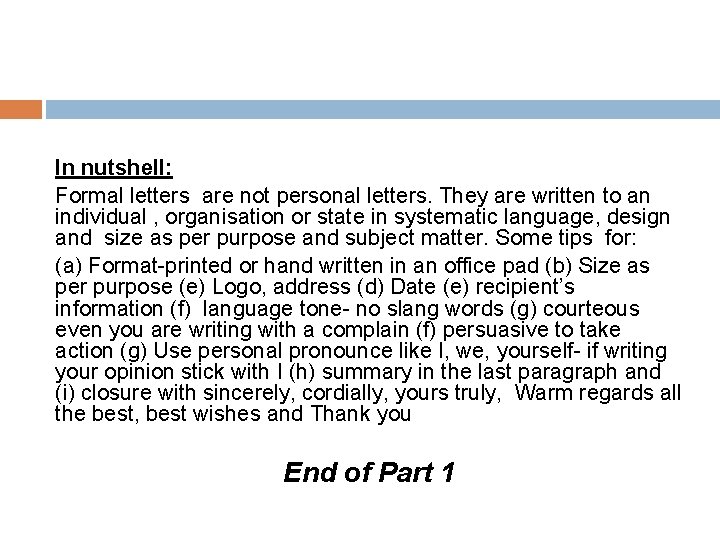
In nutshell: Formal letters are not personal letters. They are written to an individual , organisation or state in systematic language, design and size as per purpose and subject matter. Some tips for: (a) Format-printed or hand written in an office pad (b) Size as per purpose (e) Logo, address (d) Date (e) recipient’s information (f) language tone- no slang words (g) courteous even you are writing with a complain (f) persuasive to take action (g) Use personal pronounce like I, we, yourself- if writing your opinion stick with I (h) summary in the last paragraph and (i) closure with sincerely, cordially, yours truly, Warm regards all the best, best wishes and Thank you End of Part 1
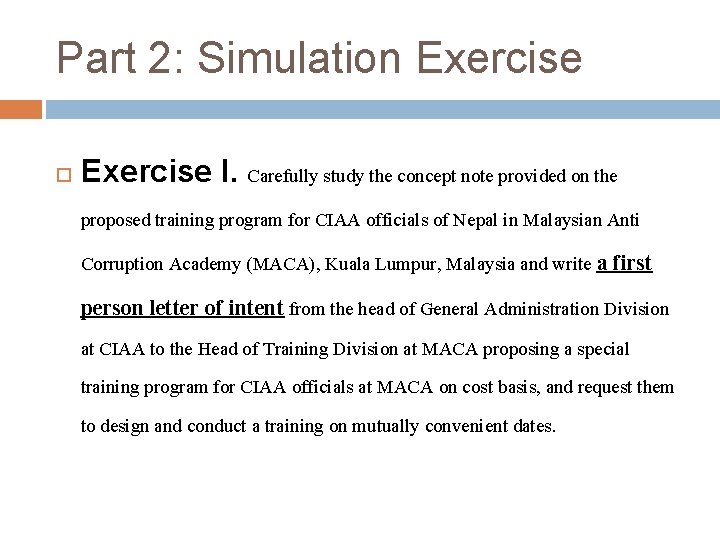
Part 2: Simulation Exercise I. Carefully study the concept note provided on the proposed training program for CIAA officials of Nepal in Malaysian Anti Corruption Academy (MACA), Kuala Lumpur, Malaysia and write a first person letter of intent from the head of General Administration Division at CIAA to the Head of Training Division at MACA proposing a special training program for CIAA officials at MACA on cost basis, and request them to design and conduct a training on mutually convenient dates.
Simulation …. Contd. Exercise ii. Study the third person note from the Ministry of Foreign Affairs to the Embassy of Suradonia in Kathmandu regarding nomination of Mr. Chandra Bahadur Nepali (Official Passport No. 0361111), Section Officer, Ministry of Industry, Commerce and Supplies to participate in a Seminar entitled “Enhancing the Role of Developing Countries in WTO Negotiations” to be held in Malawa, the capital city of Suradonia, from 25 to 27 April 2020. Since Mr. Nepali could not attend the seminar due to his unavoidable personal circumstances, write another follow up Third Person Note forwarding the nomination of Mr. Anand Singh, Section Officer (Official Passport No. 0776643) of the same Ministry in place of Mr. Nepali.
Part 3: Q & A Session Participants may ask specific questions regarding the presentation.
Thank you for your attention and cooperation!