
Off the Hook RealTime Client Side Phishing Prevention

![URL Structure Free. URL RDN Free. URL protocol: //[subdomains. ]mld. ps[/path][? query] FQDN https:](https://slidetodoc.com/presentation_image/d480365bc49a1366bed826d69bfd1721/image-8.jpg "URL Structure Free. URL RDN Free. URL protocol: //[subdomains. ]mld. ps[/path][? query] FQDN https:")
- Slides: 21
Off the Hook: Real-Time Client. Side Phishing Prevention System July 28 th, 2016 University of Helsinki Samuel Marchal*, Giovanni Armano*, Kalle Saari*, Nidhi Singh†, N. Asokan* *Aalto University - †Intel Security samuel. marchal@aalto. fi
Outline • Phishing detection system – minimal training data, language-independence, scalability, resilient to adaptive attack – highly accurate & fast (comparable to state-of-the-art) – locally computable • Target identification mechanism – language-independent, fast – highly accurate (comparable to state-of-the-art) • Browser Add-on – client-side computation, redirection to target 2
Outline • Phishing detection system – minimal training data, language-independence, scalability, resilient to adaptive attack – highly accurate & fast (comparable to state-of-the-art) – locally computable • Target identification mechanism – language-independent, fast – highly accurate (comparable to state-of-the-art) • Browser Add-on – client-side computation, redirection to target 3
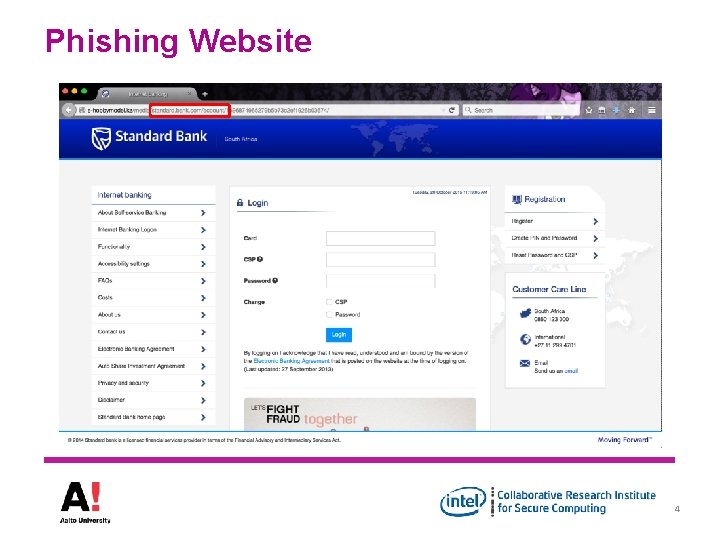
Phishing Website 4
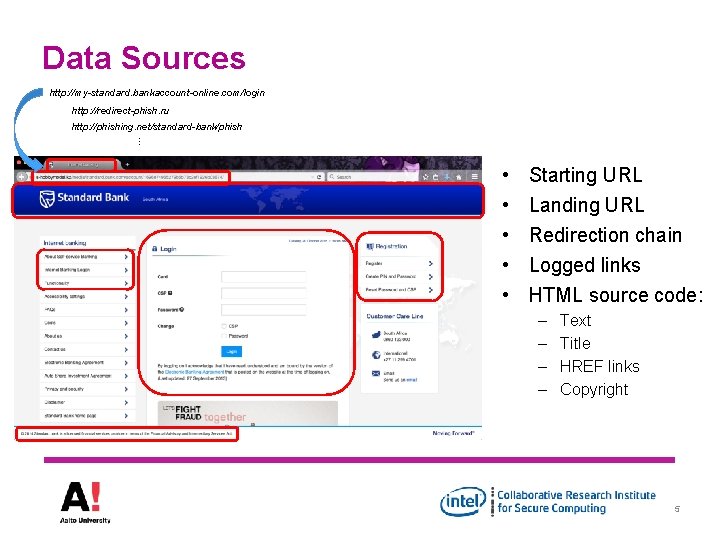
Data Sources http: //my-standard. bankaccount-online. com/login http: //redirect-phish. ru http: //phishing. net/standard-bank/phish … • • • Starting URL Landing URL Redirection chain Logged links HTML source code: – – Text Title HREF links Copyright 5
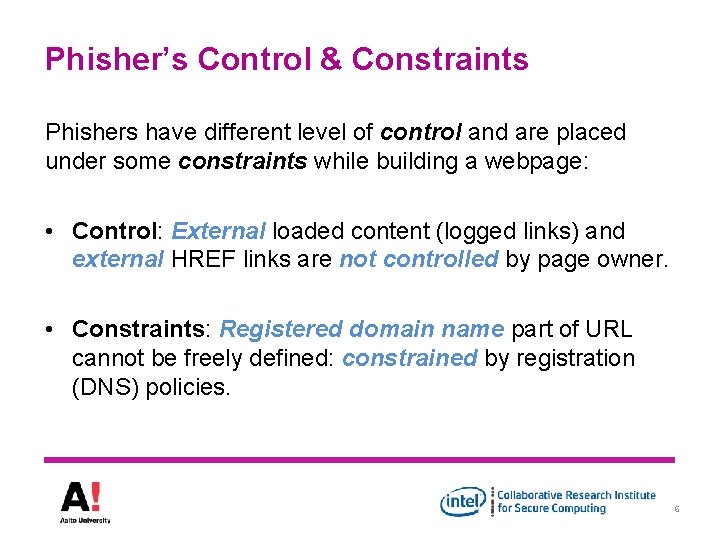
Phisher’s Control & Constraints Phishers have different level of control and are placed under some constraints while building a webpage: • Control: External loaded content (logged links) and external HREF links are not controlled by page owner. • Constraints: Registered domain name part of URL cannot be freely defined: constrained by registration (DNS) policies. 6
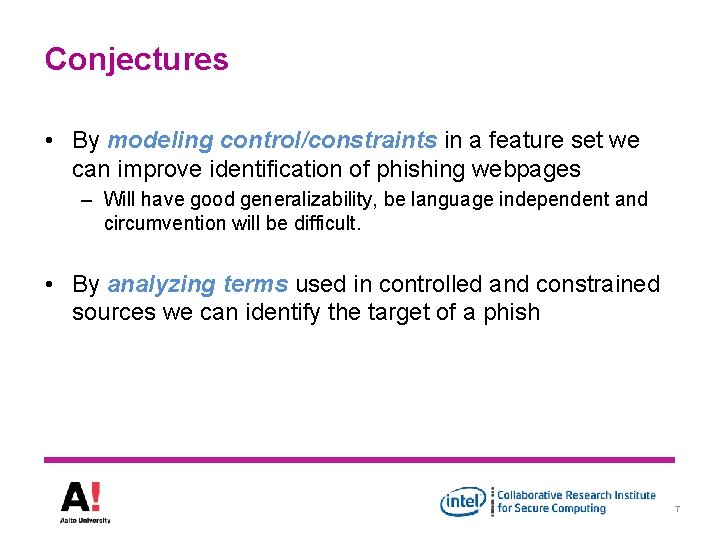
Conjectures • By modeling control/constraints in a feature set we can improve identification of phishing webpages – Will have good generalizability, be language independent and circumvention will be difficult. • By analyzing terms used in controlled and constrained sources we can identify the target of a phish 7
URL Structure Free. URL RDN Free. URL protocol: //[subdomains. ]mld. ps[/path][? query] FQDN https: //www. amazon. co. uk/ap/signin? _encoding=UTF 8 • • • Protocol = https FQDN = www. amazon. co. uk RDN = amazon. co. uk mld = amazon Free. URL = {www, /ap/signin? _encoding=UTF 8} 8
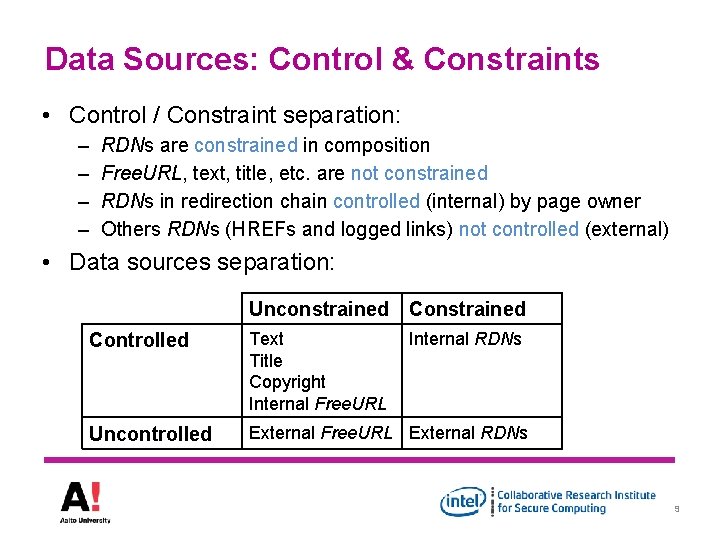
Data Sources: Control & Constraints • Control / Constraint separation: – – RDNs are constrained in composition Free. URL, text, title, etc. are not constrained RDNs in redirection chain controlled (internal) by page owner Others RDNs (HREFs and logged links) not controlled (external) • Data sources separation: Unconstrained Controlled Text Title Copyright Internal Free. URL Internal RDNs Uncontrolled External Free. URL External RDNs 9
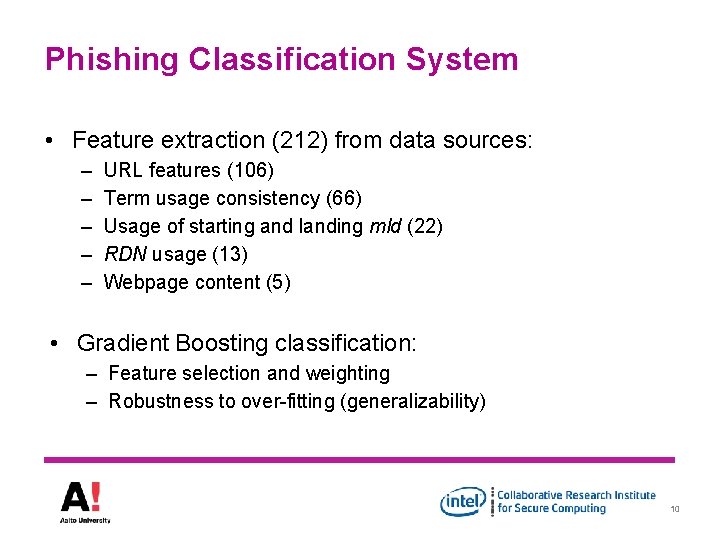
Phishing Classification System • Feature extraction (212) from data sources: – – – URL features (106) Term usage consistency (66) Usage of starting and landing mld (22) RDN usage (13) Webpage content (5) • Gradient Boosting classification: – Feature selection and weighting – Robustness to over-fitting (generalizability) 10
Classification Performance (language independence) • Classifier Training: – 4, 531 English legitimate webpages (Intel Security) – 1, 036 phishing webpages (Phish. Tank) • Assessment: – Legitimate webpages (Intel Security): • 100, 000 English • 10, 000 each in French, German, Italian, Portuguese and Spanish – 1, 216 phishing webpages (Phish. Tank) 11
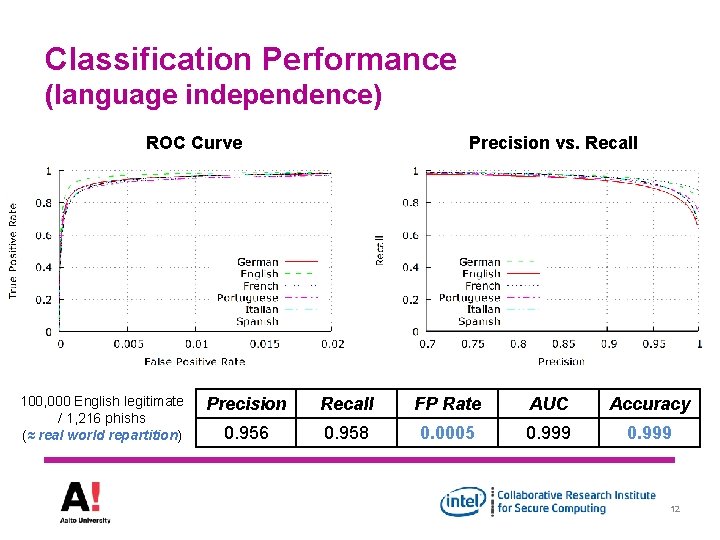
Classification Performance (language independence) ROC Curve 100, 000 English legitimate / 1, 216 phishs (≈ real world repartition) Precision vs. Recall Precision Recall FP Rate AUC Accuracy 0. 956 0. 958 0. 0005 0. 999 12
Outline • Phishing detection system – minimal training data, language-independence, scalability, resilient to adaptive attack – highly accurate & fast (comparable to state-of-the-art) – locally computable • Target identification mechanism – language-independent, fast – highly accurate (comparable to state-of-the-art) • Browser Add-on – client-side computation, redirection to target 13
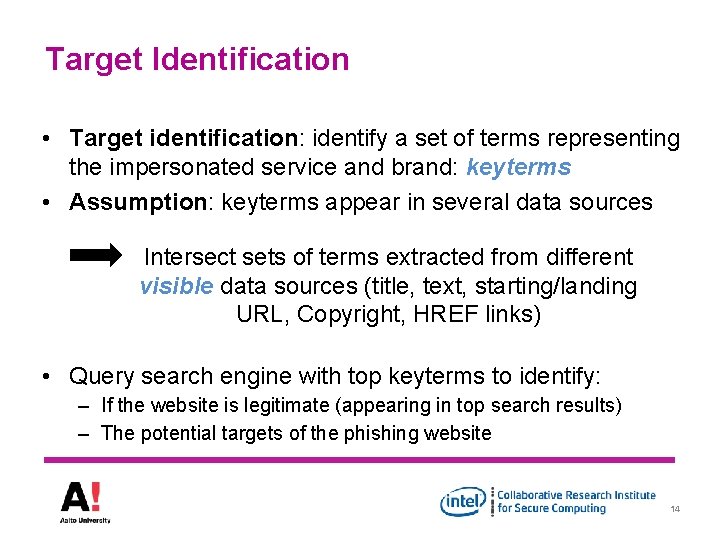
Target Identification • Target identification: identify a set of terms representing the impersonated service and brand: keyterms • Assumption: keyterms appear in several data sources Intersect sets of terms extracted from different visible data sources (title, text, starting/landing URL, Copyright, HREF links) • Query search engine with top keyterms to identify: – If the website is legitimate (appearing in top search results) – The potential targets of the phishing website 14
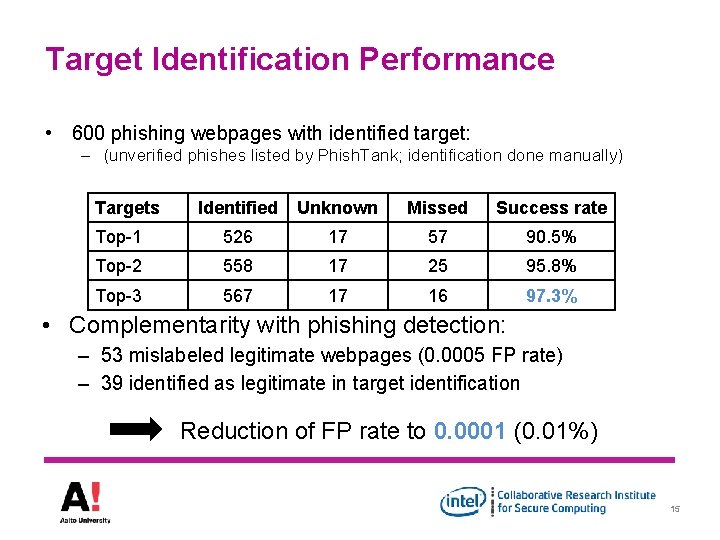
Target Identification Performance • 600 phishing webpages with identified target: – (unverified phishes listed by Phish. Tank; identification done manually) Targets Identified Unknown Missed Success rate Top-1 526 17 57 90. 5% Top-2 558 17 25 95. 8% Top-3 567 17 16 97. 3% • Complementarity with phishing detection: – 53 mislabeled legitimate webpages (0. 0005 FP rate) – 39 identified as legitimate in target identification Reduction of FP rate to 0. 0001 (0. 01%) 15
Outline • Phishing detection system – minimal training data, language-independence, scalability, resilient to adaptive attack – highly accurate & fast (comparable to state-of-the-art) – locally computable • Target identification mechanism – language-independent, fast – Highly accurate (comparable to state-of-the-art) • Browser Add-on – client-side computation, redirection to target 16
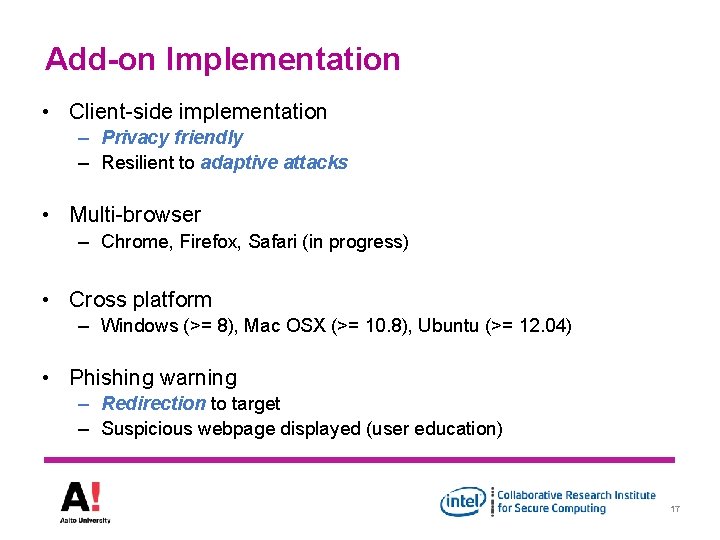
Add-on Implementation • Client-side implementation – Privacy friendly – Resilient to adaptive attacks • Multi-browser – Chrome, Firefox, Safari (in progress) • Cross platform – Windows (>= 8), Mac OSX (>= 10. 8), Ubuntu (>= 12. 04) • Phishing warning – Redirection to target – Suspicious webpage displayed (user education) 17
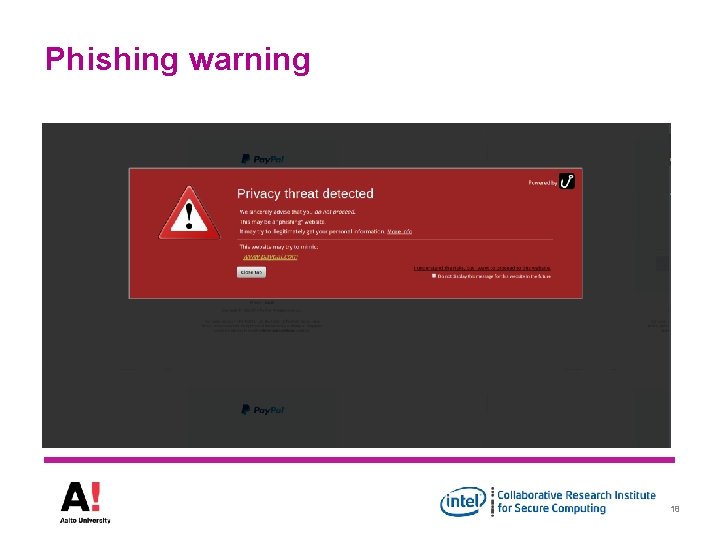
Phishing warning 18
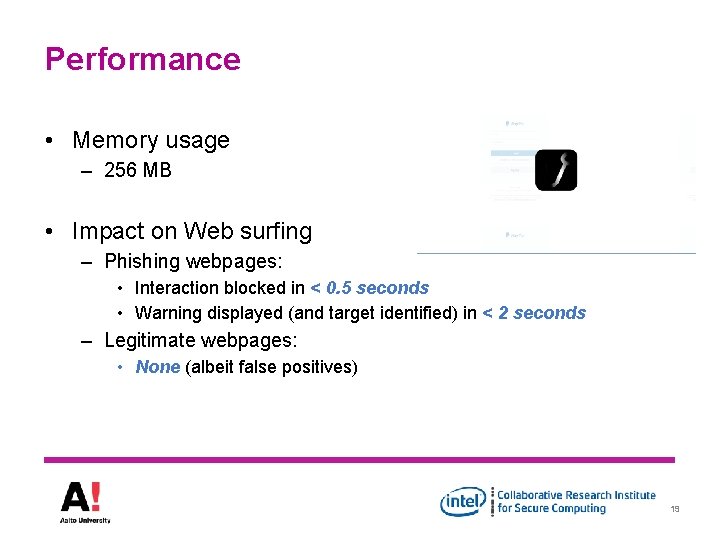
Performance • Memory usage – 256 MB • Impact on Web surfing – Phishing webpages: • Interaction blocked in < 0. 5 seconds • Warning displayed (and target identified) in < 2 seconds – Legitimate webpages: • None (albeit false positives) 19
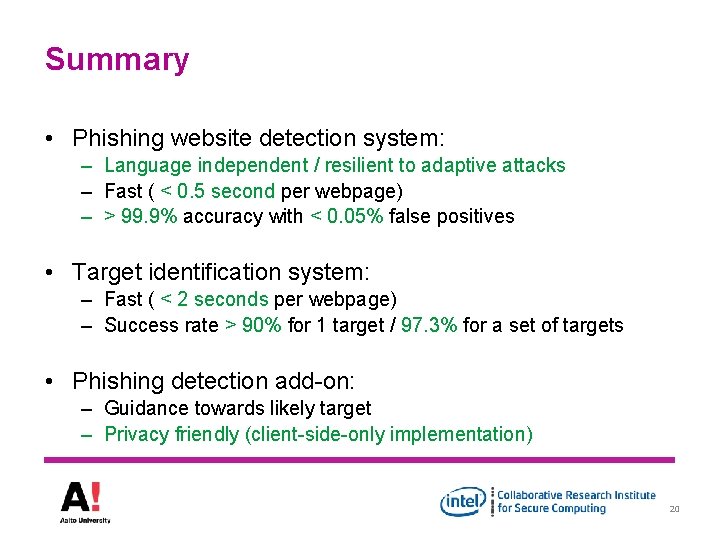
Summary • Phishing website detection system: – Language independent / resilient to adaptive attacks – Fast ( < 0. 5 second per webpage) – > 99. 9% accuracy with < 0. 05% false positives • Target identification system: – Fast ( < 2 seconds per webpage) – Success rate > 90% for 1 target / 97. 3% for a set of targets • Phishing detection add-on: – Guidance towards likely target – Privacy friendly (client-side-only implementation) 20
Questions ? https: //ssg. aalto. fi/projects/phishing/ 21