
OFDM Introduction and Basics Brian Krongold ARC Special
OFDM: Introduction and Basics Brian Krongold ARC Special Research Centre for Ultra-Broadband Information Networks THE UNIVERSITY OF MELBOURNE
Outline of this Talk n What is OFDM? (basic definition) n Why OFDM? (motivation) n How can we transmit via OFDM? n When/Where is OFDM used? (history & use) n OFDM advantages and disadvantages
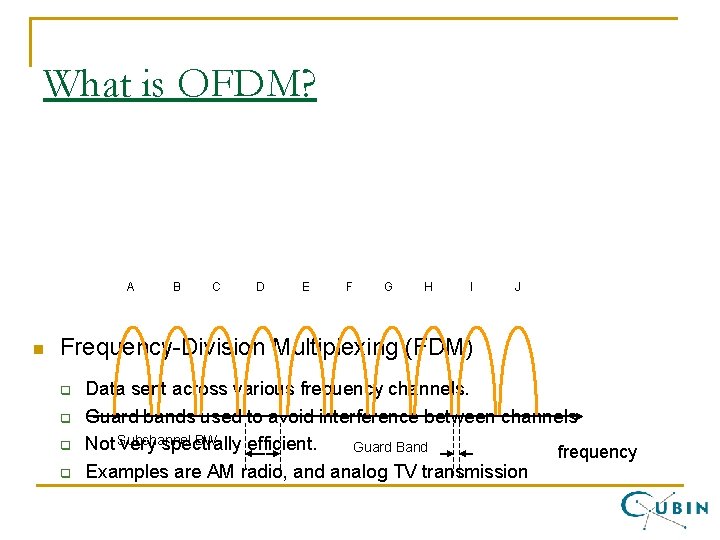
What is OFDM? A n B C D E F G H I J Frequency-Division Multiplexing (FDM) q q Data sent across various frequency channels. Guard bands used to avoid interference between channels BW Not Subchannel very spectrally efficient. Guard Band frequency Examples are AM radio, and analog TV transmission
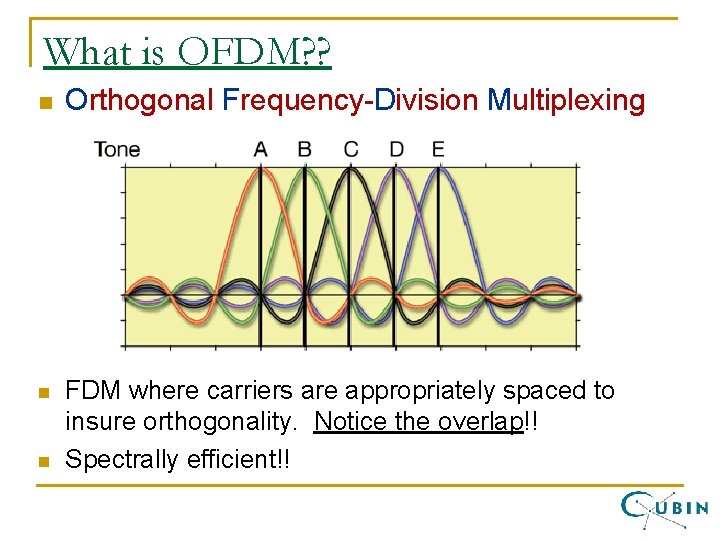
What is OFDM? ? n n n Orthogonal Frequency-Division Multiplexing FDM where carriers are appropriately spaced to insure orthogonality. Notice the overlap!! Spectrally efficient!!
What’s So Great About Orthogonality? n Transmit waveform for a given subchannel is orthogonal to that of the remaining subchannels. n Same concept of CDMA signals having orthogonal spreading codes. n At the receiver, an individual subchannel’s data can be demodulated without interference from the others. n Allows the receiver, in principle, to deal with each subchannel separately.
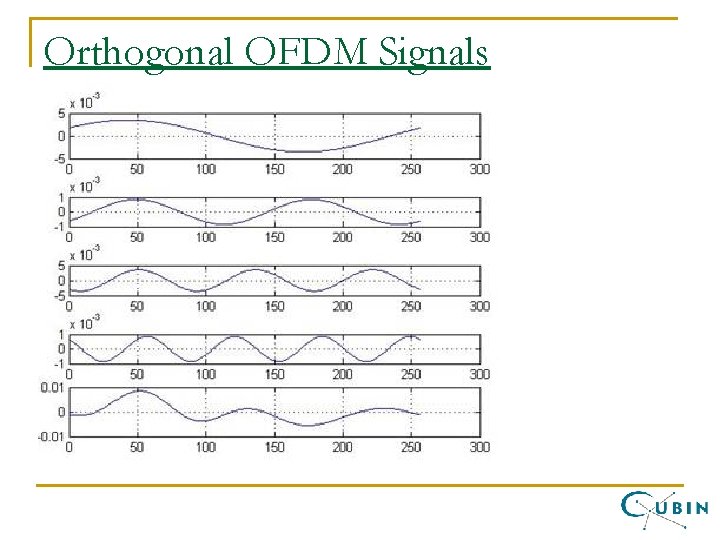
Orthogonal OFDM Signals
Why OFDM? ? ? n Next-generation systems are demanding higher and higher bit rates. q i. e. , requires more and more bandwidth (wider channel) q Wider channel increasingly less likely to be flat. (spectrally shaped) q n Spectrally-shaped channels are the frequency-domain equivalent to time-domain dispersive channels. Multipath propagation effects in wireless channels limit the increase of such rates. q These effects cause Intersymbol Interference (ISI). q Smearing of multiple adjacent data symbols with each other which increase the bit-error rate.

Why OFDM? ? ? n Narrowband signals are less sensitive to ISI and frequency-selective fading. q q q n “Flat channels” have no ISI (flatness in the frequency response). They become additive white Gaussian noise (AWGN) channels. Only effect on data symbols is white noise and a complex scaling (magnitude scaling and phase rotation) Solution: Transmit a wideband signal with many narrowband sub-bands! (Multicarrier System)
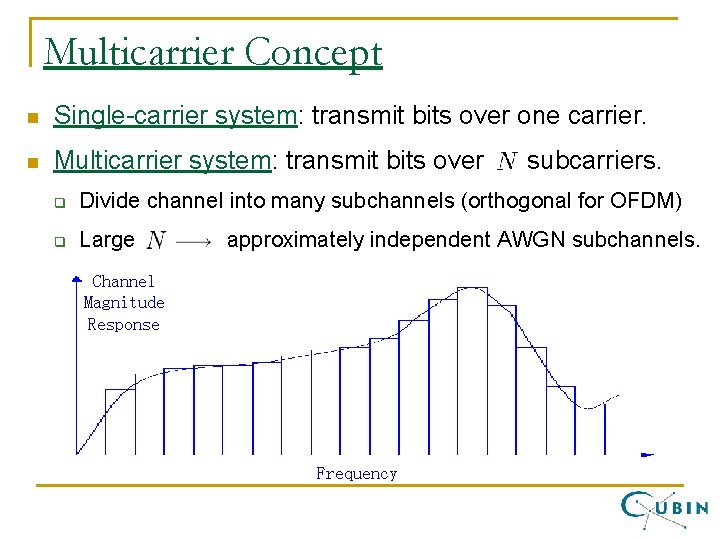
Multicarrier Concept n Single-carrier system: transmit bits over one carrier. n Multicarrier system: transmit bits over subcarriers. q Divide channel into many subchannels (orthogonal for OFDM) q Large approximately independent AWGN subchannels. Channel Magnitude Response Frequency
Why OFDM? ? ? A Simple Answer n In theory, data transmitted over a given OFDM subchannel can be demodulated without interference from other sub-bands due to orthogonality. n In theory, each subchannel can be individually equalized with a simple complex scalar multiplication. q High-rate single-carrier systems require very complicated adaptive equalizers whose performance can degrade with faster and faster data rates.
How is OFDM Implemented? n Difficult to use analog hardware to modulate data onto many subchannels. n Weinstein and Ebert (1971) discovered that a digital complex-baseband OFDM signal can be formed using the discrete Fourier transform (DFT). n q DFT is an orthogonal transformation. q Time domain Discrete frequency domain. Better yet, let’s use FFTs (which are the same, but implemented more efficiently!)
How is OFDM Implemented? n (1) Let’s take N data symbols and allocate one to each of N sub-bands. q Can be BPSK, QPSK, or M-QAM n Consider these symbols to be in the ``frequency symbol domain’’. n (2) Apply an inverse FFT (IFFT) to obtain a length-N digital time-domain signal. q This is our digital complex-baseband OFDM signal. n (3) Pass this signal through a D/A (or DAC) to form an analog signal. n (4) Modulate the analog signal to a carrier frequency
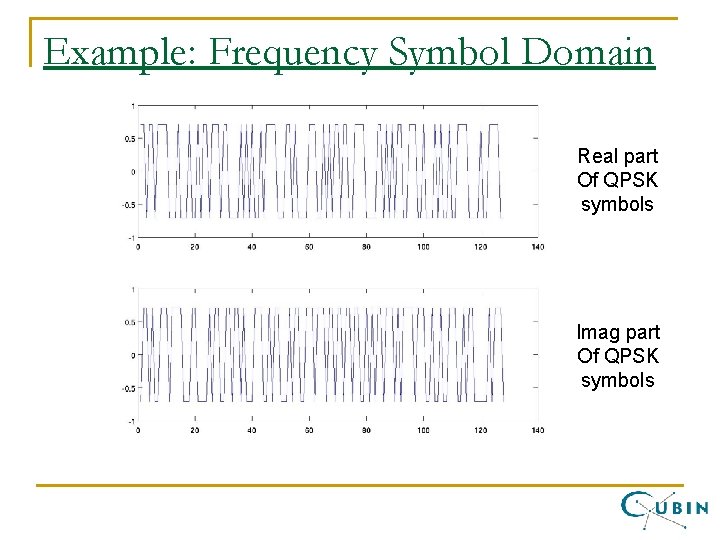
Example: Frequency Symbol Domain Real part Of QPSK symbols Imag part Of QPSK symbols
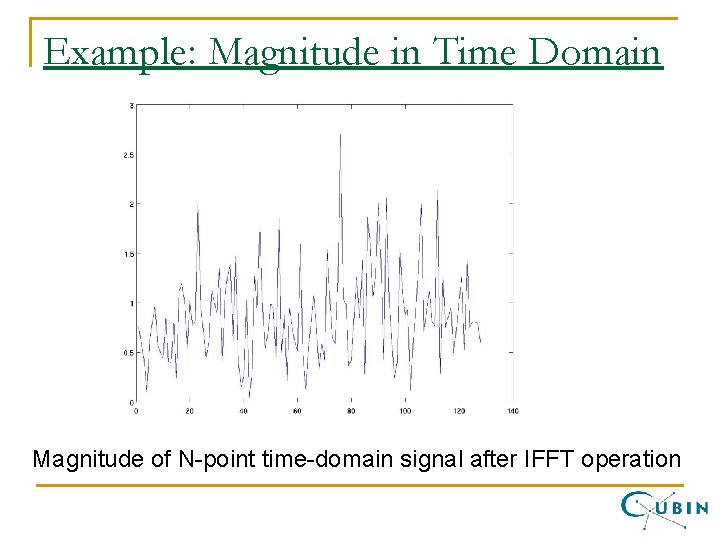
Example: Magnitude in Time Domain Magnitude of N-point time-domain signal after IFFT operation
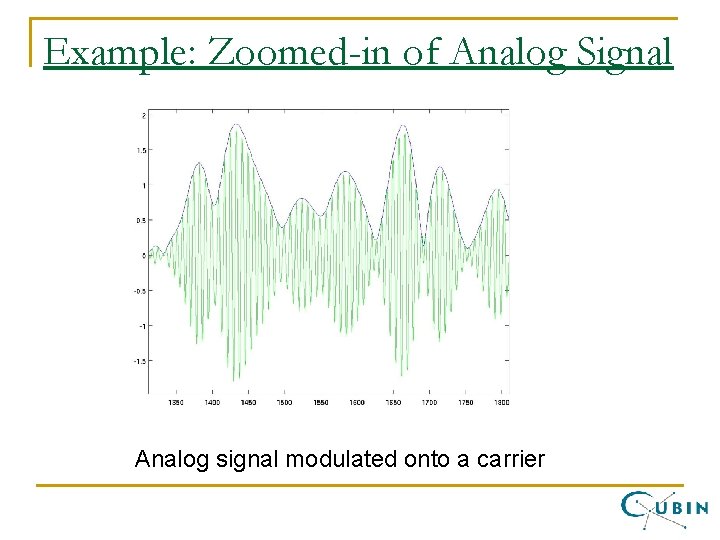
Example: Zoomed-in of Analog Signal Analog signal modulated onto a carrier
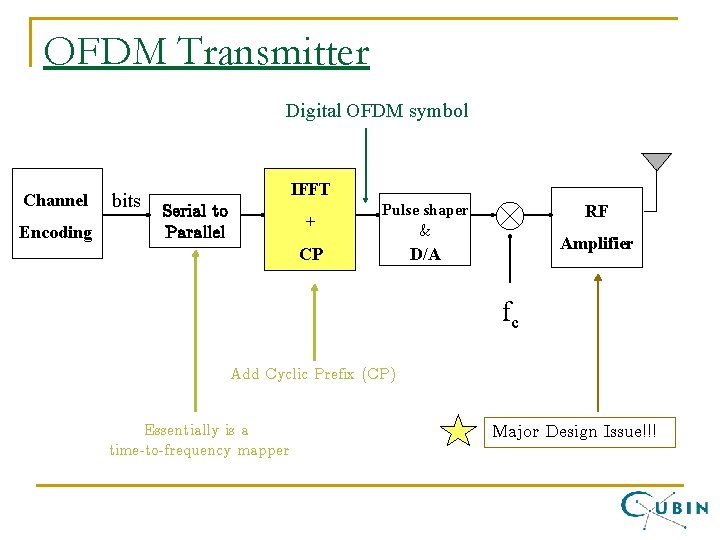
OFDM Transmitter Digital OFDM symbol Channel Encoding bits IFFT Serial to Parallel + Pulse shaper & CP D/A RF Amplifier fc Add Cyclic Prefix (CP) Essentially is a time-to-frequency mapper Major Design Issue!!!
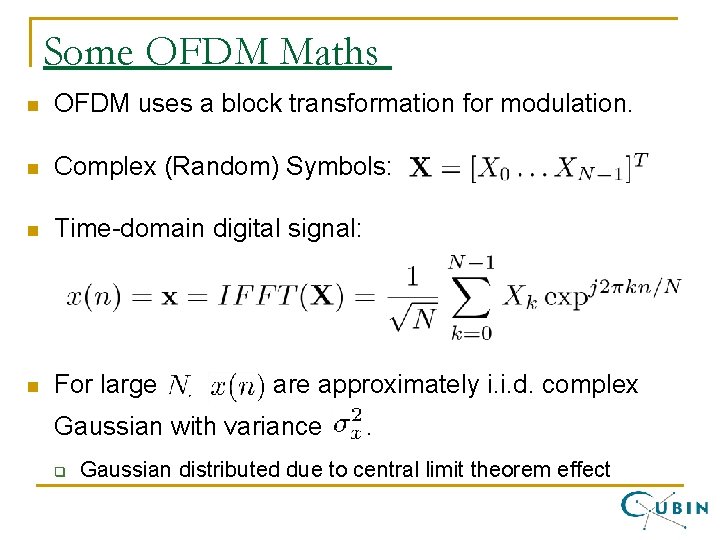
Some OFDM Maths n OFDM uses a block transformation for modulation. n Complex (Random) Symbols: n Time-domain digital signal: n For large , are approximately i. i. d. complex Gaussian with variance q . Gaussian distributed due to central limit theorem effect
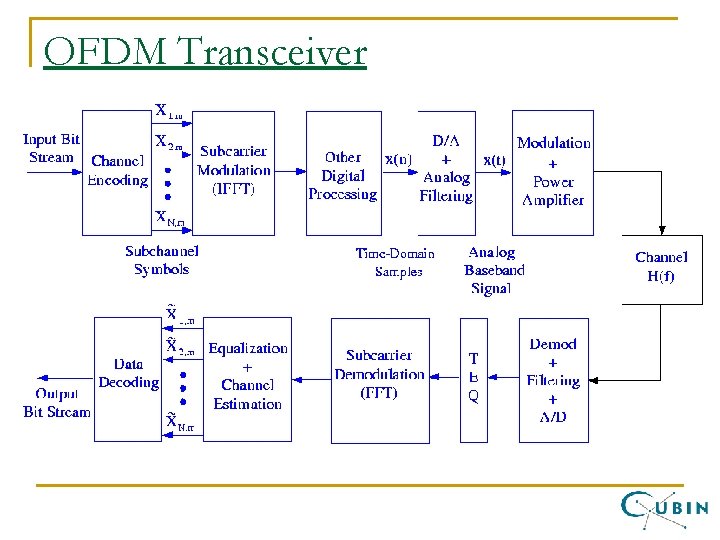
OFDM Transceiver
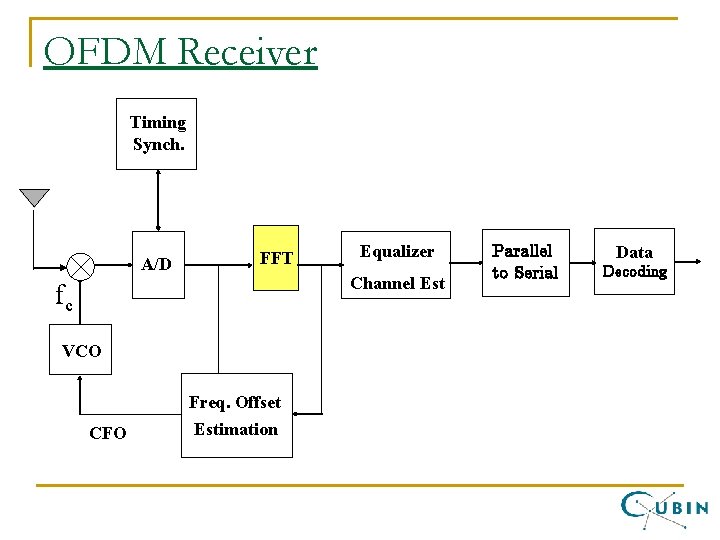
OFDM Receiver Timing Synch. A/D FFT Channel Est fc VCO CFO Equalizer Freq. Offset Estimation Parallel to Serial Data Decoding
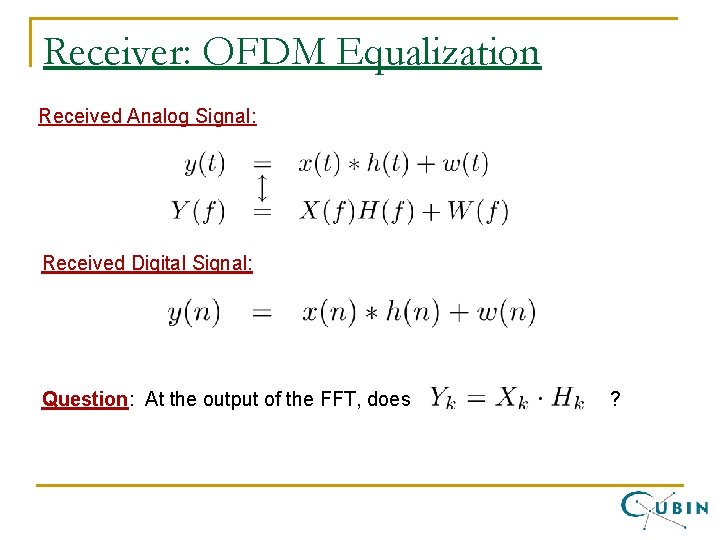
Receiver: OFDM Equalization Received Analog Signal: Received Digital Signal: Question: At the output of the FFT, does ?
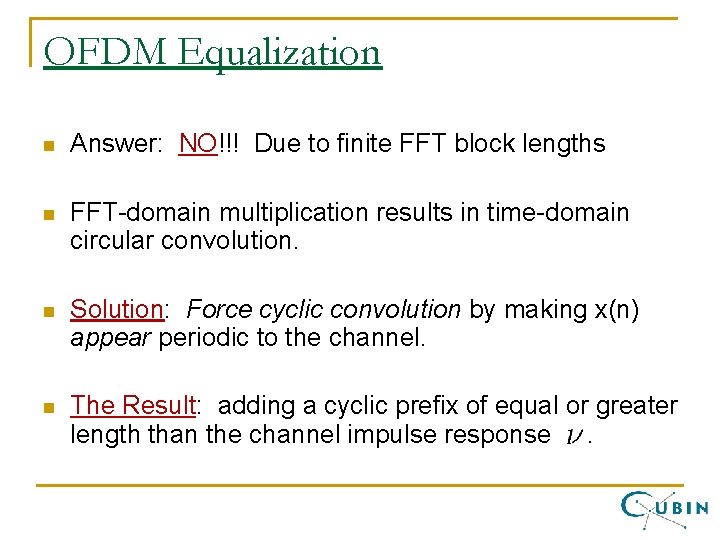
OFDM Equalization n Answer: NO!!! Due to finite FFT block lengths n FFT-domain multiplication results in time-domain circular convolution. n Solution: Force cyclic convolution by making x(n) appear periodic to the channel. n The Result: adding a cyclic prefix of equal or greater length than the channel impulse response.
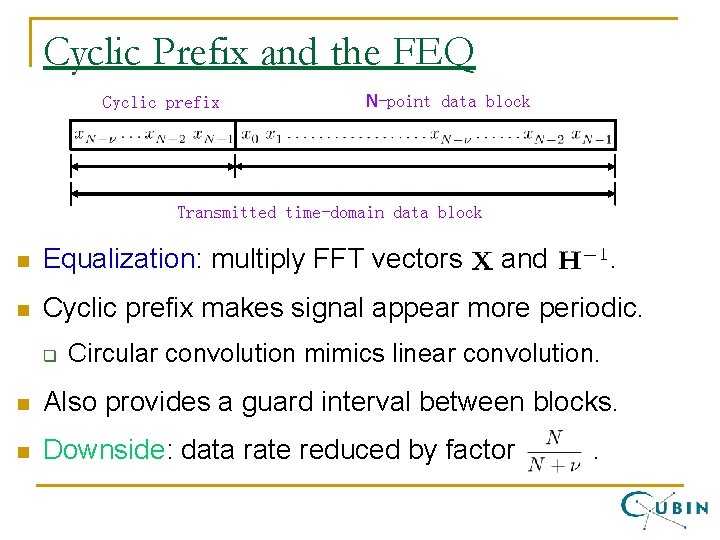
Cyclic Prefix and the FEQ Cyclic prefix N-point data block Transmitted time-domain data block n Equalization: multiply FFT vectors n Cyclic prefix makes signal appear more periodic. q and . Circular convolution mimics linear convolution. n Also provides a guard interval between blocks. n Downside: data rate reduced by factor .
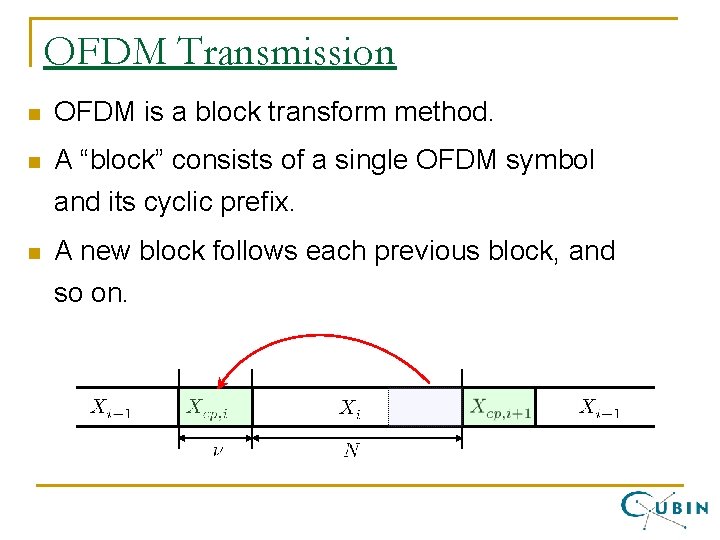
OFDM Transmission n OFDM is a block transform method. n A “block” consists of a single OFDM symbol and its cyclic prefix. n A new block follows each previous block, and so on.
When Did OFDM Come About? n 1966: R. W. Chang proposed OFDM for dispersive fading channels. Patent issued 1970. n 1971: Weinstein and Ebert first proposed using the DFT for OFDM transmission. n 1985: Cimini looked at the feasility of OFDM transmission. Does a proof of concept design. n 1987: Alard and Lasalle propose coded OFDM for digital broadcasting n 1990 s: Standards and implementation of OFDM in q q n Digital Audio Broadcasting (DAB) Asymmetric Digital Subscriber Lines (ADSL) Digital Video Broadcasting (DVB-T) Wireless LAN standards (HIPERLAN 2, IEEE 802. 11 a) What took so long for OFDM to come to fruition? q FFTs were too expensive to implement pre-1990’s. They are now cheap to implement, and OFDM can have less computational complexity than conventional single-carrier systems in some systems.
Recent/Future Use of OFDM n IEEE 802. 11 n (MIMO WLAN) n IEEE 802. 16 e (Wi. MAX), Wi. BRO, 802. 20 q n Wireless broadband standards DVB-T 2 (next-gen digital video broadcasting) q DVB-H standardized for handheld devices. n LTE / 4 G mobile communications n Optical OFDM? (coherent and non-coherent)
Advantages of OFDM n OFDM is spectrally efficient (remember the overlap!) n Robust to multipath interference q q n Subchannels are narrowband with essentially zero ISI Simple equalization compared to single-carrier systems. Robust to narrowband interference q Can always not use (i. e. , turn off) any bad subchannels n Computationally efficient compared to single-carrier. n Simple exploitation of frequency diversity (COFDM)
Disadvantages of OFDM n Very sensitive to carrier-frequency offset (CFOs) q n Causes a loss in orthogonality resulting in inter-channel interference (ICI). High peak-to-average power ratio (PAPR). q q q Occasional large peaks require an expensive high-powered amplifier (HPA) for clean (i. e. , linear) transmission. Low power efficiency results to handle a large dynamic range. Any nonlinear amplification will destroy orthogonality! n n Introduces out-of-band distortion, which is a big “No-No”!! Sensitive to clock frequency and timing offsets
Channel Estimation and Equalization Jian (Andrew) Zhang @ 11: 20
Channel Estimation n Need to estimate the complex channel gain in each subchannel in order to equalize. q Notice: equalization uses a one-tap complex scalar filter in each subchannel. Very simple and efficient. n Can estimate each Hk with pilot tones. n Better idea: utilize bandwidth coherency!! q Use pilot tones on some subchannels followed by smart interpolation to estimate remaining ones.
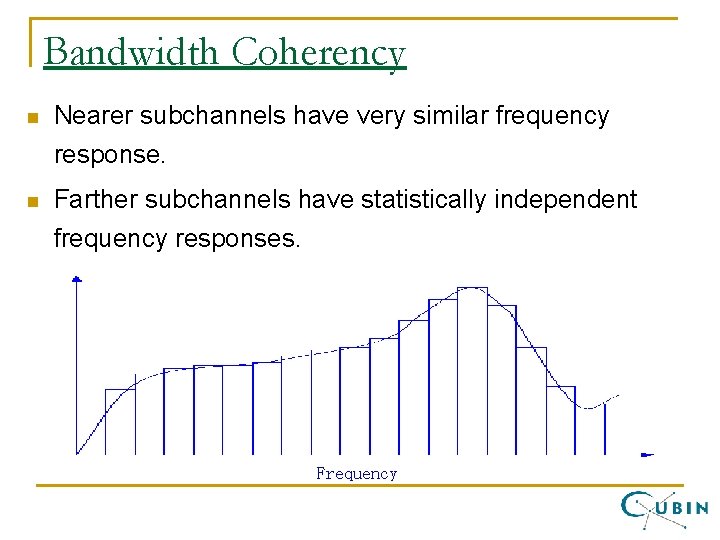
Bandwidth Coherency n Nearer subchannels have very similar frequency response. n Farther subchannels have statistically independent frequency responses. Frequency
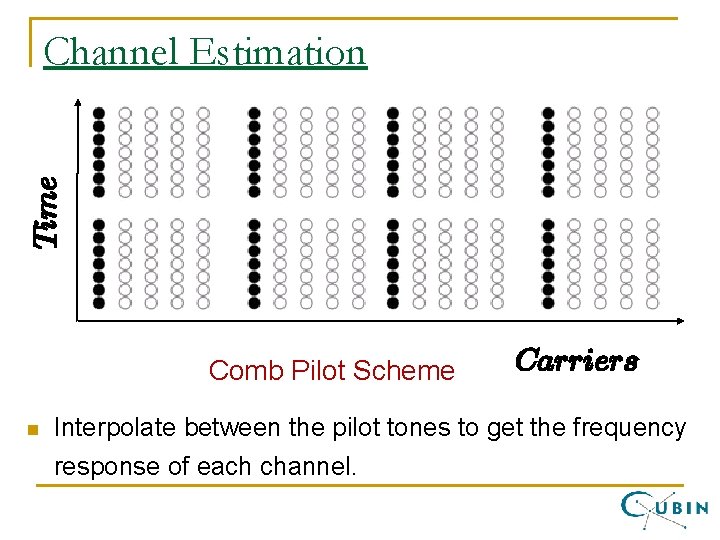
Time Channel Estimation Comb Pilot Scheme n Carriers Interpolate between the pilot tones to get the frequency response of each channel.
Time & Frequency Synchronization Matt Ruan @ 2 pm
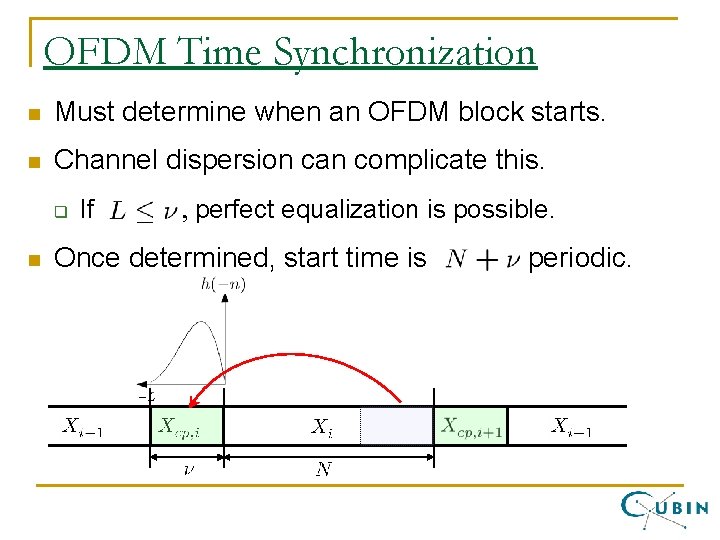
OFDM Time Synchronization n Must determine when an OFDM block starts. n Channel dispersion can complicate this. q n If , perfect equalization is possible. Once determined, start time is periodic.
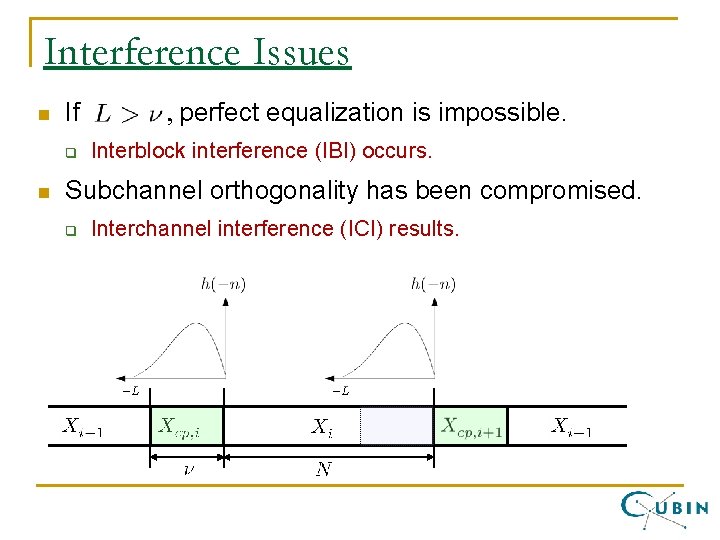
Interference Issues n If q n , perfect equalization is impossible. Interblock interference (IBI) occurs. Subchannel orthogonality has been compromised. q Interchannel interference (ICI) results.
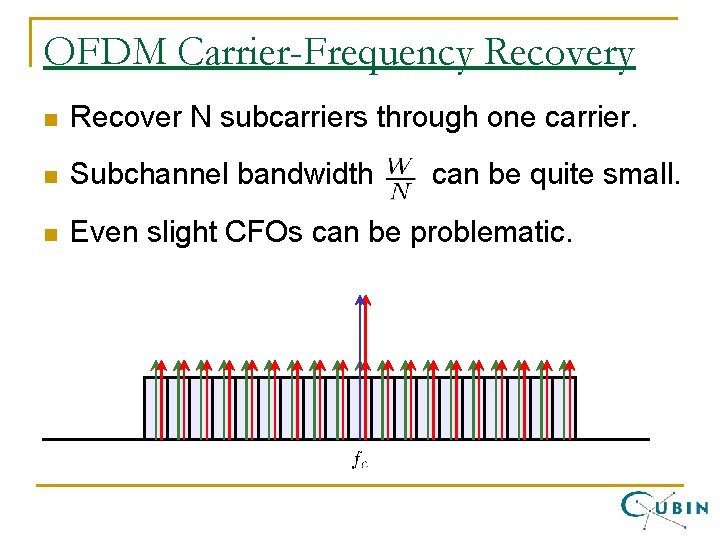
OFDM Carrier-Frequency Recovery n Recover N subcarriers through one carrier. n Subchannel bandwidth n Even slight CFOs can be problematic. can be quite small.
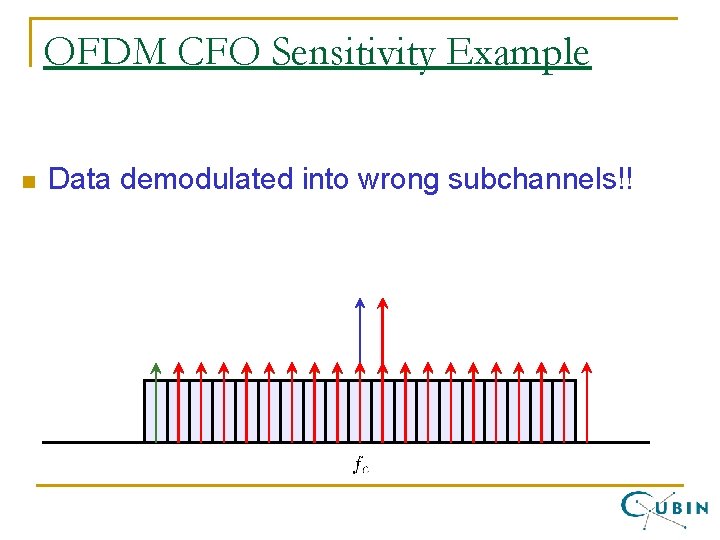
OFDM CFO Sensitivity Example n Data demodulated into wrong subchannels!!
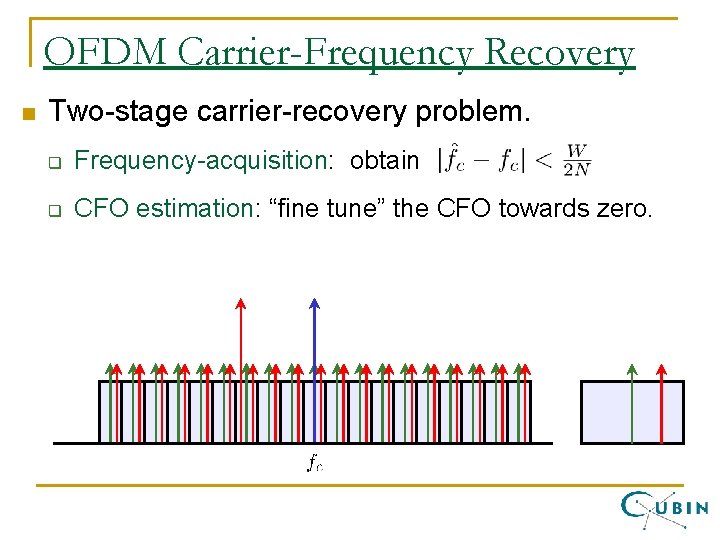
OFDM Carrier-Frequency Recovery n Two-stage carrier-recovery problem. q Frequency-acquisition: obtain q CFO estimation: “fine tune” the CFO towards zero.
Power Ratio (PAPR or PAR) Problem Dhammika Jayalath @ 3: 20 pm
Why does the PAPR Problem Occur? n Time-domain samples are linear combinations of random variables. If N is large, a central limit theorem effect begins. n The time-domain samples become approximately Gaussian distributed, and the tails are our “occasional large peaks”. n A High Powered Amplifier (HPA) essential consume power in relation to their peak power, and not the average power. q n Creates a HUGE power cost for base stations if an expensive HPA with a large dynamic range is used. NOTICE: This is an ANALOG problem. Viewing PAR results of the digital OFDM signal are not truly indicative of the analog PAR.
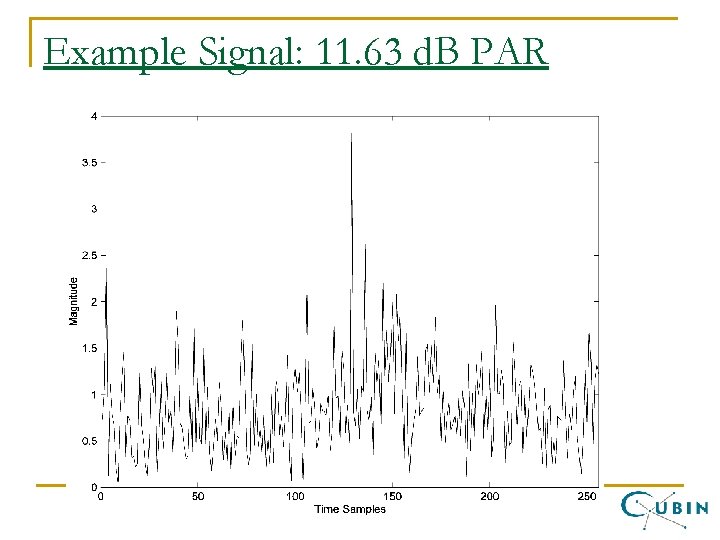
Example Signal: 11. 63 d. B PAR
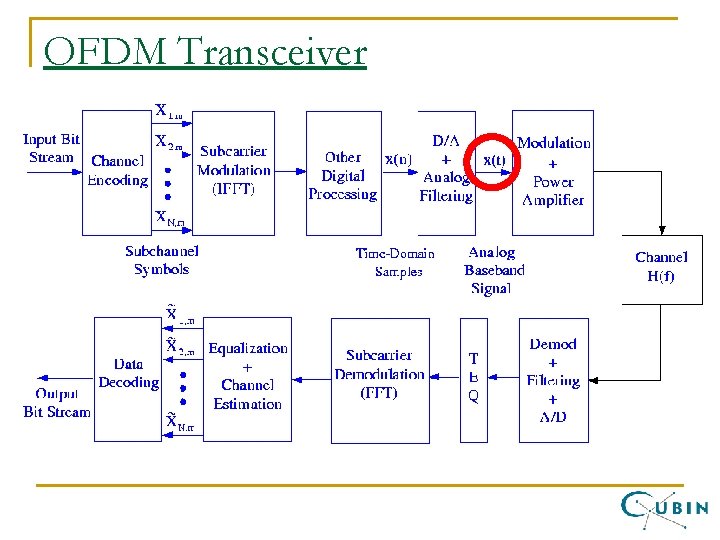
OFDM Transceiver
OFDM Resource Allocation Brian Krongold @ 4: 20 pm
Transmit Optimization with CSI n If the transmitter has full or partial channel-state information (CSI), resources such as power and data rate can be allocated according to subchannel. n Optimization problems result such as maximizing rate subject to a total power constraint. n Transmit optimized OFDM with full CSI can approach channel capacity. q Identical concept to water pouring to achieve capacity.
- Slides: 43