
OFA FABRIC SOFTWARE DEVELOPMENT PLATFORM FSDP Proposal May
OFA FABRIC SOFTWARE DEVELOPMENT PLATFORM FSDP Proposal May, 2020
EXECUTIVE SUMMARY We propose that the OFA create the OFA Fabric Software Development Platform – OFA FSDP § Comprises a hardware platform and accompanying software infrastructure § Designed to provide its target clientele with easy access to a modern cluster incorporating high performance network technologies to be used in the development, testing, and validation of software associated with client access to fabric services § Intended to be mostly automated and require little active maintenance, aka ‘lights out’ § Sited at a commercial colocation facility or similar site § Promoter members are full FSDP members § Lower level memberships will be made available at a reduced price point § Anyone wishing to make use of the FSDP must have an OFA membership at some level § Supported by normal OFA membership dues § Seen as a vehicle for driving OFA membership and stature in the community § Will strengthen the cooperation between the OFA and various upstream communities § The OFA will provide continuous integration testing to the upstream communities free of charge 2
TABLE OF CONTENTS § Motivation and Objectives § Program Overview - Fabric Software Development Platform (FSDP) program § Fabric Software Development Platform – Hardware and Software Infrastructure § Program and System Administration • Governance – FSDP Working Group • Membership, Funding Model • Siting Options 3
WHY AN FSDP PROGRAM The simple answer - It is a core component of the OFA’s mission: “The mission of the Open. Fabrics Alliance (OFA) is to accelerate the development and adoption of advanced fabrics for the benefit of the advanced networks ecosystem. ” The OFA Fabric Software Development Platform, like the OFILP (the old Logo program) before it, is a key element in driving the adoption of advanced fabrics 4
AN INSTRUCTIVE LOOK IN THE REARVIEW MIRROR The original Open. Fabrics Interoperability Logo Program was: § Designed to validate interoperability between vendors, and with the OFED stack § Narrowly focused on a small hardware vendor community § Centered around a certification program – ‘Logo Program’ § Forced participants into a rigid program schedule § Paid for by the subscribers, who were charged a fixed base fee + an incremental fee based on number of devices tested Over time … § OFED’s components were replaced by a community-supported open source RDMA subsystem § RDMA users and vendors expressed strong preference to test against standard Distros and upstream kernels § Industry consolidation reduced the number of hardware devices Long Story Short – it was the right program for its time, but that time has passed 5
QUESTION Can we design a program that delivers greater value than the OFILP at lower cost? While serving the needs of: - Alliance members - The open community - Vendors - OEMs In short, a program that delivers on the OFA’s mission 6
A BETTER IDEA? At the 2019 Workshop, a ‘re-imagined’ Interop program was proposed: § Designed to be responsive to the needs of a much broader audience • Continues to serve the traditional hardware vendors and distros • Adds Linux community, network software developers, middleware developers and others as stakeholders § Greatly improved flexibility for clients of the program • Based on an ‘on-demand’ philosophy • Retains the original logo program, (if desired by the client base), but no longer the center of the universe § Integrates popular distributions • Compared to the OFILP, which was driven by OFED § Fundamental Shift In Philosophy • Old: OFILP consisted of debug events and logo events for IHVs; focused on awarding an OFA Logo • New: FSDP is an experimental cluster, supported and maintained by the OFA and made available to members for testing, debug, and validation 7
SERVING OUR PROPOSED TARGET CLIENTS § Upstream Linux Maintainers • Automatic, continuous testing of upstream software (kernel, rdma-core, …) • Centralized testing of multiple hardware vendors’ products • Relieve maintainers of the burden of tracking the efficacy of hardware from multiple vendors • Incubation of an open source community that contributes tests that can be run on the cluster § Hardware Vendors * • Private, on demand access to a multi-vendor cluster for testing/validation of new hardware, software, firmware • Logo program, if desired § OS Distros: On demand testing for distros (Red Hat, Su. SE, OFED, etc. ) ** • Private, on demand access to a multi-vendor cluster for e. g. release testing • Logo program, if desired § ISVs, Applications, Middleware • On demand testing of specific software (Open. MPI, AMQP, Open. Stack, others) • Software development (Apache? My. SQL? ) *served by original OFA Logo Program **served by the “on-demand” testing program at NMC 8
WHAT IT IS § The program comprises a ‘lights out’ cluster maintained and supported by the OFA • Easily accessible to OFA members § The cluster has at least three intended uses • Continuous Integration testing • On-demand testing • An optional logo program § Other uses are likely (and encouraged!) to emerge as the industry becomes aware of the capability being offered 9
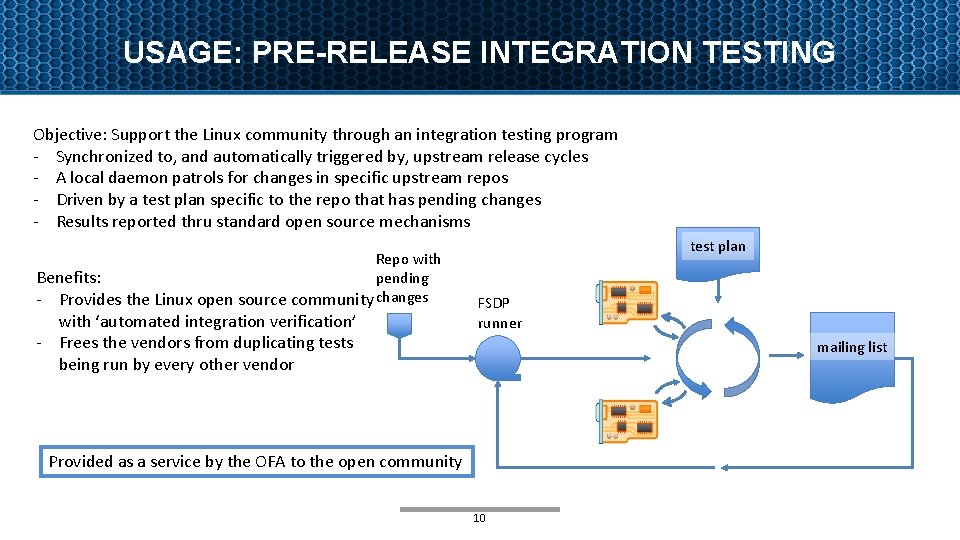
USAGE: PRE-RELEASE INTEGRATION TESTING Objective: Support the Linux community through an integration testing program - Synchronized to, and automatically triggered by, upstream release cycles - A local daemon patrols for changes in specific upstream repos - Driven by a test plan specific to the repo that has pending changes - Results reported thru standard open source mechanisms Repo with pending Benefits: - Provides the Linux open source community changes with ‘automated integration verification’ - Frees the vendors from duplicating tests being run by every other vendor test plan FSDP runner mailing list Provided as a service by the OFA to the open community 10
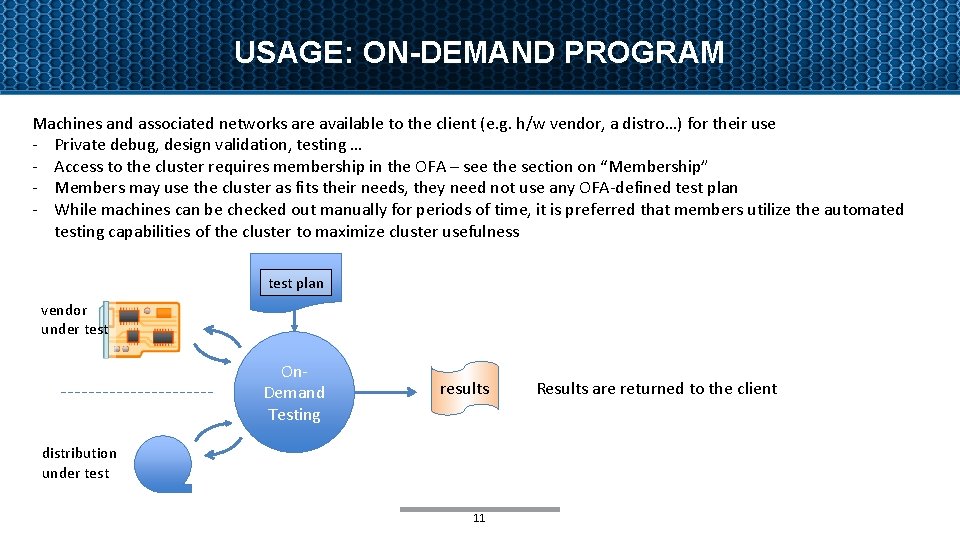
USAGE: ON-DEMAND PROGRAM Machines and associated networks are available to the client (e. g. h/w vendor, a distro…) for their use - Private debug, design validation, testing … - Access to the cluster requires membership in the OFA – see the section on “Membership” - Members may use the cluster as fits their needs, they need not use any OFA-defined test plan - While machines can be checked out manually for periods of time, it is preferred that members utilize the automated testing capabilities of the cluster to maximize cluster usefulness test plan vendor under test On. Demand Testing results distribution under test 11 Results are returned to the client
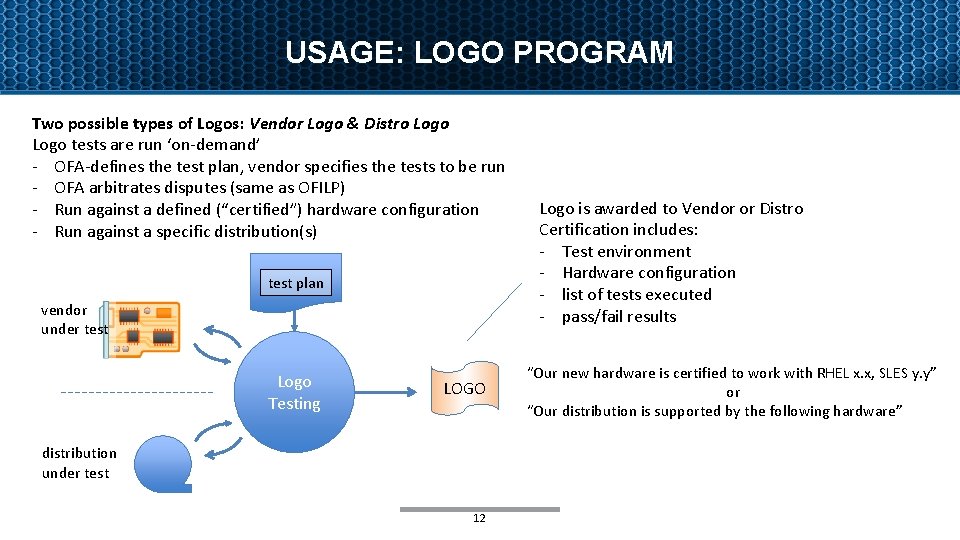
USAGE: LOGO PROGRAM Two possible types of Logos: Vendor Logo & Distro Logo tests are run ‘on-demand’ - OFA-defines the test plan, vendor specifies the tests to be run - OFA arbitrates disputes (same as OFILP) - Run against a defined (“certified”) hardware configuration - Run against a specific distribution(s) test plan vendor under test Logo Testing LOGO distribution under test 12 Logo is awarded to Vendor or Distro Certification includes: - Test environment - Hardware configuration - list of tests executed - pass/fail results “Our new hardware is certified to work with RHEL x. x, SLES y. y” or “Our distribution is supported by the following hardware”
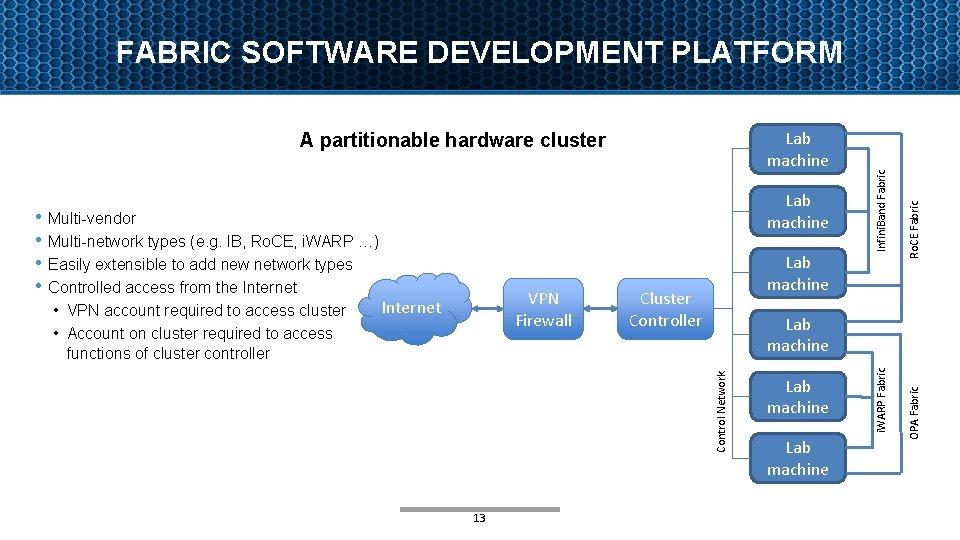
Cluster Controller Lab machine 13 Lab machine OPA Fabric VPN Firewall Lab machine i. WARP Fabric Multi-vendor Multi-network types (e. g. IB, Ro. CE, i. WARP …) Easily extensible to add new network types Controlled access from the Internet • VPN account required to access cluster • Account on cluster required to access functions of cluster controller Control Network • • Lab machine Ro. CE Fabric Lab machine A partitionable hardware cluster Infini. Band Fabric FABRIC SOFTWARE DEVELOPMENT PLATFORM
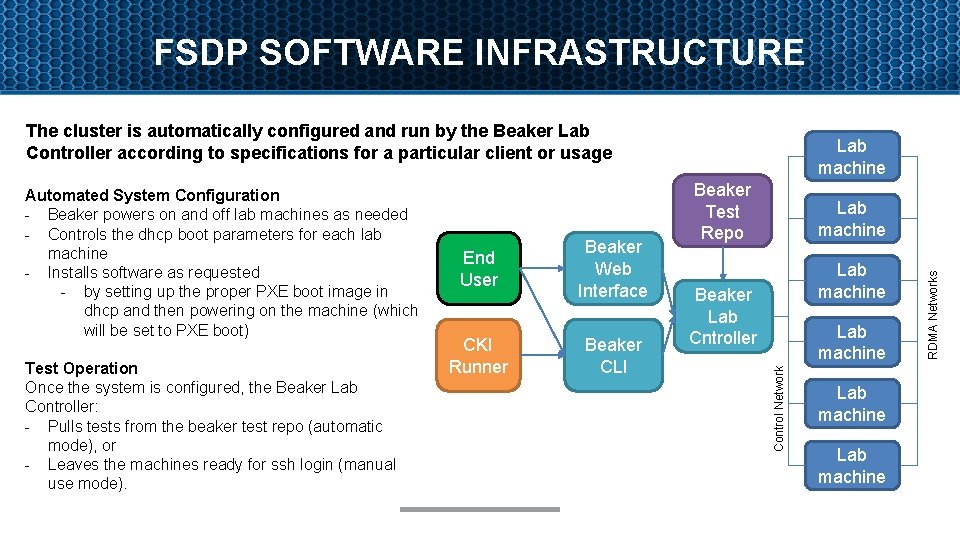
FSDP SOFTWARE INFRASTRUCTURE The cluster is automatically configured and run by the Beaker Lab Controller according to specifications for a particular client or usage Beaker Web Interface CKI Runner Beaker CLI Lab machine Beaker Lab Cntroller Lab machine RDMA Networks Test Operation Once the system is configured, the Beaker Lab Controller: - Pulls tests from the beaker test repo (automatic mode), or - Leaves the machines ready for ssh login (manual use mode). End User Beaker Test Repo Control Network Automated System Configuration - Beaker powers on and off lab machines as needed - Controls the dhcp boot parameters for each lab machine - Installs software as requested - by setting up the proper PXE boot image in dhcp and then powering on the machine (which will be set to PXE boot) Lab machine
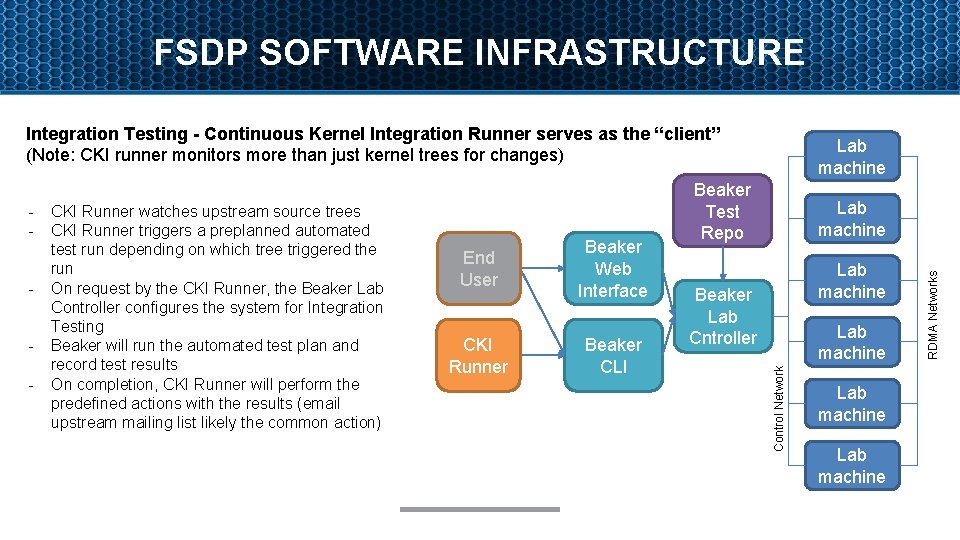
FSDP SOFTWARE INFRASTRUCTURE Integration Testing - Continuous Kernel Integration Runner serves as the “client” (Note: CKI runner monitors more than just kernel trees for changes) - End User Beaker Web Interface CKI Runner Beaker CLI Lab machine Beaker Lab Cntroller Lab machine RDMA Networks - CKI Runner watches upstream source trees CKI Runner triggers a preplanned automated test run depending on which tree triggered the run On request by the CKI Runner, the Beaker Lab Controller configures the system for Integration Testing Beaker will run the automated test plan and record test results On completion, CKI Runner will perform the predefined actions with the results (email upstream mailing list likely the common action) Beaker Test Repo Control Network - Lab machine
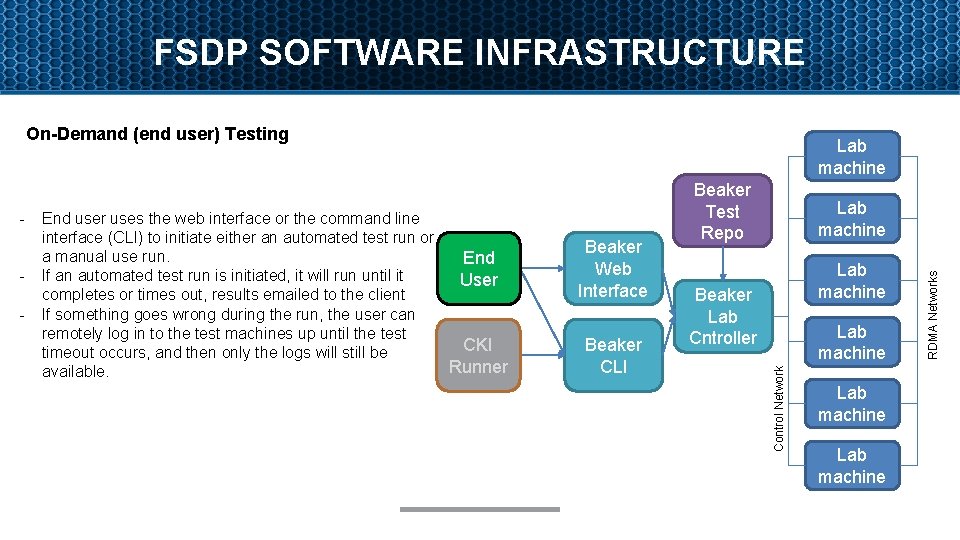
FSDP SOFTWARE INFRASTRUCTURE On-Demand (end user) Testing - Beaker Web Interface Beaker CLI Lab machine Beaker Lab Cntroller Lab machine RDMA Networks - End user uses the web interface or the command line interface (CLI) to initiate either an automated test run or a manual use run. End If an automated test run is initiated, it will run until it User completes or times out, results emailed to the client If something goes wrong during the run, the user can remotely log in to the test machines up until the test CKI timeout occurs, and then only the logs will still be Runner available. Beaker Test Repo Control Network - Lab machine
FSDP HARDWARE INFRASTRUCTURE - Inventory of existing OFA-owned hardware currently stored at UNH-IOL - Existing hardware at the UNH-IOL is older and may not serve our needs well - Ownership of some resources at the UNH-IOL is unclear - Proposed cluster hardware - 20 test servers to start, grow to 30 servers on year 3, then buy another 10 servers every 2 years and retire the 10 - oldest servers so that we stay at a total count of 30 servers - These hold various vendor’s cards and are standardized for reasonable performance on tests - Typical configuration: - 24 core CPU - 64 GB RAM - 128 GB OS drive - One or more fabric access cards 1 head node – Runs the cluster, stores all logs, runs interface to access cluster 1 serial console server – Provides access to lowest level debugging in the case that kernel oops renders ssh session unusable 17
PROGRAM ADMINISTRATION § Program will be administered by the OFA’s FSDP Working Group (FSDPWG) • This is distinct from the day-to-day operation of the testing site § The FSDPWG will serve as a gate keeper: • Controlling initial access to the program • Authorizing user accounts for sysadmin to manage • Approving individual membership requests • Approving requests for adding new repos into CI testing • Receiving and acting upon complaints of problems that, for whatever reason, couldn’t be handled by day-to-day administrators § The FSDPWG defines all potential logo test plan specifications § The FSDPWG responsible for validating logo test results • FSDPWG is the OFA agent that issues a logo • FSDPWG arbitrates logo testing disputes (same as OFILP) 18
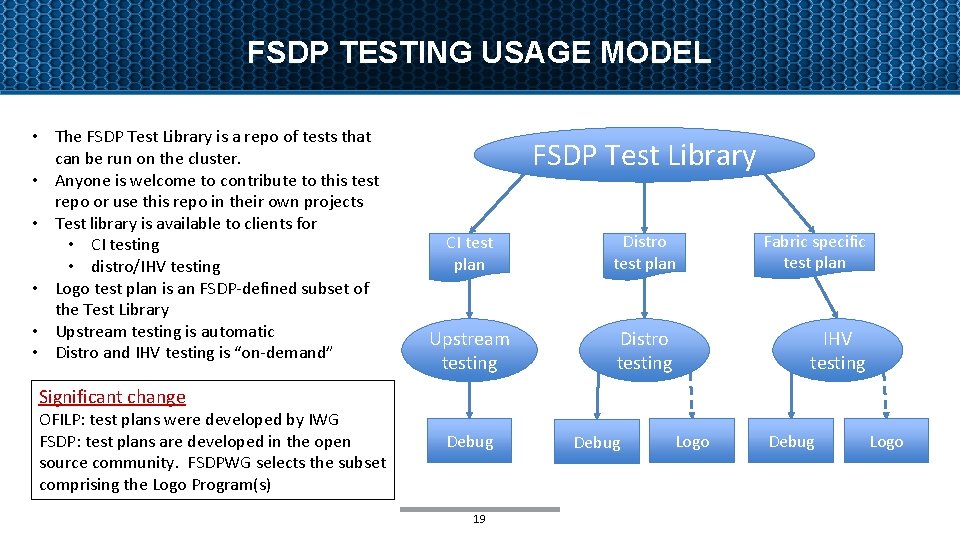
FSDP TESTING USAGE MODEL • The FSDP Test Library is a repo of tests that can be run on the cluster. • Anyone is welcome to contribute to this test repo or use this repo in their own projects • Test library is available to clients for • CI testing • distro/IHV testing • Logo test plan is an FSDP-defined subset of the Test Library • Upstream testing is automatic • Distro and IHV testing is “on-demand” FSDP Test Library CI test plan Distro test plan Fabric specific test plan Upstream testing Distro testing IHV testing Significant change OFILP: test plans were developed by IWG FSDP: test plans are developed in the open source community. FSDPWG selects the subset comprising the Logo Program(s) Debug 19 Debug Logo
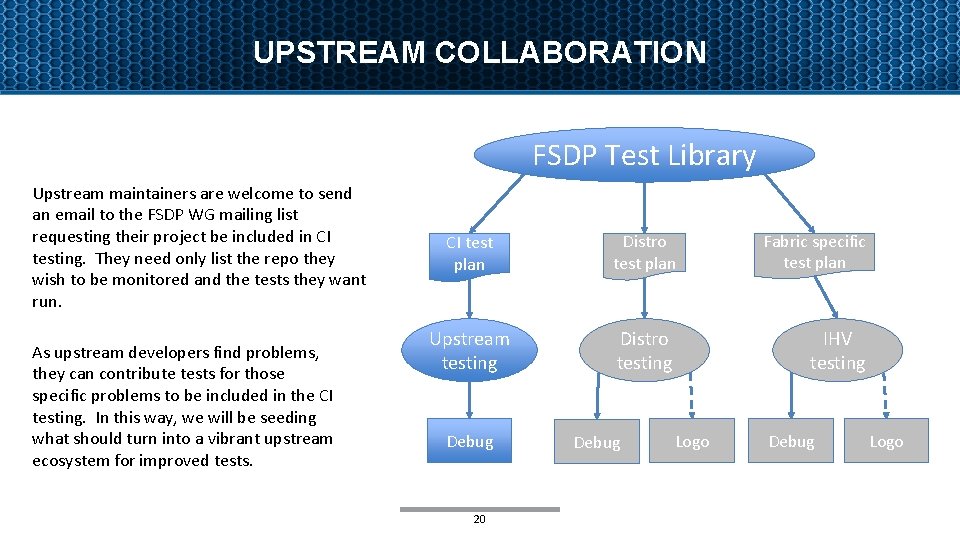
UPSTREAM COLLABORATION FSDP Test Library Upstream maintainers are welcome to send an email to the FSDP WG mailing list requesting their project be included in CI testing. They need only list the repo they wish to be monitored and the tests they want run. As upstream developers find problems, they can contribute tests for those specific problems to be included in the CI testing. In this way, we will be seeding what should turn into a vibrant upstream ecosystem for improved tests. CI test plan Distro test plan Fabric specific test plan Upstream testing Distro testing IHV testing Debug 20 Debug Logo
![FSDP OFA Statutory membership [2] membership [1] MEMBERSHIP MODEL Membership level OFA Rights FSDP](http://slidetodoc.com/presentation_image_h/e5a9d651ecf044c9d00c076f9705ac20/image-21.jpg "FSDP OFA Statutory membership [2] membership [1] MEMBERSHIP MODEL Membership level OFA Rights FSDP")
FSDP OFA Statutory membership [2] membership [1] MEMBERSHIP MODEL Membership level OFA Rights FSDP WG Rights FSDP Rights Promoter Full rights as defined by Bylaws - serve as FSDP WG Chair - right to vote in FSDP WG Unlimited access Membership level OFA Rights FSDP WG Rights FSDP Rights OFA General Member n/a - right to vote in FSDP WG Unlimited access OFA Limited Member n/a - none Unlimited access Individual Member n/a - none Free access [3] [1] Promoter Members are ‘statutory members’ by California law with special voting rights concerning the bylaws. Promoter is the only membership level defined in the bylaws. [2] FSDP Members are OFA members; FSDP membership levels are defined by OFA membership policy. [3] Access to the cluster requires OFA membership: either Promoter Member, or one of the FSDP Member levels. 21
FUNDING MODEL § Program is an OFA budgetary expense; it is supported by OFA membership dues • Versus OFILP which was wholly supported by fees charged to the client § Propose 3 levels of FSDP Membership (in addition to the statutory Promoter Member): • General OFA Member: Right to vote in FSDP WG but not to chair; unlimited testing • Limited OFA Member: No right to vote in the FSDP WG; unlimited testing • Individual Member: Limited to bona fide individuals with a demonstrated need to use the cluster § FSDPWG is treated as a “Works of Authorship” working group as described in the proposed IPR policy document • Decisions are made via voting mechanisms • Anyone may attend meetings and participate; voting is limited to Promoters and Voting FSDP members • Voting mainly applies to ratification of pre-defined logo test plans and acceptance of logo test results Significant Changes - CI Testing provided by the OFA to the upstream community free of charge - Old: OFILP was funded by fees charged to the client, run on a cost recovery basis - New: FSDP is an OFA budgetary expense funded by member dues 22
SITING OPTIONS We have received quotes from five potential hosting sites § UNH-IOL • $2, 500 monthly recurring charge • $250/month for 10 hours/month of service or $1, 000/month for 10 hours/week of service, cheapest service rates of all quotes • Facilities are well suited to hosting members that need actual physical access to the cluster • Extremely high initial setup charge § VTM Beaverton • $2, 700 monthly recurring charge • $120/hr for services • No mention of whether or not they can do the beaker admin tasks § Tier. Point (www. tierpoint. com) • $1, 400 monthly recurring charge, very low internet budget, high power budget, overage charges for each • Completely lacking any quotes for requested services § Opus Interactive (www. opusinteractive. com) • $1, 134 monthly recurring charge, moderate internet budget, moderate power budget, overage charges for each • Only quoted some of the services requested and highest for all services they did quote § John Companies, Inc (www. johncompanies. com) • $1, 995 monthly recurring charge, unlimited gigabit internet, moderate power budget, no overage charges but will need to upgrade to • • higher monthly plan to get more than 2. 8 k. W power in rack Provided quotes for all services requested, hourly rates lowest of all quotes except UNH-IOL Can be combined with our OFA website service to save a little money as John Companies is where the OFA servers are currently located 23
PLAN FOR ONGOING CLUSTER ADMINISTRATION § Ken Strandberg – Long time OFA sysadmin, has offered to install and manage the Beaker instance in the cluster for a very reasonable price • $1, 000 non-recurring setup charge • $800 monthly recurring admin charge • This is based on an estimate of 10 hours per month of required maintenance activity, with the ability to adjust the number if it turns out that this is not a reasonable estimate of time needed to manage the cluster § Other possible options include having one of the vendors do the work • John Companies provided a reasonable quote on a by-the-hour basis • UNH-IOL might include Beaker management in their Advanced Support option, waiting to hear from them § Regardless of who initially sets up the Beaker cluster, final acceptance of the setup will require the creation of a system administration guide to detail the common tasks and steps required to keep the cluster operational • This will be retained by the OFA in the case that cluster management needs to be transitioned from one place to another § Physical Site Administrators/Managers provided by vendor that provides siting • Provides day-to-day physical support • Administrators will be expected to intervene under unusual circumstances, for example a runaway job or a machine that • • won’t boot Administrators will respond to unexplained outages and restart/repair/otherwise intervene as required Will need to interface with the Beaker/Cluster admin person 24
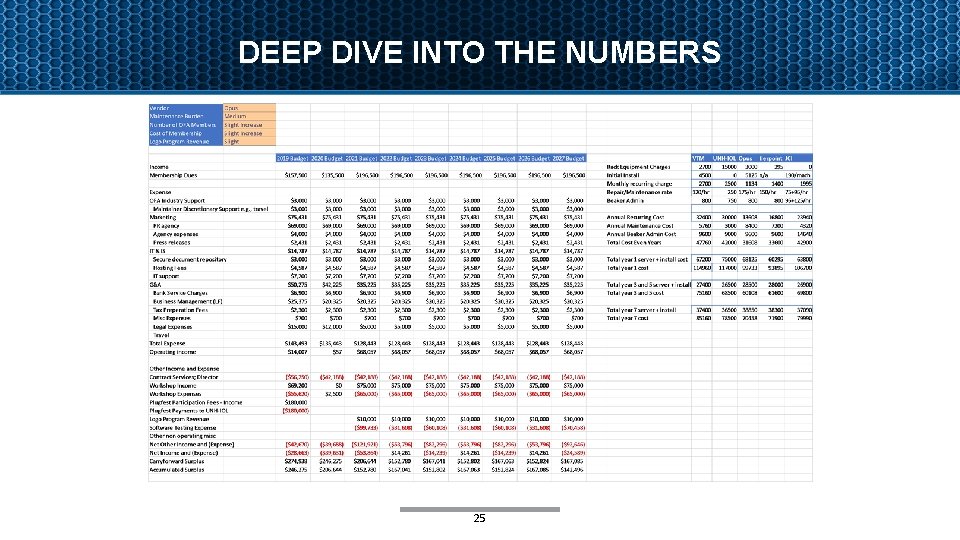
DEEP DIVE INTO THE NUMBERS 25
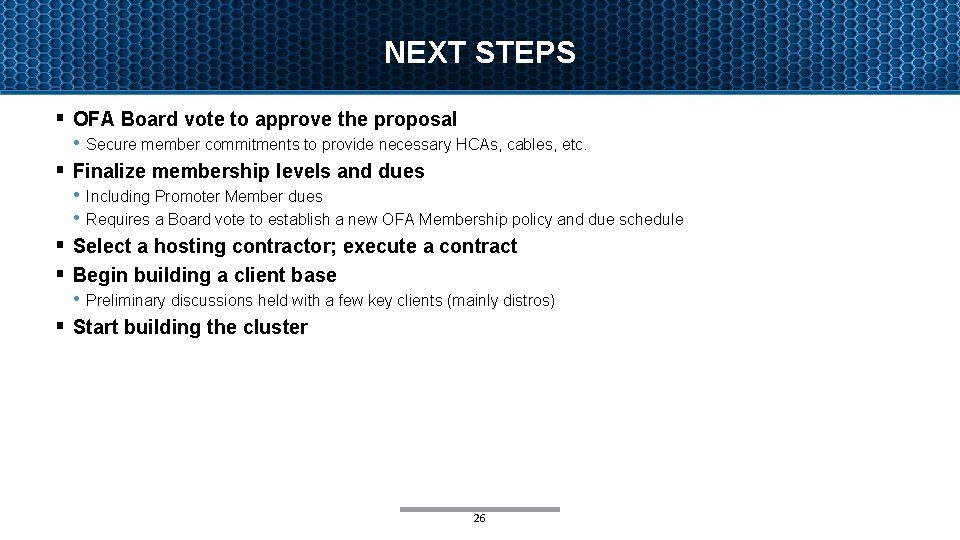
NEXT STEPS § OFA Board vote to approve the proposal § § • Secure member commitments to provide necessary HCAs, cables, etc. Finalize membership levels and dues • Including Promoter Member dues • Requires a Board vote to establish a new OFA Membership policy and due schedule Select a hosting contractor; execute a contract Begin building a client base • Preliminary discussions held with a few key clients (mainly distros) Start building the cluster 26
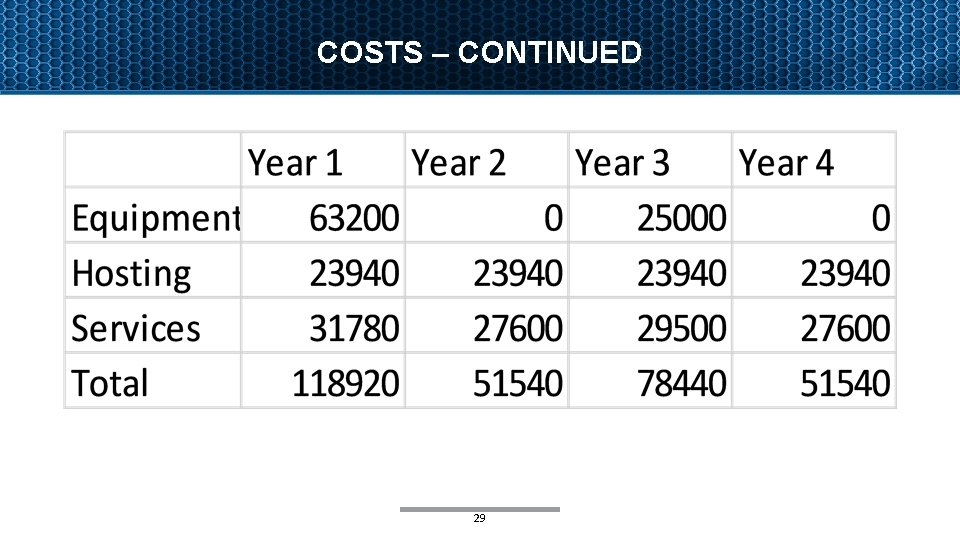
TO CLOSE THE PROPOSAL § Slide 23 – FSDP H/W Infrastructure - Doug to fill in hardware details • Everything except UNH-IOL inventory now done § Slide 29 – Costs – Initial version done, needs eyes on it 27
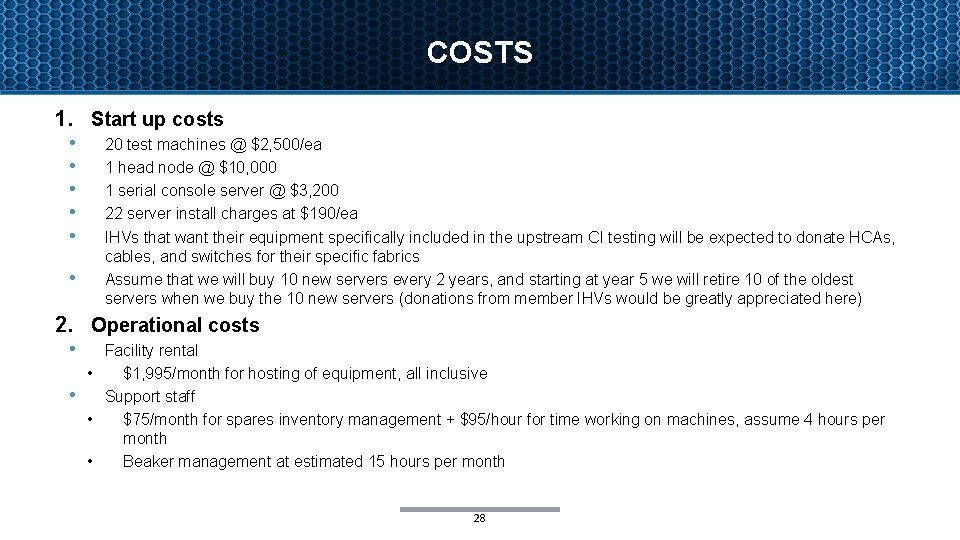
COSTS 1. Start up costs • • • 20 test machines @ $2, 500/ea 1 head node @ $10, 000 1 serial console server @ $3, 200 22 server install charges at $190/ea IHVs that want their equipment specifically included in the upstream CI testing will be expected to donate HCAs, cables, and switches for their specific fabrics Assume that we will buy 10 new servers every 2 years, and starting at year 5 we will retire 10 of the oldest servers when we buy the 10 new servers (donations from member IHVs would be greatly appreciated here) 2. Operational costs • • Facility rental • $1, 995/month for hosting of equipment, all inclusive Support staff • $75/month for spares inventory management + $95/hour for time working on machines, assume 4 hours per month • Beaker management at estimated 15 hours per month 28
COSTS – CONTINUED 29
FSDP SOFTWARE INFRASTRUCTURE Based on the following open source (or soon to be) tools developed by Red Hat CKI (Continuous Kernel Integration) Testing framework https: //gitlab. com/cki-project Beaker lab management software https: //beaker-project. org/ Various tests used by Red Hat with Beaker for years https: //github. com/CKI-project/tests-beaker
NMC DISTRO TESTING § Need arose for distro vendors to test their OFED stack for pre-release with a 3 rd party § § § entity Contract formed with New Mexico Consortium (NMC) and OFA to provide testing ground for vendors to submit their pre-release distro and test against hardware • NMC had hardware that was not utilized 9 months out of the year and kept relatively up to date Initially started off with NMC providing no cost support for testing • Intent was to provide charging once the program was fully solidified Distro test framework based on UNH-IOL interop testing • Tested distro against various RDMA hardware (IB, OPA, Ro. CE, i. WARP), both for functionality and usability Reported results back to vendor • Provided follow up and retesting as issues were found SUSE was the only vendor so far utilizing the program LANL staff were the ones performing the testing on behalf of NMC • Additional contract/support may be need to be addressed if moving forward with NMC and LANL 31 Open. Fabrics Alliance Workshop 2019
OFILP- OPENFABRICS INTEROP LOGO PROGRAM The original Interop program, dating to the 2000 s Long story short … § Was tightly coupled with, and driven by, OFED • Did vendor devices interoperate with OFED? • Did vendor devices interoperate with each other? § Narrowly focused on a small hardware vendor community • Infini. Band, Ro. CE, i. WARP § Centered around a certification program – ‘logo program’ § Forced vendors into a rigid schedule • (2 x “interop events” 2 x “debug events” per year) 32 Open. Fabrics Alliance Workshop 2019
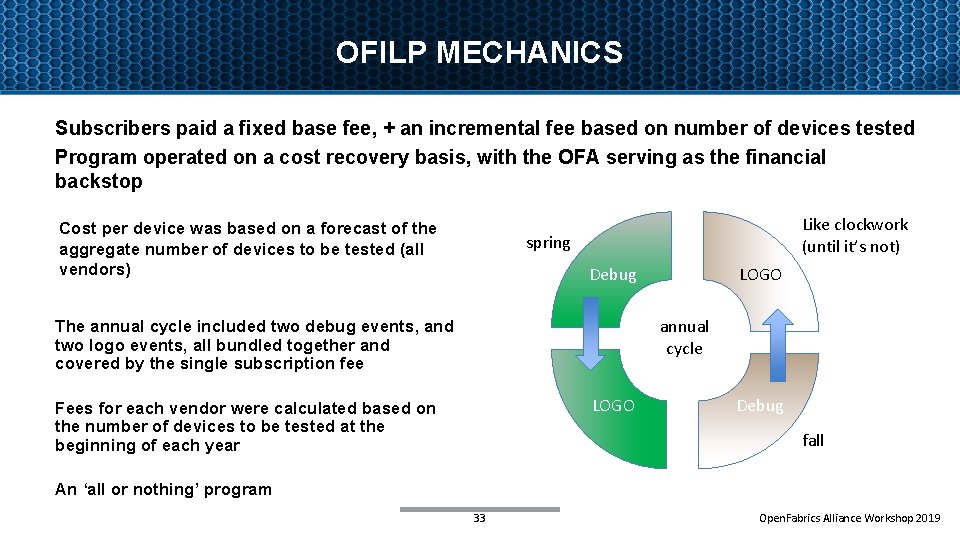
OFILP MECHANICS Subscribers paid a fixed base fee, + an incremental fee based on number of devices tested Program operated on a cost recovery basis, with the OFA serving as the financial backstop Cost per device was based on a forecast of the aggregate number of devices to be tested (all vendors) Like clockwork (until it’s not) spring Debug LOGO annual cycle The annual cycle included two debug events, and two logo events, all bundled together and covered by the single subscription fee LOGO Fees for each vendor were calculated based on the number of devices to be tested at the beginning of each year Debug fall An ‘all or nothing’ program 33 Open. Fabrics Alliance Workshop 2019
STAKEHOLDERS § Direct Stakeholders • Kernel maintainers • Hardware vendors • Distros § Indirect Stakeholders • Open. Fabrics Alliance • OEMs (rely on the IHVs to test hardware) • Upstream Linux RDMA community • OFA Alliance Members who have a stake in the success of the OFA 34 Open. Fabrics Alliance Workshop 2019
STAKEHOLDER WISH LISTS § Kernel Maintainers, Linux Open Source Community • Improve the fidelity of kernel pre-release testing • Focus on integration testing late in the kernel release cycle (when vendor driver updates have been integrated) • Ensure that existing drivers interop correctly with a pre-release kernel • Provide visibility to upstream maintainers into what’s been tested by vendors § Hardware Vendors • Reduce testing costs; • Test new hardware and/or software interoperability with other vendors and/or multiple distros • An independent certification program driven by an industry-defined test plan (for those who want it) • test upstream drivers § Distros • Support for testing release candidates against a stable, current, multi-vendor hardware base • Test backported drivers – ensure that features that work in the upstream version did not get broken in the Distro • The opportunity to evaluate vendor backported drivers before inclusion in a GA release • May value a certification program 35 Open. Fabrics Alliance Workshop 2019
UPSTREAM KERNEL PRE-RELEASE TESTING § Why? • Ensures that existing drivers interop correctly with a pre-release kernel • Provides visibility to upstream maintainers into what’s been tested by vendors • Creates a fuller picture of device testing during the kernel pre-release process § How? • Provide a known test plan to be used during the kernel pre-release process • Support integration testing late in the kernel release cycle (when all vendors driver updates have been • integrated) Provide results to the upstream linux-rdma mailing list for faster response times ed note: either beef up this slide and add a corresponding version for the h/w vendors, or ditch this slide and rely on the previous slide to get the message across. 36 Open. Fabrics Alliance Workshop 2019
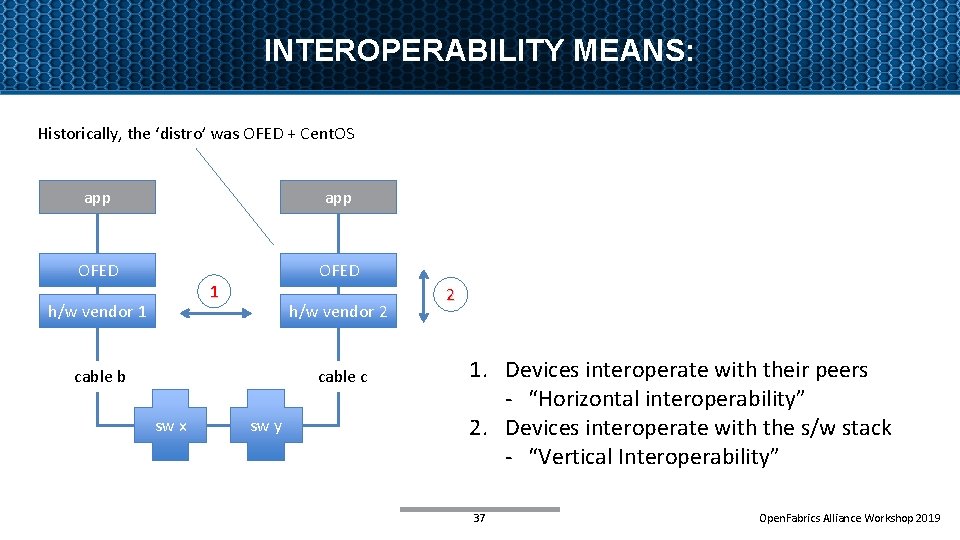
INTEROPERABILITY MEANS: Historically, the ‘distro’ was OFED + Cent. OS app OFED 1 h/w vendor 2 cable b cable c sw x sw y 2 1. Devices interoperate with their peers - “Horizontal interoperability” 2. Devices interoperate with the s/w stack - “Vertical Interoperability” 37 Open. Fabrics Alliance Workshop 2019
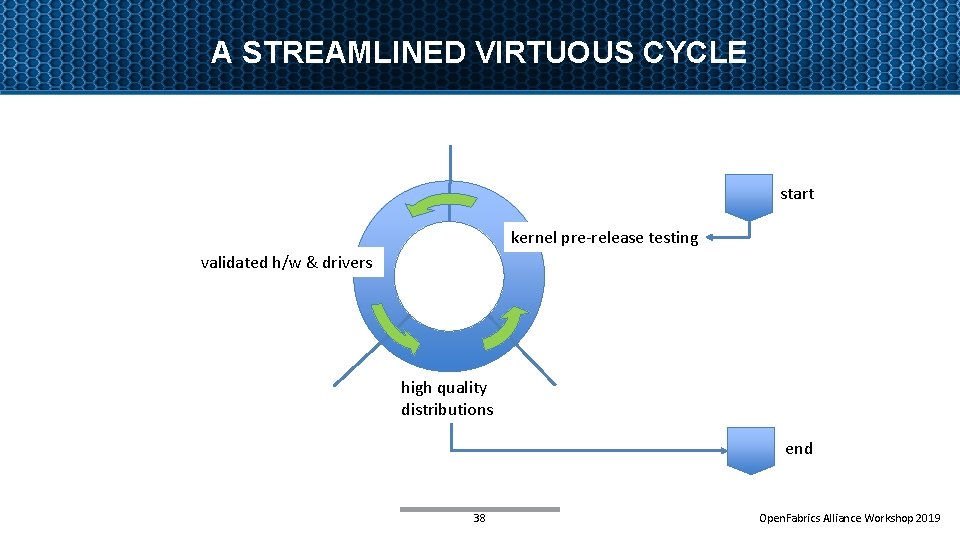
A STREAMLINED VIRTUOUS CYCLE start kernel pre-release testing validated h/w & drivers high quality distributions end 38 Open. Fabrics Alliance Workshop 2019
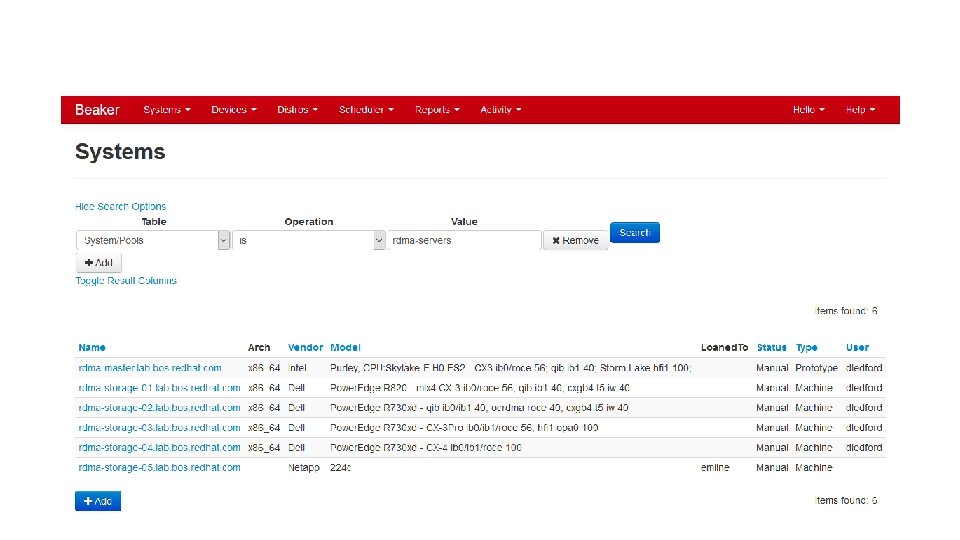
BEAKER WEB INTERFACE – SYSTEM SEARCH
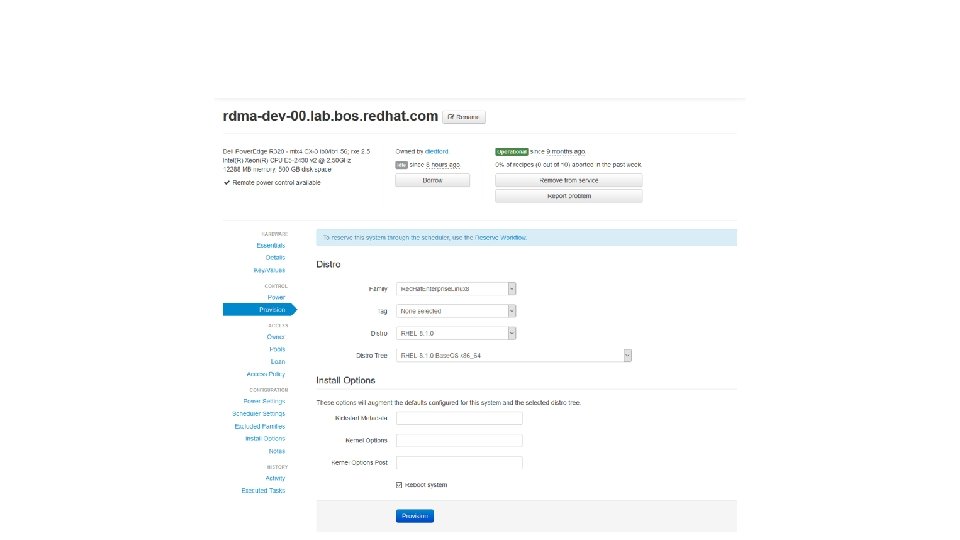
BEAKER WEB INTERFACE – PROVISIONING
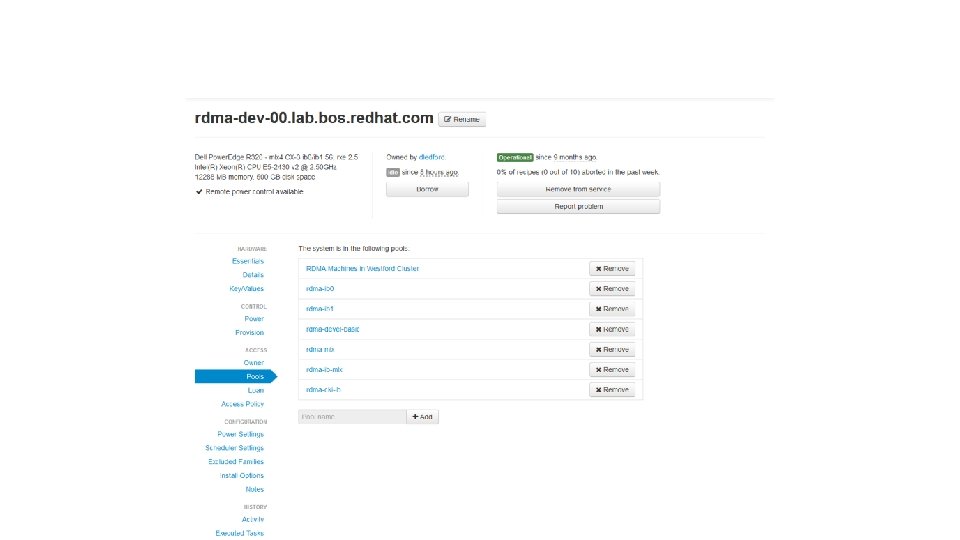
BEAKER WEB INTERFACE – POOLS
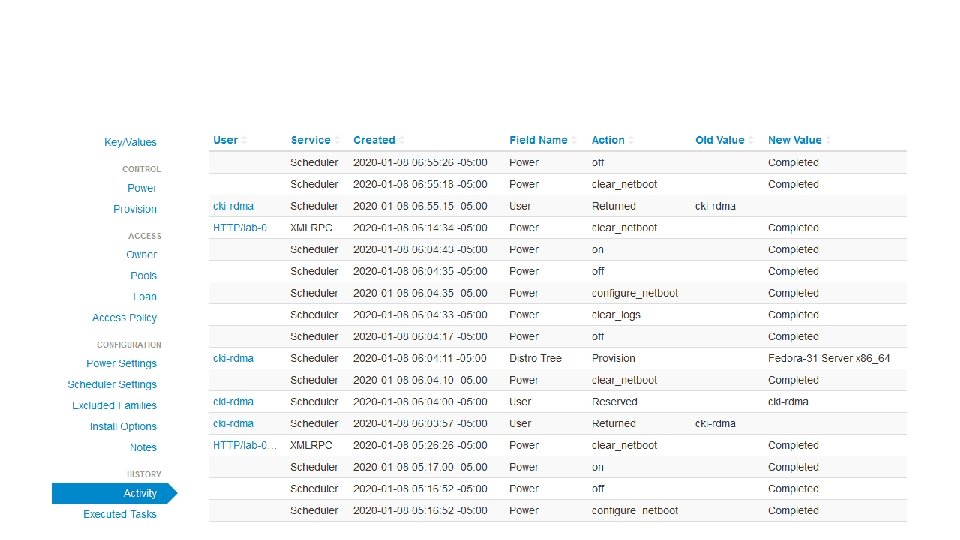
BEAKER WEB INTERFACE – ACTIVITY
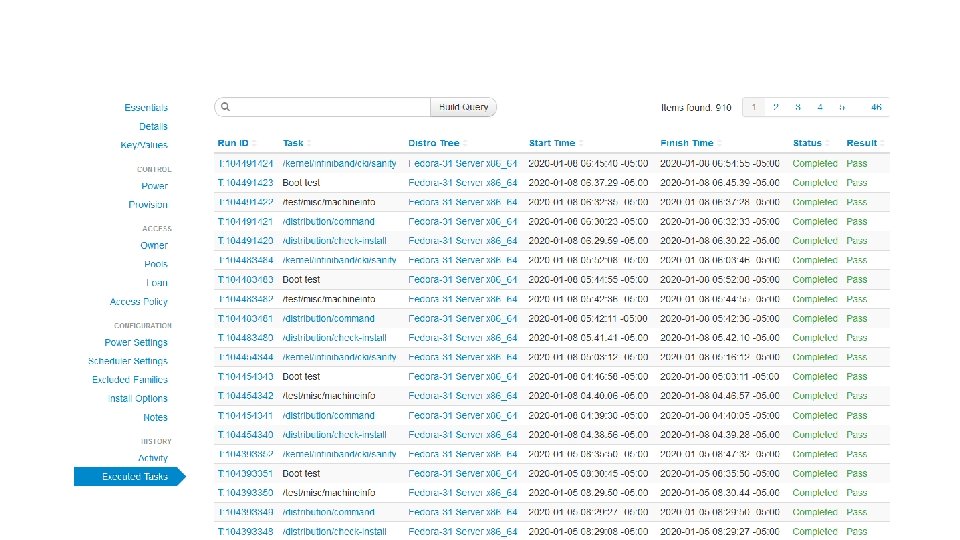
BEAKER WEB INTERFACE – EXECUTED TASKS
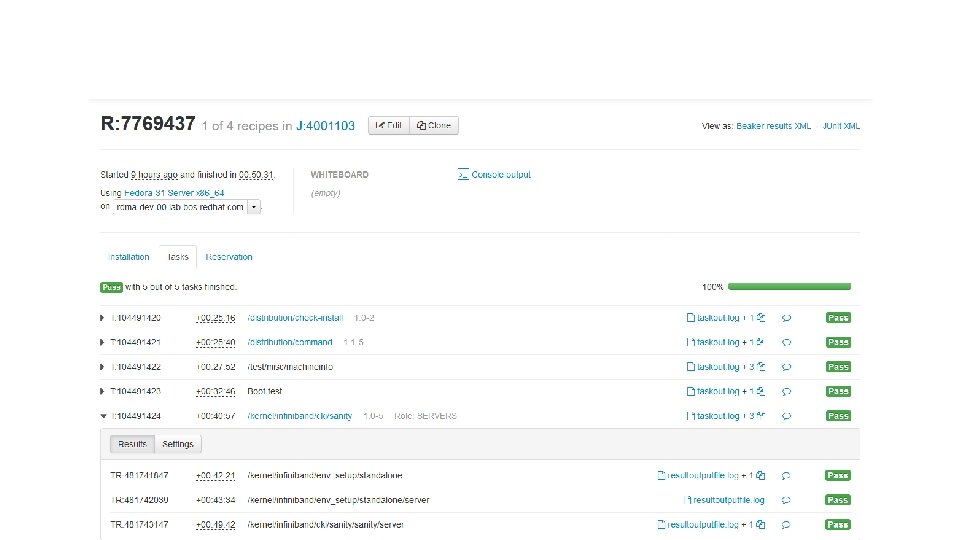
BEAKER WEB INTERFACE – JOB LOG
TARGET CLIENTS – A BROADER AUDIENCE • Upstream Linux kernel and user space software maintainers • Hardware vendors* • Distros** • ISVs, Application, Middleware developers • Network Services Consumers • … § Broadly, anybody engaged in: *served by original OFA Logo Program **served by the “on-demand” testing program at NMC • Developing networking software • Consuming networking services 46
SERVING OUR CLIENTS 1. Support upstream release cycles 2. Provide ‘On-demand’ access to all stakeholders to a multi-vendor, multifabric testbed 3. Continue the Logo Program if desired, but based on Linux distributions 47
TWO MAJOR USAGES, ONE POSSIBILITY § Continuous Integration Testing • Objective: Identify problems in the upstream software introduced in the development cycle • Provide maintainers a broad-based view of the state of device testing • vs forcing maintainers to gather that information from each individual hardware vendor • Primarily targeted at supporting kernel maintainers and to a lesser degree user space maintainers (rdma-core, etc) • hardware vendors derive some benefit too § On-Demand Development and Testing Capability for Distros, Vendors and Others • Objective: Provide a hardware and software platform for use by clients ‘on-demand’ § A Possible Third Objective – A Certification Program (‘Logo Testing’) • Objective: An industry recognized, independent certification program allowing clients (primarily hardware vendors and distros) to claim “compliance” to a given set of tests 48
- Slides: 47