
Of Mice and Men John Steinbeck n Genre
Of Mice and Men John Steinbeck n Genre: Fiction; tragedy n First Publication: 1937 n Narrator: Third-person omniscient n Protagonists: George and Lennie n n Antagonists: Curley; society; the cruel, predatory nature of human life Setting: 1930 s, South of Soledad, California
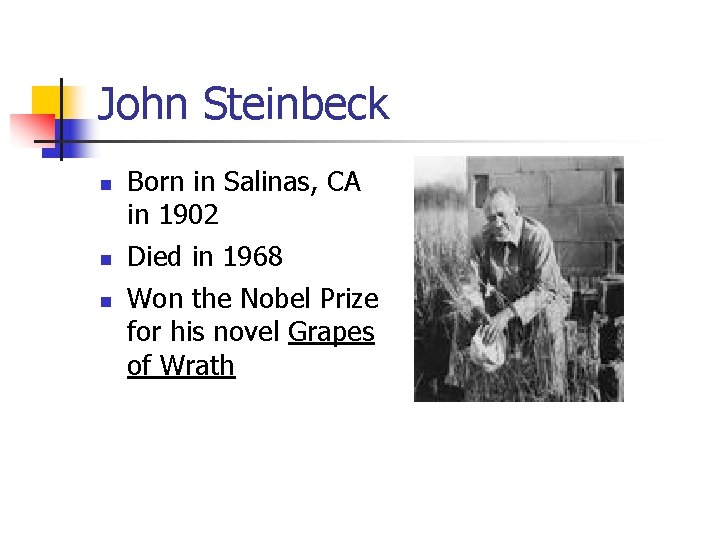
John Steinbeck n n n Born in Salinas, CA in 1902 Died in 1968 Won the Nobel Prize for his novel Grapes of Wrath
History to 1920 s n n After World War I, a recession led to a drop in the market price of farm crops, which meant that farmers were forced to produce more goods in order to earn the same amount of money. Farmers bought more land invested in expensive agricultural equipment, which plunged them into debt.
Great Depression n The stock market crash of 1929 forced banks to foreclose on mortgages and collect debts. Unable to pay their creditors, many farmers lost their property and were forced to find other work. Nation’s unemployment rate skyrocketed peaking at nearly twentyfive percent in 1933.
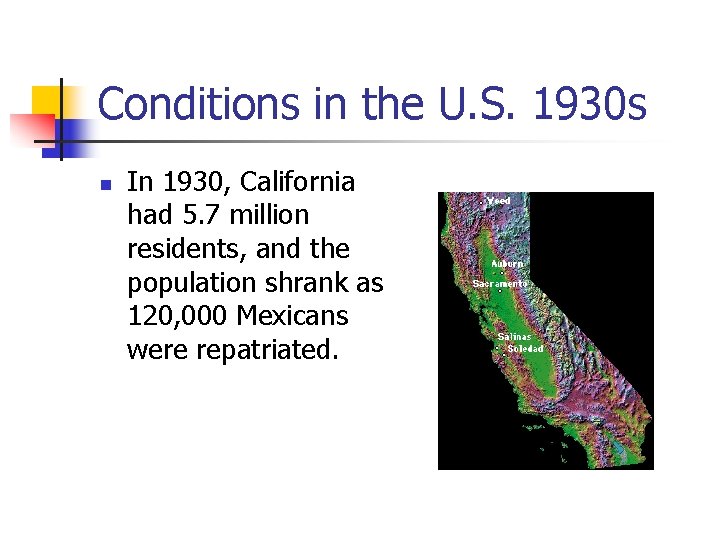
Conditions in the U. S. 1930 s n In 1930, California had 5. 7 million residents, and the population shrank as 120, 000 Mexicans were repatriated.
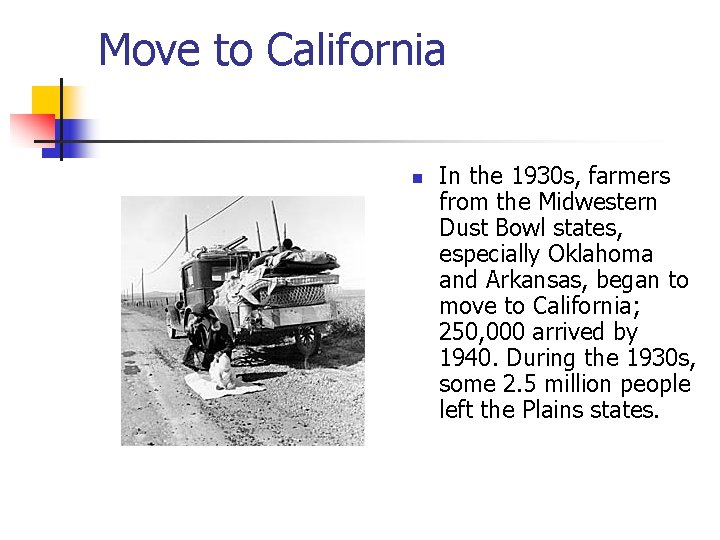
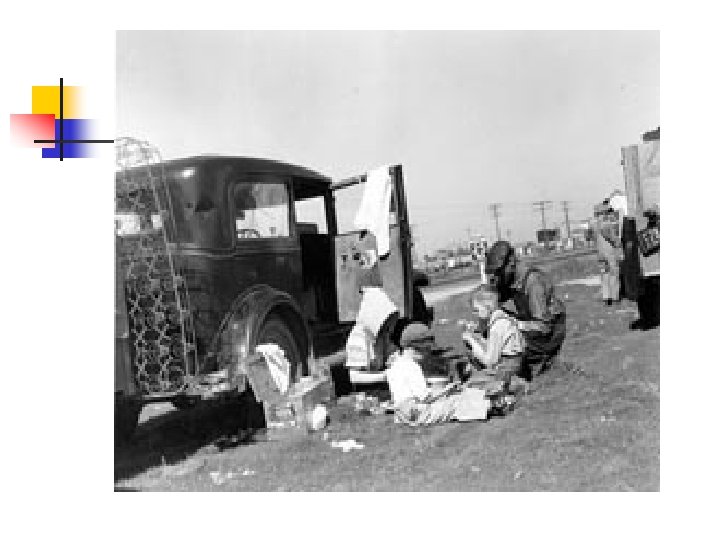
Move to California n In the 1930 s, farmers from the Midwestern Dust Bowl states, especially Oklahoma and Arkansas, began to move to California; 250, 000 arrived by 1940. During the 1930 s, some 2. 5 million people left the Plains states.
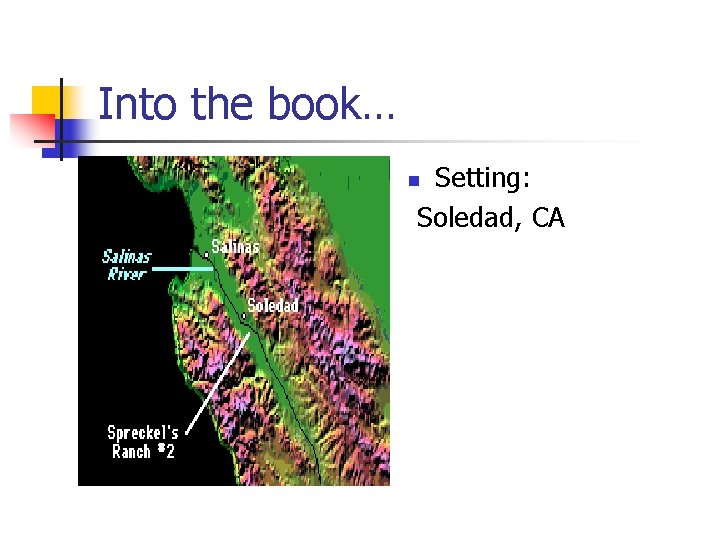
Into the book… Setting: Soledad, CA n
Prereading n n n "The best laid plans of mice and men go oft astray. " - Robert Burns This saying so impressed John Steinbeck that he titled his novel after it. What does this saying mean to you? Write a paragraph analyzing this quote. Relate it to your own life. (sec. 3)
Characters: n Lennie – a large, lumbering, childlike migrant worker. Due to his mild mental disability, Lennie completely depends upon George, his friend and traveling companion, for guidance and protection. The two men share a vision of a farm that they will own together, a vision that Lennie believes in wholeheartedly. Gentle and kind, Lennie nevertheless does not understand his own strength. His love of petting soft things, such as small animals, dresses, and people’s hair, leads to disaster.
n George – A small, wiry, quick-witted man who travels with, and cares for, Lennie. Although he frequently speaks of how much better his life would be without his caretaking responsibilities, George is obviously devoted to Lennie. George’s behavior is motivated by the desire to protect Lennie and, eventually, deliver them both to the farm of their dreams. Though George is the source of the often-told story of life on their future farm, it is Lennie’s childlike faith that enables George to actually believe his account of their future.
Due _______ Reading Section 2 pgs. 17 -37 n Write two paragraphs, one for each character – Section 3 – Writing -40 pts. Write about Lennie and George’s characters. Find one quote for each character that best describes his personality. Cite the quote i. e. (Steinbeck, pg 2). Explain why this quote characterizes each person.
Section 2 – pgs. 16 -37 Lennie and George arrive at the farm n n n n n Allusions – a literary reference to a familiar person, place, thing, or event. All page numbers refer to the Penguin Books edition, 1993. "On his head was a soiled brown Stetson hat. . . (p. 20). " " 'You got your work slips (p. 21)? ' " " 'Well, that glove's fulla vaseline (p. 27). ' " " 'An' I bet he's eatin' raw eggs and writin' to the patent medicine houses (p. 32). ' " " '. . . we'll shove off and go up the American River and pan gold (p. 33). ' " "His hands, large and lean, were as delicate in their action as those of a temple dancer (p. 34). "
Chapters One and Two Vocabulary apprehensive (adj. ): anxious; fearful archly (adv. ): playfully bridled (v. ): to pull one's head back in anger or pride; especially when one feels one has been offended buckers (n. ): people who buck grain bags calculating (adj. ): shrewd; scheming cesspool (n. ): a deep hole in the ground into which sewage from sinks, toilets, etc. is drained. cockier (adj. ): To be cocky is to be conceited, overbearing, and aggressive. complacently (adv. ): in a pleased, satisfied manner cultivator (n. ): a large farm machine used for cultivation (the preparation of the earth for planting). derogatory (adj. ): belittling and insulting disengage (v. ): free dousing (n): to douse is to be drenched with liquid. A dousing refers to someone having been covered with a liquid, in this case water, during a washing. dragfooted (adj. ) lame; dragging a lame foot gingerly (adv. ): in a careful, cautious way graybacks (n. ): lice; parasites. Lice are small, wingless insects that live off the blood of other animals. hatchet face (n): a lean, sharp face heavy-laden (adj. ) heavily loaded insteps (n. ): the parts of the shoes between the toe and the ankle jerkline skinner laboring (adj. ): working, particularly work that involves physical labor. lamely (adv. ): To be lame is to be crippled; especially to have an injured leg or foot. lashed (v. ): swung around quickly leaves (n. ): pages levelly (adv. ): Something that is level is flat and horizontal. To stare at someone levelly is to stare at that person straight on -- not looking up nor down. lightweight (n. ): a boxer who weighs between 127 - 135 pounds liniment (n. ): a medicated liquid rubbed on the skin to ease sore muscles and sprains (25)
Task for section 2 n n n Individually or in pairs, students will be assigned vocabulary words. Find the sentence where the word(s) are being used. Record the sentence. Identify the content of the sentence – what is taking place, who is speaking, what is being said, and why?
Section 3 – Lennie and George hear about Curly and Curly’s wife n n Idioms- a phrase or an expression that means something different from what the words actually say (using over his head for didn’t understand All page numbers refer to the Penguin Books edition, 1993 n n " 'I ain't got no people, ' George said (p. 41). " n " 'Well, that girl rabbits in an' tells the law she been raped. The guys in Weed start a party out to lynch Lennie (p. 42). ' " n " 'I think he is a wing-ding (p. 46). ' " n " 'Me an' Lennie's gonna roll up a stake (p. 50). ' " n " 'Well, ain't she a looloo (p. 51). ' " n " 'Curley's got yella-jackets in his drawers. . . (p. 51). ' " n " 'She's a jail bait all set on the trigger (p. 51). ' " n " 'What's it set you back? ' George asked (p. 53). " n " 'You can get a shot for two bits (p. 52). ' " n " 'If a guy don't want a flop, why he can just set in the chairs. . . (p. 52). ' " n " 'Clara gets three bucks a crack. . . (p. 53). ' " n " 'Don't let no goo-goos in, neither (p. 53). ' " n " 'Lookin' for his old lady (p. 53). ' " n " 'These here jail baits is just set on the trigger of the hoosegow (p. 56). ' " n " 'Ever' six weeks or so, ' George continued, 'them does would throw a litter. . . (p. 58). ' " n " 'The ol' people that owns it is flat bust. . . (p. 59). ' " n " 'Jus' as soon as I can't swamp out no bunk houses they'll put me on the county (p. 60). ' "
Section 3 – pgs. 38 -65 n n n Assignment – On a separate sheet of paper, complete a Reading Log while reading section 3. Record information about all the characters. What motivates each character? Record vocabulary words, allusions, and idioms Record what you already know, what you learned, and what you would like to know. Due ________ 30 pts.
Reading Log- 60 pts. n Name ______________ n Book Title ____________ n Chapter _______Date _________ n Characters: What motivates this character? What do they want from life? What is important to him or her? n Setting and Atmosphere n Vocabulary (10 words) with definitions and in text sentences n Allusions (5) with page numbers n Idioms (5) with page numbers n What I understand from this section n What I learned from this section n What I wonder about after reading this section
Chapter Four Lennie, George, and Candy spend some time with Crooks as they discuss their plans for the future. Read this section closely. Answer the following questions: 1. What are the plans now that Candy is included in Lennie and George’s dream? 2. How does the dream change now that Candy is involved?
More of chapter 4 – n Saturday night at Crook's room in the barn. All but Crooks, Candy and Lennie go to town. Lennie drops in on Crooks who philosophizes about companionship. Candy drops by and talks of their dreams. Curley's wife shows up and insults them all. Candy brags of their ranch. She infers that Lennie is the machine which got Curley. She threatens Crooks with a lynching. George arrives and all leave Crooks' room.
The Task Your task is to analyze one of the characters in the novel, Of Mice and Men, by John Steinbeck, to determine how the character thinks, feels and acts throughout the novel. The writing assignment required: 1. Write an essay to demonstrate your understanding of character motivation and how theme of loneliness is revealed in the novel. Your essay will be evaluated according to this rubric. (see handout)

Essay Questions – Pick one n n n When all the other ranch hands go to town, Lennie, Crooks and Candy are left behind. Describe what each of these three do after the others leave, and explain what they have in common that causes them to be left out. Curley's wife appears three times in the novel. Briefly describe what takes place on each occasion. On which occasion does she reveal the most about herself, and what is it? Describe in some detail the incident where Lennie crushes Curley's hand. What does this incident reveal about each of these two characters? While Curley is physically aggressive towards Lennie, his wife is sexually provocative. Show these two characters create trouble for Lennie, and combine to cause his death. Many people in the novel suffer from disappointment. Choose any three of the following characters and discuss what reasons they have to be disappointed about their life: Crooks - Curley - George - Candy
- Slides: 22