
OER for Inclusive and Equitable Quality Education From

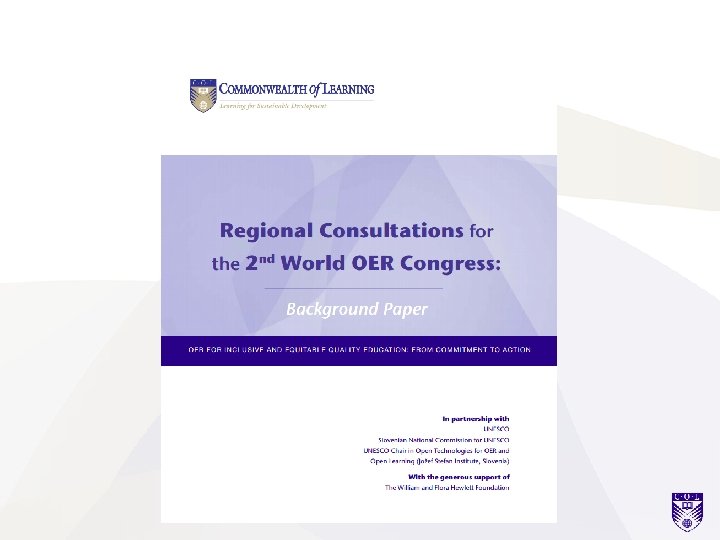
OER for Inclusive and Equitable Quality Education From Commitment to Action Professor Asha Kanwar President and CEO 2 nd World OER Congress| 18 -20 September, 2017 | Ljubljana, Slovenia
Partners
Outline • Background • Regional Consultations: • Asia, Europe, Middle East and North Africa, Africa; Latin America & the Caribbean, Pacific • Government & Stakeholder Surveys • Towards Inclusive and Equitable Quality Education
Background
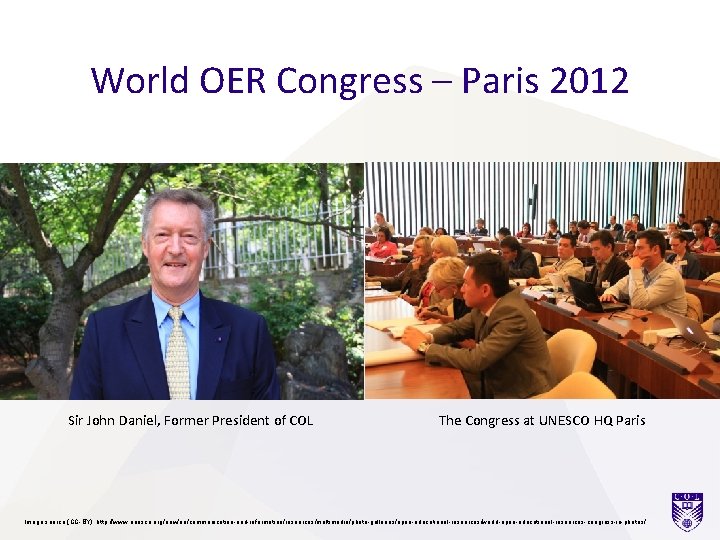
World OER Congress – Paris 2012 Sir John Daniel, Former President of COL The Congress at UNESCO HQ Paris Image source (CC-BY): http: //www. unesco. org/new/en/communication-and-information/resources/multimedia/photo-galleries/open-educational-resources/world-open-educational-resources-congress-in-photos/
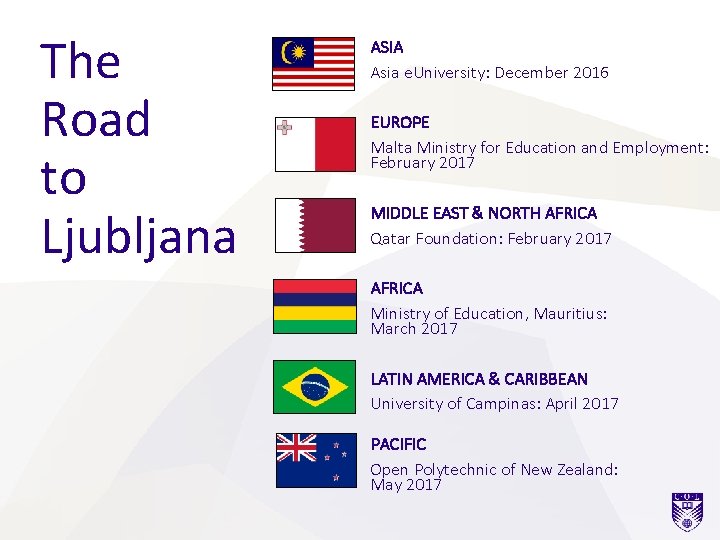
The Road to Ljubljana ASIA Asia e. University: December 2016 EUROPE Malta Ministry for Education and Employment: February 2017 MIDDLE EAST & NORTH AFRICA Qatar Foundation: February 2017 AFRICA Ministry of Education, Mauritius: March 2017 LATIN AMERICA & CARIBBEAN University of Campinas: April 2017 PACIFIC Open Polytechnic of New Zealand: May 2017
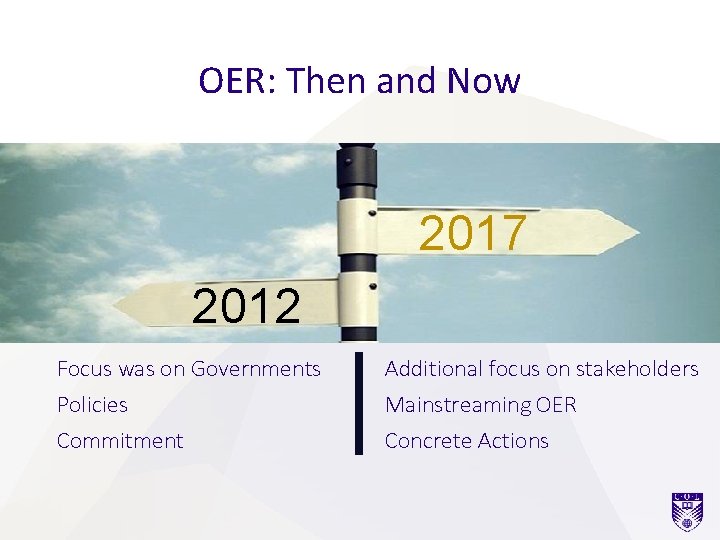
OER: Then and Now 2017 2012 Focus was on Governments Policies Commitment Additional focus on stakeholders Mainstreaming OER Concrete Actions
Regional Consultations
Objectives of RCOER • Raise regional awareness about the importance of OER and its relationship to SDG 4 • Identify strategies and solutions to overcome the challenges or barriers to mainstreaming OER • Agree on actions for consideration at the 2 nd World OER Congress
ASIA 20
Highlights: Asia • Free supply of textbooks at school level (Bangladesh) • NME-ICT follows CC BY-SA licence (India) • Commitment to Open. Course. Ware in e. Learning policy (Malaysia) • OER repositories in India, Indonesia, Malaysia, Pakistan, Philippines, Vietnam.
Priorities: Asia • Need for improved connectivity • More attention to content for people with disabilities • Increased awareness and capacity to use/ develop OER • Need for OER in local languages • National policies to guide OER
EUROPE 24
Highlights: Europe • Mostly led by institutions in project mode • Advanced technologies for multi-lingual searches possible • OER as part of a wider open ecosystem • Many initiatives but fragmented
Priorities: Europe • Need for political will and national level policies • Teachers critical in mainstreaming OER • Need for business models • Institutions must invest in QA and evidence • Move towards open education practices
MIDDLE EAST & NORTH AFRICA 13
Highlights: Middle East & North Africa • National OER Policies: Bahrain & Oman • Institutional initiatives: Open University of Sudan • National Portals: Morocco, Jordan • Emphasis on translating content into Arabic
Priorities: Middle East & North Africa • More awareness • Capacity-building • Policies at national and institutional levels • Regional cooperation • More original content needed in Arabic
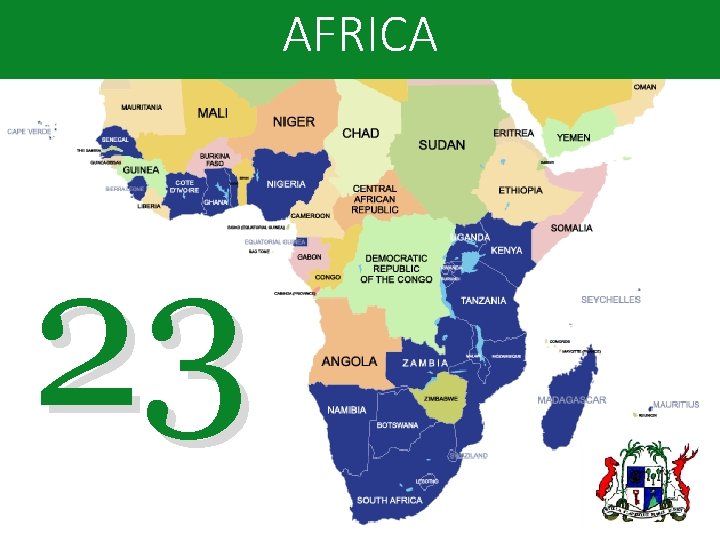
AFRICA 23
Highlights: Africa • National OER Policies: South Africa, Seychelles • Institutional initiatives: eg. National Open University of Nigeria, and Open University of Tanzania • Siyavula model in South Africa • OER Africa supporting institutions to mainstream OER
Priorities: Africa • Improved access to Internet and electricity • Enhanced awareness and capacity to use/develop OER • Policies required at national and institutional levels • Attention to local language resources
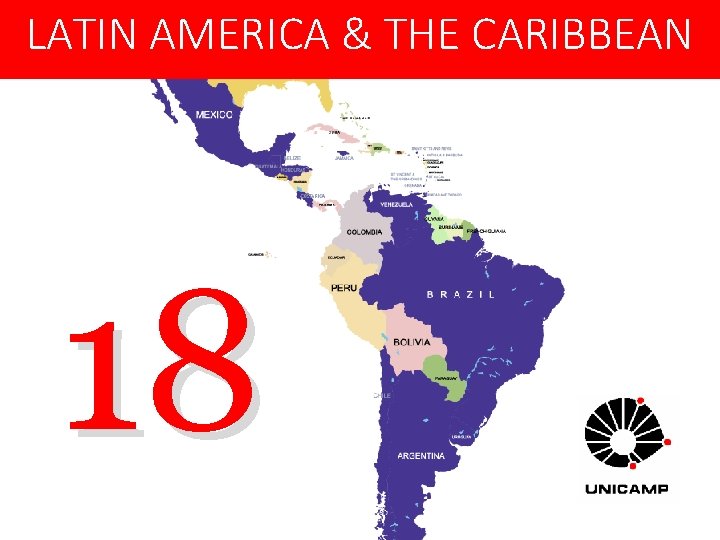
LATIN AMERICA & THE CARIBBEAN 18
Highlights: Latin America & the Caribbean • Public funded educational materials openly licensed (Antigua and Barbuda) • Institutional policy for Open Access and Open Data (Brazil and Chile) • Commitment to OER at provincial and city level (Sao Paulo) • A general awareness and a willingness to pursue OER (Grenada, Guatemala, Honduras, Mexico)
Priorities: Latin America & the Caribbean • Need for OER in national languages • Better connectivity • Accessible content required for people with disabilities • Increased capacity to use and contribute to OER • National policies needed to guide OER
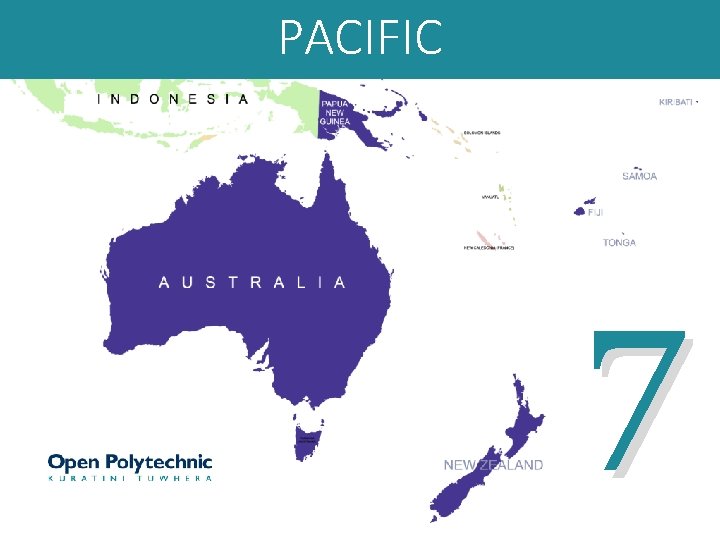
PACIFIC 7
Highlights: Pacific • National Policy in Australia, New Zealand, Fiji • Need to reduce spending on textbooks and copyright clearance • OER being used in Kiribati, Samoa, Solomon Islands, Vanuatu • OERu
Priorities: Pacific • OER policy to align to Regional Pacific Education Strategy • Emphasis on indigenous knowledge and culture • Better infrastructure and connectivity • OER as freedom, human rights and a people’s movement
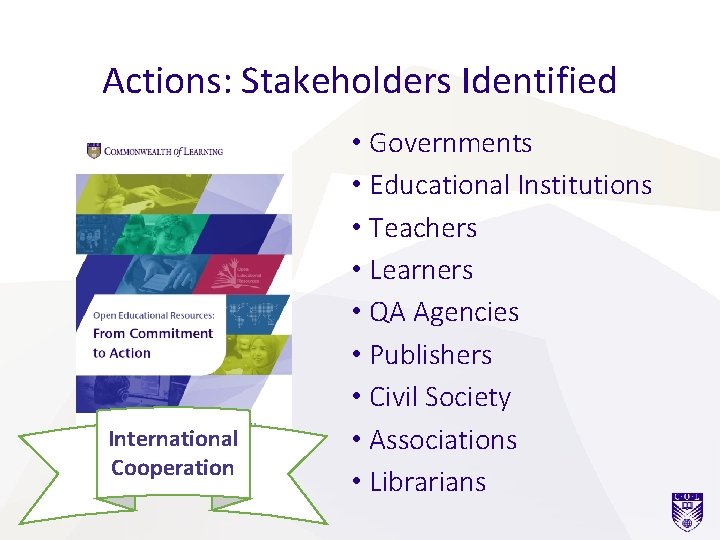
Actions: Stakeholders Identified International Cooperation • Governments • Educational Institutions • Teachers • Learners • QA Agencies • Publishers • Civil Society • Associations • Librarians
Findings of the Regional Consultations • More governments commit to support OER • Specific projects on OER are supported mainly through government funds • Still focused on OER creation rather than OER use • All regions want more collaboration
The Surveys

Two Surveys • A government survey • sent by COL to Member States • Sent by UNESCO to Member States in English and French • COL: stakeholder survey posted online and publicised via social media.
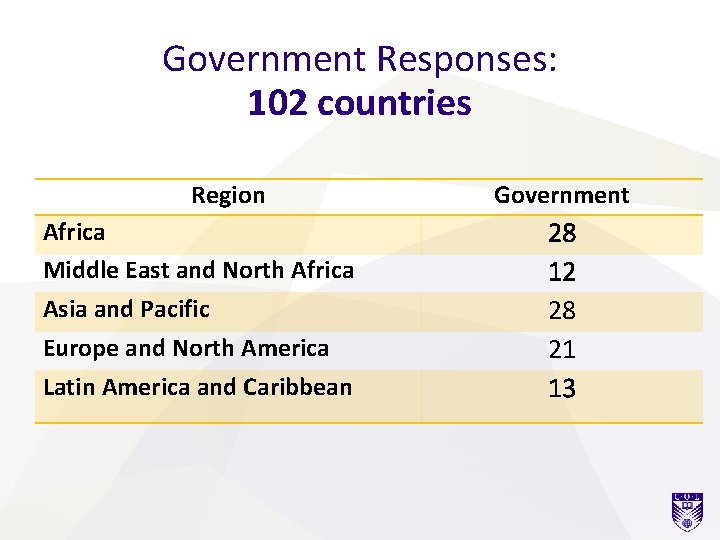
Government Responses: 102 countries Region Africa Middle East and North Africa Asia and Pacific Europe and North America Latin America and Caribbean Government 28 12 28 21 13
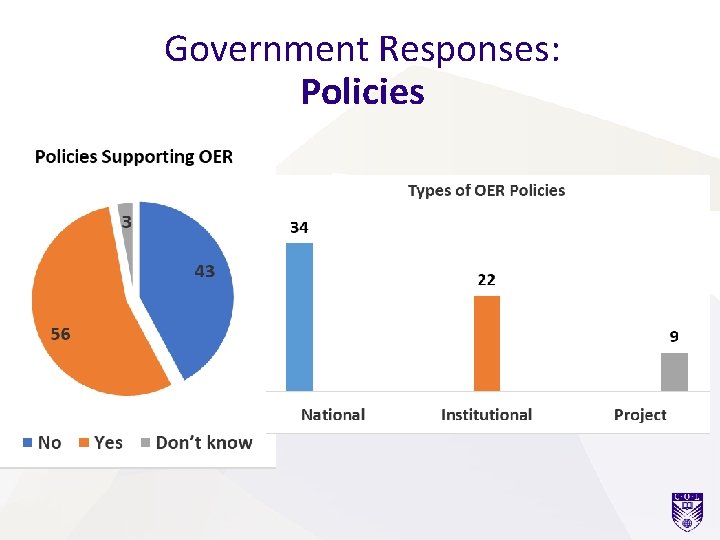
Government Responses: Policies
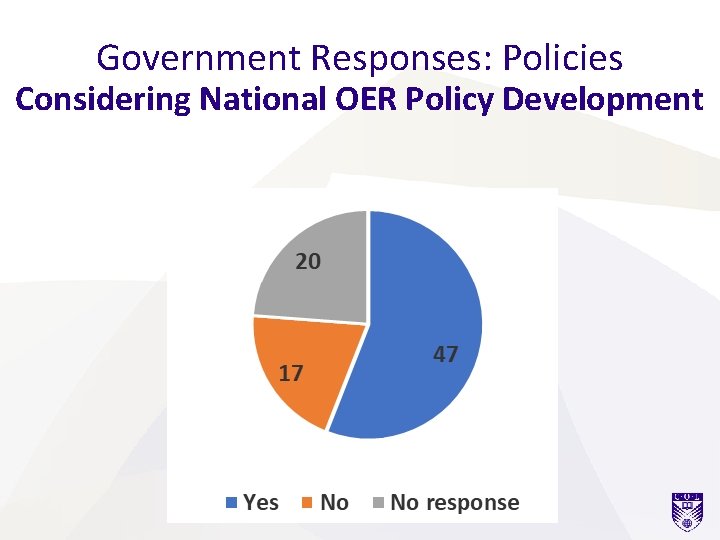
Government Responses: Policies Considering National OER Policy Development
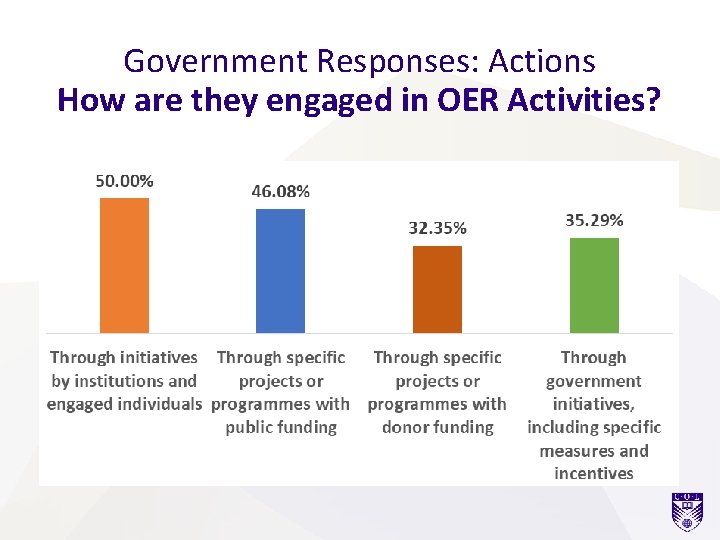
Government Responses: Actions How are they engaged in OER Activities?
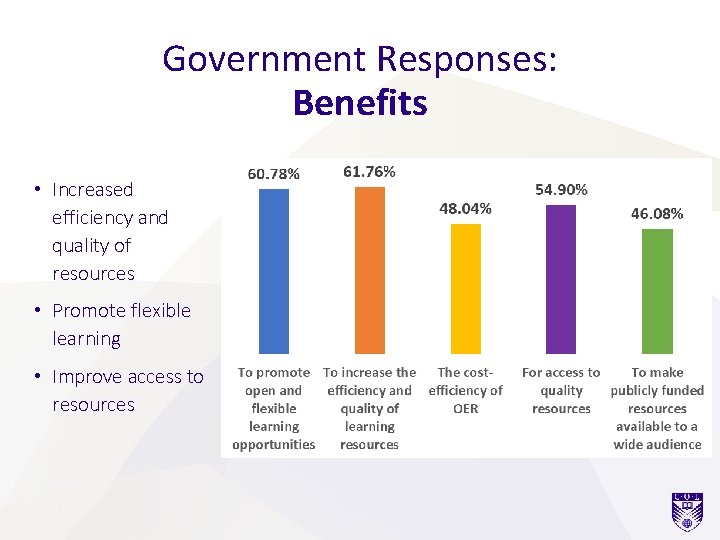
Government Responses: Benefits • Increased efficiency and quality of resources • Promote flexible learning • Improve access to resources
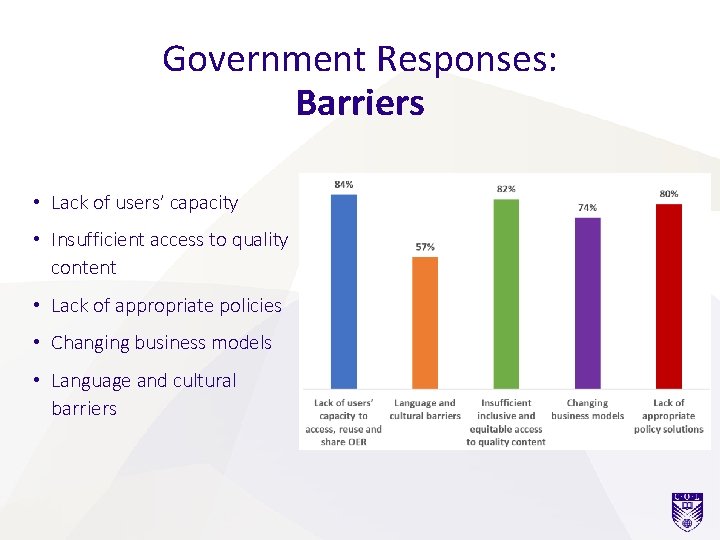
Government Responses: Barriers • Lack of users’ capacity • Insufficient access to quality content • Lack of appropriate policies • Changing business models • Language and cultural barriers
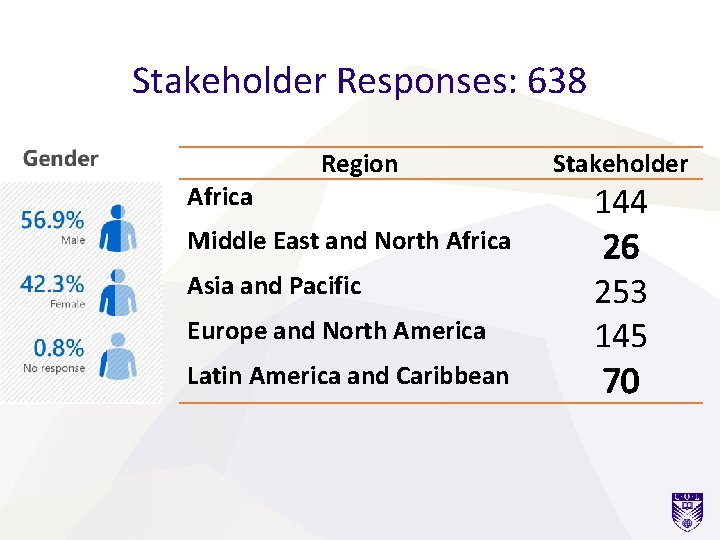
Stakeholder Responses: 638 Africa Region Middle East and North Africa Asia and Pacific Europe and North America Latin America and Caribbean Stakeholder 144 26 253 145 70
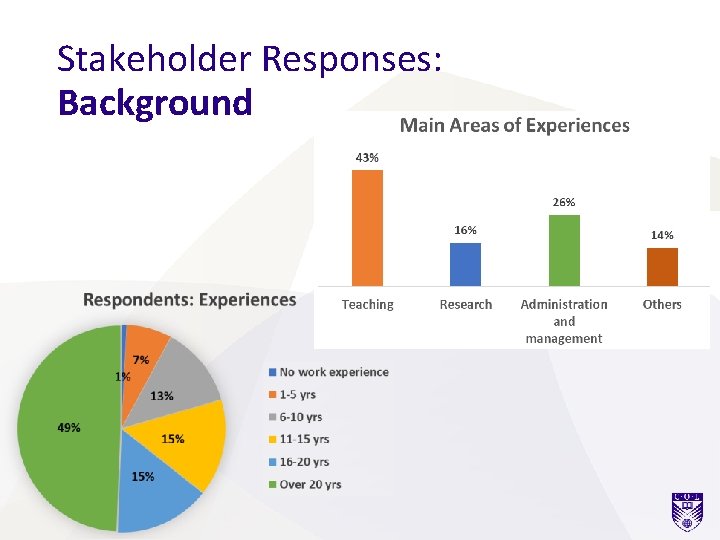
Stakeholder Responses: Background
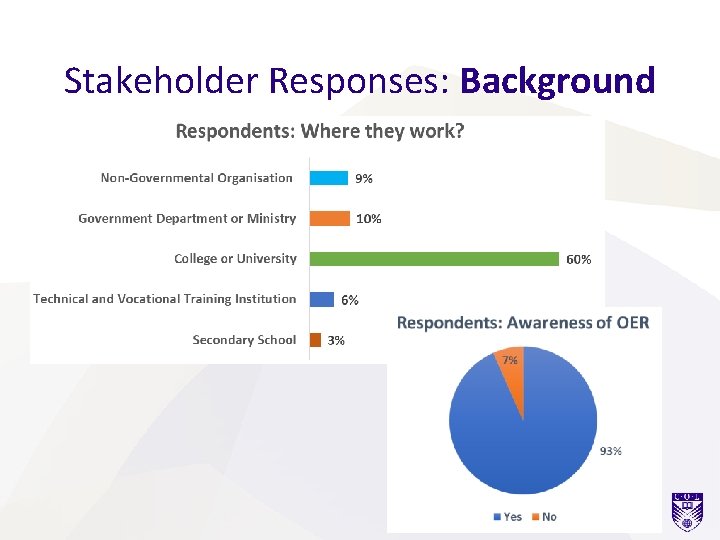
Stakeholder Responses: Background
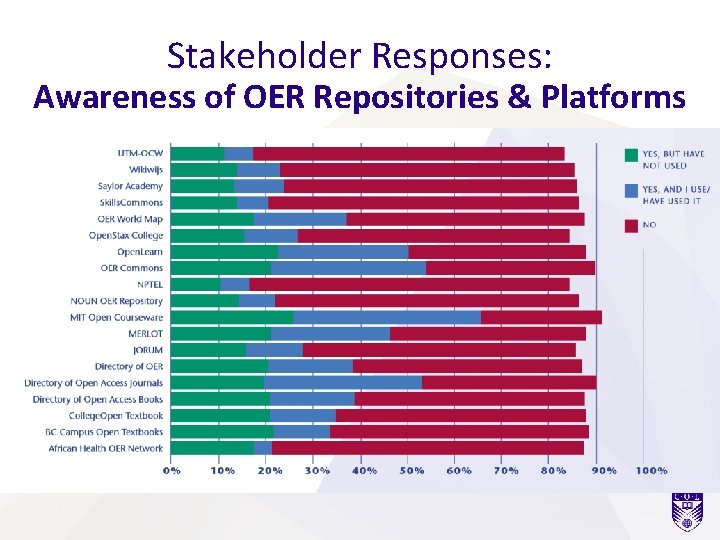
Stakeholder Responses: Awareness of OER Repositories & Platforms
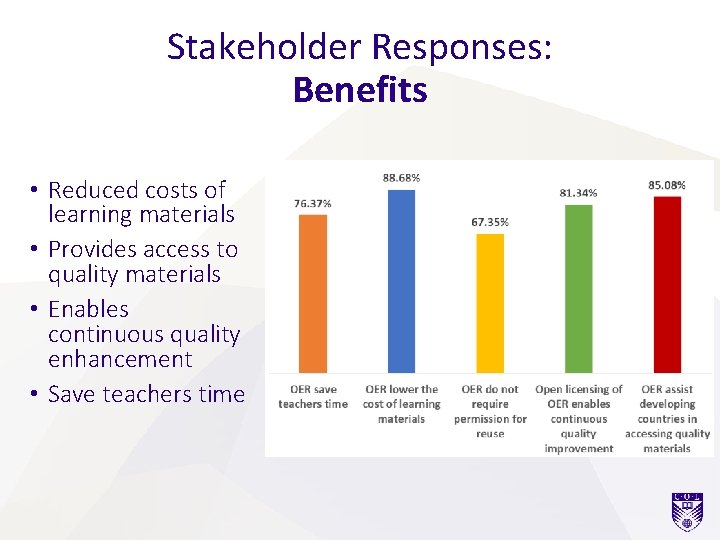
Stakeholder Responses: Benefits • Reduced costs of learning materials • Provides access to quality materials • Enables continuous quality enhancement • Save teachers time
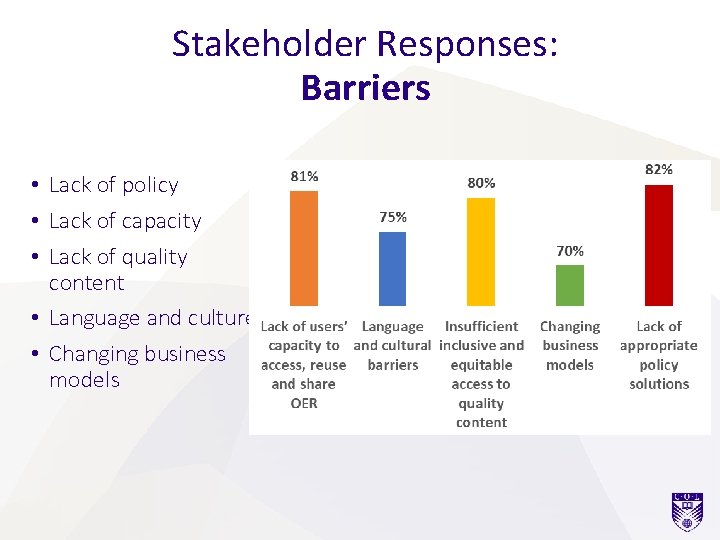
Stakeholder Responses: Barriers • Lack of policy • Lack of capacity • Lack of quality content • Language and culture • Changing business models
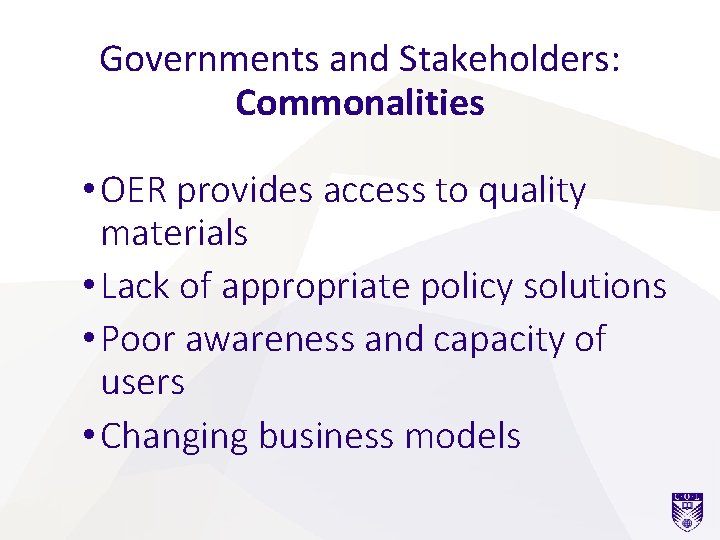
Governments and Stakeholders: Commonalities • OER provides access to quality materials • Lack of appropriate policy solutions • Poor awareness and capacity of users • Changing business models
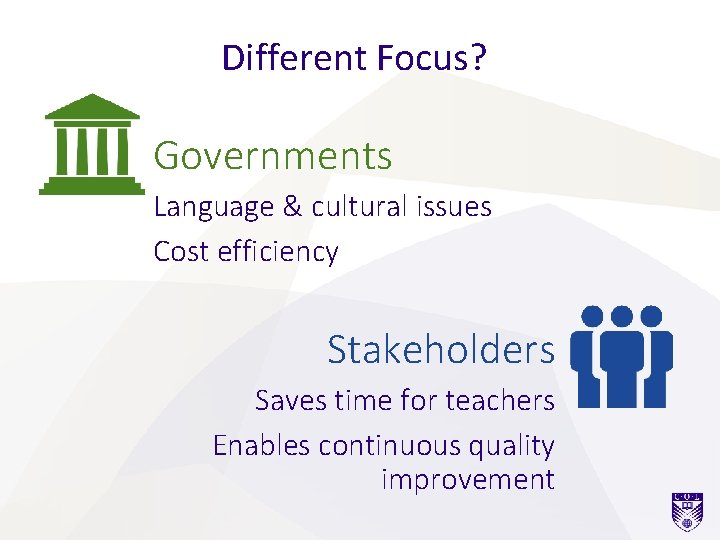
Different Focus? Governments Language & cultural issues Cost efficiency Stakeholders Saves time for teachers Enables continuous quality improvement
Towards Inclusive and Equitable Quality Education
Global Trends Policies • Increasing support, not accompanied by policies • Despite lack of national OER policies, institutional policies have grown • Regions with extensive OER activities, not always reliant on national policy as the driving force
Global Trends Repositories • OER repositories created in the global north more used than those from the global south • Majority of the repositories are at tertiary level • Repositories are available in diverse fields, including early childhood education
Global Trends Awareness • Many governments and stakeholders not clear about OER • Increased focus on open textbooks has led to neglect of OER for lifelong learning • Governments are supporting MOOCs, which are not necessarily “open”
Way Forward • Greater effort needed in creating awareness of the meaning, purpose and advantages of OER • Capacity building for the use and integration of OER for teachers • Promote policy development at both regional/national and institutional levels. A normative instrument on OER may assist Member States to adopt OER policy development
Way Forward • Better communication strategies needed to convey the results of OER research • Business models for OER need to be explored • Innovations on bridging required the digital divide • Mechanisms to monitor OER needed the progress of
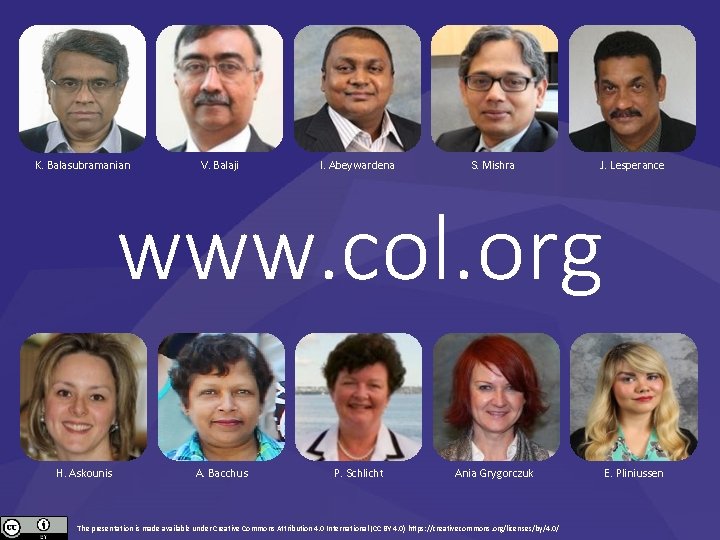
K. Balasubramanian V. Balaji I. Abeywardena S. Mishra J. Lesperance www. col. org H. Askounis A. Bacchus P. Schlicht Ania Grygorczuk The presentation is made available under Creative Commons Attribution 4. 0 International (CC BY 4. 0) https: //creativecommons. org/licenses/by/4. 0/ E. Pliniussen
- Slides: 54