
OECD WORK ON WELLBEING AND SDGS REFLECTIONS IN
OECD WORK ON WELL-BEING AND SDGS: REFLECTIONS IN THE CONTEXT OF PROJECT MAKSWELL PISA, 10 MAY 2018 Carrie Exton Head of Section, Measuring Well-Being and Progress OECD Statistics Directorate

Outline: OECD work and some themes/ objectives from Project MAKSWELL MAKing Sustainable development and WELL-being frameworks work for policy analysis • Framework development and database building OECD work on well-being (WB) and the Sustainable Development Goals (SDGs) • Filling the data gaps What is needed for a more complete picture on WB and SDGs? • Policy uses Of well-being and sustainable development metrics. What does current practice look like? Where could it go next?
Statistics Directorate: Better Data Policy-makers need feedback: • Is life is getting better, and for whom? • Which policies make life better? Which ones don’t? People (incl. civil society, media, private sector) need feedback: • To hold policy-makers to account • To inform decisions
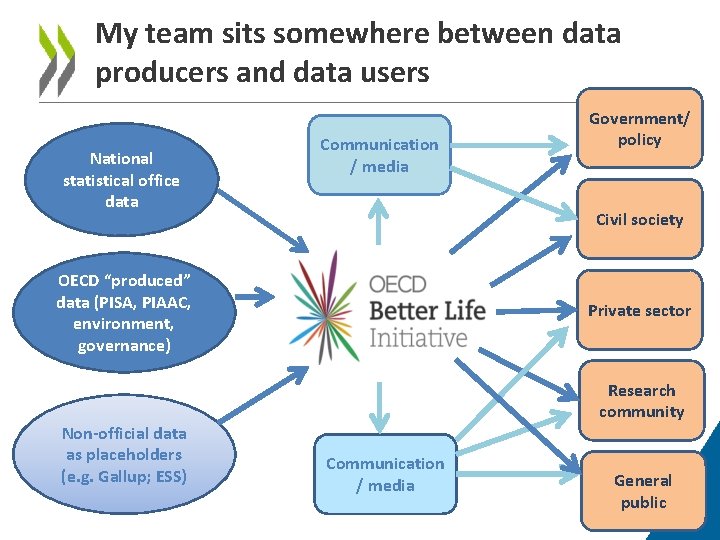
My team sits somewhere between data producers and data users National statistical office data Communication / media Civil society OECD “produced” data (PISA, PIAAC, environment, governance) Non-official data as placeholders (e. g. Gallup; ESS) Government/ policy Private sector Research community Communication / media General public
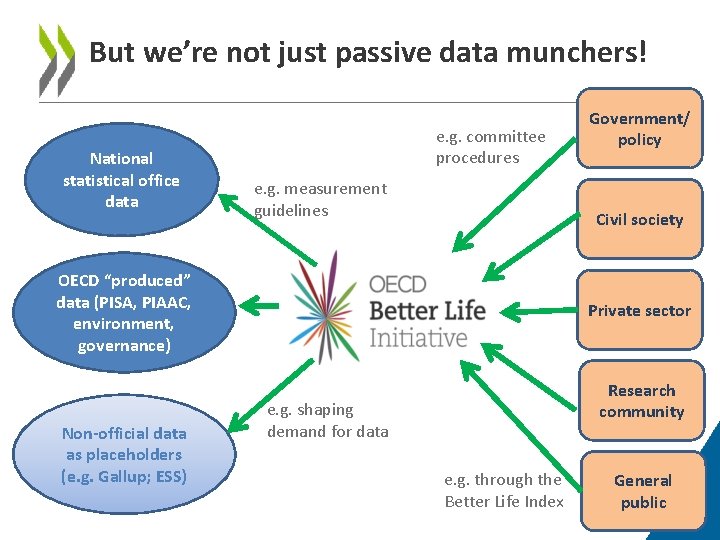
But we’re not just passive data munchers! National statistical office data e. g. committee procedures e. g. measurement guidelines Civil society OECD “produced” data (PISA, PIAAC, environment, governance) Non-official data as placeholders (e. g. Gallup; ESS) Government/ policy Private sector Research community e. g. shaping demand for data e. g. through the Better Life Index General public
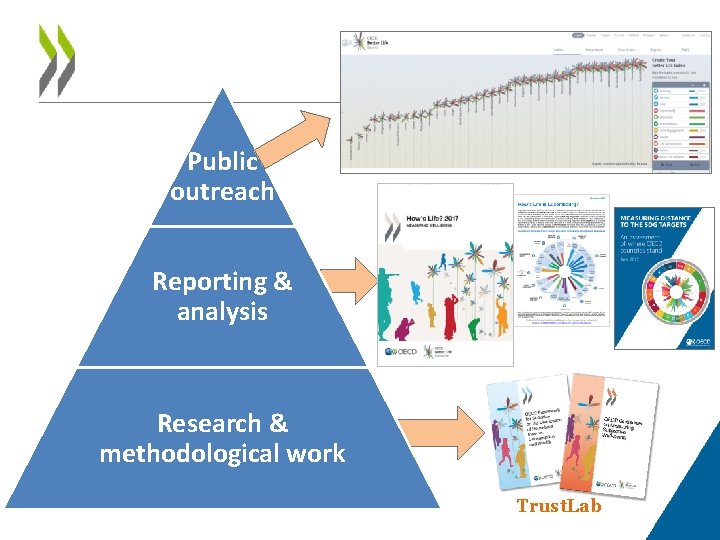
Public outreach Reporting & analysis Research & methodological work Trust. Lab
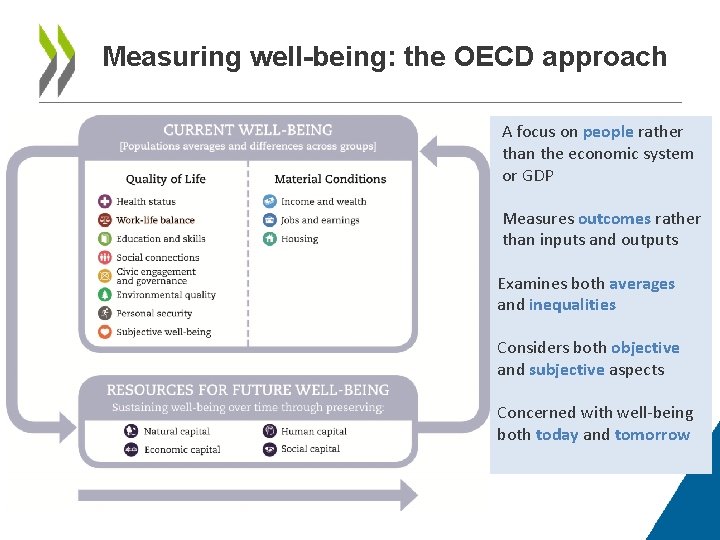
Measuring well-being: the OECD approach • A focus on people rather than the economic system or GDP • Measures outcomes rather than inputs and outputs • Examines both averages and inequalities • Considers both objective and subjective aspects • Concerned with well-being both today and tomorrow

How’s Life? – the OECD’s well-being report • Fourth edition released November 2017 • Overview of levels and trends in wellbeing since 2005 (current well-being, resources for future well-being) • Three thematic chapters: • Inequalities in well-being • Migrants’ well-being • Governance and well-being • Detailed country notes for 35 OECD members and 6 partners
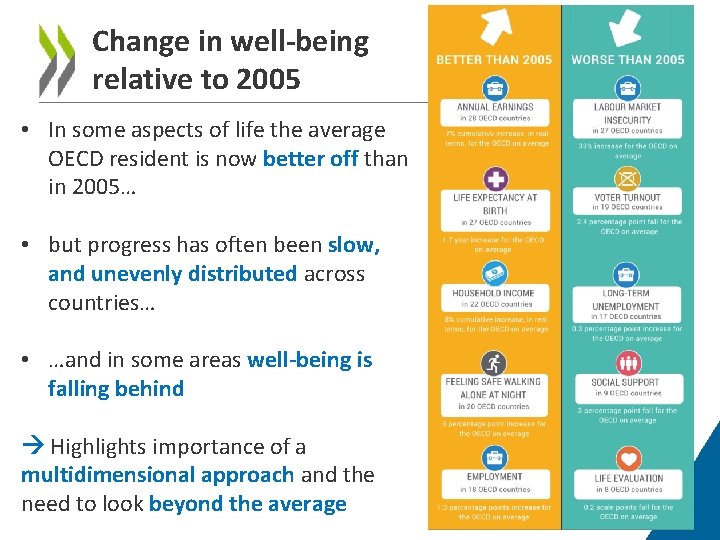
Change in well-being relative to 2005 • In some aspects of life the average OECD resident is now better off than in 2005… • but progress has often been slow, and unevenly distributed across countries… • …and in some areas well-being is falling behind Highlights importance of a multidimensional approach and the need to look beyond the average
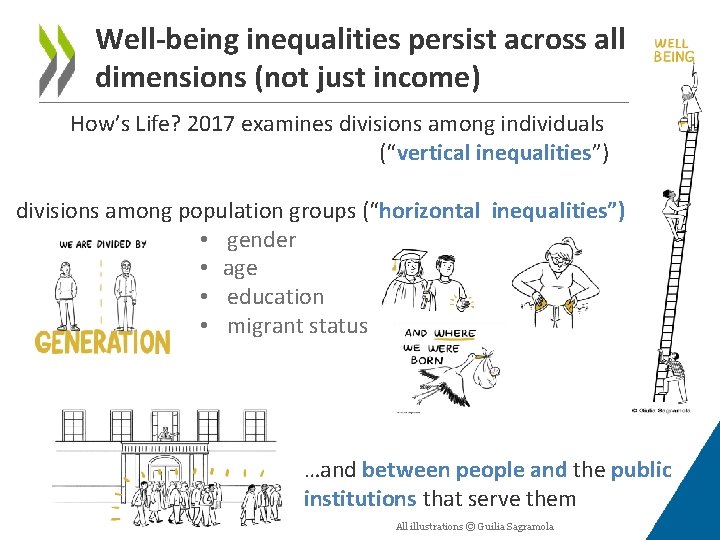
Well-being inequalities persist across all dimensions (not just income) How’s Life? 2017 examines divisions among individuals (“vertical inequalities”) divisions among population groups (“horizontal inequalities”) • gender • age • education • migrant status …and between people and the public institutions that serve them All illustrations © Guilia Sagramola

Well-being inequalities across 362 OECD regions https: //www. oecdregionalwellbeing. org/
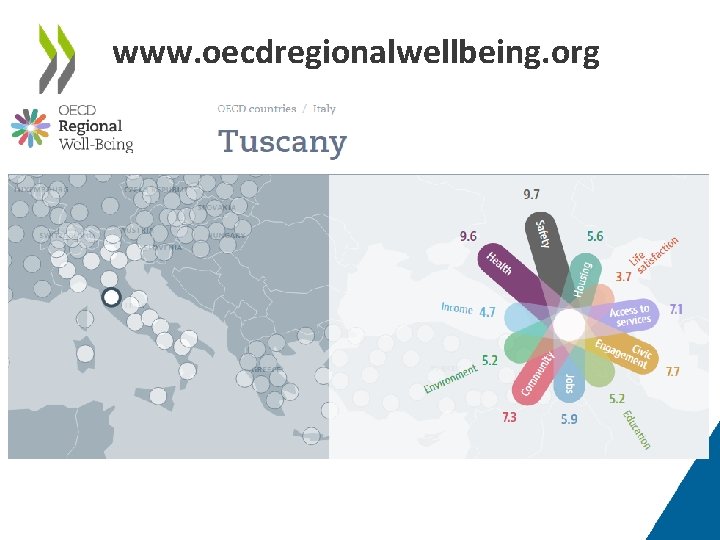
www. oecdregionalwellbeing. org
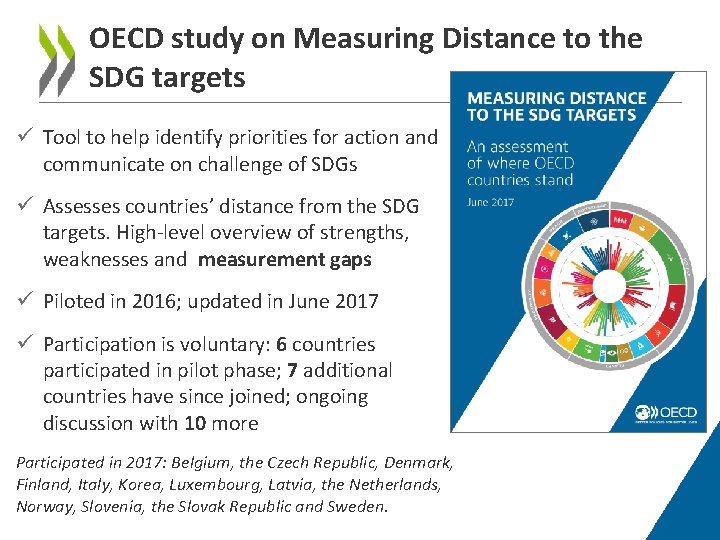
OECD study on Measuring Distance to the SDG targets ü Tool to help identify priorities for action and communicate on challenge of SDGs ü Assesses countries’ distance from the SDG targets. High-level overview of strengths, weaknesses and measurement gaps ü Piloted in 2016; updated in June 2017 ü Participation is voluntary: 6 countries participated in pilot phase; 7 additional countries have since joined; ongoing discussion with 10 more Participated in 2017: Belgium, the Czech Republic, Denmark, Finland, Italy, Korea, Luxembourg, Latvia, the Netherlands, Norway, Slovenia, the Slovak Republic and Sweden.
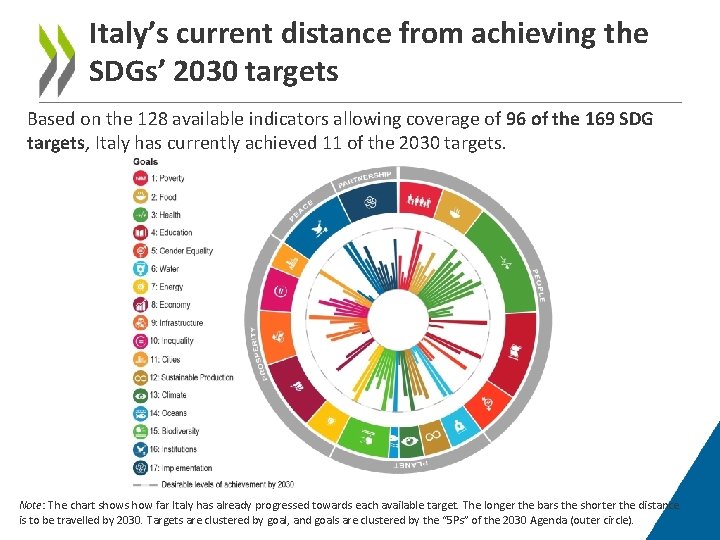
Italy’s current distance from achieving the SDGs’ 2030 targets Based on the 128 available indicators allowing coverage of 96 of the 169 SDG targets, Italy has currently achieved 11 of the 2030 targets. Note: The chart shows how far Italy has already progressed towards each available target. The longer the bars the shorter the distance is to be travelled by 2030. Targets are clustered by goal, and goals are clustered by the “ 5 Ps” of the 2030 Agenda (outer circle).
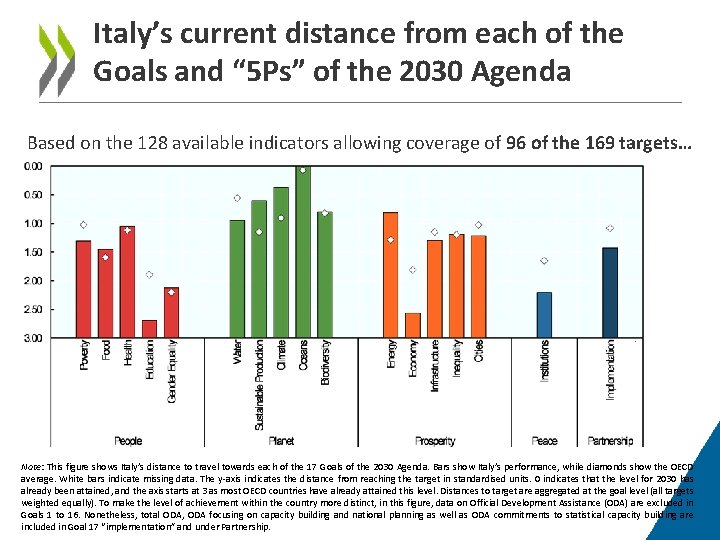
Italy’s current distance from each of the Goals and “ 5 Ps” of the 2030 Agenda Based on the 128 available indicators allowing coverage of 96 of the 169 targets… Note: This figure shows Italy’s distance to travel towards each of the 17 Goals of the 2030 Agenda. Bars show Italy’s performance, while diamonds show the OECD average. White bars indicate missing data. The y-axis indicates the distance from reaching the target in standardised units. 0 indicates that the level for 2030 has already been attained, and the axis starts at 3 as most OECD countries have already attained this level. Distances to target are aggregated at the goal level (all targets weighted equally). To make the level of achievement within the country more distinct, in this figure, data on Official Development Assistance (ODA) are excluded in Goals 1 to 16. Nonetheless, total ODA, ODA focusing on capacity building and national planning as well as ODA commitments to statistical capacity building are included in Goal 17 “implementation” and under Partnership.
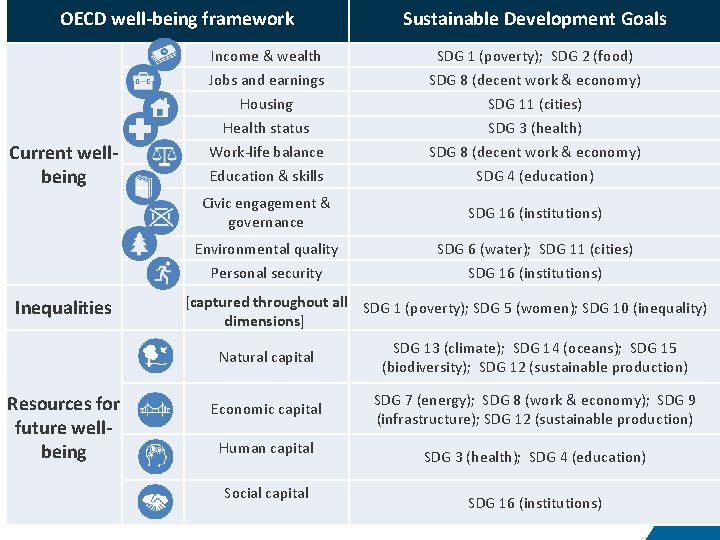
OECD well-being framework Current wellbeing Inequalities Resources for future wellbeing Income & wealth SDG 1 (poverty); SDG 2 (food) Jobs and earnings SDG 8 (decent work & economy) Housing SDG 11 (cities) Health status SDG 3 (health) Work-life balance SDG 8 (decent work & economy) Education & skills SDG 4 (education) Civic engagement & governance SDG 16 (institutions) Environmental quality SDG 6 (water); SDG 11 (cities) Personal security SDG 16 (institutions) [captured throughout all SDG 1 (poverty); SDG 5 (women); SDG 10 (inequality) dimensions] Natural capital SDG 13 (climate); SDG 14 (oceans); SDG 15 (biodiversity); SDG 12 (sustainable production) Economic capital SDG 7 (energy); SDG 8 (work & economy); SDG 9 (infrastructure); SDG 12 (sustainable production) Human capital Social capital Sustainable Development Goals SDG 3 (health); SDG 4 (education) SDG 16 (institutions)
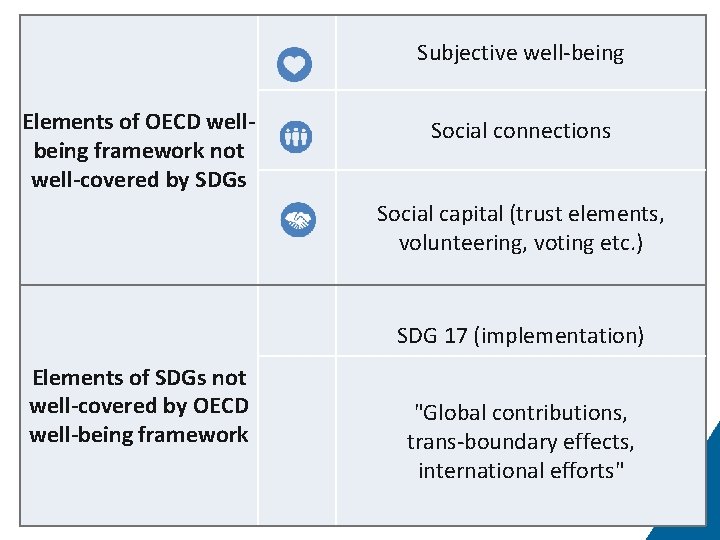
Elements of OECD wellbeing framework not well-covered by SDGs Subjective well-being Social connections Social capital (trust elements, volunteering, voting etc. ) Elements of SDGs not well-covered by OECD well-being framework SDG 17 (implementation) "Global contributions, trans-boundary effects, international efforts"
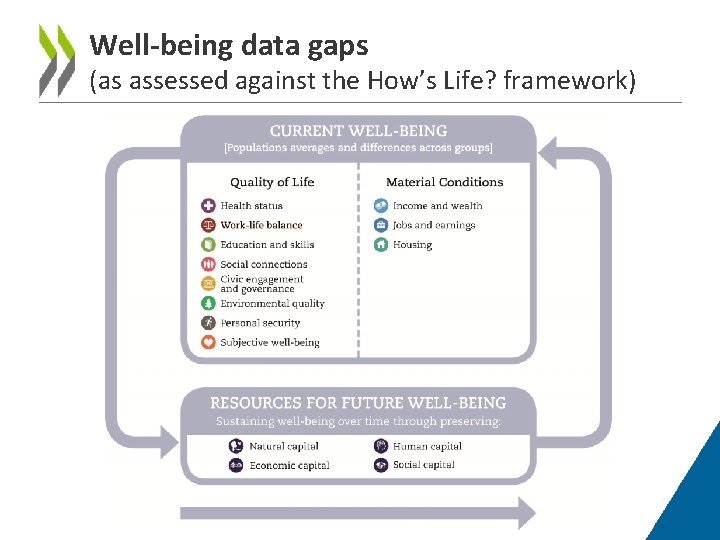
Well-being data gaps (as assessed against the How’s Life? framework)
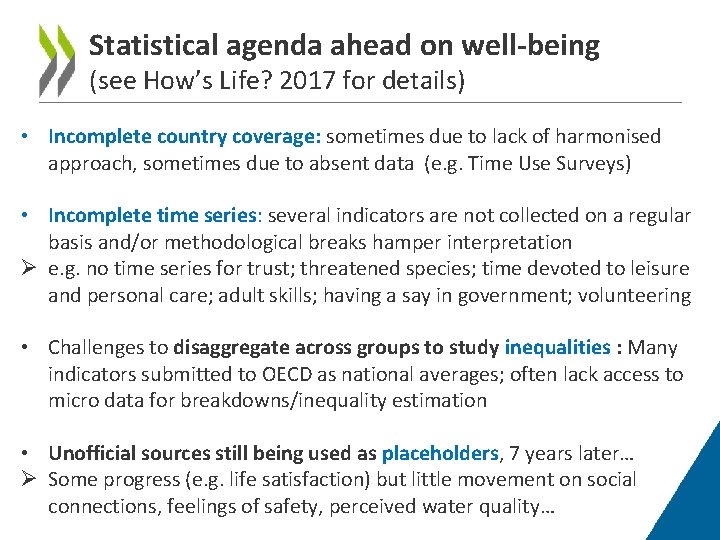
Statistical agenda ahead on well-being (see How’s Life? 2017 for details) • Incomplete country coverage: sometimes due to lack of harmonised approach, sometimes due to absent data (e. g. Time Use Surveys) • Incomplete time series: several indicators are not collected on a regular basis and/or methodological breaks hamper interpretation Ø e. g. no time series for trust; threatened species; time devoted to leisure and personal care; adult skills; having a say in government; volunteering • Challenges to disaggregate across groups to study inequalities : Many indicators submitted to OECD as national averages; often lack access to micro data for breakdowns/inequality estimation • Unofficial sources still being used as placeholders, 7 years later… Ø Some progress (e. g. life satisfaction) but little movement on social connections, feelings of safety, perceived water quality…
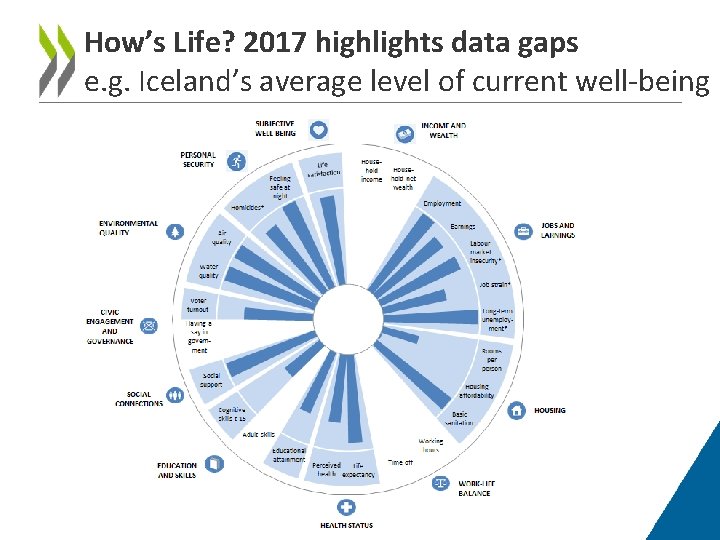
How’s Life? 2017 highlights data gaps e. g. Iceland’s average level of current well-being
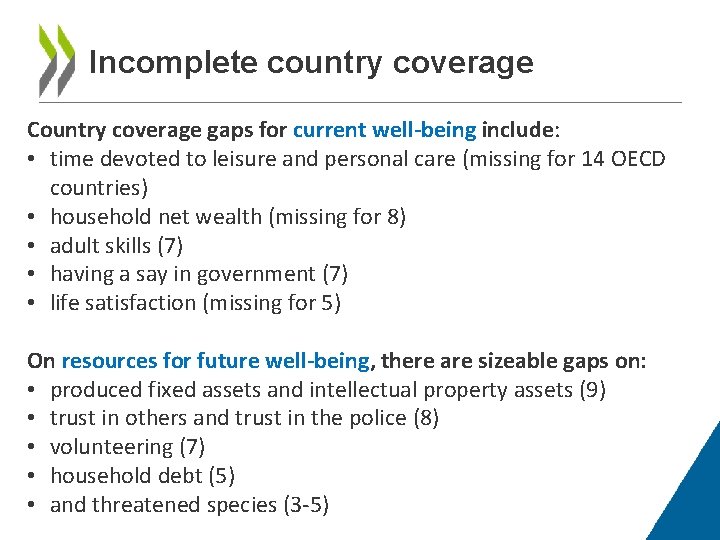
Incomplete country coverage Country coverage gaps for current well-being include: • time devoted to leisure and personal care (missing for 14 OECD countries) • household net wealth (missing for 8) • adult skills (7) • having a say in government (7) • life satisfaction (missing for 5) On resources for future well-being, there are sizeable gaps on: • produced fixed assets and intellectual property assets (9) • trust in others and trust in the police (8) • volunteering (7) • household debt (5) • and threatened species (3 -5)
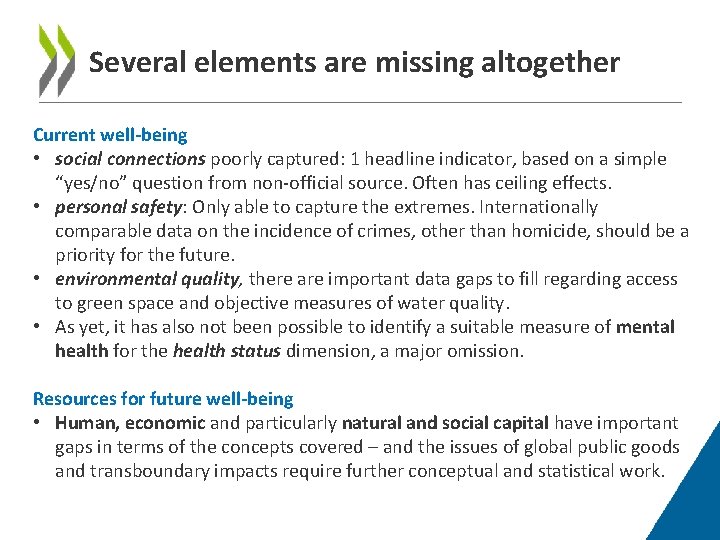
Several elements are missing altogether Current well-being • social connections poorly captured: 1 headline indicator, based on a simple “yes/no” question from non-official source. Often has ceiling effects. • personal safety: Only able to capture the extremes. Internationally comparable data on the incidence of crimes, other than homicide, should be a priority for the future. • environmental quality, there are important data gaps to fill regarding access to green space and objective measures of water quality. • As yet, it has also not been possible to identify a suitable measure of mental health for the health status dimension, a major omission. Resources for future well-being • Human, economic and particularly natural and social capital have important gaps in terms of the concepts covered – and the issues of global public goods and transboundary impacts require further conceptual and statistical work.
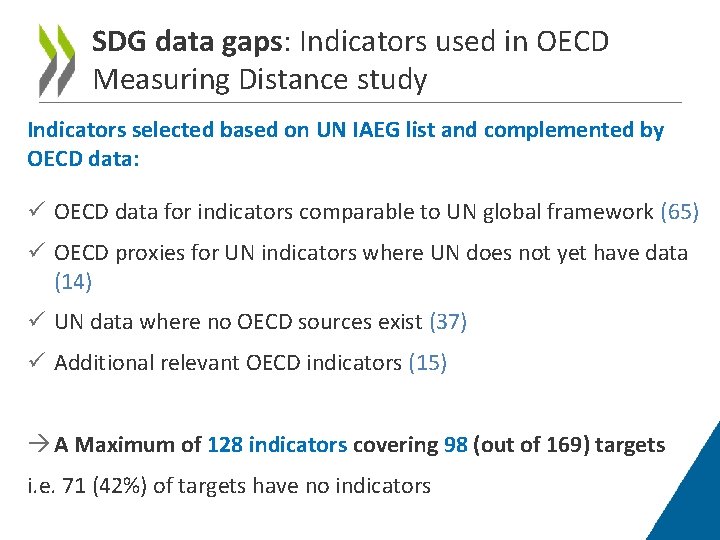
SDG data gaps: Indicators used in OECD Measuring Distance study Indicators selected based on UN IAEG list and complemented by OECD data: ü OECD data for indicators comparable to UN global framework (65) ü OECD proxies for UN indicators where UN does not yet have data (14) ü UN data where no OECD sources exist (37) ü Additional relevant OECD indicators (15) A Maximum of 128 indicators covering 98 (out of 169) targets i. e. 71 (42%) of targets have no indicators
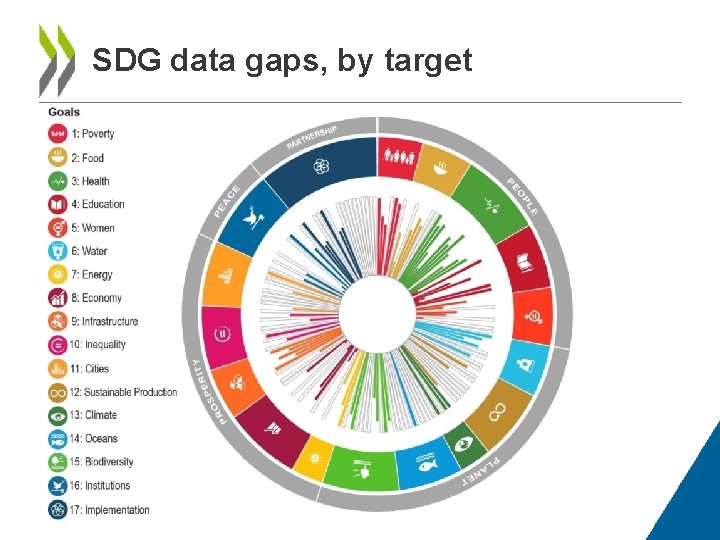
SDG data gaps, by target
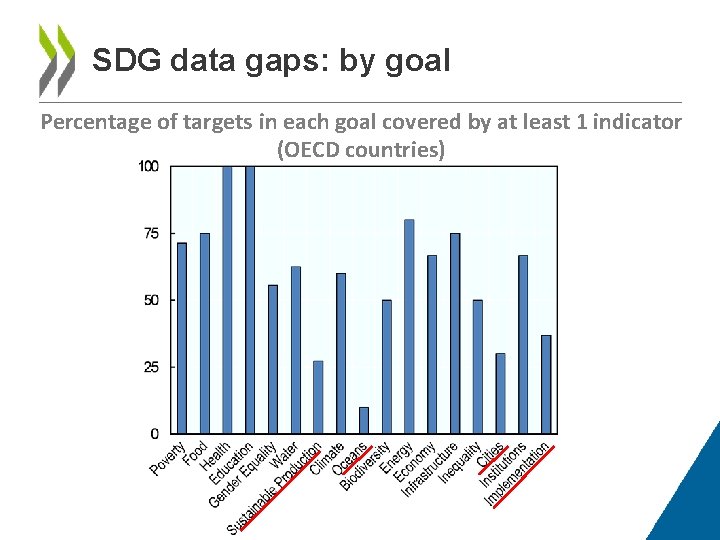
SDG data gaps: by goal Percentage of targets in each goal covered by at least 1 indicator (OECD countries)
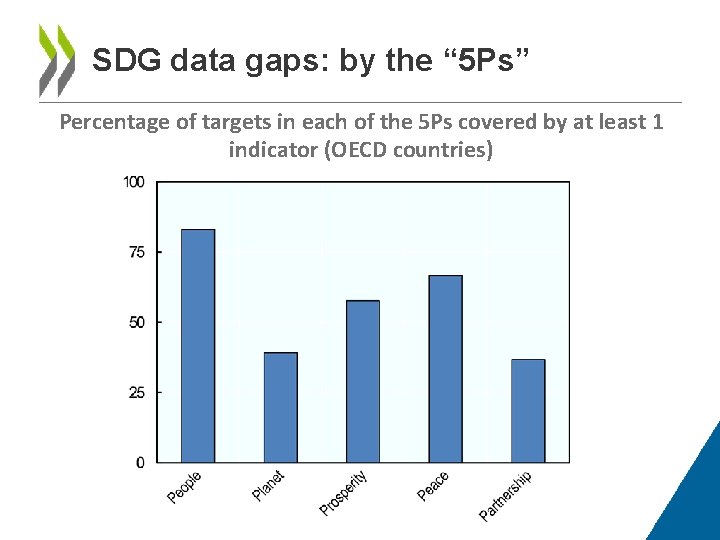
SDG data gaps: by the “ 5 Ps” Percentage of targets in each of the 5 Ps covered by at least 1 indicator (OECD countries)
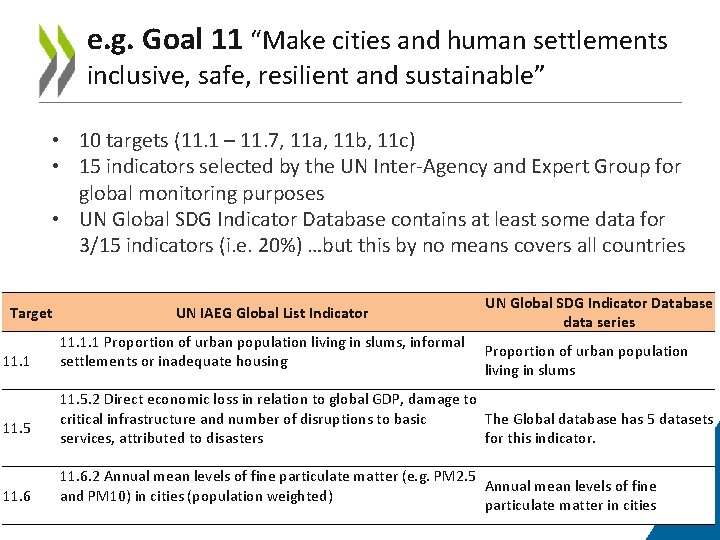
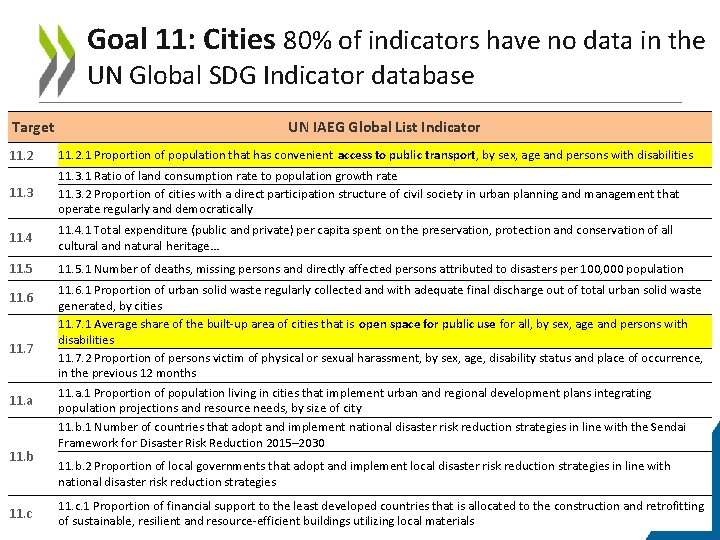
e. g. Goal 11 “Make cities and human settlements inclusive, safe, resilient and sustainable” • 10 targets (11. 1 – 11. 7, 11 a, 11 b, 11 c) • 15 indicators selected by the UN Inter-Agency and Expert Group for global monitoring purposes • UN Global SDG Indicator Database contains at least some data for 3/15 indicators (i. e. 20%) …but this by no means covers all countries Target 11. 1 11. 5 11. 6 UN IAEG Global List Indicator 11. 1. 1 Proportion of urban population living in slums, informal settlements or inadequate housing UN Global SDG Indicator Database data series Proportion of urban population living in slums 11. 5. 2 Direct economic loss in relation to global GDP, damage to critical infrastructure and number of disruptions to basic The Global database has 5 datasets services, attributed to disasters for this indicator. 11. 6. 2 Annual mean levels of fine particulate matter (e. g. PM 2. 5 Annual mean levels of fine and PM 10) in cities (population weighted) particulate matter in cities
Goal 11: Cities 80% of indicators have no data in the UN Global SDG Indicator database Target UN IAEG Global List Indicator 11. 2. 1 Proportion of population that has convenient access to public transport, by sex, age and persons with disabilities 11. 3. 1 Ratio of land consumption rate to population growth rate 11. 3. 2 Proportion of cities with a direct participation structure of civil society in urban planning and management that operate regularly and democratically 11. 4. 1 Total expenditure (public and private) per capita spent on the preservation, protection and conservation of all cultural and natural heritage… 11. 5. 1 Number of deaths, missing persons and directly affected persons attributed to disasters per 100, 000 population 11. 6 11. 7 11. a 11. b 11. c 11. 6. 1 Proportion of urban solid waste regularly collected and with adequate final discharge out of total urban solid waste generated, by cities 11. 7. 1 Average share of the built-up area of cities that is open space for public use for all, by sex, age and persons with disabilities 11. 7. 2 Proportion of persons victim of physical or sexual harassment, by sex, age, disability status and place of occurrence, in the previous 12 months 11. a. 1 Proportion of population living in cities that implement urban and regional development plans integrating population projections and resource needs, by size of city 11. b. 1 Number of countries that adopt and implement national disaster risk reduction strategies in line with the Sendai Framework for Disaster Risk Reduction 2015– 2030 11. b. 2 Proportion of local governments that adopt and implement local disaster risk reduction strategies in line with national disaster risk reduction strategies 11. c. 1 Proportion of financial support to the least developed countries that is allocated to the construction and retrofitting of sustainable, resilient and resource-efficient buildings utilizing local materials

Continuous efforts to improve the data • OECD Measurement guidelines: (Subjective well-being, Household wealth, Joint distributions of income, consumption & wealth, Quality of the work environment, Trust) • Well-being in OECD data collections (e. g. PISA, PIAAC, Trust. Lab) • Supporting UN IAEG on SDGs (OECD data used in some cases) • Developing innovative methods (e. g. Trustlab experimental techniques; satellite data for environmental stats) • OECD Smart Data Strategy

OECD Smart Data Strategy

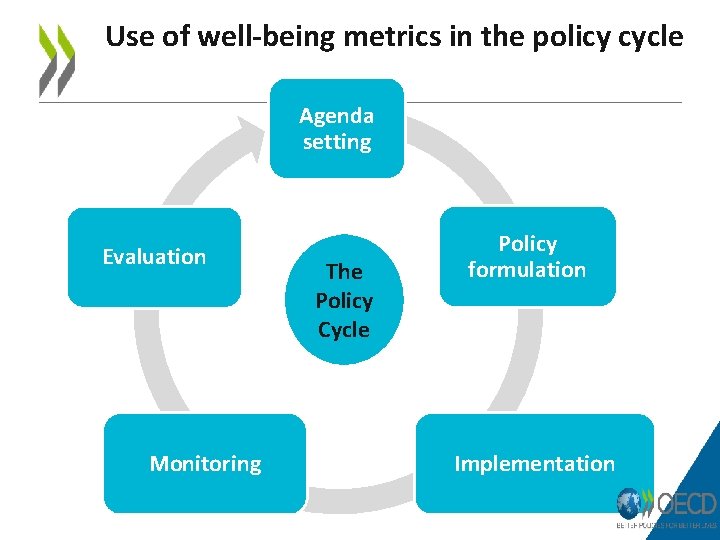
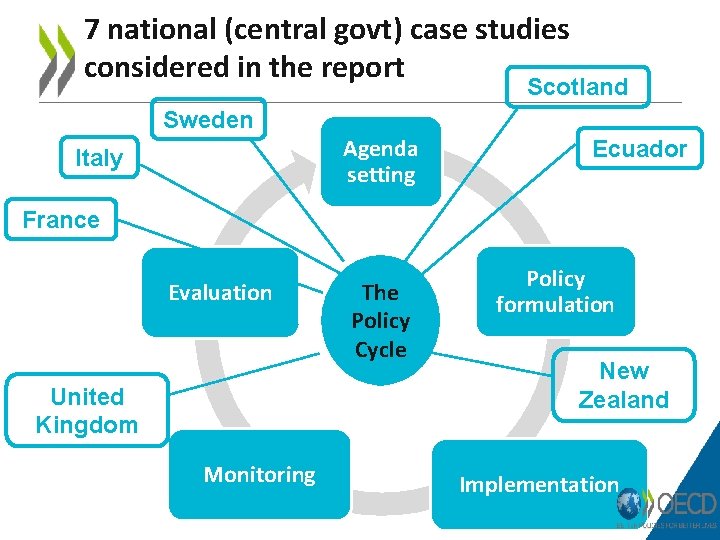
Policy use of well-being metrics OECD (Chapter 8): Countries’ Experiences with Wellbeing and Happiness Metrics • 13 countries with well-being measurement frameworks • 10 countries with specific mechanisms for embedding well -being metrics in policy • 7 detailed case studies http: //bit. ly/countries-well-being
Use of well-being metrics in the policy cycle Agenda setting Evaluation Monitoring The Policy Cycle Policy formulation Implementation
7 national (central govt) case studies considered in the report Scotland Sweden Agenda setting Italy Ecuador France Evaluation United Kingdom Monitoring The Policy Cycle Policy formulation New Zealand Implementation
5 observations from country experiences 1. Countries’ frameworks for well-being are multi-dimensional (i. e. consider several different aspects of people’s lives) 2. Most frameworks include subjective well-being measures, but not always as a headline indicator for analysis 3. Well-being metrics are used at different stages of the policy cycle, from strategic analysis, to evaluations of policy interventions 4. Efforts initiated in different institutions in different countries (Prime Minister, Cabinet, Parliament, National Statistical Offices) with varying commitment and results 5. Still early days: progress has been significant in last decade, but most initiatives are young, and still evolving. Durability over time will be crucial.
Thanks for listening! www. oecd. org/statistics/measuring-well-being-and-progress. htm www. oecd. org/howslife http: //bit. ly/countries-well-being carrie. exton@oecd. org
Recap: Project MAKSWELL objectives MAKing Sustainable development and WELL-being frameworks work for policy analysis • building up a database on beyond GDP initiatives for a wide set of EU countries • improving the database on beyond GDP initiatives • extending the geographical dimension especially focusing on the possible estimates of people’s vulnerability (e. g. poverty; regional inflation) • using the extended database for policy evaluation at macro level
Makswell reflection paper: “Future research needs in terms of statistical methodologies and new data” Themes of action 1. New data: for Agenda 2030 and Beyond GDP 2. Methodologies for new sources: complementing surveys with administrative data and other new data sources like big data. 3. Assessment capacity : development of innovative policy tools; more service-oriented statistics 4. Skills and competence development : developing basic knowledge of statistics among citizens 5. Building a data-friendly environment : Managing and fruitfully utilising the data deluge implies finding an effective regulatory framework for data production, sharing and dissemination.
- Slides: 37