
OECD Organisation for Economic Cooperation Development Principles on








- Slides: 20
OECD (Organisation for Economic Co-operation & Development) Principles on Corporate Governance
OECD - Introduction Ø It is an organisation of those countries which describe themselves as Democratic and have Market economy. Ø Its HQ is in Paris, France and it is currently headed by Jose Angel Gurria (Secretary. General)
Headquarters of OECD, Paris, France Jose Angel Gurria Secretary General, OECD
OECD - History Ø It was basically formed in 1948 as OECC (Organisation for European Economic Co-operation), and as the name suggests, it was only confined to European areas with the main motive to implement Marshall Plan. It also focused on matters like, nuclear energy, integrated education policies, etc. that time. Ø In 1961, it was re-formed as OECD to serve the mission on a global level. It had 20 countries as founding members. Currently, it has 34 countries and it is trying to include more countries.
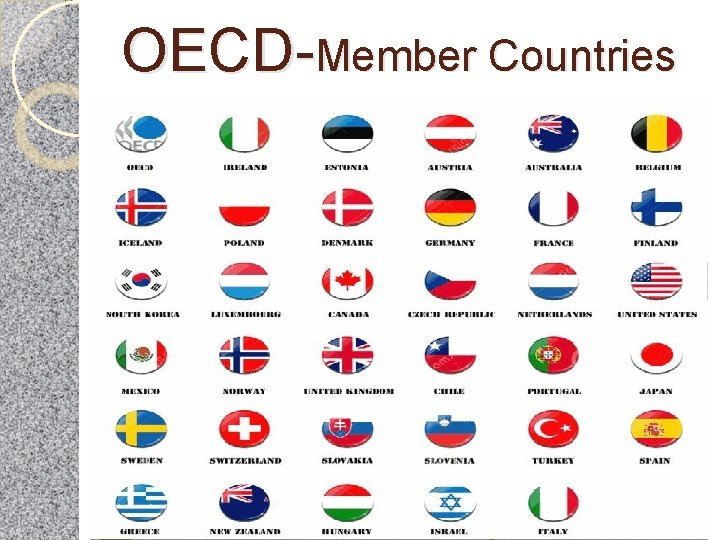
OECD-Member Countries
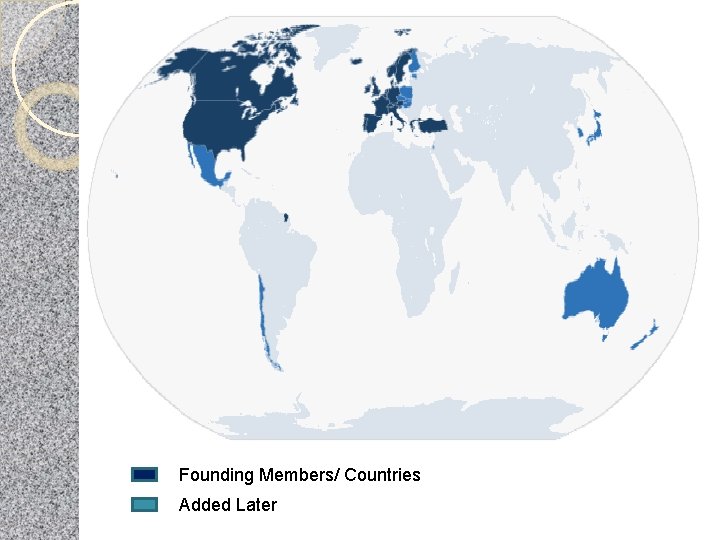
Founding Members/ Countries Added Later
Corporate Governance. Concept Ø The system by which business corporations are directed and controlled ØA set of relationships between a company’s management, its board, its shareholders and other stakeholders Ø Spells out the rules and procedures for making decisions on corporate affairs Ø Provides the structure through which the company objectives are set, and the means of attaining those objectives and monitoring performance
Corporate Governance. Importance “The cornerstone of the modern market-oriented economy” Ø It promotes the efficient use of scarce resources Ø It plays an important role in maintaining corporate integrity and managing the risk of corporate fraud, combating against management misconduct and corruption Ø It has a positive link to economic development and good corporate performance
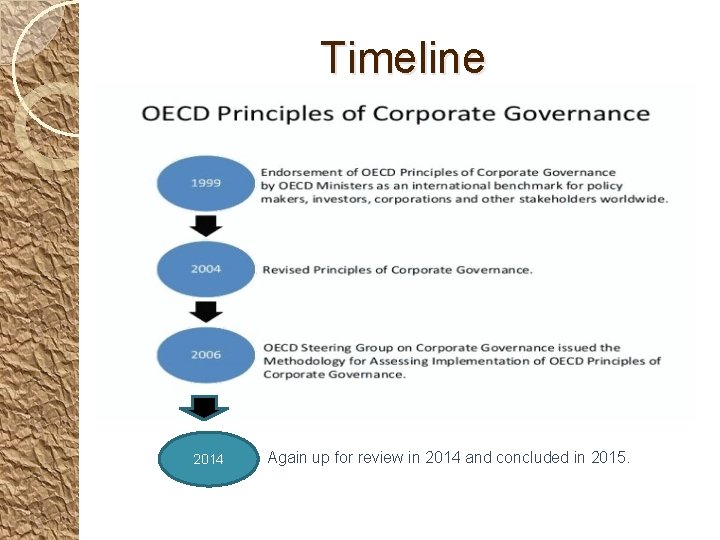
Timeline 2014 Again up for review in 2014 and concluded in 2015.
Timeline 2014 Again up for review in 2014 and concluded in 2015.
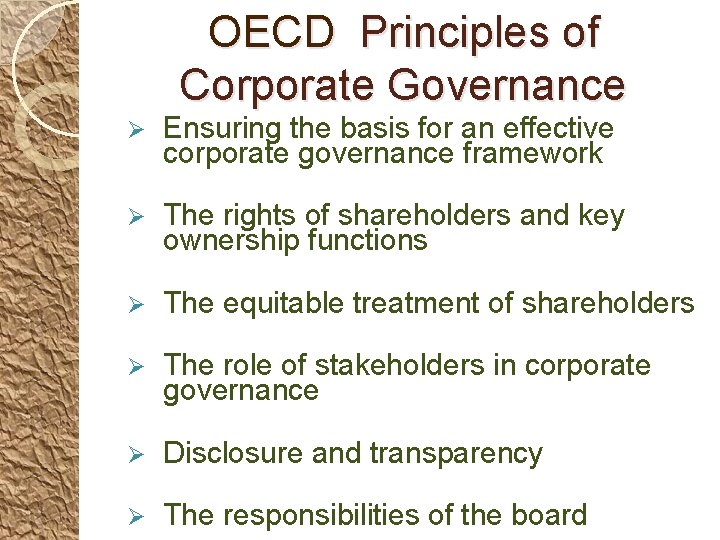
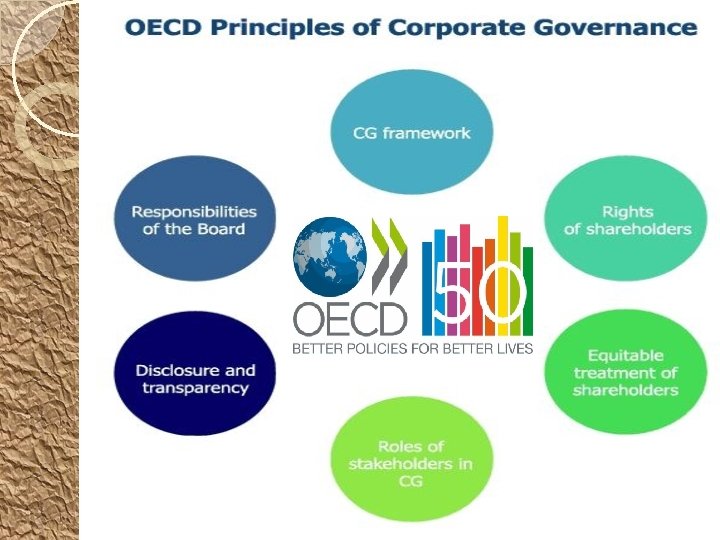
OECD Principles of Corporate Governance Ø Ensuring the basis for an effective corporate governance framework Ø The rights of shareholders and key ownership functions Ø The equitable treatment of shareholders Ø The role of stakeholders in corporate governance Ø Disclosure and transparency Ø The responsibilities of the board
Ensuring the basis for an effective corporate governance framework The corporate governance framework should promote transparent and efficient markets Be consistent with the rule of law and clearly articulate the division of responsibilities among different supervisory, regulatory and enforcement authorities
Rights of shareholders and key ownership functions Right to have shares registered and secure Should be able to take part in shareholder meetings and in major decisions concerning the firm Ability to elect board members of their choice, to table proposals, and ask questions of directors
Equitable treatment of shareholders Equitable treatment of all shareholders, foreign and minority especially Should not be abused by insiders In presence of major shareholders, improve protection of minority shareholders
Role of stakeholders in Corporate Governance Stakeholders include creditors, depositors and employees Encourage active co-operation between company and stakeholders Performance enhancing mechanisms should be available Redress for violation of legal rights Access to relevant information
Disclosure and transparency “Objective is to ensure meaningful and reliable disclosure, which allows markets to judge the fair value of a company” Material foreseeable risk factors Full financial disclosure Governance structure and policies Information should be prepared audited and disclosed in accordance with high standards of accounting, audit and non-financial disclosure Regular disclosure
Responsibilities of the Board Moves towards increasing not only the number of non-executive directors but also ensuring they are “independent” Independence of judgement and independence from management Remuneration including information on the structure of compensation schemes and termination conditions relevant not only for financial implications but also for assessing incentives and performance
Speciality of OECD Principles Emphasise “functional equivalence” - the means used to achieve the desired outcomes might vary, depending on: • Legal and institutional frameworks • Economic conditions & market structures • Political and socio-cultural environment Therefore, the Principles can be applied in any jurisdiction Effect on overall economic performance, market integrity and incentives for market participants to be considered Assessments require an evaluation of: • Scope and content of laws, regulations & voluntary codes • Company practices – how widespread is adherence to Principles? • Accessibility and effectiveness of remedies • Efficiency & effectiveness of regulatory supervision & enforcement