
OECD Budget Review of Montenegro 7 th Annual
OECD Budget Review of Montenegro 7 th Annual Meeting of OECD-CESEE Senior Budget Officials Zagreb, 30 June-1 July 2011 Valentina Kostyleva OECD
The Focus of the Presentation ü Macroeconomic context and fiscal projections ü Budget classification ü Budget calendar ü Modernisation plans ü OECD recommendations for the MTEF and fiscal rules ü One outstanding problem of budget execution: large arrears
The Macroeconomic Context ü Independence since 2006 ü Small open economy (620. 000 population) ü One of the world’s fastest growing non-oil economies in the past decade (FDI 40 % of GDP) ü Sharp deterioration in the public finances in 2009 due to large contractions in industry and construction ü The authorities aim at balancing the budget in 2012 and achieving a sizeable surplus thereafter
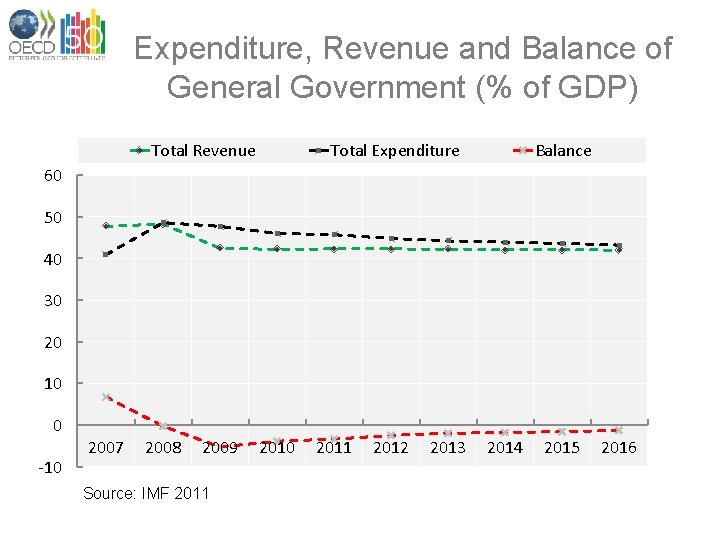
Expenditure, Revenue and Balance of General Government (% of GDP) Total Revenue Total Expenditure Balance 60 50 40 30 20 10 0 -10 2007 2008 2009 Source: IMF 2011 2010 2011 2012 2013 2014 2015 2016
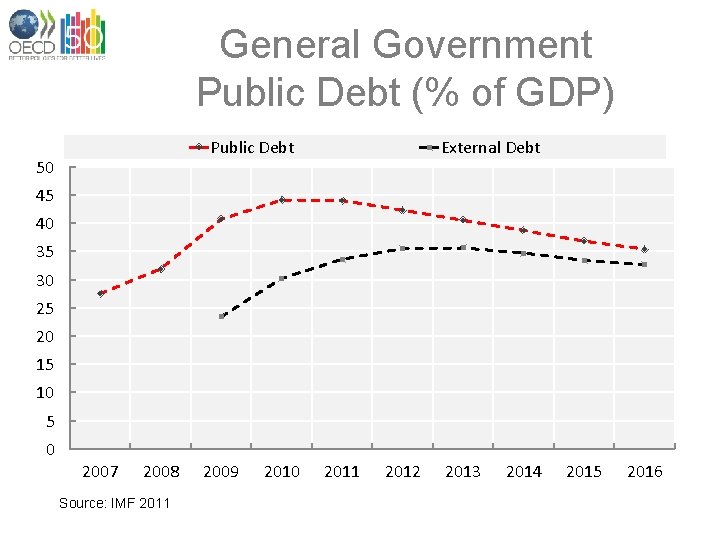
General Government Public Debt (% of GDP) Public Debt 50 External Debt 45 40 35 30 25 20 15 10 5 0 2007 2008 Source: IMF 2011 2009 2010 2011 2012 2013 2014 2015 2016
The Annual Budget Law ü Classified by: v spending units (124) v programmes (1 -3 programmes per spending unit) v economic groups (salaries, supplies and services, capital expenditures, maintenance, transfers) ü Transparent, comprehensive and easily readable document ü No multi-annual base line estimates at the line item level
Budget Calendar April May late July Septem ber late October Novemb er Decemb er • The Government adopts the Fiscal Policy Statement • The Mo. F issues the Budget Circular for spending units fixing expenditure targets • Spending units submit their requests to the Mo. F for the upcoming budget year • The Mo. F holds negotiations with spending units • Macroeconomic projections for the forthcoming budget year are updated • The Mo. F submits the Budget bill to the Government • The Budget bill is submitted to Parliament • The Budget Law for the upcoming year is adopted
The Major Weaknesses of the Present System ü Focus on the upcoming budget year ü “Bottom-up” approach associated with contentious bilateral negotiations between the Ministry of Finance and spending units
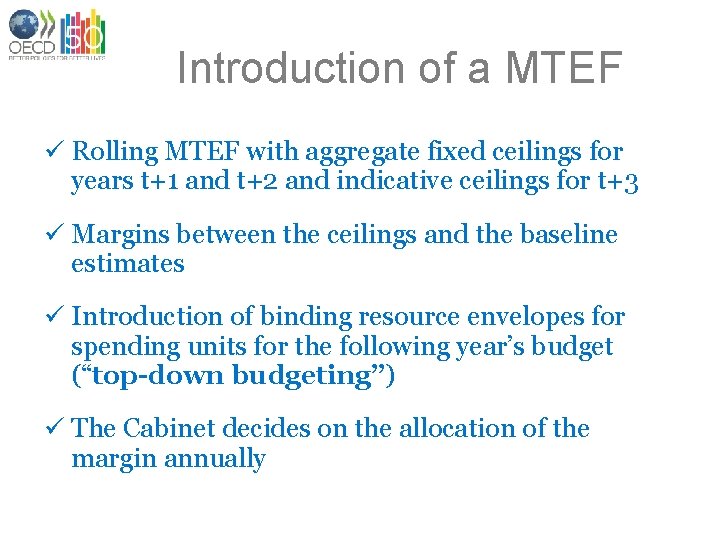
Introduction of a MTEF ü Rolling MTEF with aggregate fixed ceilings for years t+1 and t+2 and indicative ceilings for t+3 ü Margins between the ceilings and the baseline estimates ü Introduction of binding resource envelopes for spending units for the following year’s budget (“top-down budgeting”) ü The Cabinet decides on the allocation of the margin annually
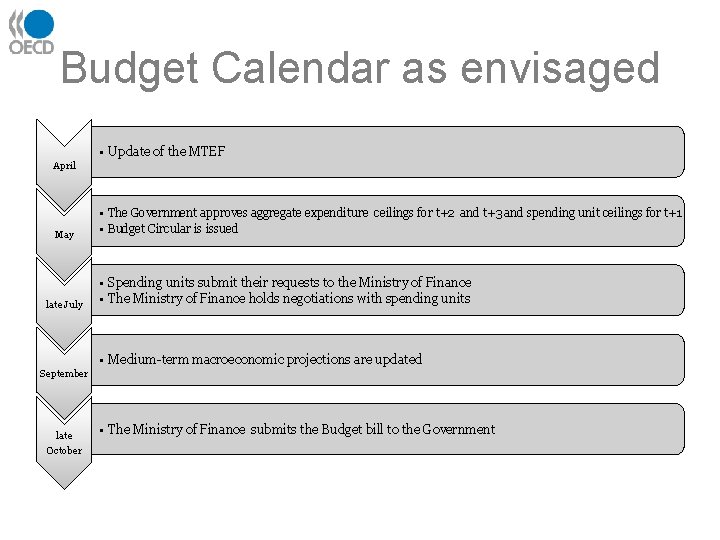
Budget Calendar as envisaged • Update of the MTEF April May late July • The Government approves aggregate expenditure ceilings for t+2 and t+3 and spending unit ceilings for t+1 • Budget Circular is issued • Spending units submit their requests to the Ministry of Finance • The Ministry of Finance holds negotiations with spending units • Medium-term macroeconomic projections are updated September late October • The Ministry of Finance submits the Budget bill to the Government
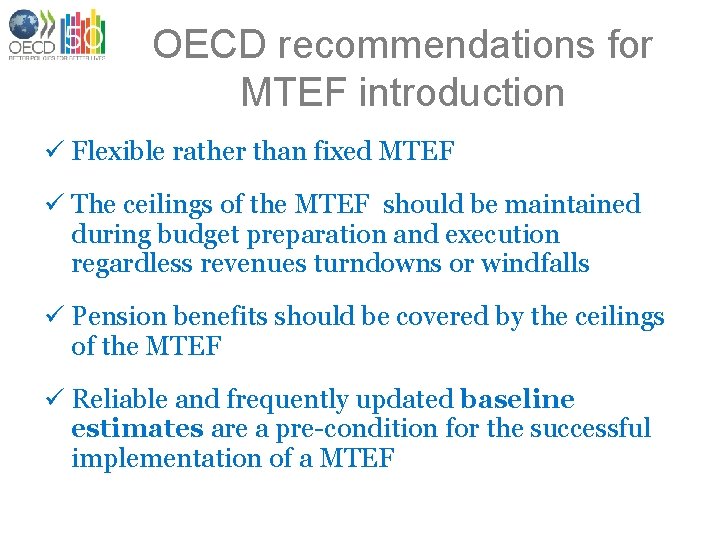
OECD recommendations for MTEF introduction ü Flexible rather than fixed MTEF ü The ceilings of the MTEF should be maintained during budget preparation and execution regardless revenues turndowns or windfalls ü Pension benefits should be covered by the ceilings of the MTEF ü Reliable and frequently updated baseline estimates are a pre-condition for the successful implementation of a MTEF
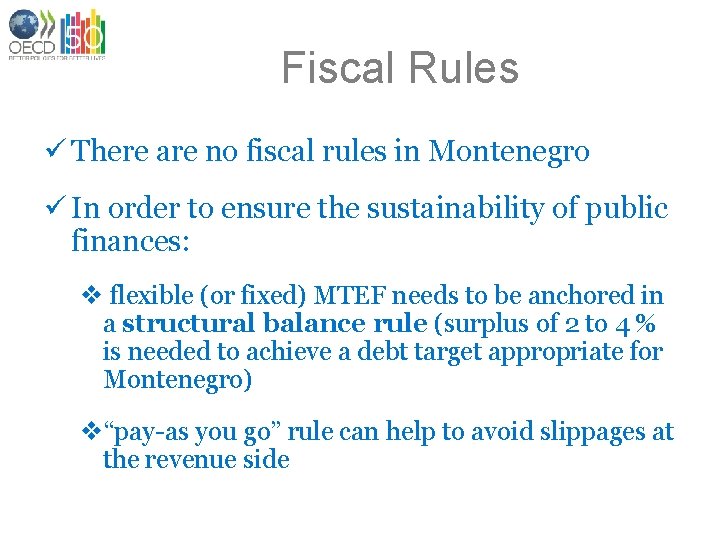
Fiscal Rules ü There are no fiscal rules in Montenegro ü In order to ensure the sustainability of public finances: v flexible (or fixed) MTEF needs to be anchored in a structural balance rule (surplus of 2 to 4 % is needed to achieve a debt target appropriate for Montenegro) v“pay-as you go” rule can help to avoid slippages at the revenue side
One outstanding problem of budget execution: arrears ü Arrears amount to 3 -4 % of total budget expenditures ü Why? v Gaps in the legislation v Deficiencies in the implementation ü How to address? v Ex-ante commitment control by the Treasury v Commitments should be integrated in the SAP IT –system v The Ministry of Finance ensures that commitments affecting future years are reported, and included in the forecasts for the future years
- Slides: 13