
ODISHA Improving access to malaria control services at
- Slides: 21
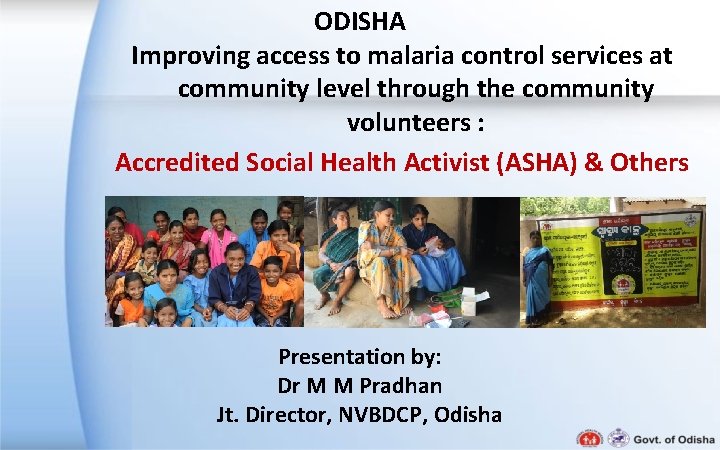
ODISHA Improving access to malaria control services at community level through the community volunteers : Accredited Social Health Activist (ASHA) & Others Presentation by: Dr M M Pradhan Jt. Director, NVBDCP, Odisha
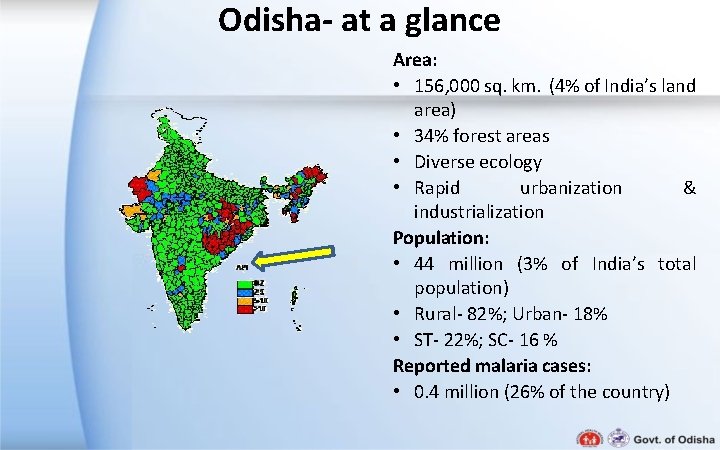
Odisha- at a glance Area: • 156, 000 sq. km. (4% of India’s land area) • 34% forest areas • Diverse ecology • Rapid urbanization & industrialization Population: • 44 million (3% of India’s total population) • Rural- 82%; Urban- 18% • ST- 22%; SC- 16 % Reported malaria cases: • 0. 4 million (26% of the country)
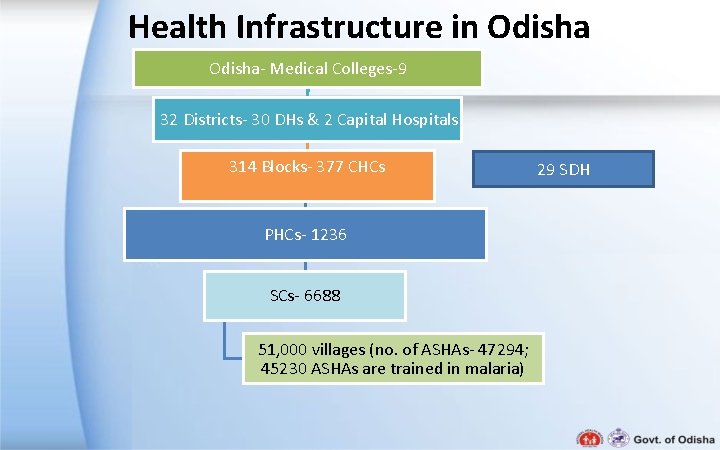
Health Infrastructure in Odisha- Medical Colleges-9 32 Districts- 30 DHs & 2 Capital Hospitals 314 Blocks- 377 CHCs PHCs- 1236 SCs- 6688 51, 000 villages (no. of ASHAs- 47294; 45230 ASHAs are trained in malaria) 29 SDH
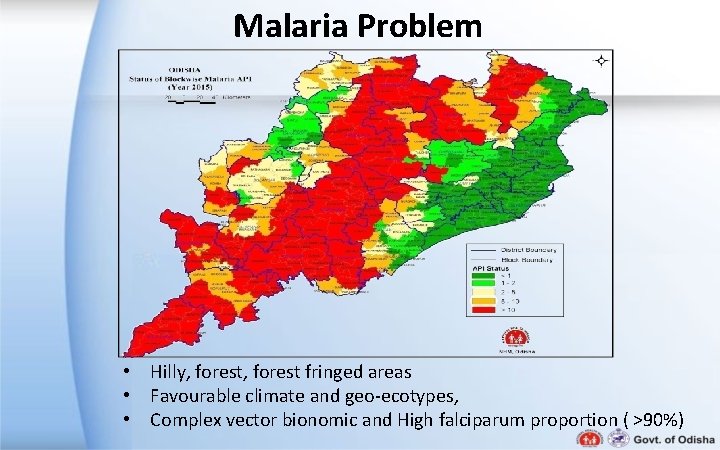
Malaria Problem • Hilly, forest fringed areas • Favourable climate and geo-ecotypes, • Complex vector bionomic and High falciparum proportion ( >90%)
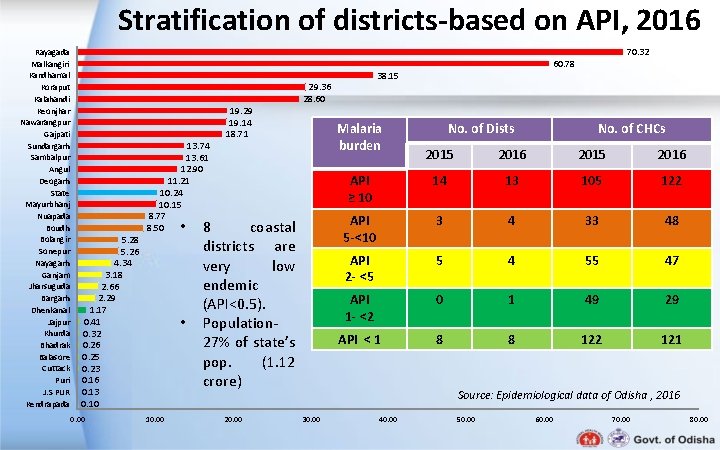
Stratification of districts-based on API, 2016 Rayagada Malkangiri Kandhamal Koraput Kalahandi Keonjhar Nawarangpur Gajpati Sundargarh Sambalpur Angul Deogarh State Mayurbhanj Nuapada Boudh Bolangir Sonepur Nayagarh Ganjam Jharsuguda Bargarh Dhenkanal Jajpur Khurda Bhadrak Balasore Cuttack Puri J. S PUR Kendrapada 5. 28 5. 26 4. 34 3. 18 2. 66 2. 29 1. 17 0. 41 0. 32 0. 26 0. 25 0. 23 0. 16 0. 13 0. 10 0. 00 13. 74 13. 61 12. 90 11. 21 10. 24 10. 15 8. 77 8. 50 • • 10. 00 19. 29 19. 14 18. 71 Malaria burden 8 coastal districts are very low endemic (API<0. 5). Population 27% of state’s pop. (1. 12 crore) 20. 00 38. 15 29. 36 28. 60 70. 32 60. 78 No. of Dists No. of CHCs 2015 2016 API ≥ 10 14 13 105 122 API 5 -<10 3 4 33 48 API 2 - <5 5 4 55 47 API 1 - <2 0 1 49 29 API < 1 8 8 122 121 Source: Epidemiological data of Odisha , 2016 30. 00 40. 00 50. 00 60. 00 70. 00 80. 00
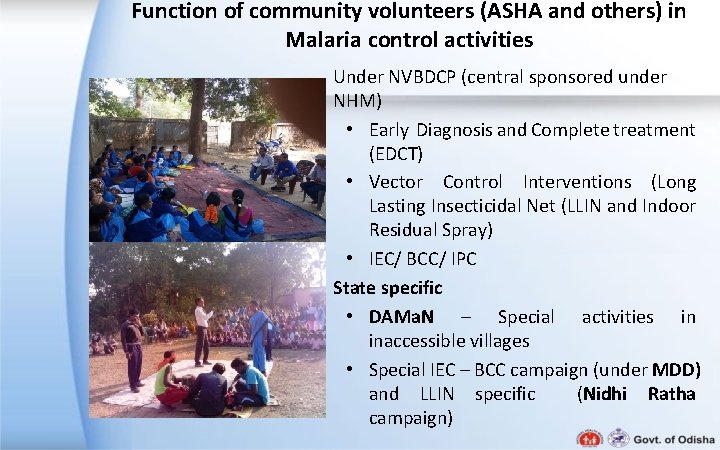
Function of community volunteers (ASHA and others) in Malaria control activities Under NVBDCP (central sponsored under NHM) • Early Diagnosis and Complete treatment (EDCT) • Vector Control Interventions (Long Lasting Insecticidal Net (LLIN and Indoor Residual Spray) • IEC/ BCC/ IPC State specific • DAMa. N – Special activities in inaccessible villages • Special IEC – BCC campaign (under MDD) and LLIN specific (Nidhi Ratha campaign)
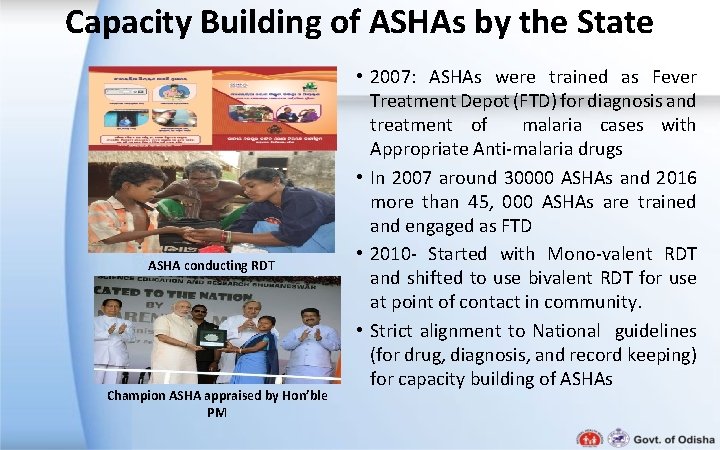
Capacity Building of ASHAs by the State ASHA conducting RDT Champion ASHA appraised by Hon’ble PM • 2007: ASHAs were trained as Fever Treatment Depot (FTD) for diagnosis and treatment of malaria cases with Appropriate Anti-malaria drugs • In 2007 around 30000 ASHAs and 2016 more than 45, 000 ASHAs are trained and engaged as FTD • 2010 - Started with Mono-valent RDT and shifted to use bivalent RDT for use at point of contact in community. • Strict alignment to National guidelines (for drug, diagnosis, and record keeping) for capacity building of ASHAs
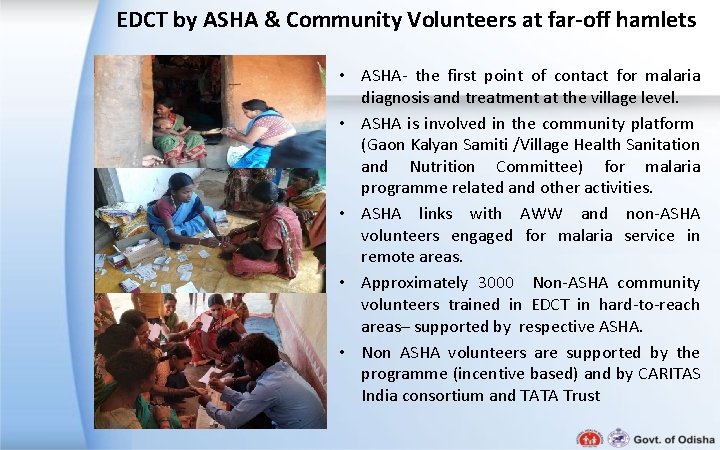
EDCT by ASHA & Community Volunteers at far-off hamlets • ASHA- the first point of contact for malaria diagnosis and treatment at the village level. • ASHA is involved in the community platform (Gaon Kalyan Samiti /Village Health Sanitation and Nutrition Committee) for malaria programme related and other activities. • ASHA links with AWW and non-ASHA volunteers engaged for malaria service in remote areas. • Approximately 3000 Non-ASHA community volunteers trained in EDCT in hard-to-reach areas– supported by respective ASHA. • Non ASHA volunteers are supported by the programme (incentive based) and by CARITAS India consortium and TATA Trust
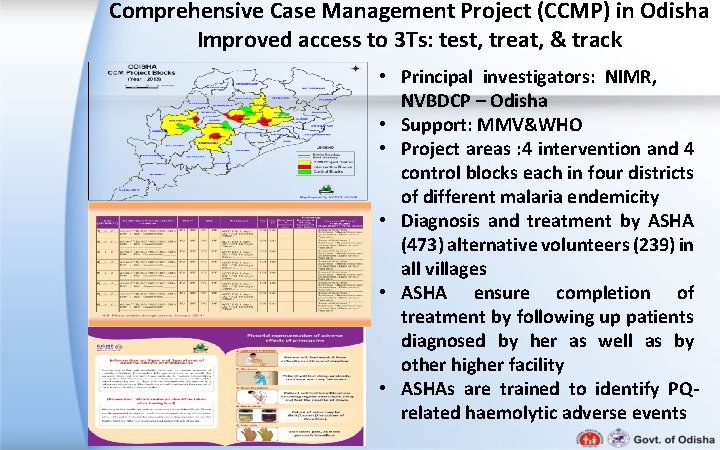
Comprehensive Case Management Project (CCMP) in Odisha Improved access to 3 Ts: test, treat, & track • Principal investigators: NIMR, NVBDCP – Odisha • Support: MMV&WHO • Project areas : 4 intervention and 4 control blocks each in four districts of different malaria endemicity • Diagnosis and treatment by ASHA (473) alternative volunteers (239) in all villages • ASHA ensure completion of treatment by following up patients diagnosed by her as well as by other higher facility • ASHAs are trained to identify PQrelated haemolytic adverse events
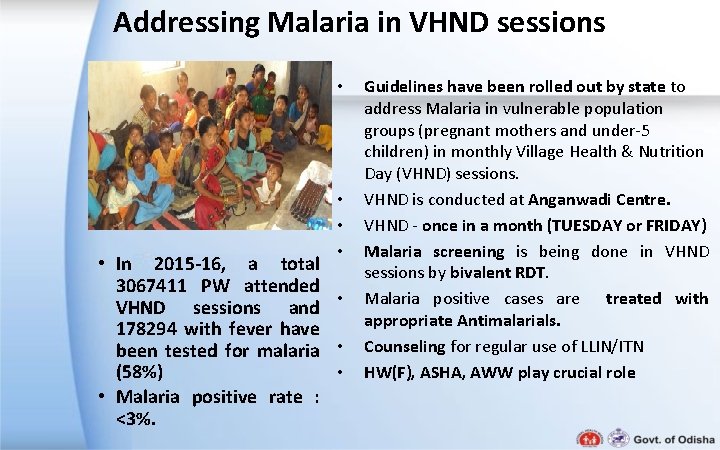
Addressing Malaria in VHND sessions • • • In 2015 -16, a total 3067411 PW attended VHND sessions and • 178294 with fever have been tested for malaria • • (58%) • Malaria positive rate : <3%. Guidelines have been rolled out by state to address Malaria in vulnerable population groups (pregnant mothers and under-5 children) in monthly Village Health & Nutrition Day (VHND) sessions. VHND is conducted at Anganwadi Centre. VHND - once in a month (TUESDAY or FRIDAY) Malaria screening is being done in VHND sessions by bivalent RDT. Malaria positive cases are treated with appropriate Antimalarials. Counseling for regular use of LLIN/ITN HW(F), ASHA, AWW play crucial role
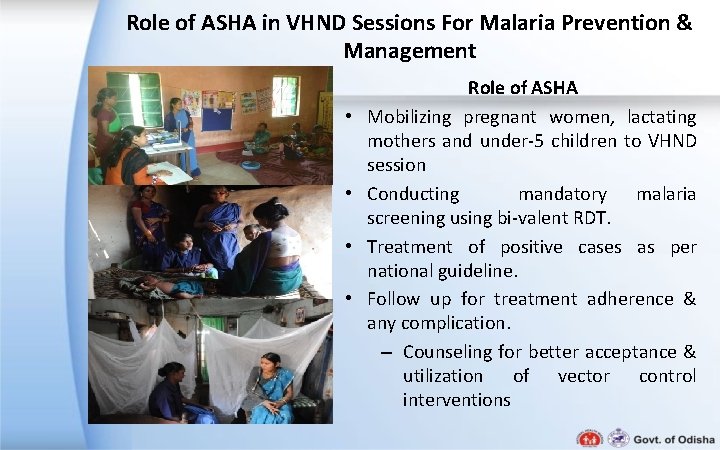
Role of ASHA in VHND Sessions For Malaria Prevention & Management • • Role of ASHA Mobilizing pregnant women, lactating mothers and under-5 children to VHND session Conducting mandatory malaria screening using bi-valent RDT. Treatment of positive cases as per national guideline. Follow up for treatment adherence & any complication. – Counseling for better acceptance & utilization of vector control interventions
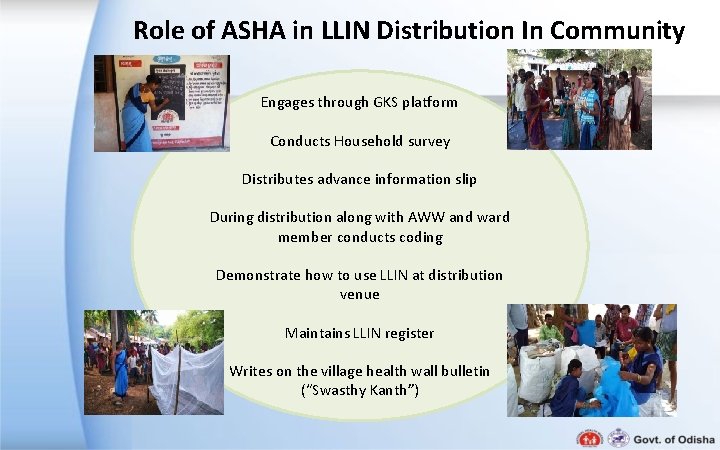
Role of ASHA in LLIN Distribution In Community Engages through GKS platform Conducts Household survey Distributes advance information slip During distribution along with AWW and ward member conducts coding Demonstrate how to use LLIN at distribution venue Maintains LLIN register Writes on the village health wall bulletin (“Swasthy Kanth”)
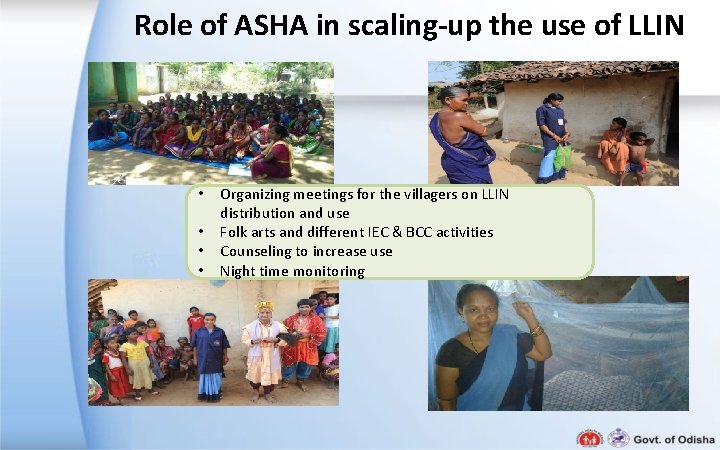
Role of ASHA in scaling-up the use of LLIN • • Organizing meetings for the villagers on LLIN distribution and use Folk arts and different IEC & BCC activities Counseling to increase use Night time monitoring
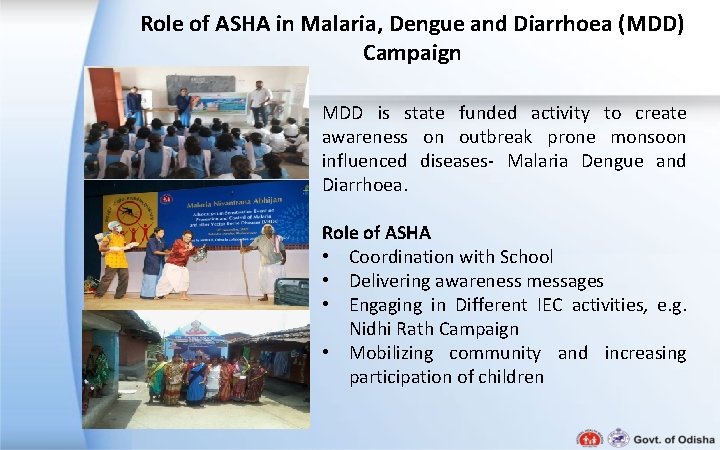
Role of ASHA in Malaria, Dengue and Diarrhoea (MDD) Campaign MDD is state funded activity to create awareness on outbreak prone monsoon influenced diseases- Malaria Dengue and Diarrhoea. Role of ASHA • Coordination with School • Delivering awareness messages • Engaging in Different IEC activities, e. g. Nidhi Rath Campaign • Mobilizing community and increasing participation of children
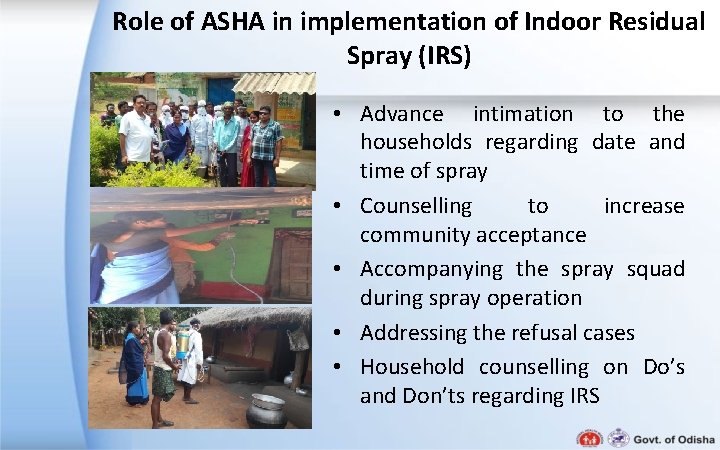
Role of ASHA in implementation of Indoor Residual Spray (IRS) • Advance intimation to the households regarding date and time of spray • Counselling to increase community acceptance • Accompanying the spray squad during spray operation • Addressing the refusal cases • Household counselling on Do’s and Don’ts regarding IRS
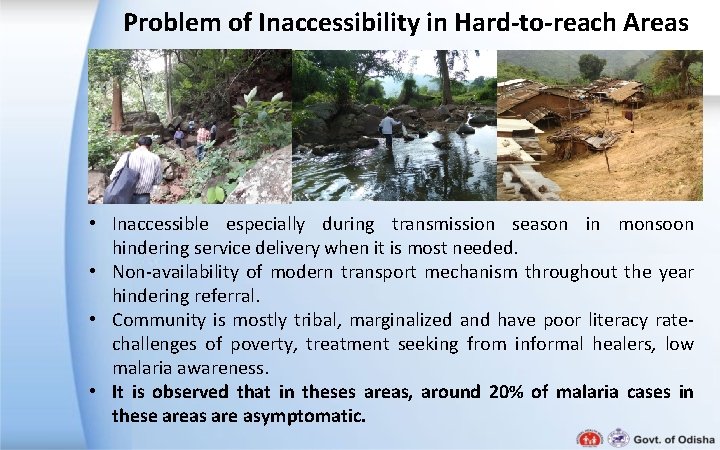
Problem of Inaccessibility in Hard-to-reach Areas • Inaccessible especially during transmission season in monsoon hindering service delivery when it is most needed. • Non-availability of modern transport mechanism throughout the year hindering referral. • Community is mostly tribal, marginalized and have poor literacy ratechallenges of poverty, treatment seeking from informal healers, low malaria awareness. • It is observed that in theses areas, around 20% of malaria cases in these areas are asymptomatic.
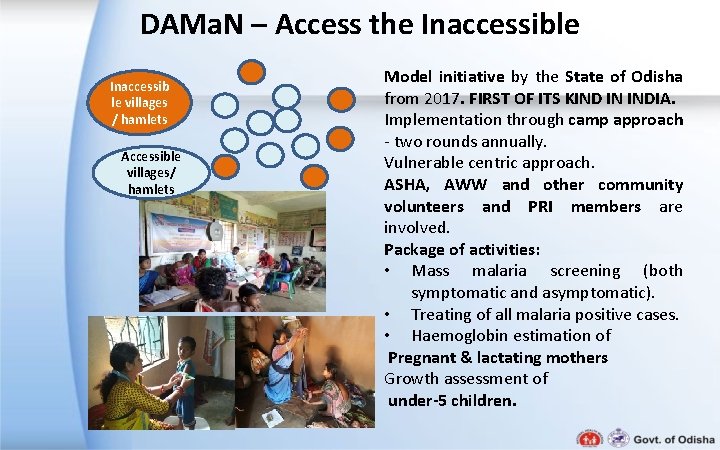
DAMa. N – Access the Inaccessible Inaccessib le villages / hamlets Accessible villages/ hamlets Model initiative by the State of Odisha from 2017. FIRST OF ITS KIND IN INDIA. Implementation through camp approach - two rounds annually. Vulnerable centric approach. ASHA, AWW and other community volunteers and PRI members are involved. Package of activities: • Mass malaria screening (both symptomatic and asymptomatic). • Treating of all malaria positive cases. • Haemoglobin estimation of Pregnant & lactating mothers Growth assessment of under-5 children.
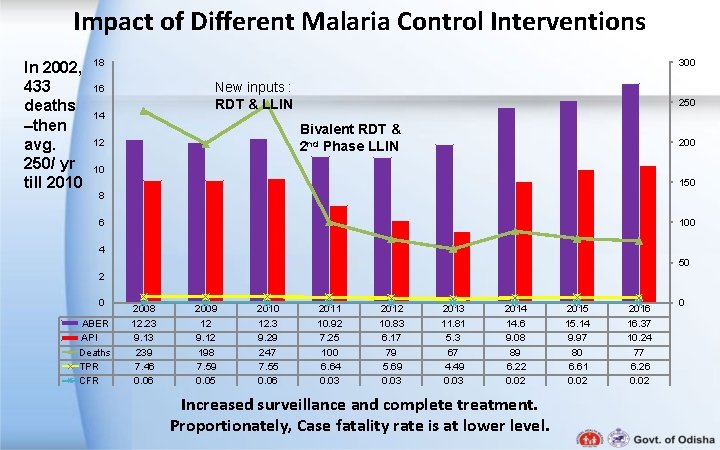
Impact of Different Malaria Control Interventions In 2002, 433 deaths –then avg. 250/ yr till 2010 18 300 New inputs : RDT & LLIN 16 14 250 Bivalent RDT & 2 nd Phase LLIN 12 200 10 150 8 6 100 4 50 2 0 ABER API Deaths TPR CFR 2008 12. 23 9. 13 239 7. 46 0. 06 2009 12 9. 12 198 7. 59 0. 05 2010 12. 3 9. 29 247 7. 55 0. 06 2011 10. 92 7. 25 100 6. 64 0. 03 2012 10. 83 6. 17 79 5. 69 0. 03 2013 11. 81 5. 3 67 4. 49 0. 03 2014 14. 6 9. 08 89 6. 22 0. 02 Increased surveillance and complete treatment. Proportionately, Case fatality rate is at lower level. 2015 15. 14 9. 97 80 6. 61 0. 02 2016 16. 37 10. 24 77 6. 26 0. 02 0
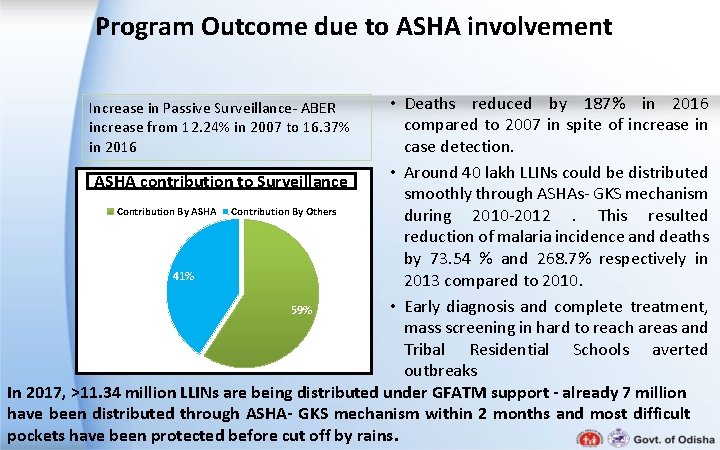
Program Outcome due to ASHA involvement • Deaths reduced by 187% in 2016 compared to 2007 in spite of increase in case detection. • Around 40 lakh LLINs could be distributed ASHA contribution to Surveillance smoothly through ASHAs- GKS mechanism Contribution By ASHA Contribution By Others during 2010 -2012. This resulted reduction of malaria incidence and deaths by 73. 54 % and 268. 7% respectively in 41% 2013 compared to 2010. • Early diagnosis and complete treatment, 59% mass screening in hard to reach areas and Tribal Residential Schools averted outbreaks In 2017, >11. 34 million LLINs are being distributed under GFATM support - already 7 million have been distributed through ASHA- GKS mechanism within 2 months and most difficult pockets have been protected before cut off by rains. Increase in Passive Surveillance- ABER increase from 12. 24% in 2007 to 16. 37% in 2016
Scalability and Opportunity • Capacity Building: With enhanced capacity building and increased nos. of ASHAs/ other community volunteers in remote villages/ hamlets, surveillance and EDCT services can be further improved. • Inclusive Approach: Health NGOs and other players can support community volunteers in remote inaccessible hamlets and service delivery can be scaled up through inclusive approach. • Scale up of best practices: The mass screening and simultaneous vector control under DAMa. N can avert deaths and lower malaria transmission rate. • Inter-sectoral Coordination: Convergence with other sectors, including sanitation, tribal affairs, rural development, women & child development etc. can add value to DAMa. N efforts for alleviation of the problems of malaria and malnutrition
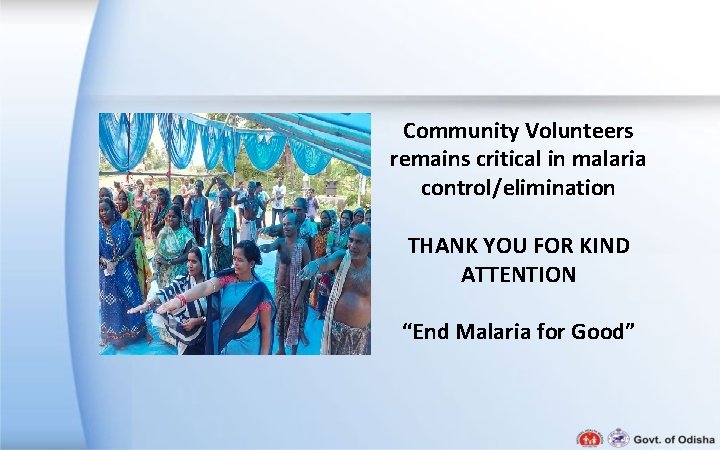
Community Volunteers remains critical in malaria control/elimination THANK YOU FOR KIND ATTENTION “End Malaria for Good”