
ODF and OOXML in Denmark 28 february 2008
ODF and OOXML in Denmark 28 february 2008 – ODF Workshop Jens Jakob Andersen, Enterprise Architect jjan@itst. dk National IT and Telecom Agency
Agenda 0) 1) 2) 3) 4) 5) 6) 7) 8) 9) The Decision Background and timetable Guidelines based on study and pilot tests How to fulfil the receive requirement How to handle the new acquisition requirement How ready are the suppliers? The National IT and Telecom Agency makes it easier for the public sector How to get started The Danish metodology The laboratory
0. The Decision On 2 June 2006, the Danish parliament (the Folketing) unanimously adopted Parliamentary Resolution B 103 on the use of open standards for software in the public sector. The Resolution instructs the Government to ensure that the public sector's use of information technology, including the use of software, should be based on open standards. A majority of the political parties have made it a condition that the use of open mandatory standards must not involve increased costs to the public sector.
0. The seven sets of Standards The Folketing have agreed on a timescale for implementing mandatory open standards under which seven sets of standards will be mandatory from 1 January 2008. The seven sets of standards are: n Standards for data exchange between public authorities (OIOXML) n Standards for electronic record management (FESD) n Standards for electronic procurement in the public sector (OIOUBL) n Standards for digital signatures (OCES) n Standards for public websites / homepages and accessibility (HTML/XHTML, CSS and WCAG) n Standards for IT security (DS 484) n Standards for document exchange (ODF/OOXML)
0. The Objectives n n Promote competition Promote interoperability between authorities and levels of government Democratic rights: The free choice of software for citizens and businesses The implementation of ODF & OOXML should be accomplished without increased costs for public sector
0. Mandatory open standards - scope n n The requirement to use mandatory open standards is only applicable to new IT solutions. Comply or Explain: The use of mandatory open standards is subject to the condition that the individual authority, in case of additional expenses or other negative consequences, including IT security considerations in the relevant authority, may omit to use the mandatory standards
0. Openness – The Danish definition in B 103 That a standard is open implies that: n the standard must be fully documented and public available, n the standard must be freely implementable without any economic, political or legal constraints on its implementation and use, now or in future, and n the standard must be standardised and maintained in an open forum via an open process (standards organisation).
1. Project background n n n On 25 June 2007, following negotiations and in full agreement with the IT spokespersons of the Danish Parliament (the Folketing), the Minister for Science, Technology and Innovation launched a timetable for the future use of open standards. Subsequently, on 3 October 2007, the Government concluded "Agreement on the use of open standards for software in the public sector" with Danish Regions and Local Government Denmark. As a result, seven sets of standards will be mandatory from 1 January 2008. One of these sets is the two mandatory open standards for editable word processing document formats: n ODF version: 1. 0 (Open Document Format) n approved as a standard by the standards organisation ISO. n OOXML version: 1. 0 (Office Open-XML) n approved as a standard by the standards organisation ECMA. It is part of the agreement that the introduction of mandatory open standards should not involve increased costs to the public sector.
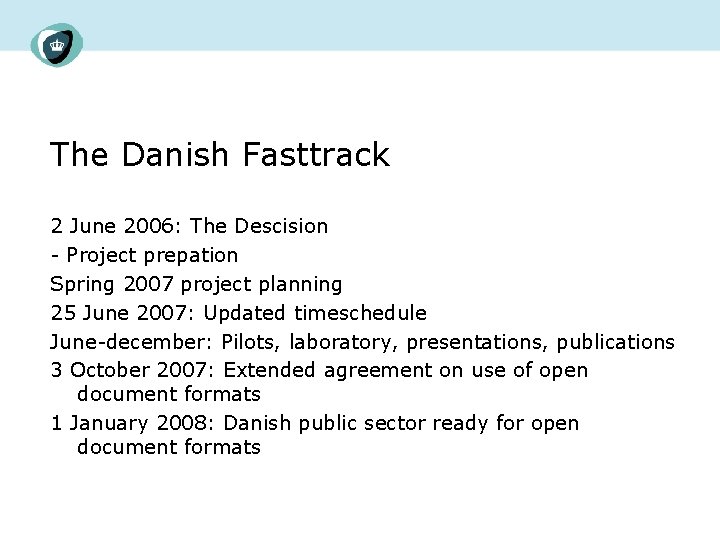
The Danish Fasttrack 2 June 2006: The Descision - Project prepation Spring 2007 project planning 25 June 2007: Updated timeschedule June-december: Pilots, laboratory, presentations, publications 3 October 2007: Extended agreement on use of open document formats 1 January 2008: Danish public sector ready for open document formats
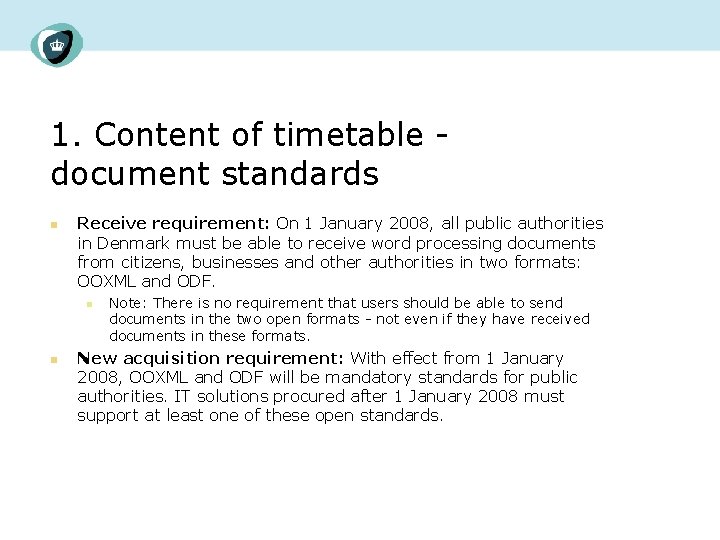
1. Content of timetable document standards n Receive requirement: On 1 January 2008, all public authorities in Denmark must be able to receive word processing documents from citizens, businesses and other authorities in two formats: OOXML and ODF. n n Note: There is no requirement that users should be able to send documents in the two open formats - not even if they have received documents in these formats. New acquisition requirement: With effect from 1 January 2008, OOXML and ODF will be mandatory standards for public authorities. IT solutions procured after 1 January 2008 must support at least one of these open standards.
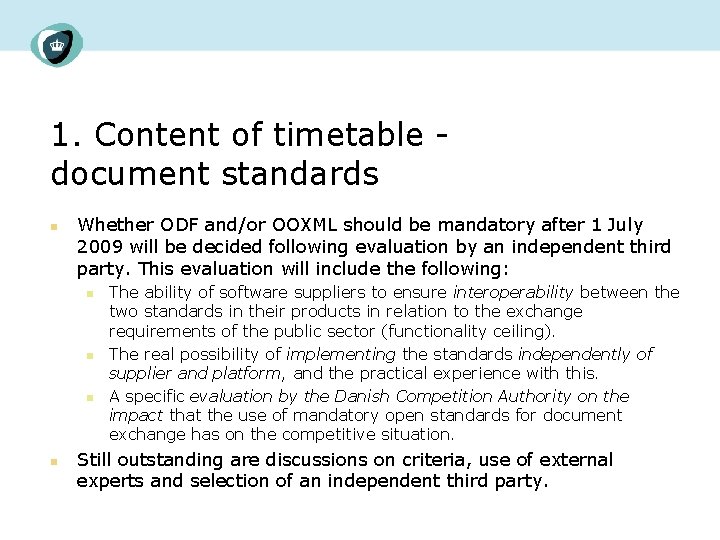
1. Content of timetable document standards n Whether ODF and/or OOXML should be mandatory after 1 July 2009 will be decided following evaluation by an independent third party. This evaluation will include the following: n n The ability of software suppliers to ensure interoperability between the two standards in their products in relation to the exchange requirements of the public sector (functionality ceiling). The real possibility of implementing the standards independently of supplier and platform, and the practical experience with this. A specific evaluation by the Danish Competition Authority on the impact that the use of mandatory open standards for document exchange has on the competitive situation. Still outstanding are discussions on criteria, use of external experts and selection of an independent third party.
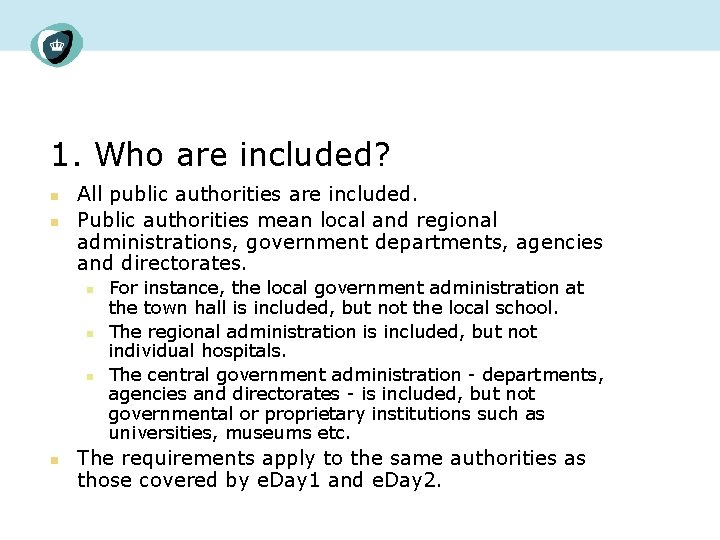
1. Who are included? n n All public authorities are included. Public authorities mean local and regional administrations, government departments, agencies and directorates. n n For instance, the local government administration at the town hall is included, but not the local school. The regional administration is included, but not individual hospitals. The central government administration - departments, agencies and directorates - is included, but not governmental or proprietary institutions such as universities, museums etc. The requirements apply to the same authorities as those covered by e. Day 1 and e. Day 2.
2. e. Day 1 and e. Day 2 e. Day 1 – 1 september 2003: The right to send and receive digitally to and from other public authorities n. Formatting guidelines in connection with e. Day still applicable: Mass transmission of documents: In general recommended to be sent as a link to HTML text on the Internet. If it is necessary to send the mass document as e-mail, it is recommended to send it in PDF format and with a link to Html text on the Internet. n. Ready official documents: If the formats used by the sender cause problems to recipients, the PDF format is recommended as a common exchange format. n. Working documents are recommended to be transmitted in an editable format that may be read by both cooperating partners. If the formats used by the sender cause problems to recipients, the PDF format is recommended as a common exchange format. n. Mail to citizens: It is recommended that mail to citizens should be annexed as PDF. n e. Day 2 - 1 february 2005: The ability to send and receive digitally signed e-mail became a requirement. n
2. Guidelines based on study and pilot test n n n n n Seeing that both standards are only used to a limited extent in the public sector today, the National IT and Telecom Agency in 2007 conducted a study involving OOXML and ODF pilot tests for the purpose of obtaining further experience with these standards. The study was conducted in a dialogue with the industry and other stakeholders, and in close collaboration with the OIO Data Standardisation and IT Architecture Committees. OOXML and ODF are relatively new and different formats As ODF and OOXML do not support exactly the same set of features and functionalities, there may be features in one document format that are not supported by the other Ensuring interoperability between OOXML and ODF is a relatively new development area for the suppliers Development of converters between OOXML and ODF has only been in progress for about one year New versions of the converters appear on a regular basis The complete OOXML and ODF specifications are relatively extensive The formats are still being developed further
2. Functionality ceiling relevant to the administration The focus of the study and pilot test has been on the functionality ceiling relevant to the administration. n n n n The functionality ceiling is an expression of what format relevant functionalities in word processing systems are used most frequently in a Danish administrative context. n n n n n Formatting Page headers and footers Footnotes and endnotes Numbered lists and bullet lists Inserted dynamic elements from other file formats Tables Inserted static images and graphics Page layout Automatically generated list of contents Set up and edit drawings/models directly in the document Templates and macros Editing Correction marking and comments Data obtained from other systems Rights control Metadata Versioning Letter merging
2. Pilots and laboratory tests n n n Pilot authorities that have been involved in the project: n Directorate for Food, Fisheries and Agri Business, represented by Jari Bøg, n Gribskov Local Authority, represented by Michel van der Linden n Region Central Jutland, represented by Henrik Jordt n Danish State Archives, represented by Anders Bo Nielsen n Århus Local Authority, represented by Peter Henriksen Suppliers that have been involved in the laboratory tests of the project: n Ciber n IBM n Magenta n Microsoft n Novell n Devoteam Consulting (overall project management of the study and pilot tests) n Sogeti (management of laboratory test) In addition, a number of other parties have been involved in the project (Team Online and the IT Departments of Odense Local Authority, the Folketing and the Ministry of Science, Technology and Innovation)
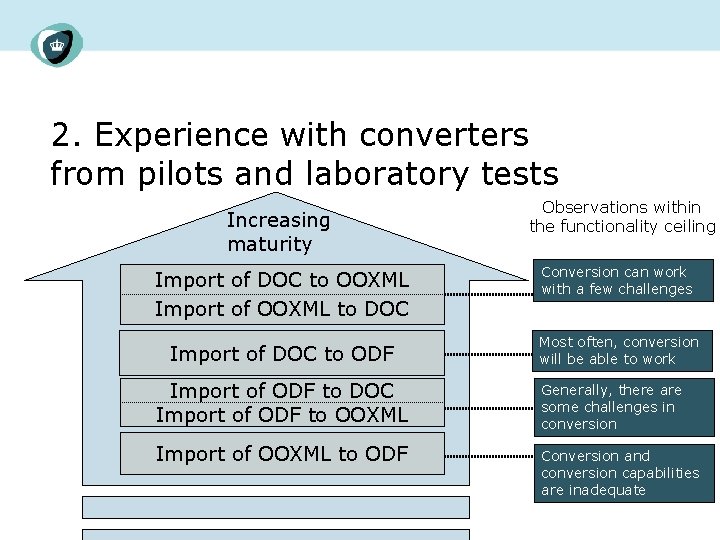
2. Experience with converters from pilots and laboratory tests Increasing maturity Import of DOC to OOXML Import of OOXML to DOC Import of DOC to ODF Observations within the functionality ceiling Conversion can work with a few challenges Most often, conversion will be able to work Import of ODF to DOC Import of ODF to OOXML Generally, there are some challenges in conversion Import of OOXML to ODF Conversion and conversion capabilities are inadequate
2. Example of converting a standard letter
2. Example of converting a standard letter: Markup
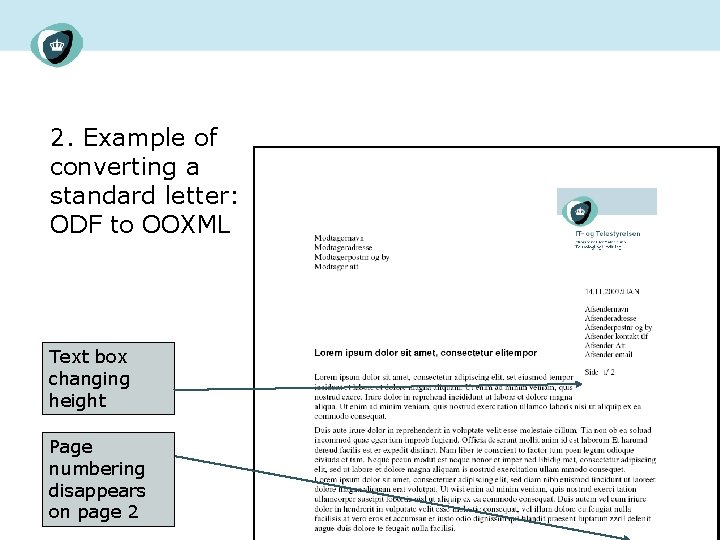
2. Example of converting a standard letter: ODF to OOXML Text box changing height Page numbering disappears on page 2
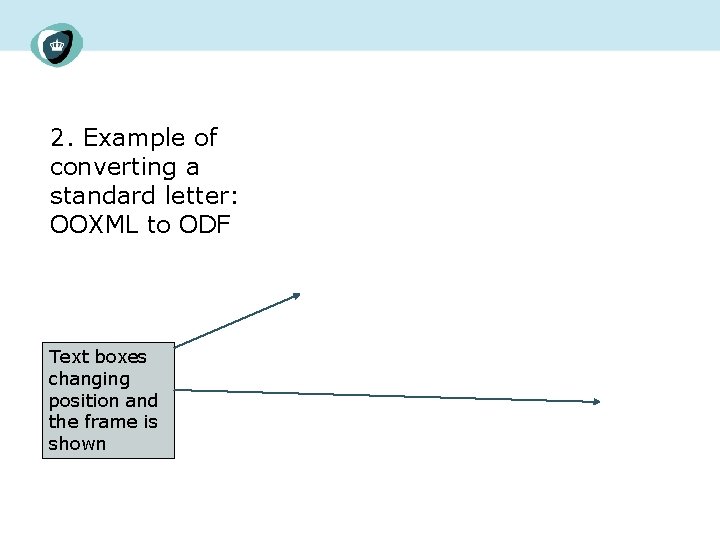
2. Example of converting a standard letter: OOXML to ODF Text boxes changing position and the frame is shown
2. Examples of visual conversion challenges n Among other things, we have noted the following visual conversion challenges within the functionality ceiling: n n n Images disappear OLE objects disappear Drawings disappear Text boxes disappear Problems in changing between language versions of tools Anchorings move Various problems, including lists of contents in connection with section/chapter segmentation Problems involving different layout on page 1 and subsequent pages Problems regarding page headers and footers Text being displaced (line spacing and text fonts) Problems with bullet lists Most visual challenges can be attributed to specific underlying technical features involving: n n n Images Lines Text boxes
2. Evaluation based on pilot and laboratory tests n Existing converters are not good enough for authorities to rely exclusively on converters n n n The more complex documents, the greater challenges. But also simple documents within the functionality ceiling may present challenges Large difference between converter scenarios (DOC to OOXML vs OOXML to ODF) All the same, converters can provide useful and quick help Choose a solution model not only based on converters n Converter maturity improved on an ongoing basis n n n There is a continued development of converters, and we have seen great improvements The conversion challenges found within the functionality ceiling can be attributed to a few underlying technical challenges and can most likely be remedied gradually as the quality of converter software improves Suppliers have a great incentive to help their public customers ensure the necessary interoperability Follow converter developments closely
3. How to fulfil the receive requirement n n n Many authorities receive editable text documents in ODF and OOXML already today. While it is possible to reject such formats today, there will not be this option from 1 January 2008. In practice, the requirement that ODF and OOXML must be received may be met in the same way as authorities probably do today if receiving a document in an unknown format - via a technical solution combined with the right organisational procedures. Some authorities already fulfil the receive requirement today.
3. Example 1 - one possible solution model for authorities with Word 2003 and DOC as production format n Conversion between DOC and the open document formats can work with few challenges. The authority will choose a solution where: n n n Microsoft Office Compatibility Pack ensures that the authority can receive OOXML documents Documents in ODF can be received via an ODF plugin - e. g. Sun ODF Plugin 1. 1 for Microsoft Office or Source. Forge Open. XML/ODF Translator Add-in for Office v 1. 1. In addition, offer a manual ODF to PDF conversion service via the authority's service desk in those cases where the user is in doubt for instance about the quality of the conversion. Here, the service desk is using Open Office v 2. 3, which may be exported direct to PDF.
3. Example 2 - one possible solution model for authorities with Word 2007 and OOXML as production format n Conversion from ODF to OOXML working with some challenges. The authority will choose a solution where: n n From Word 2007, users may import ODF via Source. Forge Open. XML/ODF Translator Add-in for Office v 1. 1. In addition, offer a manual ODF to PDF conversion service via the authority's service desk in those cases where the user is in doubt for instance about the quality of the conversion. Here, the service desk is using Open Office v 2. 3, which can export direct to PDF. In connection with especially demanding users, offer installation of Open Office v 2. 3 locally for viewing and processing ODF documents. This program may be installed by the user itself via a common drive. The user may get assistance for the installation at the service desk. The service desk has drawn up brief instructions that guide the users in applying the solutions, but no functional support is granted for the solutions.
3. Example 3 - one possible solution model for authorities with Open. Office. org 2. 1 Novell Edition and ODF as production format n Conversion from OOXML to ODF is inadequate. Therefore the authority will choose a solution where: n n n Users may handle conversion from OOXML to ODF via Open. Office. org Open. XML Translator, but since this converter cannot be expected to work without problems, install Microsoft Word Viewer + Microsoft Compatibility Pack on all clients for viewing and validating the content of received OOXML files. The authority has chosen to use the organisation's decentralised super users for assisting in using the converter and viewer solution.
3. What solution are best suited in particular cases? n The three examples you have seen only show a small selection of possible and relevant solutions. n n The technical solutions from the three cases are all unlicensed. Authorities have to find the solution that suits them best. It is important that the solution should balance relevant technical solutions with the authority’s needs, processes and organisation. Some good advice given by the NITA: n n n Find a solution that may be scaled when the need of being able to handle the new open document formats is growing Set up fixed quality assurance procedures Use PDF for exchanging documents that need not be edited (see also the e. Day recommendations) Be aware of the functionalities that present the greatest challenges, and try to avoid these in your own documents Keep an eye on whether new solutions are released that satisfy your needs better.
4. How to handle the new acquisition requirement n n New solutions mean new procurement and new development, also including further development and upgrading of software. The software involved is not only word processing systems, but may also be systems such as Enterprise Document Management (ESDH), mail, CMS or dedicated systems. When it is estimated that the requirement is applicable to the solution, at least one of the open document formats is to be supported by the software. It is the authority’s responsibility that the right requirements are imposed on suppliers (the National IT and Telecom Agency assists in providing supplier readiness lists and guidelines on tenders)
5. How ODF/OOXML ready are the suppliers? The National IT and Telecom Agency has carried out a supplier readiness evaluation in collaboration with the Danish IT Industry Association. n By 15 November 2007, 14 suppliers had responded to the survey. n n. Convergens A/S n. EDB Gruppen A/S n. Fujitsu Services n. Go. Pro n. IBM Danmark A/S nin. Captiva A/S n. KMD A/S n. Magenta Ap. S n. Microsoft Danmark Ap. S n. NNIT n. Oracle Danmark n. SAP Danmark A/S n. Scan. Jour A/S n. WM-data Danmark A/S
5. How ready are the suppliers? The feedback from suppliers shows that n 70% of the systems support both DOC, ODF and OOXML n The new formats are estimated to give n n n A higher degree of freedom in the choice of "production tools" Easier integration with third parties Easier data exchange and integration of information in business processes A higher degree of future-proofing, as the formats are open Some suppliers have experienced challenges in handling the new document formats, but all the suppliers that have experienced challenges have appointed managers to clarify what the consequences are - authorities can find a contact person in the survey if they wish to know more.
5. How ready are the suppliers? In the survey, the suppliers answer questions such as: n What system functions are supported when using the various document formats - for example: n n n History Version control Life cycle Check in / check out Publication Distribution Letter merging What timetables exist for supporting ODF/OOXML in coming versions of the system For what production tools have active integrations been established How they intend to inform/advise public authorities about the possibility of using ODF/OOXML in their systems How XML-based content via the new document formats may add extra value in the specific system What scenarios have been tested together with customers
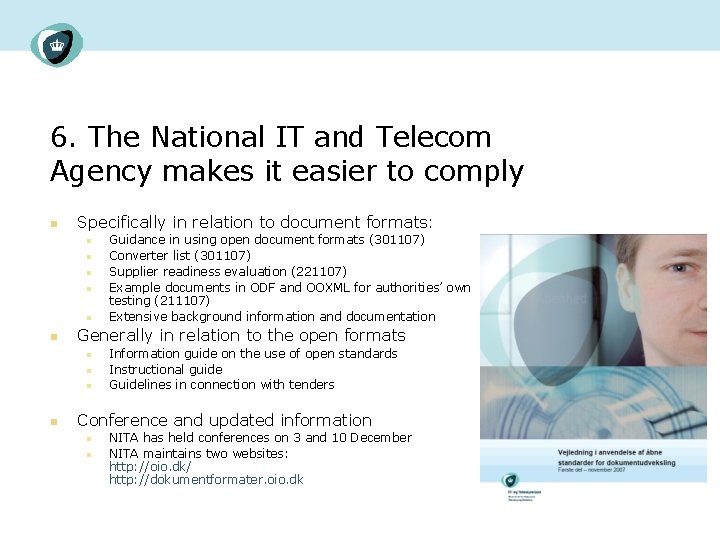
6. The National IT and Telecom Agency makes it easier to comply n Specifically in relation to document formats: n n n Generally in relation to the open formats n n Guidance in using open document formats (301107) Converter list (301107) Supplier readiness evaluation (221107) Example documents in ODF and OOXML for authorities’ own testing (211107) Extensive background information and documentation Information guide on the use of open standards Instructional guide Guidelines in connection with tenders Conference and updated information n n NITA has held conferences on 3 and 10 December NITA maintains two websites: http: //oio. dk/ http: //dokumentformater. oio. dk
7. Advice to authorities on how to get started n n n n n Learn the new requirements: Read the preliminary guidelines on http: //dokumentformater. oio. dk/ Appoint an internal project manager Inform your staff about the receive requirement to be met from 1 January 2008 Define your requirements for being able to receive text documents in the ODF and OOXML formats Clarify your ambition level in connection with the new document formats Clarify your ambition level in connection with new acquisitions Prepare the operational situation Start a dialogue with relevant system suppliers Create your own initial experience with the two document formats Read more on http: //dokumentformater. oio. dk/hvordan-kommer-I-i-gang
ODEF – Pilots and Laboratory The Danish metodology
The Danish goals for the project • • • Testing based on field-studies Field-studies with focus on everyday document-functionality - Functional ceiling Repeatability – full documentation of setup og execution of test – full repeatability
The Danish approach • • • Step 1: The methodology document Step 2: Pilot-test planning and execution Step 3: Examination of pilot-test results Step 4: Planning the laboratory on basis of results from pilot-tests – using hypothesisbased planning Step 5: Exectuting the laboratory-tests Step 6: Conclude on the results
Structured test – based on field -studies • Methodology described in the projects ”Methodology-document”: http: //dokumentformater. oio. dk/leverancer/resolveuid/3 dca 8627572 a 669 d 3048 c 93 d 22 b 5713 f • • Every pilot-study planned and documented in a test-plan Every pilot-study fully documented – setup, source-documents, test-execution, analysis and results – in paper and electronic media
Notes on the Danish documentlaboratory
The Laboratory • • • Test-cases based on hypotheses about visual findings from pilot-studies Structured approach to further studies A neutral ground, where technical experts from IBM, Novell and Microsoft worked together on examining the visual findings – and identifying the underlying technical issues
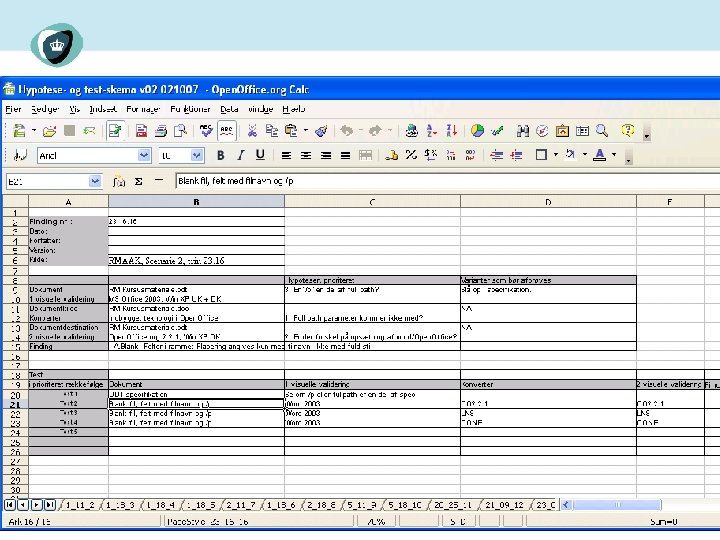
Hypotheses
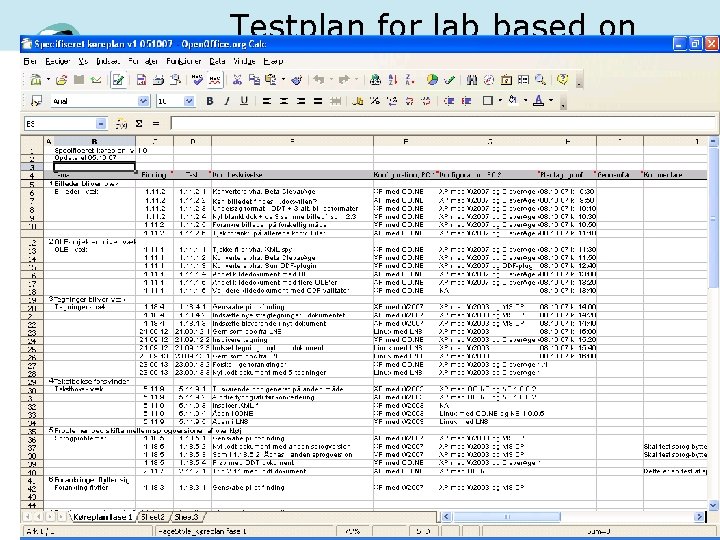
Testplan for lab based on hypotheses and test-cases

Documentation structure
Laboratory results
Thank you for your attention. A few other Danish initiatives: Open Source Exchange: http: //ec. europa. eu/idabc/en/document/7257 Questions? Contactinformation: Jens Jakob Andersen jjan@itst. dk
- Slides: 45