
OD approach is based on 7 basic principles
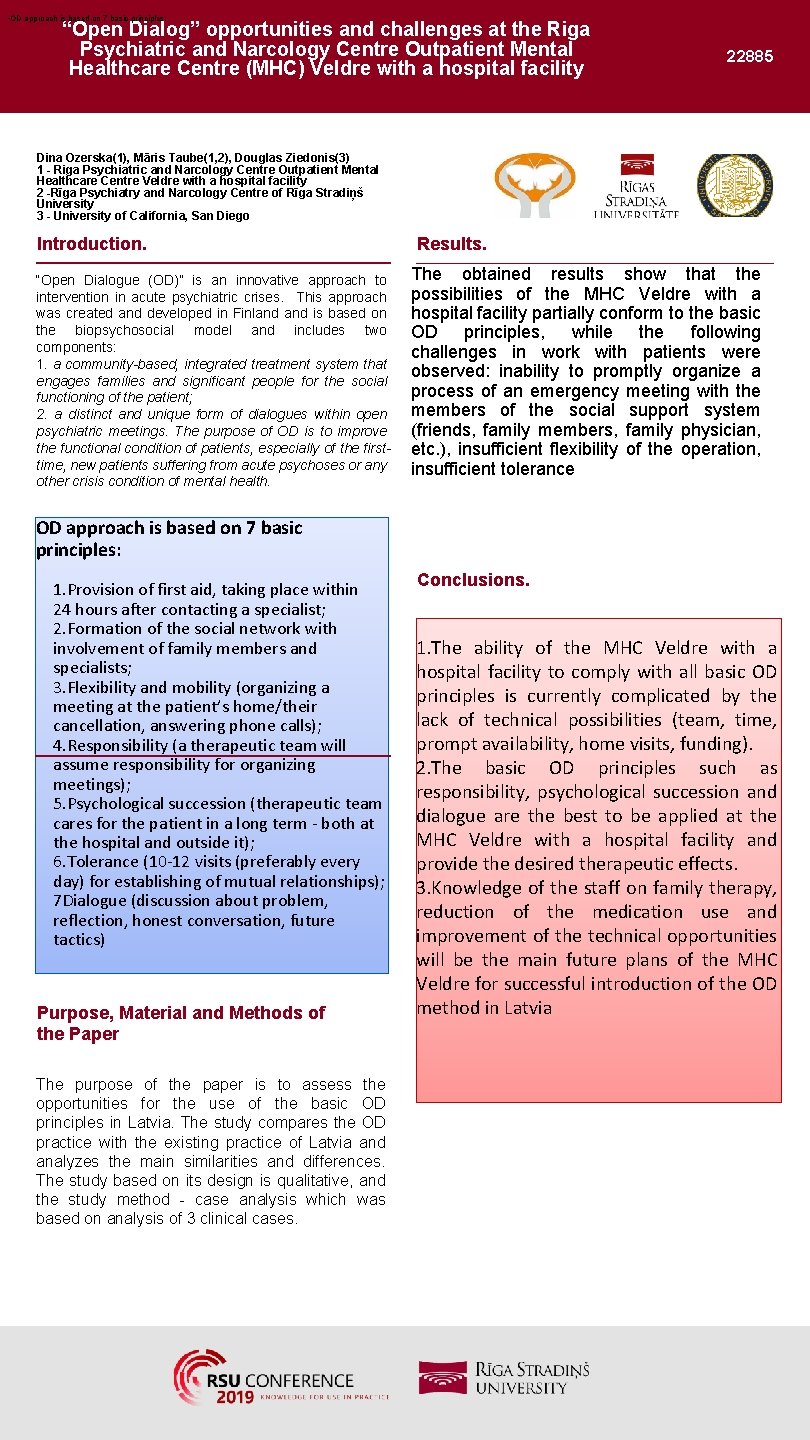
• OD approach is based on 7 basic principles: “Open Dialog” opportunities and challenges at the Riga Psychiatric and Narcology Centre Outpatient Mental Healthcare Centre (MHC) Veldre with a hospital facility 22885 Dina Ozerska(1), Māris Taube(1, 2), Douglas Ziedonis(3) 1 - Riga Psychiatric and Narcology Centre Outpatient Mental Healthcare Centre Veldre with a hospital facility 2 -Rīga Psychiatry and Narcology Centre of Rīga Stradiņš University 3 - University of California, San Diego Introduction. “Open Dialogue (OD)” is an innovative approach to intervention in acute psychiatric crises. This approach was created and developed in Finland is based on the biopsychosocial model and includes two components: 1. a community-based, integrated treatment system that engages families and significant people for the social functioning of the patient; 2. a distinct and unique form of dialogues within open psychiatric meetings. The purpose of OD is to improve the functional condition of patients, especially of the firsttime, new patients suffering from acute psychoses or any other crisis condition of mental health. Results. The obtained results show that the possibilities of the MHC Veldre with a hospital facility partially conform to the basic OD principles, while the following challenges in work with patients were observed: inability to promptly organize a process of an emergency meeting with the members of the social support system (friends, family members, family physician, etc. ), insufficient flexibility of the operation, insufficient tolerance OD approach is based on 7 basic principles: 1. Provision of first aid, taking place within 24 hours after contacting a specialist; 2. Formation of the social network with involvement of family members and specialists; 3. Flexibility and mobility (organizing a meeting at the patient’s home/their cancellation, answering phone calls); 4. Responsibility (a therapeutic team will assume responsibility for organizing meetings); 5. Psychological succession (therapeutic team cares for the patient in a long term - both at the hospital and outside it); 6. Tolerance (10 -12 visits (preferably every day) for establishing of mutual relationships); 7 Dialogue (discussion about problem, reflection, honest conversation, future tactics) Purpose, Material and Methods of the Paper The purpose of the paper is to assess the opportunities for the use of the basic OD principles in Latvia. The study compares the OD practice with the existing practice of Latvia and analyzes the main similarities and differences. The study based on its design is qualitative, and the study method - case analysis which was based on analysis of 3 clinical cases. Conclusions. 1. The ability of the MHC Veldre with a hospital facility to comply with all basic OD principles is currently complicated by the lack of technical possibilities (team, time, prompt availability, home visits, funding). 2. The basic OD principles such as responsibility, psychological succession and dialogue are the best to be applied at the MHC Veldre with a hospital facility and provide the desired therapeutic effects. 3. Knowledge of the staff on family therapy, reduction of the medication use and improvement of the technical opportunities will be the main future plans of the MHC Veldre for successful introduction of the OD method in Latvia
- Slides: 1