
Ocular Chemical BurnsChemical burns to the eye are
Ocular Chemical Burns“Chemical burns to the eye are among the most urgent of ocular emergencies… Copious irrigation is the most important emergency treatment of the chemically-burned eye… This procedure probably has more of an influence on the outcome of the injury than any otherapeutic approach. ”
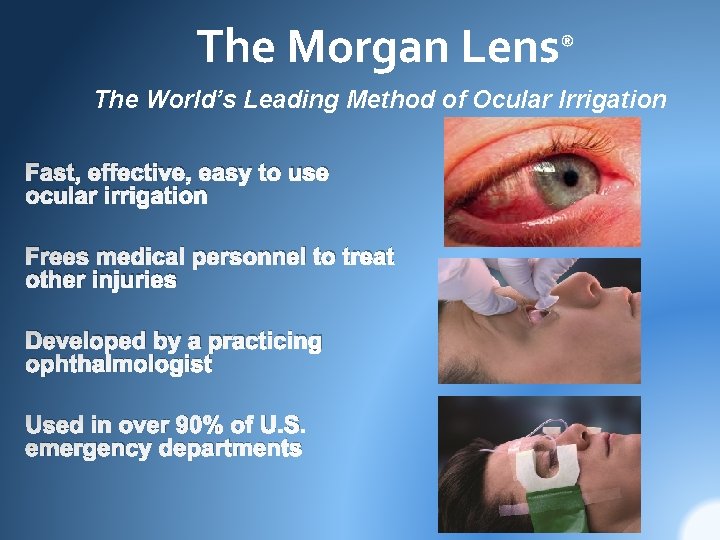
The Morgan Lens® The World’s Leading Method of Ocular Irrigation Fast, effective, easy to use ocular irrigation Frees medical personnel to treat other injuries Developed by a practicing ophthalmologist Used in over 90% of U. S. emergency departments
Uses of the Morgan Lens Alkali Burns Acid Burns Thermal and Actinic (UV-related) Burns Irritants (gasoline, detergents, etc. ) Non-embedded Foreign Bodies Foreign Body Sensation (FBS) With No Visible Foreign Body Routine Pre-Operative Eyelid Surgery Severe Infection—controlled medication delivery
Alkali Burns (Bases) Most serious of all ocular burns Penetrate rapidly, increasing p. H of anterior chamber Can cause severe damage to collagen, nerve endings, keratocytes, the iris and ciliary body Loss of corneal epithelium leads to increased risk of infection Common materials that contain alkali: • Lye (in drain cleaners) • Lime (in plaster, cement) • Ammonia (in fertilizers, cleaning agents) • Motor vehicle airbags
Acid Burns Immediately denature proteins • Opacifies cornea, slows deep penetration Eye initially may look worse than alkali burn although damage often is not as severe Common Acids: hydrofluoric* hydrochloric sulfurous nitric acetic Most common sources: Industrial accidents and automobile battery explosions *Hydrofluoric Acid Burns-very serious HF penetrates quickly and acts like an alkali
Irritants Cause more discomfort than actual damage Common Irritants: • Gasoline • Tactical & Defense Sprays (“Pepper” Spray) • Some Household Detergents Note: Liquid detergent capsules may form alkalis when dissolved in water Irritants are substances with a neutral p. H
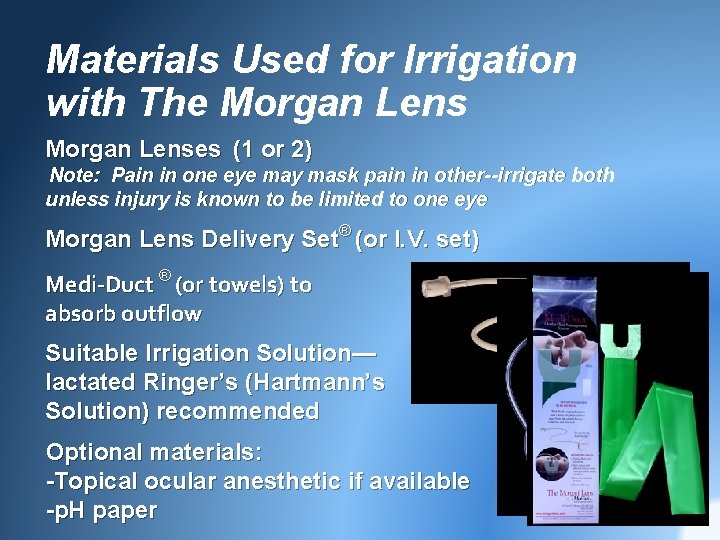
Materials Used for Irrigation with The Morgan Lenses (1 or 2) Note: Pain in one eye may mask pain in other--irrigate both unless injury is known to be limited to one eye Morgan Lens Delivery Set® (or I. V. set) Medi-Duct ® (or towels) to absorb outflow Suitable Irrigation Solution— lactated Ringer’s (Hartmann’s Solution) recommended Optional materials: -Topical ocular anesthetic if available -p. H paper
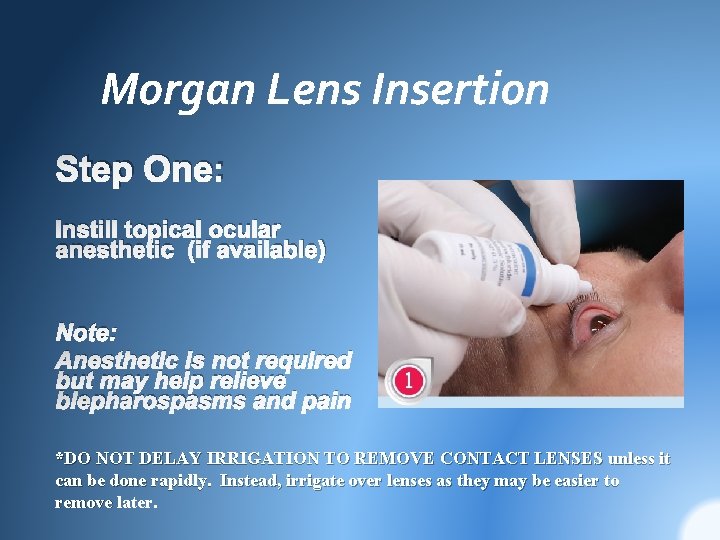
Morgan Lens Insertion Step One: Instill topical ocular anesthetic (if available) Note: Anesthetic is not required but may help relieve blepharospasms and pain *DO NOT DELAY IRRIGATION TO REMOVE CONTACT LENSES unless it can be done rapidly. Instead, irrigate over lenses as they may be easier to remove later.
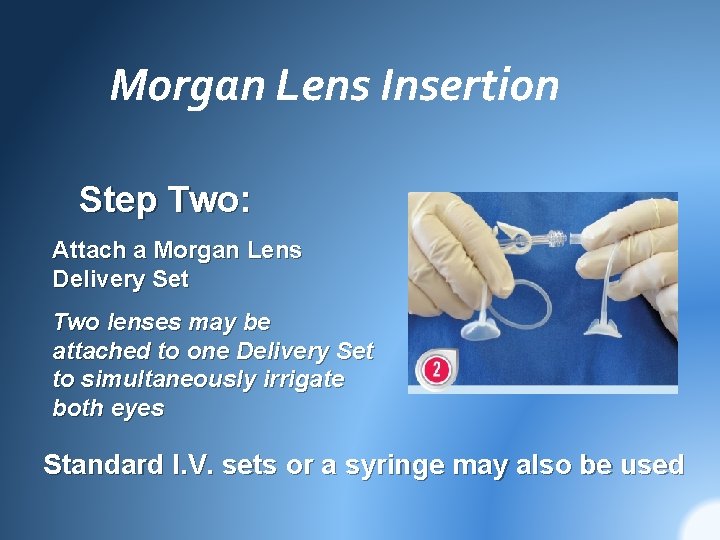
Morgan Lens Insertion Step Two: Attach a Morgan Lens Delivery Set Two lenses may be attached to one Delivery Set to simultaneously irrigate both eyes Standard I. V. sets or a syringe may also be used
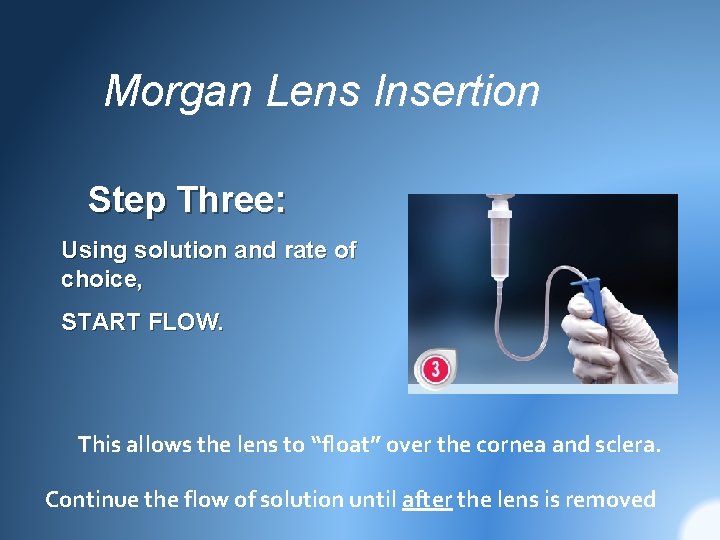
Morgan Lens Insertion Step Three: Using solution and rate of choice, START FLOW. This allows the lens to “float” over the cornea and sclera. Continue the flow of solution until after the lens is removed
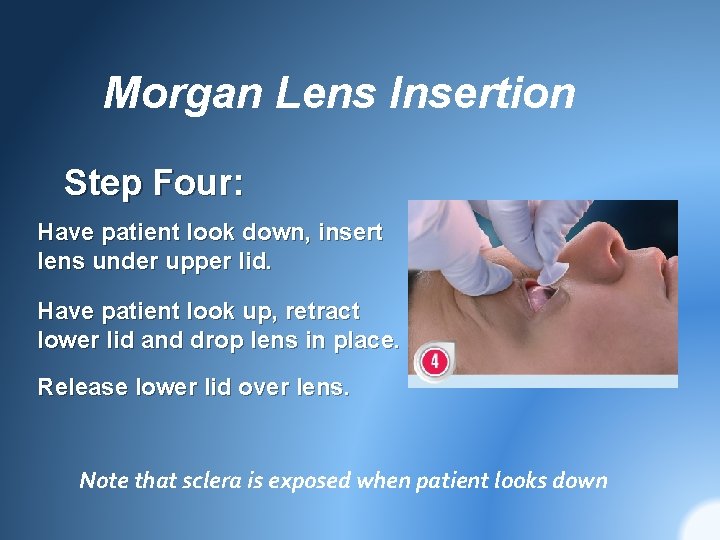
Morgan Lens Insertion Step Four: Have patient look down, insert lens under upper lid. Have patient look up, retract lower lid and drop lens in place. Release lower lid over lens. Note that sclera is exposed when patient looks down
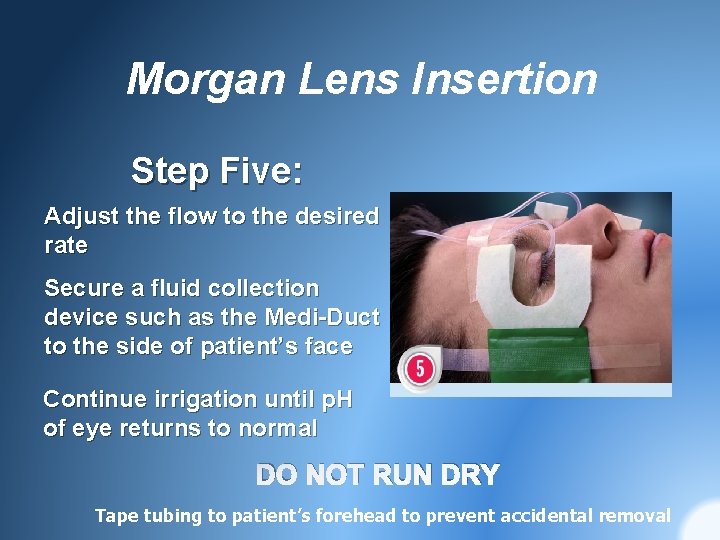
Morgan Lens Insertion Step Five: Adjust the flow to the desired rate Secure a fluid collection device such as the Medi-Duct to the side of patient’s face Continue irrigation until p. H of eye returns to normal DO NOT RUN DRY Tape tubing to patient’s forehead to prevent accidental removal
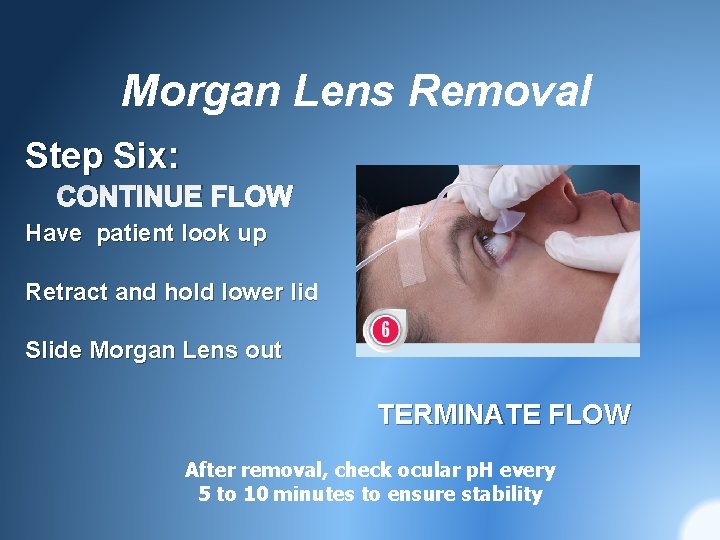
Morgan Lens Removal Step Six: CONTINUE FLOW Have patient look up Retract and hold lower lid Slide Morgan Lens out TERMINATE FLOW After removal, check ocular p. H every 5 to 10 minutes to ensure stability
Irrigation Times For Irritants: 20 to 30 minutes minimum For Acids and Alkalis: Irrigate with at least 2 liters of fluid per eye Check p. H of medial canthus If neutral, remove lens, wait 5 -10 minutes Measure p. H of medial canthus Repeat until p. H remains between 7. 5 and 8 For very strong acids or alkalis, continue irrigation for 2 hours after reaching surface p. H of 7. 5 -8. 0 to ensure neutralization of the anterior chamber
Questions for Patients Do NOT delay irrigation to take patient history* When did injury occur? What substance was involved? Is the patient on any medication or allergic to any medications? Was the patient wearing safety glasses when injury occurred? Are there any other injuries? Did patient receive any prior treatment? From Nursing 2000, Volume 30, Number 8 *Removal of contact lenses (when necessary) should be done ONLY IF IT DOES NOT DELAY irrigation-removal may be easier after a period of irrigation.
Contraindications Protruding foreign body Penetrating eye injury Suspected or actual rupture of the globe Do not instill anesthetic agents if allergies are known
Lactated Ringer’s vs. Normal Saline Mor. Tan recommends the use of lactated Ringer’s (Hartmann’s Solution) p. H closer to that of tears p. H of tears: approximately 7. 1 p. H of lactated Ringer’s: 6. 0 to 7. 5 p. H of Normal Saline: 4. 5 to 7. 0 Increased patient tolerance Normal Saline may cause discomfort and/or morphological changes to the eye* Buffering capacity lactated Ringer’s solution returns p. H to neutral more quickly with either acidic or basic contaminants* *from independent studies
Suggestions for the “Difficult Patient” Reassure patient: insertion will quickly relieve pain. Any delay will cause further damage. Seconds count! The irrigating solution provides cooling and soothing sensation The injured cornea is protected from “squeegee” action of eyelids each time the patient blinks Remind them their eyes may be closed during procedure Chemicals may generate heat when mixed with water- irrigation will cool the eye Remember: the Morgan Lens does not touch the cornea A topical anesthetic may help relieve anxiety Additional anesthetic may be instilled without removing lens. Pinch tubing and instill drop into medial canthus.
Benefits of the Morgan Lens 100% of irrigating solution is delivered directly to cornea, culde-sac and conjunctiva (even when eyes are closed) Frees medical staff to attend to other injuries Patient can be transported during procedure Patient rests comfortably Highly cost effective There is minimal contact with the injured skin surrounding the eye Symblepharon (adhesion) formation is prevented
Issues with Alternative Methods The eyes must be manually held open or the patient has to blink repeatedly for the fluid to reach the cornea Keeping the eyes open may be extremely painful Fluid will take the “path of least resistance” and simply flow off the surface rather than flushing the fornices Locating components and assembly may be required Retracted eyelids may have pockets that can trap chemicals Continual contact with burned skin around the eye may be necessary to keep the eye open Full-time attention is required for the irrigation process
Summary Burns are among the most urgent of ocular emergencies Copious irrigation must be started quickly (at scene of accident if possible) All surfaces of the eye (cornea, sclera, cul-desac, and inner eyelid) must be flushed thoroughly Irrigation should be continued until p. H of eye returns to normal (alkali burns may require hours of continuous irrigation; severe infections may require irrigation for hours or even days)* *See MORGAN LENS USES CHART available at morganlens. com

The World’s Leader in Ocular Irrigation For more information, or to order the Morgan Lens, contact: Mor. Tan, Inc. P. O. Box 8719 Missoula, MT 59807 USA Phone: 1 -800 -423 -8659 or (406) 728 -2522 Fax: (406) 728 -9332 morganlens. com © 2018 Rev. D email: mortan@morganlens. com Mor. Tan is an ISO 13485 registered company Please do not duplicate or modify without permission from Mor. Tan, Inc
- Slides: 22