
October 31 st 2012 IT Architecture Roadmap Checkpoint
October 31 st, 2012 IT Architecture Roadmap Checkpoint #2 Executive Summary & Roadmap ry and Business Confidential 1
IT Architecture Roadmap • Executive Summary • Proposed 2013 IT Architecture Roadmap • Supporting Materials Proprietary and Business Confidential 2
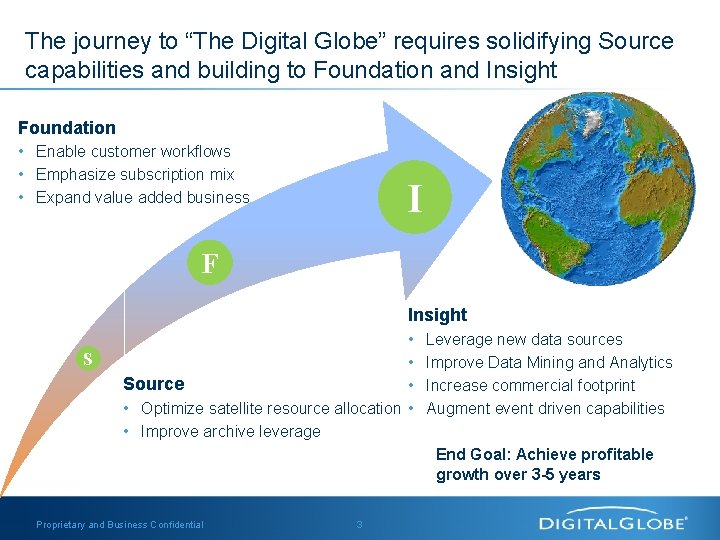
The journey to “The Digital Globe” requires solidifying Source capabilities and building to Foundation and Insight Foundation • Enable customer workflows • Emphasize subscription mix • Expand value added business I F Insight S • • Source • • Optimize satellite resource allocation • • Improve archive leverage Leverage new data sources Improve Data Mining and Analytics Increase commercial footprint Augment event driven capabilities End Goal: Achieve profitable growth over 3 -5 years Proprietary and Business Confidential 3
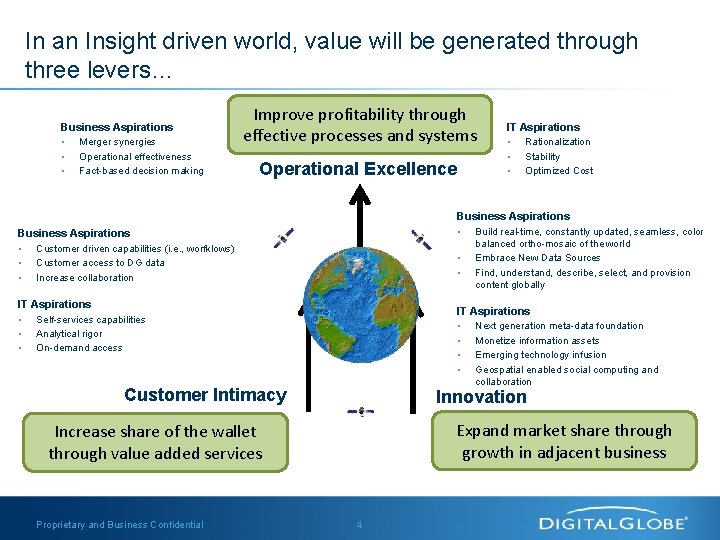
In an Insight driven world, value will be generated through three levers… Business Aspirations • Merger synergies • Operational effectiveness • Fact-based decision making Improve profitability through effective processes and systems Operational Excellence Business Aspirations • Build real-time, constantly updated, seamless, color Business Aspirations • Customer driven capabilities (i. e. , worfklows) • Customer access to DG data • Increase collaboration • • IT Aspirations • Self-services capabilities • Analytical rigor • On-demand access balanced ortho-mosaic of the world Embrace New Data Sources Find, understand, describe, select, and provision content globally IT Aspirations • Next generation meta-data foundation • Monetize information assets • Emerging technology infusion • Geospatial enabled social computing and collaboration Customer Intimacy Innovation Expand market share through growth in adjacent business Increase share of the wallet through value added services Proprietary and Business Confidential IT Aspirations • Rationalization • Stability • Optimized Cost 4
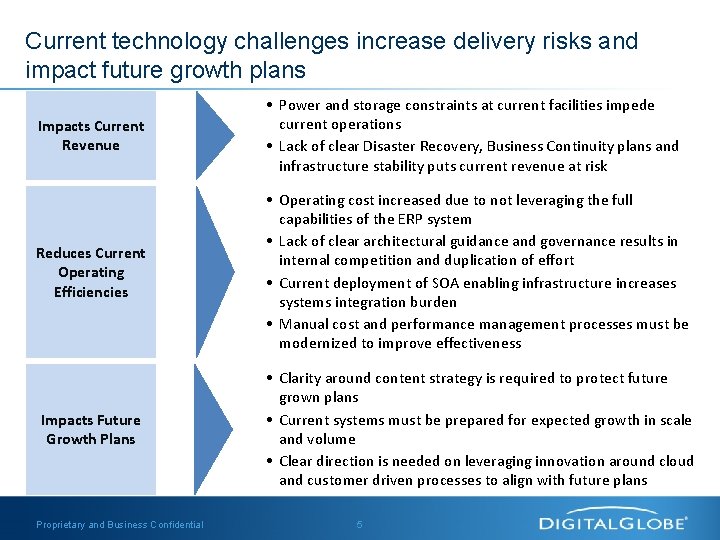
Current technology challenges increase delivery risks and impact future growth plans Impacts Current Revenue • Power and storage constraints at current facilities impede current operations • Lack of clear Disaster Recovery, Business Continuity plans and infrastructure stability puts current revenue at risk Reduces Current Operating Efficiencies • Operating cost increased due to not leveraging the full capabilities of the ERP system • Lack of clear architectural guidance and governance results in internal competition and duplication of effort • Current deployment of SOA enabling infrastructure increases systems integration burden • Manual cost and performance management processes must be modernized to improve effectiveness Impacts Future Growth Plans • Clarity around content strategy is required to protect future grown plans • Current systems must be prepared for expected growth in scale and volume • Clear direction is needed on leveraging innovation around cloud and customer driven processes to align with future plans Proprietary and Business Confidential 5

Improvement opportunities have been identified around five focus areas… Area Strategy Alignment S F Value Enablers I OE CI Key Initiatives IN Infrastructure “Optimize the Foundation” • • Storage ILM & SM replacement Data Center Rationalization Network/Security Enhancement Disaster Recovery Architecture & Governance “Enable EA to drive consistency” • • EA Blueprint & IT Op Model IT Combination IT Metrics Foundation Methods, Processes & Tools SOA “Institutionalize SOA discipline” • Enterprise Service Factory • Next Gen Service Bus Geo. Eye ERP Integration Cost Accounting Process Optimization Capability Expansion SAP “Leverage the investment” • • Content “Establish a clear direction” • ECM Strategy • Next Gen ECM Implementation S – Source F – Foundation I – Insight Proprietary and Business Confidential OE – Operational Excellence CI – Customer Intimacy IN – Innovation 6

Initiatives have been prioritized based on strategic importance and implementation complexity Infrastructure High 15 17 Degree of Strategic Importance 1 19 7 2 9 13 Architecture & Governance EA Organization Standup IT Combination Mgmt. Office IT Operating Model IT Metrics Foundation Delivery Framework (ADM) Demand Mgmt. Refinement Service Oriented Architecture 6 13. Service Factory 14. SOA Environment Hardening 4 10 Storage Manager Replacement Storage Operations Optimization DC Assessment & Optimization Network Assessment & Optimization Security Assessment & Optimization DR Assessment & Optimization 7. 8. 9. 10. 11. 12. 16 3 14 12 20 18 8 5 1. 2. 3. 4. 5. 6. SAP 11 15. 16. 17. 18. Geo. Eye ERP Integration Cost Accounting Process Optimization Capability Expansion Enterprise Content Mgmt. (ECM) 19. ECM Strategy 20. ECM Implementation Low Level of Effort/Complexity Proprietary and Business Confidential 7 High Estimated Cost <$2 M $2 - 5 M >$5 M
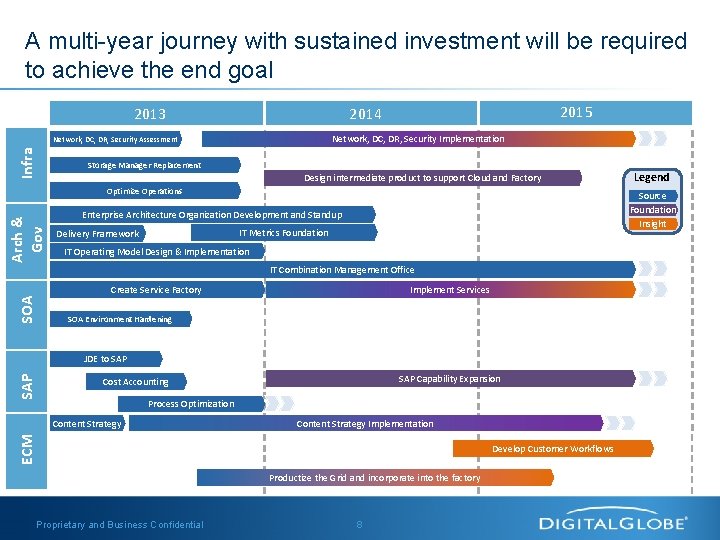
A multi-year journey with sustained investment will be required to achieve the end goal Network, DC, DR, Security Implementation Network, DC, DR, Security Assessment Infra 2015 2014 2013 Storage Manager Replacement Design intermediate product to support Cloud and Factory Arch & Gov Optimize Operations Source Foundation Insight Enterprise Architecture Organization Development and Standup IT Metrics Foundation Delivery Framework IT Operating Model Design & Implementation SOA IT Combination Management Office Implement Services Create Service Factory SOA Environment Hardening SAP JDE to SAP Capability Expansion Cost Accounting Process Optimization Content Strategy Implementation ECM Content Strategy Develop Customer Workflows Productize the Grid and incorporate into the factory Proprietary and Business Confidential Legend 8
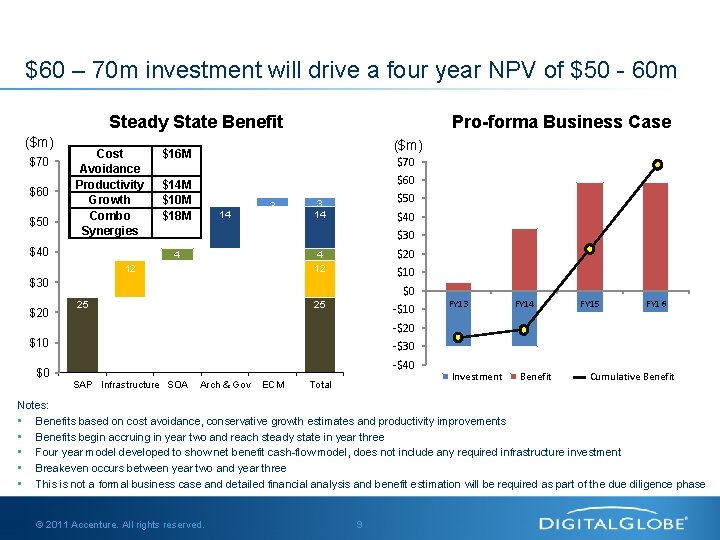
$60 – 70 m investment will drive a four year NPV of $50 - 60 m Steady State Benefit ($m) $70 $60 $50 Cost Avoidance Productivity Growth Combo Synergies $40 Pro-forma Business Case ($m) $16 M $70 $60 $14 M $10 M $18 M 14 3 $50 3 14 $40 $30 4 $20 4 12 12 $10 $30 $20 $0 25 25 -$10 FY 13 FY 14 FY 15 FY 16 -$20 $10 $0 -$30 -$40 SAP Infrastructure SOA Arch & Gov ECM Total Investment Benefit Cumulative Benefit Notes: • Benefits based on cost avoidance, conservative growth estimates and productivity improvements • Benefits begin accruing in year two and reach steady state in year three • Four year model developed to show net benefit cash-flow model, does not include any required infrastructure investment • Breakeven occurs between year two and year three • This is not a formal business case and detailed financial analysis and benefit estimation will be required as part of the due diligence phase © 2011 Accenture. All rights reserved. 9
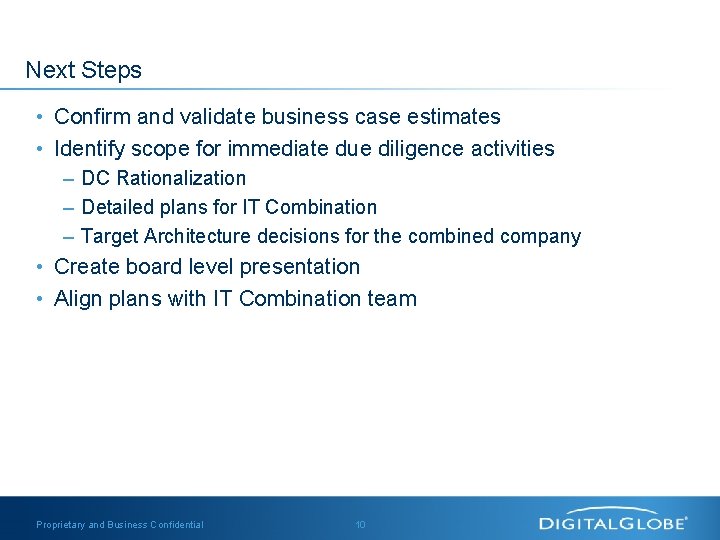
Next Steps • Confirm and validate business case estimates • Identify scope for immediate due diligence activities – DC Rationalization – Detailed plans for IT Combination – Target Architecture decisions for the combined company • Create board level presentation • Align plans with IT Combination team Proprietary and Business Confidential 10
IT Architecture Roadmap • Executive Summary • Proposed 2013 IT Architecture Roadmap • Supporting Materials Proprietary and Business Confidential 11
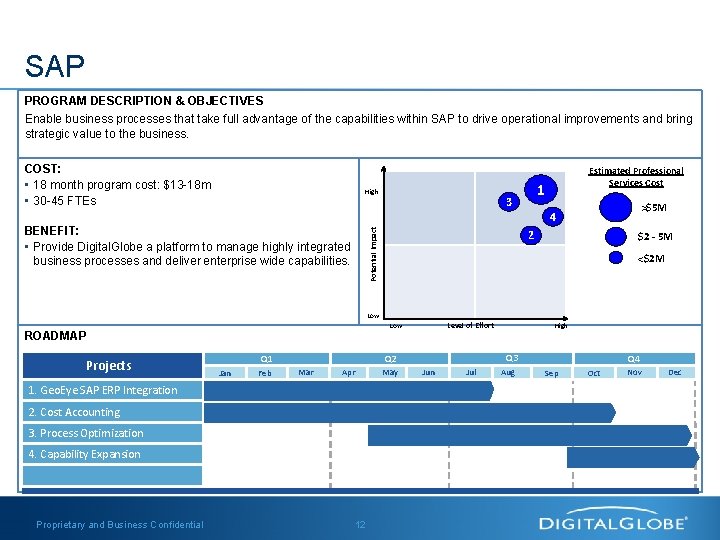
SAP PROGRAM DESCRIPTION & OBJECTIVES Enable business processes that take full advantage of the capabilities within SAP to drive operational improvements and bring strategic value to the business. COST: • 18 month program cost: $13 -18 m • 30 -45 FTEs High Estimated Professional Services Cost 1 3 >$5 M 4 Potential Impact BENEFIT: • Provide Digital. Globe a platform to manage highly integrated business processes and deliver enterprise wide capabilities. 2 <$2 M Low Projects Q 1 Jan Feb Mar 2. Cost Accounting 3. Process Optimization 4. Capability Expansion 12 May High Q 3 Q 2 Apr 1. Geo. Eye SAP ERP Integration Proprietary and Business Confidential Level of Effort Low ROADMAP $2 - 5 M Jun Jul Aug Q 4 Sep Oct Nov Dec
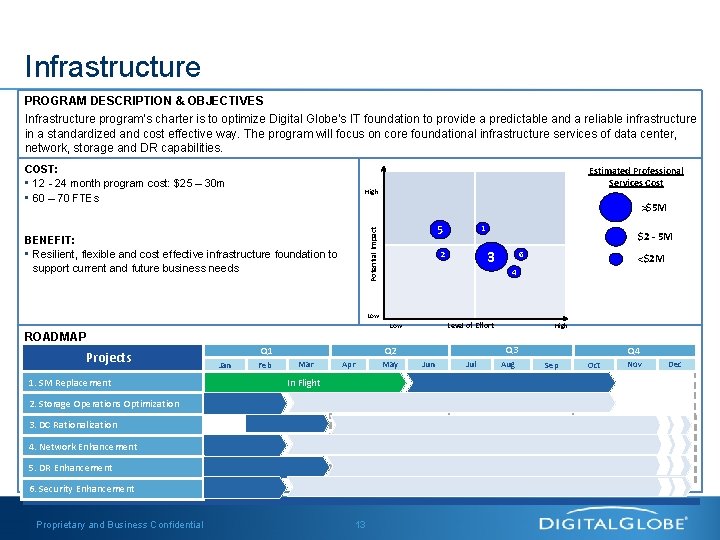
Infrastructure PROGRAM DESCRIPTION & OBJECTIVES Infrastructure program’s charter is to optimize Digital Globe’s IT foundation to provide a predictable and a reliable infrastructure in a standardized and cost effective way. The program will focus on core foundational infrastructure services of data center, network, storage and DR capabilities. COST: • 12 - 24 month program cost: $25 – 30 m • 60 – 70 FTEs Estimated Professional Services Cost High >$5 M 5 Potential Impact BENEFIT: • Resilient, flexible and cost effective infrastructure foundation to support current and future business needs Projects 1. SM Replacement Q 1 Jan Feb Mar In Flight 2. Storage Operations Optimization 3. DC Rationalization 4. Network Enhancement 5. DR Enhancement 6. Security Enhancement Proprietary and Business Confidential 13 May <$2 M 4 High Q 3 Q 2 Apr 6 Level of Effort Low Q 1 $2 - 5 M 3 2 Low ROADMAP 1 Jun Jul Aug Q 4 Sep Oct Nov Dec
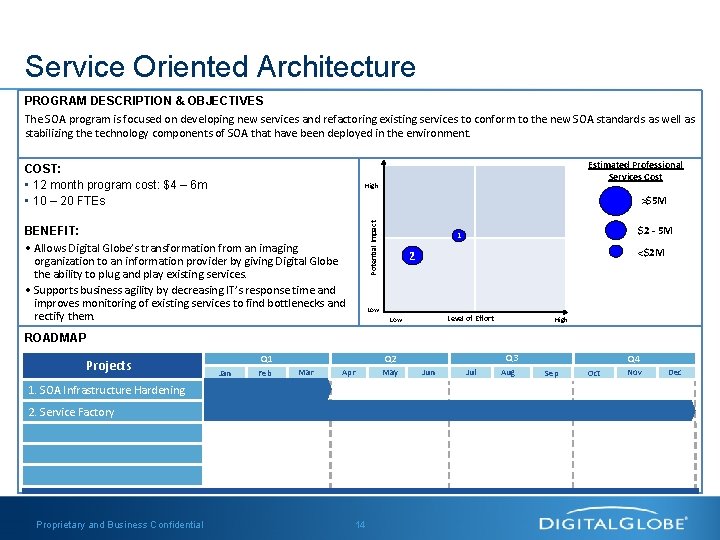
Service Oriented Architecture PROGRAM DESCRIPTION & OBJECTIVES The SOA program is focused on developing new services and refactoring existing services to conform to the new SOA standards as well as stabilizing the technology components of SOA that have been deployed in the environment. COST: • 12 month program cost: $4 – 6 m • 10 – 20 FTEs High Potential Impact >$5 M BENEFIT: • Allows Digital Globe’s transformation from an imaging organization to an information provider by giving Digital Globe the ability to plug and play existing services. • Supports business agility by decreasing IT’s response time and improves monitoring of existing services to find bottlenecks and rectify them. ROADMAP Projects Jan Feb Mar <$2 M 2 Level of Effort Low Q 1 $2 - 5 M 1 Low 2. Service Factory 14 May High Q 3 Q 2 Apr 1. SOA Infrastructure Hardening Proprietary and Business Confidential Estimated Professional Services Cost Jun Jul Aug Q 4 Sep Oct Nov Dec
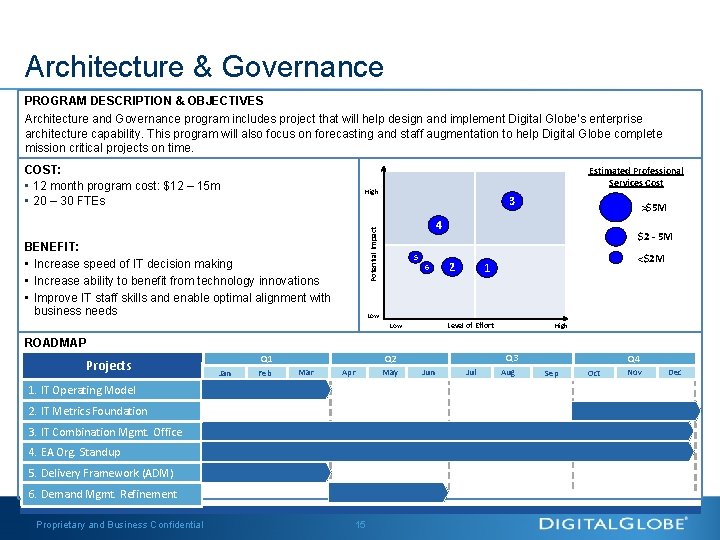
Architecture & Governance PROGRAM DESCRIPTION & OBJECTIVES Architecture and Governance program includes project that will help design and implement Digital Globe’s enterprise architecture capability. This program will also focus on forecasting and staff augmentation to help Digital Globe complete mission critical projects on time. COST: • 12 month program cost: $12 – 15 m • 20 – 30 FTEs Estimated Professional Services Cost High 3 4 Potential Impact BENEFIT: • Increase speed of IT decision making • Increase ability to benefit from technology innovations • Improve IT staff skills and enable optimal alignment with business needs 5 6 Low Projects Q 1 Jan Feb Mar 2 2. IT Metrics Foundation 3. IT Combination Mgmt. Office 4. EA Org. Standup 5. Delivery Framework (ADM) 6. Demand Mgmt. Refinement 15 May <$2 M 1 High Q 3 Q 2 Apr 1. IT Operating Model Proprietary and Business Confidential $2 - 5 M Level of Effort Low ROADMAP >$5 M Jun Jul Aug Q 4 Sep Oct Nov Dec
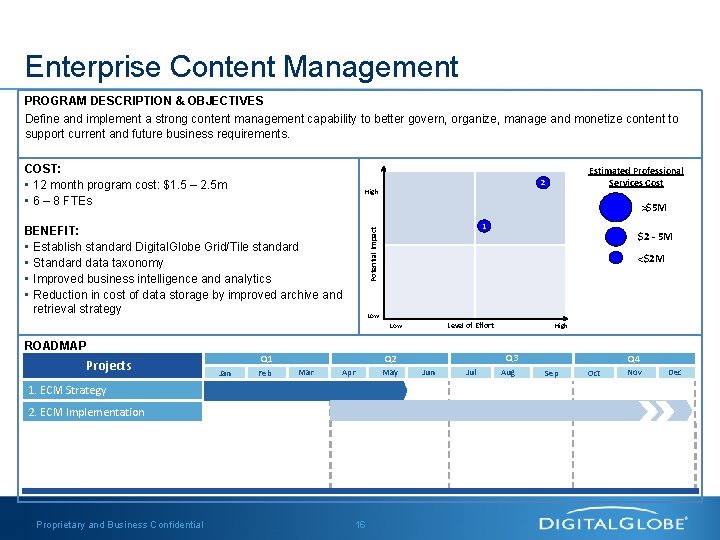
Enterprise Content Management PROGRAM DESCRIPTION & OBJECTIVES Define and implement a strong content management capability to better govern, organize, manage and monetize content to support current and future business requirements. COST: • 12 month program cost: $1. 5 – 2. 5 m • 6 – 8 FTEs High >$5 M 1 Potential Impact BENEFIT: • Establish standard Digital. Globe Grid/Tile standard • Standard data taxonomy • Improved business intelligence and analytics • Reduction in cost of data storage by improved archive and retrieval strategy Low Projects Q 1 Jan Feb Mar Level of Effort 1. ECM Strategy 2. ECM Implementation Proprietary and Business Confidential 16 May High Q 3 Q 2 Apr $2 - 5 M <$2 M Low ROADMAP Estimated Professional Services Cost 2 Jun Jul Aug Q 4 Sep Oct Nov Dec
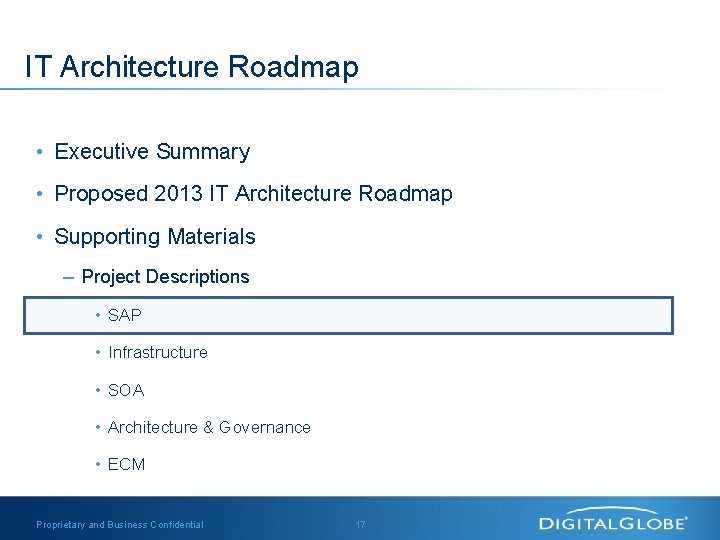
IT Architecture Roadmap • Executive Summary • Proposed 2013 IT Architecture Roadmap • Supporting Materials – Project Descriptions • SAP • Infrastructure • SOA • Architecture & Governance • ECM Proprietary and Business Confidential 17
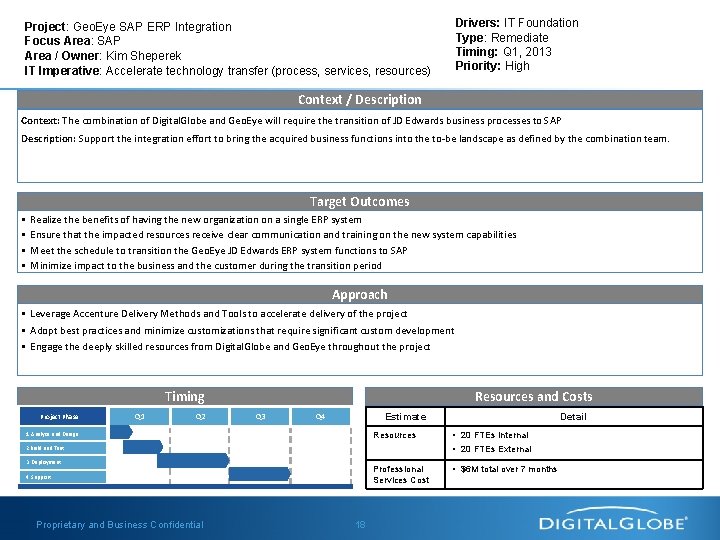
Drivers: IT Foundation Type: Remediate Timing: Q 1, 2013 Priority: High Project: Geo. Eye SAP ERP Integration Focus Area: SAP Area / Owner: Kim Sheperek IT Imperative: Accelerate technology transfer (process, services, resources) Context / Description Context: The combination of Digital. Globe and Geo. Eye will require the transition of JD Edwards business processes to SAP Description: Support the integration effort to bring the acquired business functions into the to-be landscape as defined by the combination team. Target Outcomes • Realize the benefits of having the new organization on a single ERP system • Ensure that the impacted resources receive clear communication and training on the new system capabilities • Meet the schedule to transition the Geo. Eye JD Edwards ERP system functions to SAP • Minimize impact to the business and the customer during the transition period Approach • Leverage Accenture Delivery Methods and Tools to accelerate delivery of the project • Adopt best practices and minimize customizations that require significant custom development • Engage the deeply skilled resources from Digital. Globe and Geo. Eye throughout the project Timing Project Phase Q 1 Q 2 Resources and Costs Q 3 Estimate Q 4 1. Analyze and Design Resources • 20 FTEs Internal • 20 FTEs External Professional Services Cost • $6 M total over 7 months 2 Build and Test 3. Deployment 4. Support Proprietary and Business Confidential 18 Detail
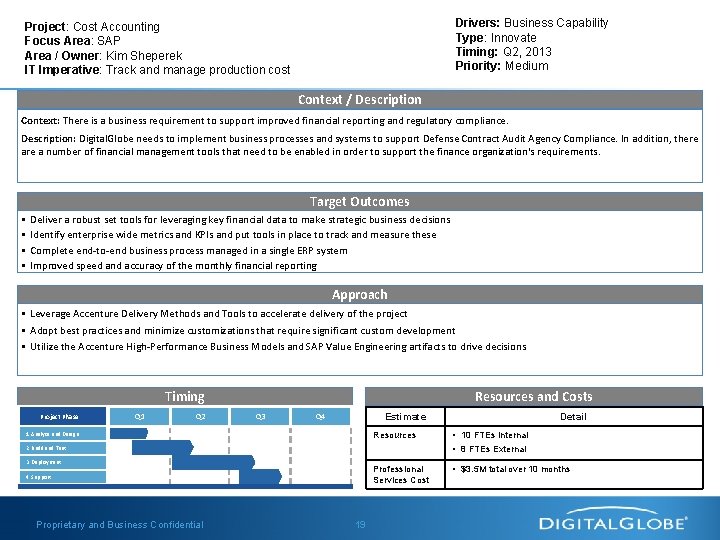
Drivers: Business Capability Type: Innovate Timing: Q 2, 2013 Priority: Medium Project: Cost Accounting Focus Area: SAP Area / Owner: Kim Sheperek IT Imperative: Track and manage production cost Context / Description Context: There is a business requirement to support improved financial reporting and regulatory compliance. Description: Digital. Globe needs to implement business processes and systems to support Defense Contract Audit Agency Compliance. In addition, there a number of financial management tools that need to be enabled in order to support the finance organization's requirements. Target Outcomes • Deliver a robust set tools for leveraging key financial data to make strategic business decisions • Identify enterprise wide metrics and KPIs and put tools in place to track and measure these • Complete end-to-end business process managed in a single ERP system • Improved speed and accuracy of the monthly financial reporting Approach • Leverage Accenture Delivery Methods and Tools to accelerate delivery of the project • Adopt best practices and minimize customizations that require significant custom development • Utilize the Accenture High-Performance Business Models and SAP Value Engineering artifacts to drive decisions Timing Project Phase Q 1 Q 2 Resources and Costs Q 3 Estimate Q 4 1. Analyze and Design Resources • 10 FTEs Internal • 8 FTEs External Professional Services Cost • $3. 5 M total over 10 months 2. Build and Test 3. Deployment 4. Support Proprietary and Business Confidential 19 Detail
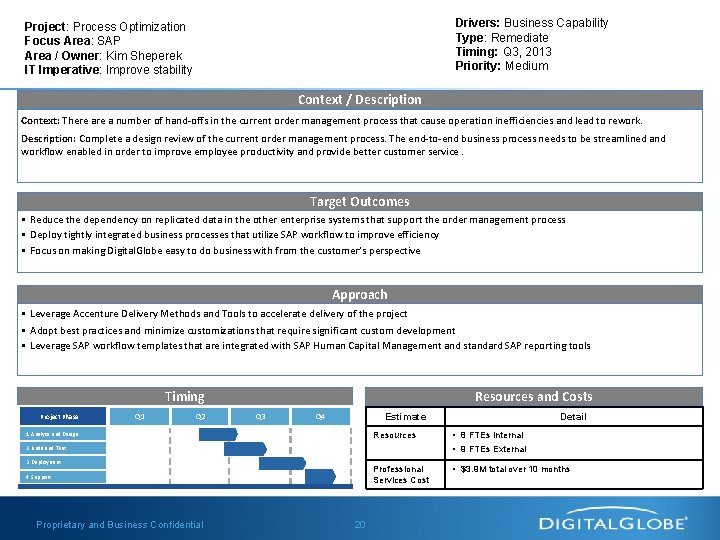
Drivers: Business Capability Type: Remediate Timing: Q 3, 2013 Priority: Medium Project: Process Optimization Focus Area: SAP Area / Owner: Kim Sheperek IT Imperative: Improve stability Context / Description Context: There a number of hand-offs in the current order management process that cause operation inefficiencies and lead to rework. Description: Complete a design review of the current order management process. The end-to-end business process needs to be streamlined and workflow enabled in order to improve employee productivity and provide better customer service. Target Outcomes • Reduce the dependency on replicated data in the other enterprise systems that support the order management process • Deploy tightly integrated business processes that utilize SAP workflow to improve efficiency • Focus on making Digital. Globe easy to do business with from the customer’s perspective Approach • Leverage Accenture Delivery Methods and Tools to accelerate delivery of the project • Adopt best practices and minimize customizations that require significant custom development • Leverage SAP workflow templates that are integrated with SAP Human Capital Management and standard SAP reporting tools Timing Project Phase Q 1 Q 2 Resources and Costs Q 3 Estimate Q 4 1. Analyze and Design Resources • 8 FTEs Internal • 9 FTEs External Professional Services Cost • $3. 9 M total over 10 months 2. Build and Test 3. Deployment 4. Support Proprietary and Business Confidential 20 Detail
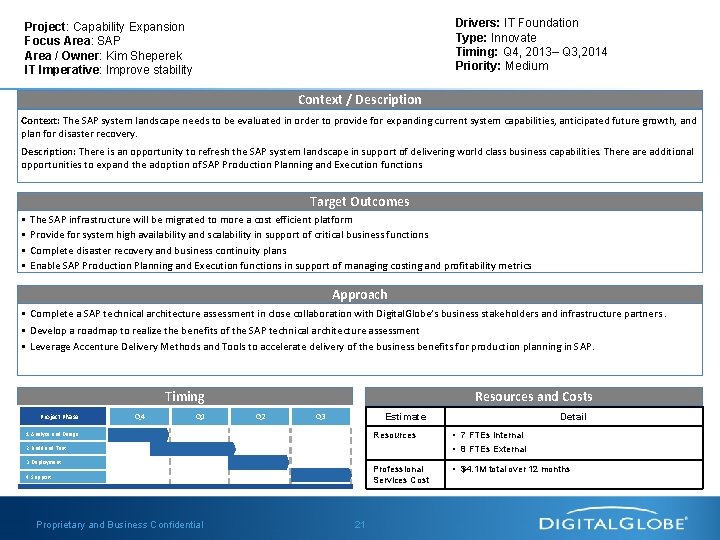
Drivers: IT Foundation Type: Innovate Timing: Q 4, 2013– Q 3, 2014 Priority: Medium Project: Capability Expansion Focus Area: SAP Area / Owner: Kim Sheperek IT Imperative: Improve stability Context / Description Context: The SAP system landscape needs to be evaluated in order to provide for expanding current system capabilities, anticipated future growth, and plan for disaster recovery. Description: There is an opportunity to refresh the SAP system landscape in support of delivering world class business capabilities. There additional opportunities to expand the adoption of SAP Production Planning and Execution functions Target Outcomes • The SAP infrastructure will be migrated to more a cost efficient platform • Provide for system high availability and scalability in support of critical business functions • Complete disaster recovery and business continuity plans • Enable SAP Production Planning and Execution functions in support of managing costing and profitability metrics Approach • Complete a SAP technical architecture assessment in close collaboration with Digital. Globe’s business stakeholders and infrastructure partners. • Develop a roadmap to realize the benefits of the SAP technical architecture assessment • Leverage Accenture Delivery Methods and Tools to accelerate delivery of the business benefits for production planning in SAP. Timing Project Phase Q 4 Q 1 Resources and Costs Q 2 Estimate Q 3 1. Analyze and Design Resources • 7 FTEs Internal • 8 FTEs External Professional Services Cost • $4. 1 M total over 12 months 2. Build and Test 3. Deployment 4. Support Proprietary and Business Confidential 21 Detail
IT Architecture Roadmap • Executive Summary • Proposed 2013 IT Architecture Roadmap • Supporting Materials – Project Descriptions • SAP • Infrastructure • SOA • Architecture & Governance • ECM Proprietary and Business Confidential 22
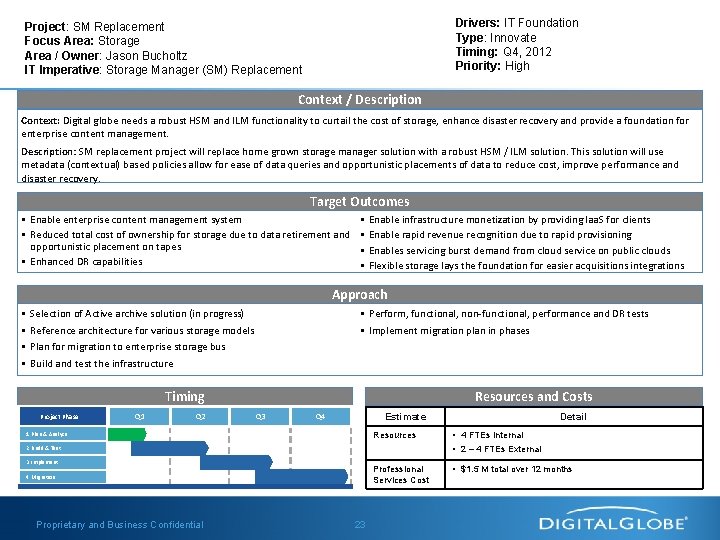
Drivers: IT Foundation Type: Innovate Timing: Q 4, 2012 Priority: High Project: SM Replacement Focus Area: Storage Area / Owner: Jason Bucholtz IT Imperative: Storage Manager (SM) Replacement Context / Description Context: Digital globe needs a robust HSM and ILM functionality to curtail the cost of storage, enhance disaster recovery and provide a foundation for enterprise content management. Description: SM replacement project will replace home grown storage manager solution with a robust HSM / ILM solution. This solution will use metadata (contextual) based policies allow for ease of data queries and opportunistic placements of data to reduce cost, improve performance and disaster recovery. Target Outcomes • Enable enterprise content management system • Reduced total cost of ownership for storage due to data retirement and opportunistic placement on tapes • Enhanced DR capabilities • Enable infrastructure monetization by providing Iaa. S for clients • Enable rapid revenue recognition due to rapid provisioning • Enables servicing burst demand from cloud service on public clouds • Flexible storage lays the foundation for easier acquisitions integrations Approach • Perform, functional, non-functional, performance and DR tests • Implement migration plan in phases • Selection of Active archive solution (in progress) • Reference architecture for various storage models • Plan for migration to enterprise storage bus • Build and test the infrastructure Timing Project Phase Q 1 Q 2 Resources and Costs Q 3 Estimate Q 4 1. Plan & Analyze Resources • 4 FTEs Internal • 2 – 4 FTEs External Professional Services Cost • $1. 5 M total over 12 months 2. Build & Test 3. Implement 4. Migration Proprietary and Business Confidential 23 Detail
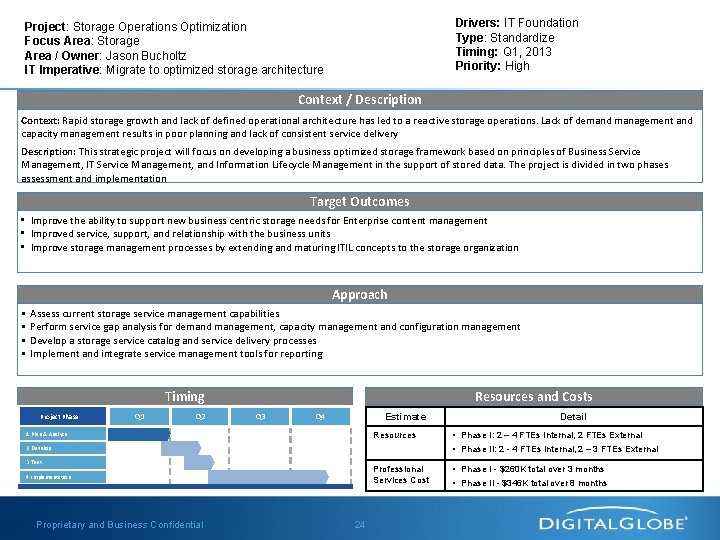
Drivers: IT Foundation Type: Standardize Timing: Q 1, 2013 Priority: High Project: Storage Operations Optimization Focus Area: Storage Area / Owner: Jason Bucholtz IT Imperative: Migrate to optimized storage architecture Context / Description Context: Rapid storage growth and lack of defined operational architecture has led to a reactive storage operations. Lack of demand management and capacity management results in poor planning and lack of consistent service delivery Description: This strategic project will focus on developing a business optimized storage framework based on principles of Business Service Management, IT Service Management, and Information Lifecycle Management in the support of stored data. The project is divided in two phases assessment and implementation Target Outcomes • Improve the ability to support new business centric storage needs for Enterprise content management • Improved service, support, and relationship with the business units • Improve storage management processes by extending and maturing ITIL concepts to the storage organization Approach • Assess current storage service management capabilities • Perform service gap analysis for demand management, capacity management and configuration management • Develop a storage service catalog and service delivery processes • Implement and integrate service management tools for reporting Timing Project Phase Q 1 Q 2 Resources and Costs Q 3 Estimate Q 4 1. Plan & Analyze Resources • Phase I: 2 – 4 FTEs Internal, 2 FTEs External • Phase II: 2 - 4 FTEs Internal, 2 – 3 FTEs External Professional Services Cost • Phase I - $260 K total over 3 months • Phase II - $346 K total over 8 months 2. Develop 3. Test 4. Implementation Proprietary and Business Confidential 24 Detail
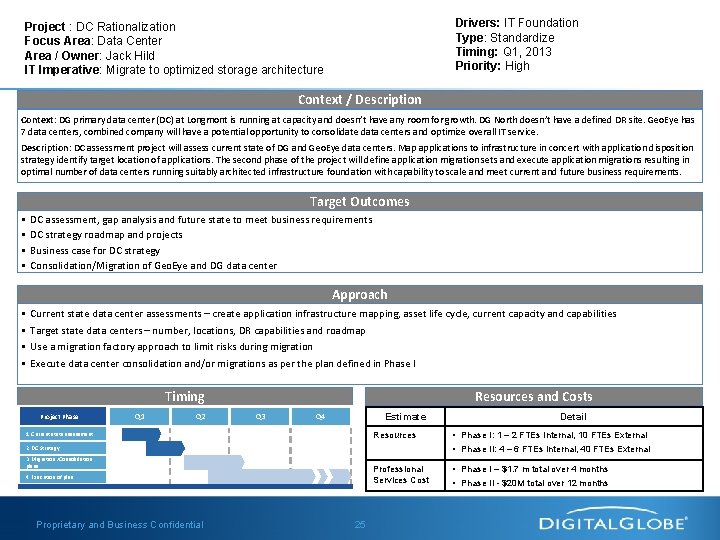
Drivers: IT Foundation Type: Standardize Timing: Q 1, 2013 Priority: High Project : DC Rationalization Focus Area: Data Center Area / Owner: Jack Hild IT Imperative: Migrate to optimized storage architecture Context / Description Context: DG primary data center (DC) at Longmont is running at capacity and doesn’t have any room for growth. DG North doesn’t have a defined DR site. Geo. Eye has 7 data centers, combined company will have a potential opportunity to consolidate data centers and optimize overall IT service. Description: DC assessment project will assess current state of DG and Geo. Eye data centers. Map applications to infrastructure in concert with application disposition strategy identify target location of applications. The second phase of the project will define application migration sets and execute application migrations resulting in optimal number of data centers running suitably architected infrastructure foundation with capability to scale and meet current and future business requirements. Target Outcomes • DC assessment, gap analysis and future state to meet business requirements • DC strategy roadmap and projects • Business case for DC strategy • Consolidation/Migration of Geo. Eye and DG data center Approach • Current state data center assessments – create application infrastructure mapping, asset life cycle, current capacity and capabilities • Target state data centers – number, locations, DR capabilities and roadmap • Use a migration factory approach to limit risks during migration • Execute data center consolidation and/or migrations as per the plan defined in Phase I Timing Project Phase Q 1 Q 2 Resources and Costs Q 3 Estimate Q 4 1. Current state assessment Resources • Phase I: 1 – 2 FTEs Internal, 10 FTEs External • Phase II: 4 – 6 FTEs Internal, 40 FTEs External Professional Services Cost • Phase I – $1. 7 m total over 4 months • Phase II - $20 M total over 12 months 2. DC Strategy 3. Migration /Consolidation plans 4. Execution of plan Proprietary and Business Confidential 25 Detail
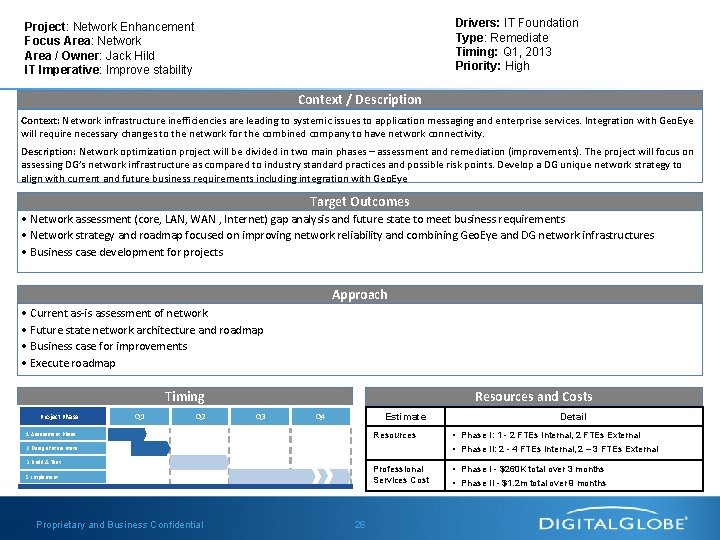
Drivers: IT Foundation Type: Remediate Timing: Q 1, 2013 Priority: High Project: Network Enhancement Focus Area: Network Area / Owner: Jack Hild IT Imperative: Improve stability Context / Description Context: Network infrastructure inefficiencies are leading to systemic issues to application messaging and enterprise services. Integration with Geo. Eye will require necessary changes to the network for the combined company to have network connectivity. Description: Network optimization project will be divided in two main phases – assessment and remediation (improvements). The project will focus on assessing DG’s network infrastructure as compared to industry standard practices and possible risk points. Develop a DG unique network strategy to align with current and future business requirements including integration with Geo. Eye Target Outcomes • Network assessment (core, LAN, WAN , Internet) gap analysis and future state to meet business requirements • Network strategy and roadmap focused on improving network reliability and combining Geo. Eye and DG network infrastructures • Business case development for projects Approach • Current as-is assessment of network • Future state network architecture and roadmap • Business case for improvements • Execute roadmap Timing Project Phase Q 1 Q 2 Resources and Costs Q 3 Estimate Q 4 1. Assessment Phase Resources • Phase I: 1 - 2 FTEs Internal, 2 FTEs External • Phase II: 2 - 4 FTEs Internal, 2 – 3 FTEs External Professional Services Cost • Phase I - $260 K total over 3 months • Phase II - $1. 2 m total over 9 months 2. Design future state 3. Build & Test 5. Implement Proprietary and Business Confidential 26 Detail
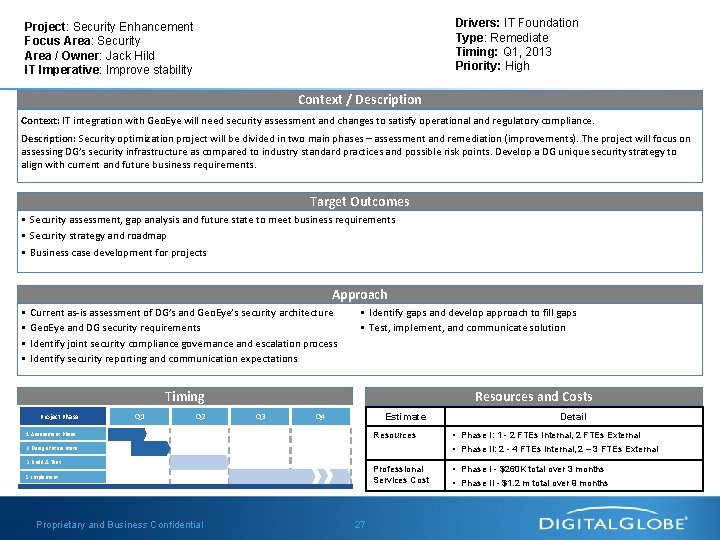
Drivers: IT Foundation Type: Remediate Timing: Q 1, 2013 Priority: High Project: Security Enhancement Focus Area: Security Area / Owner: Jack Hild IT Imperative: Improve stability Context / Description Context: IT integration with Geo. Eye will need security assessment and changes to satisfy operational and regulatory compliance. Description: Security optimization project will be divided in two main phases – assessment and remediation (improvements). The project will focus on assessing DG’s security infrastructure as compared to industry standard practices and possible risk points. Develop a DG unique security strategy to align with current and future business requirements. Target Outcomes • Security assessment, gap analysis and future state to meet business requirements • Security strategy and roadmap • Business case development for projects Approach • Current as-is assessment of DG’s and Geo. Eye’s security architecture • Geo. Eye and DG security requirements • Identify joint security compliance governance and escalation process • Identify security reporting and communication expectations • Identify gaps and develop approach to fill gaps • Test, implement, and communicate solution Timing Project Phase Q 1 Q 2 Resources and Costs Q 3 Estimate Q 4 1. Assessment Phase Resources • Phase I: 1 - 2 FTEs Internal, 2 FTEs External • Phase II: 2 - 4 FTEs Internal, 2 – 3 FTEs External Professional Services Cost • Phase I - $260 K total over 3 months • Phase II - $1. 2 m total over 9 months 2. Design future state 3. Build & Test 5. Implement Proprietary and Business Confidential 27 Detail
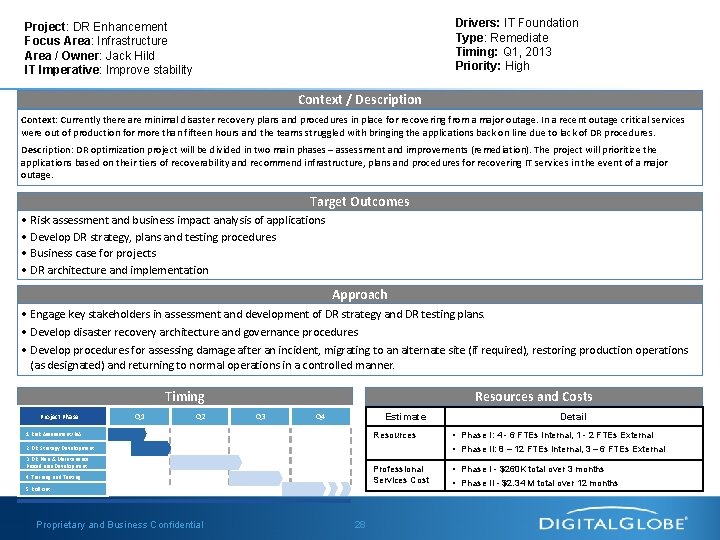
Drivers: IT Foundation Type: Remediate Timing: Q 1, 2013 Priority: High Project: DR Enhancement Focus Area: Infrastructure Area / Owner: Jack Hild IT Imperative: Improve stability Context / Description Context: Currently there are minimal disaster recovery plans and procedures in place for recovering from a major outage. In a recent outage critical services were out of production for more than fifteen hours and the teams struggled with bringing the applications back on line due to lack of DR procedures. Description: DR optimization project will be divided in two main phases – assessment and improvements (remediation). The project will prioritize the applications based on their tiers of recoverability and recommend infrastructure, plans and procedures for recovering IT services in the event of a major outage. Target Outcomes • Risk assessment and business impact analysis of applications • Develop DR strategy, plans and testing procedures • Business case for projects • DR architecture and implementation Approach • Engage key stakeholders in assessment and development of DR strategy and DR testing plans. • Develop disaster recovery architecture and governance procedures • Develop procedures for assessing damage after an incident, migrating to an alternate site (if required), restoring production operations (as designated) and returning to normal operations in a controlled manner. Timing Project Phase Q 1 Q 2 Resources and Costs Q 3 Estimate Q 4 1. Risk Assessment/BIA Resources • Phase I: 4 - 6 FTEs Internal, 1 - 2 FTEs External • Phase II: 8 – 12 FTEs Internal, 3 – 6 FTEs External Professional Services Cost • Phase I - $260 K total over 3 months • Phase II - $2. 34 M total over 12 months 2. DR Strategy Development 3. DR Plan & Maintenance Procedures Development 4. Training and Testing 5. Roll out Proprietary and Business Confidential 28 Detail
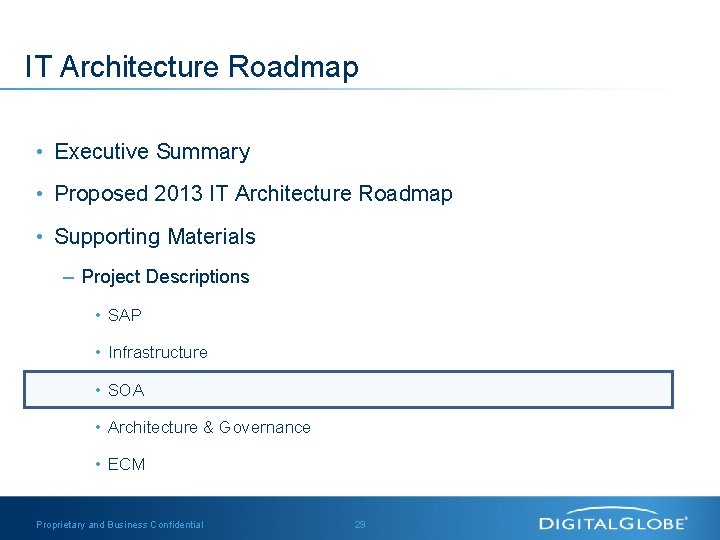
IT Architecture Roadmap • Executive Summary • Proposed 2013 IT Architecture Roadmap • Supporting Materials – Project Descriptions • SAP • Infrastructure • SOA • Architecture & Governance • ECM Proprietary and Business Confidential 29
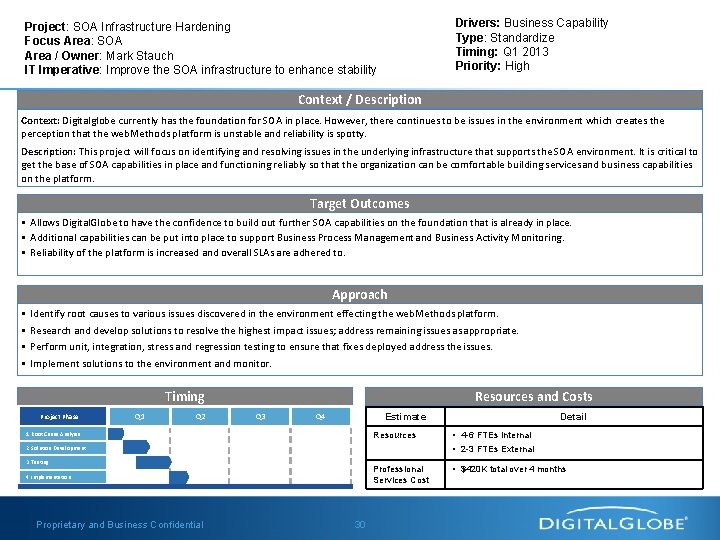
Drivers: Business Capability Type: Standardize Timing: Q 1 2013 Priority: High Project: SOA Infrastructure Hardening Focus Area: SOA Area / Owner: Mark Stauch IT Imperative: Improve the SOA infrastructure to enhance stability Context / Description Context: Digitalglobe currently has the foundation for SOA in place. However, there continues to be issues in the environment which creates the perception that the web. Methods platform is unstable and reliability is spotty. Description: This project will focus on identifying and resolving issues in the underlying infrastructure that supports the SOA environment. It is critical to get the base of SOA capabilities in place and functioning reliably so that the organization can be comfortable building services and business capabilities on the platform. Target Outcomes • Allows Digital. Globe to have the confidence to build out further SOA capabilities on the foundation that is already in place. • Additional capabilities can be put into place to support Business Process Management and Business Activity Monitoring. • Reliability of the platform is increased and overall SLAs are adhered to. Approach • Identify root causes to various issues discovered in the environment effecting the web. Methods platform. • Research and develop solutions to resolve the highest impact issues; address remaining issues as appropriate. • Perform unit, integration, stress and regression testing to ensure that fixes deployed address the issues. • Implement solutions to the environment and monitor. Timing Project Phase Q 1 Q 2 Resources and Costs Q 3 Estimate Q 4 1. Root Cause Analysis Resources • 4 -6 FTEs Internal • 2 -3 FTEs External Professional Services Cost • $420 K total over 4 months 2. Solution Development 3. Testing 4. Implementation Proprietary and Business Confidential 30 Detail
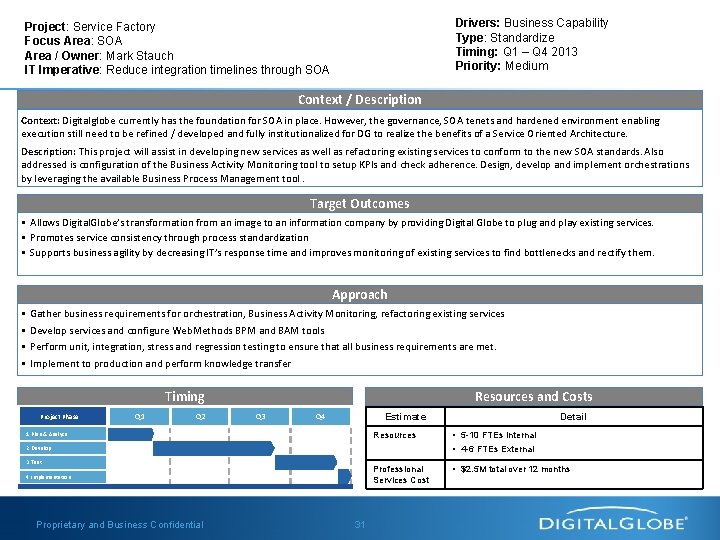
Drivers: Business Capability Type: Standardize Timing: Q 1 – Q 4 2013 Priority: Medium Project: Service Factory Focus Area: SOA Area / Owner: Mark Stauch IT Imperative: Reduce integration timelines through SOA Context / Description Context: Digitalglobe currently has the foundation for SOA in place. However, the governance, SOA tenets and hardened environment enabling execution still need to be refined / developed and fully institutionalized for DG to realize the benefits of a Service Oriented Architecture. Description: This project will assist in developing new services as well as refactoring existing services to conform to the new SOA standards. Also addressed is configuration of the Business Activity Monitoring tool to setup KPIs and check adherence. Design, develop and implement orchestrations by leveraging the available Business Process Management tool. Target Outcomes • Allows Digital. Globe’s transformation from an image to an information company by providing Digital Globe to plug and play existing services. • Promotes service consistency through process standardization • Supports business agility by decreasing IT’s response time and improves monitoring of existing services to find bottlenecks and rectify them. Approach • Gather business requirements for orchestration, Business Activity Monitoring, refactoring existing services • Develop services and configure Web. Methods BPM and BAM tools • Perform unit, integration, stress and regression testing to ensure that all business requirements are met. • Implement to production and perform knowledge transfer Timing Project Phase Q 1 Q 2 Resources and Costs Q 3 Estimate Q 4 1. Plan & Analyze Resources • 5 -10 FTEs Internal • 4 -6 FTEs External Professional Services Cost • $2. 5 M total over 12 months 2. Develop 3. Test 4. Implementation Proprietary and Business Confidential 31 Detail
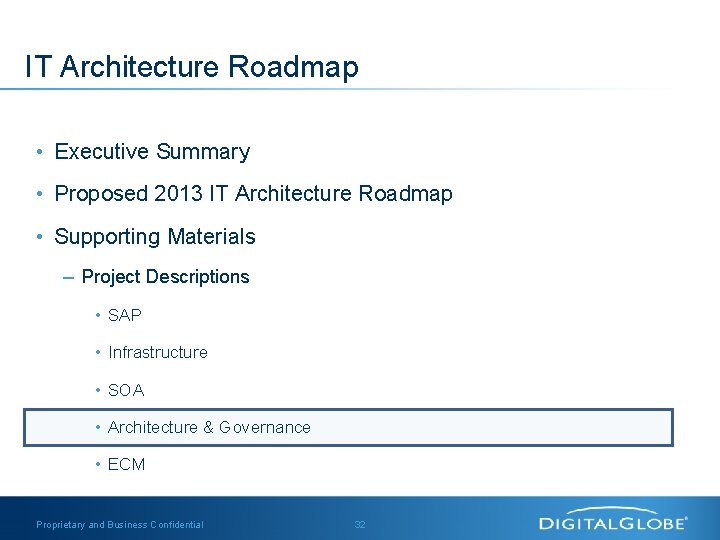
IT Architecture Roadmap • Executive Summary • Proposed 2013 IT Architecture Roadmap • Supporting Materials – Project Descriptions • SAP • Infrastructure • SOA • Architecture & Governance • ECM Proprietary and Business Confidential 32
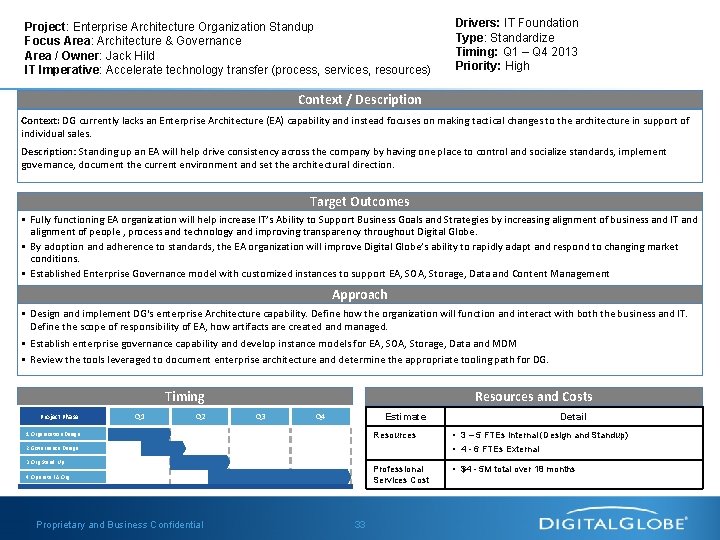
Project: Enterprise Architecture Organization Standup Focus Area: Architecture & Governance Area / Owner: Jack Hild IT Imperative: Accelerate technology transfer (process, services, resources) Drivers: IT Foundation Type: Standardize Timing: Q 1 – Q 4 2013 Priority: High Context / Description Context: DG currently lacks an Enterprise Architecture (EA) capability and instead focuses on making tactical changes to the architecture in support of individual sales. Description: Standing up an EA will help drive consistency across the company by having one place to control and socialize standards, implement governance, document the current environment and set the architectural direction. Target Outcomes • Fully functioning EA organization will help increase IT’s Ability to Support Business Goals and Strategies by increasing alignment of business and IT and alignment of people , process and technology and improving transparency throughout Digital Globe. • By adoption and adherence to standards, the EA organization will improve Digital Globe’s ability to rapidly adapt and respond to changing market conditions. • Established Enterprise Governance model with customized instances to support EA, SOA, Storage, Data and Content Management Approach • Design and implement DG's enterprise Architecture capability. Define how the organization will function and interact with both the business and IT. Define the scope of responsibility of EA, how artifacts are created and managed. • Establish enterprise governance capability and develop instance models for EA, SOA, Storage, Data and MDM • Review the tools leveraged to document enterprise architecture and determine the appropriate tooling path for DG. Timing Project Phase Q 1 Q 2 Resources and Costs Q 3 Estimate Q 4 1. Organization Design Resources • 3 – 5 FTEs Internal (Design and Standup) • 4 - 6 FTEs External Professional Services Cost • $4 - 5 M total over 18 months 2. Governance Design 3. Org Stand Up 4. Operate EA Org Proprietary and Business Confidential 33 Detail
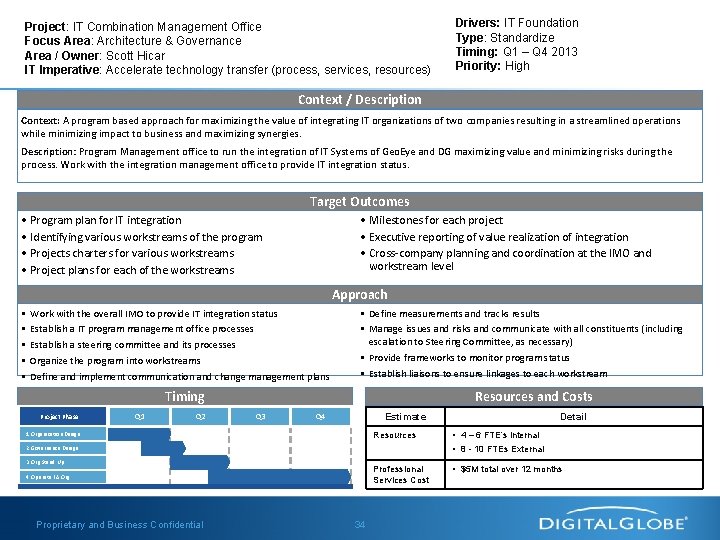
Project: IT Combination Management Office Focus Area: Architecture & Governance Area / Owner: Scott Hicar IT Imperative: Accelerate technology transfer (process, services, resources) Drivers: IT Foundation Type: Standardize Timing: Q 1 – Q 4 2013 Priority: High Context / Description Context: A program based approach for maximizing the value of integrating IT organizations of two companies resulting in a streamlined operations while minimizing impact to business and maximizing synergies. Description: Program Management office to run the integration of IT Systems of Geo. Eye and DG maximizing value and minimizing risks during the process. Work with the integration management office to provide IT integration status. Target Outcomes • Program plan for IT integration • Identifying various workstreams of the program • Projects charters for various workstreams • Project plans for each of the workstreams • Milestones for each project • Executive reporting of value realization of integration • Cross-company planning and coordination at the IMO and workstream level Approach • • Work with the overall IMO to provide IT integration status Establish a IT program management office processes Establish a steering committee and its processes Organize the program into workstreams Define and implement communication and change management plans • Define measurements and tracks results • Manage issues and risks and communicate with all constituents (including escalation to Steering Committee, as necessary) • Provide frameworks to monitor program status • Establish liaisons to ensure linkages to each workstream Develop processes and tools for. Timing management of the transition Lead LD 1 planning Project Phase Q 1 Q 2 Q 3 Resources and Costs Estimate Q 4 1. Organization Design Resources • 4 – 6 FTE’s internal • 8 - 10 FTEs External Professional Services Cost • $5 M total over 12 months 2. Governance Design 3. Org Stand Up 4. Operate EA Org Proprietary and Business Confidential 34 Detail
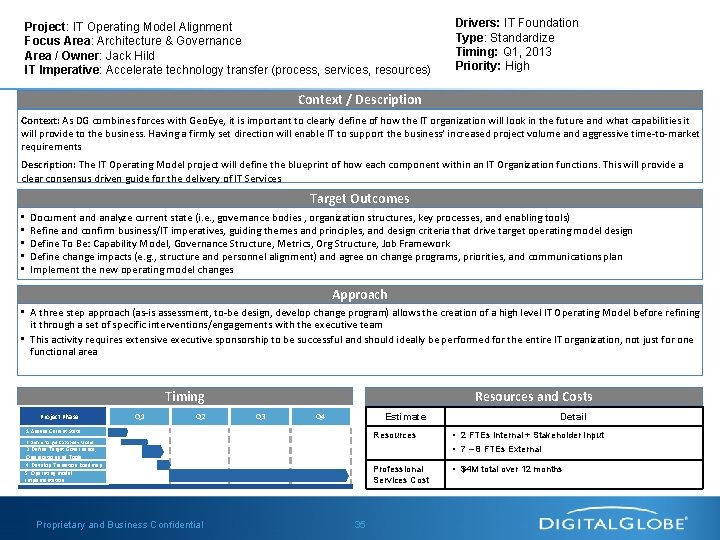
Project: IT Operating Model Alignment Focus Area: Architecture & Governance Area / Owner: Jack Hild IT Imperative: Accelerate technology transfer (process, services, resources) Drivers: IT Foundation Type: Standardize Timing: Q 1, 2013 Priority: High Context / Description Context: As DG combines forces with Geo. Eye, it is important to clearly define of how the IT organization will look in the future and what capabilities it will provide to the business. Having a firmly set direction will enable IT to support the business’ increased project volume and aggressive time-to-market requirements Description: The IT Operating Model project will define the blueprint of how each component within an IT Organization functions. This will provide a clear consensus driven guide for the delivery of IT Services Target Outcomes • • • Document and analyze current state (i. e. , governance bodies , organization structures, key processes, and enabling tools) Refine and confirm business/IT imperatives, guiding themes and principles, and design criteria that drive target operating model design Define To Be: Capability Model, Governance Structure, Metrics, Org Structure, Job Framework Define change impacts (e. g. , structure and personnel alignment) and agree on change programs, priorities, and communications plan Implement the new operating model changes Approach • A three step approach (as-is assessment, to-be design, develop change program) allows the creation of a high level IT Operating Model before refining it through a set of specific interventions/engagements with the executive team • This activity requires extensive executive sponsorship to be successful and should ideally be performed for the entire IT organization, not just for one functional area Timing Project Phase Q 1 Q 2 Resources and Costs Q 3 Estimate Q 4 1. Assess Current State 2. Define Target Capability Model 3. Define Target Governance, Organization and Tools 4. Develop Transition Roadmap 5. Operating model implementation Proprietary and Business Confidential 35 Detail Resources • 2 FTEs Internal + Stakeholder Input • 7 – 8 FTEs External Professional Services Cost • $4 M total over 12 months
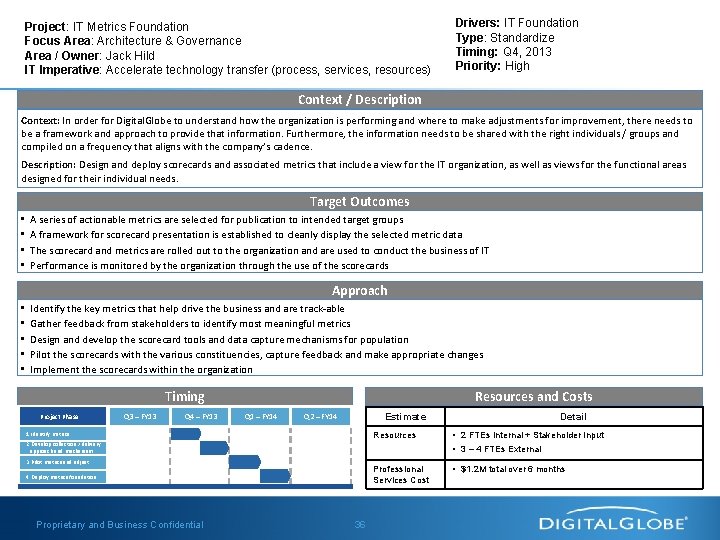
Project: IT Metrics Foundation Focus Area: Architecture & Governance Area / Owner: Jack Hild IT Imperative: Accelerate technology transfer (process, services, resources) Drivers: IT Foundation Type: Standardize Timing: Q 4, 2013 Priority: High Context / Description Context: In order for Digital. Globe to understand how the organization is performing and where to make adjustments for improvement, there needs to be a framework and approach to provide that information. Furthermore, the information needs to be shared with the right individuals / groups and compiled on a frequency that aligns with the company’s cadence. Description: Design and deploy scorecards and associated metrics that include a view for the IT organization, as well as views for the functional areas designed for their individual needs. Target Outcomes • • A series of actionable metrics are selected for publication to intended target groups A framework for scorecard presentation is established to cleanly display the selected metric data The scorecard and metrics are rolled out to the organization and are used to conduct the business of IT Performance is monitored by the organization through the use of the scorecards Approach • • • Identify the key metrics that help drive the business and are track-able Gather feedback from stakeholders to identify most meaningful metrics Design and develop the scorecard tools and data capture mechanisms for population Pilot the scorecards with the various constituencies, capture feedback and make appropriate changes Implement the scorecards within the organization Timing Project Phase Q 3 – FY 13 Q 4 – FY 13 Resources and Costs Q 1 – FY 14 Estimate Q 2 – FY 14 1. Identify metrics Resources • 2 FTEs Internal + Stakeholder Input • 3 – 4 FTEs External Professional Services Cost • $1. 2 M total over 6 months 2. Develop collection / delivery approach and mechanism 3. Pilot metrics and adjust 4. Deploy metrics foundation Proprietary and Business Confidential 36 Detail
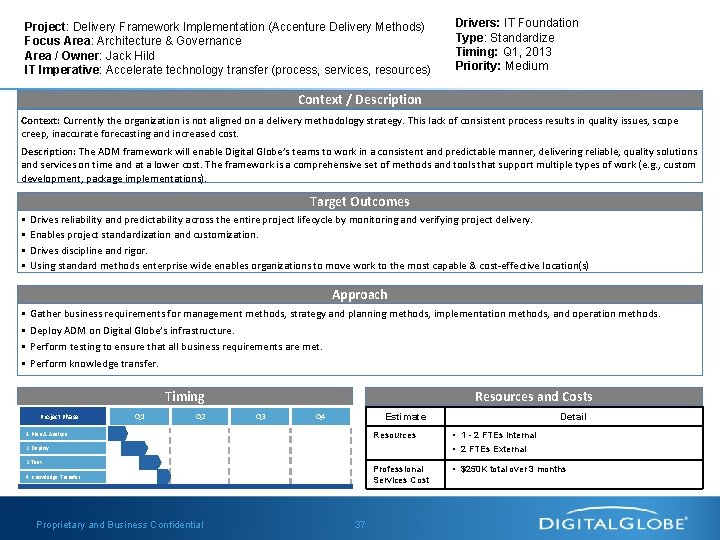
Project: Delivery Framework Implementation (Accenture Delivery Methods) Focus Area: Architecture & Governance Area / Owner: Jack Hild IT Imperative: Accelerate technology transfer (process, services, resources) Drivers: IT Foundation Type: Standardize Timing: Q 1, 2013 Priority: Medium Context / Description Context: Currently the organization is not aligned on a delivery methodology strategy. This lack of consistent process results in quality issues, scope creep, inaccurate forecasting and increased cost. Description: The ADM framework will enable Digital Globe’s teams to work in a consistent and predictable manner, delivering reliable, quality solutions and services on time and at a lower cost. The framework is a comprehensive set of methods and tools that support multiple types of work (e. g. , custom development, package implementations). Target Outcomes • Drives reliability and predictability across the entire project lifecycle by monitoring and verifying project delivery. • Enables project standardization and customization. • Drives discipline and rigor. • Using standard methods enterprise wide enables organizations to move work to the most capable & cost-effective location(s) Approach • Gather business requirements for management methods, strategy and planning methods, implementation methods, and operation methods. • Deploy ADM on Digital Globe’s infrastructure. • Perform testing to ensure that all business requirements are met. • Perform knowledge transfer. Timing Project Phase Q 1 Q 2 Resources and Costs Q 3 Estimate Q 4 1. Plan & Analyze Resources • 1 - 2 FTEs Internal • 2 FTEs External Professional Services Cost • $250 K total over 3 months 2. Deploy 3. Test 4. Knowledge Transfer Proprietary and Business Confidential 37 Detail
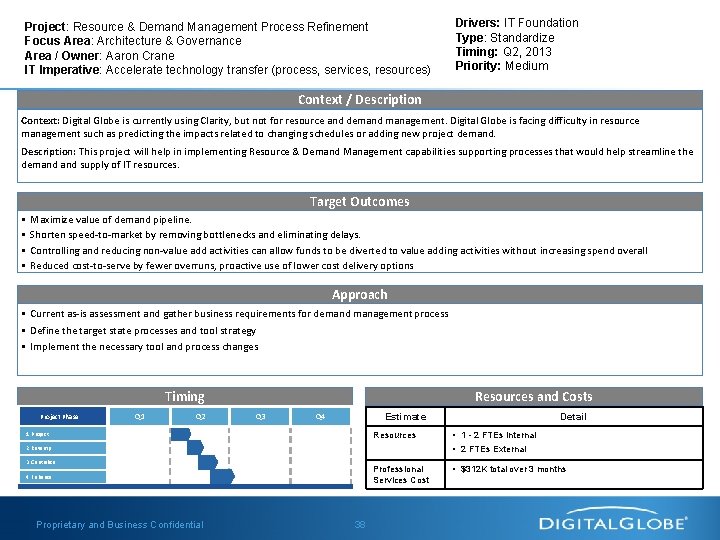
Project: Resource & Demand Management Process Refinement Focus Area: Architecture & Governance Area / Owner: Aaron Crane IT Imperative: Accelerate technology transfer (process, services, resources) Drivers: IT Foundation Type: Standardize Timing: Q 2, 2013 Priority: Medium Context / Description Context: Digital Globe is currently using Clarity, but not for resource and demand management. Digital Globe is facing difficulty in resource management such as predicting the impacts related to changing schedules or adding new project demand. Description: This project will help in implementing Resource & Demand Management capabilities supporting processes that would help streamline the demand supply of IT resources. Target Outcomes • Maximize value of demand pipeline. • Shorten speed-to-market by removing bottlenecks and eliminating delays. • Controlling and reducing non-value add activities can allow funds to be diverted to value adding activities without increasing spend overall • Reduced cost-to-serve by fewer overruns, proactive use of lower cost delivery options Approach • Current as-is assessment and gather business requirements for demand management process • Define the target state processes and tool strategy • Implement the necessary tool and process changes Timing Project Phase Q 1 Q 2 Resources and Costs Q 3 Estimate Q 4 1. Project Resources • 1 - 2 FTEs Internal • 2 FTEs External Professional Services Cost • $312 K total over 3 months 2. Revamp 3. Centralize 4. Enhance Proprietary and Business Confidential 38 Detail

IT Architecture Roadmap • Executive Summary • Proposed 2013 IT Architecture Roadmap • Supporting Materials – Project Descriptions • SAP • Infrastructure • SOA • Architecture & Governance • ECM Proprietary and Business Confidential 39
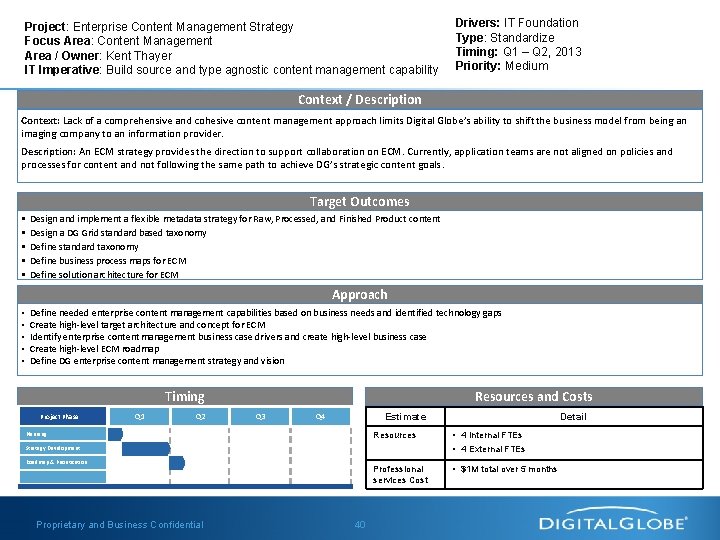
Project: Enterprise Content Management Strategy Focus Area: Content Management Area / Owner: Kent Thayer IT Imperative: Build source and type agnostic content management capability Drivers: IT Foundation Type: Standardize Timing: Q 1 – Q 2, 2013 Priority: Medium Context / Description Context: Lack of a comprehensive and cohesive content management approach limits Digital Globe’s ability to shift the business model from being an imaging company to an information provider. Description: An ECM strategy provides the direction to support collaboration on ECM. Currently, application teams are not aligned on policies and processes for content and not following the same path to achieve DG’s strategic content goals. Target Outcomes • • • Design and implement a flexible metadata strategy for Raw, Processed, and Finished Product content Design a DG Grid standard based taxonomy Define standard taxonomy Define business process maps for ECM Define solution architecture for ECM Approach • • • Define needed enterprise content management capabilities based on business needs and identified technology gaps Create high-level target architecture and concept for ECM Identify enterprise content management business case drivers and create high-level business case Create high-level ECM roadmap Define DG enterprise content management strategy and vision Timing Project Phase Q 1 Q 2 Resources and Costs Q 3 Estimate Q 4 Planning Resources • 4 Internal FTEs • 4 External FTEs Professional services Cost • $1 M total over 5 months Strategy Development Roadmap & Prioritization Proprietary and Business Confidential 40 Detail
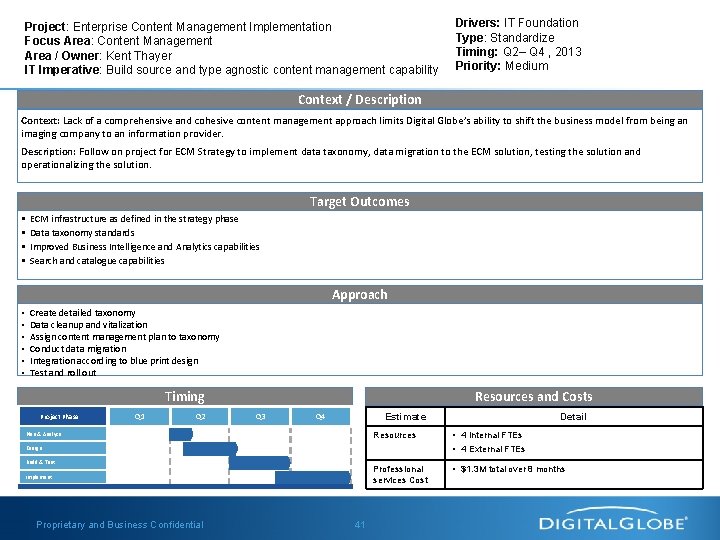
Project: Enterprise Content Management Implementation Focus Area: Content Management Area / Owner: Kent Thayer IT Imperative: Build source and type agnostic content management capability Drivers: IT Foundation Type: Standardize Timing: Q 2– Q 4 , 2013 Priority: Medium Context / Description Context: Lack of a comprehensive and cohesive content management approach limits Digital Globe’s ability to shift the business model from being an imaging company to an information provider. Description: Follow on project for ECM Strategy to implement data taxonomy, data migration to the ECM solution, testing the solution and operationalizing the solution. Target Outcomes • • ECM infrastructure as defined in the strategy phase Data taxonomy standards Improved Business Intelligence and Analytics capabilities Search and catalogue capabilities Approach • • • Create detailed taxonomy Data cleanup and vitalization Assign content management plan to taxonomy Conduct data migration Integration according to blue print design Test and roll out Timing Project Phase Q 1 Q 2 Resources and Costs Q 3 Estimate Q 4 Plan & Analyze Resources • 4 Internal FTEs • 4 External FTEs Professional services Cost • $1. 3 M total over 8 months Design Build & Test Implement Proprietary and Business Confidential 41 Detail
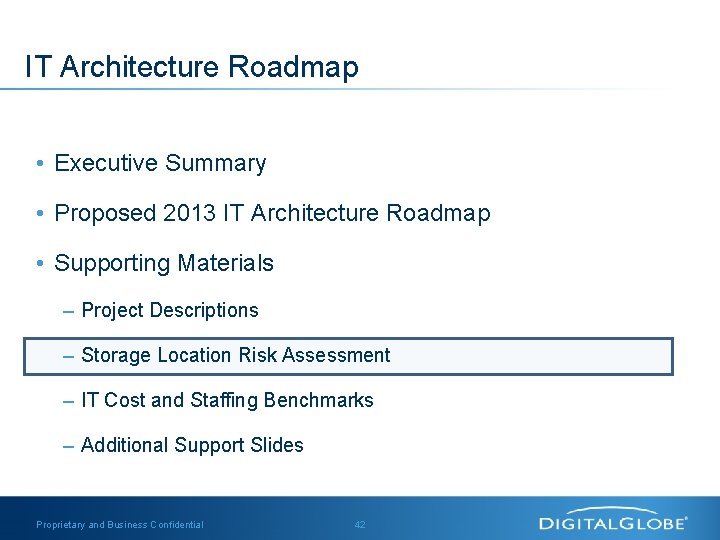
IT Architecture Roadmap • Executive Summary • Proposed 2013 IT Architecture Roadmap • Supporting Materials – Project Descriptions – Storage Location Risk Assessment – IT Cost and Staffing Benchmarks – Additional Support Slides Proprietary and Business Confidential 42
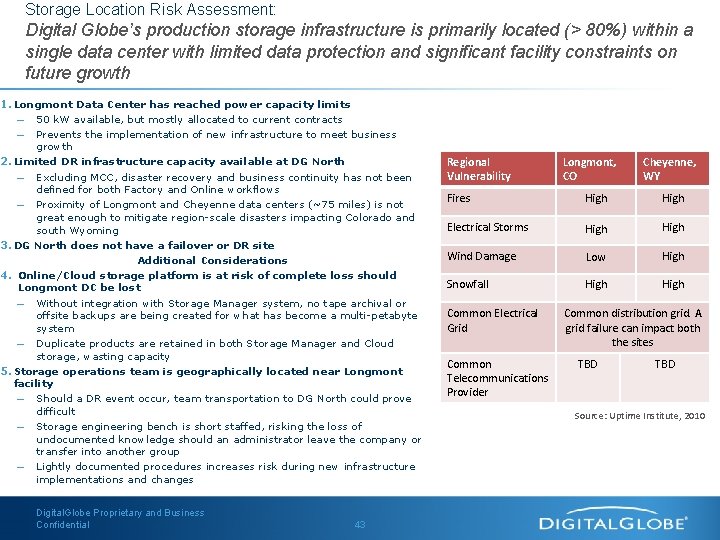
Storage Location Risk Assessment: Digital Globe’s production storage infrastructure is primarily located (> 80%) within a single data center with limited data protection and significant facility constraints on future growth 1. Longmont Data Center has reached power capacity limits – 50 k. W available, but mostly allocated to current contracts – Prevents the implementation of new infrastructure to meet business growth 2. Limited DR infrastructure capacity available at DG North – Excluding MCC, disaster recovery and business continuity has not been defined for both Factory and Online workflows – Proximity of Longmont and Cheyenne data centers (~75 miles) is not great enough to mitigate region-scale disasters impacting Colorado and south Wyoming 3. DG North does not have a failover or DR site Additional Considerations 4. Online/Cloud storage platform is at risk of complete loss should Longmont DC be lost – Without integration with Storage Manager system, no tape archival or offsite backups are being created for what has become a multi-petabyte system – Duplicate products are retained in both Storage Manager and Cloud storage, wasting capacity 5. Storage operations team is geographically located near Longmont facility – Should a DR event occur, team transportation to DG North could prove difficult – Storage engineering bench is short staffed, risking the loss of undocumented knowledge should an administrator leave the company or transfer into another group – Lightly documented procedures increases risk during new infrastructure implementations and changes Digital. Globe Proprietary and Business Confidential 43 Regional Vulnerability Longmont, CO Cheyenne, WY Fires High Electrical Storms High Wind Damage Low High Snowfall High Common Electrical Grid Common Telecommunications Provider Common distribution grid. A grid failure can impact both the sites TBD Source: Uptime Institute, 2010
IT Architecture Roadmap • Executive Summary • Proposed 2013 IT Architecture Roadmap • Supporting Materials – Project Descriptions – Storage Location Risk Assessment – IT Cost and Staffing Benchmarks – Additional Support Slides Proprietary and Business Confidential 44
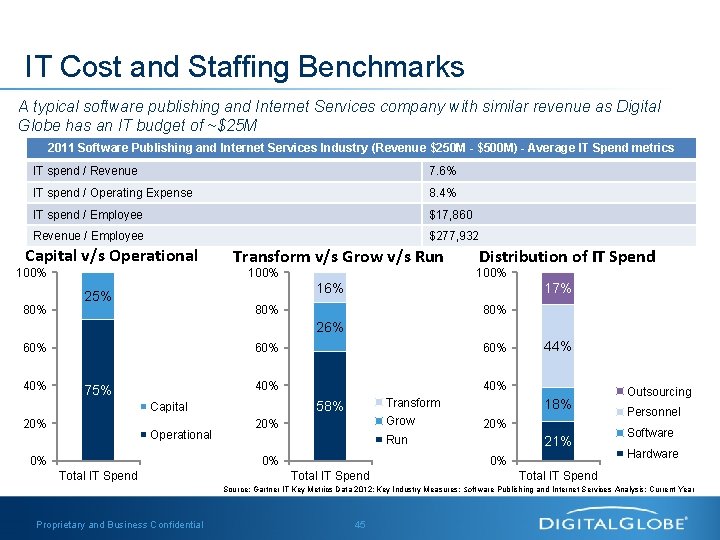
IT Cost and Staffing Benchmarks A typical software publishing and Internet Services company with similar revenue as Digital Globe has an IT budget of ~$25 M 2011 Software Publishing and Internet Services Industry (Revenue $250 M - $500 M) - Average IT Spend metrics IT spend / Revenue 7. 6% IT spend / Operating Expense 8. 4% IT spend / Employee $17, 860 Revenue / Employee $277, 932 Capital v/s Operational 100% 80% Transform v/s Grow v/s Run 100% Distribution of IT Spend 100% 16% 25% 17% 80% 26% 60% 40% 75% 60% 40% 58% Capital 20% Operational 0% Transform Grow 20% Total IT Spend 18% 20% Run 0% 44% 21% 0% Total IT Spend Outsourcing Personnel Software Hardware Total IT Spend Source: Gartner IT Key Metrics Data 2012: Key Industry Measures: Software Publishing and Internet Services Analysis: Current Year Proprietary and Business Confidential 45
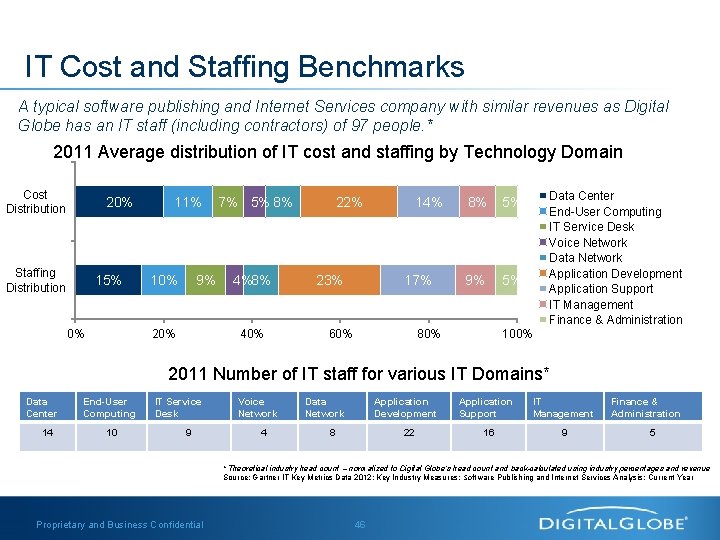
IT Cost and Staffing Benchmarks A typical software publishing and Internet Services company with similar revenues as Digital Globe has an IT staff (including contractors) of 97 people. * 2011 Average distribution of IT cost and staffing by Technology Domain Cost Distribution 20% Staffing Distribution 15% 0% 11% 10% 9% 20% 7% 5% 8% 4%8% 40% 22% 23% 14% 17% 60% 8% 5% 9% 5% 80% Data Center End-User Computing IT Service Desk Voice Network Data Network Application Development Application Support IT Management Finance & Administration 100% 2011 Number of IT staff for various IT Domains* Data Center 14 End-User Computing 10 IT Service Desk 9 Voice Network 4 Data Network Application Development 8 22 Application Support IT Management 16 9 Finance & Administration 5 * Theoretical industry head count – normalized to Digital Globe’s head count and back-calculated using industry percentages and revenue Source: Gartner IT Key Metrics Data 2012: Key Industry Measures: Software Publishing and Internet Services Analysis: Current Year Proprietary and Business Confidential 46
IT Architecture Roadmap • Executive Summary • Proposed 2013 IT Architecture Roadmap • Supporting Materials – Project Descriptions – Storage Location Risk Assessment – IT Cost and Staffing Benchmarks – Additional Support Slides Proprietary and Business Confidential 47
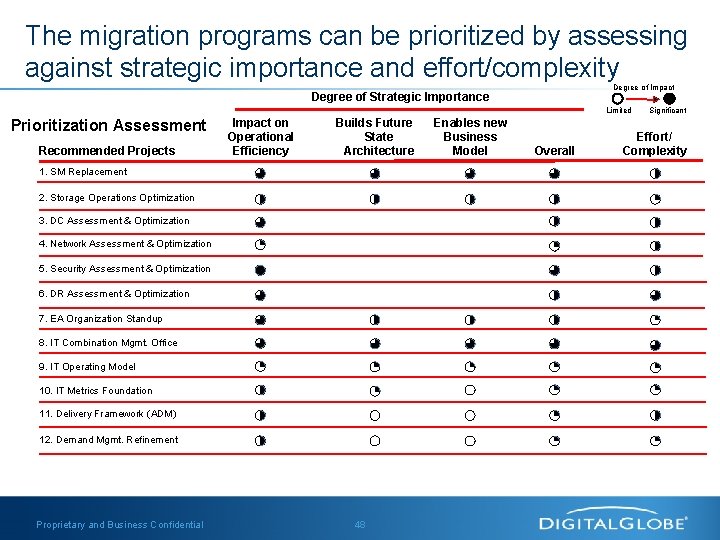
The migration programs can be prioritized by assessing against strategic importance and effort/complexity Degree of Impact Degree of Strategic Importance Limited Prioritization Assessment Recommended Projects Impact on Operational Efficiency Builds Future State Architecture 1. SM Replacement 2. Storage Operations Optimization 3. DC Assessment & Optimization 4. Network Assessment & Optimization 5. Security Assessment & Optimization 6. DR Assessment & Optimization 7. EA Organization Standup 8. IT Combination Mgmt. Office 9. IT Operating Model 10. IT Metrics Foundation 11. Delivery Framework (ADM) 12. Demand Mgmt. Refinement Proprietary and Business Confidential 48 Enables new Business Model Overall Significant Effort/ Complexity
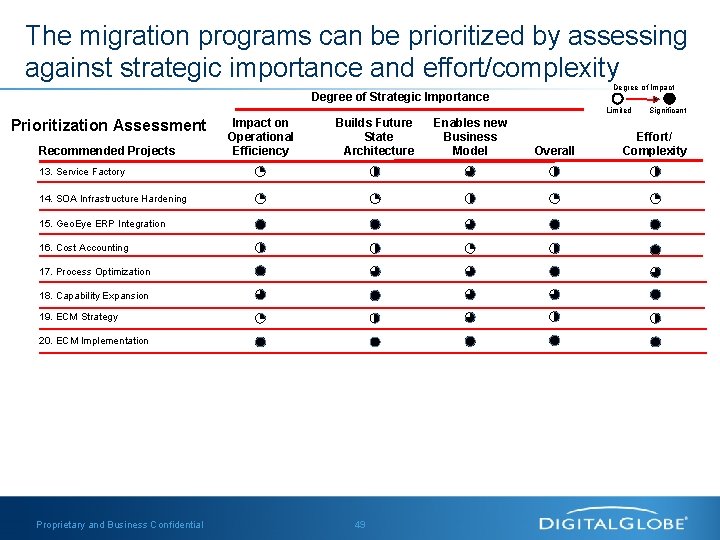
The migration programs can be prioritized by assessing against strategic importance and effort/complexity Degree of Impact Degree of Strategic Importance Limited Prioritization Assessment Recommended Projects Impact on Operational Efficiency Builds Future State Architecture 13. Service Factory 14. SOA Infrastructure Hardening 15. Geo. Eye ERP Integration 16. Cost Accounting 17. Process Optimization 18. Capability Expansion 19. ECM Strategy 20. ECM Implementation Proprietary and Business Confidential 49 Enables new Business Model Overall Significant Effort/ Complexity
- Slides: 49