
October 28 2020 Mississippis Natural Environment Landforms and
October 28, 2020 Mississippi’s Natural Environment Landforms and Biota 1
2 October 28, 2020 Landform regions of the state Landforms are physical and geographical divisions and MS lies within the Gulf Coastal Plain region. Elevation-height of the land above sea level Topography are the physical features such as mountains or plateaus. Most of MS is rolling hills. Highest point in MS is Woodall Mountain in Tishomingo County and is 806 feet above sea level.
3 October 28, 2020 Distinct Landform regions North Eastern Corner: The Tombigbee Hills The Black Prairie The Pontotoc Ridge The Flatwoods The Central/East: The North Central Hills The Loess Hills The Yazoo Basin
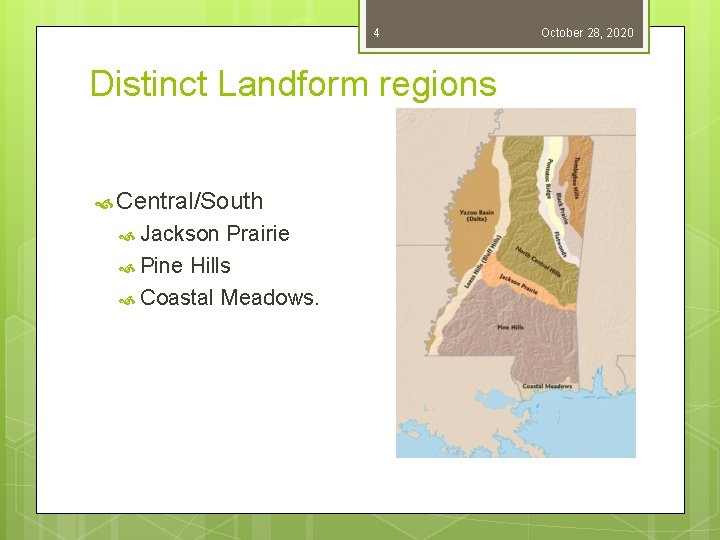
4 Distinct Landform regions Central/South Jackson Prairie Pine Hills Coastal Meadows. October 28, 2020
5 October 28, 2020 Soil types and regions Alluvial soil is soil that is deposited by water. Loams soil is a combination of the three (sand, silt, clay) textures. Loess soils (of the Loess Hills) are fertile and important for agriculture. Black Prairie clay is soils that develop large cracks during the dry season and swell with moisture during times of more rainfall.
6 October 28, 2020 Biota is a term used to describe the flora and fauna of a region. Flora refers to the natural vegetation on the land. Fauna refers to the animal life of a particular area.
7 October 28, 2020 Ecoregions Ecology is concerned interrelationships between life forms and their environment. Ecosystem is a group of organisms and their environment that function as a ecological unit in nature. Ecoregions are geographical areas on Earth’s surface where organisms interact with the environment and function similarly. Remote sensing is the process of collecting, storing, and extracting environmental information from the images of the ground. Geographic Information System (GIS) is an information system specifically designed to analyze environmental information about Earth.
- Slides: 7