
October 21 2020 DeIdentification Anonymization Protecting Data Privacy
October 21, 2020 De-Identification + Anonymization: Protecting Data Privacy + Preserving Data Utility under HIPAA, CCPA + the GDPR Daniel Barth-Jones Assistant Professor of Clinical Epidemiology, Mailman School of Public Health, Columbia University Fielding Greaves Sr. Director, State & Regional Government Affairs Advanced Medical Technology Association (Adva. Med) James Janisse Assistant Professor Department of Family Medicine and Public Health Sciences Wayne State University Kristen Rosati Partner, Coppersmith Brockelman PLC Ann Waldo Principal, Waldo Law Offices
Speaker Kristen Rosati Partner, Coppersmith Brockelman PLC Kristen is considered one of the nation’s leading “Big Data” and HIPAA compliance attorneys. She has deep experience in data sharing for research and clinical integration initiatives, data breaches, health information exchange, clinical research compliance, and biobanking and genomic privacy. Kristen is a sought-after national speaker on these issues and has been active in national healthcare policy. Kristen is Past President (2013 -2014) of the American Health Law Association (AHLA), the nation’s largest health care legal organization. Kristen received her B. A. , with high honors, and her J. D. , cum laude, from the University of Michigan. She clerked for the late Judge Thomas Tang of the U. S. Court of Appeals for the Ninth Circuit and for the late Judge Earl H. Carroll of the U. S. District Court for the District of Arizona.
Agenda • An overview of the laws that govern de-identification • A deep dive into HIPAA de-identification and some of the challenging issues presented
A Complicated Web of Laws Regulating De-Identification • US federal law HIPAA Common Rule FDA regulations for clinical trials NIH policies (the Clinical Trials Policy and regulations regarding Certificates of Confidentiality) • Federal substance use disorder treatment regulations (the “Part 2 regulations”) • • • US state laws • Consumer privacy protection laws (e. g. , the California Consumer Protection Act) • State health information confidentiality laws • State licensure requirements • EU General Data Protection Regulation – and individual countries’ laws throughout the world 4
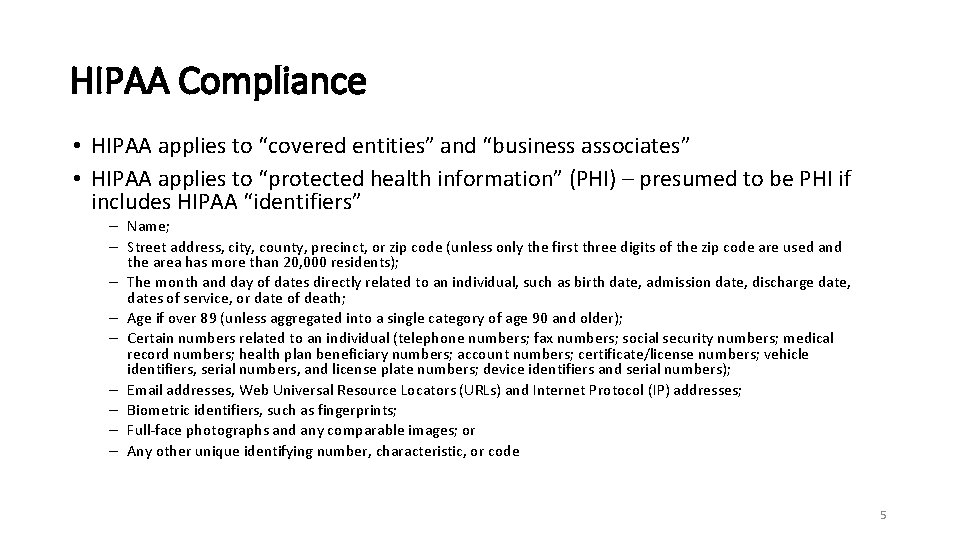
HIPAA Compliance • HIPAA applies to “covered entities” and “business associates” • HIPAA applies to “protected health information” (PHI) – presumed to be PHI if includes HIPAA “identifiers” – Name; – Street address, city, county, precinct, or zip code (unless only the first three digits of the zip code are used and the area has more than 20, 000 residents); – The month and day of dates directly related to an individual, such as birth date, admission date, discharge date, dates of service, or date of death; – Age if over 89 (unless aggregated into a single category of age 90 and older); – Certain numbers related to an individual (telephone numbers; fax numbers; social security numbers; medical record numbers; health plan beneficiary numbers; account numbers; certificate/license numbers; vehicle identifiers, serial numbers, and license plate numbers; device identifiers and serial numbers); – Email addresses, Web Universal Resource Locators (URLs) and Internet Protocol (IP) addresses; – Biometric identifiers, such as fingerprints; – Full-face photographs and any comparable images; or – Any other unique identifying number, characteristic, or code 5
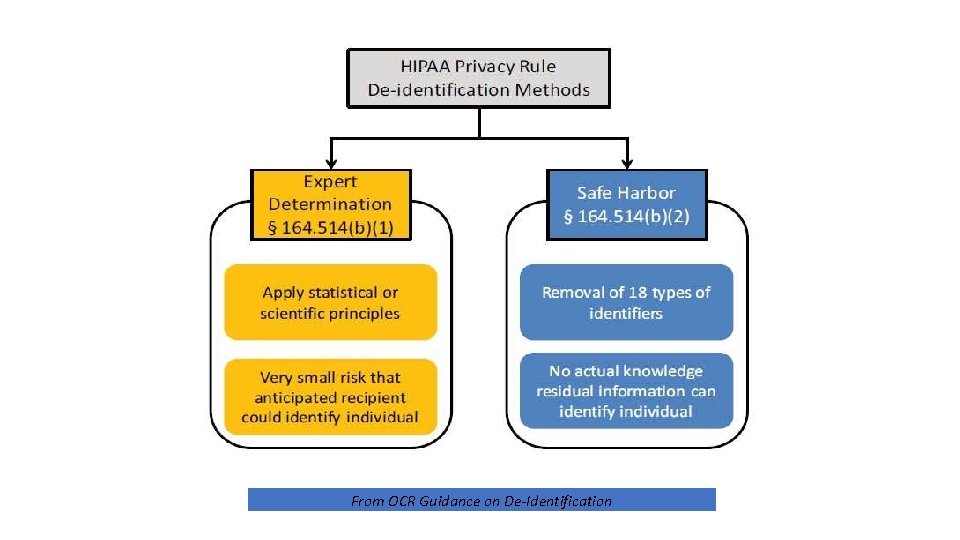
From OCR Guidance on De-Identification
HIPAA De-Identification • Office for Civil Rights (OCR) Guidance on De-Identification (11/25/12): https: //www. hhs. gov/sites/default/files/ocr/privacy/hipaa/understanding/coveredentities/Deidentification/hhs_deid_guidance. pdf • Frequent questions under the safe harbor de-identification method: • • • When does a discloser have “actual knowledge” that the recipient can identify an individual? What constitutes a “unique identifying number, characteristic, or code”? Does date-shifting meet the requirements of a “code” under the safe harbor? Can data use agreements be used to support findings of de-identification? Can genetic information be de-identified under the safe harbor? (See next slide) 7
HIPAA: Is Genetic Information PHI? • Genetic information is “health information” • Health information is PHI if it is “individually identifiable information”-- identifies the individual or “there is a reasonable basis to believe the information can be used to identify the individual” • OCR has concluded that not all genetic information is “individually identifiable, ” but has not provided guidance on when genetic information is individually identifiable • Common interpretation: genetic information is not PHI unless it is accompanied by HIPAA identifiers or unless you have actual knowledge the recipient has the ability to link the genetic information to a person’s identity 8
The Revised Common Rule • Applies to federally-funded human subjects research in the US • Significant changes • Potential changes to “identifiability” • New HIPAA exemption • New requirements for informed consent • New exemption for research with “broad consent” • New exemption for publicly available information • New rule for preparing for research • New rule on single IRB for collaborative research
Common Rule Compliance • Current definition of “identifiable private information”: “private information for which the identity of the subject is or may readily be ascertained by the investigator or associated with the information” • “Identifiability” may change over time • Requires agencies to assess within one year of final rule whethere are technologies or techniques that should be considered to generate identifiable private information, even if not accompanied by traditional identifiers (such as whole genome analysis) • May widen difference in interpretation of “non-identified” information under Common Rule (i. e. , investigator cannot readily ascertain identity of research participants) and “de-identified” under HIPAA 10
European Union General Data Protection Regulation (GDPR) • Jurisdictional reach: • Applies to organizations “established” (with a physical location) within the European Economic Area (EEA) • Applies to organizations outside the EEA that offer goods or services to data subjects within the EEA or monitor the behavior of data subjects within the EEA • Applies to EEA organization transfer of “Personal Data” to the United States • Applies to EEA “data controller” using “data processor” outside the EEA (regardless of residency of data subject) 11
GDPR • Personal data directly or indirectly identifies a living person • Name, identification number, location data, online identifiers, factors specific to the physical, psychological, genetic, mental, economic, cultural or social identity • More sensitive data have special protection • Genetic data, biometric data for the purpose of creating unique identification, data concerning health, data regarding race, religion, politics, sex • Treatment of de-identified data • No de-identification “safe harbor”– data is “anonymized” if under a “facts and circumstances” test, the data cannot be identified by any means “reasonably likely to be used … either by the controller or by another person” • “Pseudonymised” (coded) still personal data 12
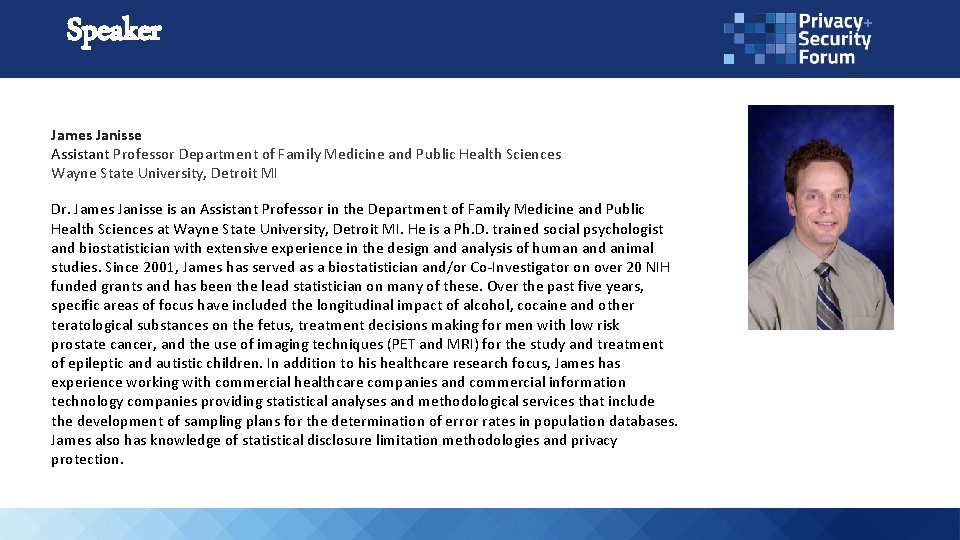
Speaker James Janisse Assistant Professor Department of Family Medicine and Public Health Sciences Wayne State University, Detroit MI Dr. James Janisse is an Assistant Professor in the Department of Family Medicine and Public Health Sciences at Wayne State University, Detroit MI. He is a Ph. D. trained social psychologist and biostatistician with extensive experience in the design and analysis of human and animal studies. Since 2001, James has served as a biostatistician and/or Co-Investigator on over 20 NIH funded grants and has been the lead statistician on many of these. Over the past five years, specific areas of focus have included the longitudinal impact of alcohol, cocaine and other teratological substances on the fetus, treatment decisions making for men with low risk prostate cancer, and the use of imaging techniques (PET and MRI) for the study and treatment of epileptic and autistic children. In addition to his healthcare research focus, James has experience working with commercial healthcare companies and commercial information technology companies providing statistical analyses and methodological services that include the development of sampling plans for the determination of error rates in population databases. James also has knowledge of statistical disclosure limitation methodologies and privacy protection.
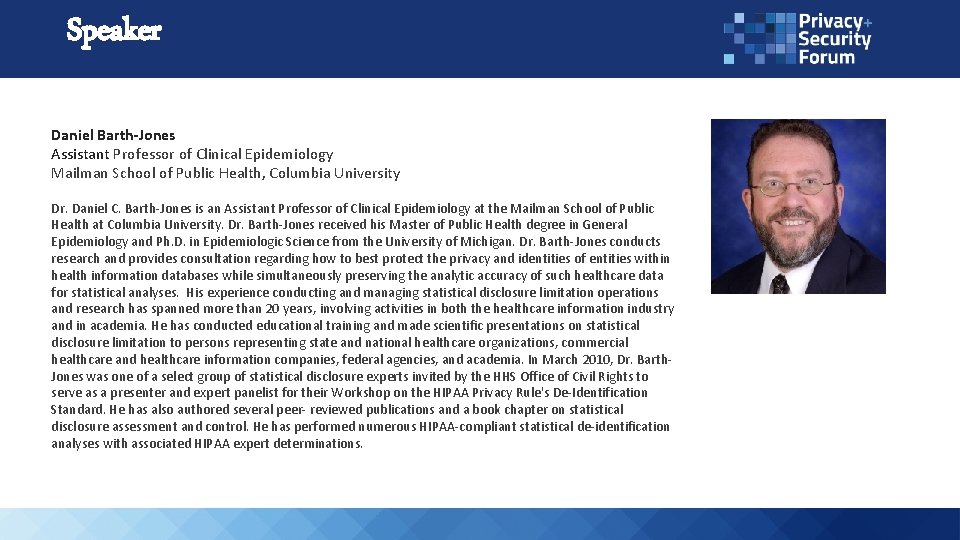
Speaker Daniel Barth-Jones Assistant Professor of Clinical Epidemiology Mailman School of Public Health, Columbia University Dr. Daniel C. Barth-Jones is an Assistant Professor of Clinical Epidemiology at the Mailman School of Public Health at Columbia University. Dr. Barth-Jones received his Master of Public Health degree in General Epidemiology and Ph. D. in Epidemiologic Science from the University of Michigan. Dr. Barth-Jones conducts research and provides consultation regarding how to best protect the privacy and identities of entities within health information databases while simultaneously preserving the analytic accuracy of such healthcare data for statistical analyses. His experience conducting and managing statistical disclosure limitation operations and research has spanned more than 20 years, involving activities in both the healthcare information industry and in academia. He has conducted educational training and made scientific presentations on statistical disclosure limitation to persons representing state and national healthcare organizations, commercial healthcare and healthcare information companies, federal agencies, and academia. In March 2010, Dr. Barth. Jones was one of a select group of statistical disclosure experts invited by the HHS Office of Civil Rights to serve as a presenter and expert panelist for their Workshop on the HIPAA Privacy Rule's De-Identification Standard. He has also authored several peer- reviewed publications and a book chapter on statistical disclosure assessment and control. He has performed numerous HIPAA-compliant statistical de-identification analyses with associated HIPAA expert determinations.
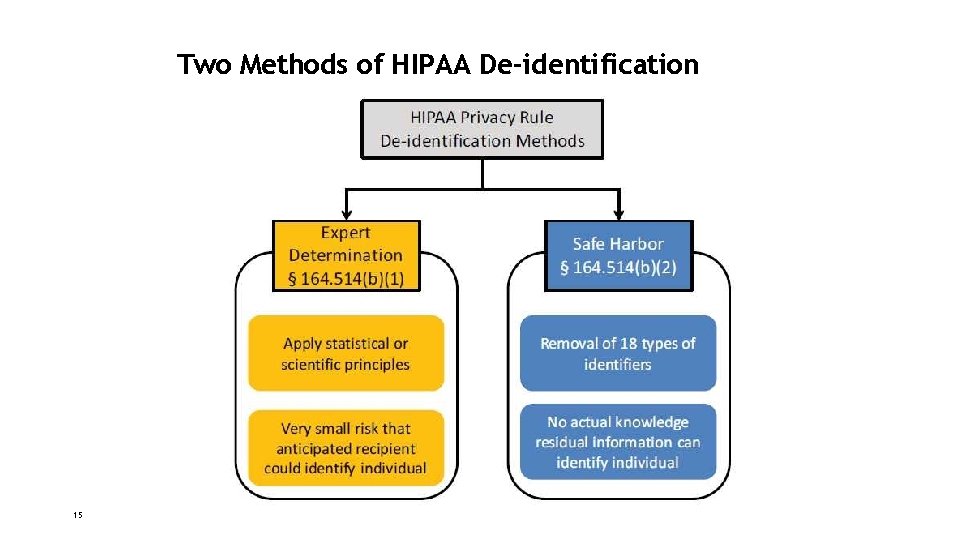
Two Methods of HIPAA De-identification 15
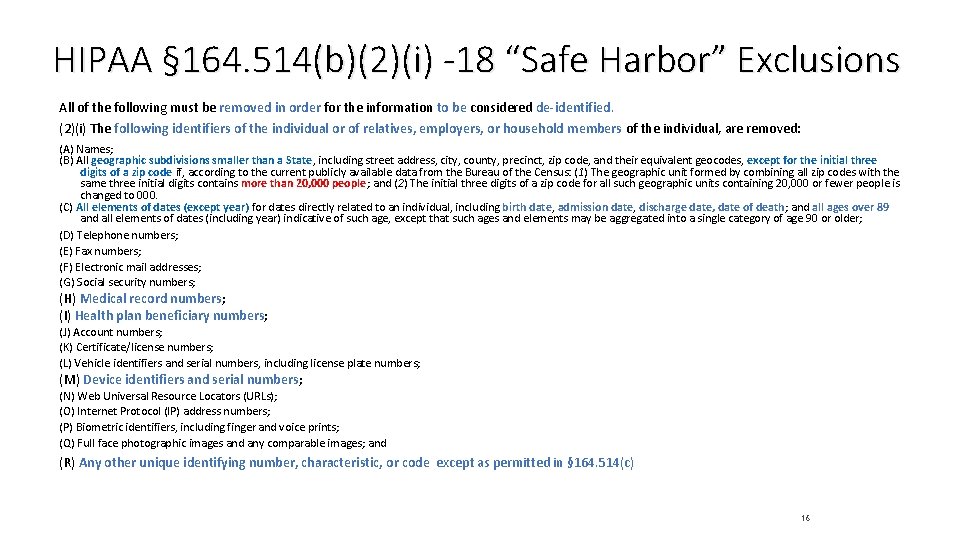
HIPAA § 164. 514(b)(2)(i) -18 “Safe Harbor” Exclusions All of the following must be removed in order for the information to be considered de-identified. (2)(i) The following identifiers of the individual or of relatives, employers, or household members of the individual, are removed: (A) Names; (B) All geographic subdivisions smaller than a State, including street address, city, county, precinct, zip code, and their equivalent geocodes, except for the initial three digits of a zip code if, according to the current publicly available data from the Bureau of the Census: (1) The geographic unit formed by combining all zip codes with the same three initial digits contains more than 20, 000 people; and (2) The initial three digits of a zip code for all such geographic units containing 20, 000 or fewer people is changed to 000. (C) All elements of dates (except year) for dates directly related to an individual, including birth date, admission date, discharge date, date of death; and all ages over 89 and all elements of dates (including year) indicative of such age, except that such ages and elements may be aggregated into a single category of age 90 or older; (D) Telephone numbers; (E) Fax numbers; (F) Electronic mail addresses; (G) Social security numbers; (H) Medical record numbers; (I) Health plan beneficiary numbers; (J) Account numbers; (K) Certificate/license numbers; (L) Vehicle identifiers and serial numbers, including license plate numbers; (M) Device identifiers and serial numbers; (N) Web Universal Resource Locators (URLs); (O) Internet Protocol (IP) address numbers; (P) Biometric identifiers, including finger and voice prints; (Q) Full face photographic images and any comparable images; and (R) Any other unique identifying number, characteristic, or code except as permitted in § 164. 514(c) 16
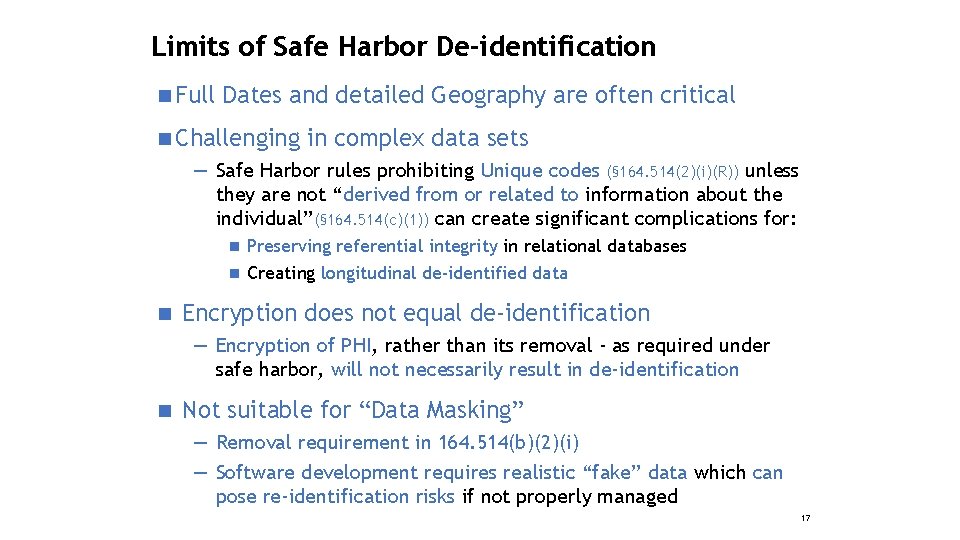
Limits of Safe Harbor De-identification n Full Dates and detailed Geography are often critical n Challenging in complex data sets — Safe Harbor rules prohibiting Unique codes (§ 164. 514(2)(i)(R)) unless they are not “derived from or related to information about the individual”(§ 164. 514(c)(1)) can create significant complications for: Preserving referential integrity in relational databases n Creating longitudinal de-identified data n n Encryption does not equal de-identification — Encryption of PHI, rather than its removal - as required under safe harbor, will not necessarily result in de-identification n Not suitable for “Data Masking” — Removal requirement in 164. 514(b)(2)(i) — Software development requires realistic “fake” data which can pose re-identification risks if not properly managed 17
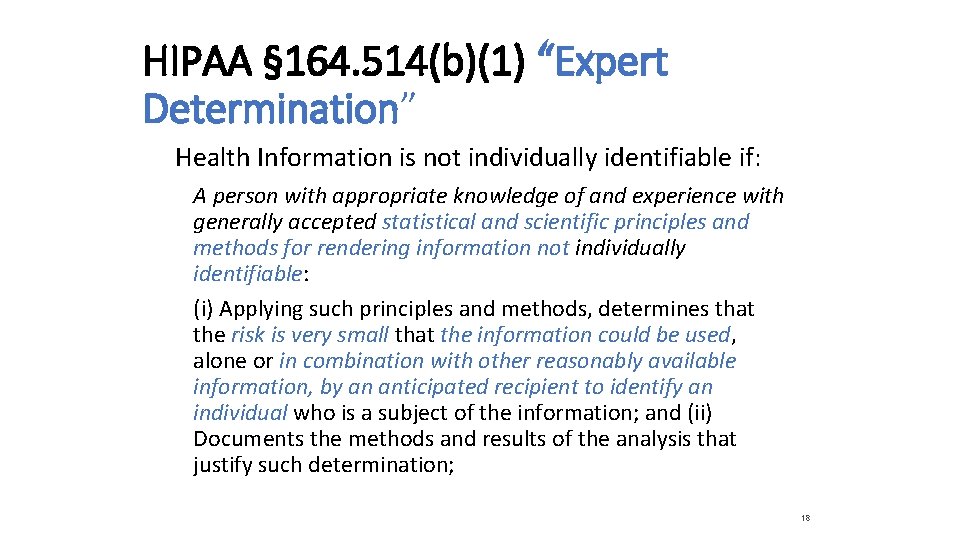
HIPAA § 164. 514(b)(1) “Expert Determination” Health Information is not individually identifiable if: A person with appropriate knowledge of and experience with generally accepted statistical and scientific principles and methods for rendering information not individually identifiable: (i) Applying such principles and methods, determines that the risk is very small that the information could be used, alone or in combination with other reasonably available information, by an anticipated recipient to identify an individual who is a subject of the information; and (ii) Documents the methods and results of the analysis that justify such determination; 18
19
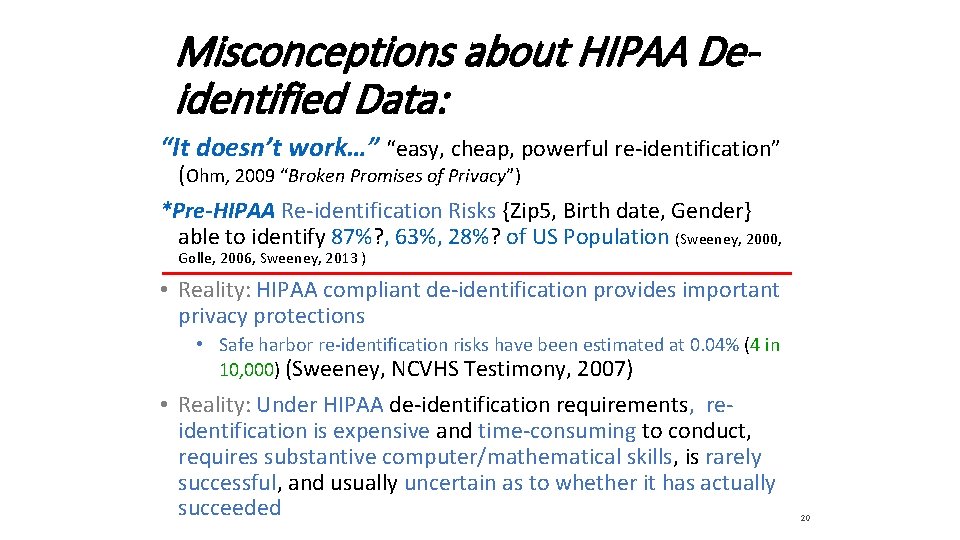
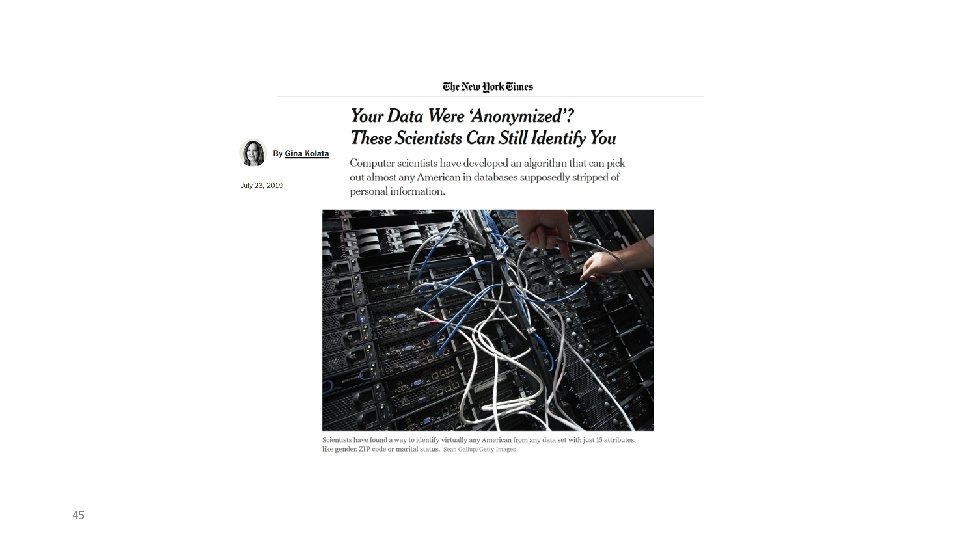
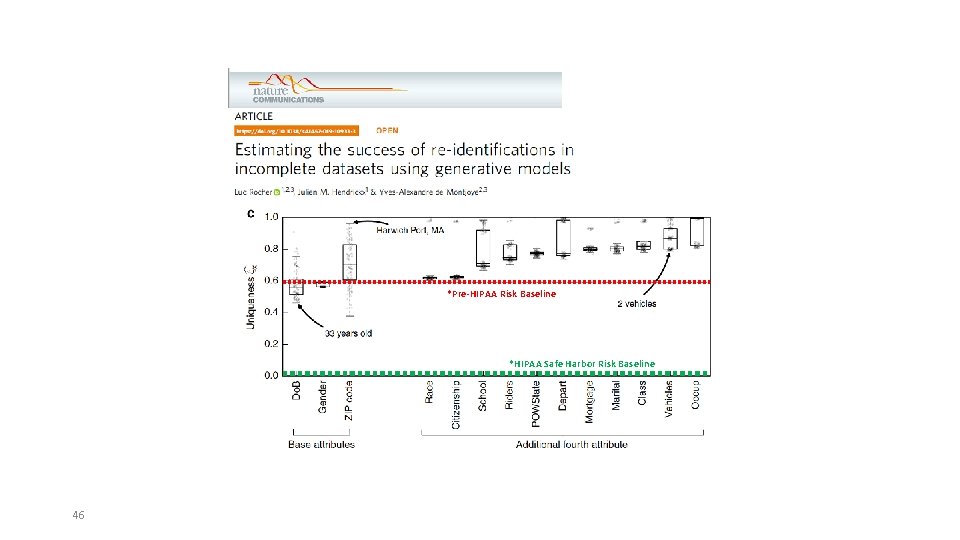
Misconceptions about HIPAA Deidentified Data: “It doesn’t work…” “easy, cheap, powerful re-identification” (Ohm, 2009 “Broken Promises of Privacy”) *Pre-HIPAA Re-identification Risks {Zip 5, Birth date, Gender} able to identify 87%? , 63%, 28%? of US Population (Sweeney, 2000, Golle, 2006, Sweeney, 2013 ) • Reality: HIPAA compliant de-identification provides important privacy protections • Safe harbor re-identification risks have been estimated at 0. 04% (4 in 10, 000) (Sweeney, NCVHS Testimony, 2007) • Reality: Under HIPAA de-identification requirements, reidentification is expensive and time-consuming to conduct, requires substantive computer/mathematical skills, is rarely successful, and usually uncertain as to whether it has actually succeeded 20
Misconceptions about HIPAA Deidentified Data: “It works perfectly and permanently…” • Reality: • Perfect de-identification is not possible. • De-identifying does not free data from all possible subsequent privacy concerns. • Data is never permanently “de-identified”… There is no 100% guarantee that de-identified data will remain de-identified regardless of what you do with it after it is de-identified. 21
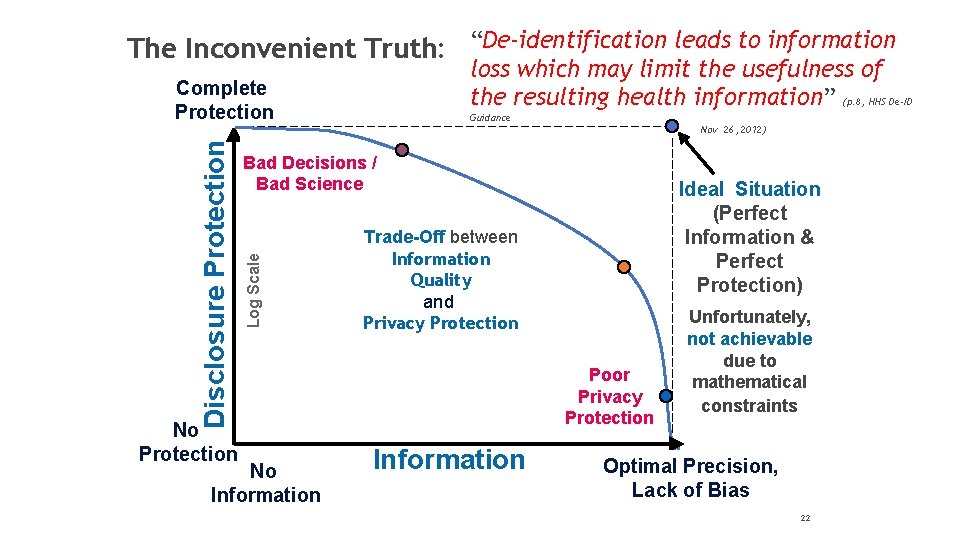
The Inconvenient Truth: “De-identification leads to information loss which may limit the usefulness of the resulting health information” (p. 8, HHS De-ID Complete Protection Guidance No Protection Bad Decisions / Bad Science Log Scale Disclosure Protection Nov 26, 2012) No Information Ideal Situation (Perfect Information & Perfect Protection) Trade-Off between Information Quality and Privacy Protection Poor Privacy Protection Information Unfortunately, not achievable due to mathematical constraints Optimal Precision, Lack of Bias 22
Successful Solutions: Balancing Disclosure Risk and Statistical Accuracy • When appropriately implemented, statistical de-identification seeks to protect and balance two vitally important societal interests: • 1) Protection of the privacy of individuals in healthcare data sets, (Disclosure or Identification Risk), and • 2) Preserving the utility and accuracy of statistical analyses performed with de-identified data (Loss of Information). • Limiting disclosure inevitably reduces the quality of statistical information to some degree, but the appropriate disclosure control methods result in small information losses while substantially reducing identifiability. 23
Permissible “Very Small” Risk • Privacy Rule permits a covered entity or its business associate to use and disclose information that it does not provide a reasonable basis to identify an individual. • Even when de-identification is properly applied, it will yield data that retains some risk of identification. Although the risk is very small, it is not zero. • There is some possibility that de-identified data could be linked back to the identity of the patient. 24
Expert Determination Data Set (EDDS) = Statistical De-identification Data Set (SDDS) • Expert Determination (or Statistical De-identification) often can be used to release some of the safe harbor “prohibited identifiers” provided that the risk of re-identification is “very small”. • For example, more detailed geography, dates of service or encryption codes could possibly be used within statistical deidentified data sets based on statistical disclosure analyses showing that the risks are very small. • However, disclosure analyses must be conducted to assess risks of re-identification (e. g. , encrypted data with strong statistical associations to unencrypted data can pose important re-identification risks) 25
Essential Re-identification Concepts • Essential Re-identification and Statistical Disclosure Concepts • Record Linkage • Linkage Keys (Quasi-identifiers) • Sample Uniques and Population Uniques • Straightforward Methods for Controlling Re-identification Risk • Decreasing Uniques: • by Reducing Key Resolutions • by Increasing Reporting Population Sizes 26
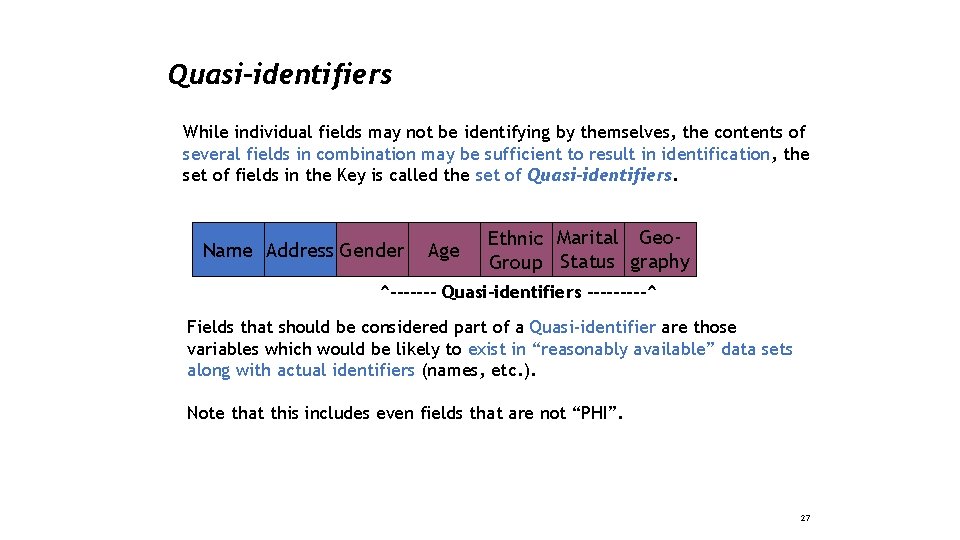
Quasi-identifiers While individual fields may not be identifying by themselves, the contents of several fields in combination may be sufficient to result in identification, the set of fields in the Key is called the set of Quasi-identifiers. Name Address Gender Age Ethnic Marital Geo. Group Status graphy ^------- Quasi-identifiers -----^ Fields that should be considered part of a Quasi-identifier are those variables which would be likely to exist in “reasonably available” data sets along with actual identifiers (names, etc. ). Note that this includes even fields that are not “PHI”. 27
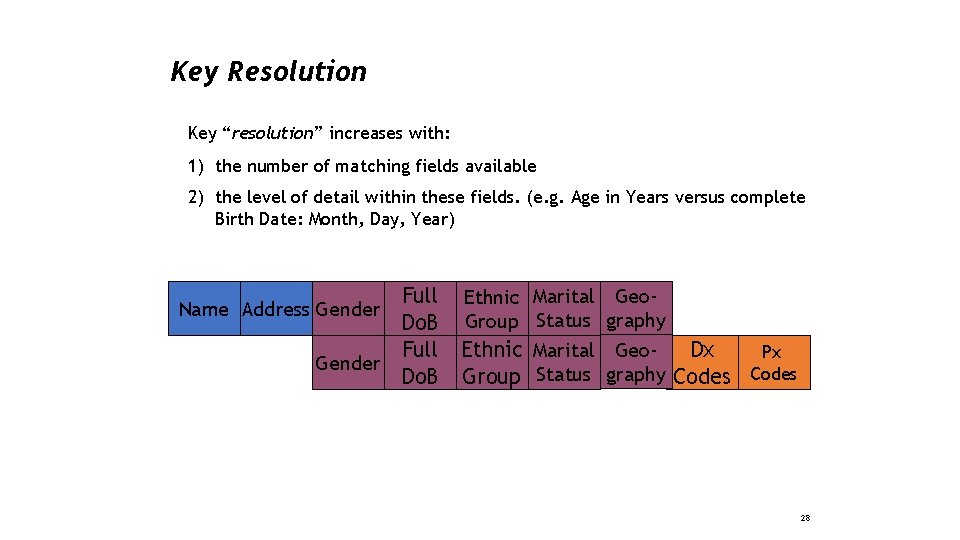
Key Resolution Key “resolution” increases with: 1) the number of matching fields available 2) the level of detail within these fields. (e. g. Age in Years versus complete Birth Date: Month, Day, Year) Full Do. B Full Gender Do. B Name Address Gender Ethnic Marital Geo. Group Status graphy Ethnic Marital Geo- Dx Px Group Status graphy Codes 28
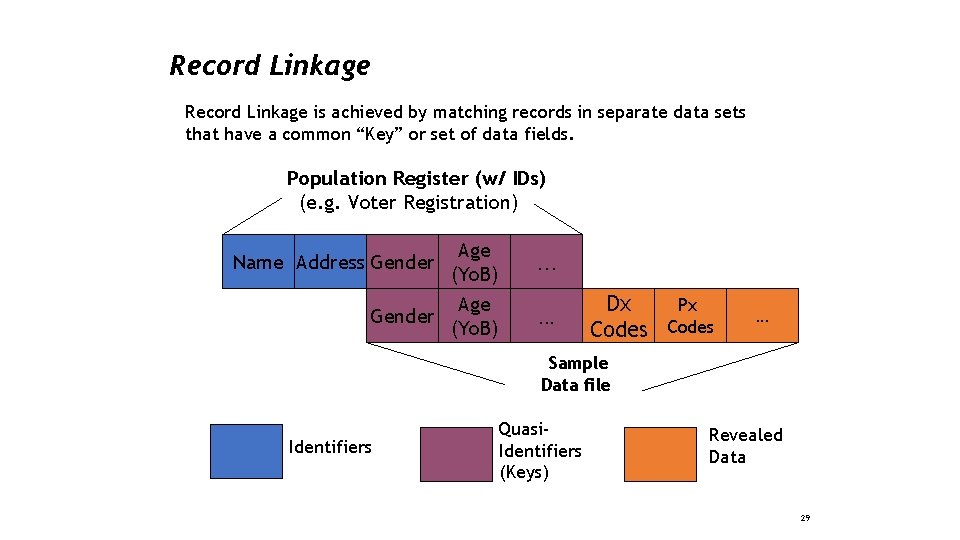
Record Linkage is achieved by matching records in separate data sets that have a common “Key” or set of data fields. Population Register (w/ IDs) (e. g. Voter Registration) Age (Yo. B) Age Gender (Yo. B) Name Address Gender …. . . Dx Px Codes . . . Sample Data file Identifiers Quasi. Identifiers (Keys) Revealed Data 29
Sample and Population Uniques • When only one person with a particular set of characteristics exists within a given data set (typically referred to as the sample data set), such an individual is referred to as a “Sample Unique”. • When only one person with a particular set of characteristics exists within the entire population or within a defined area, such an individual is referred to as a “Population Unique”. 30
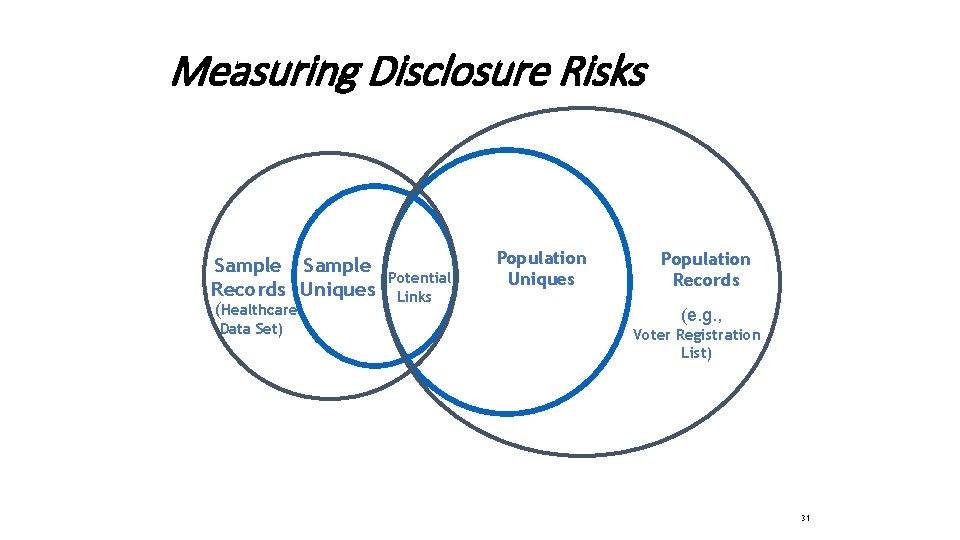
Measuring Disclosure Risks Sample Records Uniques (Healthcare Data Set) Potential Links Population Uniques Population Records (e. g. , Voter Registration List) 31
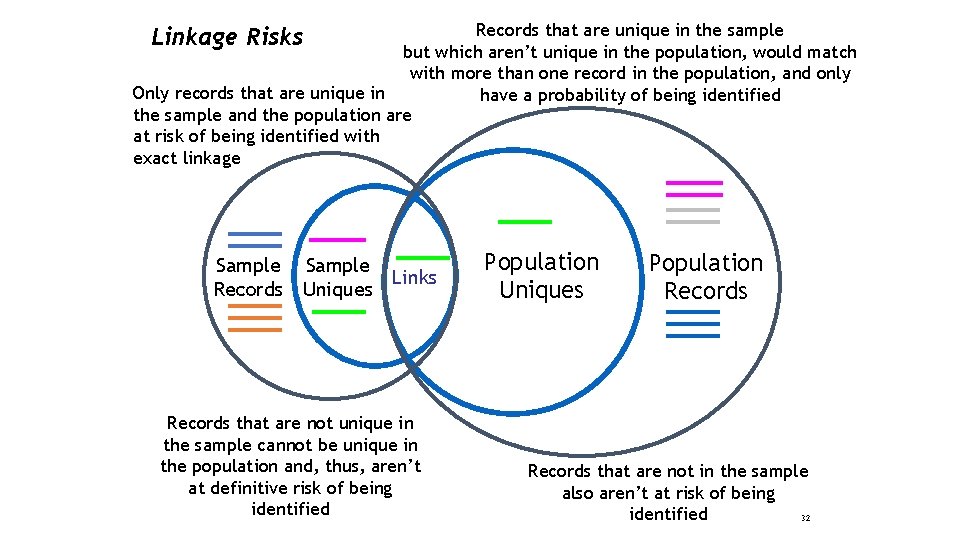
Records that are unique in the sample but which aren’t unique in the population, would match with more than one record in the population, and only Only records that are unique in have a probability of being identified the sample and the population are at risk of being identified with exact linkage Linkage Risks Sample Links Records Uniques Records that are not unique in the sample cannot be unique in the population and, thus, aren’t at definitive risk of being identified Population Uniques Population Records that are not in the sample also aren’t at risk of being identified 32
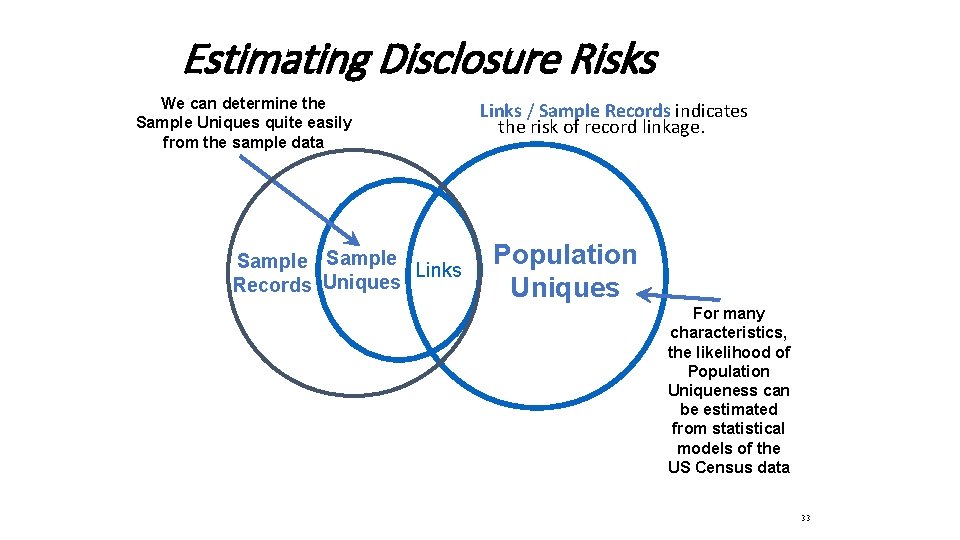
Estimating Disclosure Risks We can determine the Sample Uniques quite easily from the sample data Sample Links Records Uniques Links / Sample Records indicates the risk of record linkage. Population Uniques For many characteristics, the likelihood of Population Uniqueness can be estimated from statistical models of the US Census data 33
Reducing Disclosure Risks • Application of distortion based methods in frequently updated data sets is non-trivial, and, therefore, typically expensive and logistically complicated to implement, requiring complex data management operations to assure proper application. • Because of such logistic complications, the two simplest methods for reducing disclosure risks are also the most practical when protecting privacy in data streams. • The two most basic methods of reducing disclosure risks involve: • Reducing Key Resolution • Increasing Reporting Unit Populations 34
Basic Solutions: Reducing Key Resolutions • Reducing Key Resolution will both reduce the proportion of Sample Uniques in the data set (or data stream) and the probability that an individual is Population Unique with regard to the re-identification key. • Key Resolution can be reduced either by: • Reducing the number of Quasi-identifiers that are released (i. e. , restrict number of variables reported), or by • Reducing the number of categories or values within a Quasi-Identifier (e. g. , report Year of Birth rather than complete birth date). 35
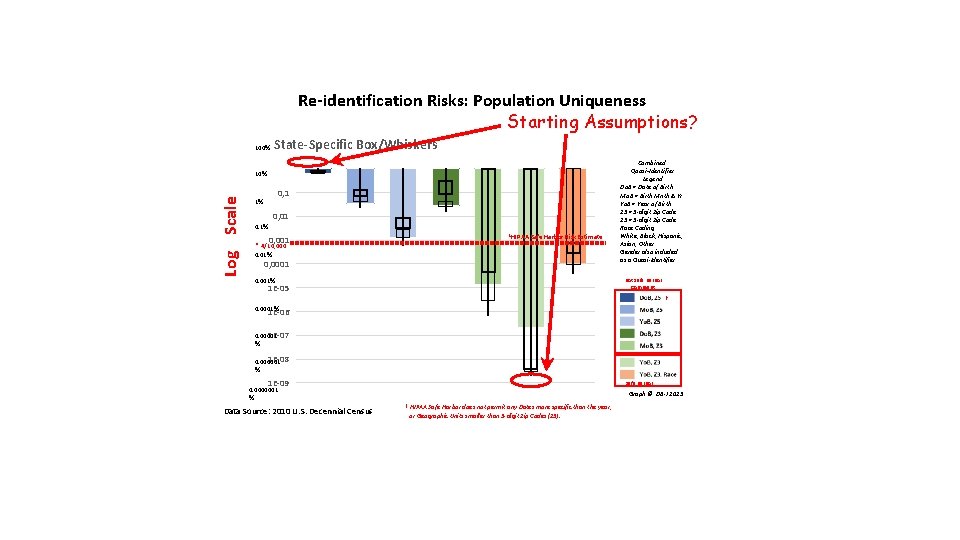
Basic Solutions: Increasing the Population Sizes of Geographic Reporting Units • Another easily implemented solution for reducing disclosure risks is simply to impose a requirement for minimum population sizes within any geographic reporting units. • Example: the Safe Harbor provision specifies that the only geographic units smaller than the State that are reportable under safe harbor de-identification are 3 -digit Zip Codes containing populations of more than 20, 000 individuals. • However, statistical disclosure risk analyses should be conducted in order to assure that appropriate thresholds have been selected and that these thresholds will result in very small disclosure risks for the specific key resolutions of the set of variables which are to be reported. 36
Basic Solutions: Increasing Sizes of Reporting Units, cont’d. • Using larger population sizes for geographic reporting areas is an important method of controlling disclosure risks because increasing the reporting population size decreases the probability of an individual being unique within the reporting area and, thus, the risk of reidentification. • Ideally, any method for restricting the reporting of geographic information should allow reporting on all (or most) of the population, but the level of geographic resolution would be scaled to the underlying population density to control disclosure risks. 37
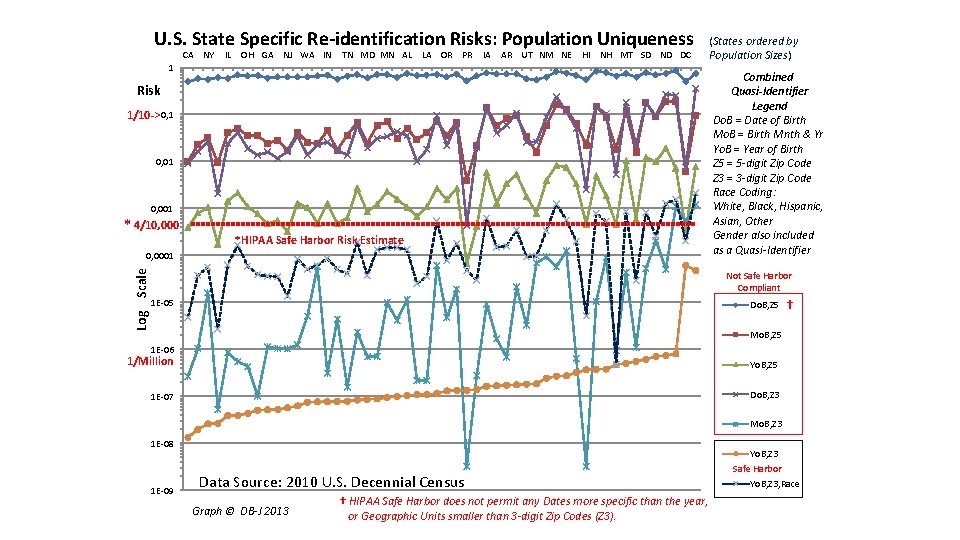
U. S. State Specific Re-identification Risks: Population Uniqueness CA NY IL OH GA NJ WA IN TN MD MN AL LA OR PR IA AR UT NM NE HI NH MT SD ND DC 1 Risk 1/10 -> 0, 1 0, 001 * 4/10, 000 *HIPAA Safe Harbor Risk Estimate Log Scale 0, 0001 (States ordered by Population Sizes) Combined Quasi-Identifier Legend Do. B = Date of Birth Mo. B = Birth Mnth & Yr Yo. B = Year of Birth Z 5 = 5 -digit Zip Code Z 3 = 3 -digit Zip Code Race Coding: White, Black, Hispanic, Asian, Other Gender also included as a Quasi-Identifier Not Safe Harbor Compliant 1 E-05 Do. B, Z 5 † Mo. B, Z 5 1 E-06 1/Million Yo. B, Z 5 1 E-07 Do. B, Z 3 Mo. B, Z 3 1 E-08 1 E-09 Yo. B, Z 3 Data Source: 2010 U. S. Decennial Census Graph © DB-J 2013 † HIPAA Safe Harbor does not permit any Dates more specific than the year, or Geographic Units smaller than 3 -digit Zip Codes (Z 3). Safe Harbor Yo. B, Z 3, Race
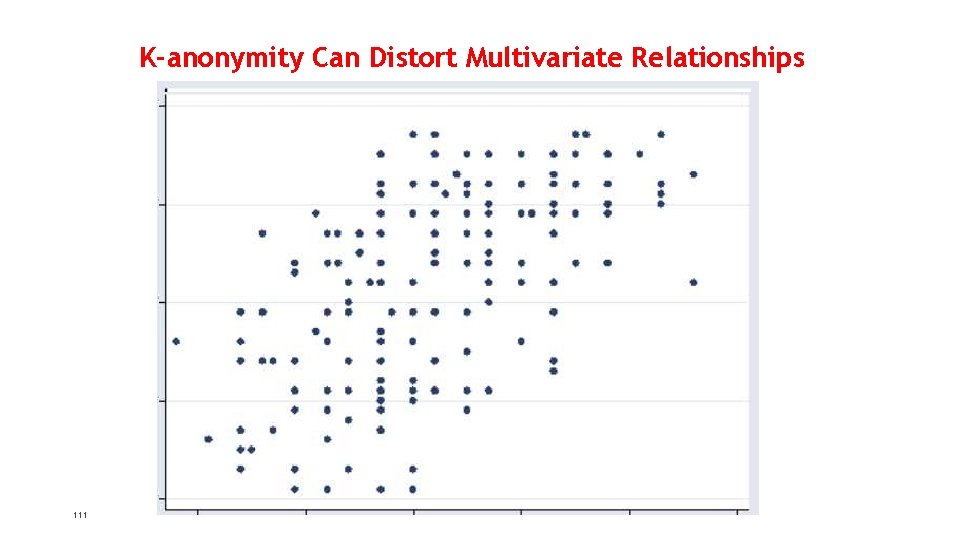
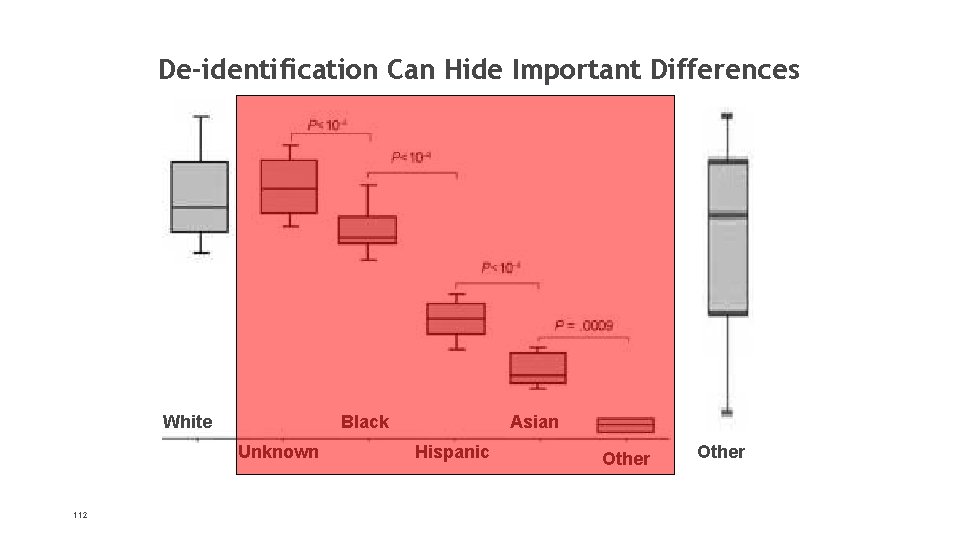
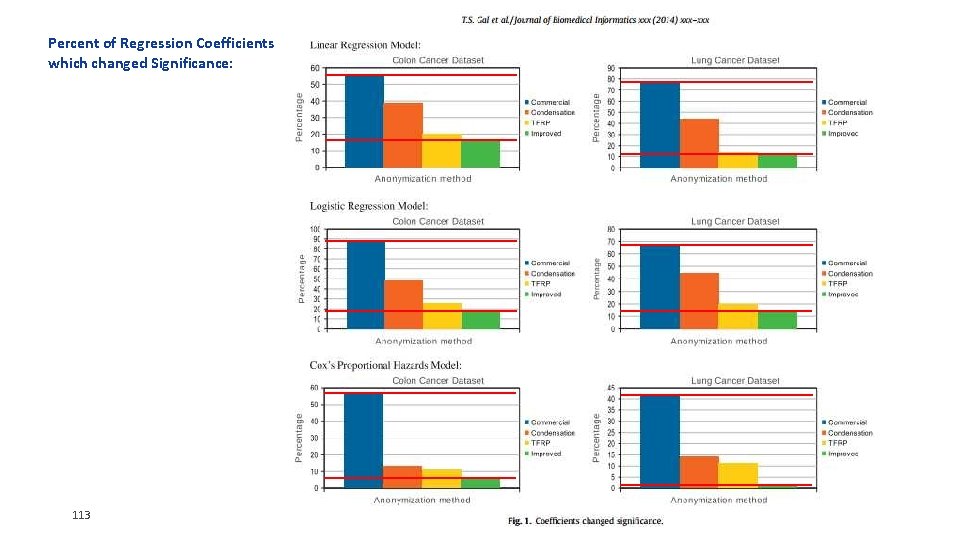
Balancing Disclosure Risk/Statistical Accuracy • • • Balancing disclosure risks and statistical accuracy is essential because some popular de-identification methods (e. g. k-anonymity) can unnecessarily, and often undetectably, degrade the accuracy of deidentified data for multivariate statistical analyses or data mining (distorting variance-covariance matrixes, masking heterogeneous sub-groups which have been collapsed in generalization protections) This problem is well-understood by statisticians, but not as well recognized and integrated within public policy. Poorly conducted de-identification can lead to “bad science” and “bad decisions”. Reference: C. Aggarwal http: //www. vldb 2005. org/program/paper/fri/p 901 -aggarwal. pdf 39
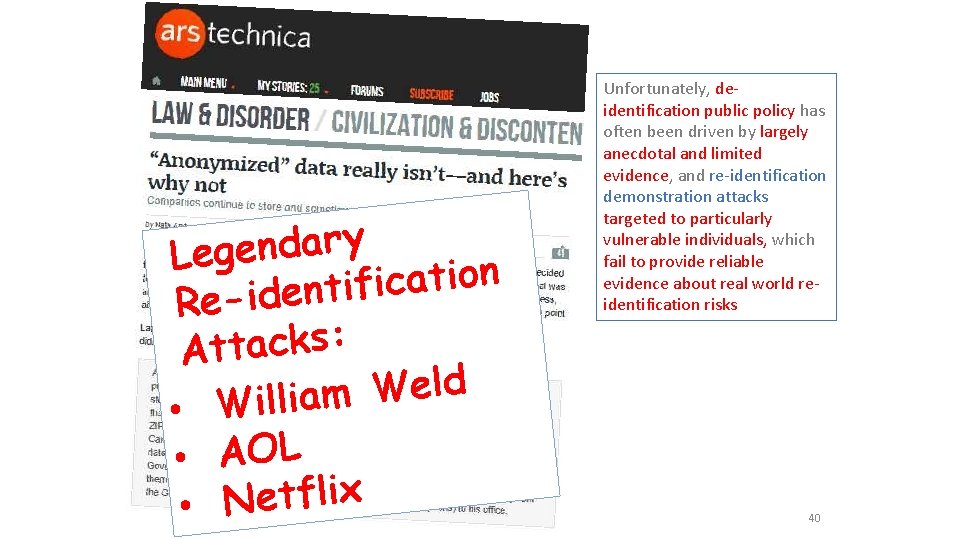
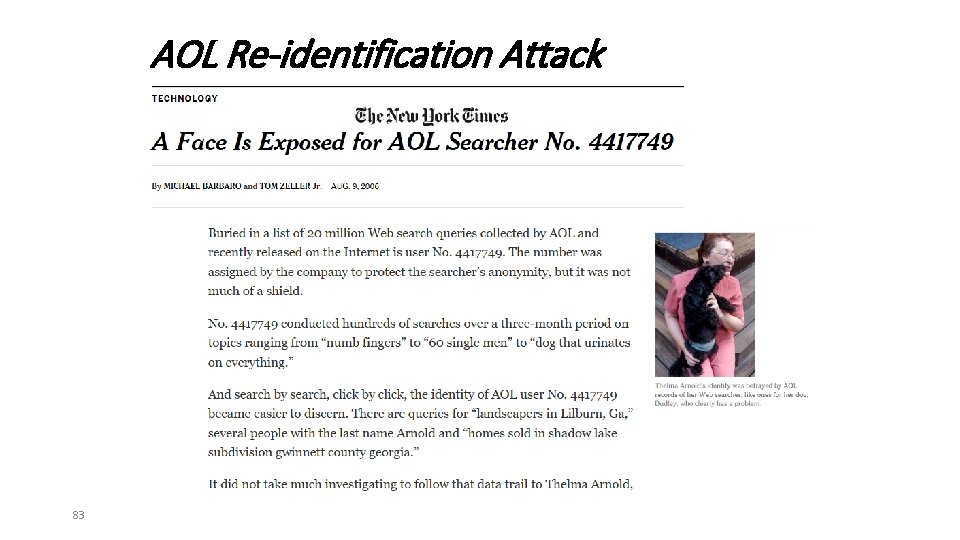
y r a d n e Leg n o i t a c i f i t n e d i e R : s k c a t t A d l e W m a i l l i W • • AOL x i l f t e N • Unfortunately, deidentification public policy has often been driven by largely anecdotal and limited evidence, and re-identification demonstration attacks targeted to particularly vulnerable individuals, which fail to provide reliable evidence about real world reidentification risks 40
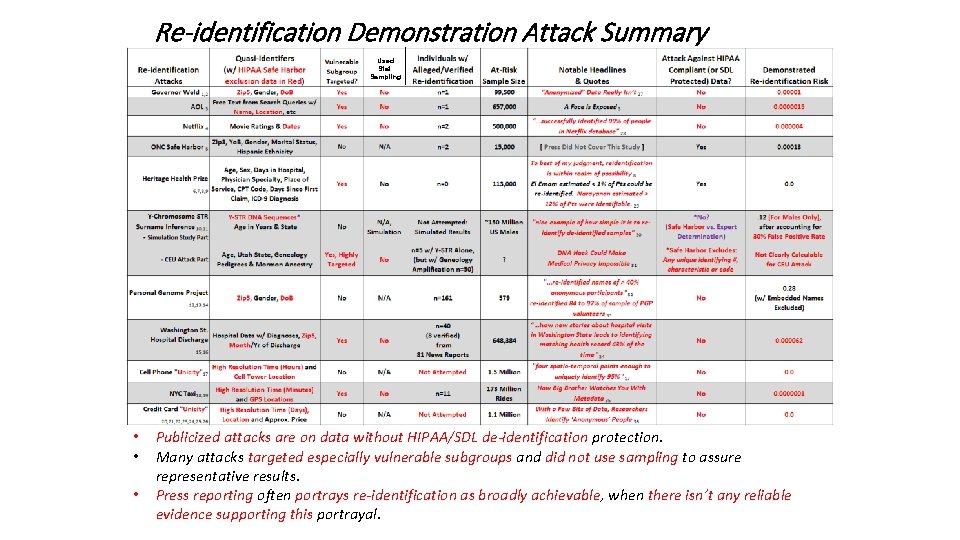
Re-identification Demonstration Attack Summary Used Stat. Sampling • • • Publicized attacks are on data without HIPAA/SDL de-identification protection. Many attacks targeted especially vulnerable subgroups and did not use sampling to assure representative results. Press reporting often portrays re-identification as broadly achievable, when there isn’t any reliable evidence supporting this portrayal.
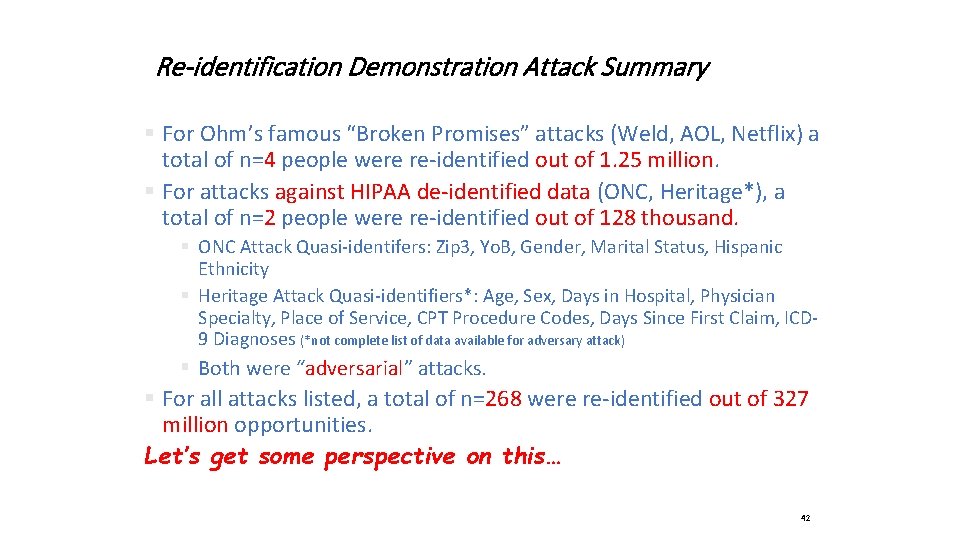
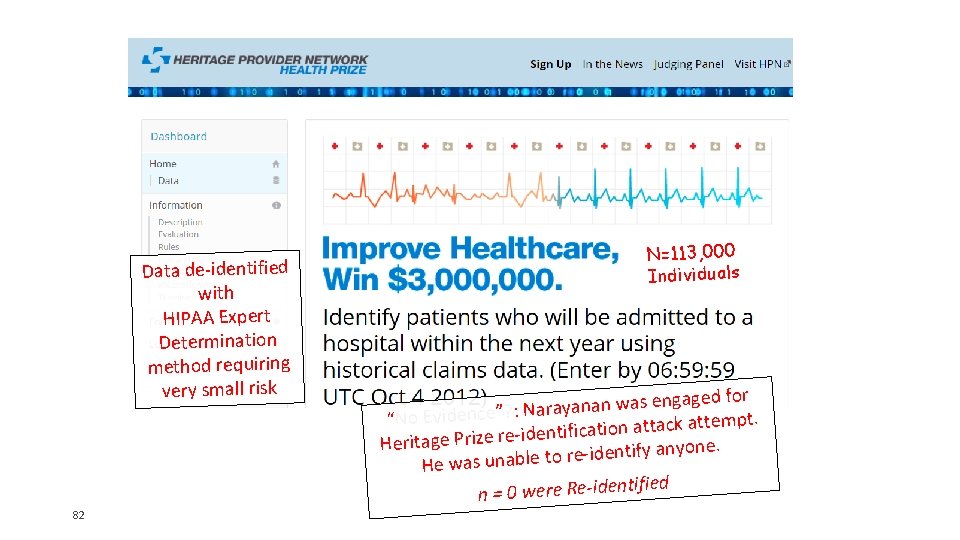
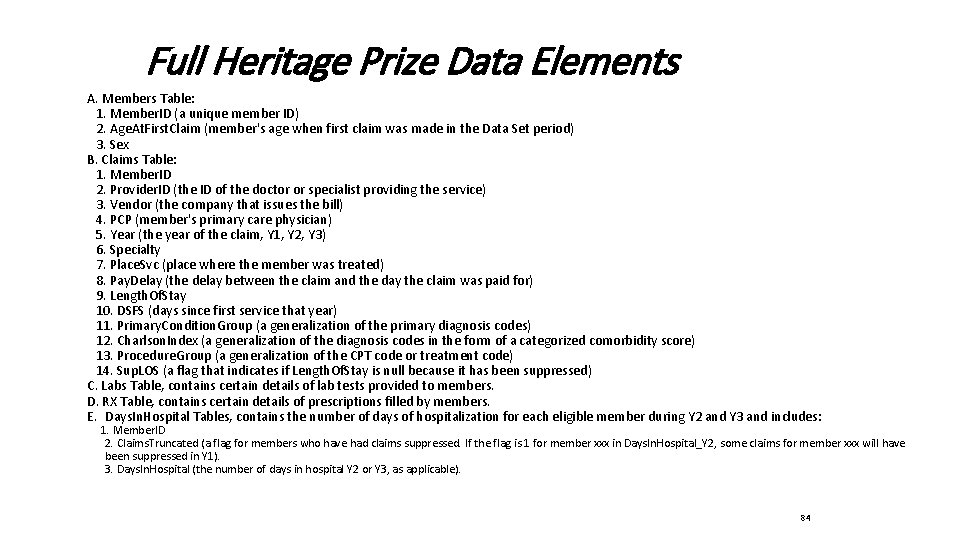
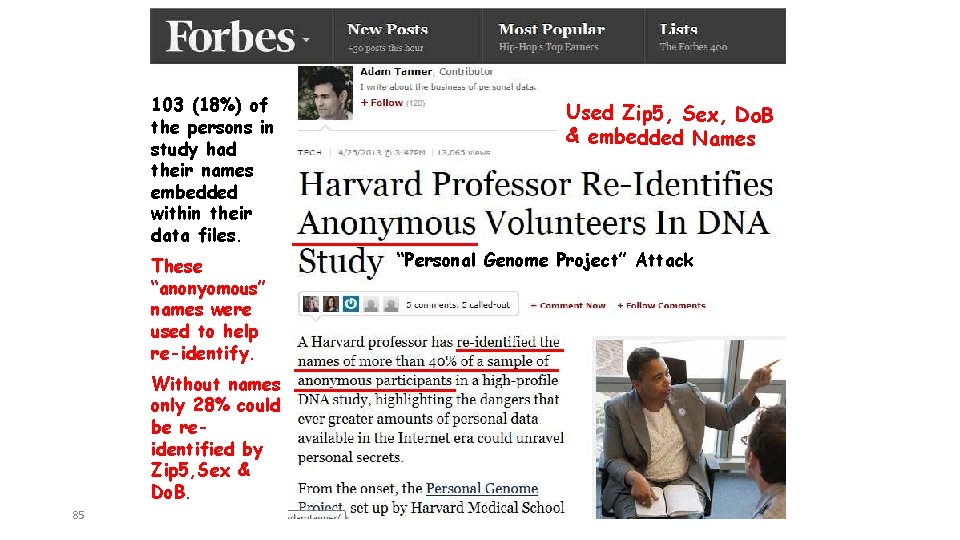
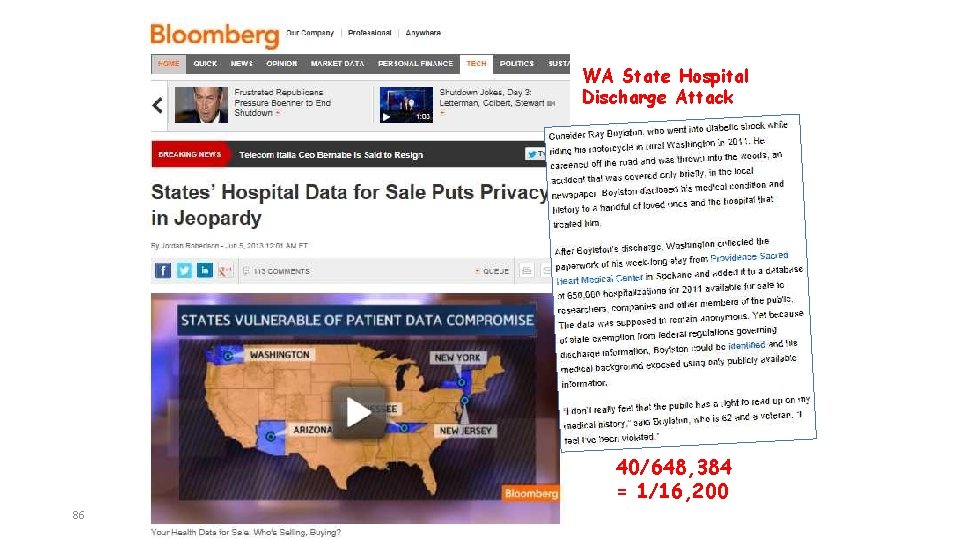
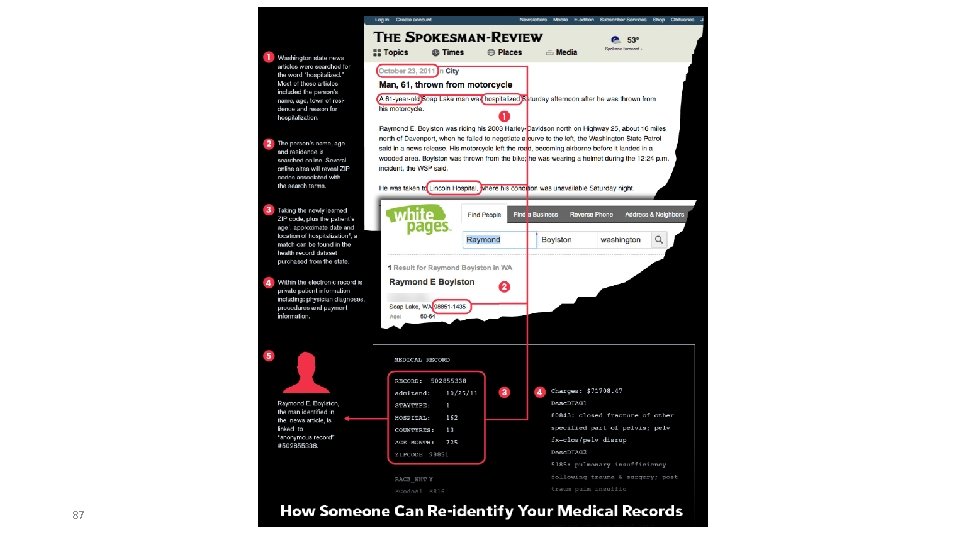
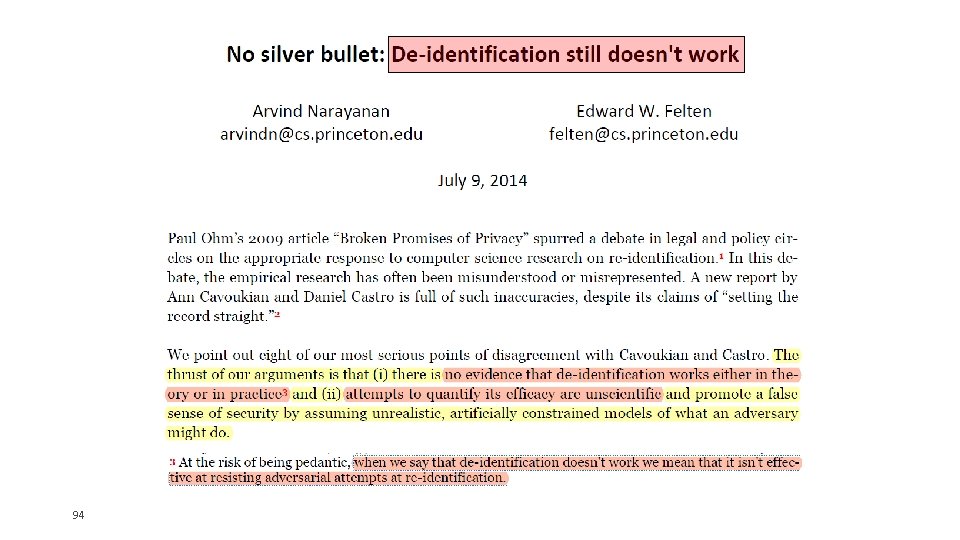
Re-identification Demonstration Attack Summary § For Ohm’s famous “Broken Promises” attacks (Weld, AOL, Netflix) a total of n=4 people were re-identified out of 1. 25 million. § For attacks against HIPAA de-identified data (ONC, Heritage*), a total of n=2 people were re-identified out of 128 thousand. § ONC Attack Quasi-identifers: Zip 3, Yo. B, Gender, Marital Status, Hispanic Ethnicity § Heritage Attack Quasi-identifiers*: Age, Sex, Days in Hospital, Physician Specialty, Place of Service, CPT Procedure Codes, Days Since First Claim, ICD 9 Diagnoses (*not complete list of data available for adversary attack) § Both were “adversarial” attacks. § For all attacks listed, a total of n=268 were re-identified out of 327 million opportunities. Let’s get some perspective on this… 42
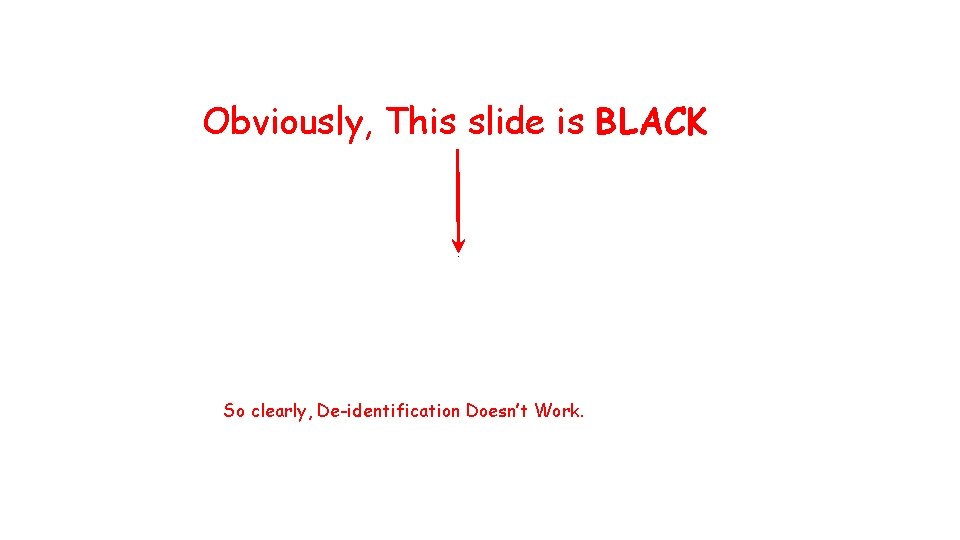
Obviously, This slide is BLACK . So clearly, De-identification Doesn’t Work.
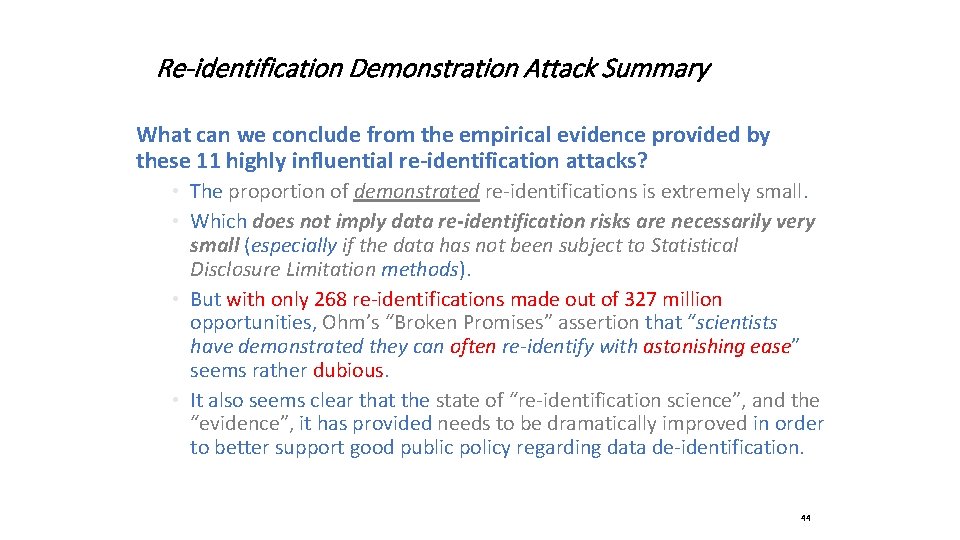
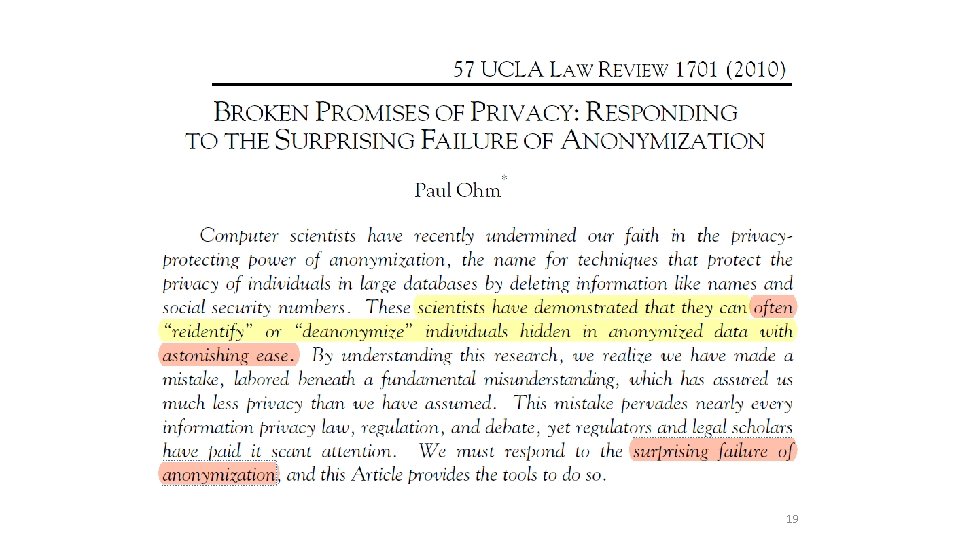
Re-identification Demonstration Attack Summary What can we conclude from the empirical evidence provided by these 11 highly influential re-identification attacks? • The proportion of demonstrated re-identifications is extremely small. • Which does not imply data re-identification risks are necessarily very small (especially if the data has not been subject to Statistical Disclosure Limitation methods). • But with only 268 re-identifications made out of 327 million opportunities, Ohm’s “Broken Promises” assertion that “scientists have demonstrated they can often re-identify with astonishing ease” seems rather dubious. • It also seems clear that the state of “re-identification science”, and the “evidence”, it has provided needs to be dramatically improved in order to better support good public policy regarding data de-identification. 44
45
*Pre-HIPAA Risk Baseline *HIPAA Safe Harbor Risk Baseline 46
Re-identification Risks: Population Uniqueness Starting Assumptions? 100% State-Specific Box/Whiskers Log Scale 10% 0, 1 1% 0, 01 0. 1% 0, 001 * 4/10, 000 *HIPAA Safe Harbor Risk Estimate 0. 01% 0, 0001 0. 001% Combined Quasi-Identifier Legend Do. B = Date of Birth Mo. B = Birth Mnth & Yr Yo. B = Year of Birth Z 5 = 5 -digit Zip Code Z 3 = 3 -digit Zip Code Race Coding: White, Black, Hispanic, Asian, Other Gender also included as a Quasi-Identifier Not Safe Harbor Compliant 1 E-05 † 0. 0001% 1 E-06 0. 00001 1 E-07 % 1 E-08 0. 000001 % 1 E-09 Safe Harbor 0. 0000001 % Data Source: 2010 U. S. Decennial Census Graph © DB-J 2013 † HIPAA Safe Harbor does not permit any Dates more specific than the year, or Geographic Units smaller than 3 -digit Zip Codes (Z 3).
References for Re-identification Attack Summary Table 1. Sweeney, L. k-anonymity: a model for protecting privacy. International Journal on Uncertainty, Fuzziness and Knowledge-based Systems, 10 (5), 2002; 557 -570. 2. Barth-Jones, DC. , The 'Re-Identification' of Governor William Weld's Medical Information: A Critical Re-Examination of Health Data Identification Risks and Privacy Protections, Then and Now (July 2012). http: //ssrn. com/abstract=2076397 3. Michael Barbaro, Tom Zeller Jr. A Face Is Exposed for AOL Searcher No. 4417749. New York Times August 6, 2006. www. nytimes. com/2006/08/09/technology/09 aol. html 4. Narayanan, A. , Shmatikov, V. Robust De-anonymization of Large Sparse Datasets. Proceeding SP '08 Proceedings of the 2008 IEEE Symposium on Security and Privacy p. 111 -125. 5. Kwok, P. K. ; Lafky, D. Harder Than You Think: A Case Study of Re-Identification Risk of HIPAA Compliant Records. Joint Statistical Meetings. Section on Government Statistics. Miami, FL Aug 2, 2011. p. 3826 -3833. 6. El Emam K, et al. De-identification Methods for Open Health Data: The Case of the Heritage Health Prize Claims Dataset. J Med Internet Res 2012; 14(1): e 33 7. Valentino-De. Vries, J. May the Best Algorithm Win… With $3 Million Prize, Health Insurer Raises Stakes on the Data-Crunching Circuit. Wall Street Journal. March 16, 2011. March 17, 2011 http: //www. wsj. com/article_email/SB 10001424052748704662604576202392747278936 -l. My. Qj. Ax. MTAx. MDEw. NTEx. NDUy. Wj. html 8. Narayanan, A. An Adversarial Analysis of the Reidentifiability of the Heritage Health Prize Dataset. May 27, 2011 http: //randomwalker. info/publications/heritage-health-re-identifiability. pdf 9. Narayanan, A. Felten, E. W. No silver bullet: De-identification still doesn't work. July 9, 2014 http: //randomwalker. info/publications/nosilver-bullet-de-identification. pdf 10. Melissa Gymrek, Amy L. Mc. Guire, David Golan, Eran Halperin, Yaniv Erlich. Identifying Personal Genomes by Surname Inference. Science 18 Jan 2013: 321 -324. 11. Barth-Jones, D. Public Policy Considerations for Recent Re-Identification Demonstration Attacks on Genomic Data Sets: Part 1. Harvard Law, Petrie-Flom Center: Online Symposium on the Law, Ethics & Science of Re-identification Demonstrations. http: //blogs. harvard. edu/billofhealth/2013/05/29/public-policy-considerations-for-recent-re-identification-demonstration-attacks-ongenomic-data-sets-part-1 -re-identification-symposium/ 12. Sweeney, L. , Abu, A, Winn, J. Identifying Participants in the Personal Genome Project by Name (April 29, 2013). http: //ssrn. com/abstract=2257732 48
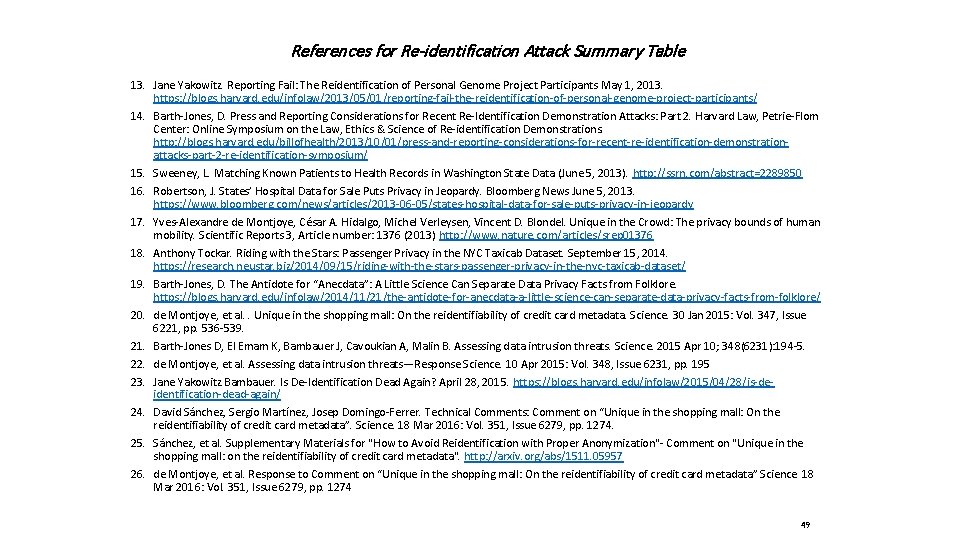
References for Re-identification Attack Summary Table 13. Jane Yakowitz. Reporting Fail: The Reidentification of Personal Genome Project Participants May 1, 2013. https: //blogs. harvard. edu/infolaw/2013/05/01/reporting-fail-the-reidentification-of-personal-genome-project-participants/ 14. Barth-Jones, D. Press and Reporting Considerations for Recent Re-Identification Demonstration Attacks: Part 2. Harvard Law, Petrie-Flom Center: Online Symposium on the Law, Ethics & Science of Re-identification Demonstrations. http: //blogs. harvard. edu/billofhealth/2013/10/01/press-and-reporting-considerations-for-recent-re-identification-demonstrationattacks-part-2 -re-identification-symposium/ 15. Sweeney, L. Matching Known Patients to Health Records in Washington State Data (June 5, 2013). http: //ssrn. com/abstract=2289850 16. Robertson, J. States’ Hospital Data for Sale Puts Privacy in Jeopardy. Bloomberg News June 5, 2013. https: //www. bloomberg. com/news/articles/2013 -06 -05/states-hospital-data-for-sale-puts-privacy-in-jeopardy 17. Yves-Alexandre de Montjoye, César A. Hidalgo, Michel Verleysen, Vincent D. Blondel. Unique in the Crowd: The privacy bounds of human mobility. Scientific Reports 3, Article number: 1376 (2013) http: //www. nature. com/articles/srep 01376 18. Anthony Tockar. Riding with the Stars: Passenger Privacy in the NYC Taxicab Dataset. September 15, 2014. https: //research. neustar. biz/2014/09/15/riding-with-the-stars-passenger-privacy-in-the-nyc-taxicab-dataset/ 19. Barth-Jones, D. The Antidote for “Anecdata”: A Little Science Can Separate Data Privacy Facts from Folklore. https: //blogs. harvard. edu/infolaw/2014/11/21/the-antidote-for-anecdata-a-little-science-can-separate-data-privacy-facts-from-folklore/ 20. de Montjoye, et al. . Unique in the shopping mall: On the reidentifiability of credit card metadata. Science. 30 Jan 2015: Vol. 347, Issue 6221, pp. 536 -539. 21. Barth-Jones D, El Emam K, Bambauer J, Cavoukian A, Malin B. Assessing data intrusion threats. Science. 2015 Apr 10; 348(6231): 194 -5. 22. de Montjoye, et al. Assessing data intrusion threats—Response Science. 10 Apr 2015: Vol. 348, Issue 6231, pp. 195 23. Jane Yakowitz Bambauer. Is De-Identification Dead Again? April 28, 2015. https: //blogs. harvard. edu/infolaw/2015/04/28/is-deidentification-dead-again/ 24. David Sánchez, Sergio Martínez, Josep Domingo-Ferrer. Technical Comments: Comment on “Unique in the shopping mall: On the reidentifiability of credit card metadata”. Science. 18 Mar 2016: Vol. 351, Issue 6279, pp. 1274. 25. Sánchez, et al. Supplementary Materials for "How to Avoid Reidentification with Proper Anonymization"- Comment on "Unique in the shopping mall: on the reidentifiability of credit card metadata". http: //arxiv. org/abs/1511. 05957 26. de Montjoye, et al. Response to Comment on “Unique in the shopping mall: On the reidentifiability of credit card metadata” Science 18 Mar 2016: Vol. 351, Issue 6279, pp. 1274 49
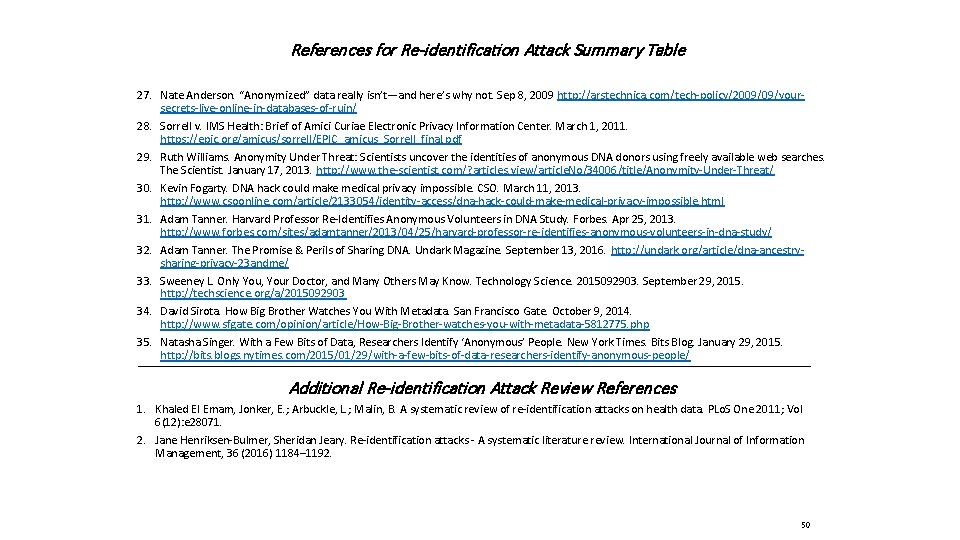
References for Re-identification Attack Summary Table 27. Nate Anderson. “Anonymized” data really isn’t—and here’s why not. Sep 8, 2009 http: //arstechnica. com/tech-policy/2009/09/yoursecrets-live-online-in-databases-of-ruin/ 28. Sorrell v. IMS Health: Brief of Amici Curiae Electronic Privacy Information Center. March 1, 2011. https: //epic. org/amicus/sorrell/EPIC_amicus_Sorrell_final. pdf 29. Ruth Williams. Anonymity Under Threat: Scientists uncover the identities of anonymous DNA donors using freely available web searches. The Scientist. January 17, 2013. http: //www. the-scientist. com/? articles. view/article. No/34006/title/Anonymity-Under-Threat/ 30. Kevin Fogarty. DNA hack could make medical privacy impossible. CSO. March 11, 2013. http: //www. csoonline. com/article/2133054/identity-access/dna-hack-could-make-medical-privacy-impossible. html 31. Adam Tanner. Harvard Professor Re-Identifies Anonymous Volunteers in DNA Study. Forbes. Apr 25, 2013. http: //www. forbes. com/sites/adamtanner/2013/04/25/harvard-professor-re-identifies-anonymous-volunteers-in-dna-study/ 32. Adam Tanner. The Promise & Perils of Sharing DNA. Undark Magazine. September 13, 2016. http: //undark. org/article/dna-ancestrysharing-privacy-23 andme/ 33. Sweeney L. Only You, Your Doctor, and Many Others May Know. Technology Science. 2015092903. September 29, 2015. http: //techscience. org/a/2015092903 34. David Sirota. How Big Brother Watches You With Metadata. San Francisco Gate. October 9, 2014. http: //www. sfgate. com/opinion/article/How-Big-Brother-watches-you-with-metadata-5812775. php 35. Natasha Singer. With a Few Bits of Data, Researchers Identify ‘Anonymous’ People. New York Times. Bits Blog. January 29, 2015. http: //bits. blogs. nytimes. com/2015/01/29/with-a-few-bits-of-data-researchers-identify-anonymous-people/ Additional Re-identification Attack Review References 1. Khaled El Emam, Jonker, E. ; Arbuckle, L. ; Malin, B. A systematic review of re-identification attacks on health data. PLo. S One 2011; Vol 6(12): e 28071. 2. Jane Henriksen-Bulmer, Sheridan Jeary. Re-identification attacks - A systematic literature review. International Journal of Information Management, 36 (2016) 1184– 1192. 50
Online Symposium on the Law, Ethics & Science of Re-identification Demonstrations • http: //blogs. law. harvard. edu/billofhealth/2013/05/29/public-policyconsiderations-for-recent-re-identification-demonstration-attacks-ongenomic-data-sets-part-1 -re-identification-symposium/ • https: //blogs. law. harvard. edu/billofhealth/2013/10/01/press-andreporting-considerations-for-recent-re-identification-demonstrationattacks-part-2 -re-identification-symposium/ • http: //blogs. law. harvard. edu/billofhealth/2013/10/02/ethicalconcerns-conduct-and-public-policy-for-re-identification-and-deidentification-practice-part-3 -re-identification-symposium/
Speaker Ann Waldo Principal, Waldo Law Offices Organization Ann Waldo is the Principal in the boutique law firm of Waldo Law Offices in Washington, DC. She provides legal counsel and government advocacy regarding health data privacy and data strategy. She has worked as Chief Privacy Officer for Lenovo, Chief Privacy Officer at Hoffmann-La Roche, in Public Policy at Glaxo. Smith. Kline, in-house counsel at IBM, and commercial litigation. Ann has a JD from UNC Law School with high honors. She is licensed to practice law in DC and North Carolina and is a member of the Bar of the U. S. Supreme Court. She is passionate about health data and innovation.
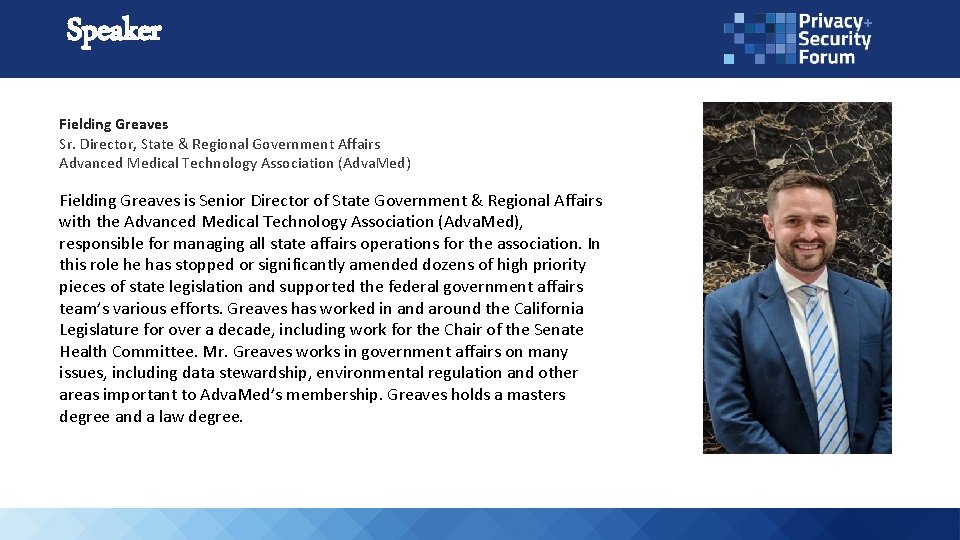
Speaker Fielding Greaves Sr. Director, State & Regional Government Affairs Advanced Medical Technology Association (Adva. Med) Fielding Greaves is Senior Director of State Government & Regional Affairs with the Advanced Medical Technology Association (Adva. Med), responsible for managing all state affairs operations for the association. In this role he has stopped or significantly amended dozens of high priority pieces of state legislation and supported the federal government affairs team’s various efforts. Greaves has worked in and around the California Legislature for over a decade, including work for the Chair of the Senate Health Committee. Mr. Greaves works in government affairs on many issues, including data stewardship, environmental regulation and other areas important to Adva. Med’s membership. Greaves holds a masters degree and a law degree.
CCPA and De-Identification News Flash – CA AB 713 Signed by Gov. Newsom
CA AB 713 An Extraordinary Victory A victory for – • Reasonableness • Listening to different perspectives. Respect. Patience. Compromise • Medical science and research • Healthcare and life science efficiency • Above all, for patients
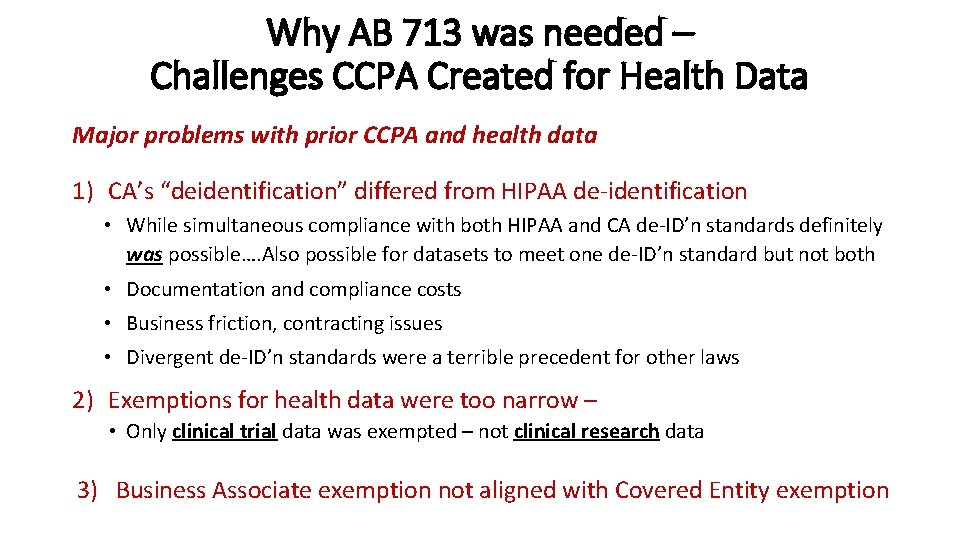
Why AB 713 was needed – Challenges CCPA Created for Health Data Major problems with prior CCPA and health data 1) CA’s “deidentification” differed from HIPAA de-identification • While simultaneous compliance with both HIPAA and CA de-ID’n standards definitely was possible…. Also possible for datasets to meet one de-ID’n standard but not both • Documentation and compliance costs • Business friction, contracting issues • Divergent de-ID’n standards were a terrible precedent for other laws 2) Exemptions for health data were too narrow – • Only clinical trial data was exempted – not clinical research data 3) Business Associate exemption not aligned with Covered Entity exemption
CCPA General Definition of “deidentified” CCPA general definition: “Deidentified” means information that cannot reasonably identify, relate to, describe, be capable of being associated with, or be linked, directly or indirectly, to a particular consumer, provided that a business that uses deidentified information: 1) Has implemented technical safeguards that prohibit reidentification of the consumer to whom the information may pertain. 2) Has implemented business processes that specifically prohibit reidentification of the information. 3) Has implemented business processes to prevent inadvertent release of deidentified information. 4) Makes no attempt to reidentify the information. Note differences from HIPAA – ambiguities, focus on business processes, possibility that de-ID’d data recipient could “undo” original de-ID’n done at the source
AB 713 – The Legislative Process 2019 “Health fix” amendments • • To have CCPA recognize HIPAA de-ID’n standard for health data To expand clinical research data exemption To align Business Associates exemption with Covered Entity exemption To exempt adverse event and device tracking data • Broad HC support • Agreement reached with privacy advocates • Amendments weren’t enacted, but opened door for 2020
AB 713 – 2020 • Exceptional alignment between healthcare and privacy advocates throughout 2020 • January: • Sen. Mullin put health fix amendments into AB 713 • Sen. Health Committee • ACRO and Adva. Med testified in support • Other supporters included United Health Group, CA Hosp Assn, AHIP, BIO, Bio. Com, CA Life Sciences Assn, IPMPC, Medical Imaging and Technology Alliance, Ph. RMA, and Waldo Law • Privacy coalition expressed neutrality and said they’d been closely collaborating with industry • Sen Health reported out unanimously
AB 713 – 2020 • Feb – August: • Additional amendments, discussions, negotiations • “Urgency clause” added to make bill effective immediately • Ban on re-identification of de-identified patient data added • Provisions moved into new code sections not touched by CPRA ballot initiative • Unanimous approval by Senate and Assembly • Sept. 25, 2020: • Governor Newsom signed • New law took effect immediately
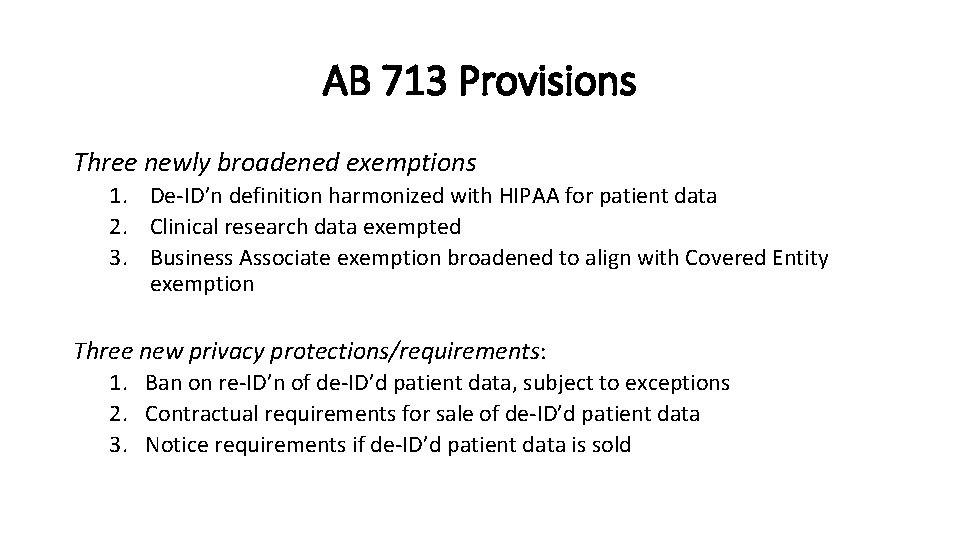
AB 713 Provisions Three newly broadened exemptions 1. De-ID’n definition harmonized with HIPAA for patient data 2. Clinical research data exempted 3. Business Associate exemption broadened to align with Covered Entity exemption Three new privacy protections/requirements: 1. Ban on re-ID’n of de-ID’d patient data, subject to exceptions 2. Contractual requirements for sale of de-ID’d patient data 3. Notice requirements if de-ID’d patient data is sold
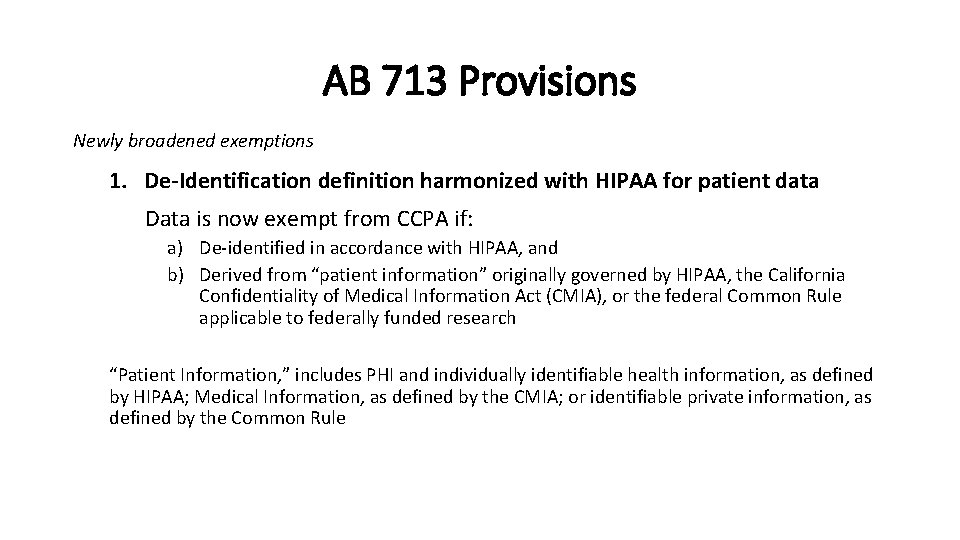
AB 713 Provisions Newly broadened exemptions 1. De-Identification definition harmonized with HIPAA for patient data Data is now exempt from CCPA if: a) De-identified in accordance with HIPAA, and b) Derived from “patient information” originally governed by HIPAA, the California Confidentiality of Medical Information Act (CMIA), or the federal Common Rule applicable to federally funded research “Patient Information, ” includes PHI and individually identifiable health information, as defined by HIPAA; Medical Information, as defined by the CMIA; or identifiable private information, as defined by the Common Rule
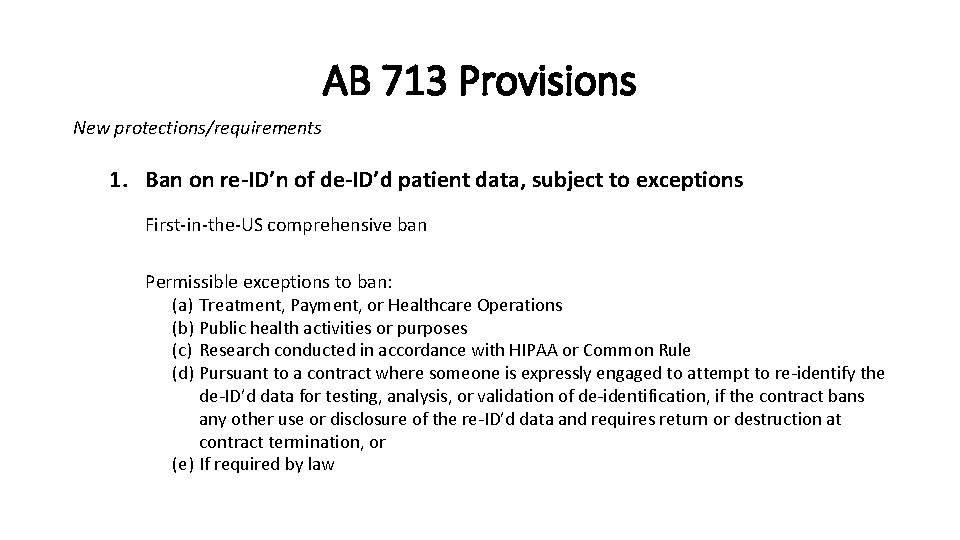
AB 713 Provisions New protections/requirements 1. Ban on re-ID’n of de-ID’d patient data, subject to exceptions First-in-the-US comprehensive ban Permissible exceptions to ban: (a) Treatment, Payment, or Healthcare Operations (b) Public health activities or purposes (c) Research conducted in accordance with HIPAA or Common Rule (d) Pursuant to a contract where someone is expressly engaged to attempt to re-identify the de-ID’d data for testing, analysis, or validation of de-identification, if the contract bans any other use or disclosure of the re-ID’d data and requires return or destruction at contract termination, or (e) If required by law
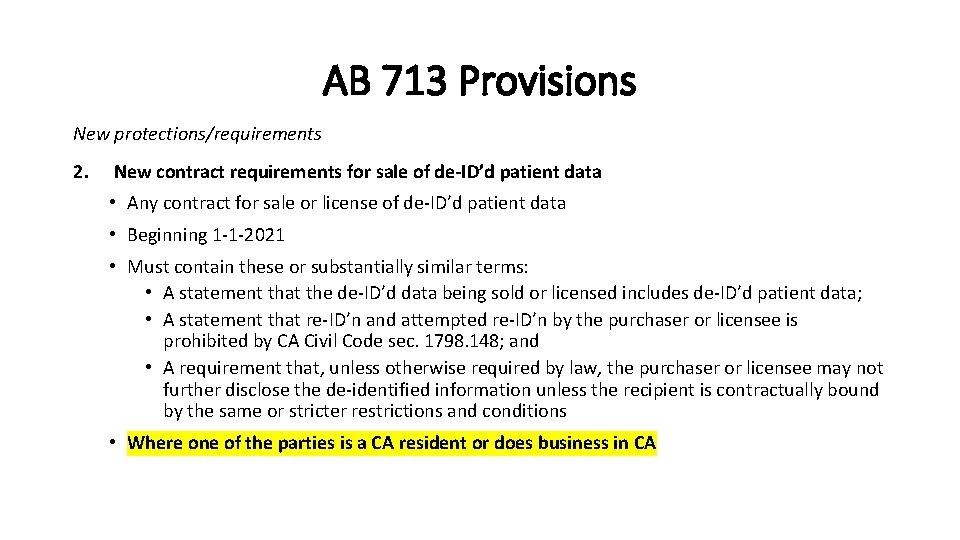
AB 713 Provisions New protections/requirements 2. New contract requirements for sale of de-ID’d patient data • Any contract for sale or license of de-ID’d patient data • Beginning 1 -1 -2021 • Must contain these or substantially similar terms: • A statement that the de-ID’d data being sold or licensed includes de-ID’d patient data; • A statement that re-ID’n and attempted re-ID’n by the purchaser or licensee is prohibited by CA Civil Code sec. 1798. 148; and • A requirement that, unless otherwise required by law, the purchaser or licensee may not further disclose the de-identified information unless the recipient is contractually bound by the same or stricter restrictions and conditions • Where one of the parties is a CA resident or does business in CA
AB 713 Provisions New protections/requirements 3. Notice requirement re: HIPAA-de-ID’d patient data • Applies to businesses that sell or disclose patient data de-ID’d per HIPAA (now exempt from CCPA) • Must include in Privacy Policy: • Whether the business sells or discloses de-ID’d data derived from patient data • If so, whether such data was de-ID’d pursuant to one or more of the permissible HIPAA methods – i. e. , Safe Harbor or expert determination method
AB 713 and the Ballot Initiative/CPRA • Concern that CPRA could supersede and nullify AB 713 • Author of AB 713 thus moved its protections into new code sections • New provisions now housed in 1798. 146 and 1798. 148 (which don’t exist in CPRA or prior CCPA)
And now – The Bad News Almost all of the other pending federal and state bills would create complications and burdens on de-identification, healthcare, and medical research data • Exemptions are inadequate – most exempt only PHI (and/or HIPAA-regulated entities) • Most have novel and divergent definitions of de-identified data • Almost no bills are harmonized with HIPAA de-identification standard
Examples from Pending Legislation CA Privacy Rights and Enforcement Act of 2020 (k) “Deidentified” means information that cannot reasonably be used to infer information about, or otherwise be linked to, an identifiable consumer, provided that the business that possesses the information: (A) takes reasonable measures to ensure that the information cannot be associated with a consumer or household; (B) publicly commits to maintain and use the information in deidentified form and not to attempt to reidentify the information, except as necessary to ensure compliance with this subdivision; and (C) contractually obligates any recipients of the information to comply with al provisions of this subdivision. But remember – this should not supersede AB 713’s de-ID’n harmonization with HIPAA standard for patient data
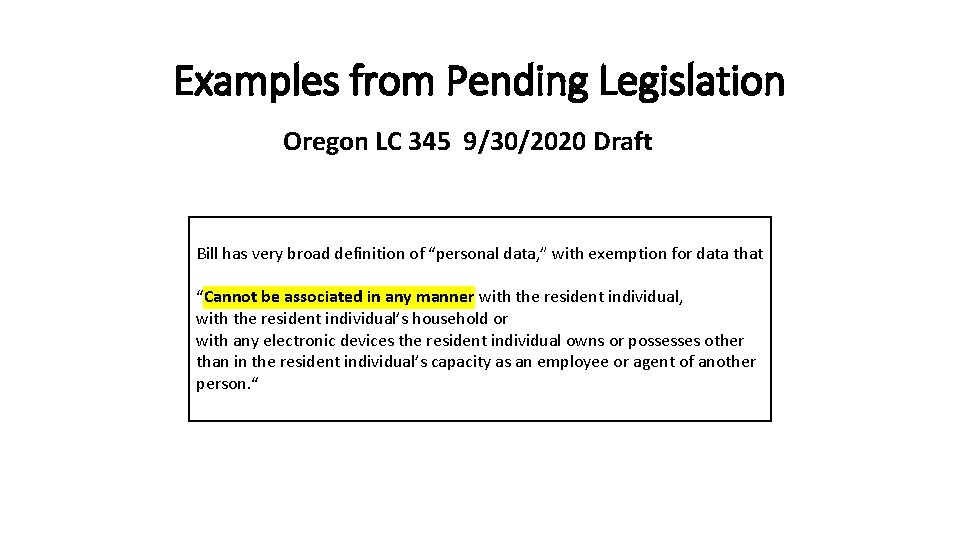
Examples from Pending Legislation Oregon LC 345 9/30/2020 Draft Bill has very broad definition of “personal data, ” with exemption for data that “Cannot be associated in any manner with the resident individual, with the resident individual’s household or with any electronic devices the resident individual owns or possesses other than in the resident individual’s capacity as an employee or agent of another person. “
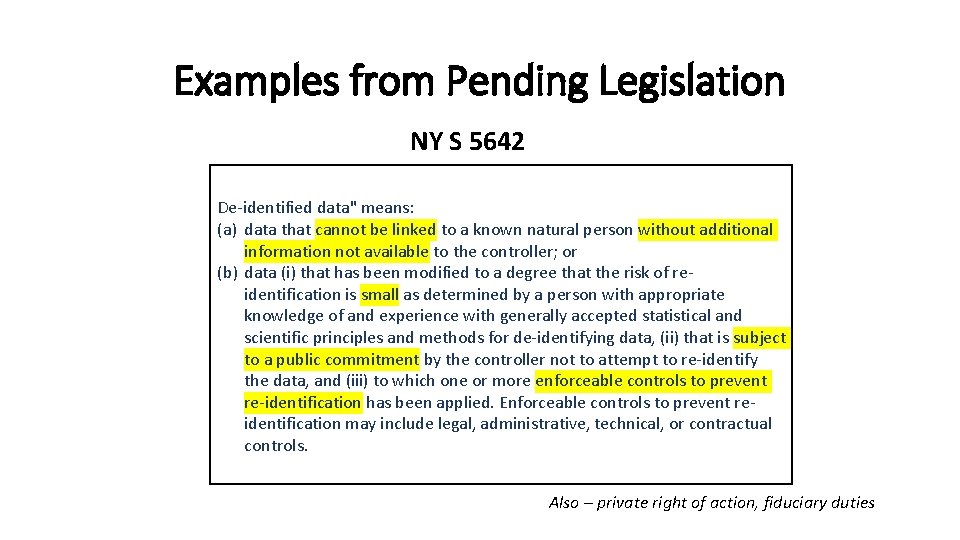
Examples from Pending Legislation NY S 5642 De-identified data" means: (a) data that cannot be linked to a known natural person without additional information not available to the controller; or (b) data (i) that has been modified to a degree that the risk of reidentification is small as determined by a person with appropriate knowledge of and experience with generally accepted statistical and scientific principles and methods for de-identifying data, (ii) that is subject to a public commitment by the controller not to attempt to re-identify the data, and (iii) to which one or more enforceable controls to prevent re-identification has been applied. Enforceable controls to prevent reidentification may include legal, administrative, technical, or contractual controls. Also – private right of action, fiduciary duties
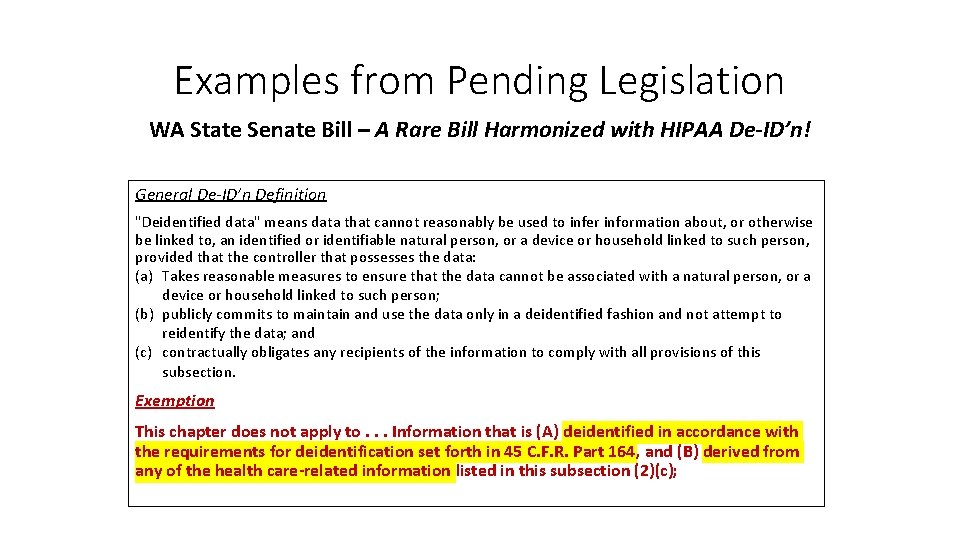
Examples from Pending Legislation WA State Senate Bill – A Rare Bill Harmonized with HIPAA De-ID’n! General De-ID’n Definition "Deidentified data" means data that cannot reasonably be used to infer information about, or otherwise be linked to, an identified or identifiable natural person, or a device or household linked to such person, provided that the controller that possesses the data: (a) Takes reasonable measures to ensure that the data cannot be associated with a natural person, or a device or household linked to such person; (b) publicly commits to maintain and use the data only in a deidentified fashion and not attempt to reidentify the data; and (c) contractually obligates any recipients of the information to comply with all provisions of this subsection. Exemption This chapter does not apply to. . . Information that is (A) deidentified in accordance with the requirements for deidentification set forth in 45 C. F. R. Part 164, and (B) derived from any of the health care-related information listed in this subsection (2)(c);
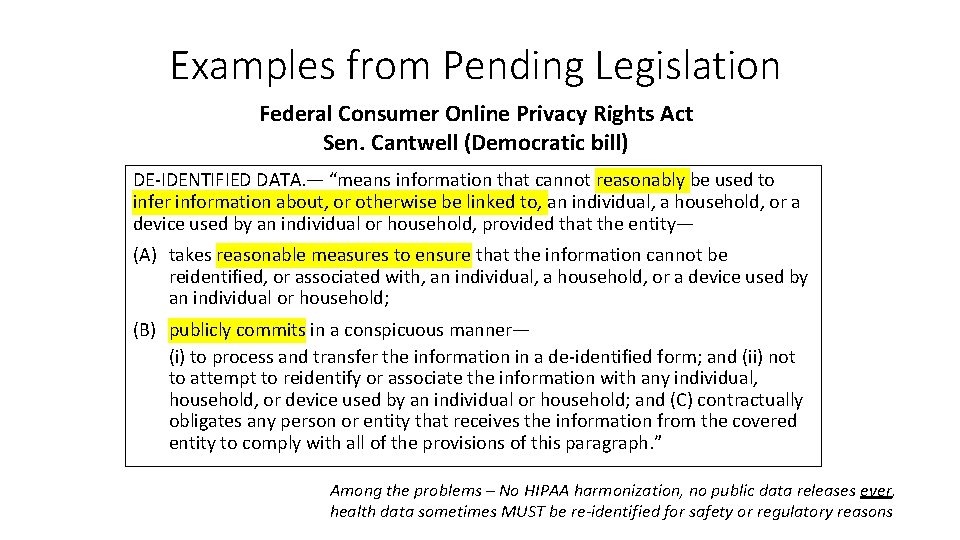
Examples from Pending Legislation Federal Consumer Online Privacy Rights Act Sen. Cantwell (Democratic bill) DE-IDENTIFIED DATA. — “means information that cannot reasonably be used to infer information about, or otherwise be linked to, an individual, a household, or a device used by an individual or household, provided that the entity— (A) takes reasonable measures to ensure that the information cannot be reidentified, or associated with, an individual, a household, or a device used by an individual or household; (B) publicly commits in a conspicuous manner— (i) to process and transfer the information in a de-identified form; and (ii) not to attempt to reidentify or associate the information with any individual, household, or device used by an individual or household; and (C) contractually obligates any person or entity that receives the information from the covered entity to comply with all of the provisions of this paragraph. ” Among the problems – No HIPAA harmonization, no public data releases ever, health data sometimes MUST be re-identified for safety or regulatory reasons
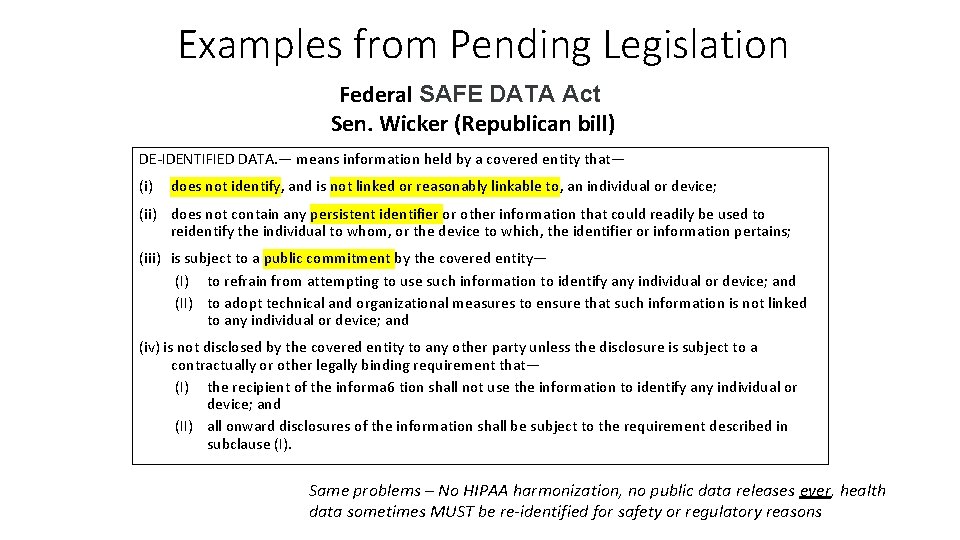
Examples from Pending Legislation Federal SAFE DATA Act Sen. Wicker (Republican bill) DE-IDENTIFIED DATA. — means information held by a covered entity that— (i) does not identify, and is not linked or reasonably linkable to, an individual or device; (ii) does not contain any persistent identifier or other information that could readily be used to reidentify the individual to whom, or the device to which, the identifier or information pertains; (iii) is subject to a public commitment by the covered entity— (I) to refrain from attempting to use such information to identify any individual or device; and (II) to adopt technical and organizational measures to ensure that such information is not linked to any individual or device; and (iv) is not disclosed by the covered entity to any other party unless the disclosure is subject to a contractually or other legally binding requirement that— (I) the recipient of the informa 6 tion shall not use the information to identify any individual or device; and (II) all onward disclosures of the information shall be subject to the requirement described in subclause (I). Same problems – No HIPAA harmonization, no public data releases ever, health data sometimes MUST be re-identified for safety or regulatory reasons
Consequences of Divergent De-ID’n Laws How to manage if more than two de-ID’n standards apply to dataset? ØNeed to document compliance with both. May require legal, statistical, and operational documentation ØCompliance and operational costs ØUncertainty ØContractual wrangling; legal disputes and costs ØBusiness friction and delays ØSome data projects may just not be possible under non-HIPAA law ØLeads to mounting cost of healthcare and new drugs and devices
What can be done to show support for medical research and de-ID’d data? Exempting PHI is not enough! State harmonization with existing federal standards for research, HIPAA, Common Rule, and de-ID’n of health data is imperative New federal legislation needs harmonization with HIPAA de-ID’n and thoughtful, comprehensive exemptions for patient data ØSupport medical research by advocating for consistent HIPAA de-ID’n standard nationwide ØOppose inconsistent de-ID’n standards that will lead to friction, legal cost, waste – and research delays
“Future Proofing” Data for Evolving Standards of De-Identification • Use statistical expert determination of de-identification to meet both HIPAA and evolving state de-identification standards • Employ contractual controls over de-identified data • • • Prohibition on re-identification of individuals in data Restrict downstream disclosures without approval Impose specific security controls on protection of de-identified data Consider location of data -- bring tools to the data (versus data to the tools) if feasible CCPA-required language for non-exempt entities, where one of the parties is a California resident or does business in California: • A statement that the de-identified information being sold or licensed includes de-identified patient information; • A statement that re-identification and attempted re-identification by the purchaser or licensor is prohibited by CA Civil Code sec. 1798. 148; and • A requirement that, unless otherwise required by law, the purchaser or buyer may not further disclose the de-identified information unless the recipient is contractually bound by the same or stricter restrictions and conditions 76
Questions + Contact Daniel Barth-Jones Assistant Professor of Clinical Epidemiology Mailman School of Public Health, Columbia University db 2431@columbia. edu Fielding Greaves Sr. Director State & Regional Government Affairs, Adva. Med. Organization fgreaves@advamed. org James Janisse Assistant Professor of Population Health Services jjanis@med. wayne. edu Kristen Rosati Partner Coppersmith Brockelman PLC krosati@cblawyers. com Ann Waldo Principal Waldo Law Offices awaldo@waldolawoffices. co m

Reserve Slides for Questions
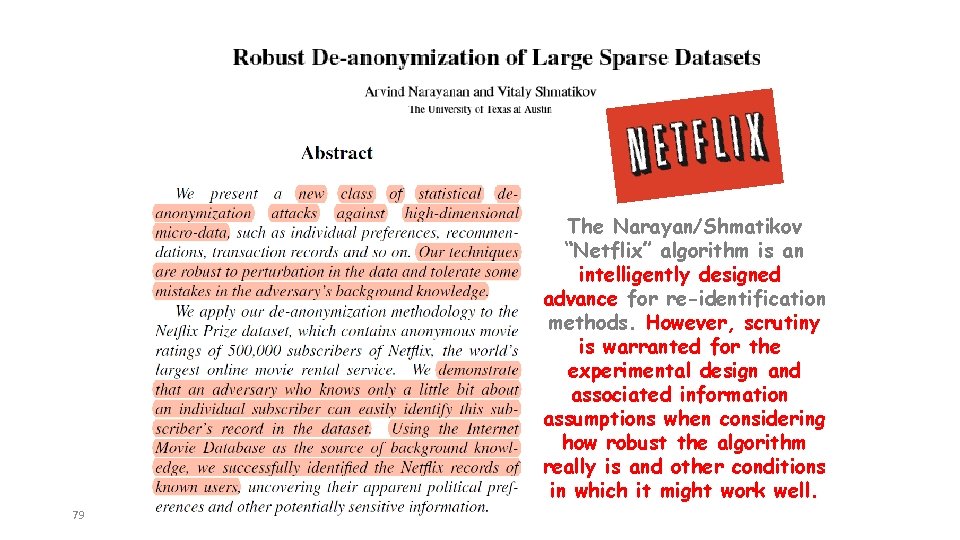
The Narayan/Shmatikov “Netflix” algorithm is an intelligently designed advance for re-identification methods. However, scrutiny is warranted for the experimental design and associated information assumptions when considering how robust the algorithm really is and other conditions in which it might work well. 79
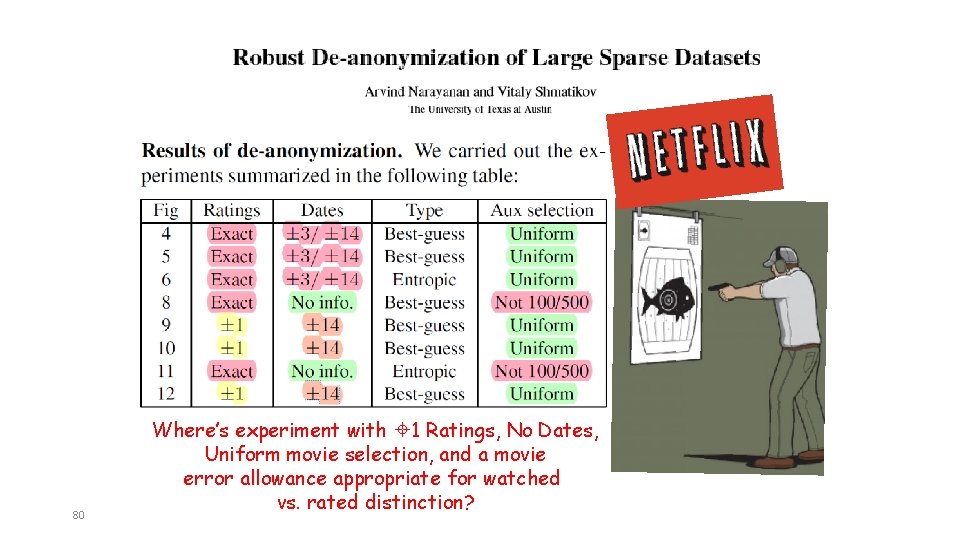
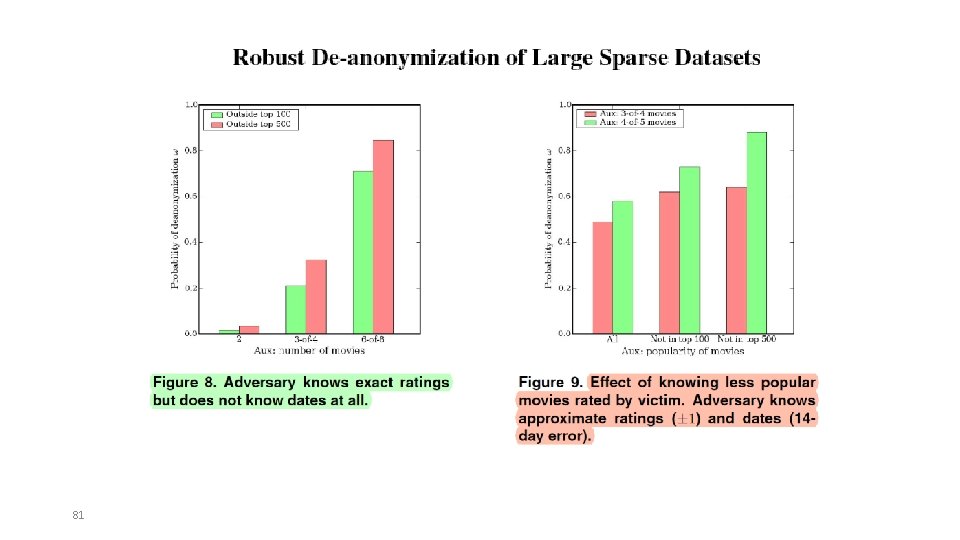
80 Where’s experiment with 1 Ratings, No Dates, Uniform movie selection, and a movie error allowance appropriate for watched vs. rated distinction?
81
Data de-identified with HIPAA Expert Determination method requiring very small risk 82 N=113, 000 Individuals gaged for n e s a w n a y ra a “No Evidence”? : N k attempt. c a tt a n o ti a c fi ti n e d Heritage Prize re-i yone. n a fy ti n e d -i re to He was unable tified n = 0 were Re-iden
AOL Re-identification Attack 83
Full Heritage Prize Data Elements A. Members Table: 1. Member. ID (a unique member ID) 2. Age. At. First. Claim (member's age when first claim was made in the Data Set period) 3. Sex B. Claims Table: 1. Member. ID 2. Provider. ID (the ID of the doctor or specialist providing the service) 3. Vendor (the company that issues the bill) 4. PCP (member's primary care physician) 5. Year (the year of the claim, Y 1, Y 2, Y 3) 6. Specialty 7. Place. Svc (place where the member was treated) 8. Pay. Delay (the delay between the claim and the day the claim was paid for) 9. Length. Of. Stay 10. DSFS (days since first service that year) 11. Primary. Condition. Group (a generalization of the primary diagnosis codes) 12. Charlson. Index (a generalization of the diagnosis codes in the form of a categorized comorbidity score) 13. Procedure. Group (a generalization of the CPT code or treatment code) 14. Sup. LOS (a flag that indicates if Length. Of. Stay is null because it has been suppressed) C. Labs Table, contains certain details of lab tests provided to members. D. RX Table, contains certain details of prescriptions filled by members. E. Days. In. Hospital Tables, contains the number of days of hospitalization for each eligible member during Y 2 and Y 3 and includes: 1. Member. ID 2. Claims. Truncated (a flag for members who have had claims suppressed. If the flag is 1 for member xxx in Days. In. Hospital_Y 2, some claims for member xxx will have been suppressed in Y 1). 3. Days. In. Hospital (the number of days in hospital Y 2 or Y 3, as applicable). 84
103 (18%) of the persons in study had their names embedded within their data files. These “anonyomous” names were used to help re-identify. Without names only 28% could be reidentified by Zip 5, Sex & Do. B. 85 Used Zip 5, Sex, Do. B & embedded Names “Personal Genome Project” Attack
WA State Hospital Discharge Attack 40/648, 384 = 1/16, 200 86
87
88
“Y-STR Surname” Attack Headlines d Used for an , n le o St , d ke ac H e B crets Can Now “Your Biggest Genetic Se Target Marketing” 89
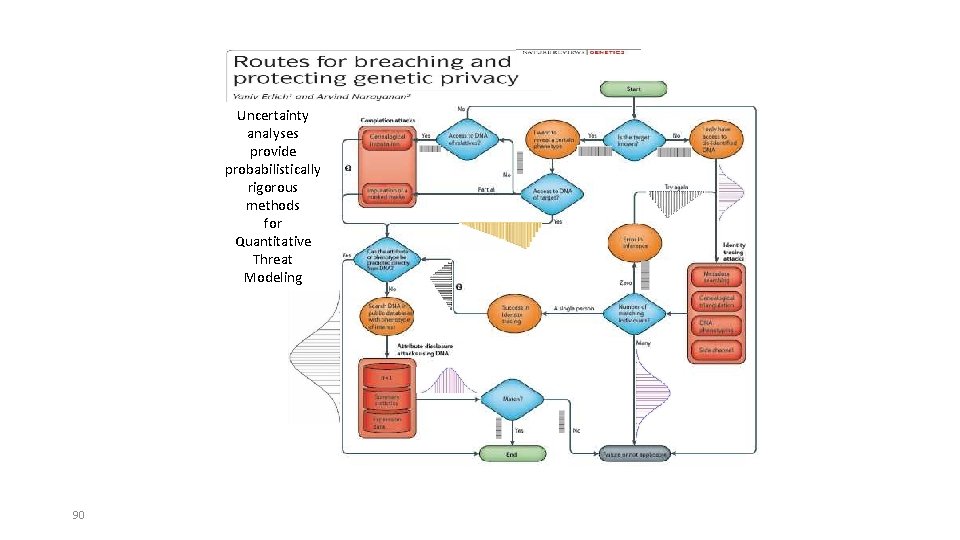
Uncertainty analyses provide probabilistically rigorous methods for Quantitative Threat Modeling 90
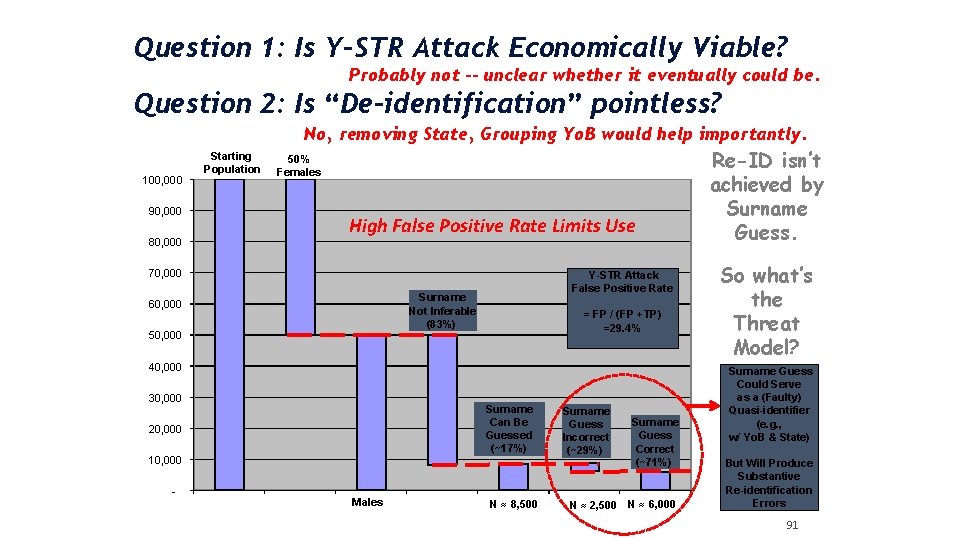
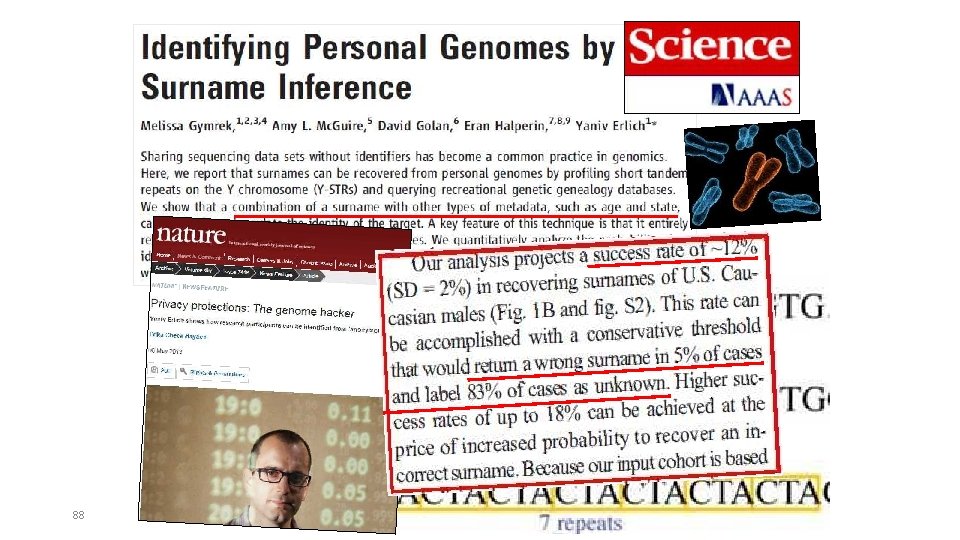
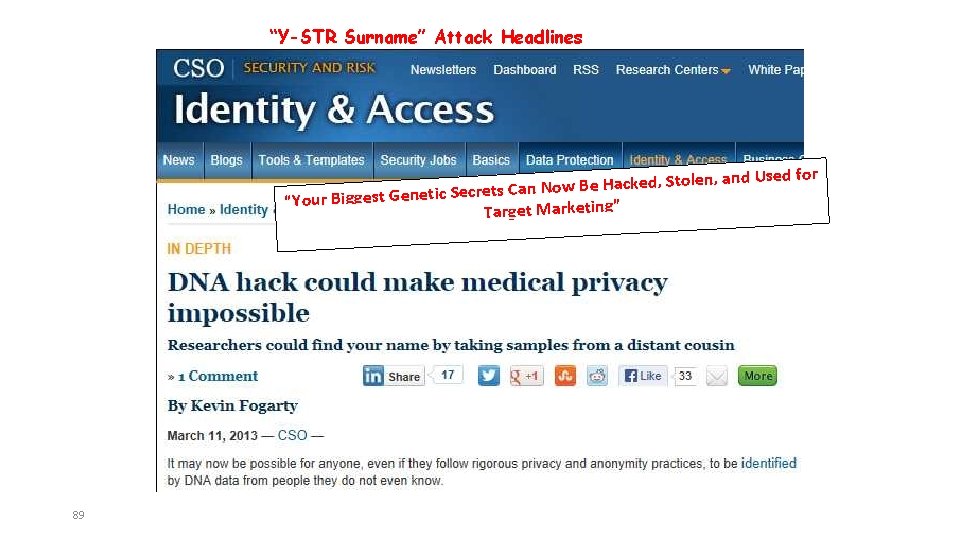
Question 1: Is Y-STR Attack Economically Viable? Probably not -- unclear whether it eventually could be. Question 2: Is “De-identification” pointless? No, removing State, Grouping Yo. B would help importantly. 100, 000 90, 000 80, 000 Starting Population 50% Females High False Positive Rate Limits Use 70, 000 Y-STR Attack False Positive Rate Surname Not Inferable (83%) 60, 000 50, 000 = FP / (FP +TP) =29. 4% 40, 000 30, 000 Surname Can Be Guessed (~17%) 20, 000 10, 000 - Males N ≈ 8, 500 Surname Guess Incorrect (~29%) Surname Guess Correct (~71%) N ≈ 2, 500 N ≈ 6, 000 Re-ID isn’t achieved by Surname Guess. So what’s the Threat Model? Surname Guess Could Serve as a (Faulty) Quasi-identifier (e. g. , w/ Yo. B & State) But Will Produce Substantive Re-identification Errors 91
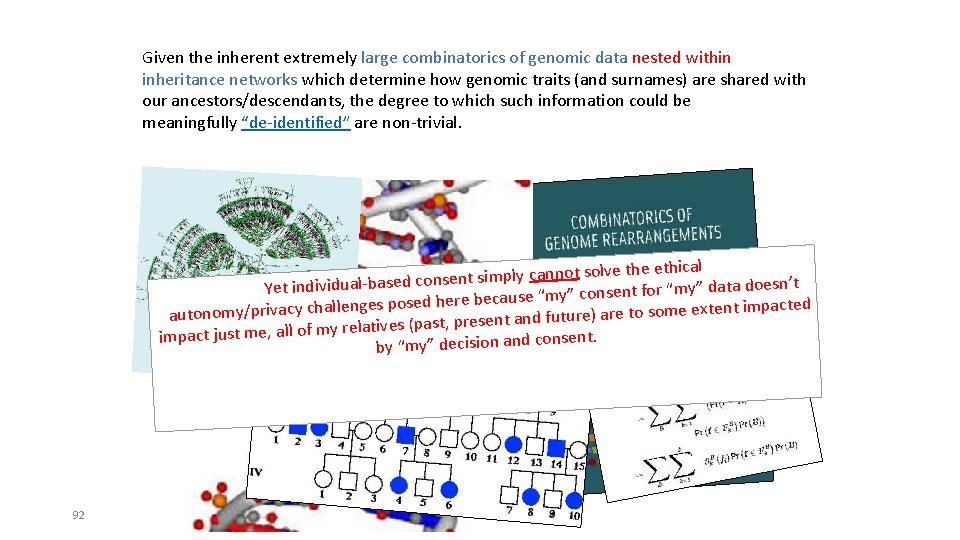
Given the inherent extremely large combinatorics of genomic data nested within inheritance networks which determine how genomic traits (and surnames) are shared with our ancestors/descendants, the degree to which such information could be meaningfully “de-identified” are non-trivial. the ethical e lv so ot nn ca y pl m si t en doesn’t ta da y” Yet individual-based cons “m r fo t en ns co d here because “my” se po es ng le al ch y extent impacted ac iv e m so to e ar ) autonomy/pr re tu fu d tives (past, present an la re y m of l al e, m st ju impact nsent. by “my” decision and co 92
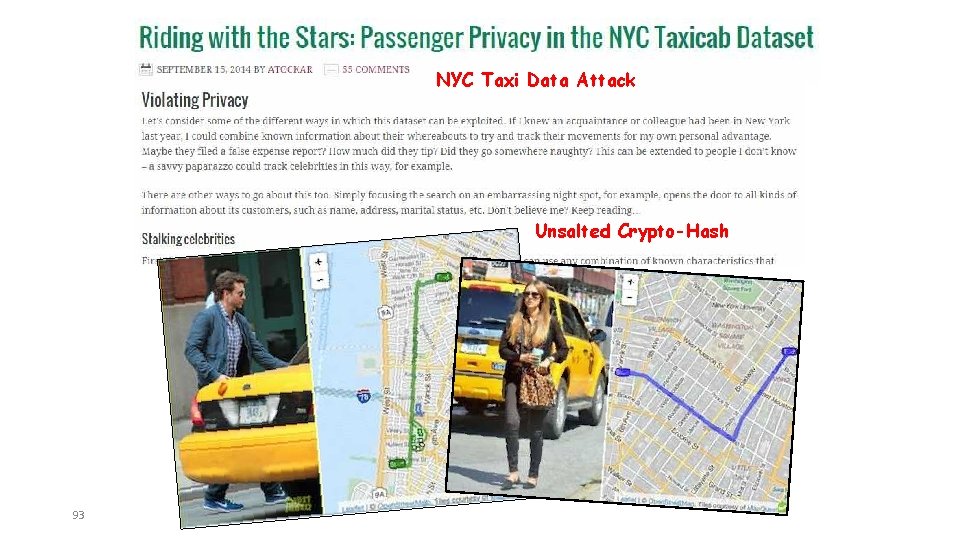
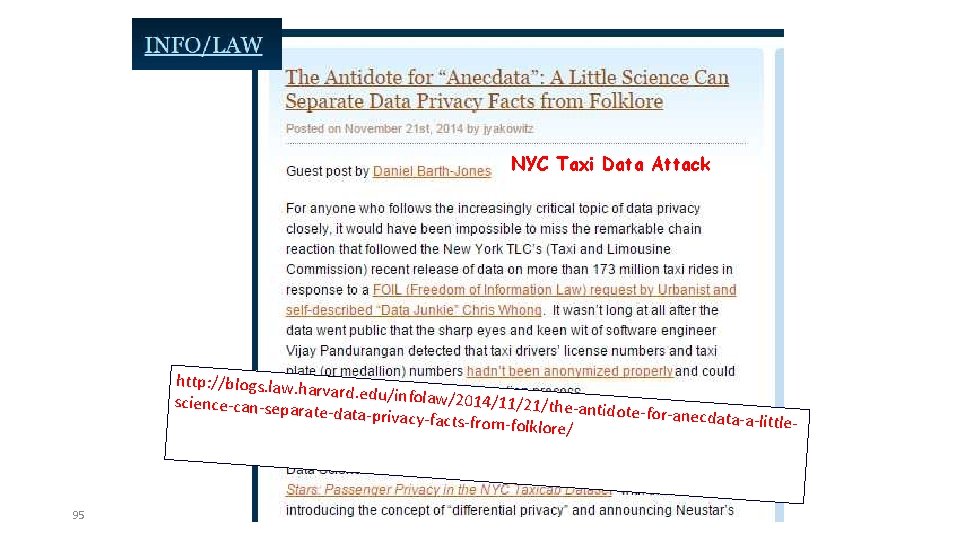
NYC Taxi Data Attack Unsalted Crypto-Hash 93
94
NYC Taxi Data Attack http: //blogs. law. h arvard. edu/infolaw /2014/11/21/the-a science-can-separa ntidote-for-anecd te-data-privacy-fa ata-a-littlects-from-folklore/ 95
Cell Data Uniqueness 96 Sample Unique ≠ Re-identifiable
January 2015 97
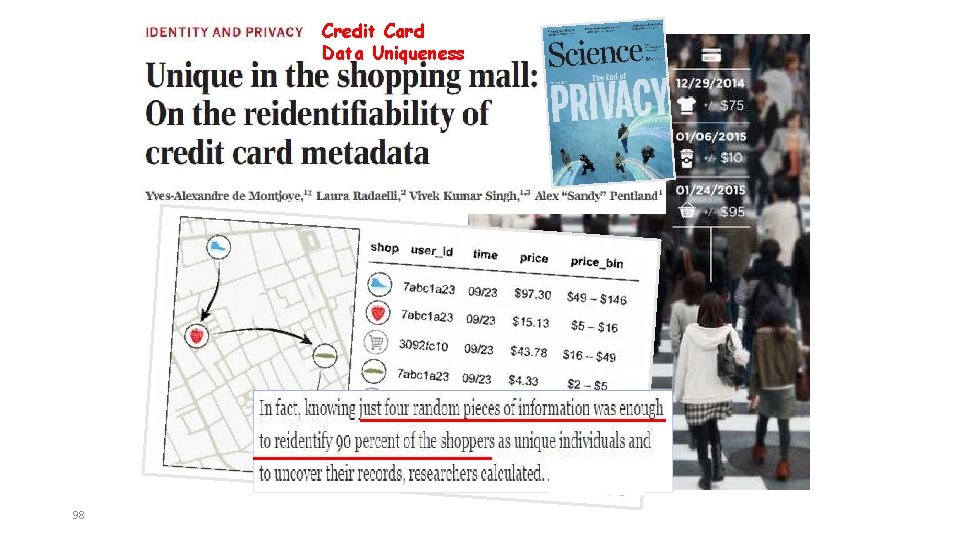
Credit Card Data Uniqueness 98
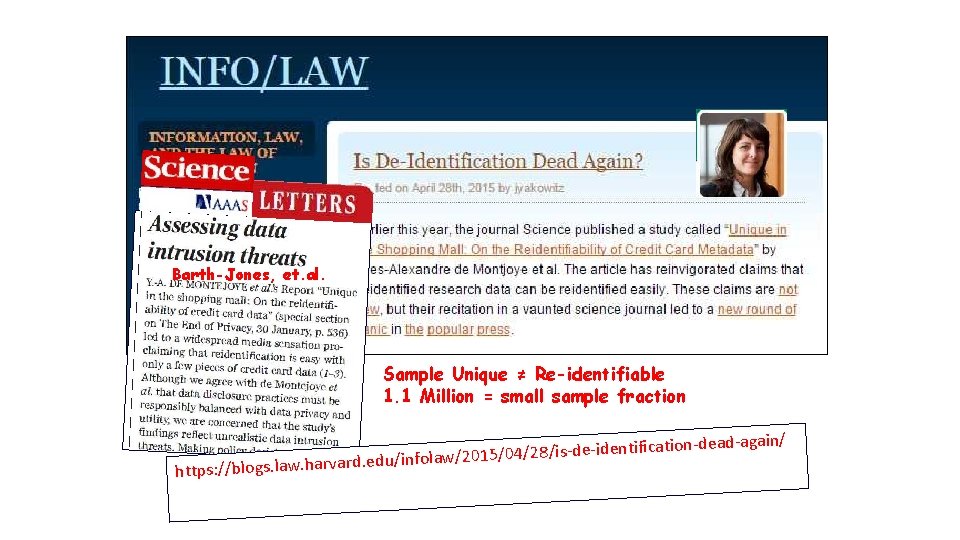
Barth-Jones, et. al. Sample Unique ≠ Re-identifiable 1. 1 Million = small sample fraction-dead-again/ ca fi ti en id e-d is 8/ /2 04. edu/infolaw/2015/ rd va ar. h w la s. og bl // s: tp ht
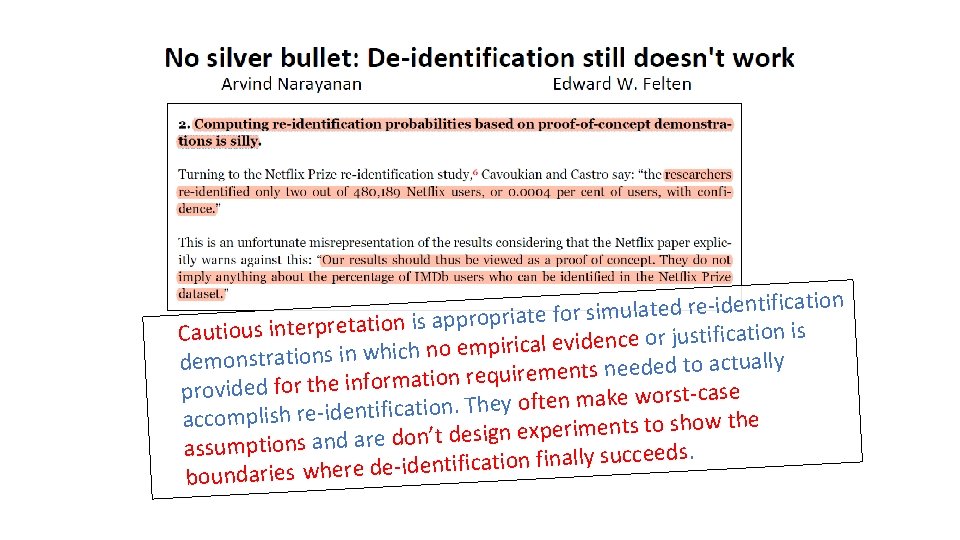
tion a c fi ti n e d -i re d te la u m si riate for p ro p p a is n o ti ta re rp te tion is a Cautious in ic if st ju r o e c n e id v e l a o empiric n h ic h w in s n o ti ra st n o lly a tu dem c a to d e e n ts n e m require n o ti a rm fo in e th r fo d e provid case trs o w e k a m n e ft o y e h tion. T accomplish re-identifica the w o sh to ts n e m ri e p x e n n’t desig o d re a d n a s n o ti p m u ss a ds. e e c c su y ll a n fi n o ti a c fi ti en boundaries where de-id
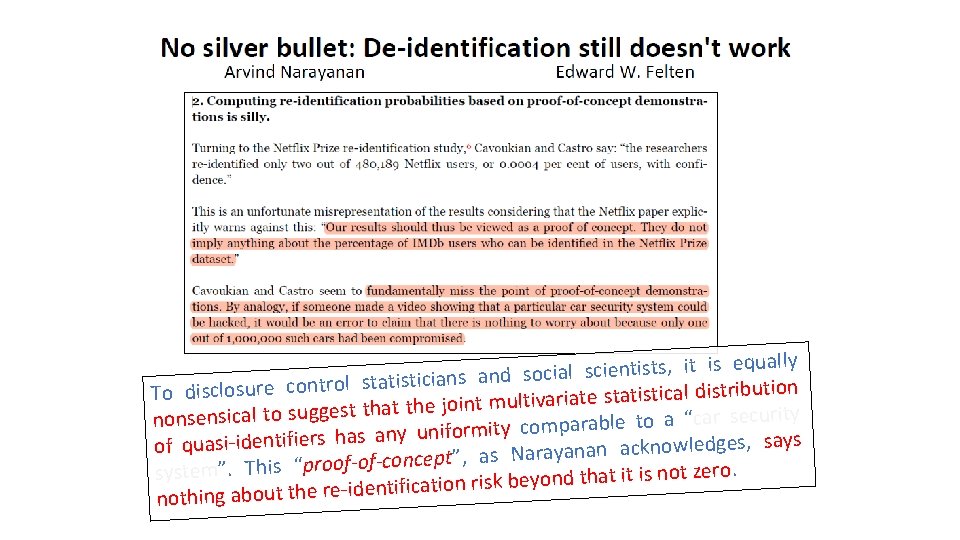
qually e is it s, st ti n ie sc l a ci ns and so ia ic st ti a st l o tr n co re tribution is d l a ic To disclosu st ti a st te a ri a iv lt the joint mu t a th st e g g su to l ca si n “car security a nonse to le b ra a p m co y it ny uniform a s a h rs e fi ti n e d s, says -i e si g a d u le q w o of n ck a n a y ra pt”, as Na ce n co fo fo ro “p is h T ro. ze t o system”. n is it t a th d n o y e b fication risk ti n e d -i re e th t u o b a g in noth
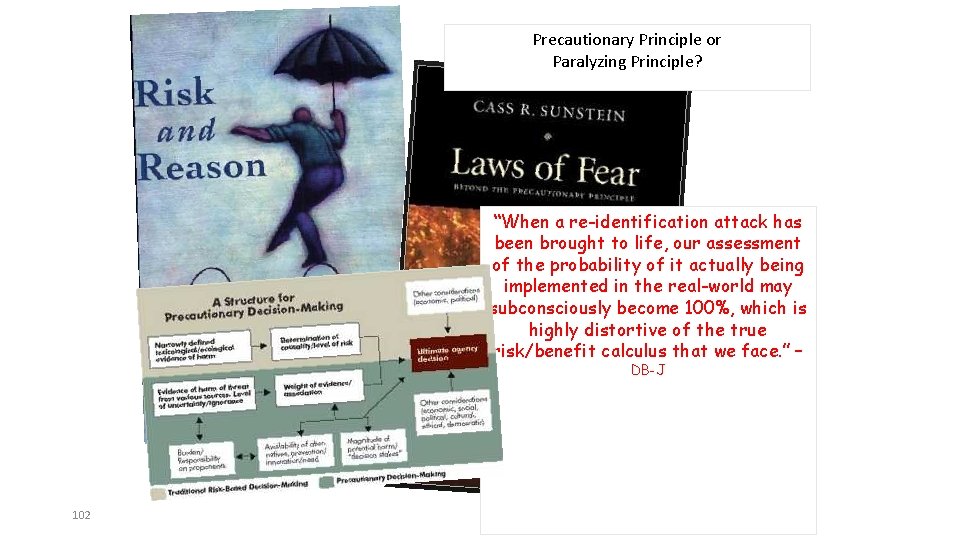
Precautionary Principle or Paralyzing Principle? “When a re-identification attack has been brought to life, our assessment of the probability of it actually being implemented in the real-world may subconsciously become 100%, which is highly distortive of the true risk/benefit calculus that we face. ” – DB-J 102
Re-identification Science Policy Shortcomings: 6 ways in which “Re-identification Science” has (thus far) typically failed to best support sound public policies: 1. Attacking only trivially “straw man” de-identified data, where modern statistical disclosure control methods (like HIPAA) weren’t used. 2. Targeting only especially vulnerable subpopulations and failing to use statistical random samples to provide policy-makers with representative re-identification risks for the entire population. 3. Making bad (often worst-case) assumptions and then failing to provide evidence to justify assumptions. Corollary: Not designing experiments to show the boundaries where de-identification finally succeeds. 103
Re-identification Science Policy Shortcomings: 6 ways in which “Re-identification Science” has (thus far) typically failed to support sound public policies (Cont’d): 4. Failing to distinguish between sample uniqueness, population uniqueness and re-identifiability (i. e. , the ability to correctly link population unique observations to identities). 5. Failing to fully specify relevant threat models (using data intrusion scenarios that account for all of the motivations, process steps, and information required to successfully complete the re-identification attack for the members of the population). 6. Unrealistic emphasis on absolute “Privacy Guarantees” and failure to recognize unavoidable trade-offs between data privacy and statistical accuracy/utility. 104
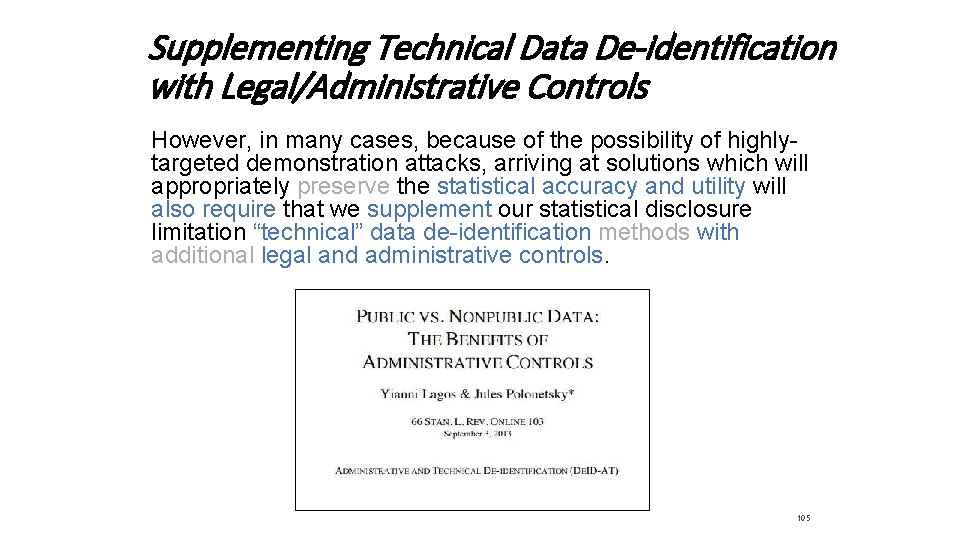
Supplementing Technical Data De-identification with Legal/Administrative Controls However, in many cases, because of the possibility of highlytargeted demonstration attacks, arriving at solutions which will appropriately preserve the statistical accuracy and utility will also require that we supplement our statistical disclosure limitation “technical” data de-identification methods with additional legal and administrative controls. 105
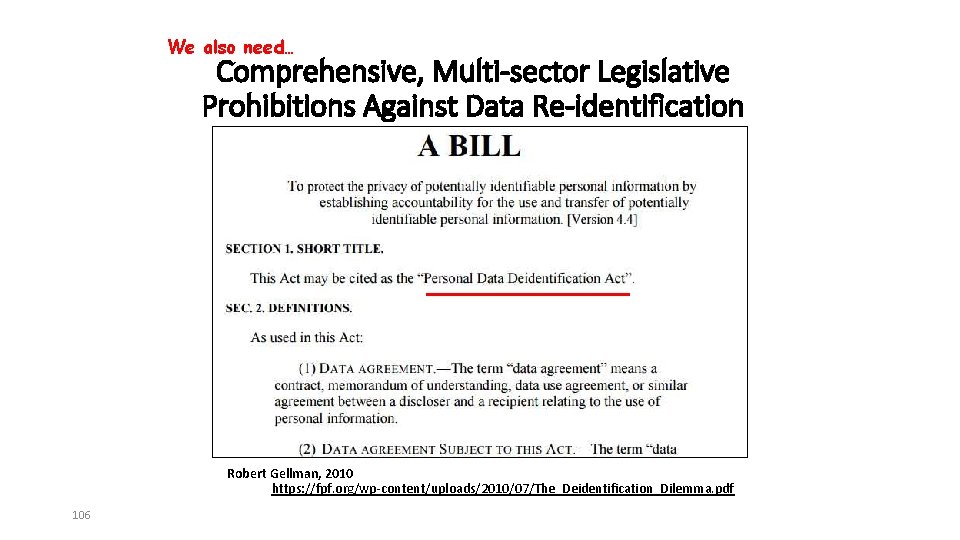
We also need… Comprehensive, Multi-sector Legislative Prohibitions Against Data Re-identification Robert Gellman, 2010 https: //fpf. org/wp-content/uploads/2010/07/The_Deidentification_Dilemma. pdf 106
Why Privacy Science Must Become A “Systems Science” § Paul Ohm described a dystopic vision that all information is effectively PII and that the failure of perfect de-identification would lead us through cycles of accretive re-identification toward a universal “database of ruin”. § This misconception ignores the underlying mathematical realities which indicate that when modern statistical disclosure limitation (SDL) methods can be used to effectively de-identify data, we will have resulting increases in “false positive” re-identifications. § Such false positive linkages will practically prevent the ability of such systemic “crystallization” of iteratively linked de-identified data into accurate dossiers for the very vast majority of the population. § Because of this de-identification, although imperfectly protective, is critical for reaching reasonable solutions which can continue to offer pragmatic and sustainable data obscurity in the evolving era of big data. 107
Why Privacy Science Must Become A “Systems Science” § Modern SDL-based de-identification essential protections for preventing mass re-identification at scale and positions advocating for wholesale abandonment of de-identification due to less-than-perfect efficacy discard one of data privacy’s most effective tools for an idealistic hope of perfect privacy protections makes “perfect the enemy of the good”. § Systems perspective using uncertainty analyses can help to apply consistent and rigorous probabilistic methods accounting for our uncertainty about the efficacy of various technical, administrative and legal protections at different stages in data intrusion scenarios to demonstrate that combining these methods can lead to useful assurance that (admittedly less than perfect) deidentification can still provide useful protections without resorting to only worst case scenarios about data intruder’s knowledge. 108
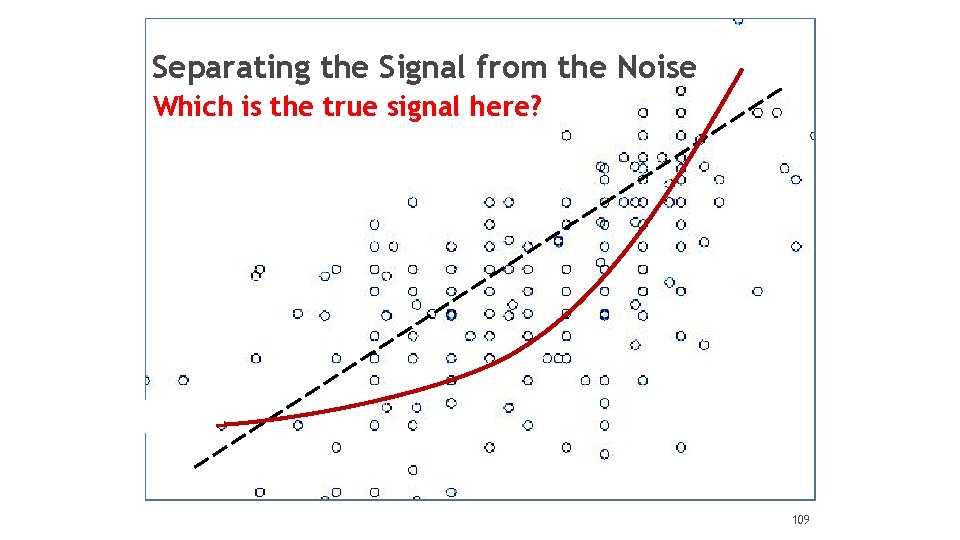
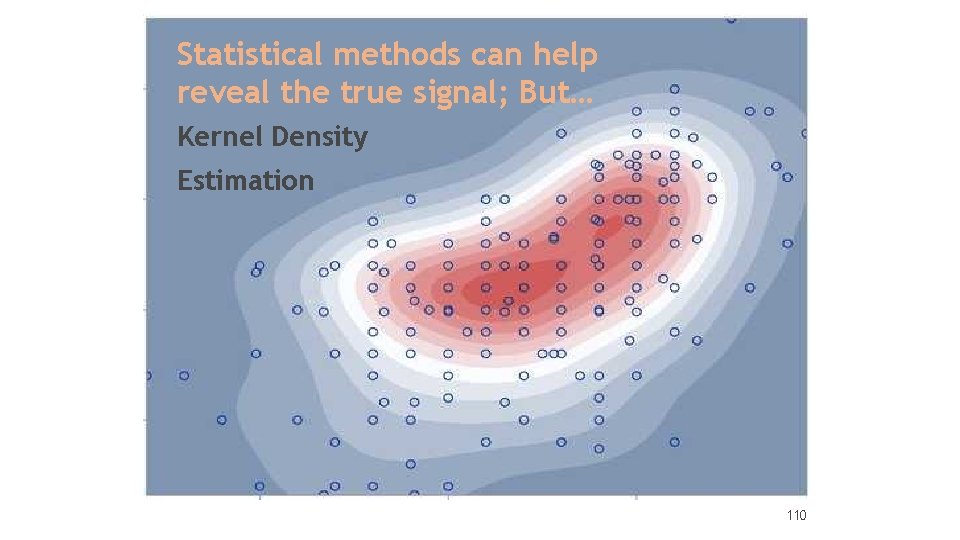
Separating the Signal from the Noise Which is the true signal here? 109
Statistical methods can help reveal the true signal; But… Kernel Density Estimation 110
K-anonymity Can Distort Multivariate Relationships 111
De-identification Can Hide Important Differences Black White Unknown 112 Asian Hispanic Other
Percent of Regression Coefficients which changed Significance: 113
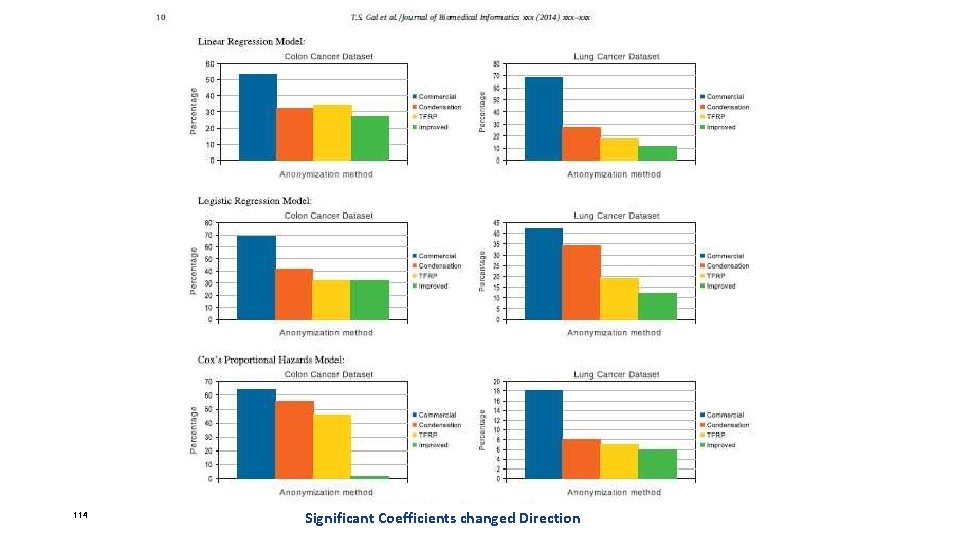
114 Significant Coefficients changed Direction
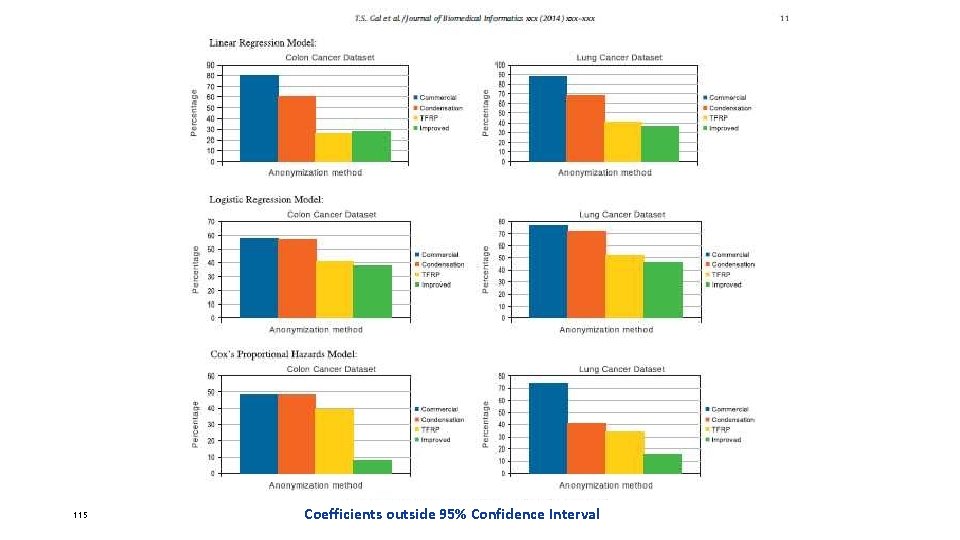
115 Coefficients outside 95% Confidence Interval
If this is what we are going to do to our ability to conduct accurate research – then… we should all just give up and go home. • • • Although poorly conducted de-identification can distort our ability to learn what is true leading to “bad science/decisions”, this does not need to be an inevitable outcome. Well-conducted de-identification practice always carefully considers both the re-identification risk context and examines and controls the possible distortion to the statistical accuracy and utility of the de-identified data to assure de-identified data has been appropriately and usefully de-identified. But doing this requires a firm understanding/grounding in the extensive body of the statistical disclosure control/limitation literature. 116
Preventing Identification with Geographic Censoring and Masking • Geographic Censoring refers to preventing identification by not reporting data from individuals within those areas with high disclosure risks • Obviously, geographic censoring is preferable only when the populations requiring censoring are very small. • Geographic Masking refers to preventing identification by modifying the original geographic reporting areas. • The simplest method of geographic masking is to combine or aggregate geographic units with high reidentification risks into larger population units. 117
Challenge: Subtraction Geography (i. e. , Geographical Differencing) • Challenge: Data recipients often request reporting on more than one geography (e. g. , both State and 3 digit Zip code). • Subtraction Geography creates disclosure risk problems when more than one geography is reported for the same area and the geographies overlap. • Also called geographical differencing, this problem occurs when the multiple overlapping geographies are used to reveal smaller areas for re-identification searches. 118
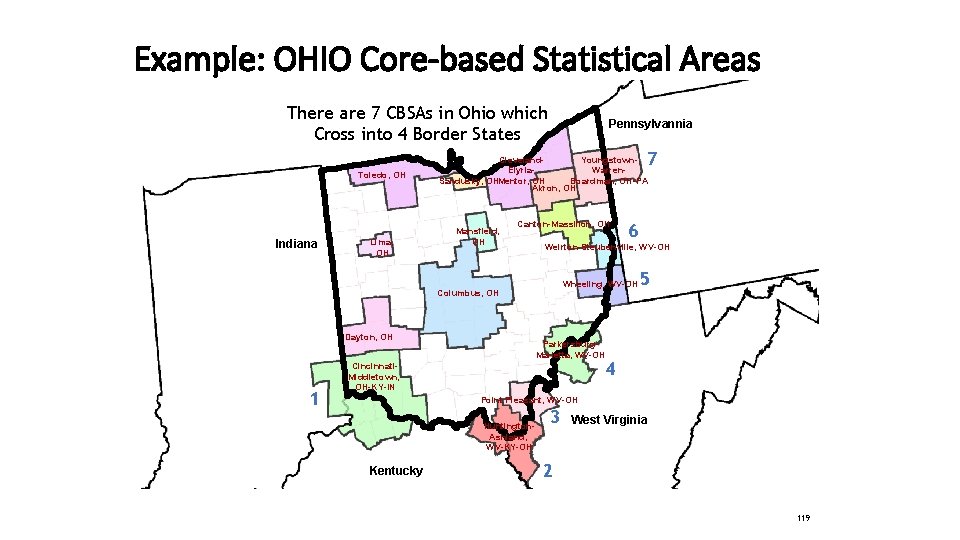
Example: OHIO Core-based Statistical Areas There are 7 CBSAs in Ohio which Cross into 4 Border States Pennsylvannia 7 Toledo, OH Indiana Lima, OH Cleveland. Youngstown. Elyria. Warren. Sandusky, OHMentor, OH Boardman, OH-PA Akron, OH Mansfield, OH Canton-Massillon, OH Wheeling, WV-OH Columbus, OH Dayton, OH 1 6 Weirton-Steubenville, WV-OH 5 Parkersburg. Marietta, WV-OH 4 Cincinnati. Middletown, OH-KY-IN Point Pleasant, WV-OH Huntington. Ashland, WV-KY-OH Kentucky 3 West Virginia 2 119
Data Intrusion Scenarios: • Prob(Re-identification) = Prob(Re-ident|Attempt)*Prob(Attempt) • Note that Prob(Attempt) & Prob(Reident|Attempt) are actually not likely to be independent - higher re-identification probabilities are likely to increase re-identification attempts. • Some very useful frameworks exist for characterizing Data Intrusion Scenarios: • Elliot & Dale, 1999, Duncan & Elliot Chapter 2, 2011 • We can frame the Prob(Attempt) in terms of: Motivation, Resources, Data Access, Attack Methods, Quasi-identifier Properties and Sets, Data Divergence Issues, and Probability of Success, Consequences and Alternatives for Goal Achievement 120
Conceptualizing Data Intrusion • The information assumed about the Data Intruder’s state of knowledge and resources is called a “Data Intrusion Scenario”. • We can’t protect against every possible scenario, but we can protect against a realistic set of likely scenarios. • For example, it may be reasonable to assume that there will be multiple data intruders each possessing different confidential knowledge. 121
Classifying Variables • Identifying Variables • Name, SSN, Address etc. (Should already be removed from the sample data) • Key (or Quasi-identifier Variables) • Variables that in combination can identify and are “reasonably available” in databases along with Identifying variables (e. g. , Date of Birth, Gender, Zip Code) • Confidential Variables • Variables that the intruder might know about a specific target, but which would be very unlikely to be known in general (Hosp. Adm. Date, Diagnoses, etc. ) 122
Conceptualizing Data Intrusion • A reasonable assessment of statistical disclosure risks should include: • Formulating a comprehensive set of Data Intrusion Scenarios • Estimating (conservatively) the “costs and availability” of the required data intrusion resources • Conducting Statistical Disclosure Risk Analyses • Calculating the risk of disclosure given the associated costs, etc. • Providing a well-reasoned, clear and probablistically coherent justification for the case that the risk of identification is “very small” (under HIPAA Expert Determination. 123
Three Main Data Intrusion Scenarios: • Specific-Target (aka “Nosy Neighbor”) Attacks (Have specific target individuals in mind: acquaintances or celebrities) • Marketing Attacks (Want as many re-identifications as possible in order to market to these individuals, may tolerate a high proportion of incorrect re-identifications, but this can come at the risk of being caught re-identifying) • Demonstration Attacks (Want to demonstrate reidentification is possible to discredit the practice or to harm the data holder; Doesn’t matter who is re-identified so unverified re-identifications may also achieve intended goals) 124
Data Intrusion Details: • Motivation: To acquire specific information vs. Discredit/Harm de-identification policies or data holders • Resources/Data Access: Statistical Skills; Knowledge/Data Access and Data Sources (Matters of Public Record, Commercially Available Data, Personal Knowledge); Computing Skills & Resources; Impediments provided by Computer Security and Governance/Legal controls. • Attack Methods: Primary Intrusion Scenarios (Specific Target, Marketing, Demonstration), Deterministic vs. Probabilistic matching, Multi-stage Linkage attacks with or without verifications steps. 125
Data Intrusion Details: • Quasi-identifier Properties and Sets • Key Resolution • Skewness • Associations between Quasi-identifiers & “Special Unique” Interactions for Combinations of Quasi-identifiers • Data Divergence Issues • Missing Data Rates • The “Myth of the Perfect Population Register” • Time Dynamic Variables • Measurement and Coding Variations and Errors 126
Importance of “Data Divergence” • Probabilistic record linkage has some capacity deal with errors and inconsistencies in the linking data between the sample and the population caused by “data divergence”: • Time dynamics in the variables (e. g. changing Zip Codes when individuals move, Change in Martial Status, Income Levels, etc. ), • Missing and Incomplete data and • Keystroke or other coding errors in either dataset, • But the links created by probabilistic record linkage are subject to uncertainty. The data intruder is never really certain that the correct persons have been re-identified. 127
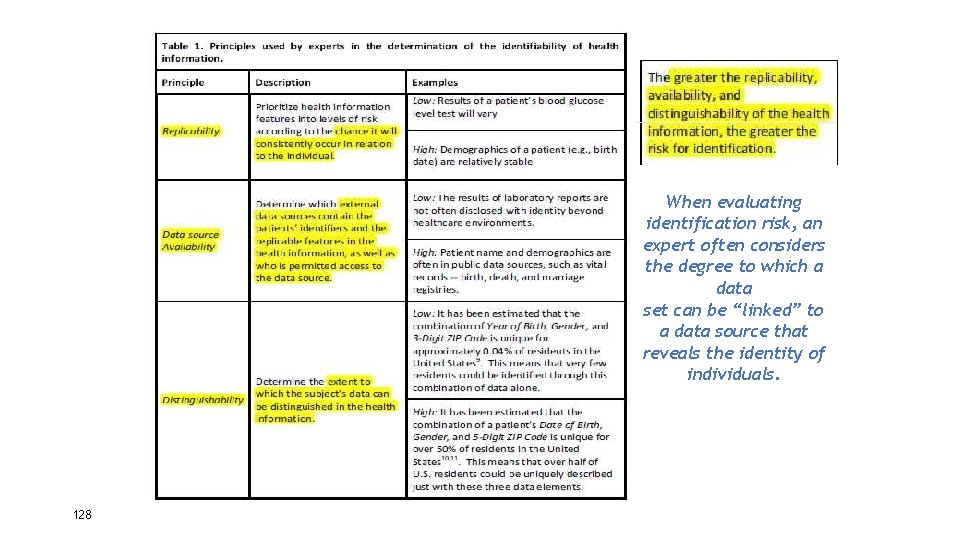
When evaluating identification risk, an expert often considers the degree to which a data set can be “linked” to a data source that reveals the identity of individuals. 128
Data Intrusion Details: • Probability of: • Success (Not only information from verifiable re-identifications or economic gains, but also success in terms of desired policy or organizational harm goals) • Consequences for Re-identification Attempts (Legal and/or Economic Ramifications for Re-identification Attempts) • Alternatives for Goal Achievement • Are there preferable alternatives for data intruder’s goal achievement that have more cost-effective economic incentives or avoid negative consequences of re-identification attempts? 129
Sensitivity Analyses • Non-parametric multivariate methods such as Partial Rank Correlation Coefficients (PRCC) can examine the relationships of the input parameters and the outcome variables produced in the simulations. • Identify input parameters with large effects. • Clarify the implications that uncertainties have for policy recommendations. • Identify future research that will be critical for making robust policy decisions.
HHS Guidance (Nov 26, 2012) Q 2. 2 ”Who is an “expert? ” (p. 10) • No specific professional degree or certification for de-identification experts. • Relevant expertise may be gained through various routes of education and experience. • Experts may be found in the statistical, mathematical, or other scientific domains. • From an enforcement perspective, OCR would review the relevant professional experience and academic or other training of the expert, as well as their actual experience using health information deidentification methodologies. 131
Recommended Skills for De-Identification Experts • • • Statistical Disclosure Limitation/Control HIPAA/HITECH Law Corporate Compliance Privacy Preserving Data Publishing Medical Informatics Privacy Preserving Data Mining Biostatistics/Epidemiology Health Systems Research Cryptography Computer Security Geographic Information Systems 132
HHS Guidance Q 2. 3 Acceptable level of identification risk? (p. 11) • There is no explicit numerical level of identification risk that is deemed to universally meet the “very small” level. • The ability of a recipient of information to identify an individual is dependent on many factors, which an expert will need to take into account while assessing the risk. 133
HHS Guidance Q 2. 4 How long is an expert determination valid? (p. 11) • The Privacy Rule does not explicitly require an expiration date for de-identification determinations. • However, experts have recognized that technology, social conditions, and the availability of information change over time. Consequently, certain de-identification practitioners use the approach of time-limited certifications. • The expert will assess the expected change of computational capability and access to various data sources, and determine an appropriate timeframe. 134
Q 2. 5 Can an expert derive multiple solutions from the same data set for a recipient? (p. 11) • Yes. Experts may design multiple solutions, each of which is tailored to the information reasonably available to the anticipated recipient of the data set. • The expert must take care to ensure that the data sets cannot be combined to compromise the protections. • Example: An expert may derive one data set with detailed geocodes and generalized age (e. g. , 5 -year age ranges) and another data set that contains generalized geocodes (e. g. , only the first two digits) and fine-grained age (e. g. , days from birth). 135
Q 2. 5 Can an expert derive multiple solutions from the same data set for a recipient? (Cont’d) • The expert may certify both data sets after determining that the two data sets could not be merged to individually identify a patient. • This determination may be based on a technical proof regarding the inability to merge such data sets. • Alternatively, the expert also could require additional safeguards through a data use agreement. 136
Q 2. 6. How do experts assess the risk of identification of information? (p. 12 -16) • No single universal solution • A combination of technical and policy procedures are often applied. • OCR does not require a particular process for an expert to use to reach a determination that the risk of identification is very small. • The Rule does require that the methods and results of the analysis that justify the determination be documented and made available to OCR upon request. 137
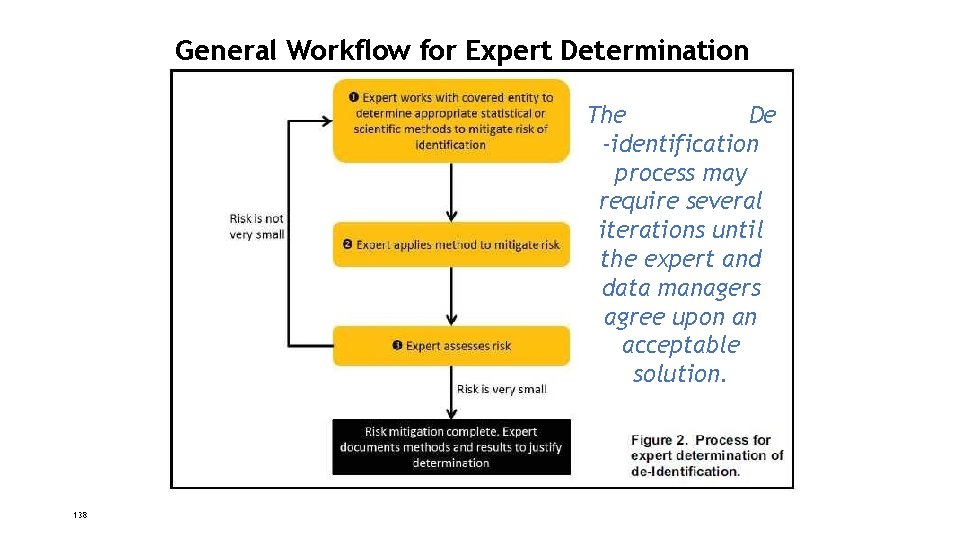
General Workflow for Expert Determination The De -identification process may require several iterations until the expert and data managers agree upon an acceptable solution. 138
Q 2. 8. What are the approaches by which an expert mitigates the risk of identification? (p. 18) • The Privacy Rule does not require a particular approach to reduce the re-identification risk to very small. • In general, the expert will adjust certain features or values in the data to ensure that unique, identifiable elements are not expected to exist. • An overarching common goal of such approaches is to balance disclosure risk against data utility. 139
Q 2. 8. What are the approaches by which an expert mitigates the risk of identification? (Cont’d) • Determination of which method is most appropriate will be assessed by the expert on a case-by-case basis. • The expert may also consider limiting distribution of records through a data use agreement or restricted access agreement in which the recipient agrees to limits on who can use or receive the data, or agrees not to attempt identification of the subjects. Specific details of such an agreement are left to the discretion of the expert and covered entity. 140
Q 2. 9 Can an Expert determine a code derived from PHI is de-identified? (p. 21 -22) • A common de-identification technique for obscuring information is to use a one-way cryptographic function (known as a hash function) • Disclosure of codes derived from PHI in a de-identified data set is allowed if an expert determines that the data meets the requirements at § 164. 514(b)(1). The re-identification provision in § 164. 514(c) does not preclude the transformation of PHI into values derived by cryptographic hash functions using the expert determination method, provided the keys associated with such functions are not disclosed. 141
De-identification Risk Assessment • The following disciplines have important stakeholder positions in understanding the many considerations important for de-identification risk assessments: – Medical Researchers and Epidemiologists - who understand the many socially beneficial medical and public health uses of de-identified health information – Biostatisticians - who understand the errors and biases that can be introduced into statistical research by deidentification methods – Re-identification Researchers - who understand reidentification risk estimation and data intrusion scenarios – Medical Ethicists - who understand the importance of ensuring individual protections in balance with societal research interests.
Requisite Skills for De-Identification Teams • • • Statistical Disclosure Limitation/Control HIPAA/HITECH Law Corporate Compliance Privacy Preserving Data Publishing Medical Informatics Privacy Preserving Data Mining Biostatistics/Epidemiology Health Systems Research Cryptography Computer Security Geographic Information Systems 143
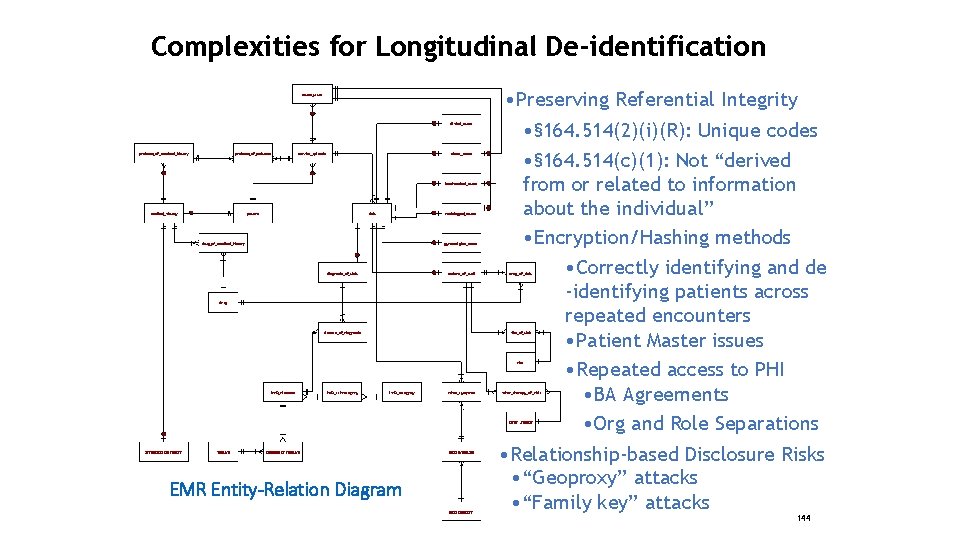
Complexities for Longitudinal De-identification • Preserving Referential Integrity • § 164. 514(2)(i)(R): Unique codes • § 164. 514(c)(1): Not “derived from or related to information about the individual” • Encryption/Hashing methods • Correctly identifying and de -identifying patients across repeated encounters • Patient Master issues • Repeated access to PHI • BA Agreements • Org and Role Separations EMR Entity-Relation Diagram • Relationship-based Disclosure Risks • “Geoproxy” attacks • “Family key” attacks 144
Suggested Conditions for Deidentified Data Use Recipients of De-identified Data should be required to: 1) Not re-identify, or attempt to re-identify, or allow to be reidentified, any patients or individuals who are the subject of Protected Health Information within the data, or their relatives, family or household members. 2)Not link any other data elements to the data without obtaining certification that the data remains de-identified. 3) Implement and maintain appropriate data security and privacy policies, procedures and associated physical, technical and administrative safeguards to assure that it is accessed only by authorized personnel and will remain deidentified. 4) Assure that all personnel or parties with access to the data agree to abide by all of the foregoing conditions. 145
Data Privacy Concerns are Far Too Important (and Complex) to be summed up with Catch Phrases or “Anecdata” Eye-catching headlines and twitter-buzz announcing “There’s No Such Thing as Anonymous Data” might draw the public’s attention to broader and important concerns about data privacy in this era of “Big Data”, but such statements are essentially meaningless, even misleading, for further generalization without consideration of the specific de/re-identification contexts -- including the precise data details (e. g. , number of variables, resolution of their coding schemas, special data properties, such as spatial/geographic detail, network properties, etc. ) de-identification methods applied, and associated experimental design for re-identification attack demonstrations. Good Public Policy demands reliable scientific evidence… 146
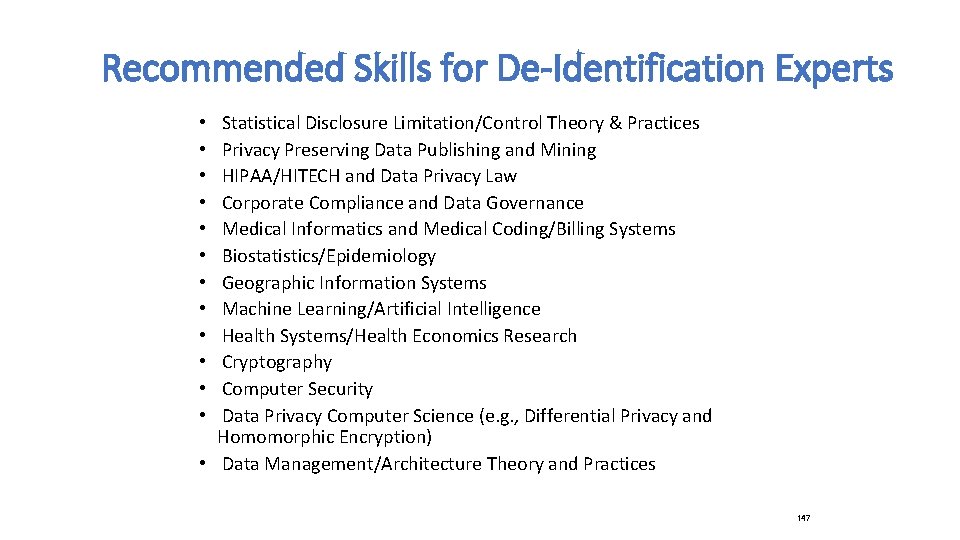
Recommended Skills for De-Identification Experts Statistical Disclosure Limitation/Control Theory & Practices Privacy Preserving Data Publishing and Mining HIPAA/HITECH and Data Privacy Law Corporate Compliance and Data Governance Medical Informatics and Medical Coding/Billing Systems Biostatistics/Epidemiology Geographic Information Systems Machine Learning/Artificial Intelligence Health Systems/Health Economics Research Cryptography Computer Security Data Privacy Computer Science (e. g. , Differential Privacy and Homomorphic Encryption) • Data Management/Architecture Theory and Practices • • • 147
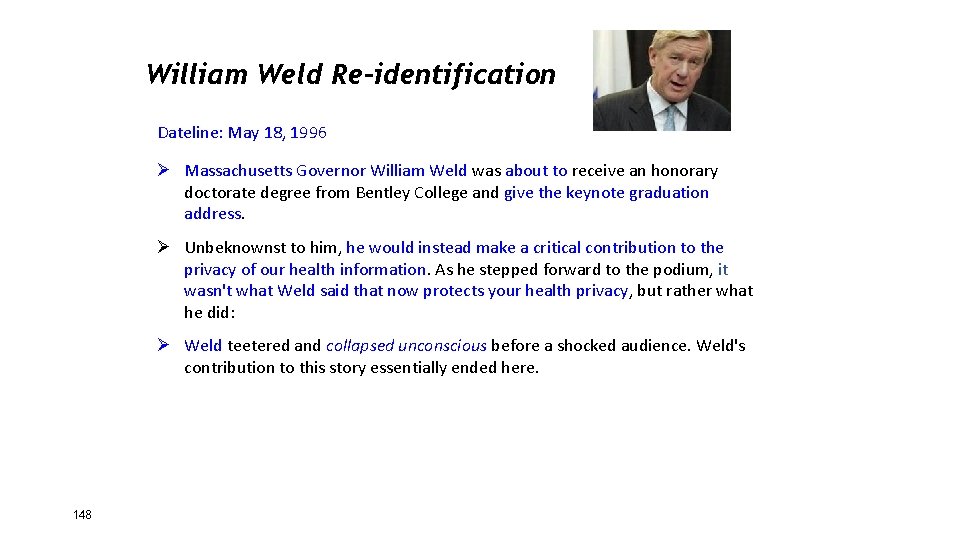
William Weld Re-identification Dateline: May 18, 1996 Ø Massachusetts Governor William Weld was about to receive an honorary doctorate degree from Bentley College and give the keynote graduation address. Ø Unbeknownst to him, he would instead make a critical contribution to the privacy of our health information. As he stepped forward to the podium, it wasn't what Weld said that now protects your health privacy, but rather what he did: Ø Weld teetered and collapsed unconscious before a shocked audience. Weld's contribution to this story essentially ended here. 148
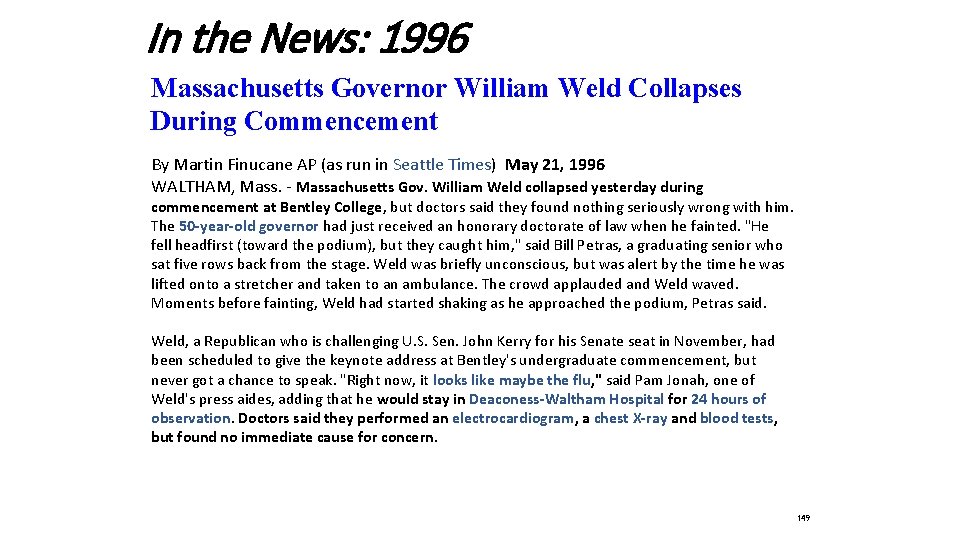
In the News: 1996 Massachusetts Governor William Weld Collapses During Commencement By Martin Finucane AP (as run in Seattle Times) May 21, 1996 WALTHAM, Mass. - Massachusetts Gov. William Weld collapsed yesterday during commencement at Bentley College, but doctors said they found nothing seriously wrong with him. The 50 -year-old governor had just received an honorary doctorate of law when he fainted. "He fell headfirst (toward the podium), but they caught him, " said Bill Petras, a graduating senior who sat five rows back from the stage. Weld was briefly unconscious, but was alert by the time he was lifted onto a stretcher and taken to an ambulance. The crowd applauded and Weld waved. Moments before fainting, Weld had started shaking as he approached the podium, Petras said. Weld, a Republican who is challenging U. S. Sen. John Kerry for his Senate seat in November, had been scheduled to give the keynote address at Bentley's undergraduate commencement, but never got a chance to speak. "Right now, it looks like maybe the flu, " said Pam Jonah, one of Weld's press aides, adding that he would stay in Deaconess-Waltham Hospital for 24 hours of observation. Doctors said they performed an electrocardiogram, a chest X-ray and blood tests, but found no immediate cause for concern. 149
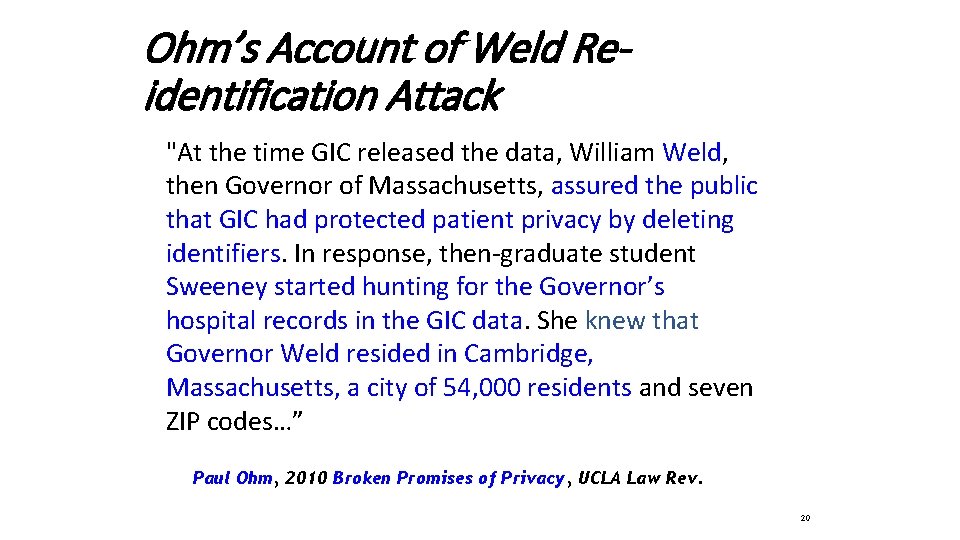
Ohm’s Account of Weld Reidentification Attack "At the time GIC released the data, William Weld, then Governor of Massachusetts, assured the public that GIC had protected patient privacy by deleting identifiers. In response, then-graduate student Sweeney started hunting for the Governor’s hospital records in the GIC data. She knew that Governor Weld resided in Cambridge, Massachusetts, a city of 54, 000 residents and seven ZIP codes…” Paul Ohm, 2010 Broken Promises of Privacy, UCLA Law Rev. 20
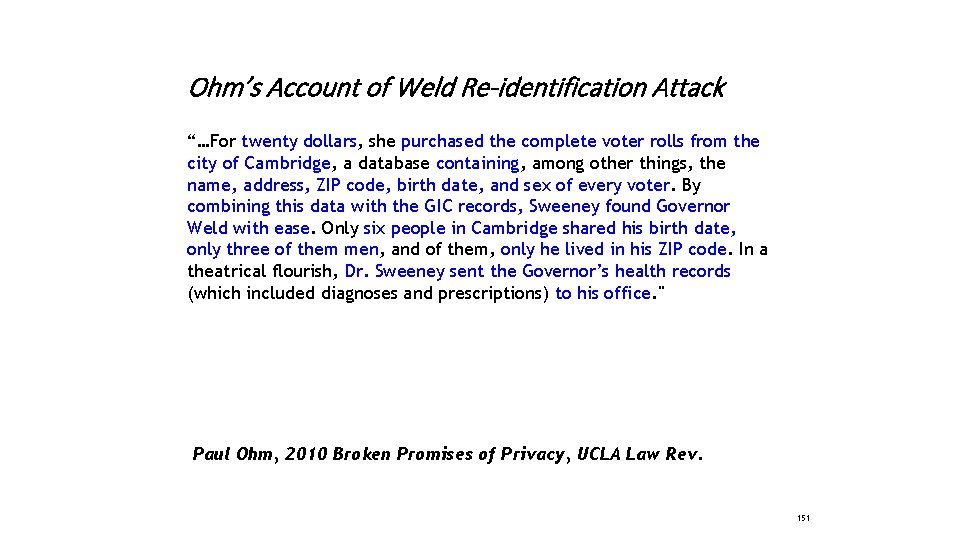
Ohm’s Account of Weld Re-identification Attack “…For twenty dollars, she purchased the complete voter rolls from the city of Cambridge, a database containing, among other things, the name, address, ZIP code, birth date, and sex of every voter. By combining this data with the GIC records, Sweeney found Governor Weld with ease. Only six people in Cambridge shared his birth date, only three of them men, and of them, only he lived in his ZIP code. In a theatrical flourish, Dr. Sweeney sent the Governor’s health records (which included diagnoses and prescriptions) to his office. " Paul Ohm, 2010 Broken Promises of Privacy, UCLA Law Rev. 151
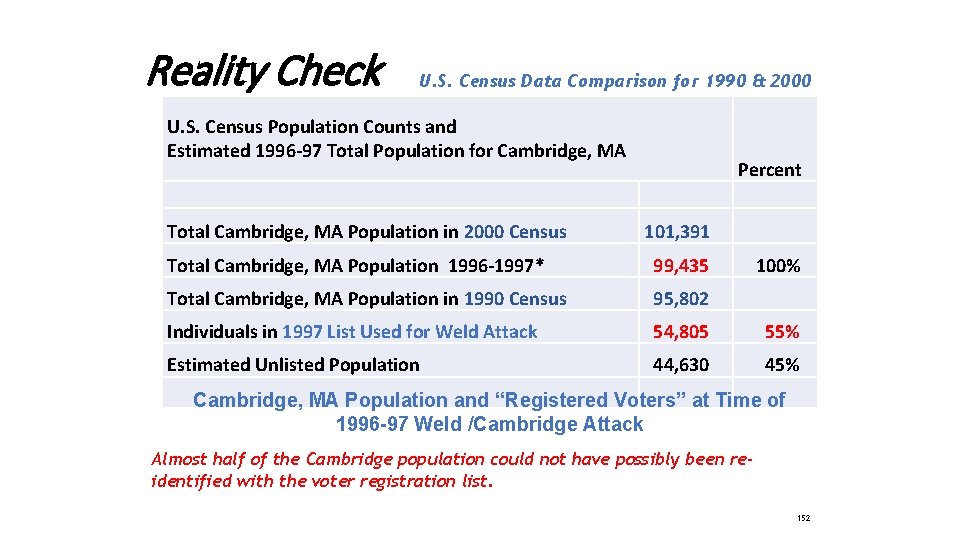
Reality Check U. S. Census Data Comparison for 1990 & 2000 U. S. Census Population Counts and Estimated 1996 -97 Total Population for Cambridge, MA Total Cambridge, MA Population in 2000 Census Percent 101, 391 Total Cambridge, MA Population 1996 -1997* 99, 435 100% Total Cambridge, MA Population in 1990 Census 95, 802 Individuals in 1997 List Used for Weld Attack 54, 805 55% Estimated Unlisted Population 44, 630 45% Cambridge, MA Population and “Registered Voters” at Time of 1996 -97 Weld /Cambridge Attack Almost half of the Cambridge population could not have possibly been reidentified with the voter registration list. 152
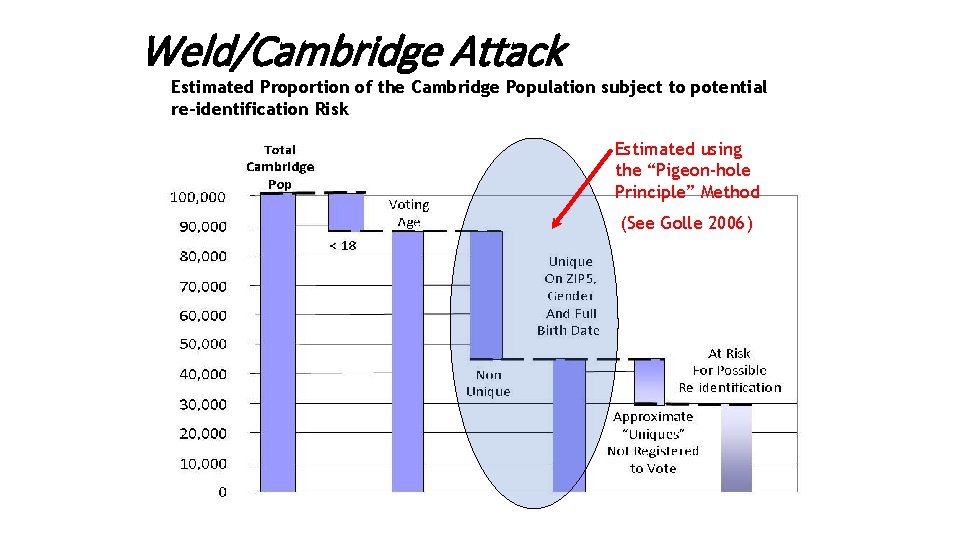
Weld/Cambridge Attack Estimated Proportion of the Cambridge Population subject to potential re-identification Risk Estimated using the “Pigeon-hole Principle” Method (See Golle 2006) 153
How Typical was Weld’s Re-identification? Ø Weld was extremely easy to re-identify within the GIC hospitalization data for Massachusetts employees for several reasons. Ø He was state employee and publicly known to have been hospitalized, so one could expect that Weld's hospital billing data would be within the GIC hospital data set. Ø This foreknowledge would not likely exist for random re-identification targets unknown to an imagined "data intruder". Ø For a randomly selected target, a data intruder would be unlikely to know whether any chance target individual was a state employee or had been recently hospitalized. Ø Weld was also sure to be registered to vote and publicly known to reside in Cambridge so he could be found in the Cambridge Voter Registration list. Ø This foreknowledge would not exist for random re-identification targets. 154
Myth of the “Perfect Population Register” • The critical part of many re-identification efforts that is often assumed by disclosure scientists is the assumption of a perfect population register. • All Population registers will have data errors and be incomplete to some extent. (e. g. Nationwide voter registration levels typically are about 70%) • However, some types of data errors are more critical than others. • Persons who are not included in population registers will not have identifiers which can be linked to identify them. • Persons who are not in a population register can not re-identified, but they also indirectly reduce the probability of correct reidentification for others. • If only one person within a quasi-identifier set is missing from the population register, then the probability of correct re-identification drops to 50%; if two persons are missing, then the probability of correct re-identification is 33% , and so on. 155
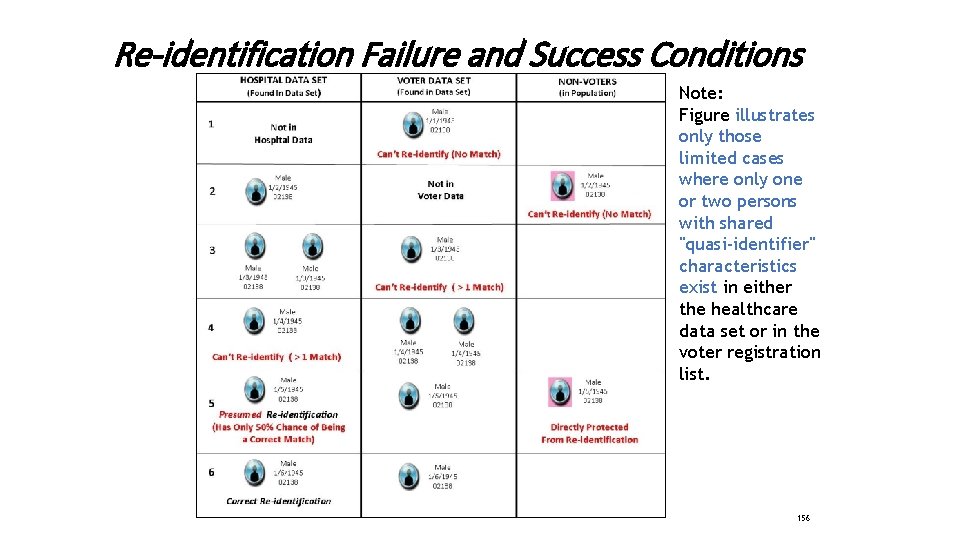
Re-identification Failure and Success Conditions Note: Figure illustrates only those limited cases where only one or two persons with shared "quasi-identifier" characteristics exist in either the healthcare data set or in the voter registration list. 156
Myth of the “Perfect Population Register” Note that in Row 5 on previous slide: Ø Every person not within the voter list is directly protected from re-identification. Ø Furthermore, their absence from the population register also reduces the probability that others who share their quasi-identifier set would be correctly re-identified. Ø This is an extremely important limitation on reidentification when imperfect population registers are used. 157
Myth of the “Perfect Population Register” Ø Without the important advantage of the public information regarding Weld's hospitalization, a data intruder would have had to go through a daunting process of making sure that there were not any other males living in the ZIP code 02138 at the time of Weld's collapse who were born on Weld's birthday in order to be certain that Weld was correctly reidentified using such a voter list attack method. Ø There were approximately 35, 000 persons living in ZIP code 02138 in 1997. Ø It is difficult to imagine how a lone data intruder would have had the ability to complete this essential step in the re-identification process. 158
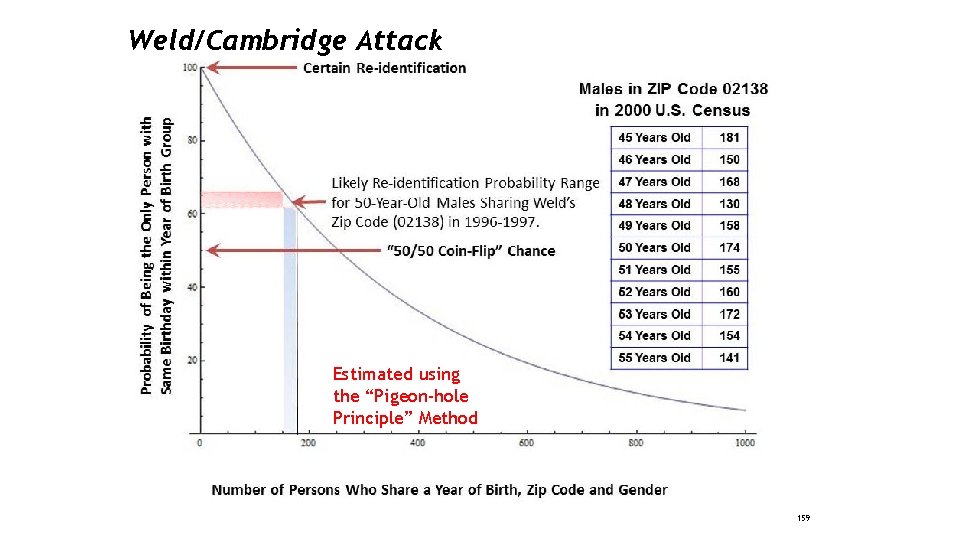
Weld/Cambridge Attack Estimated using the “Pigeon-hole Principle” Method 159
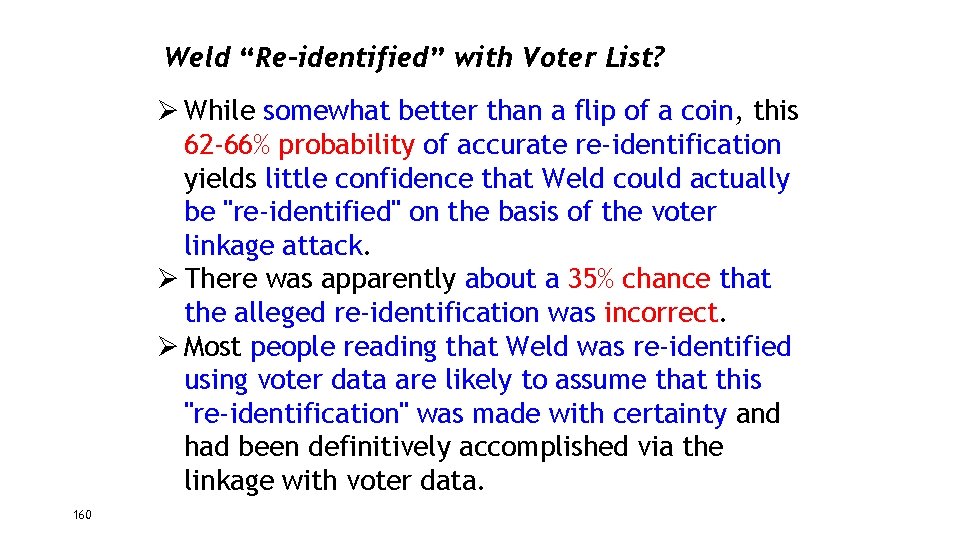
Weld “Re-identified” with Voter List? Ø While somewhat better than a flip of a coin, this 62 -66% probability of accurate re-identification yields little confidence that Weld could actually be "re-identified" on the basis of the voter linkage attack. Ø There was apparently about a 35% chance that the alleged re-identification was incorrect. Ø Most people reading that Weld was re-identified using voter data are likely to assume that this "re-identification" was made with certainty and had been definitively accomplished via the linkage with voter data. 160
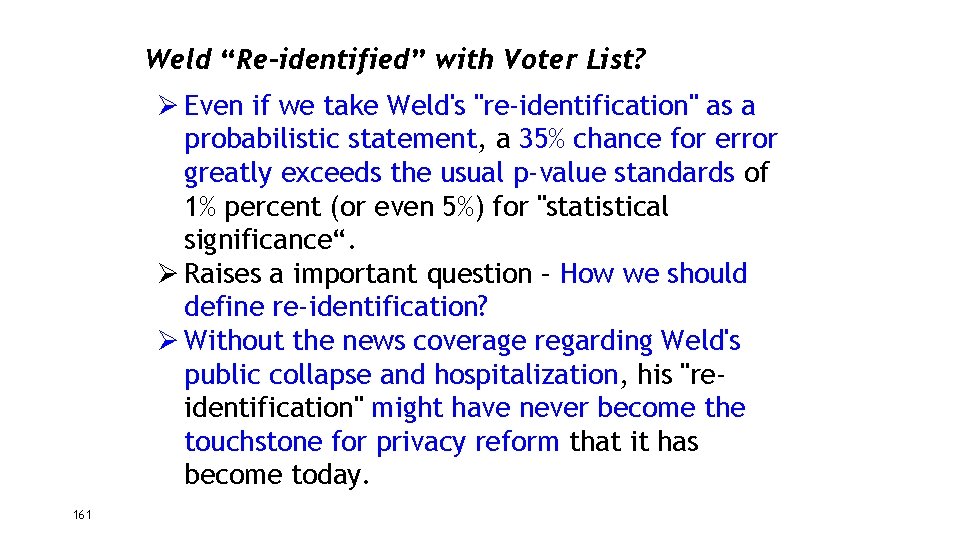
Weld “Re-identified” with Voter List? Ø Even if we take Weld's "re-identification" as a probabilistic statement, a 35% chance for error greatly exceeds the usual p-value standards of 1% percent (or even 5%) for "statistical significance“. Ø Raises a important question – How we should define re-identification? Ø Without the news coverage regarding Weld's public collapse and hospitalization, his "reidentification" might have never become the touchstone for privacy reform that it has become today. 161
Influence of Weld Re-identification on HIPAA Ø It’s difficult to overstate the influence of the Weld/ Cambridge voter list attack on U. S. health privacy policy - it had a clear impact on the development of the de-identification provisions within HIPAA Privacy Rule. Ø The Weld re-identification has served an important illustration of privacy risks that were not adequately controlled prior to the advent of the HIPAA Privacy Rule in 2003. Ø It is now quite clear that simple combinations of high -resolution variables (like birthdates and ZIP codes) can put an unacceptable portion of the population at risk for potential re-identification. 162
Ethical Equipoise? Is it an ethically compromised position, in the coming age of personalized medicine, if we end up purposefully masking the racial, ethnic or other groups (e. g. American Indians or LDS Church members, etc. ), or for those with certain rare genetic diseases/disorders, in order to protect them against supposed re-identification, and thus also deny them the benefits of research conducted with de-identified data that may help address their health disparities, find cures for their rare diseases, or facilitate “orphan drug” research that would otherwise not be economically viable, especially if those re-identification attempts may not be forthcoming in the real-world? 163
- Slides: 163