
October 2020 IEEE 802 11 201576 r 1
October 2020 IEEE 802. 11 -20/1576 r 1 Multilink Management for Non-STR Soft AP Date: 2020 -10 -06 Authors: Submission Slide 1 Ronny Yongho Kim, KNUT
October 2020 IEEE 802. 11 -20/1576 r 1 Introduction • Soft AP for MLD operation has been defined in SFD [1] – 802. 11 be defines mechanisms to support the operation of a Non-STR AP MLD in R 1. The mechanisms are limited to instantiate a Non-STR Non-AP MLD as a Soft AP that could utilize all its links under TBD conditions. The exact language to govern such scope is TBD. • Non-STR AP MLD has not been fully considered – In [2], Non-STR AP MLD’s operation is discussed • Soft AP can be a non-STR MLD and power saving operation may impact the other link’s normal operation. – NSTR link pair for Soft AP should be considered for various scenarios including tethering with AP – In [3], restricted TWT is proposed to reduce the delay and can be applied to Soft AP • However, restricted TWT does not fully consider NSTR link pair issue of soft AP • This contribution discusses NSTR link pair issues for two possible Soft AP use cases Submission Slide 2 Ronny Yongho Kim, KNUT
![October 2020 IEEE 802. 11 -20/1576 r 1 Recap: Definition of soft AP [4]](http://slidetodoc.com/presentation_image_h2/431da8d079fae8eb76366b8605b96a3e/image-3.jpg "October 2020 IEEE 802. 11 -20/1576 r 1 Recap: Definition of soft AP [4]")
October 2020 IEEE 802. 11 -20/1576 r 1 Recap: Definition of soft AP [4] • Soft access point (AP) multi-link device (MLD): An AP MLD with restricted capabilities that is in a battery powered (other characteristics TBD) device. • Non Simultaneous Transmit and Receive (NSTR) soft access point (AP) multi-link device (MLD): A soft AP MLD having at least one non-STR link pair. Submission Slide 3 Ronny Yongho Kim, KNUT
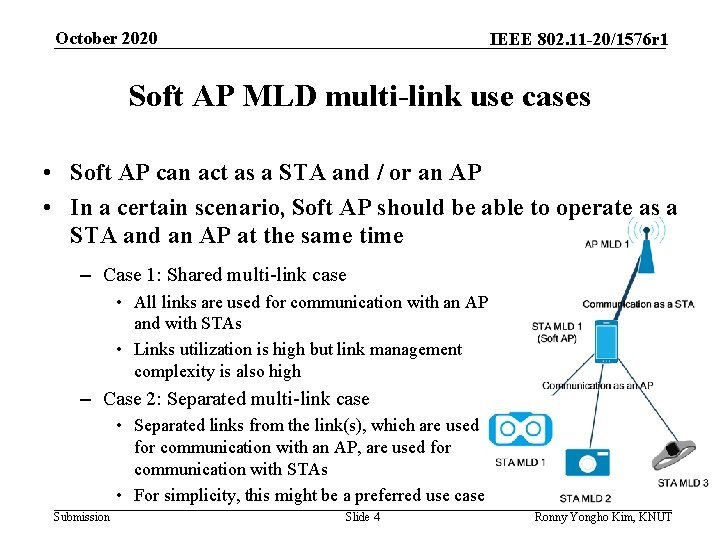
October 2020 IEEE 802. 11 -20/1576 r 1 Soft AP MLD multi-link use cases • Soft AP can act as a STA and / or an AP • In a certain scenario, Soft AP should be able to operate as a STA and an AP at the same time – Case 1: Shared multi-link case • All links are used for communication with an AP and with STAs • Links utilization is high but link management complexity is also high – Case 2: Separated multi-link case • Separated links from the link(s), which are used for communication with an AP, are used for communication with STAs • For simplicity, this might be a preferred use case Submission Slide 4 Ronny Yongho Kim, KNUT
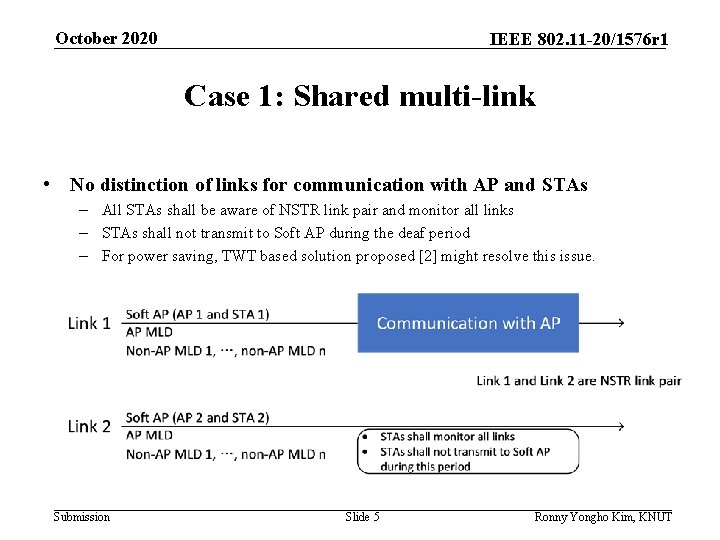
October 2020 IEEE 802. 11 -20/1576 r 1 Case 1: Shared multi-link • No distinction of links for communication with AP and STAs – All STAs shall be aware of NSTR link pair and monitor all links – STAs shall not transmit to Soft AP during the deaf period – For power saving, TWT based solution proposed [2] might resolve this issue. Submission Slide 5 Ronny Yongho Kim, KNUT
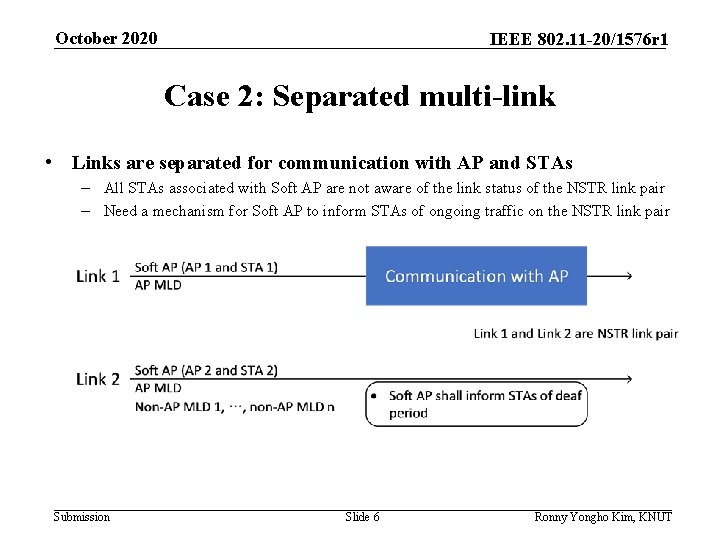
October 2020 IEEE 802. 11 -20/1576 r 1 Case 2: Separated multi-link • Links are separated for communication with AP and STAs – All STAs associated with Soft AP are not aware of the link status of the NSTR link pair – Need a mechanism for Soft AP to inform STAs of ongoing traffic on the NSTR link pair Submission Slide 6 Ronny Yongho Kim, KNUT

October 2020 IEEE 802. 11 -20/1576 r 1 Conclusion • In this contribution, two possible Soft AP use cases are considered – Case 1: Shared multi-link – Case 2: Separated multi-link • For NSTR link pair issue, NSTR AP multi-link operation shall be defined – Case 1: Shared multi-link • All STAs shall monitor all links (new rule for STAs) • Soft AP can inform STAs of the other links status – Case 2: Separated multi-link • Soft AP shall inform STAs of the other links status • In order to proceed the Soft AP procedure development further, allowable Soft AP use cases shall be decided Submission Slide 7 Ronny Yongho Kim, KNUT
![October 2020 IEEE 802. 11 -20/1576 r 1 Reference [1] 11 -20/0566 r 70,](http://slidetodoc.com/presentation_image_h2/431da8d079fae8eb76366b8605b96a3e/image-8.jpg "October 2020 IEEE 802. 11 -20/1576 r 1 Reference [1] 11 -20/0566 r 70,")
October 2020 IEEE 802. 11 -20/1576 r 1 Reference [1] 11 -20/0566 r 70, “Compendium of straw polls and potential changes to the Specification Framework Document” [2] 11 -20/1402 r 0, “Issues on MLD Power Saving” [3] 11 -20/1046 r 5, “Prioritized EDCA channel access – slot management” [4] 11 -20/1407 r 12 “Proposed Draft Text for MLO: Soft AP MLD Operation” Submission Slide 8 Ronny Yongho Kim, KNUT
October 2020 IEEE 802. 11 -20/1576 r 1 Straw Poll #1 • Which Soft AP use case is allowable? – Option 1: Shared multi-links • No distinction between links used for communication with AP and links used for communication with STAs – Option 2: Separated multi-links • Certain links are designated for communication with AP • Some links are only used for communication with STAs – Option 3: Both – Option 4: Neither Submission Slide 9 Ronny Yongho Kim, KNUT
- Slides: 9