
October 2001 doc IEEE 802 15 01442 r
October, 2001 doc. : IEEE 802. 15 -01/442 r 0 Project: IEEE P 802. 15 Working Group for Wireless Personal Area Networks (WPANs) Submission Title: Comparison of TI-IPC's AFH Mechanism and Bandspeed's ICR Proposal Date Submitted: October 1, 2001 Source: (1) HK Chen, YC Maa, and KC Chen (2) Anuj Batra, Kofi Anim-Appiah, and Jin-Meng Ho Company: (1) Integrated Programmable Communications, Inc. (2) Texas Instruments, Inc. Address: (1)Taiwan Laboratories Address: P. O. Box 24 -226, Hsinchu, Taiwan 300 (2) 12500 TI Boulevard, Dallas, TX 75243 TEL(1) +886 3 516 5106, FAX: +886 3 516 5108, E-Mail: {hkchen, ycmaa, kc}@inprocomm. com (2) +1 214 480 4220, FAX: 972 761 6966, E-Mail: {batra, kofi, jinmengho}@ti. com Re: [] Abstract: This presentation shows the comparisons of TI-IPC's AFH Mechanism and Bandspeed's ICR Proposal Purpose: Submission to Task Group 2 for comparing the two mechanisms. Notice: This document has been prepared to assist the IEEE P 802. 15. It is offered as a basis for discussion and is not binding on the contributing individual(s) or organization(s). The material in this document is subject to change in form and content after further study. The contributor(s) reserve(s) the right to add, amend or withdraw material contained herein. Release: The contributor acknowledges and accepts that this contribution becomes the property of IEEE and may be made publicly available by P 802. 15. Submission Slide 1 Integrated Programmable Communications, Inc. and Texas Instruments, Inc.
October, 2001 doc. : IEEE 802. 15 -01/442 r 0 Comparison of TI-IPC's AFH Mechanism and Bandspeed's ICR Proposal HK Chen, YC Maa, and KC Chen Integrated Programmable Communications Anuj Batra, Kofi Anim-Appiah, and Jin-Meng Ho Texas Instruments Submission Slide 2 Integrated Programmable Communications, Inc. and Texas Instruments, Inc.
October, 2001 doc. : IEEE 802. 15 -01/442 r 0 ACL Link Qo. S Definition q BLUETOOTH Specification Version 1. 1, Part C: 3. 20 QUALITY OF SERVICE (Qo. S) The Link Manager provides Quality of Service capabilities. A poll interval, which is defined as the maximum time between subsequent transmissions from the master to a particular slave on the ACL link, is used to support bandwidth allocation and latency control. The poll interval is guaranteed in the active mode except when there are collisions with page, page scan, inquiry and inquiry scan. The poll interval is also known as Tpoll. These PDUs can be sent at anytime after connection setup is completed. Submission Slide 3 Integrated Programmable Communications, Inc. and Texas Instruments, Inc.
October, 2001 doc. : IEEE 802. 15 -01/442 r 0 Qo. S Consideration in AFH q. The maximum length of the continuous window of bad channels should be bounded. üThis bound (BWmax) should minimized for best Qo. S. q. It is very useful if the ACL packet scheduling algorithm can easily predict the position and length of every bad window. Submission Slide 4 Integrated Programmable Communications, Inc. and Texas Instruments, Inc.
October, 2001 doc. : IEEE 802. 15 -01/442 r 0 Qo. S Comparison: ACL Link (1) q Partition Sequence ü Guaranteed and minimized BWmax. ü Well-structured superframe, easy to predict the position and length of each bad window. q ICR ü The length of bad window depends on the underlying hopping sequence. It can create much longer bad window. ü Unable to predict the position and length of each bad window Submission Slide 5 Integrated Programmable Communications, Inc. and Texas Instruments, Inc.
October, 2001 doc. : IEEE 802. 15 -01/442 r 0 Qo. S Comparison: ACL Link (2) q. Numerical Example üScenario 1: • One 802. 11 b BSS at Channel 1 – SBK={0, 1, 2, …, 22}, SG={23, 24, …, 77, 78} – NBK=23, NG=56 üScenario 2: • Two 802. 11 b BSSes, at Channel 1 and 11 – SBK={0, 1, 2, …, 22, 49, 50, …, 70, 71}, SG={23, 24, …, 47, 48, 72, 73, … 77, 78} – NBK=46, NG=33 Submission Slide 6 Integrated Programmable Communications, Inc. and Texas Instruments, Inc.
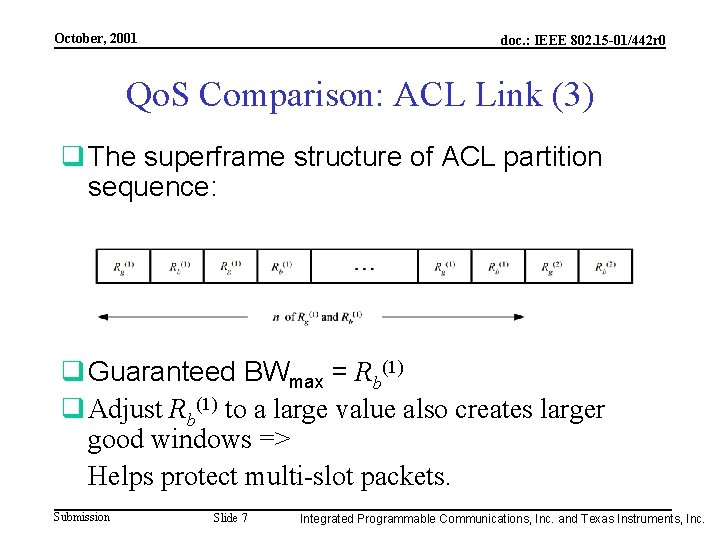
October, 2001 doc. : IEEE 802. 15 -01/442 r 0 Qo. S Comparison: ACL Link (3) q The superframe structure of ACL partition sequence: q Guaranteed BWmax = Rb(1) q Adjust Rb(1) to a large value also creates larger good windows => Helps protect multi-slot packets. Submission Slide 7 Integrated Programmable Communications, Inc. and Texas Instruments, Inc.
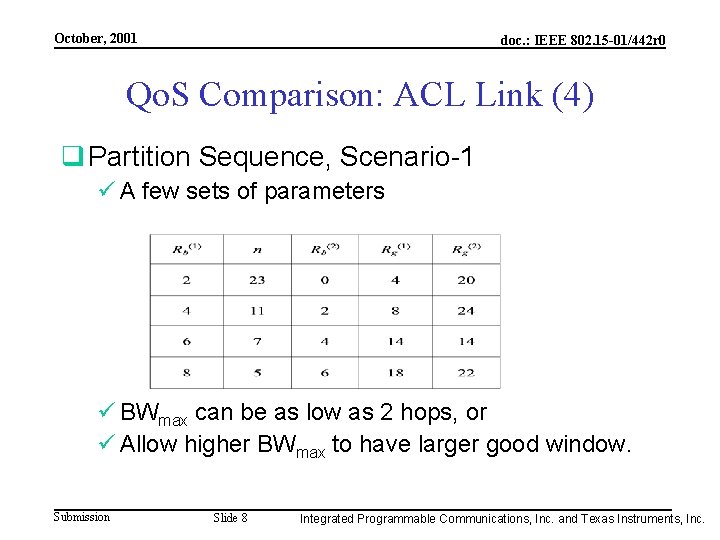
October, 2001 doc. : IEEE 802. 15 -01/442 r 0 Qo. S Comparison: ACL Link (4) q Partition Sequence, Scenario-1 ü A few sets of parameters ü BWmax can be as low as 2 hops, or ü Allow higher BWmax to have larger good window. Submission Slide 8 Integrated Programmable Communications, Inc. and Texas Instruments, Inc.
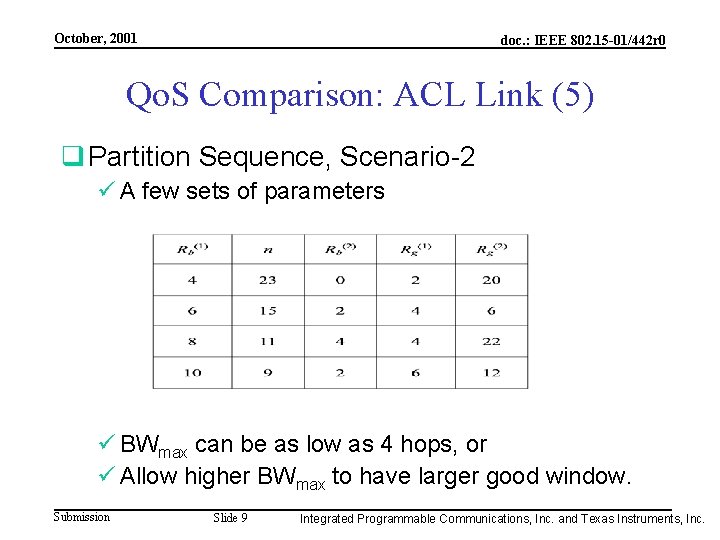
October, 2001 doc. : IEEE 802. 15 -01/442 r 0 Qo. S Comparison: ACL Link (5) q Partition Sequence, Scenario-2 ü A few sets of parameters ü BWmax can be as low as 4 hops, or ü Allow higher BWmax to have larger good window. Submission Slide 9 Integrated Programmable Communications, Inc. and Texas Instruments, Inc.
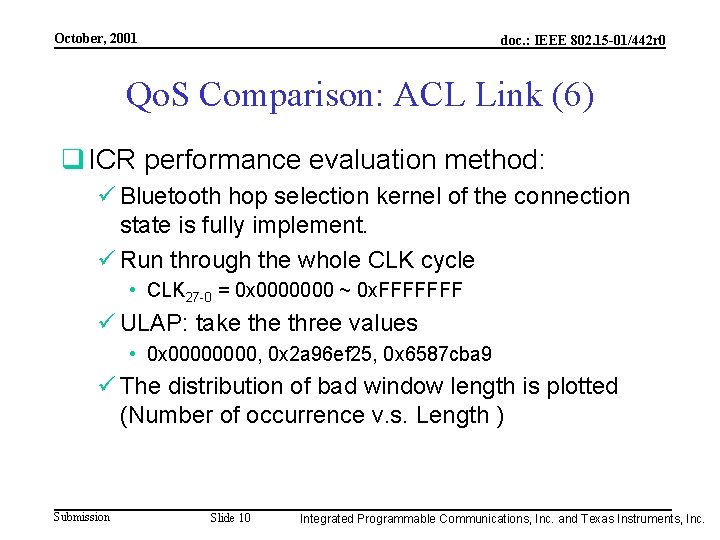
October, 2001 doc. : IEEE 802. 15 -01/442 r 0 Qo. S Comparison: ACL Link (6) q ICR performance evaluation method: ü Bluetooth hop selection kernel of the connection state is fully implement. ü Run through the whole CLK cycle • CLK 27 -0 = 0 x 0000000 ~ 0 x. FFFFFFF ü ULAP: take three values • 0 x 0000, 0 x 2 a 96 ef 25, 0 x 6587 cba 9 ü The distribution of bad window length is plotted (Number of occurrence v. s. Length ) Submission Slide 10 Integrated Programmable Communications, Inc. and Texas Instruments, Inc.
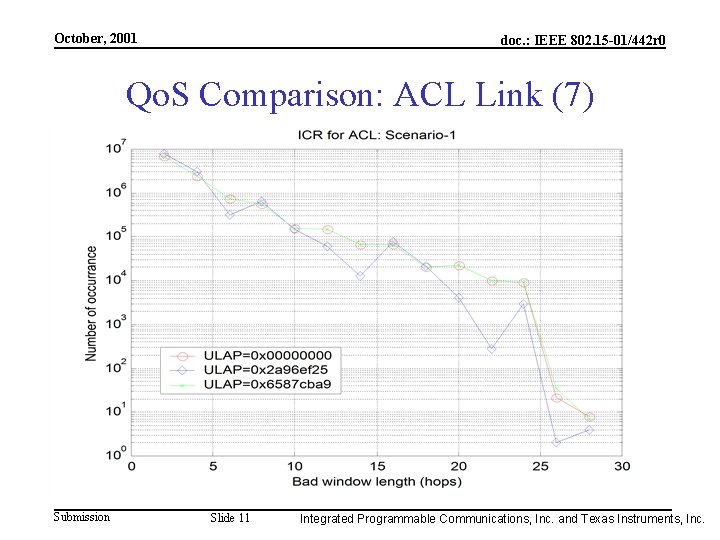
October, 2001 doc. : IEEE 802. 15 -01/442 r 0 Qo. S Comparison: ACL Link (7) Submission Slide 11 Integrated Programmable Communications, Inc. and Texas Instruments, Inc.
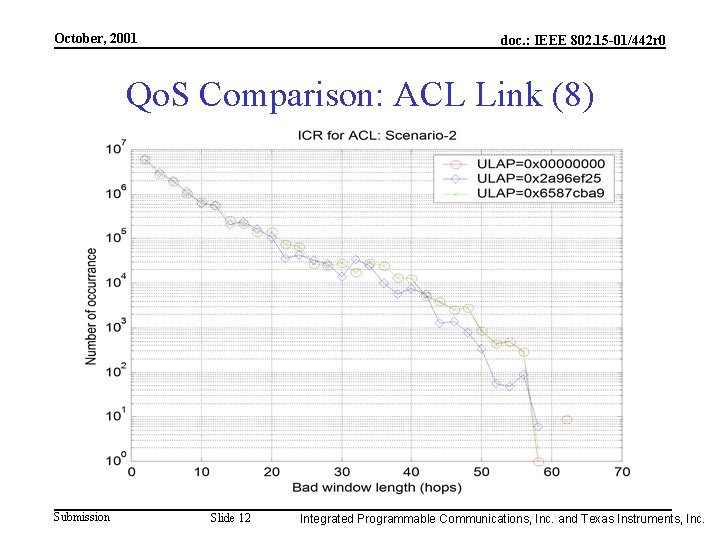
October, 2001 doc. : IEEE 802. 15 -01/442 r 0 Qo. S Comparison: ACL Link (8) Submission Slide 12 Integrated Programmable Communications, Inc. and Texas Instruments, Inc.
October, 2001 doc. : IEEE 802. 15 -01/442 r 0 Qo. S Comparison: mixed SCO+ACL (1) q. Numerical example: üScenario-1 and Scenario-2 are the same as previously described. üSCO traffic: one HV 3 link, Dsco=0. üHere the SCO link has higher priority to have full protection, and we consider the dead window for the ACL traffic. The dead window includes the SCO slots and the bad ACL slots. Submission Slide 13 Integrated Programmable Communications, Inc. and Texas Instruments, Inc.
October, 2001 doc. : IEEE 802. 15 -01/442 r 0 Qo. S Comparison: mixed SCO+ACL (2) q Partition sequence ü Scenario-1 • Each frame has at least two good MAUs, and there is only one HV 3 link to protect. Hence each frame have at least one good MAU for the ACL link. • DWmax (max dead window) = one frame = 6 hops ü Scenario-2 • Each frame has at least one good MAU to protect the HV 3 link. The residue MAUs are distributed evenly, with “inter. Frame. Spacing” = 4. • DWmax = 4 frames = 24 hops. Submission Slide 14 Integrated Programmable Communications, Inc. and Texas Instruments, Inc.
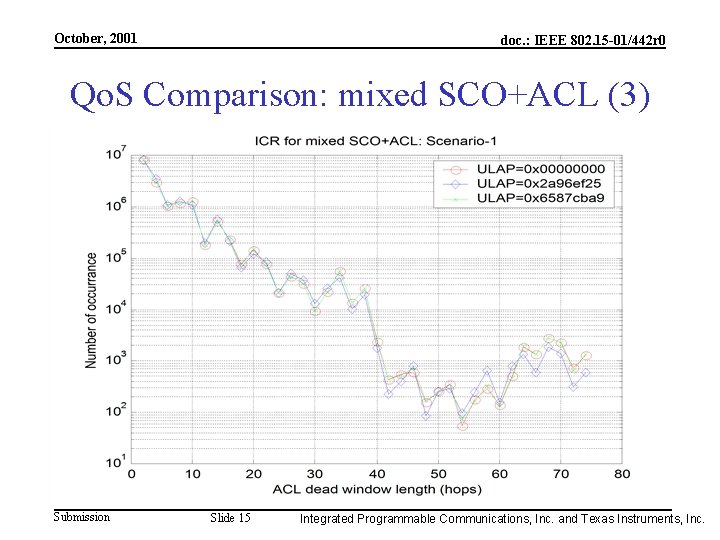
October, 2001 doc. : IEEE 802. 15 -01/442 r 0 Qo. S Comparison: mixed SCO+ACL (3) Submission Slide 15 Integrated Programmable Communications, Inc. and Texas Instruments, Inc.
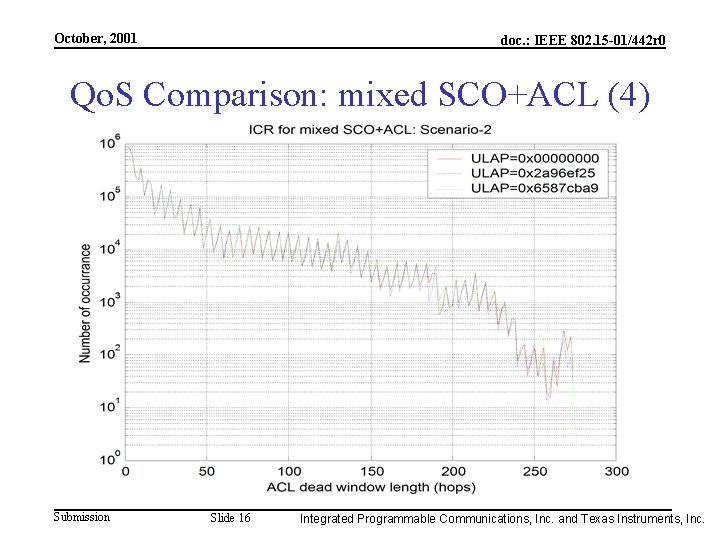
October, 2001 doc. : IEEE 802. 15 -01/442 r 0 Qo. S Comparison: mixed SCO+ACL (4) Submission Slide 16 Integrated Programmable Communications, Inc. and Texas Instruments, Inc.
October, 2001 doc. : IEEE 802. 15 -01/442 r 0 AFH Synchronization (1) q AFH synchronization ü Master and Slaves must share some common information to produce the same adaptive hopping sequence q Information includes: ü Quasi-static information: it is kept constant within a session of AFH, but can be changed at the next session. • Channel classification: the sets of good/bad-kept/bad-not-used channels – SG, SBK, SBN. NG, NBK, NBN • Traffic related parameters: – The bad-window size, protected SCO streams, priority/nonpriority slots Submission Slide 17 Integrated Programmable Communications, Inc. and Texas Instruments, Inc.
October, 2001 doc. : IEEE 802. 15 -01/442 r 0 AFH Synchronization (2) q Information includes (cont’d): ü Time-varying information: • it can change from hop to hop. • It will bring challenges to AFH synchronization. We have to – Obtain the information value – Know which hop the information value applies to – Obtain the information value in time (old information is useless) • Bluetooth CLK is time-varying, but it is already synchronized. • GUD counter of Fit-Best ICR is time-varying, and it needs some scheme to get synchronized. Submission Slide 18 Integrated Programmable Communications, Inc. and Texas Instruments, Inc.
October, 2001 doc. : IEEE 802. 15 -01/442 r 0 AFH Synchronization (3) q It is a consensus in AFH group to use LMP for AFH synchronization. ü Perfect place for control information exchange in the Bluetooth design. ü Simply extend the command set by defining new commands for AFH. q LMP is not able to handle time-critical information ü There is no guarantee how many slots it takes for the LMP packet to get through. ü If the transmission of this LMP packet is failed, the LC layer will retransmit, but the value of time-varying information has changed already. q LMP can not be used for the synchronization of GUD counter in Fit-Best ICR. Submission Slide 19 Integrated Programmable Communications, Inc. and Texas Instruments, Inc.
October, 2001 doc. : IEEE 802. 15 -01/442 r 0 AFH Synchronization (4) q. Join AFH in the midway üWhen a slave joins a pico-net, or the slave is waked up from some low-power mode, it could request to enter an existing AFH session. üAn AFH session can last from a few seconds to less than 30 seconds. Not allowing to join AFH in the midway could create bad user experience. Submission Slide 20 Integrated Programmable Communications, Inc. and Texas Instruments, Inc.
October, 2001 doc. : IEEE 802. 15 -01/442 r 0 AFH Synchronization (5) q Partition Sequence ü All parameters are quasi-static within an AFH session. ü Slaves can switch to AFH anytime during AFH. q Fit-Best ICR ü The GUD counter can change for each hop, and it is a time-varying and time-critical parameter. ü The GUD counter can not be transmitted through the LMP message since LMP can not handle time-critical information. ü Slaves can not join AFH in the midway of AFH. Submission Slide 21 Integrated Programmable Communications, Inc. and Texas Instruments, Inc.
October, 2001 doc. : IEEE 802. 15 -01/442 r 0 Conclusions q Compared to the partition sequence approach, ICR could create much longer bad/dead window for ACL link or mixed SCOACL traffic, which dramatically reduces the Qo. S capabilities. q Fit-Best ICR uses a time-varying GUD counter, and it can not be synchronized through LMP. q With Fit-Best ICR, the slaves can not join AFH in the midway, leading to bad user experience. Submission Slide 22 Integrated Programmable Communications, Inc. and Texas Instruments, Inc.
- Slides: 22