
OCIO Cloud Workshop Agenda 1 2 3 4
- Slides: 10
OCIO Cloud Workshop
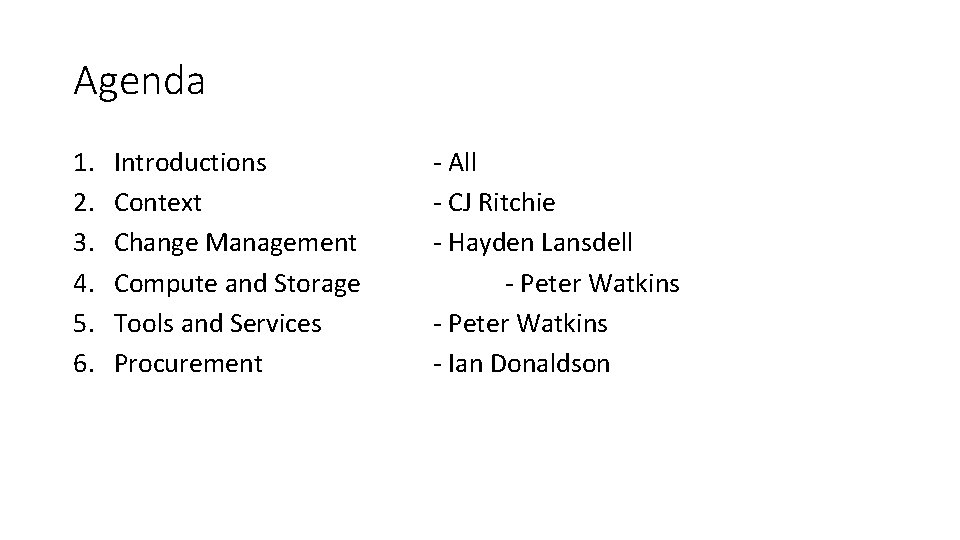
Agenda 1. 2. 3. 4. 5. 6. Introductions Context Change Management Compute and Storage Tools and Services Procurement - All - CJ Ritchie - Hayden Lansdell - Peter Watkins - Ian Donaldson
“At the heart of almost every failure is an organization that tries to apply new technology at scale without applying the same radicalism to changes in processes, culture, governance, people and leadership. ” - Public Digital, NRPP Lessons Learned Review
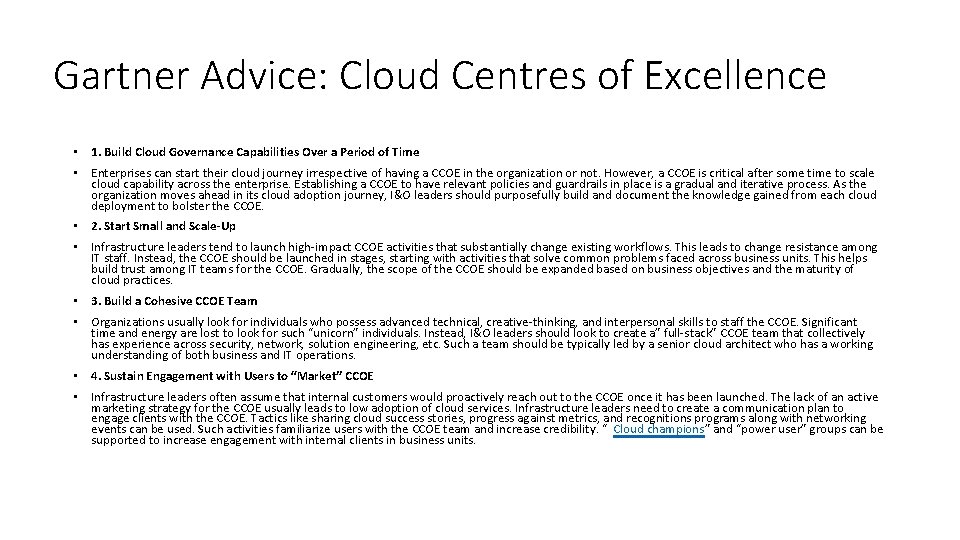
Gartner Advice: Cloud Centres of Excellence • 1. Build Cloud Governance Capabilities Over a Period of Time • Enterprises can start their cloud journey irrespective of having a CCOE in the organization or not. However, a CCOE is critical after some time to scale cloud capability across the enterprise. Establishing a CCOE to have relevant policies and guardrails in place is a gradual and iterative process. As the organization moves ahead in its cloud adoption journey, I&O leaders should purposefully build and document the knowledge gained from each cloud deployment to bolster the CCOE. • 2. Start Small and Scale-Up • Infrastructure leaders tend to launch high-impact CCOE activities that substantially change existing workflows. This leads to change resistance among IT staff. Instead, the CCOE should be launched in stages, starting with activities that solve common problems faced across business units. This helps build trust among IT teams for the CCOE. Gradually, the scope of the CCOE should be expanded based on business objectives and the maturity of cloud practices. • 3. Build a Cohesive CCOE Team • Organizations usually look for individuals who possess advanced technical, creative-thinking, and interpersonal skills to staff the CCOE. Significant time and energy are lost to look for such “unicorn” individuals. Instead, I&O leaders should look to create a” full-stack” CCOE team that collectively has experience across security, network, solution engineering, etc. Such a team should be typically led by a senior cloud architect who has a working understanding of both business and IT operations. • 4. Sustain Engagement with Users to “Market” CCOE • Infrastructure leaders often assume that internal customers would proactively reach out to the CCOE once it has been launched. The lack of an active marketing strategy for the CCOE usually leads to low adoption of cloud services. Infrastructure leaders need to create a communication plan to engage clients with the CCOE. Tactics like sharing cloud success stories, progress against metrics, and recognitions programs along with networking events can be used. Such activities familiarize users with the CCOE team and increase credibility. “ Cloud champions” and “power user” groups can be supported to increase engagement with internal clients in business units.
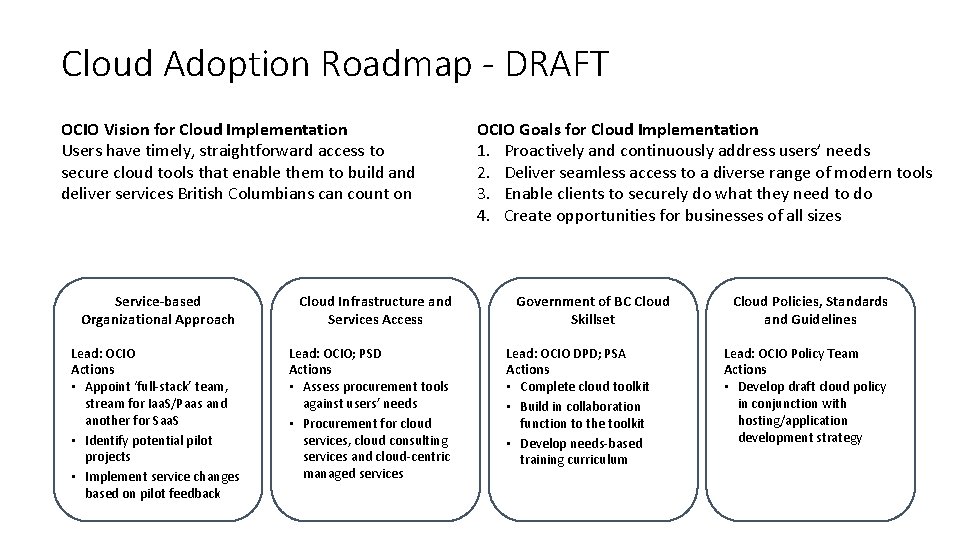
Cloud Adoption Roadmap - DRAFT OCIO Vision for Cloud Implementation Users have timely, straightforward access to secure cloud tools that enable them to build and deliver services British Columbians can count on Service-based Organizational Approach Lead: OCIO Actions • Appoint ‘full-stack’ team, stream for Iaa. S/Paas and another for Saa. S • Identify potential pilot projects • Implement service changes based on pilot feedback Cloud Infrastructure and Services Access Lead: OCIO; PSD Actions • Assess procurement tools against users’ needs • Procurement for cloud services, cloud consulting services and cloud-centric managed services OCIO Goals for Cloud Implementation 1. Proactively and continuously address users’ needs 2. Deliver seamless access to a diverse range of modern tools 3. Enable clients to securely do what they need to do 4. Create opportunities for businesses of all sizes Government of BC Cloud Skillset Lead: OCIO DPD; PSA Actions • Complete cloud toolkit • Build in collaboration function to the toolkit • Develop needs-based training curriculum Cloud Policies, Standards and Guidelines Lead: OCIO Policy Team Actions • Develop draft cloud policy in conjunction with hosting/application development strategy
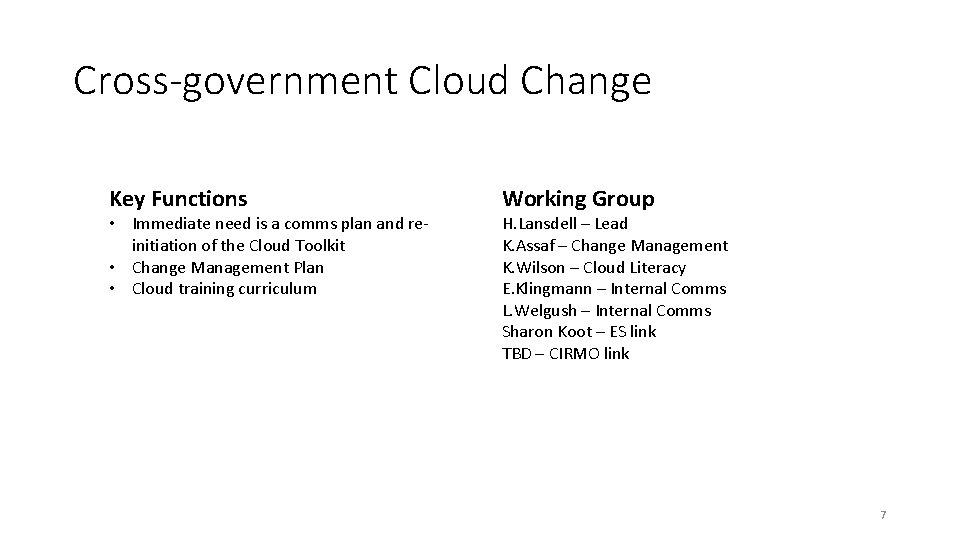
Cross-government Cloud Change Key Functions • Immediate need is a comms plan and reinitiation of the Cloud Toolkit • Change Management Plan • Cloud training curriculum Working Group H. Lansdell – Lead K. Assaf – Change Management K. Wilson – Cloud Literacy E. Klingmann – Internal Comms L. Welgush – Internal Comms Sharon Koot – ES link TBD – CIRMO link 7
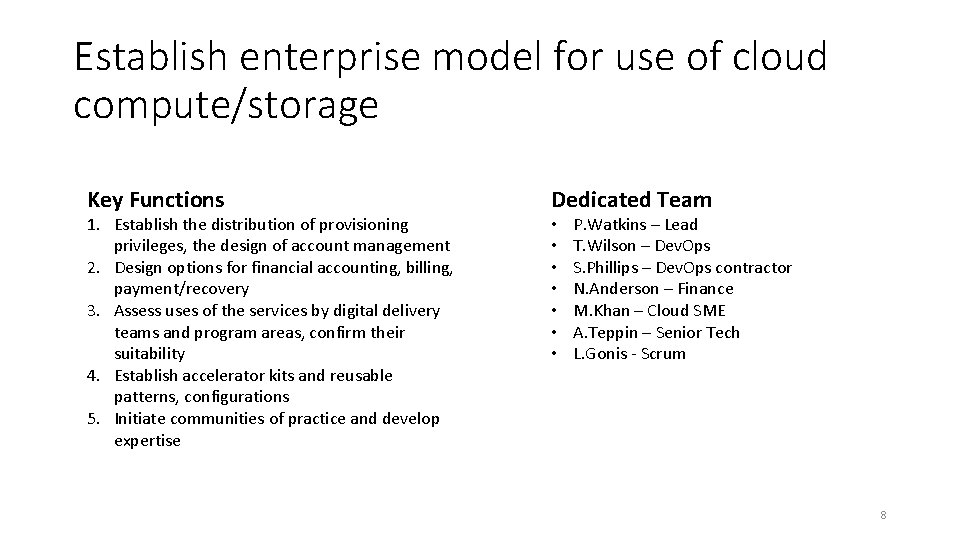
Establish enterprise model for use of cloud compute/storage Key Functions 1. Establish the distribution of provisioning privileges, the design of account management 2. Design options for financial accounting, billing, payment/recovery 3. Assess uses of the services by digital delivery teams and program areas, confirm their suitability 4. Establish accelerator kits and reusable patterns, configurations 5. Initiate communities of practice and develop expertise Dedicated Team • • P. Watkins – Lead T. Wilson – Dev. Ops S. Phillips – Dev. Ops contractor N. Anderson – Finance M. Khan – Cloud SME A. Teppin – Senior Tech L. Gonis - Scrum 8
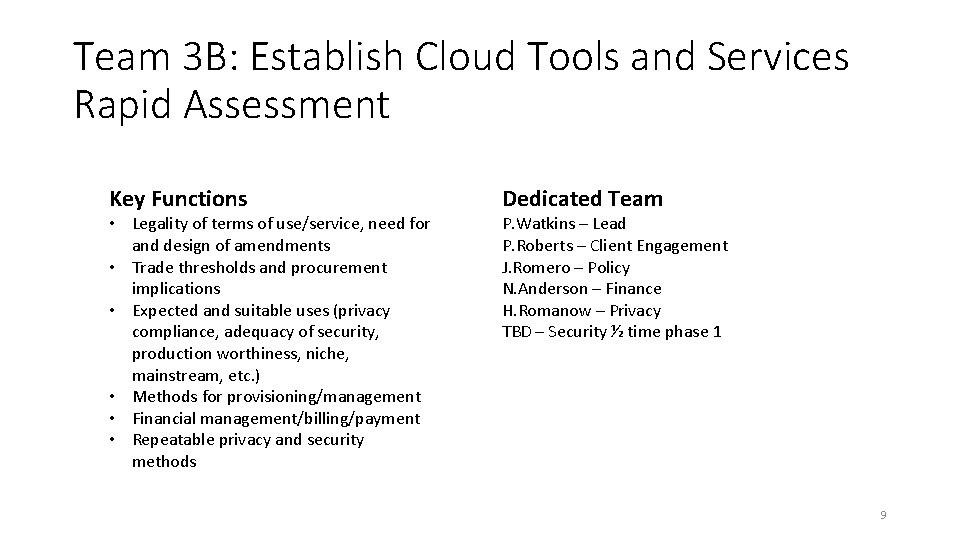
Team 3 B: Establish Cloud Tools and Services Rapid Assessment Key Functions • Legality of terms of use/service, need for and design of amendments • Trade thresholds and procurement implications • Expected and suitable uses (privacy compliance, adequacy of security, production worthiness, niche, mainstream, etc. ) • Methods for provisioning/management • Financial management/billing/payment • Repeatable privacy and security methods Dedicated Team P. Watkins – Lead P. Roberts – Client Engagement J. Romero – Policy N. Anderson – Finance H. Romanow – Privacy TBD – Security ½ time phase 1 9
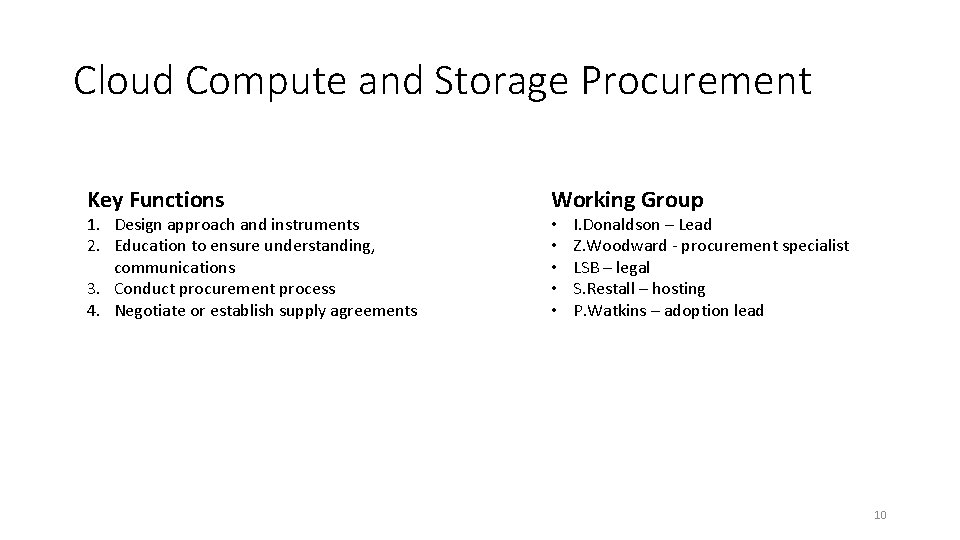
Cloud Compute and Storage Procurement Key Functions 1. Design approach and instruments 2. Education to ensure understanding, communications 3. Conduct procurement process 4. Negotiate or establish supply agreements Working Group • • • I. Donaldson – Lead Z. Woodward - procurement specialist LSB – legal S. Restall – hosting P. Watkins – adoption lead 10