
Oceans and Ocean Currents 6 th Grade Earth
- Slides: 33
Oceans and Ocean Currents 6 th Grade Earth Science Dickerson Middle School
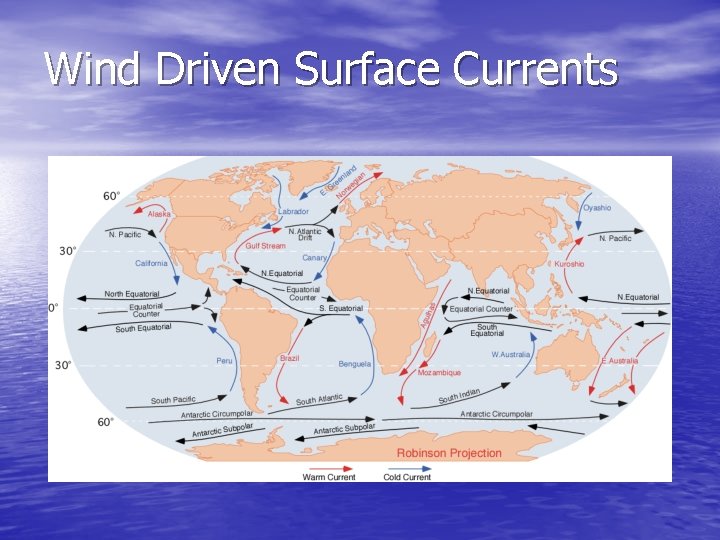
Ocean Currents • Currents move ocean water great distances around the planet • They are a like a river within the ocean • There are two types 1. 2. Surface currents Deep currents
1. Surface Currents Link • Horizontal, stream-like movements of water that occur at or near the surface of the ocean • Can reach depths of several hundred meters
Surface Currents • Controlled by three factors –Global winds –Continental Deflections –Coriolis Effect
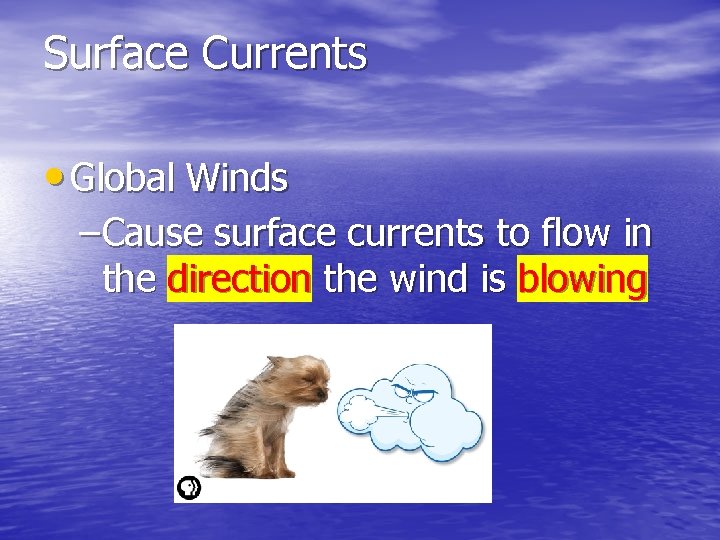
Surface Currents • Global Winds – Cause surface currents to flow in the direction the wind is blowing
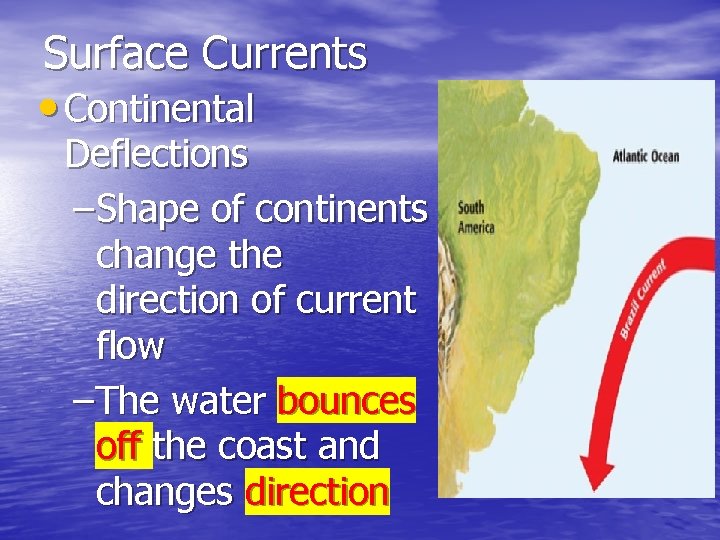
Surface Currents • Continental Deflections – Shape of continents change the direction of current flow – The water bounces off the coast and changes direction
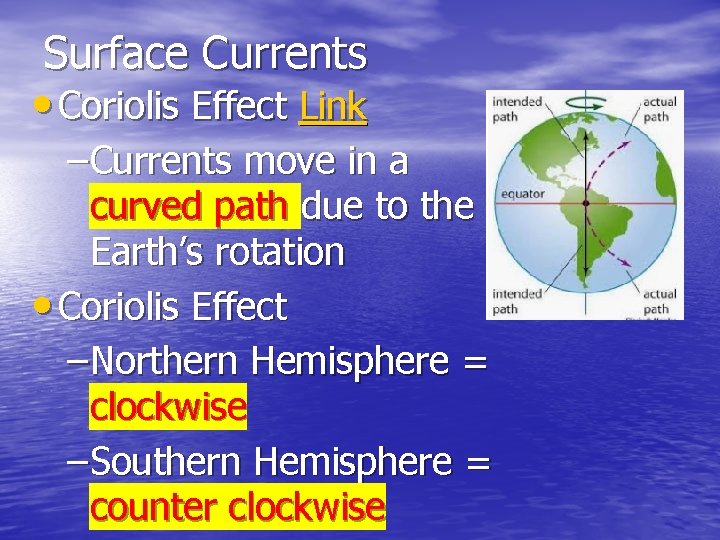
Surface Currents • Coriolis Effect Link – Currents move in a curved path due to the Earth’s rotation • Coriolis Effect – Northern Hemisphere = clockwise – Southern Hemisphere = counter clockwise
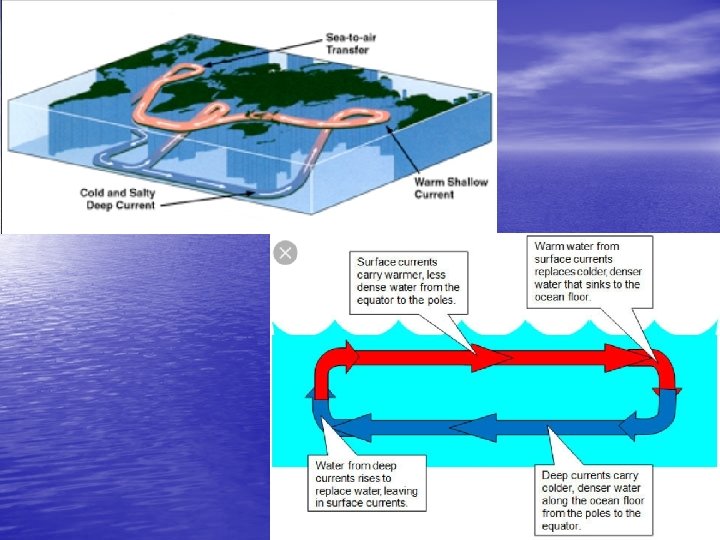
Deep Ocean Currents • Stream-like movement of ocean water far below the surface
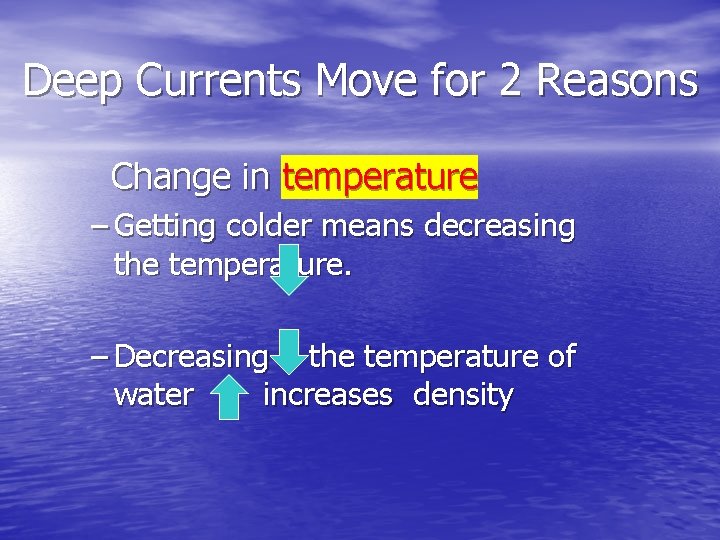
Deep Currents Move for 2 Reasons Change in temperature – Getting colder means decreasing the temperature. – Decreasing the temperature of water increases density
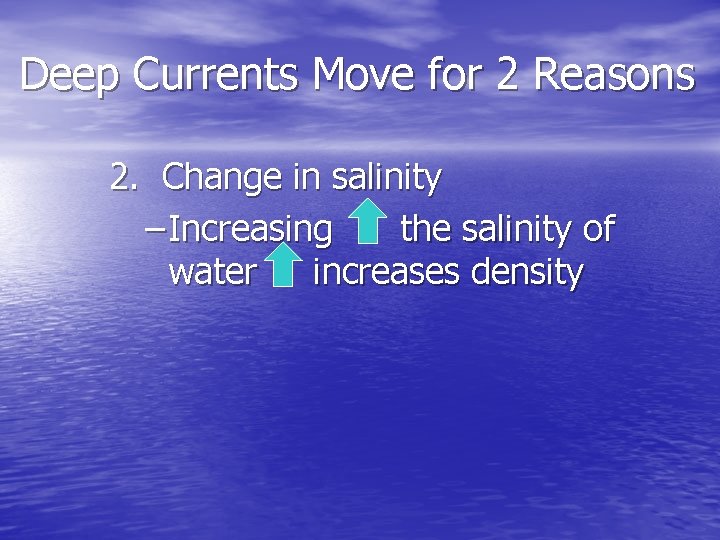
Deep Currents Move for 2 Reasons 2. Change in salinity – Increasing the salinity of water increases density
Salinity • The total amount of dissolved salts in water. • Near the surface, rain, snow, and melting ice add fresh water to the ocean, lowering the salinity.
Salinity • Salinity is also lower near the mouths of large rivers, since they empty fresh water into the ocean • Rivers dissolve salt out of rocks and soil as water flows over land into the ocean.
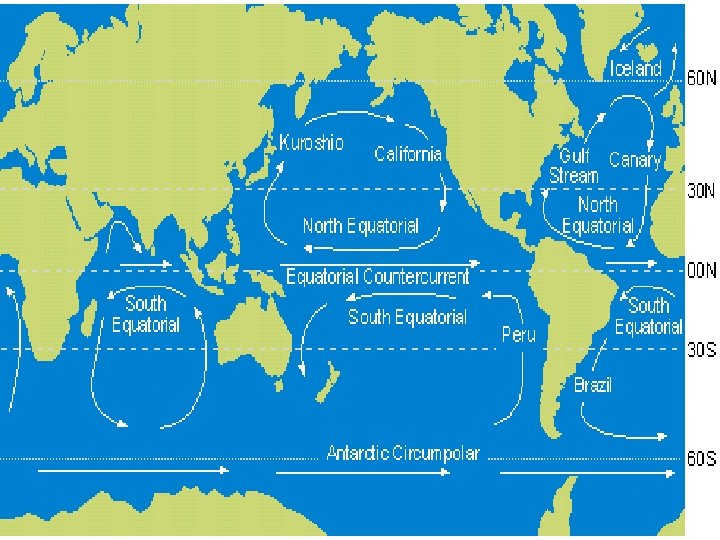
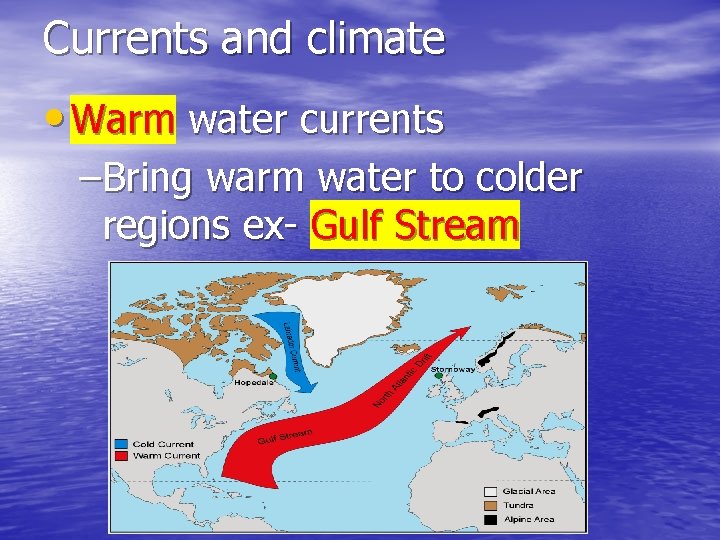
Currents and climate • Warm water currents –Bring warm water to colder regions ex- Gulf Stream
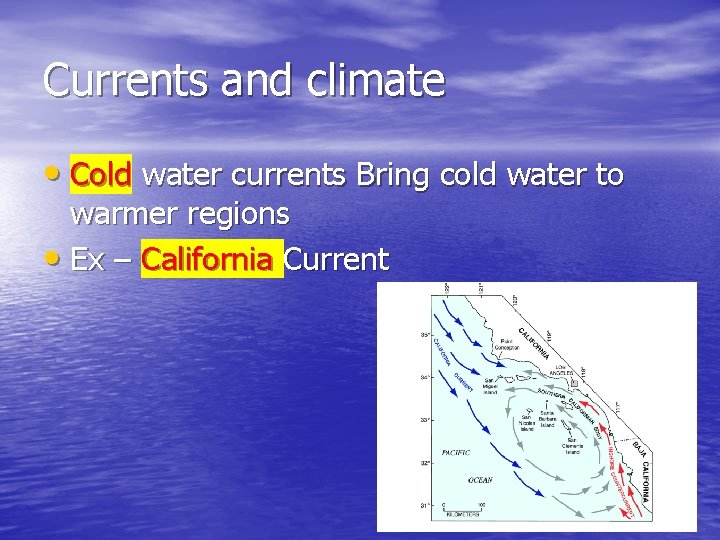
Currents and climate • Cold water currents Bring cold water to warmer regions • Ex – California Current
Wind Driven Surface Currents
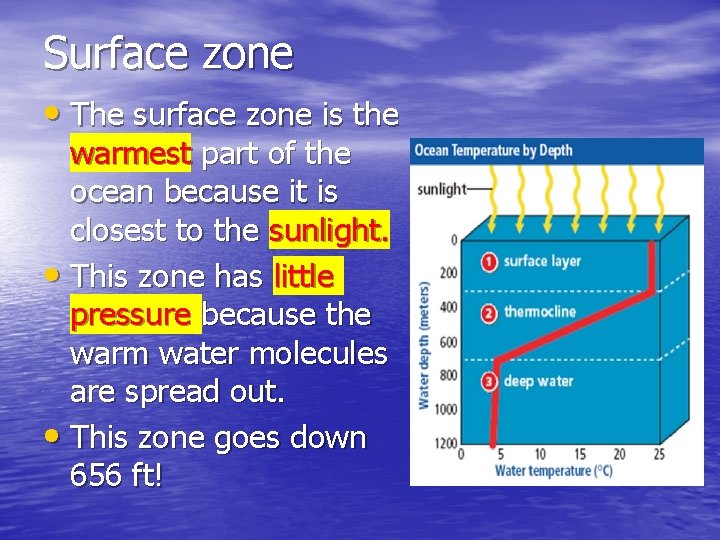
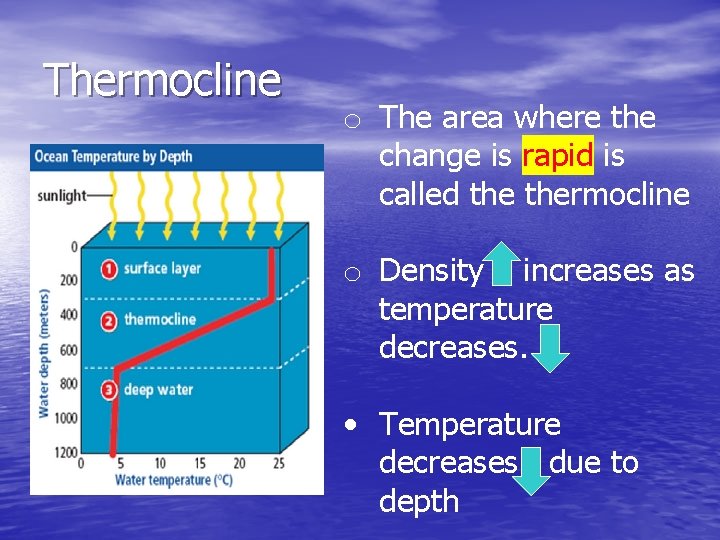
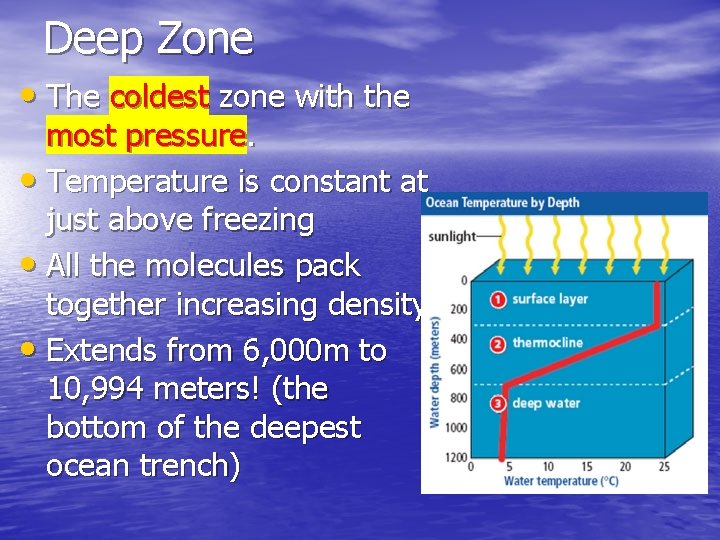
Temperature zones in the Ocean • As the ocean gets deeper, the water gets colder because it is further from direct sunlight. The temperature decreases with increased depth. • There are three temperature zones in the ocean. – Surface zone – Thermocline – Deep zone
Surface zone • The surface zone is the warmest part of the ocean because it is closest to the sunlight. • This zone has little pressure because the warm water molecules are spread out. • This zone goes down 656 ft!
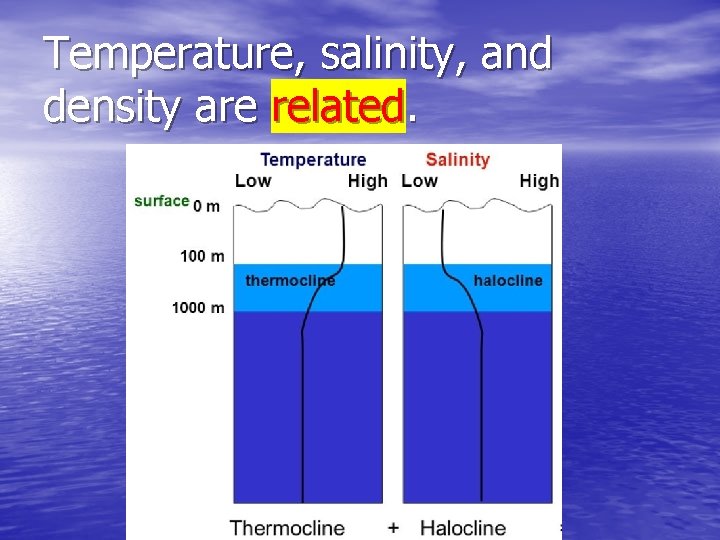
Thermocline o The area where the change is rapid is called thermocline o Density increases as temperature decreases. • Temperature decreases due to depth
Deep Zone • The coldest zone with the most pressure. • Temperature is constant at just above freezing • All the molecules pack together increasing density. • Extends from 6, 000 m to 10, 994 meters! (the bottom of the deepest ocean trench)
What is Salinity? • Salinity is the amount of dissolved salt in water. • Salinity affects currents because salt in water increases density. • The more dense the water, the more it sinks to the bottom of the ocean pushing other water in a current.
How does salinity vary (change)? • When salt is left behind in water, the salinity increases. Two methods are: • Evaporation - salt is left behind as the water evaporates. This makes the water more salty (increases salinity) • Freezing – salt is left behind as the surface water freezes, this also increases salinity
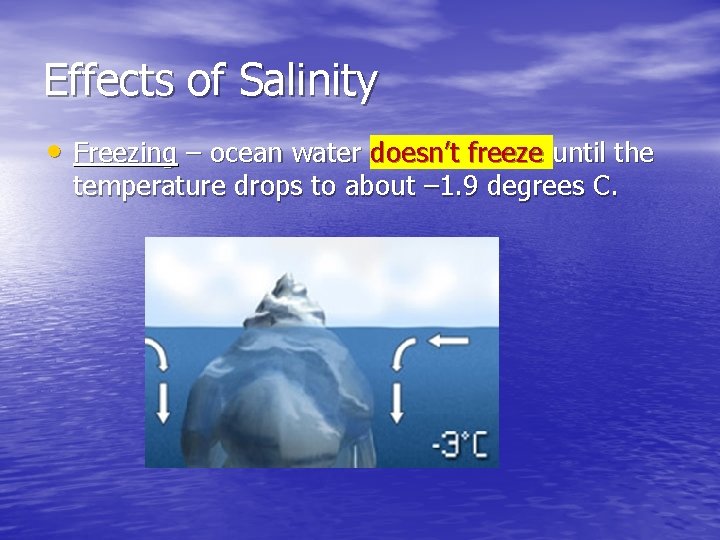
Effects of Salinity • Freezing – ocean water doesn’t freeze until the temperature drops to about – 1. 9 degrees C.
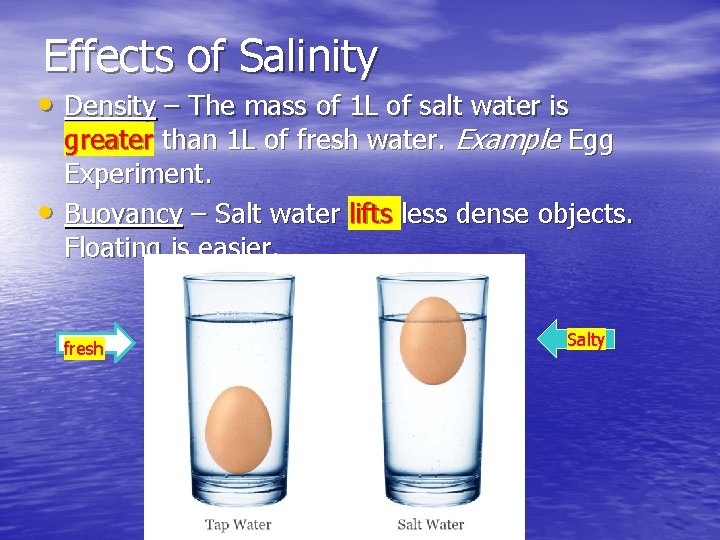
Effects of Salinity • Density – The mass of 1 L of salt water is • greater than 1 L of fresh water. Example Egg Experiment. Buoyancy – Salt water lifts less dense objects. Floating is easier. fresh Salty
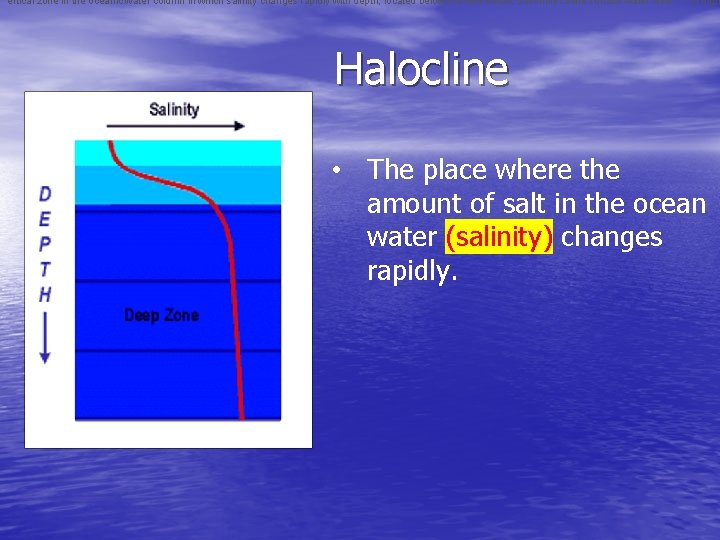
ertical zone in the oceanic water column in which salinity changes rapidly with depth, located below the well-mixed, uniformly saline surface water layer. . In high Halocline • The place where the amount of salt in the ocean water (salinity) changes rapidly.
Temperature, salinity, and density are related.
Specific Heat • Specific heat is the amount of heat that it takes to raise the temperature of 1 gram of matter by 1 degree Celsius. • All material has a different specific heat. This is why grass is cooler to walk on than asphalt during the summer.
Specific Heat of Land • Land heats up faster than water, but it also cools off more quickly. • This is why the sand near the ocean during the day is hot on your feet, but at night it cools off.
Specific Heat of Water • The specific heat of water is 1 calorie/gram this is the highest specific heat of any common substance. • This is why it takes a very long time to heat the swimming pool every summer. (It is cold in May, but like bath water in August. • Oceans heat slowly, hold heat well, and give off heat slowly.
Specific Heat of Water vs Land – In winter, the ocean acts like a heater to faster cooling land. – In summer, the ocean acts like an air conditioner as cooler ocean air moves inland through convection currents. – Land near the ocean is often warmer in winter and cooler in summer.
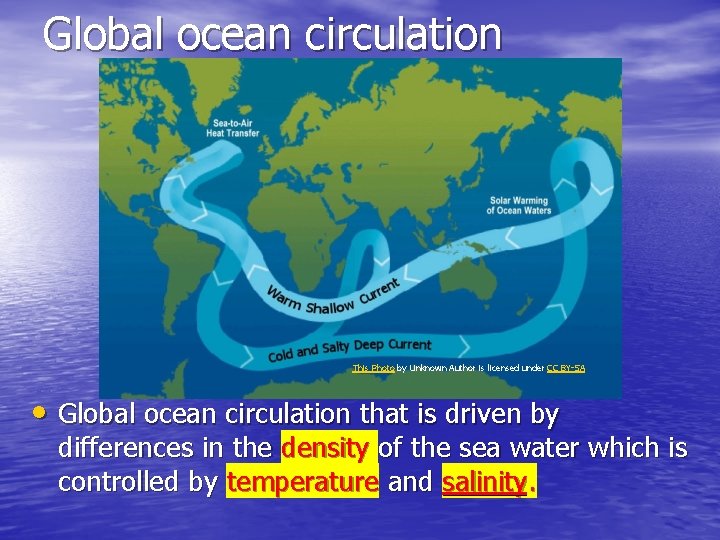
Global ocean circulation This Photo by Unknown Author is licensed under CC BY-SA • Global ocean circulation that is driven by differences in the density of the sea water which is controlled by temperature and salinity.
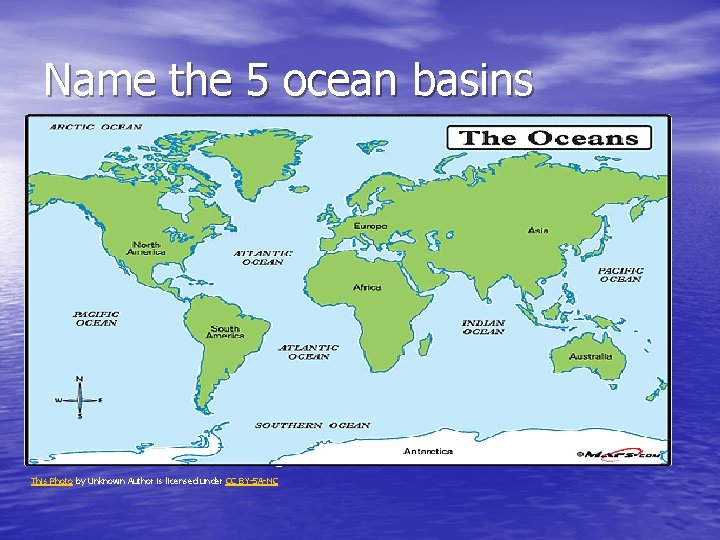
Name the 5 ocean basins This Photo by Unknown Author is licensed under CC BY-SA-NC