
Oceans and Ice Branch Seminar Whitecaps seasalt aerosols

Oceans and Ice Branch Seminar Whitecaps, sea-salt aerosols, and climate Magdalena D. Anguelova College of Marine Studies University of Delaware 18 October, 2001
Outline Sea-salt aerosols and climate n Sea spray n Whitecap coverage estimation n

Climate studies © Ocean Drilling Program
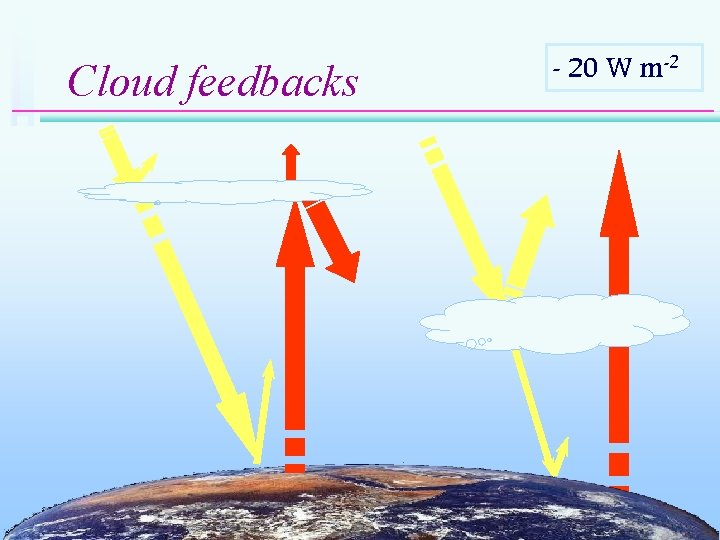
Cloud feedbacks - 20 W m-2
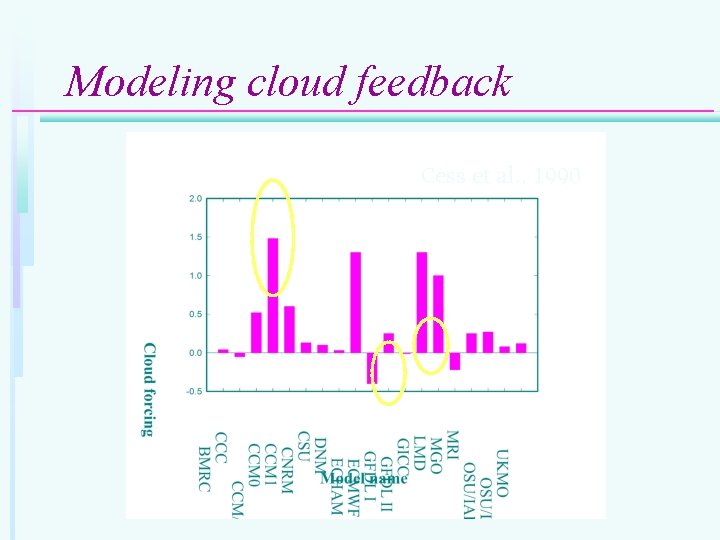
Modeling cloud feedback Cess et al. , 1990
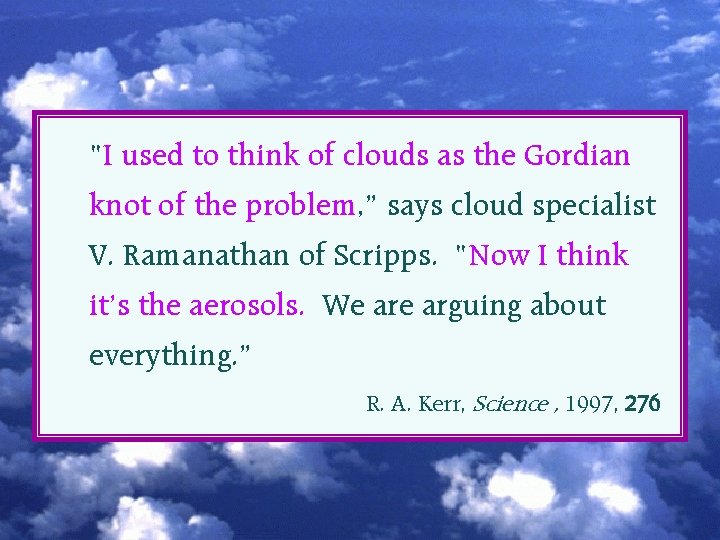
“I used to think of clouds as the Gordian knot of the problem, ” says cloud specialist V. Ramanathan of Scripps. “Now I think it’s the aerosols. We arguing about everything. ” R. A. Kerr, Science , 1997, 276
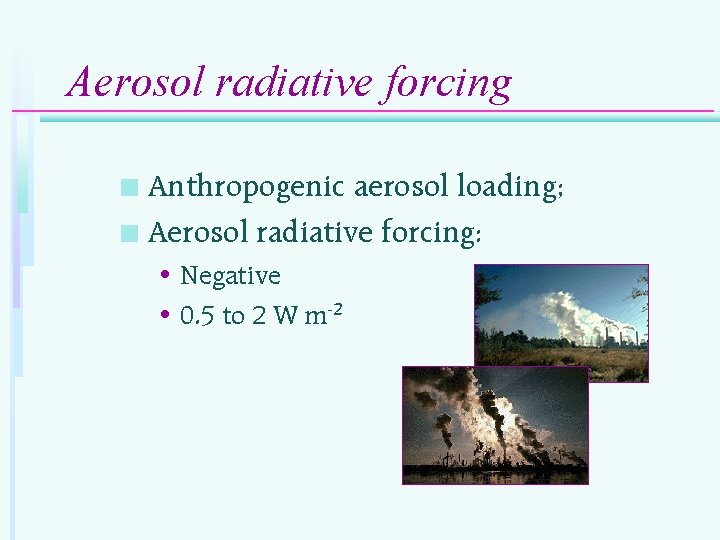
Aerosol radiative forcing Anthropogenic aerosol loading; n Aerosol radiative forcing: n • Negative • 0. 5 to 2 W m-2
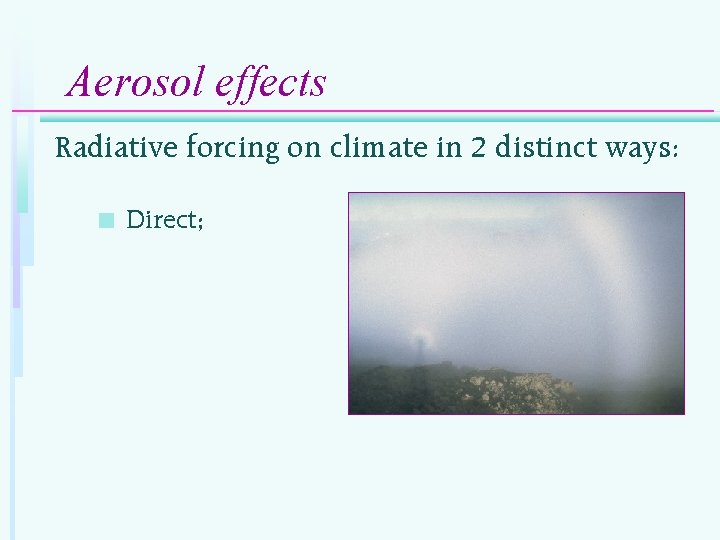
Aerosol effects Radiative forcing on climate in 2 distinct ways: n Direct;
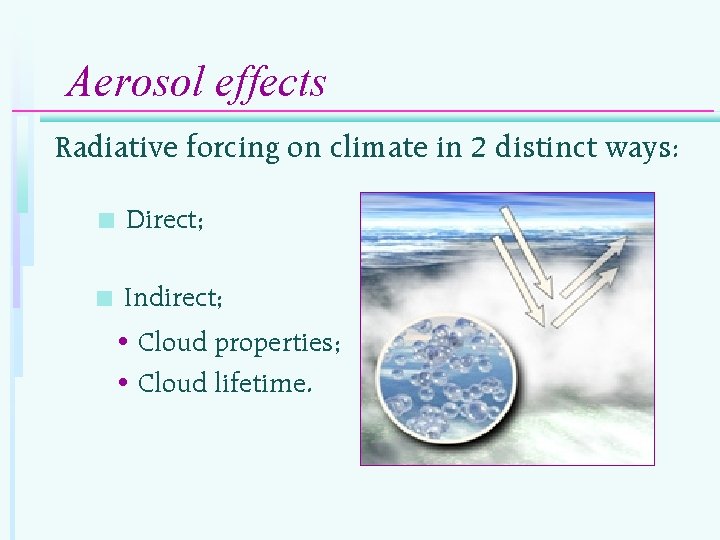
Aerosol effects Radiative forcing on climate in 2 distinct ways: n Direct; n Indirect; • Cloud properties; • Cloud lifetime.
Recognized Need Include aerosol direct and indirect forcing in climate models.
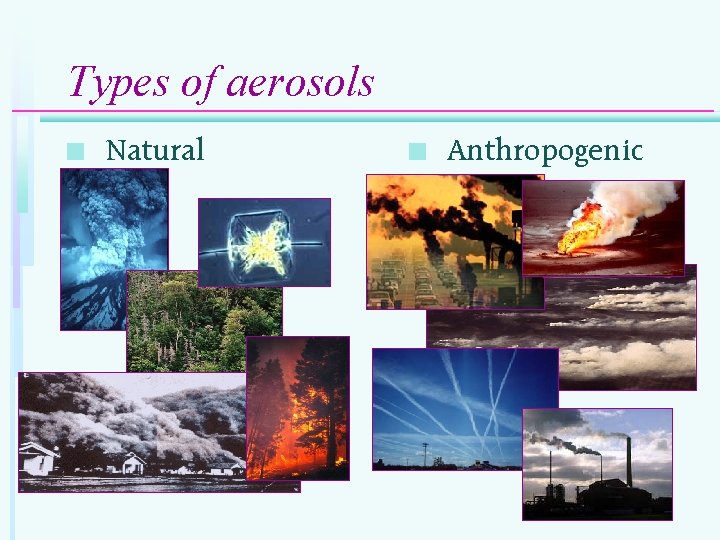
Types of aerosols n Natural n Anthropogenic
Baseline Clean atmosphere is affected only by natural background aerosols. Sea-salt aerosols are the dominant aerosol species in background atmosphere.
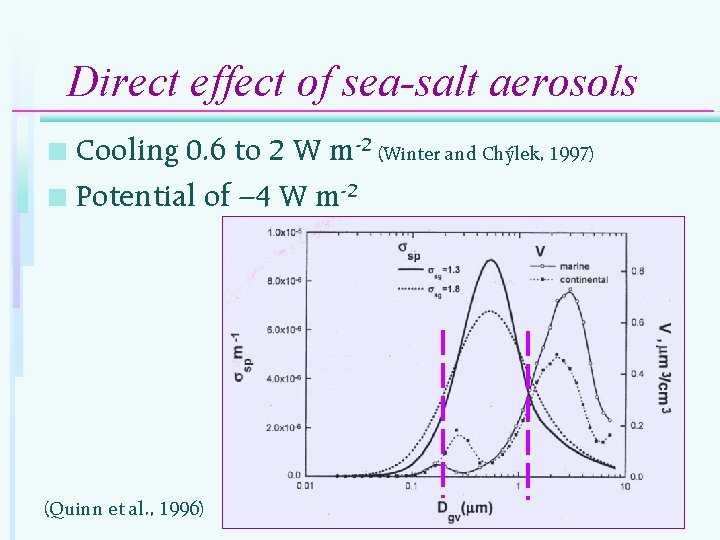
Direct effect of sea-salt aerosols Cooling 0. 6 to 2 W m-2 (Winter and Chýlek, 1997) n Potential of – 4 W m-2 n (Quinn et al. , 1996)
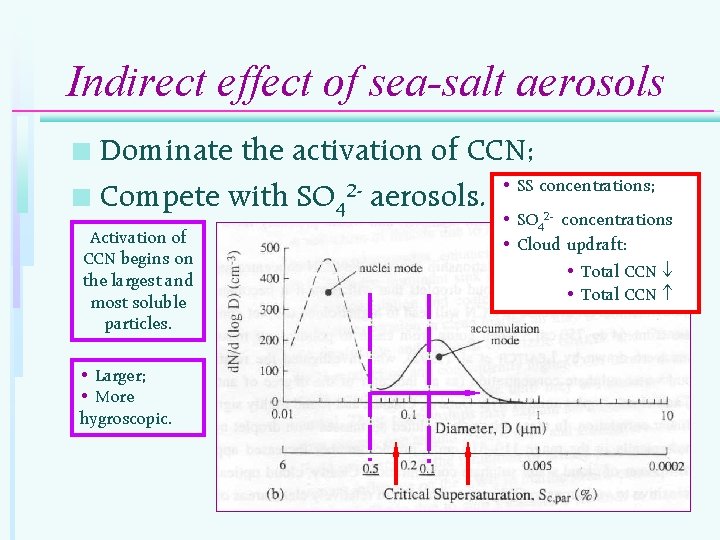
Indirect effect of sea-salt aerosols Dominate the activation of CCN; • SS concentrations; 2 n Compete with SO 4 aerosols. n Activation of CCN begins on the largest and most soluble particles. • Larger; • More hygroscopic. • SO 42 - concentrations • Cloud updraft: Andreae (1995) • Total CCN
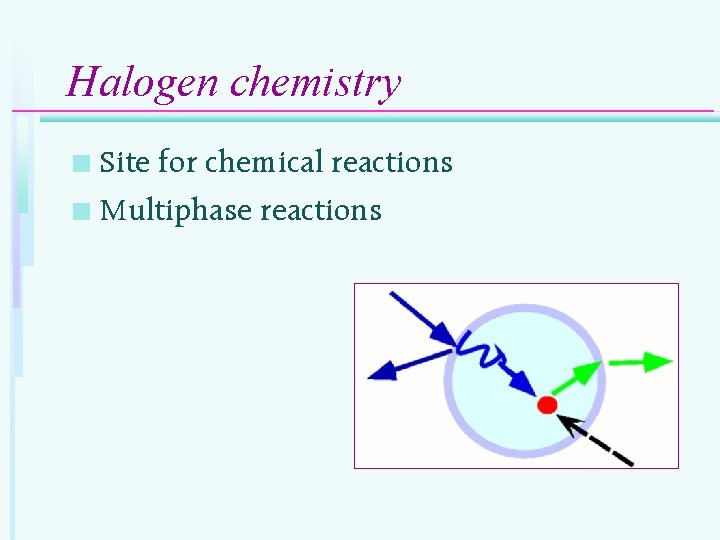
Halogen chemistry Site for chemical reactions n Multiphase reactions n
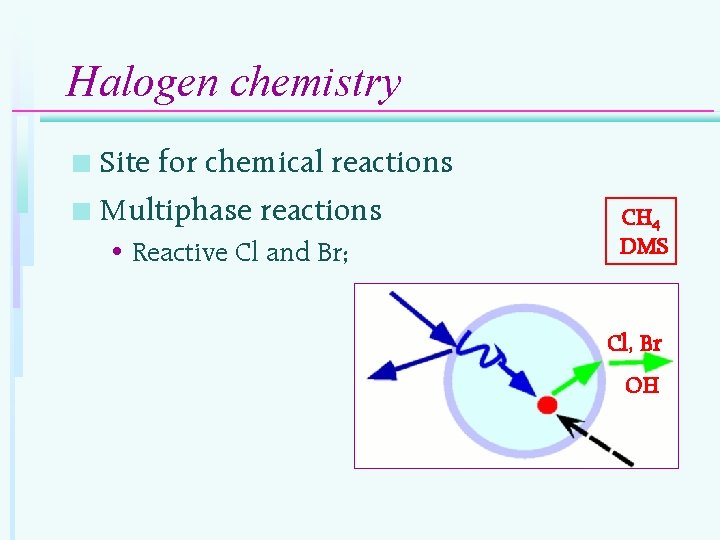
Halogen chemistry Site for chemical reactions n Multiphase reactions n • Reactive Cl and Br; CH 4 DMS Cl, Br OH
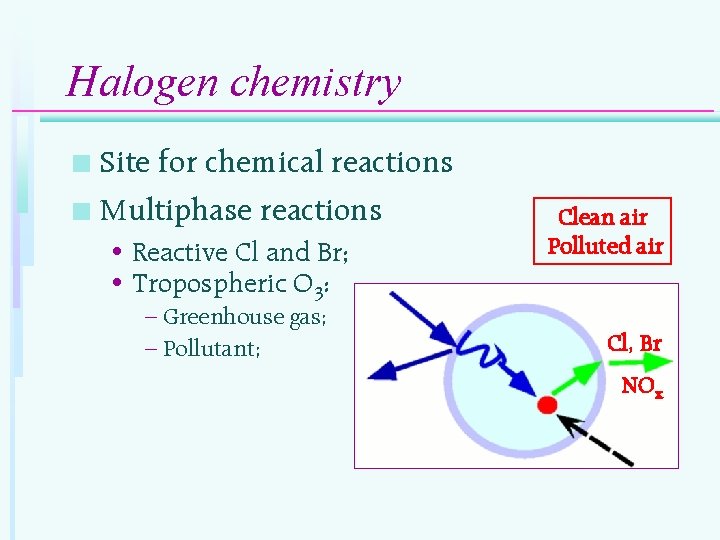
Halogen chemistry Site for chemical reactions n Multiphase reactions n • Reactive Cl and Br; • Tropospheric O 3: – Greenhouse gas; – Pollutant; Clean air Polluted air Cl, Br NOx
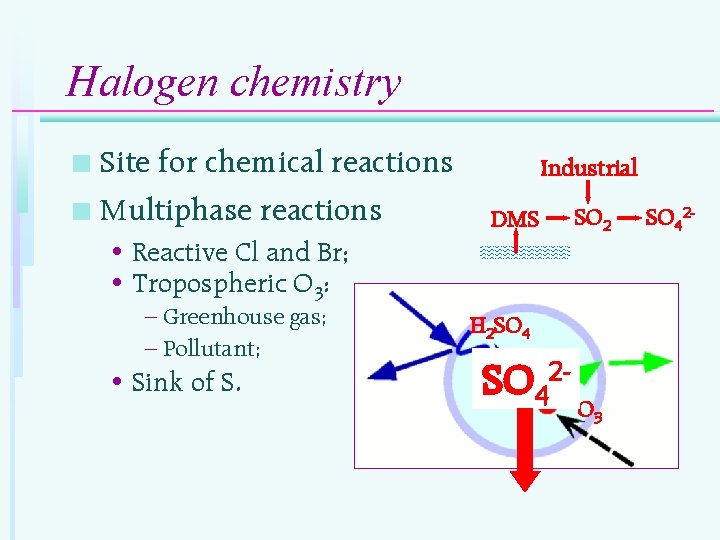
Halogen chemistry Site for chemical reactions n Multiphase reactions n Industrial DMS SO 2 • Reactive Cl and Br; • Tropospheric O 3: – Greenhouse gas; – Pollutant; • Sink of S. H 2 SO 42 - O 3 SO 42 -
Sea-salt aerosol effects must be accounted for.
Outline Sea-salt aerosols and climate n Sea spray n Whitecap coverage estimation n
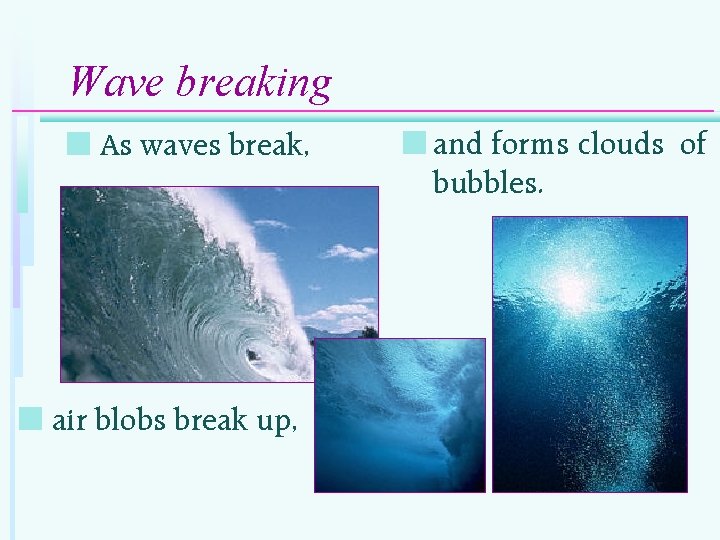
Wave breaking n As waves break, n air blobs break up, n and forms clouds of bubbles.
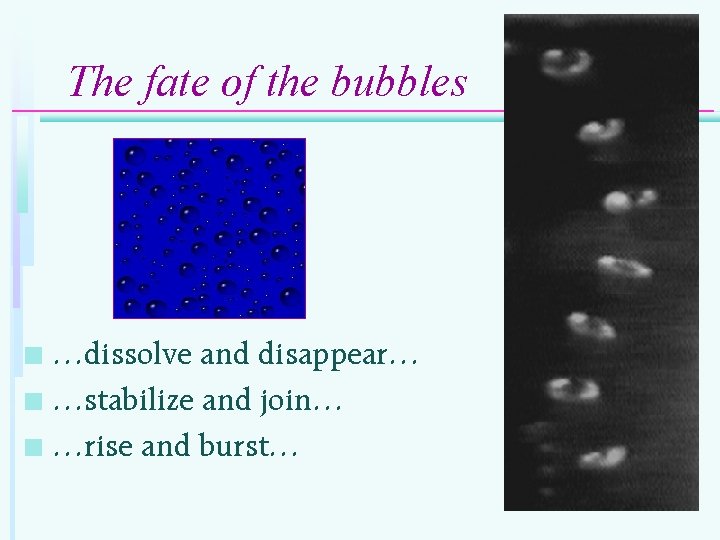
The fate of the bubbles …dissolve and disappear… n …stabilize and join… n …rise and burst… n
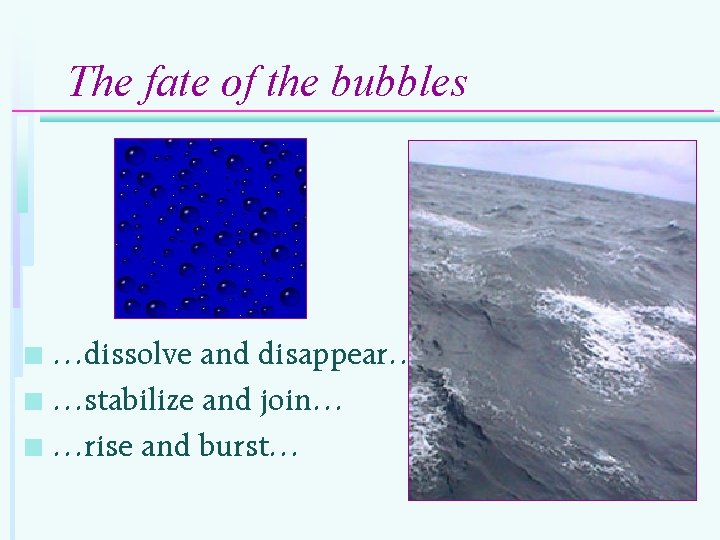
The fate of the bubbles …dissolve and disappear… n …stabilize and join… n …rise and burst… n
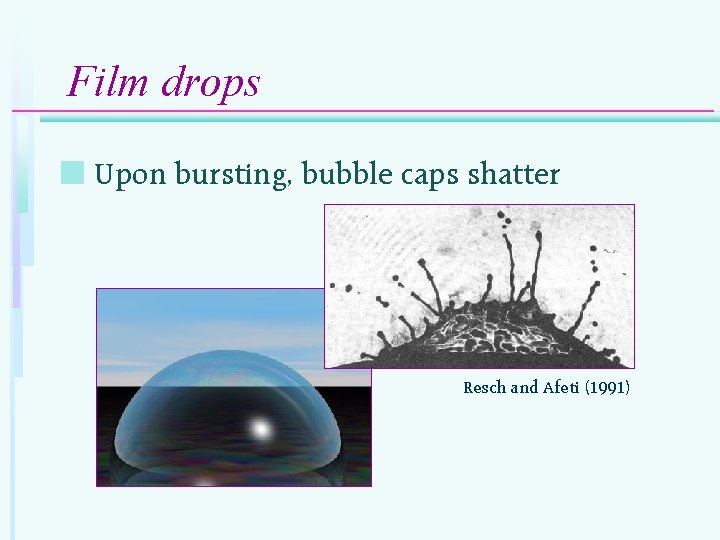
Film drops n Upon bursting, bubble caps shatter Resch and Afeti (1991)
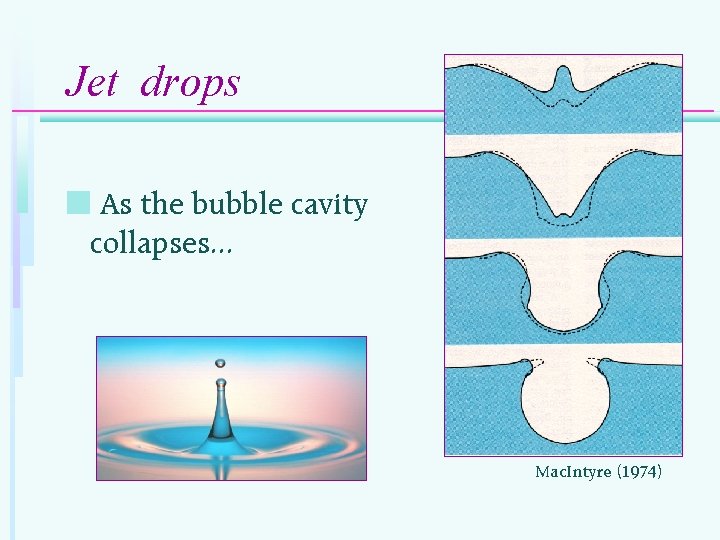
Jet drops n As the bubble cavity collapses. . . Mac. Intyre (1974)
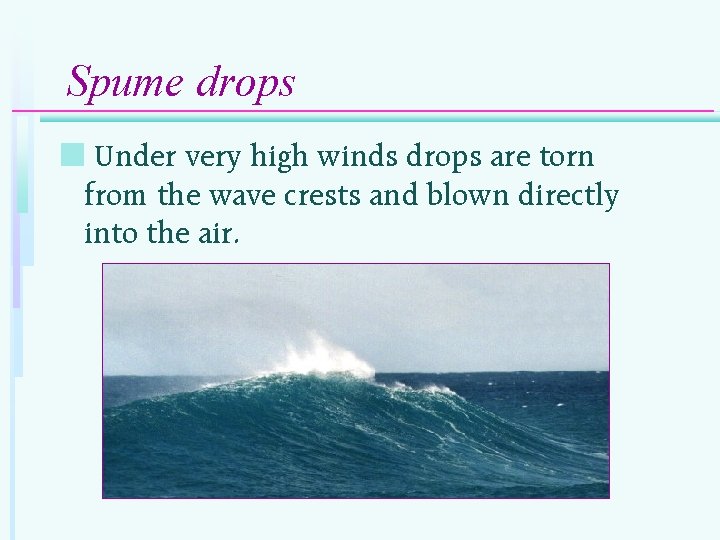
Spume drops n Under very high winds drops are torn from the wave crests and blown directly into the air.
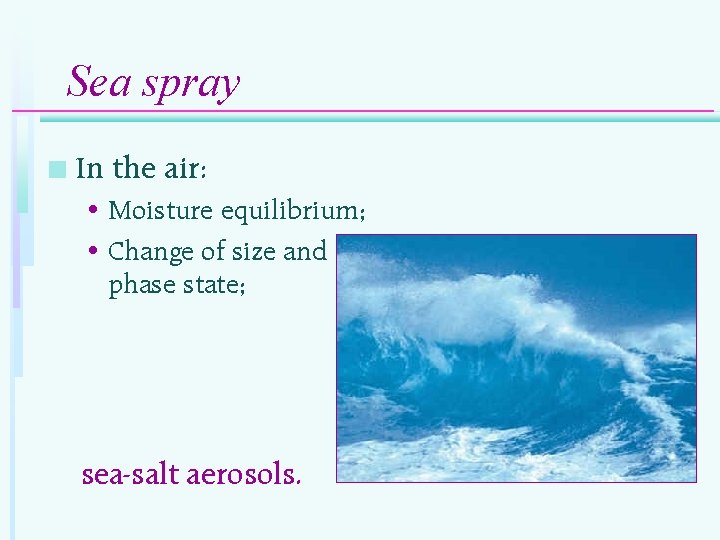
Sea spray n In the air: • Moisture equilibrium; • Change of size and phase state; sea-salt aerosols.
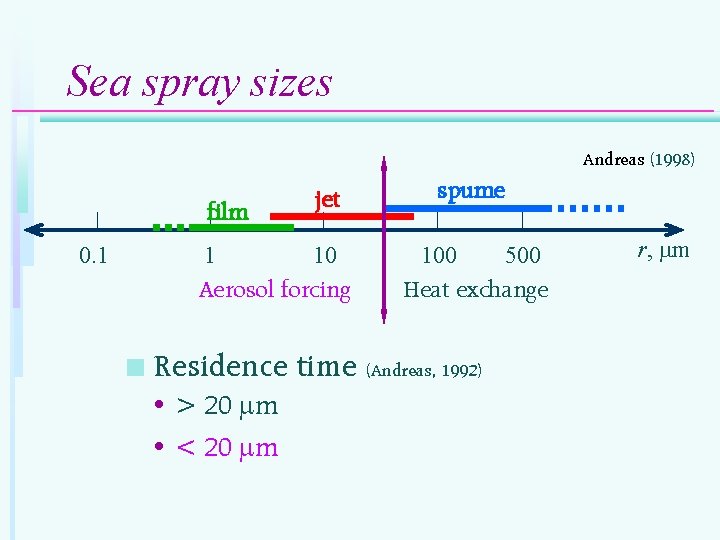
Sea spray sizes Andreas (1998) film 0. 1 jet 1 10 Aerosol forcing n spume 100 500 Heat exchange Residence time (Andreas, 1992) • > 20 m • < 20 m r, m
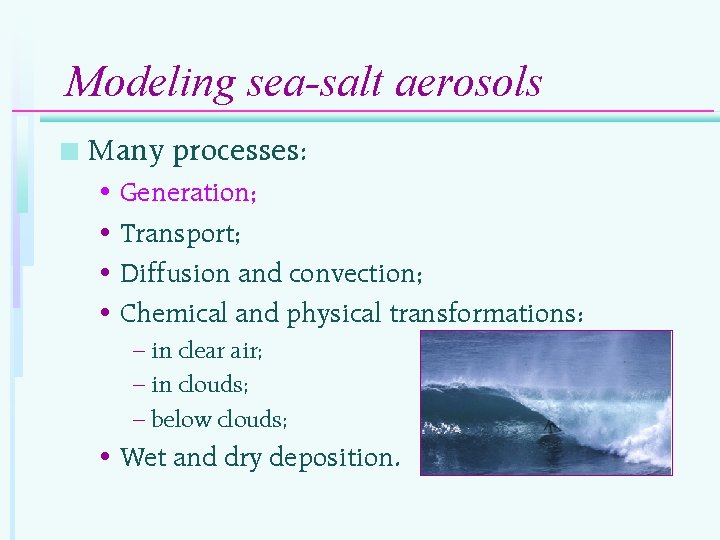
Modeling sea-salt aerosols n Many processes: • Generation; • Transport; • Diffusion and convection; • Chemical and physical transformations: – in clear air; – in clouds; – below clouds; • Wet and dry deposition.
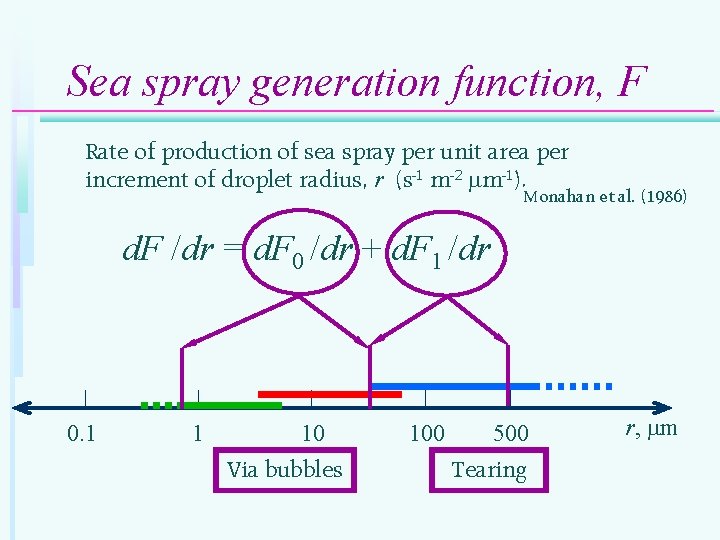
Sea spray generation function, F Rate of production of sea spray per unit area per increment of droplet radius, r (s-1 m-2 m-1). Monahan et al. (1986) d. F /dr = d. F 0 /dr + d. F 1 /dr 0. 1 1 10 Via bubbles 100 500 Tearing r, m
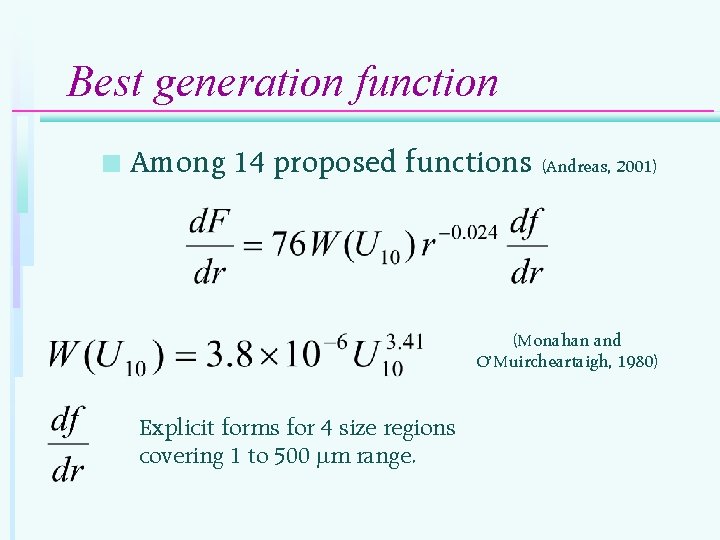
Best generation function n Among 14 proposed functions (Andreas, 2001) (Monahan and O’Muircheartaigh, 1980) Explicit forms for 4 size regions covering 1 to 500 m range.
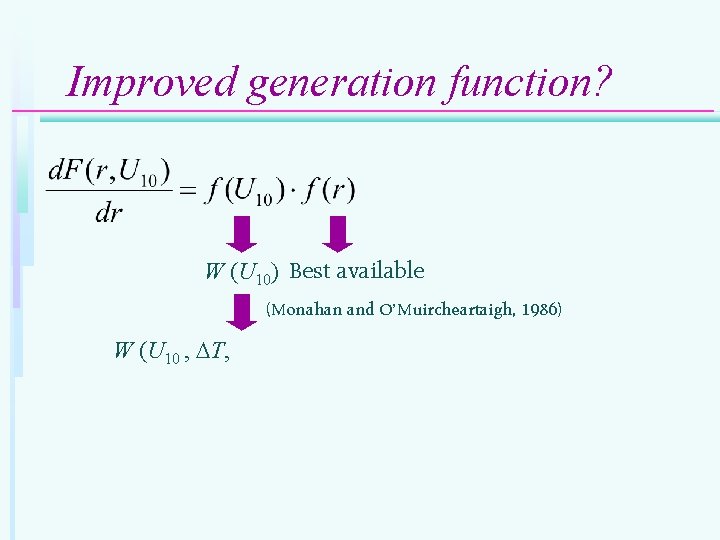
Improved generation function? W (U 10) Best available (Monahan and O’Muircheartaigh, 1986) W (U 10 , T, Ts , S, f , d , C )
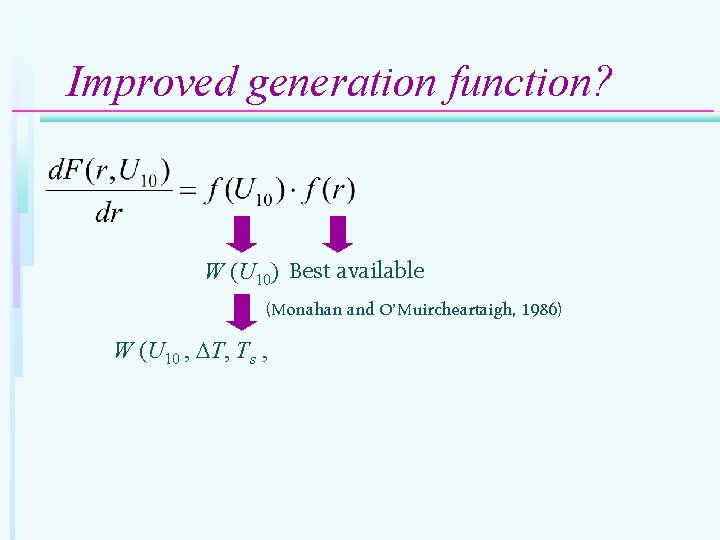
Improved generation function? W (U 10) Best available (Monahan and O’Muircheartaigh, 1986) W (U 10 , T, Ts , S, f , d , C )
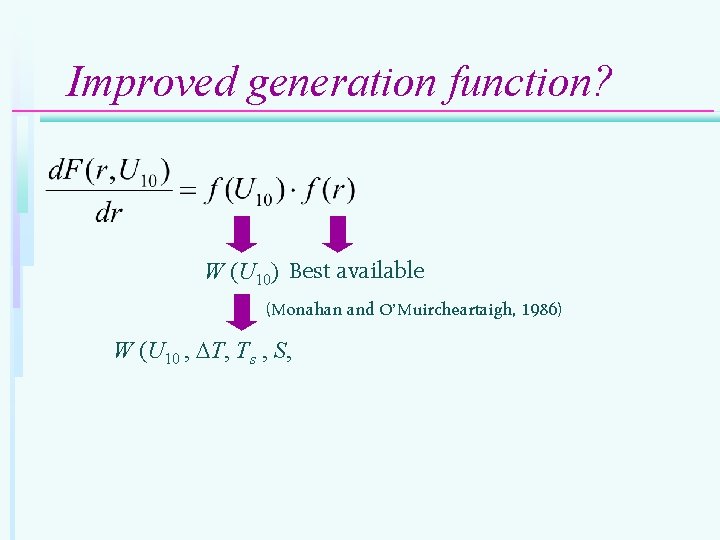
Improved generation function? W (U 10) Best available (Monahan and O’Muircheartaigh, 1986) W (U 10 , T, Ts , S, f , d , C )
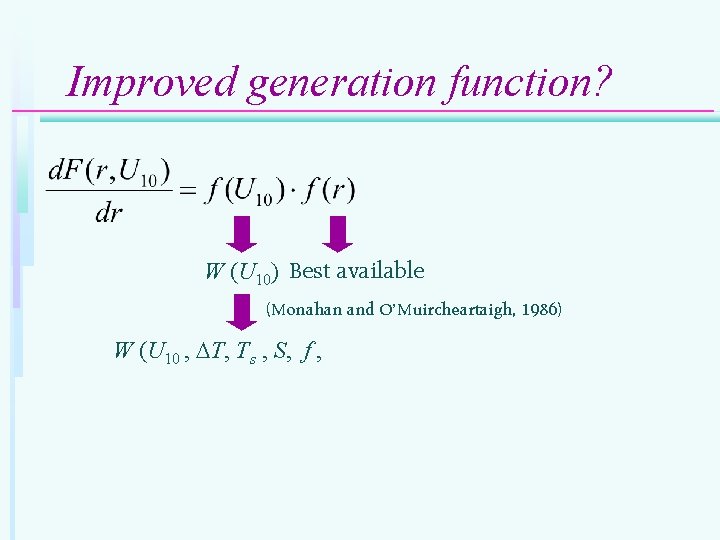
Improved generation function? W (U 10) Best available (Monahan and O’Muircheartaigh, 1986) W (U 10 , T, Ts , S, f , d , C )
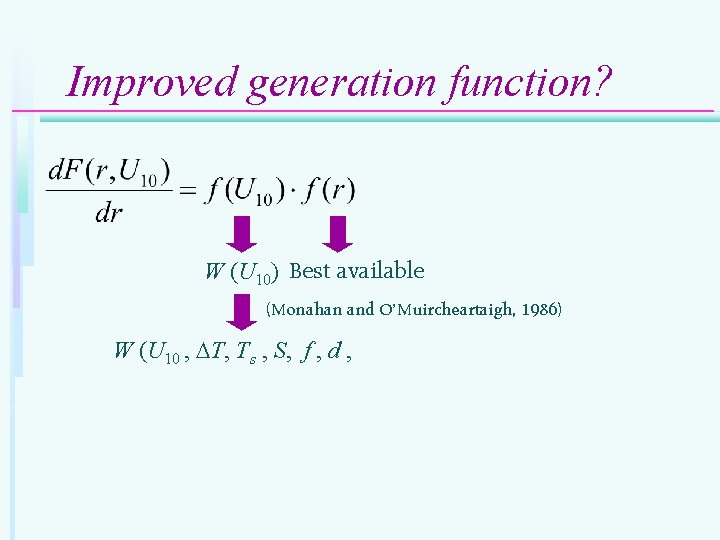
Improved generation function? W (U 10) Best available (Monahan and O’Muircheartaigh, 1986) W (U 10 , T, Ts , S, f , d , C )
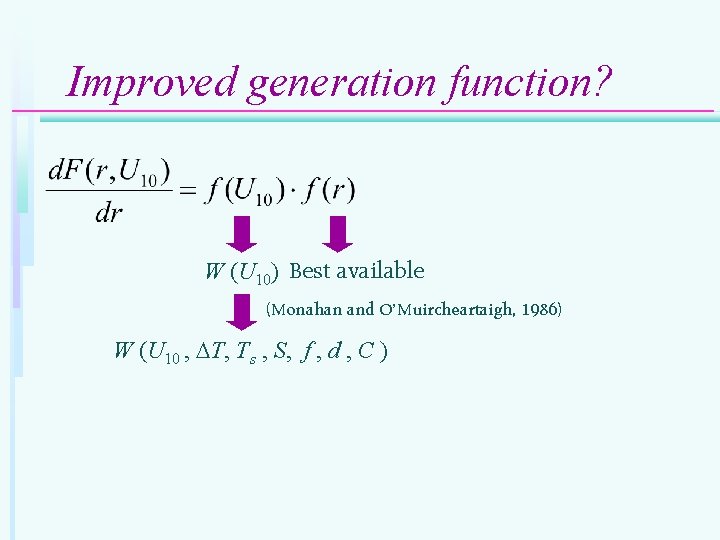
Improved generation function? W (U 10) Best available (Monahan and O’Muircheartaigh, 1986) W (U 10 , T, Ts , S, f , d , C )
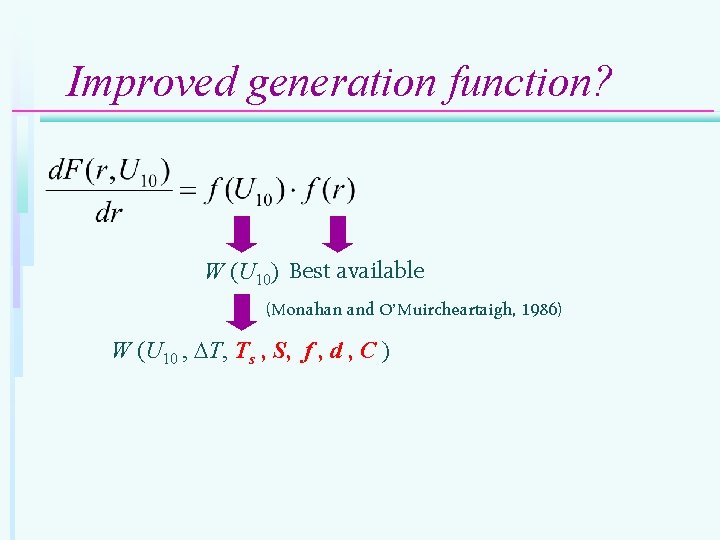
Improved generation function? W (U 10) Best available (Monahan and O’Muircheartaigh, 1986) W (U 10 , T, Ts , S, f , d , C )
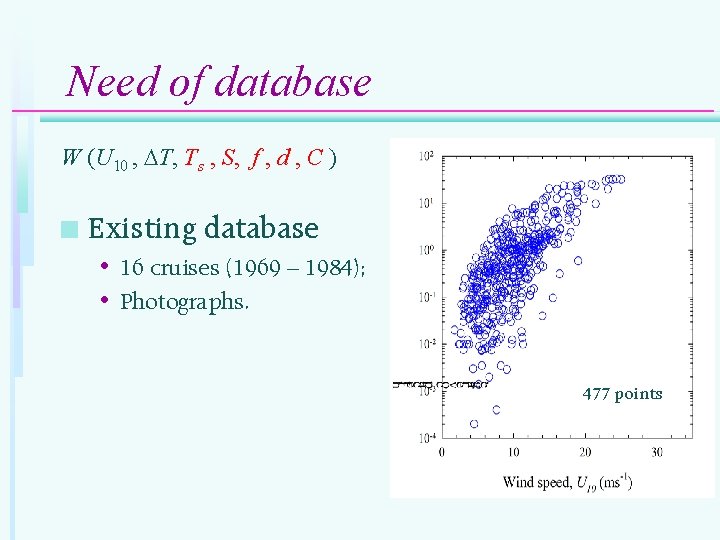
Need of database W (U 10 , T, Ts , S, f , d , C ) n Existing database • 16 cruises (1969 – 1984); • Photographs. 477 points
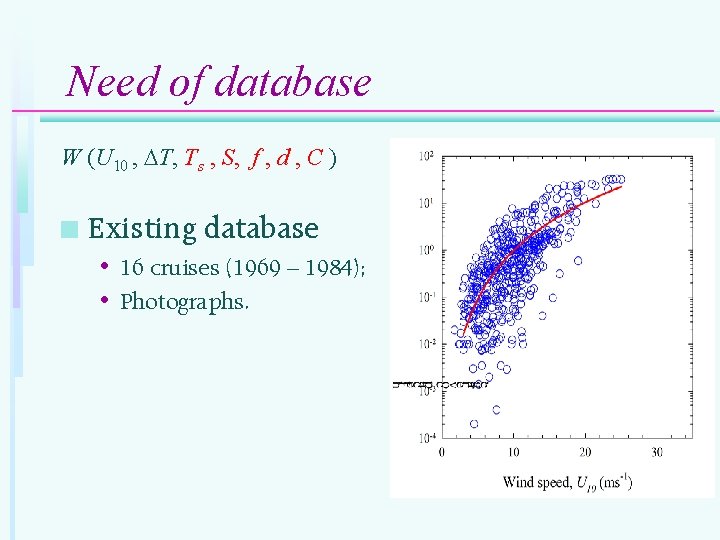
Need of database W (U 10 , T, Ts , S, f , d , C ) n Existing database • 16 cruises (1969 – 1984); • Photographs. 477 points
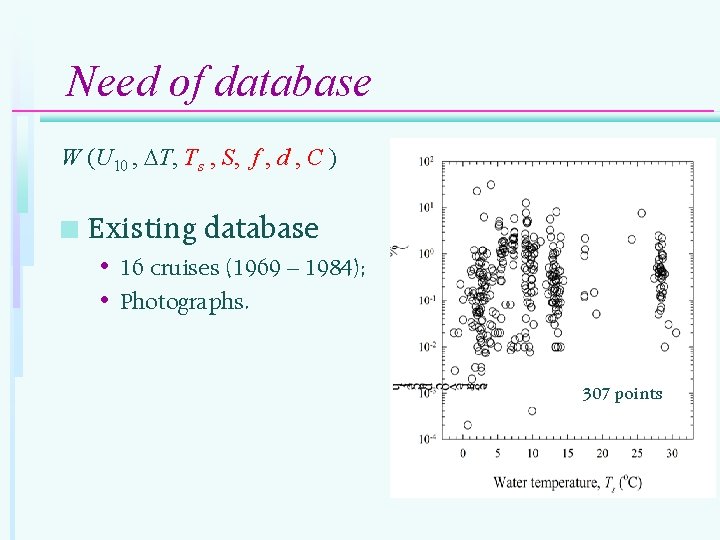
Need of database W (U 10 , T, Ts , S, f , d , C ) n Existing database • 16 cruises (1969 – 1984); • Photographs. 307 477 points
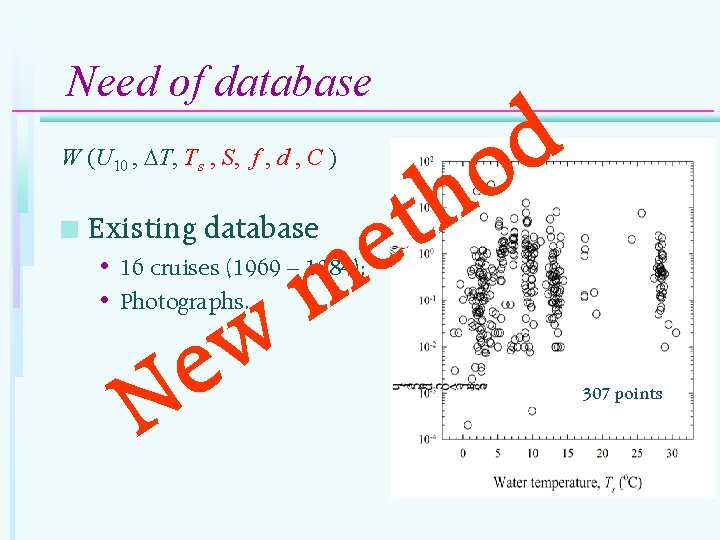
Need of database W (U 10 , T, Ts , S, f , d , C ) n d o h t e m Existing database • 16 cruises (1969 – 1984); • Photographs. w e N 307 477 points
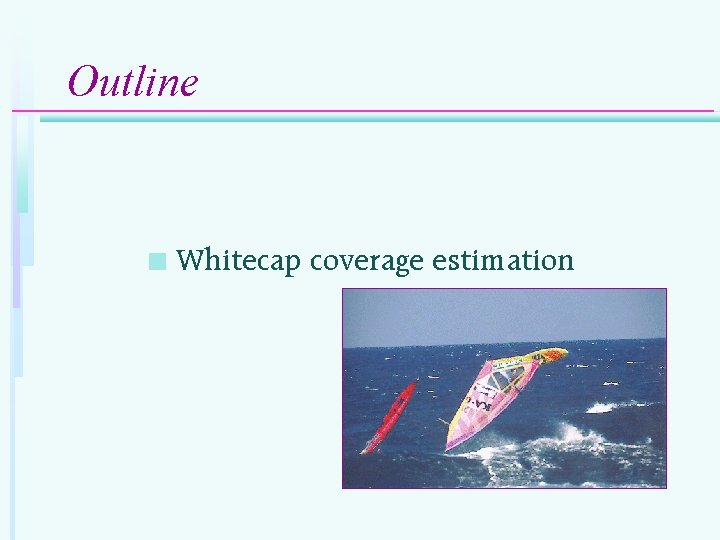
Outline Sea-salt aerosols and climate n Sea spray n Whitecap coverage estimation n
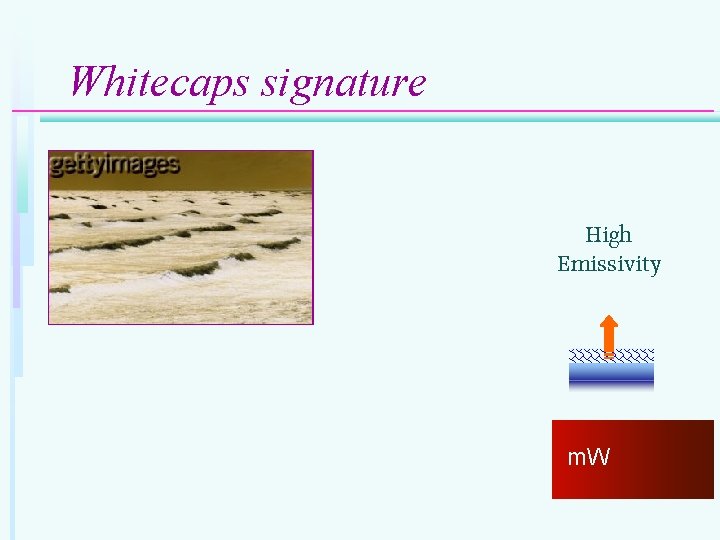
Whitecaps signature Reflectivity High Reflectivity Emissivity UV Vis IR m. W
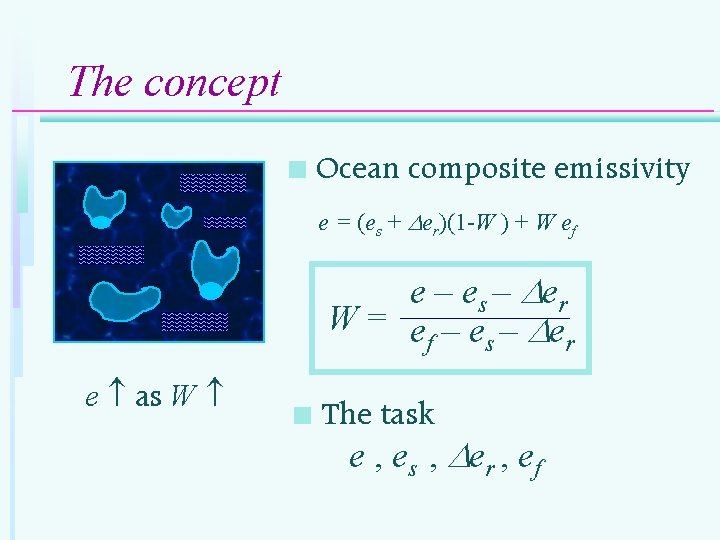
The concept n Ocean composite emissivity e = (es + er)(1 -W ) + W ef e – es – er W = e – e f s r e as W n The task e , es , er , ef
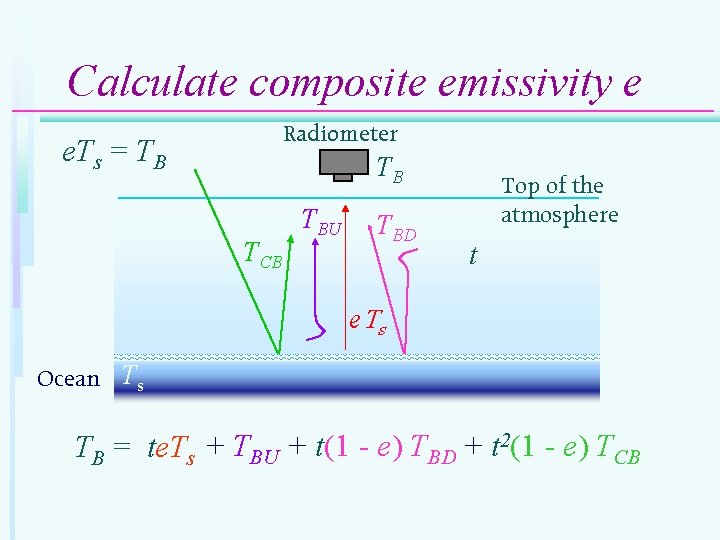
Calculate composite emissivity e Radiometer e. Ts = TB TB TCB TBU TBD Top of the atmosphere t e. Ts Ocean Ts TB = te. Ts + TBU + t(1 - e) TBD + t 2(1 - e) TCB
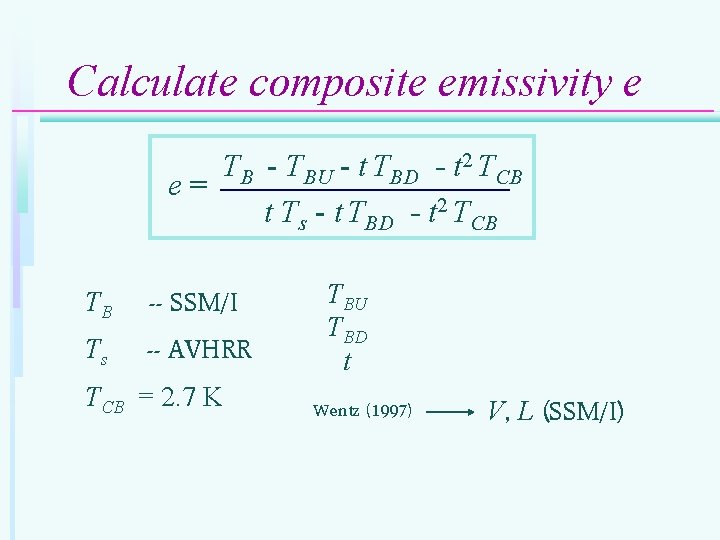
Calculate composite emissivity e TB - TBU - t TBD - t 2 TCB e= t Ts - t TBD - t 2 TCB TB -- SSM/I Ts -- AVHRR TCB = 2. 7 K TBU TBD t Wentz (1997) V, L (SSM/I)
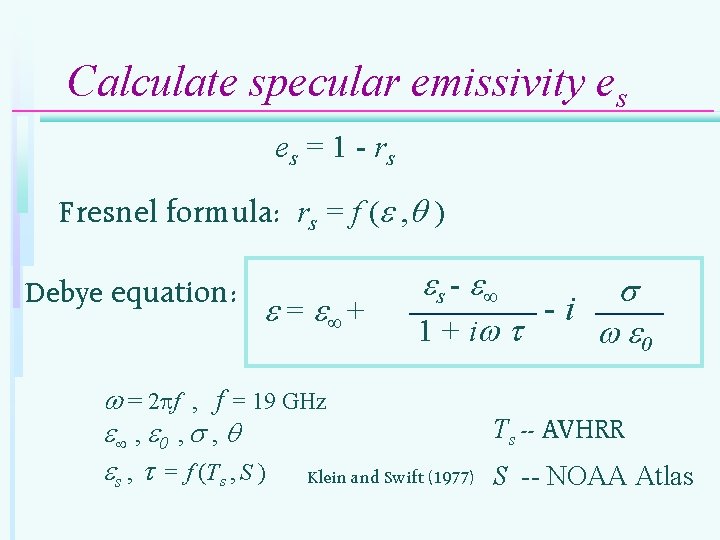
Calculate specular emissivity es e s = 1 - rs Fresnel formula: rs = f ( , ) Debye equation: = + s - -i 1 + i 0 = 2 f , f = 19 GHz Ts -- AVHRR , 0 , , s , = f (Ts , S ) Klein and Swift (1977) S -- NOAA Atlas
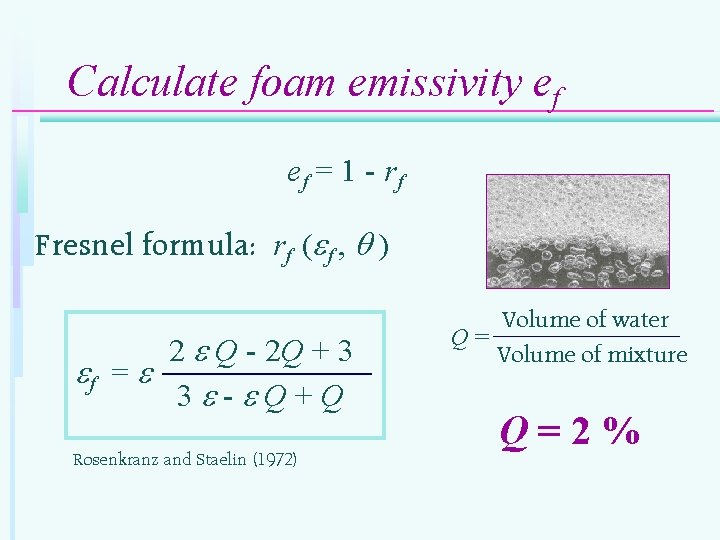
Calculate foam emissivity ef e f = 1 - rf Fresnel formula: rf ( f , ) 2 Q - 2 Q + 3 f = 3 - Q+Q Rosenkranz and Staelin (1972) Volume of water Q= Volume of mixture Q=2%
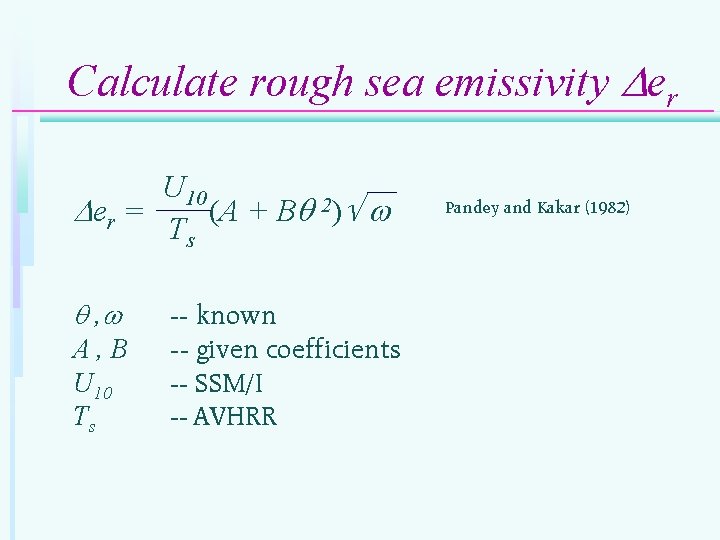
Calculate rough sea emissivity er U 10 er = (A + B 2) Ts , A, B U 10 Ts -- known -- given coefficients -- SSM/I -- AVHRR Pandey and Kakar (1982)
What else? Analytical expressions; n Data (TB, U 10, V, L, Ts, S ); n Preparation; n Error analysis; n Calculate W; n
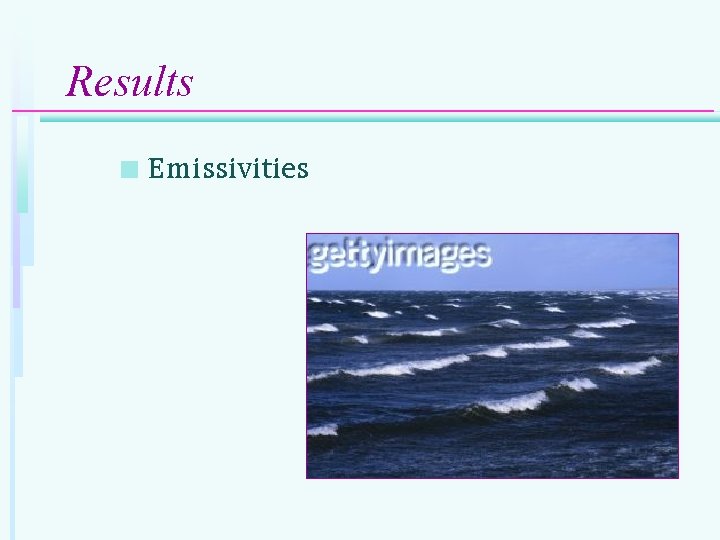
Results n Emissivities
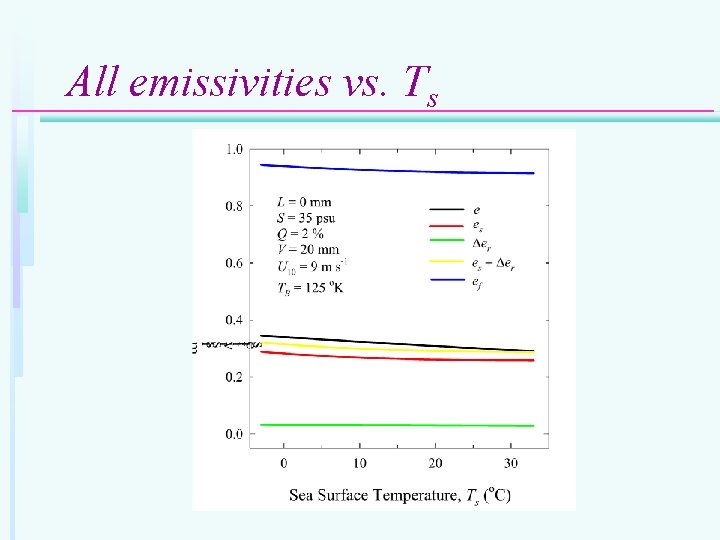
All emissivities vs. Ts
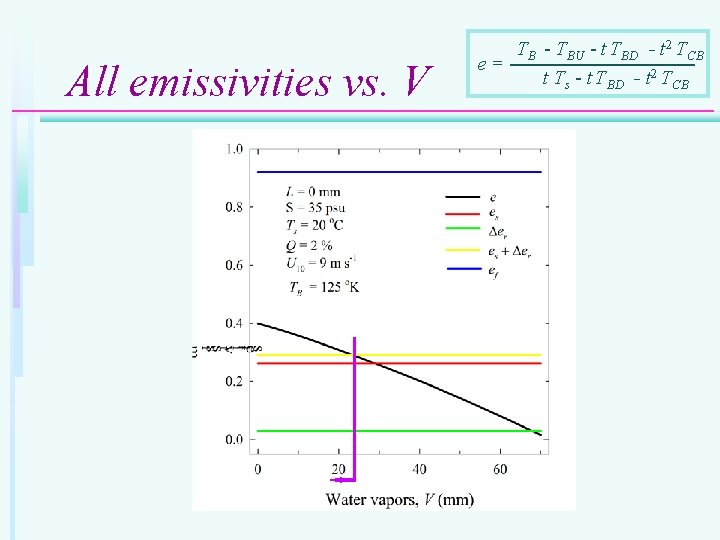
All emissivities vs. V TB - TBU - t TBD - t 2 TCB e= t Ts - t TBD - t 2 TCB
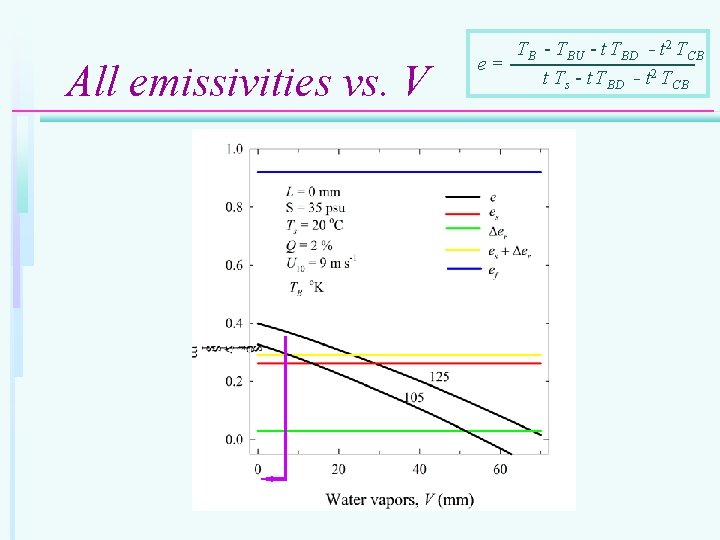
All emissivities vs. V TB - TBU - t TBD - t 2 TCB e= t Ts - t TBD - t 2 TCB
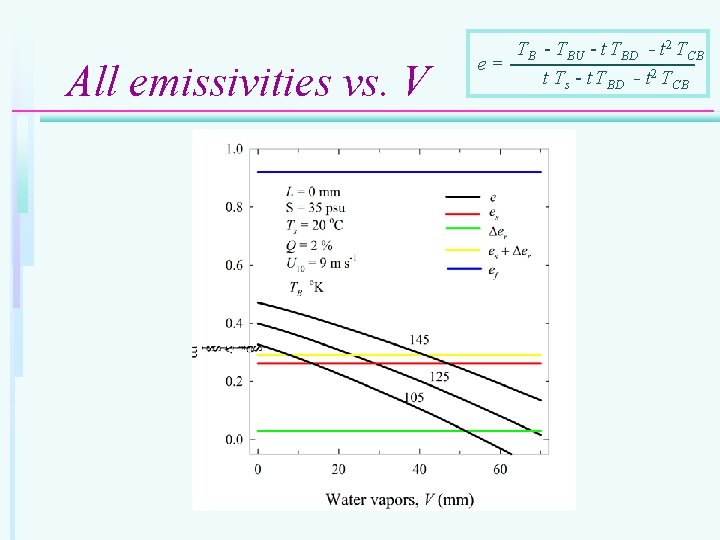
All emissivities vs. V TB - TBU - t TBD - t 2 TCB e= t Ts - t TBD - t 2 TCB
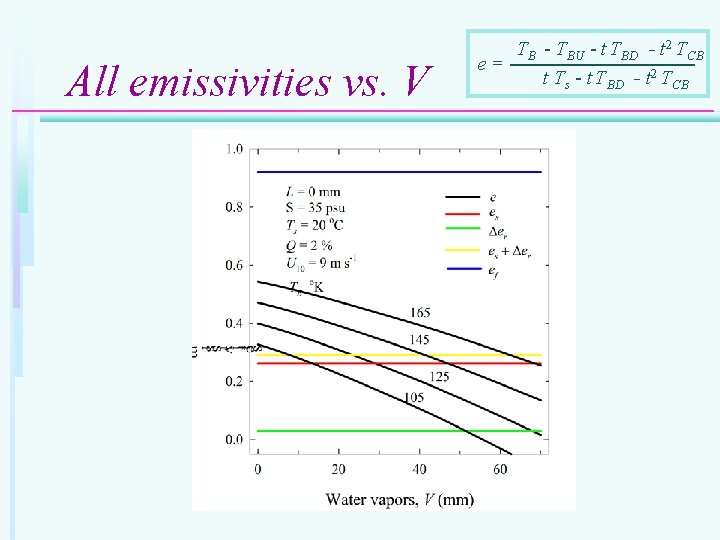
All emissivities vs. V TB - TBU - t TBD - t 2 TCB e= t Ts - t TBD - t 2 TCB
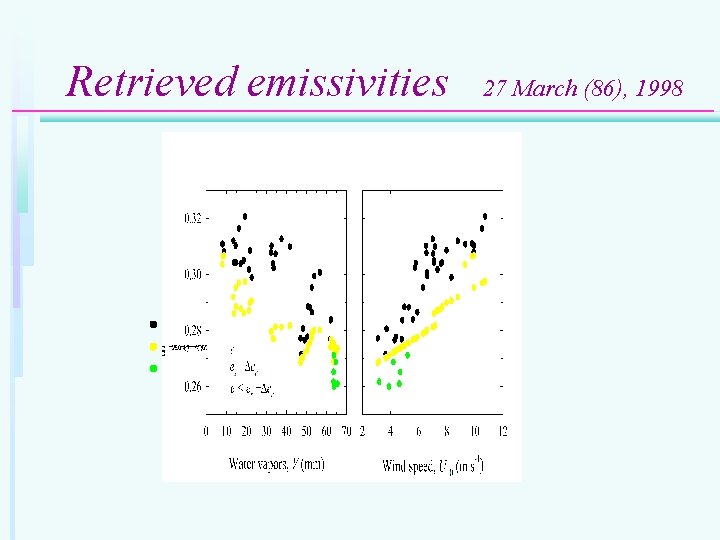
Retrieved emissivities 27 March (86), 1998
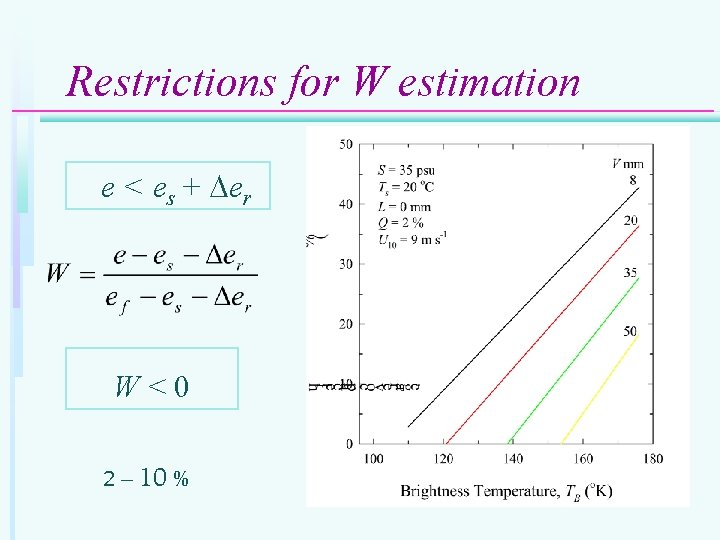
Restrictions for W estimation e < es + er W<0 2 – 10 %
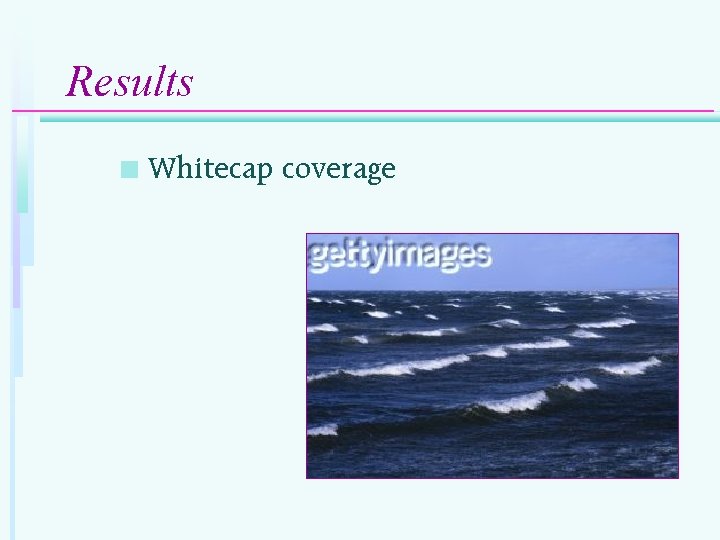
Results n Whitecap coverage
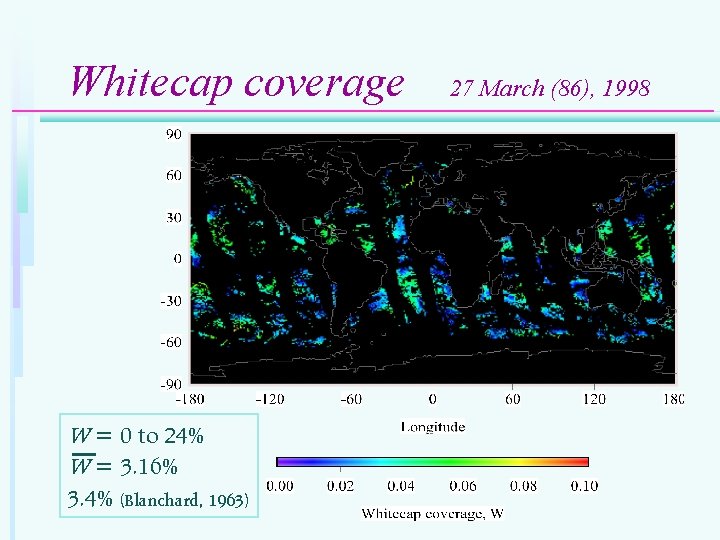
Whitecap coverage W = 0 to 24% W = 3. 16% 3. 4% (Blanchard, 1963) 27 March (86), 1998
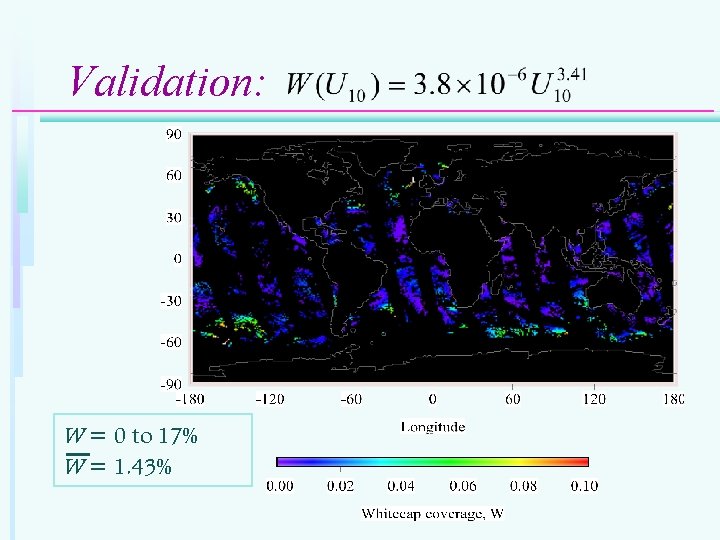
Validation: W = 0 to 17% W = 1. 43%
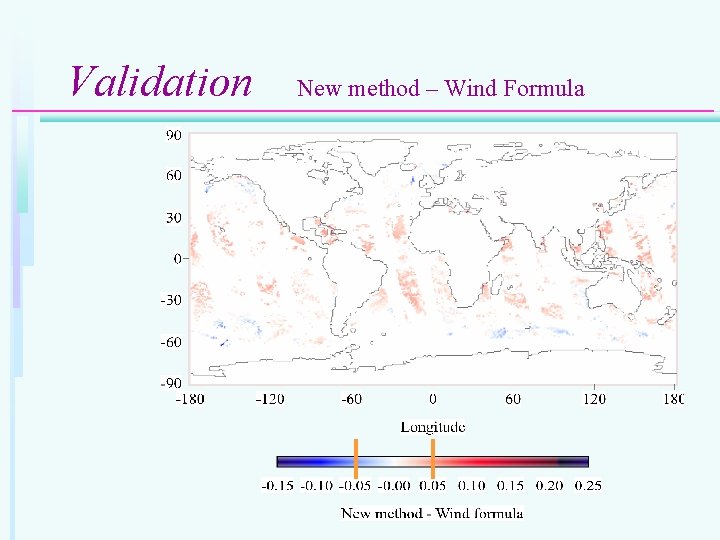
Validation New method – Wind Formula
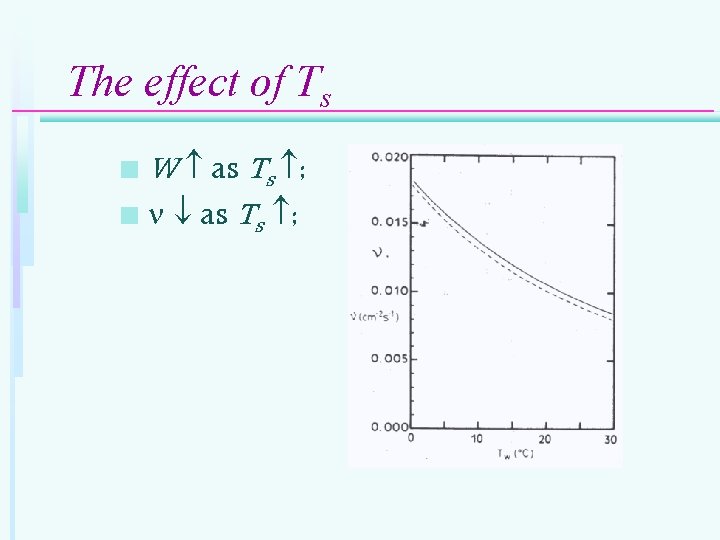
The effect of Ts W as Ts ; n
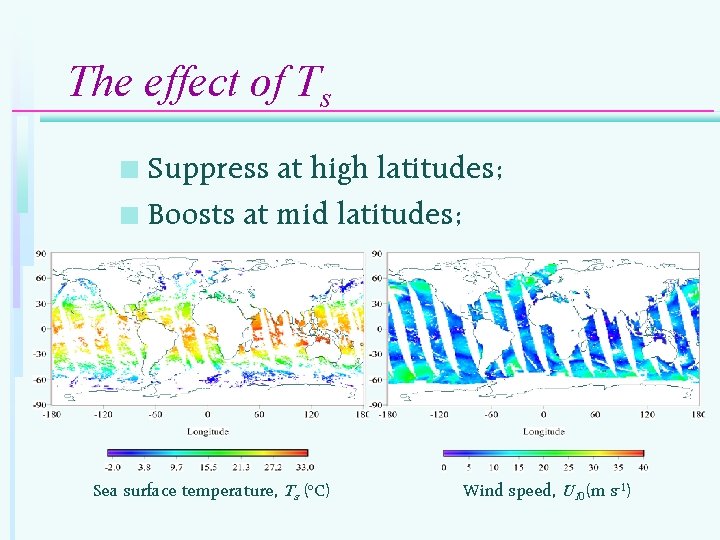
The effect of Ts Suppress at high latitudes; n Boosts at mid latitudes; n Sea surface temperature, Ts (o. C) Wind speed, U 10(m s-1)
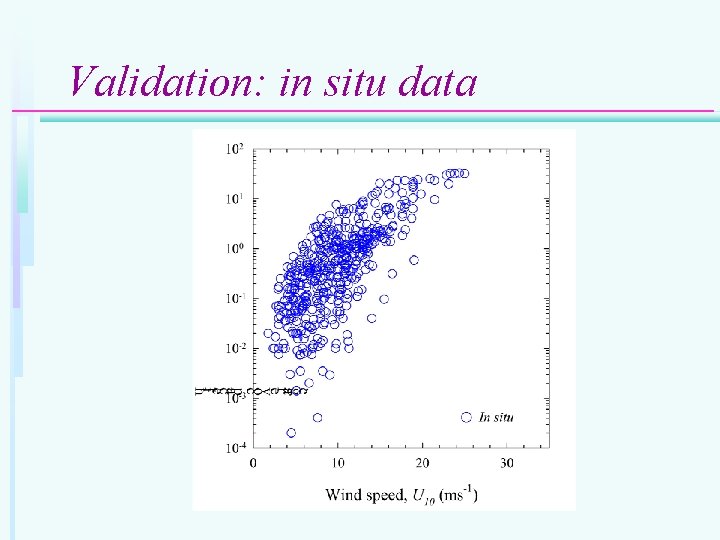
Validation: in situ data
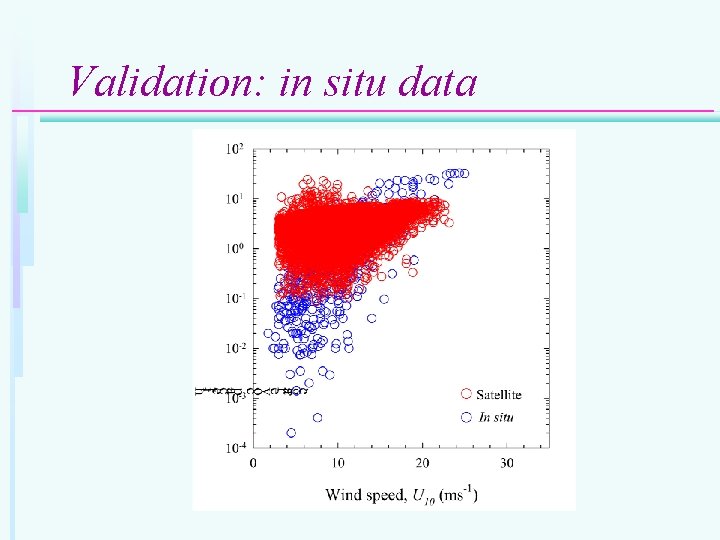
Validation: in situ data
Another hour to talk about Database organization; n Regressions; n Modified formula; n Global distribution of sea-salt aerosols; n Estimations for climate processes. n
Questions
- Slides: 69