
Oceanography Tools Names and Functions 8 Peterson Grabber
Oceanography Tools
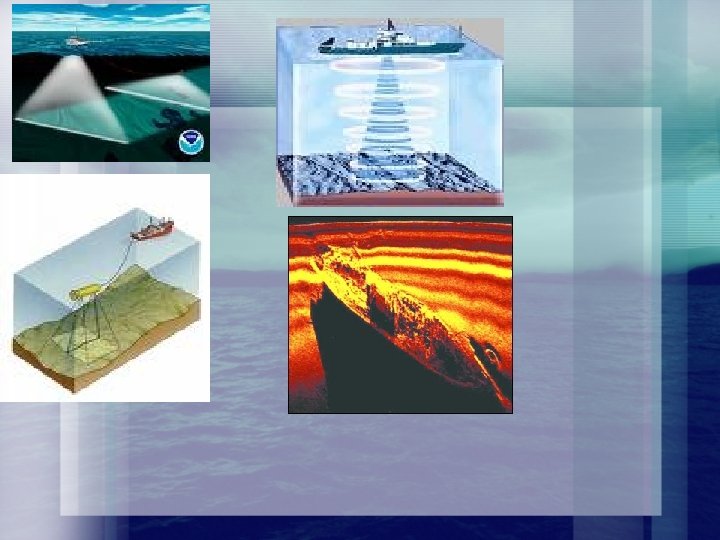
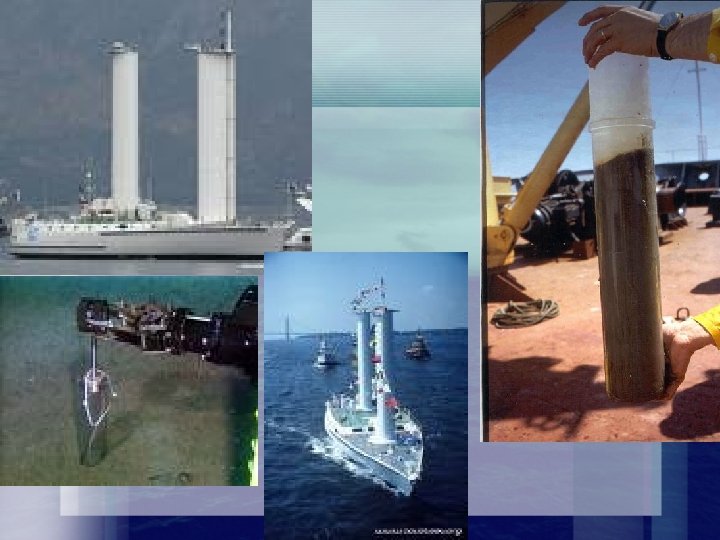
Names and Functions • # 8: Peterson Grabber- Bottom Sampler • #7: Secchi Disk- Measures Turbidity and Visibility. • #4: Trieste- First bathyscaphe to descend 35, 800 Ft. to the bottom of the Mariana’s Trench. • #9: Purse Seine Net- enormous nets closed at the bottom by a draw string, often used to catch tuna.
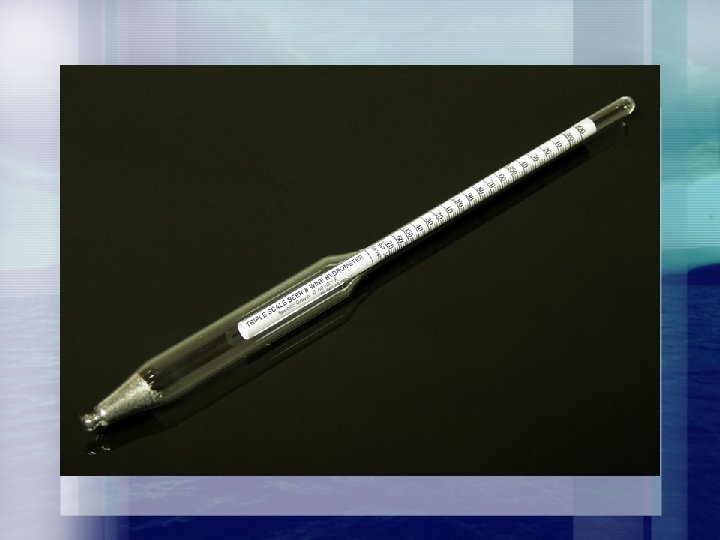
• # 14: Plankton Net- Net towed or dipped to gather plankton sample. • #3: Alcyone- Cousteau’s new turbo-sail ship • #16: Core sampler- takes core samples of the ocean floor • #5: Hydrometer- Measures density and temperature and can be crossed-referenced to find salinity.
• #6: Conshelf- Cousteau’s two man diving saucer used to explore the continental shelf. • #17: Dredge- Chain mesh attached to a square metal frame used to sample rocks on the bottom • #2: Water collecting bottle- Collects water samples.
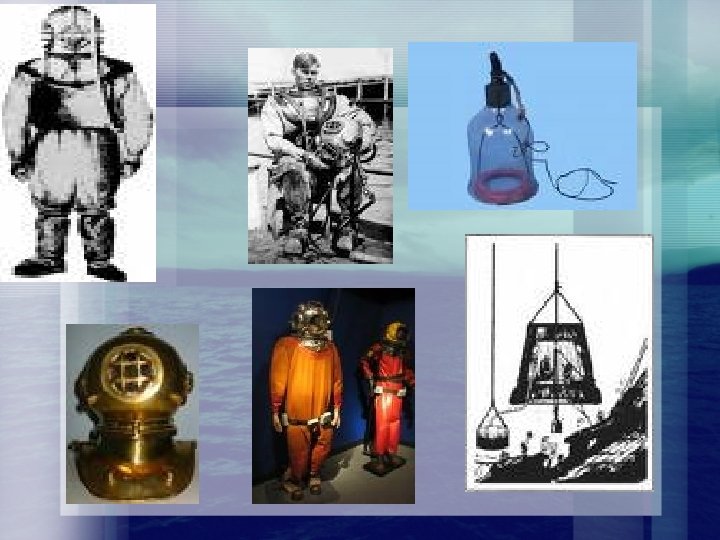
• #12: Alvin- Research submersible used to locate bombs, titanic, bismarck, hydro-thermal vents. • #13: Side Scan Sonar- Acronym for sound navigation and ranging, used to locate objects in water. • #18: Aluminaut- Early deep diving craft used for collectin mineral samples and for research.
• #1: Dip net- retrieves a variety of samples from the water • #20: Current Meter- Determines the speed and the direction of the currents. • #15: Flip- 355 ft. Floating instrument platform that can become vertical • #19: Nansen Bottle- collects water samples at a variety of depths. • #11: Underwater camera- provides video and photographs at deep depths.
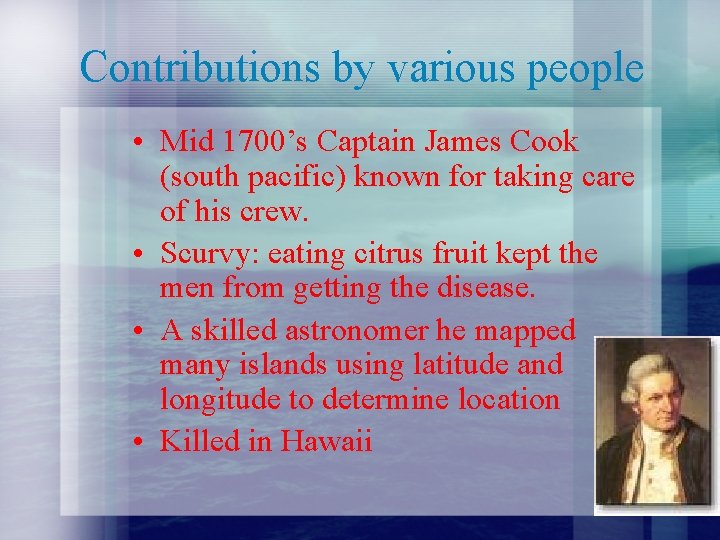
Contributions by various people • Mid 1700’s Captain James Cook (south pacific) known for taking care of his crew. • Scurvy: eating citrus fruit kept the men from getting the disease. • A skilled astronomer he mapped many islands using latitude and longitude to determine location • Killed in Hawaii
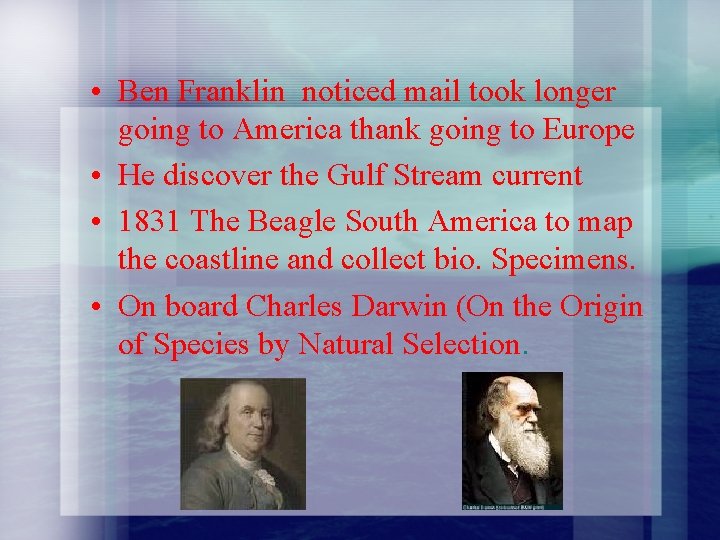
• Ben Franklin noticed mail took longer going to America thank going to Europe • He discover the Gulf Stream current • 1831 The Beagle South America to map the coastline and collect bio. Specimens. • On board Charles Darwin (On the Origin of Species by Natural Selection.
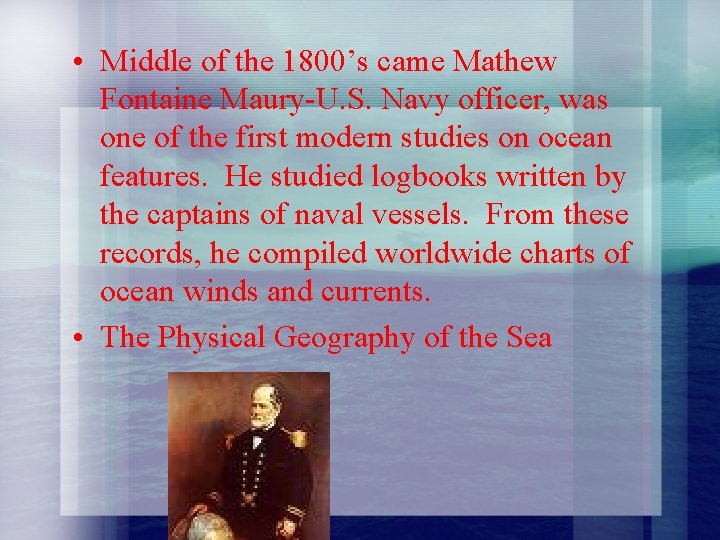
• Middle of the 1800’s came Mathew Fontaine Maury-U. S. Navy officer, was one of the first modern studies on ocean features. He studied logbooks written by the captains of naval vessels. From these records, he compiled worldwide charts of ocean winds and currents. • The Physical Geography of the Sea
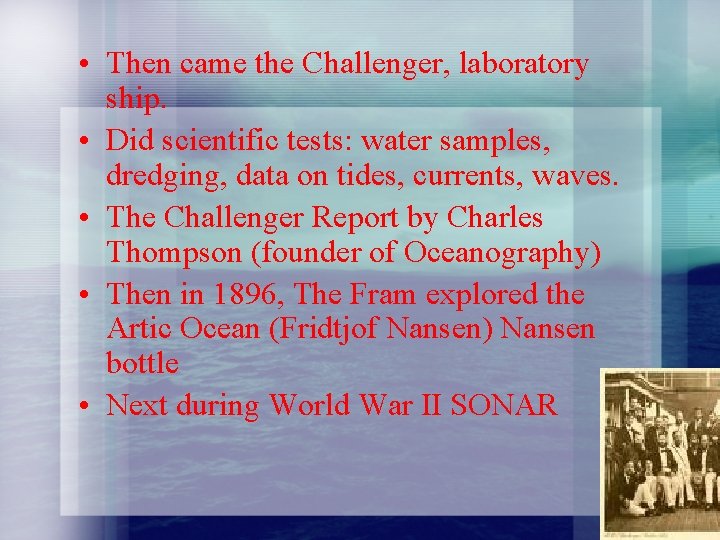
• Then came the Challenger, laboratory ship. • Did scientific tests: water samples, dredging, data on tides, currents, waves. • The Challenger Report by Charles Thompson (founder of Oceanography) • Then in 1896, The Fram explored the Artic Ocean (Fridtjof Nansen) Nansen bottle • Next during World War II SONAR
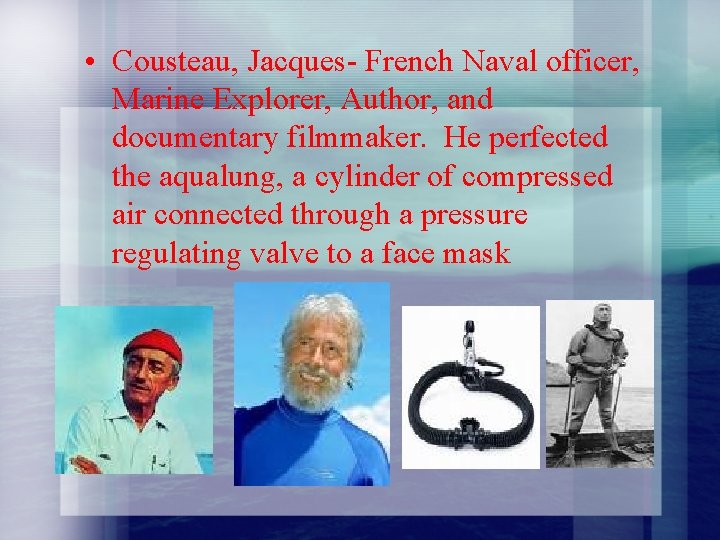
• Cousteau, Jacques- French Naval officer, Marine Explorer, Author, and documentary filmmaker. He perfected the aqualung, a cylinder of compressed air connected through a pressure regulating valve to a face mask
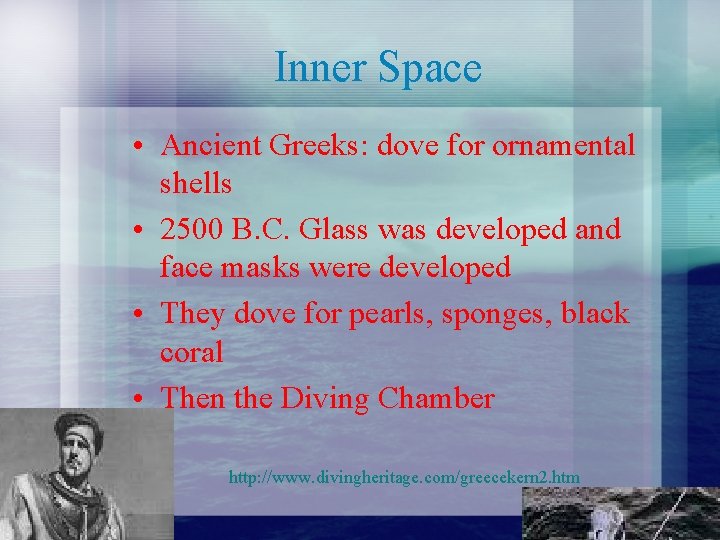
Inner Space • Ancient Greeks: dove for ornamental shells • 2500 B. C. Glass was developed and face masks were developed • They dove for pearls, sponges, black coral • Then the Diving Chamber http: //www. divingheritage. com/greecekern 2. htm
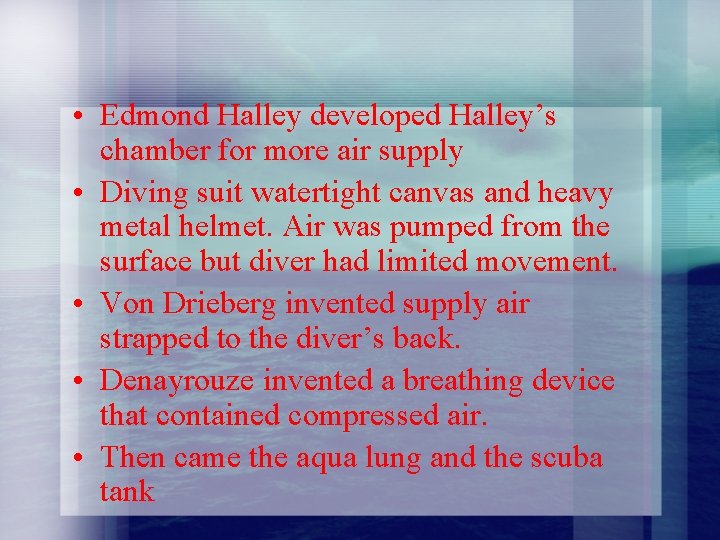
• Edmond Halley developed Halley’s chamber for more air supply • Diving suit watertight canvas and heavy metal helmet. Air was pumped from the surface but diver had limited movement. • Von Drieberg invented supply air strapped to the diver’s back. • Denayrouze invented a breathing device that contained compressed air. • Then came the aqua lung and the scuba tank
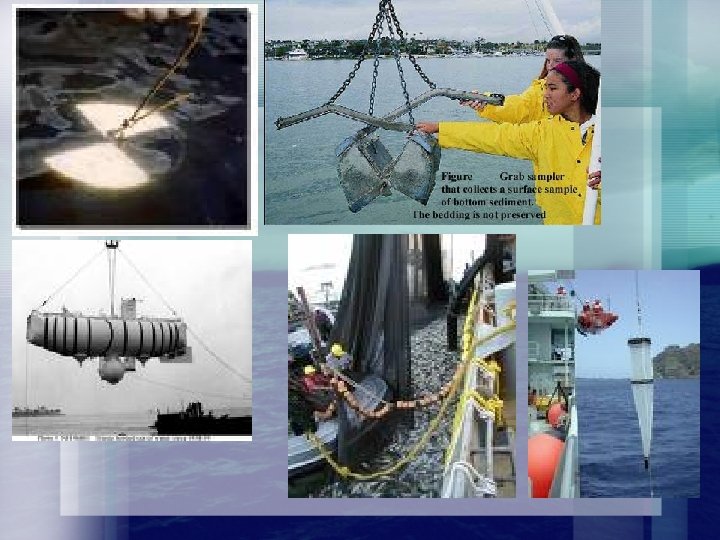
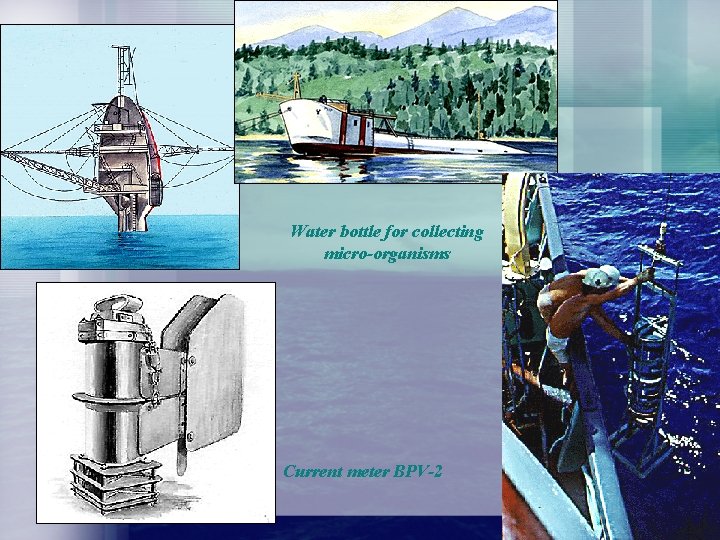
Water bottle for collecting micro-organisms Current meter BPV-2
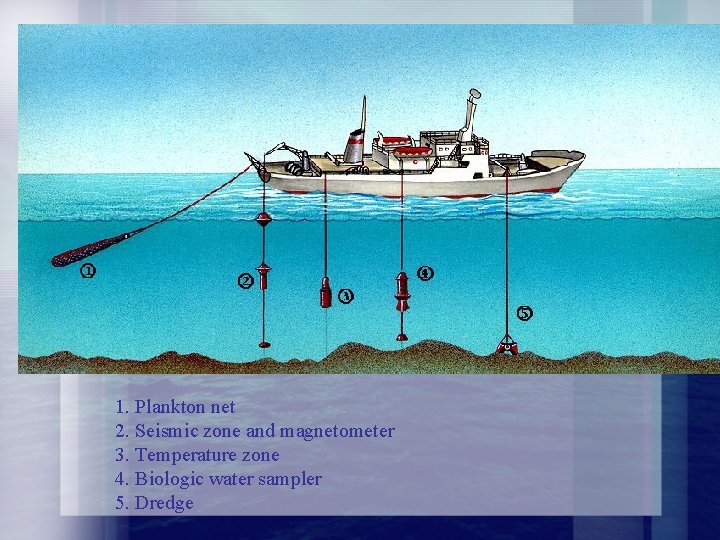
1. Plankton net 2. Seismic zone and magnetometer 3. Temperature zone 4. Biologic water sampler 5. Dredge
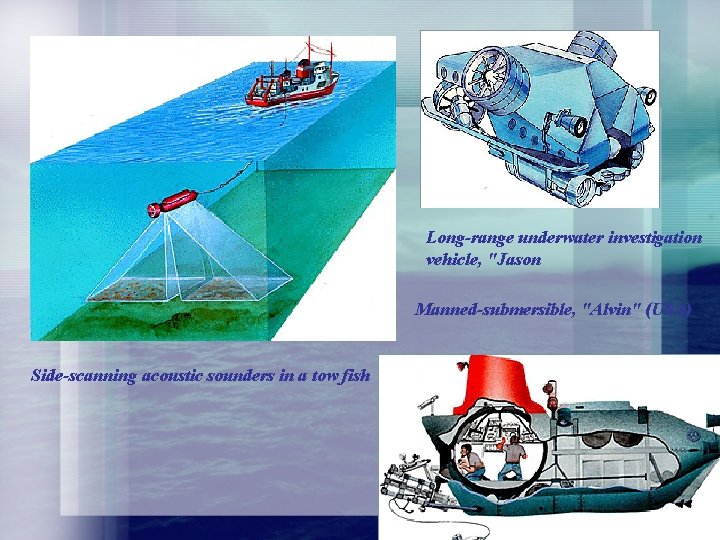
Long-range underwater investigation vehicle, "Jason Manned-submersible, "Alvin" (USA) Side-scanning acoustic sounders in a tow fish
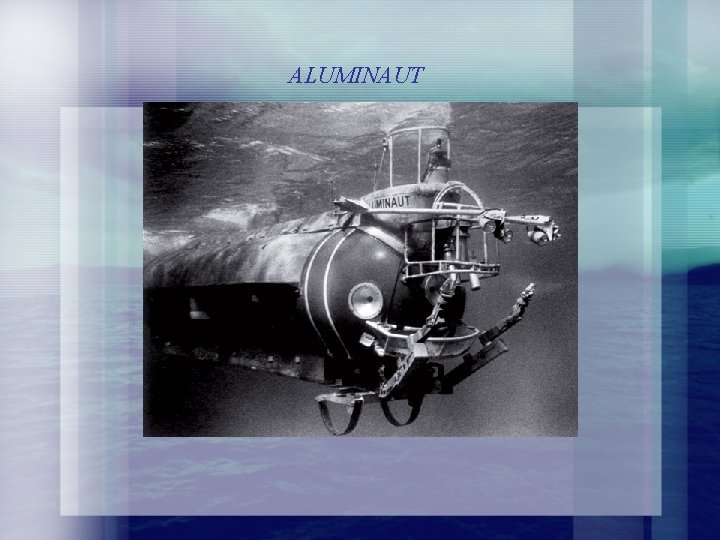
ALUMINAUT
- Slides: 22