
Oceanography An Invitation to Marine Science 9 e
- Slides: 18
Oceanography, An Invitation to Marine Science | 9 e Tom Garrison 10 Waves © 2016 Cengage Learning. All Rights Reserved.
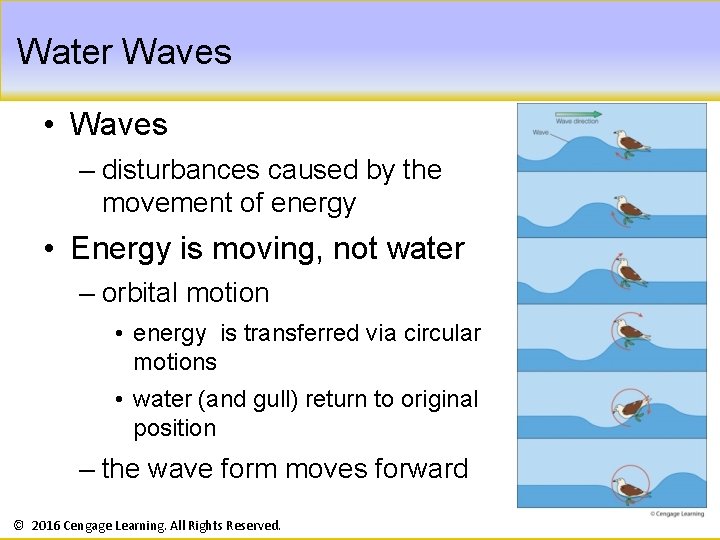
Water Waves • Waves – disturbances caused by the movement of energy • Energy is moving, not water – orbital motion • energy is transferred via circular motions • water (and gull) return to original position – the wave form moves forward © 2016 Cengage Learning. All Rights Reserved.
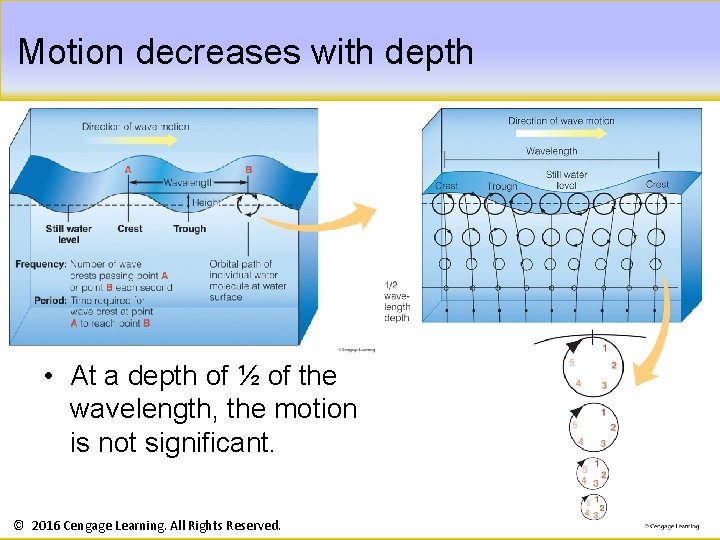
Motion decreases with depth • At a depth of ½ of the wavelength, the motion is not significant. © 2016 Cengage Learning. All Rights Reserved.
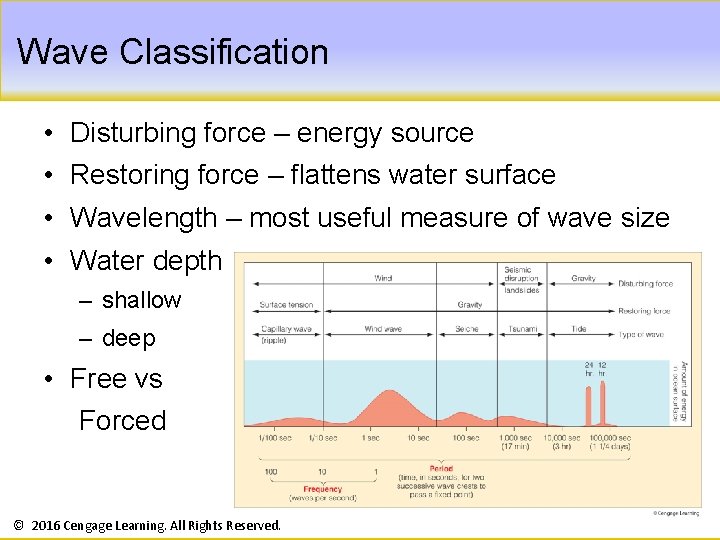
Wave Classification • • Disturbing force – energy source Restoring force – flattens water surface Wavelength – most useful measure of wave size Water depth – shallow – deep • Free vs Forced © 2016 Cengage Learning. All Rights Reserved.
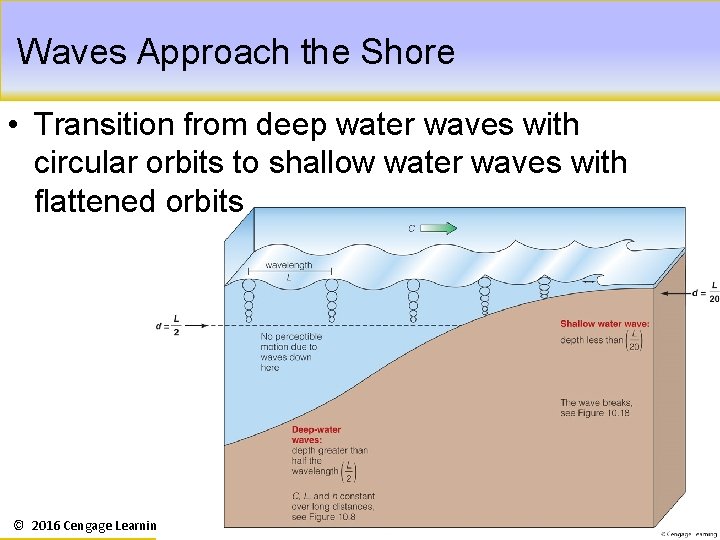
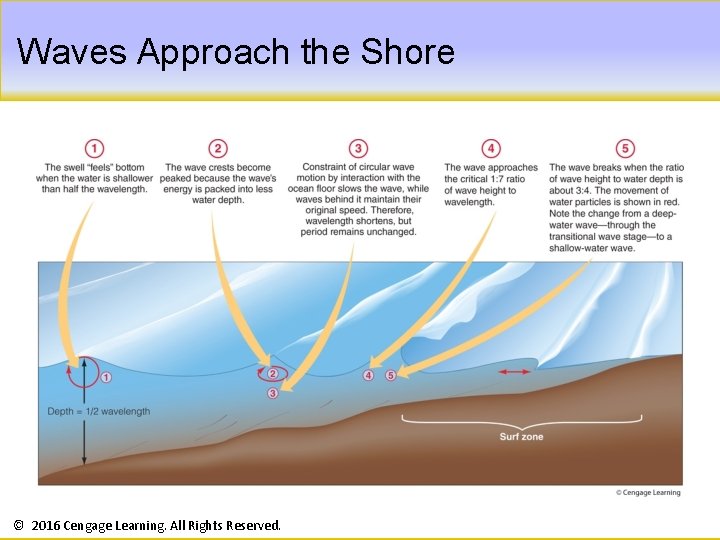
Wave Classification – water depth • Deep-water waves – depth greater than ½ wavelength – not touching bottom – wind waves in the open ocean • Shallow-water waves – depth less than ½ wavelength – touching bottom – cannot have full stack of orbiting circles – wind waves approaching the shore – very large waves • tsunamis • tides © 2016 Cengage Learning. All Rights Reserved.
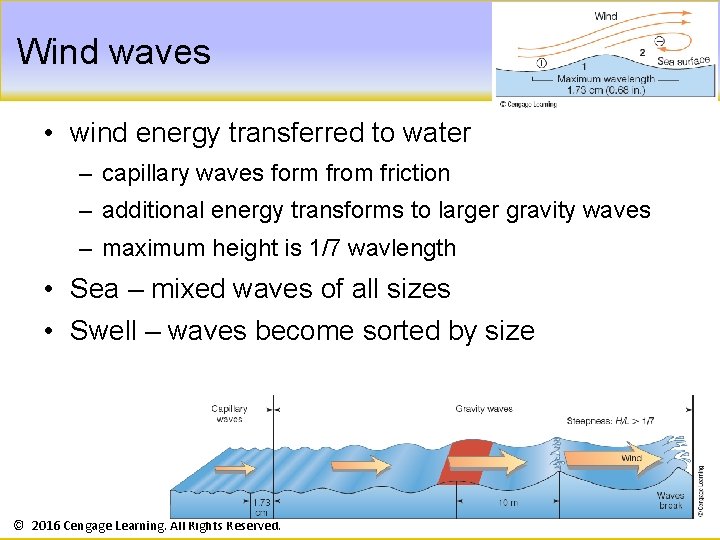
Wind waves • wind energy transferred to water – capillary waves form from friction – additional energy transforms to larger gravity waves – maximum height is 1/7 wavlength • Sea – mixed waves of all sizes • Swell – waves become sorted by size © 2016 Cengage Learning. All Rights Reserved.
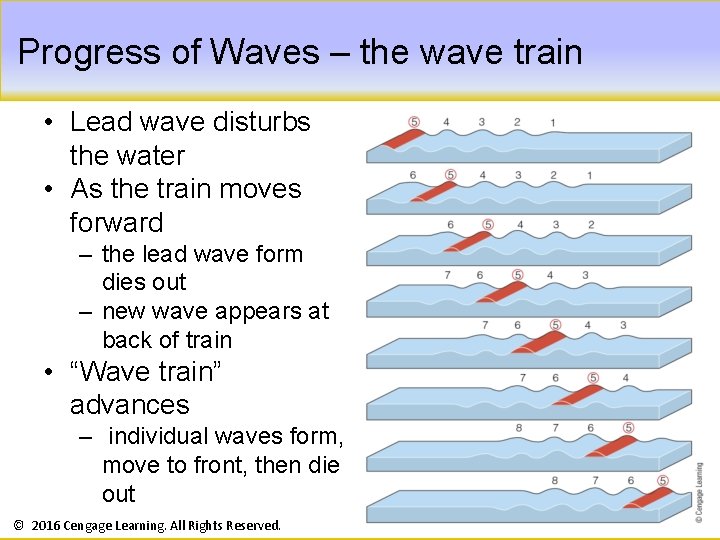
Progress of Waves – the wave train • Lead wave disturbs the water • As the train moves forward – the lead wave form dies out – new wave appears at back of train • “Wave train” advances – individual waves form, move to front, then die out © 2016 Cengage Learning. All Rights Reserved.
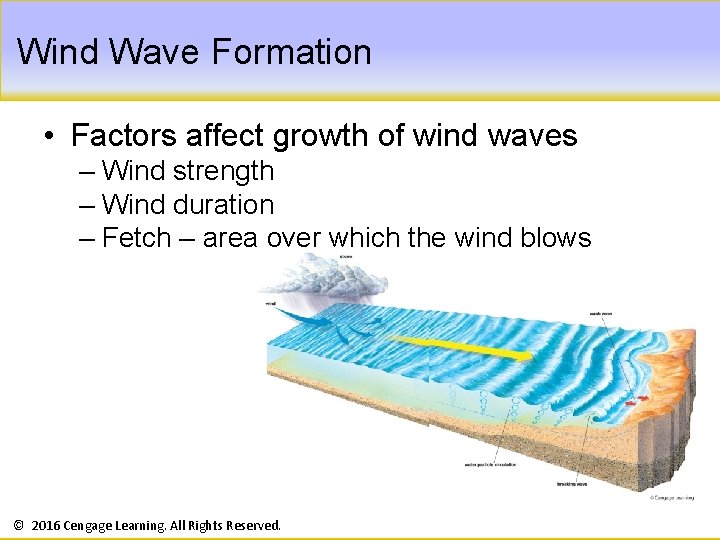
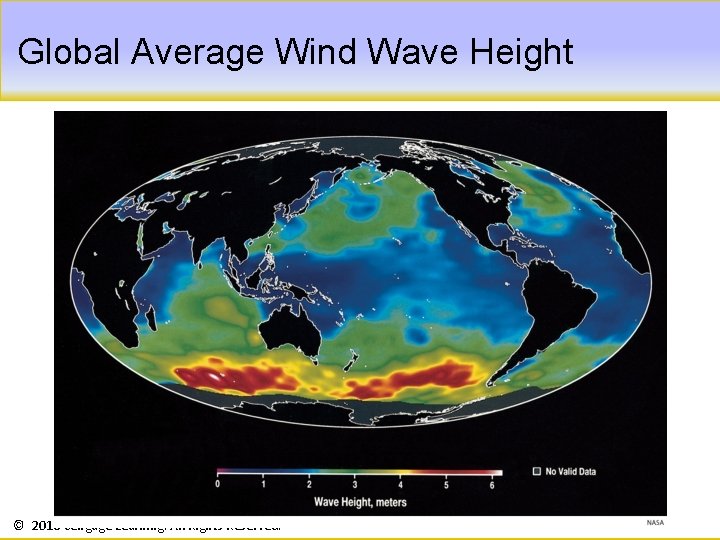
Wind Wave Formation • Factors affect growth of wind waves – Wind strength – Wind duration – Fetch – area over which the wind blows © 2016 Cengage Learning. All Rights Reserved.
Global Average Wind Wave Height © 2016 Cengage Learning. All Rights Reserved.
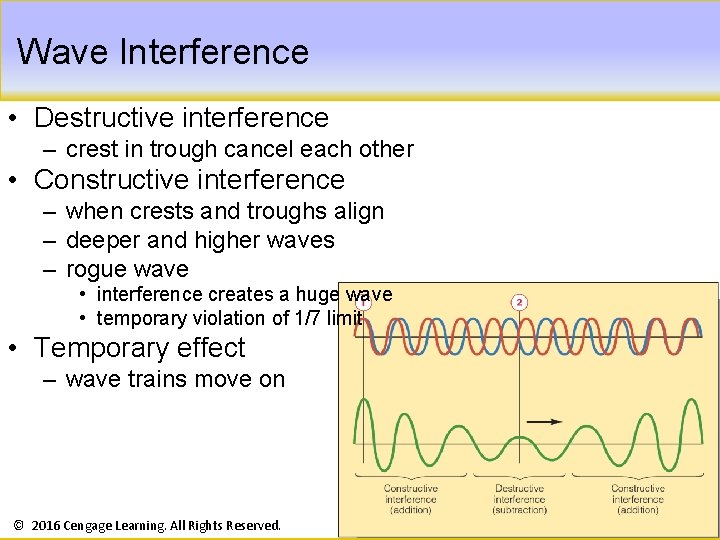
Wave Interference • Destructive interference – crest in trough cancel each other • Constructive interference – when crests and troughs align – deeper and higher waves – rogue wave • interference creates a huge wave • temporary violation of 1/7 limit • Temporary effect – wave trains move on © 2016 Cengage Learning. All Rights Reserved.
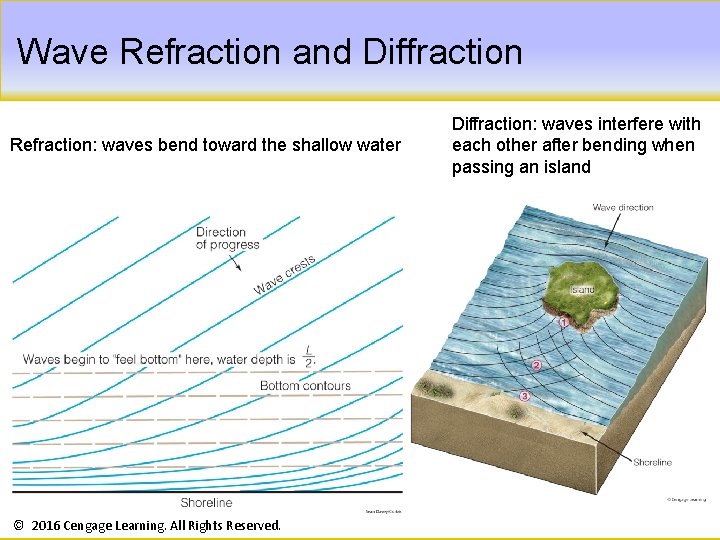
Waves Approach the Shore • Transition from deep water waves with circular orbits to shallow water waves with flattened orbits © 2016 Cengage Learning. All Rights Reserved.
Waves Approach the Shore © 2016 Cengage Learning. All Rights Reserved.
Wave Refraction and Diffraction Refraction: waves bend toward the shallow water © 2016 Cengage Learning. All Rights Reserved. Diffraction: waves interfere with each other after bending when passing an island
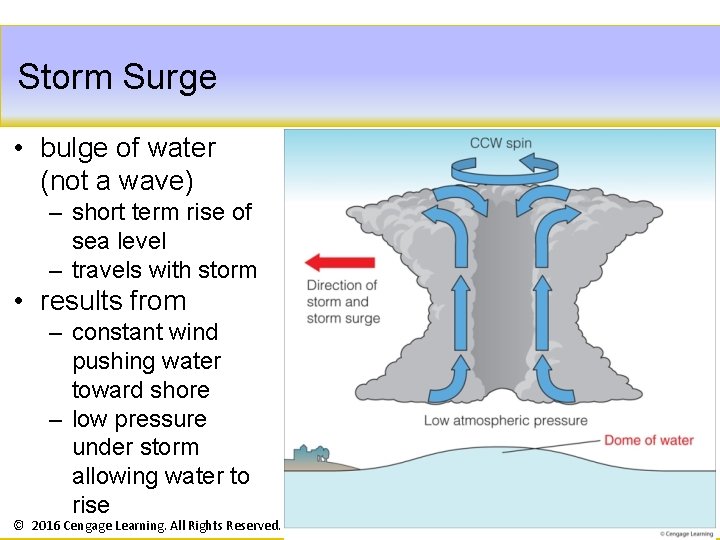
Storm Surge • bulge of water (not a wave) – short term rise of sea level – travels with storm • results from – constant wind pushing water toward shore – low pressure under storm allowing water to rise © 2016 Cengage Learning. All Rights Reserved.
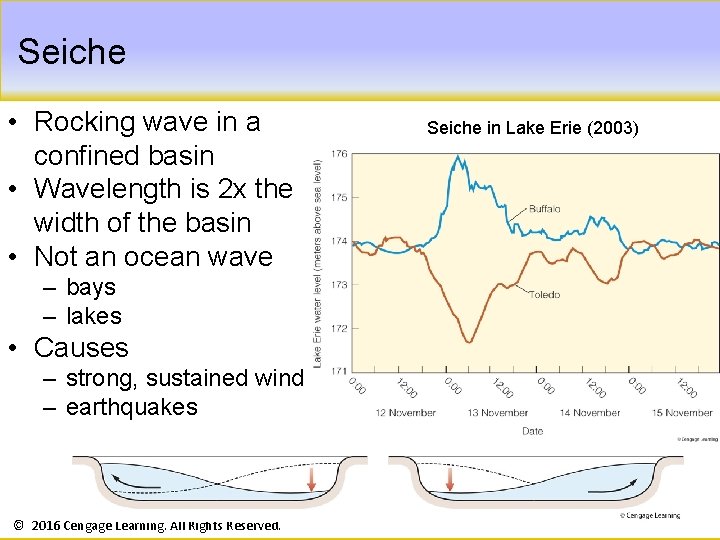
Seiche • Rocking wave in a confined basin • Wavelength is 2 x the width of the basin • Not an ocean wave – bays – lakes • Causes – strong, sustained wind – earthquakes © 2016 Cengage Learning. All Rights Reserved. Seiche in Lake Erie (2003)
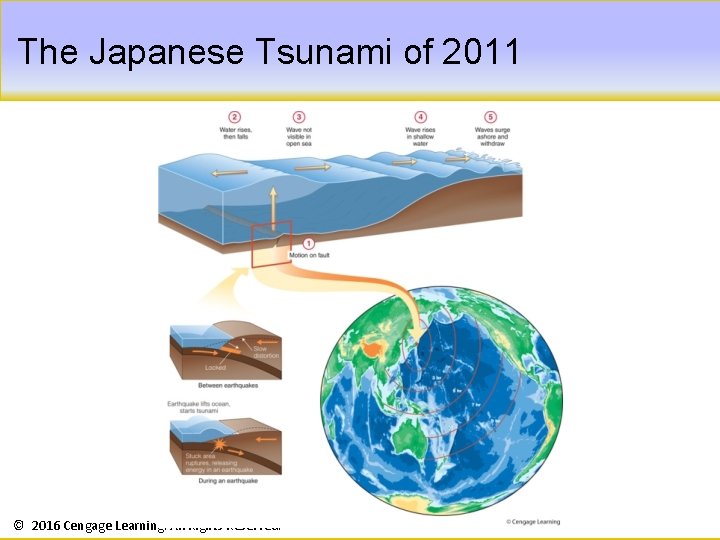
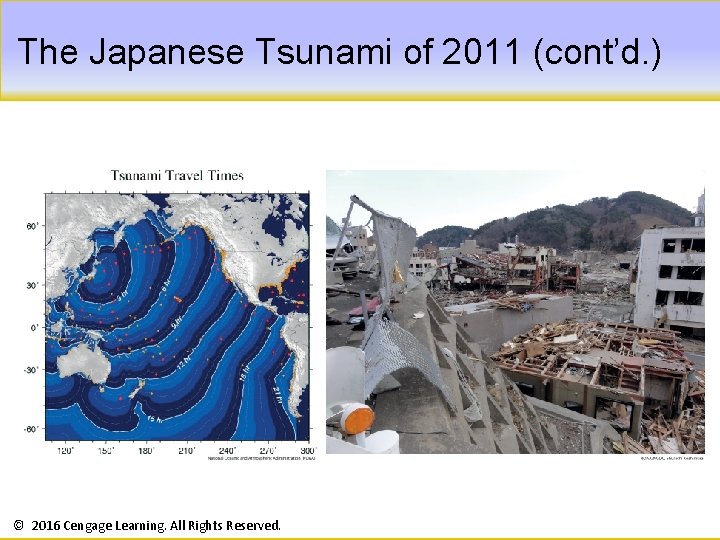
Tsunami • Caused by rapid displacement of water – landslide – fault movement • Long-wavelength – 75 to 125 miles – always shallow-water waves (ocean is 2 miles deep) – always touching bottom – no room for full stack of orbital motion • Height – short on open ocean (1 to 3 feet) – dramatically increases at shore • 3 to 30 feet is common • up to 100 feet in some places • Fast – 400 to 600 miles per hour in the open ocean – 50 to 70 miles per hour as they approach the shore – can cross the Pacific Ocean in 12 hours © 2016 Cengage Learning. All Rights Reserved.
The Japanese Tsunami of 2011 © 2016 Cengage Learning. All Rights Reserved.
The Japanese Tsunami of 2011 (cont’d. ) © 2016 Cengage Learning. All Rights Reserved.