
Oceanography An Invitation to Marine Science 7 th
- Slides: 21
Oceanography An Invitation to Marine Science, 7 th Tom Garrison Chapter 18 The Ocean and the Environment
Chapter 18 Study Plan • An Introduction to Marine Environmental Issues • Marine Pollutants May Be Natural or Human. Generated • Organisms Cannot Prosper if Their Habitat Is Disturbed • Marine Conservation Areas Offer a Glimmer of Hope • Human Activity Is Causing Global Oceanic Change • What Can Be Done?
Chapter 18 Main Concepts • Since 1961, human demand on Earth’s organisms and raw materials has more than doubled, and now exceeds Earth’s natural replacement capacity by at least 20%. • A pollutant causes damage by interfering directly or indirectly with the biochemical processes of an organism. About three-quarters of the pollution entering the ocean comes from human activities on land. • The ocean’s increasing acidity is a serious threat to calciumdeposition organisms. Coral reefs are especially endangered by acidification. • Phytoplankton productivity may be affected by a decrease in stratospheric ozone and the formation of “ozone holes. ” • The global temperature trend has been generally upward in the 18, 000 years since the last ice age, but the rate of increase has recently accelerated. We are entering a period of rapid global warming, some or most of which is caused by human activity. • Although it is not yet possible to specify with precision the percentage of observed global warming caused by human activity, it seems reasonable to err on the side of safety and minimize emissions of anthropogenic greenhouse gases.
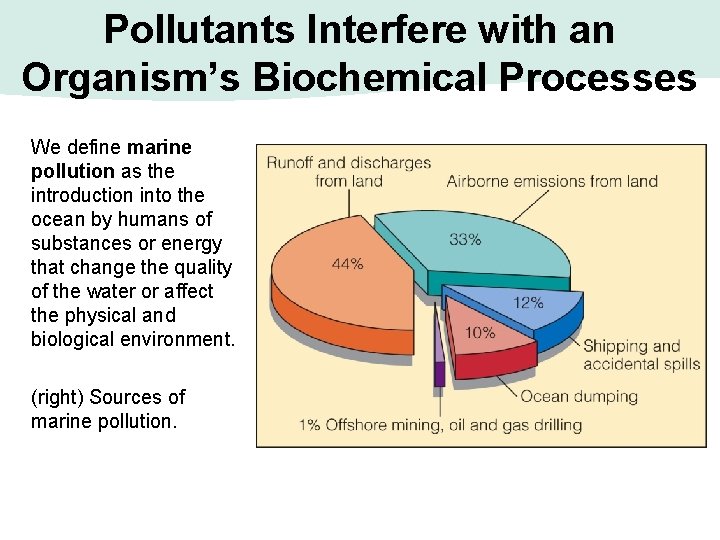
Pollutants Interfere with an Organism’s Biochemical Processes We define marine pollution as the introduction into the ocean by humans of substances or energy that change the quality of the water or affect the physical and biological environment. (right) Sources of marine pollution.
Pollutants Interfere with an Organism’s Biochemical Processes • What are some characteristics of a pollutant? • Quantity - the amount of a particular pollutant present • Toxicity - the amount of a pollutant required to cause damage • Persistence - the length of time a pollutant lasts in an environment
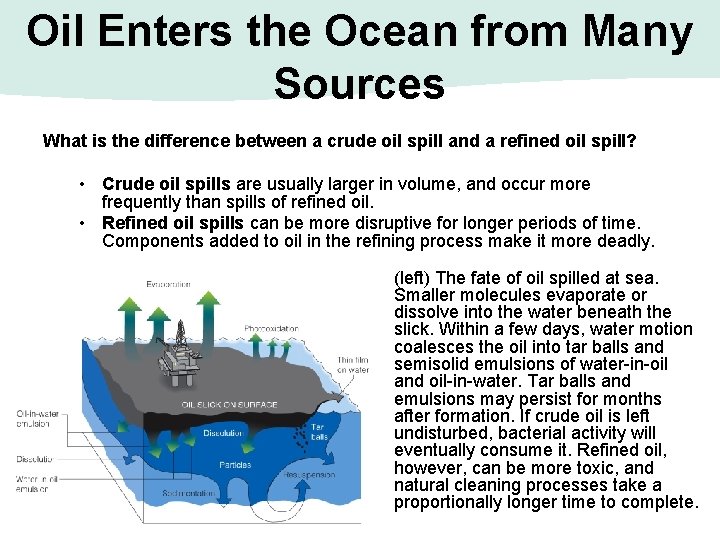
Oil Enters the Ocean from Many Sources What is the difference between a crude oil spill and a refined oil spill? • Crude oil spills are usually larger in volume, and occur more frequently than spills of refined oil. • Refined oil spills can be more disruptive for longer periods of time. Components added to oil in the refining process make it more deadly. (left) The fate of oil spilled at sea. Smaller molecules evaporate or dissolve into the water beneath the slick. Within a few days, water motion coalesces the oil into tar balls and semisolid emulsions of water-in-oil and oil-in-water. Tar balls and emulsions may persist for months after formation. If crude oil is left undisturbed, bacterial activity will eventually consume it. Refined oil, however, can be more toxic, and natural cleaning processes take a proportionally longer time to complete.
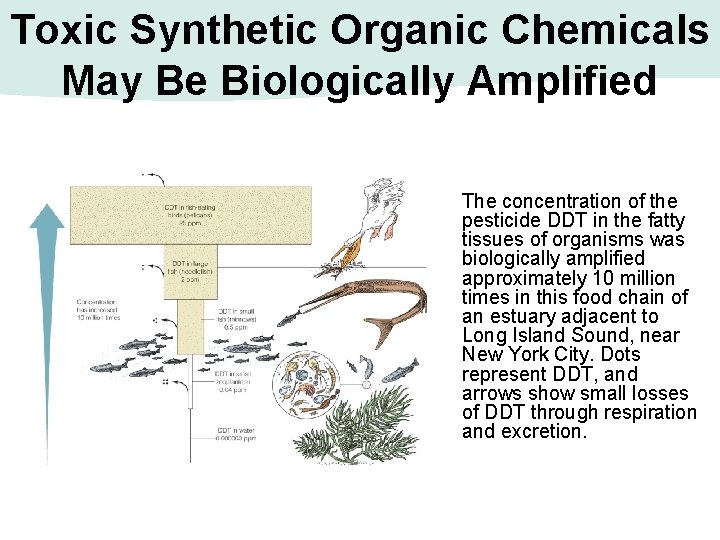
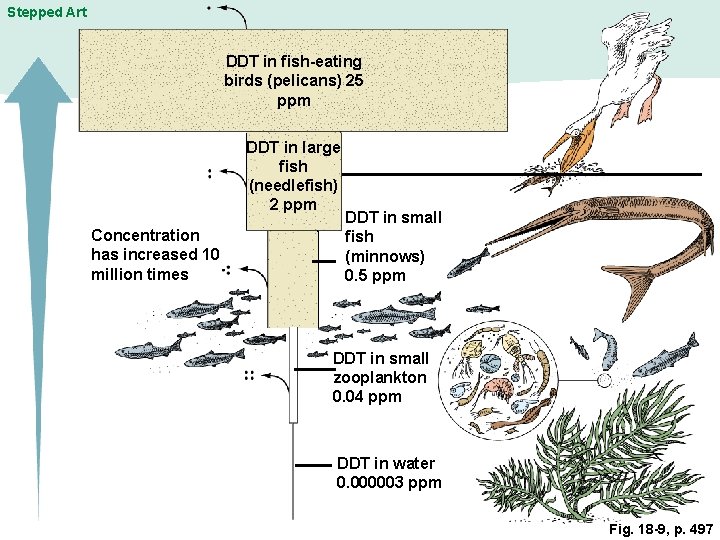
Toxic Synthetic Organic Chemicals May Be Biologically Amplified The concentration of the pesticide DDT in the fatty tissues of organisms was biologically amplified approximately 10 million times in this food chain of an estuary adjacent to Long Island Sound, near New York City. Dots represent DDT, and arrows show small losses of DDT through respiration and excretion.
Stepped Art DDT in fish-eating birds (pelicans) 25 ppm DDT in large fish (needlefish) 2 ppm Concentration has increased 10 million times DDT in small fish (minnows) 0. 5 ppm DDT in small zooplankton 0. 04 ppm DDT in water 0. 000003 ppm Fig. 18 -9, p. 497
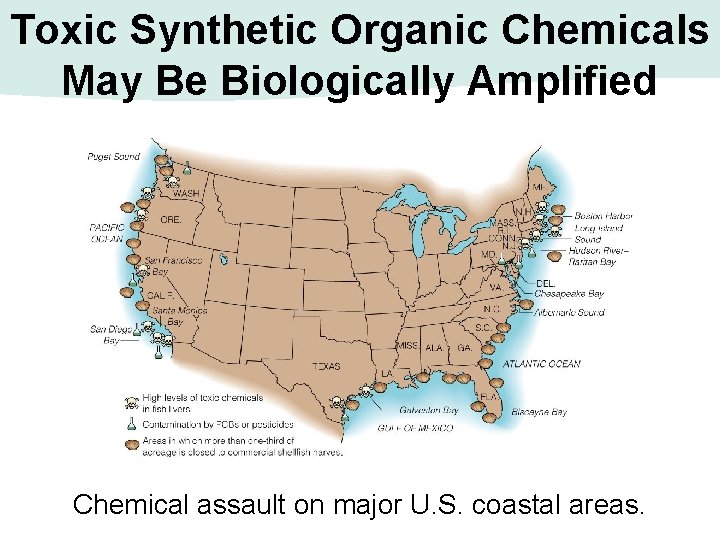
Toxic Synthetic Organic Chemicals May Be Biologically Amplified Chemical assault on major U. S. coastal areas.
Heavy Metals Can Be Toxic in Very Small Quantities • Small quantities of heavy metals can cause damage to organisms. Some examples of heavy metals that can cause damage are: – Lead – Mercury – Copper • Sources of heavy metal pollution: – Coal combustion and electric utilities – Steel and iron manufacturing – Fuel oils and fuel additives – Incineration of urban refuse
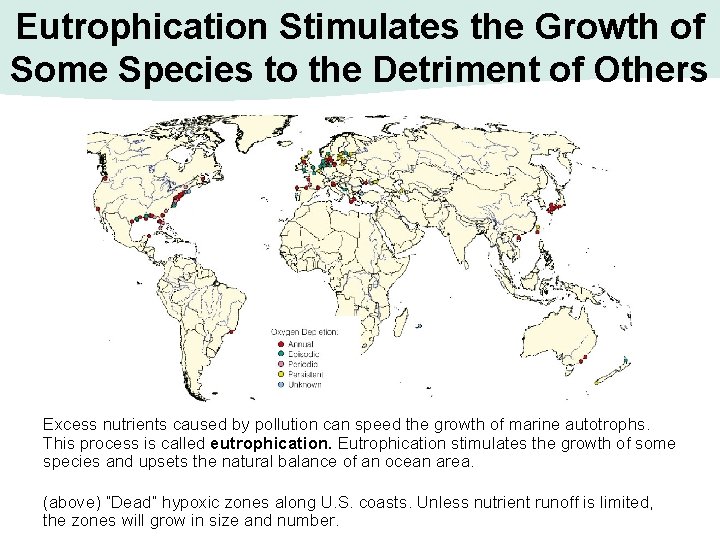
Eutrophication Stimulates the Growth of Some Species to the Detriment of Others Excess nutrients caused by pollution can speed the growth of marine autotrophs. This process is called eutrophication. Eutrophication stimulates the growth of some species and upsets the natural balance of an ocean area. (above) “Dead” hypoxic zones along U. S. coasts. Unless nutrient runoff is limited, the zones will grow in size and number.
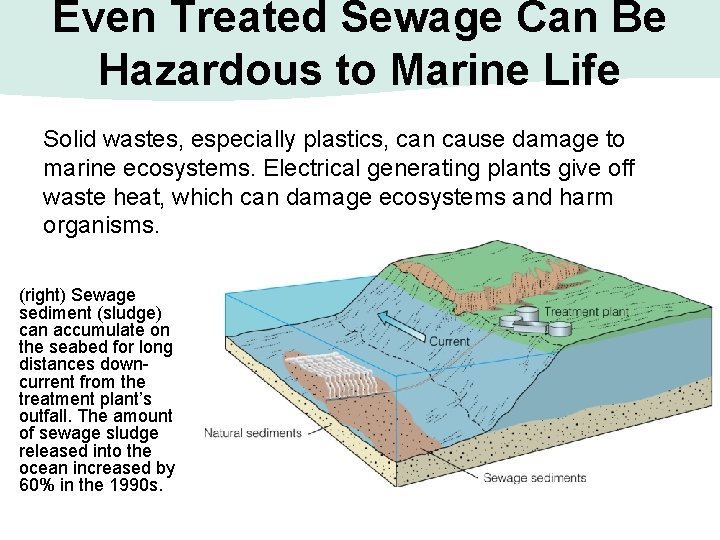
Even Treated Sewage Can Be Hazardous to Marine Life Solid wastes, especially plastics, can cause damage to marine ecosystems. Electrical generating plants give off waste heat, which can damage ecosystems and harm organisms. (right) Sewage sediment (sludge) can accumulate on the seabed for long distances downcurrent from the treatment plant’s outfall. The amount of sewage sludge released into the ocean increased by 60% in the 1990 s.
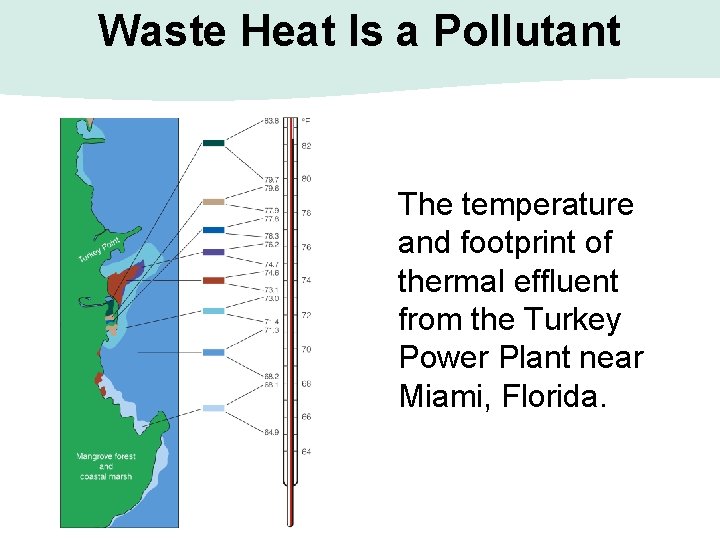
Waste Heat Is a Pollutant The temperature and footprint of thermal effluent from the Turkey Power Plant near Miami, Florida.
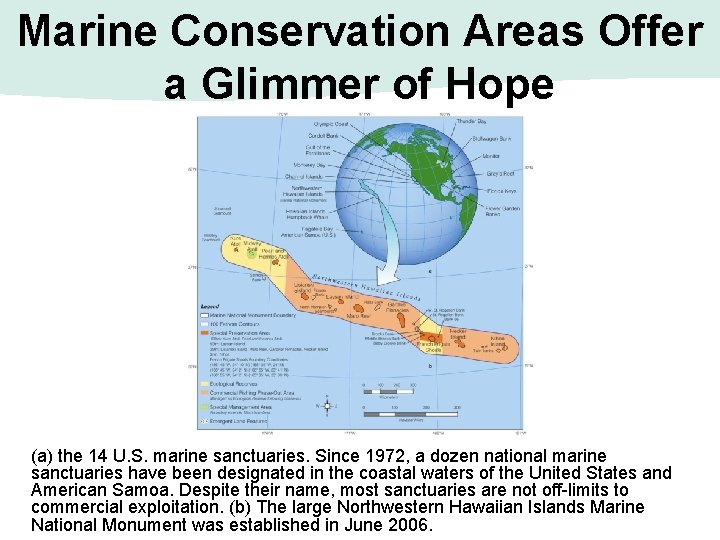
Marine Conservation Areas Offer a Glimmer of Hope (a) the 14 U. S. marine sanctuaries. Since 1972, a dozen national marine sanctuaries have been designated in the coastal waters of the United States and American Samoa. Despite their name, most sanctuaries are not off-limits to commercial exploitation. (b) The large Northwestern Hawaiian Islands Marine National Monument was established in June 2006.
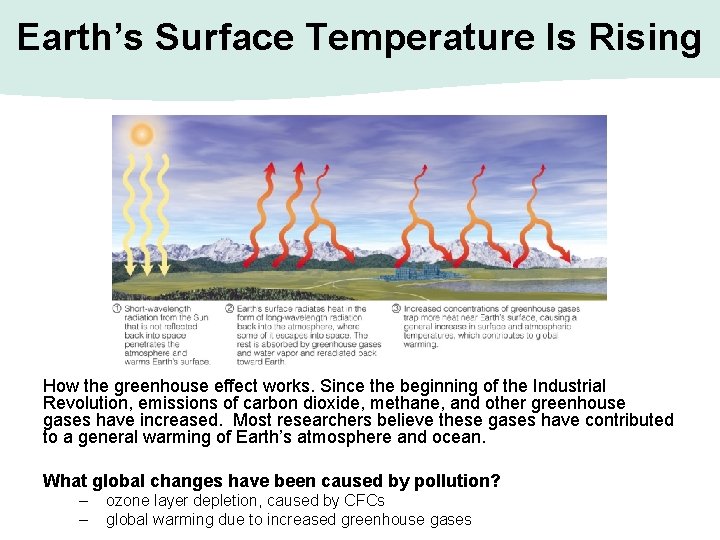
Earth’s Surface Temperature Is Rising How the greenhouse effect works. Since the beginning of the Industrial Revolution, emissions of carbon dioxide, methane, and other greenhouse gases have increased. Most researchers believe these gases have contributed to a general warming of Earth’s atmosphere and ocean. What global changes have been caused by pollution? – – ozone layer depletion, caused by CFCs global warming due to increased greenhouse gases
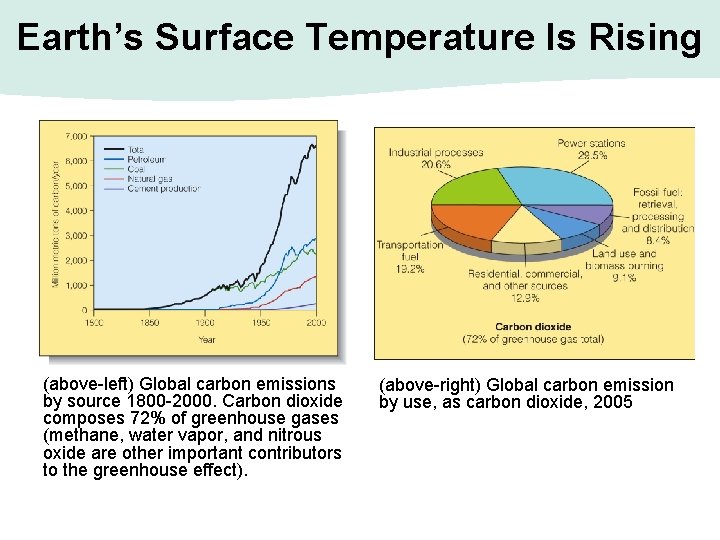
Earth’s Surface Temperature Is Rising (above-left) Global carbon emissions by source 1800 -2000. Carbon dioxide composes 72% of greenhouse gases (methane, water vapor, and nitrous oxide are other important contributors to the greenhouse effect). (above-right) Global carbon emission by use, as carbon dioxide, 2005
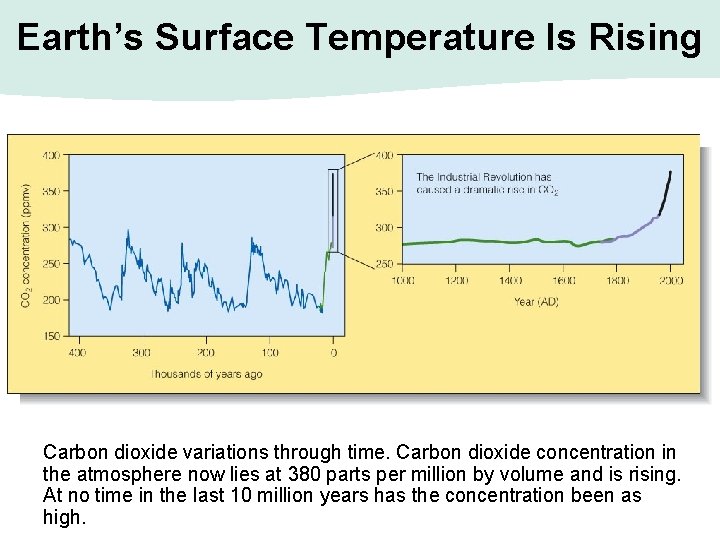
Earth’s Surface Temperature Is Rising Carbon dioxide variations through time. Carbon dioxide concentration in the atmosphere now lies at 380 parts per million by volume and is rising. At no time in the last 10 million years has the concentration been as high.
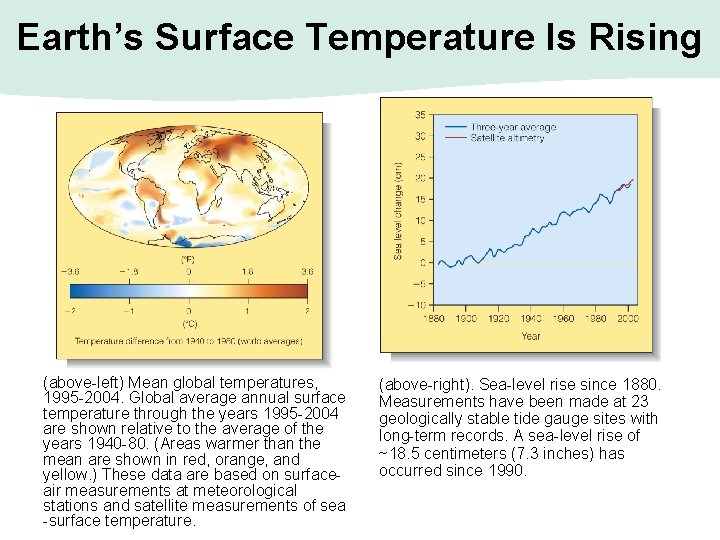
Earth’s Surface Temperature Is Rising (above-left) Mean global temperatures, 1995 -2004. Global average annual surface temperature through the years 1995 -2004 are shown relative to the average of the years 1940 -80. (Areas warmer than the mean are shown in red, orange, and yellow. ) These data are based on surfaceair measurements at meteorological stations and satellite measurements of sea -surface temperature. (above-right). Sea-level rise since 1880. Measurements have been made at 23 geologically stable tide gauge sites with long-term records. A sea-level rise of ~18. 5 centimeters (7. 3 inches) has occurred since 1990.
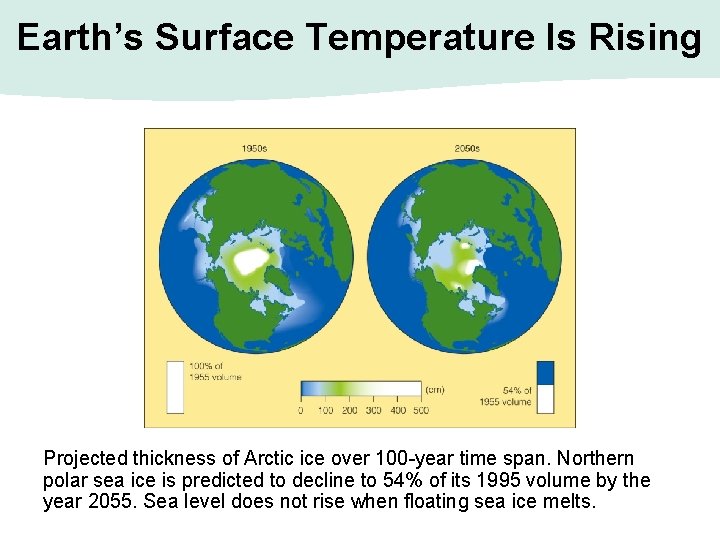
Earth’s Surface Temperature Is Rising Projected thickness of Arctic ice over 100 -year time span. Northern polar sea ice is predicted to decline to 54% of its 1995 volume by the year 2055. Sea level does not rise when floating sea ice melts.
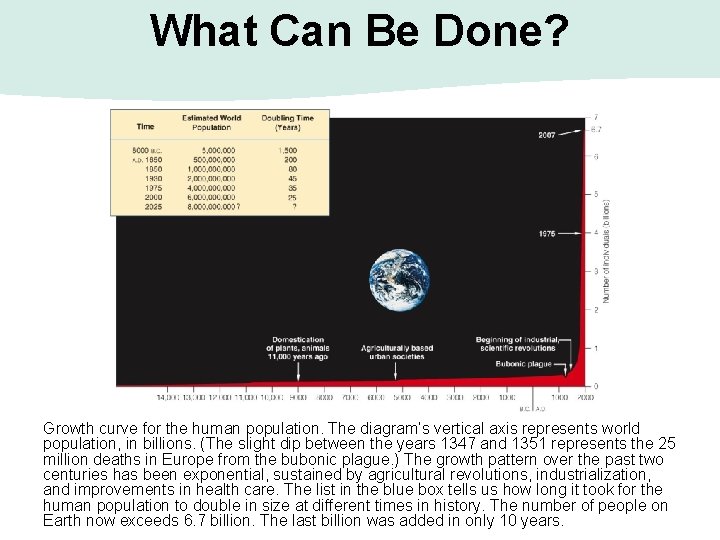
What Can Be Done? Growth curve for the human population. The diagram’s vertical axis represents world population, in billions. (The slight dip between the years 1347 and 1351 represents the 25 million deaths in Europe from the bubonic plague. ) The growth pattern over the past two centuries has been exponential, sustained by agricultural revolutions, industrialization, and improvements in health care. The list in the blue box tells us how long it took for the human population to double in size at different times in history. The number of people on Earth now exceeds 6. 7 billion. The last billion was added in only 10 years.
Chapter 18 in Perspective In this chapter you learned that our species has always exercised its capacity to consume resources and pollute its surroundings, but only in the last few generations have our efforts affected the ocean and atmosphere on a planetary scale. The introduction into the biosphere of unnatural compounds (or natural compounds in unnatural quantities) has had—and will continue to have—unexpected detrimental effects. The destruction of marine habitats and the uncontrolled harvesting of the ocean’s living resources have also disturbed delicate ecological balances. We have embarked on a time of inadvertent global experimentation, and find ourselves in difficult situations for which solutions do not come easily. This is an unpleasant chapter – the only one I do not enjoy working on. Nonetheless, I urge you think carefully about what you’ve seen, then read the Afterword that follows. The problems are yours to solve. You will find some encouragement there.