
OCEANESS 410 Class 9 MidOcean Ridges Dax Soule
- Slides: 24
OCEAN/ESS 410 Class 9. Mid-Ocean Ridges Dax Soule
Mid-Ocean Ridges Dax Soule
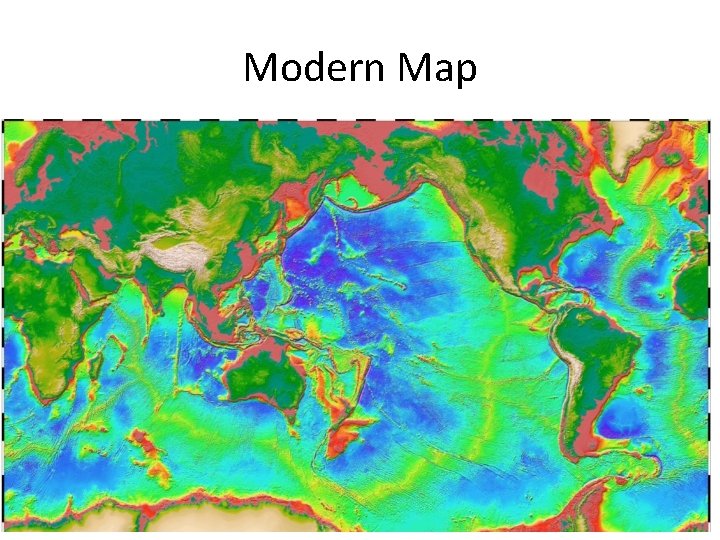
Modern Map
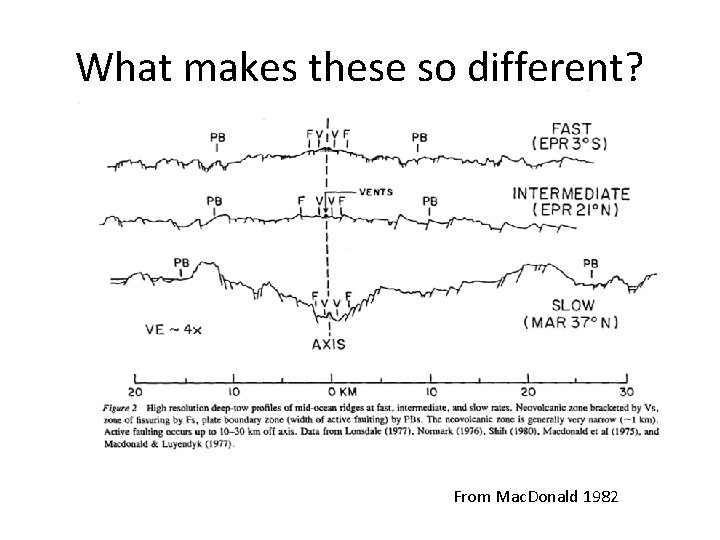
What makes these so different? From Mac. Donald 1982
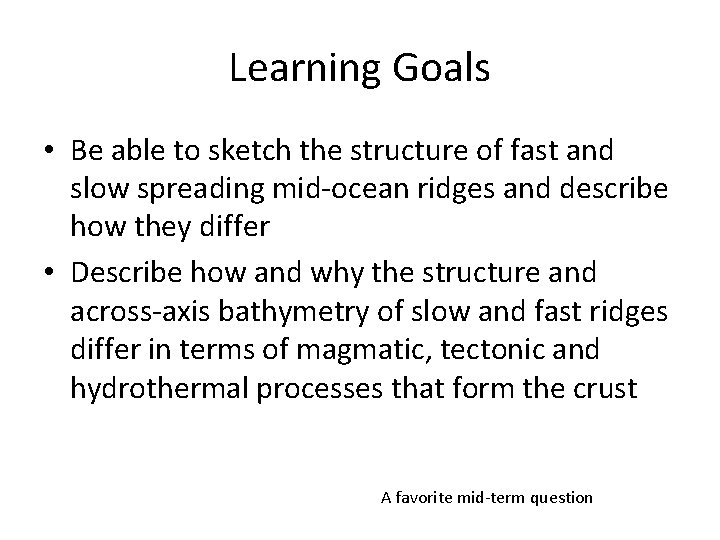
Learning Goals • Be able to sketch the structure of fast and slow spreading mid-ocean ridges and describe how they differ • Describe how and why the structure and across-axis bathymetry of slow and fast ridges differ in terms of magmatic, tectonic and hydrothermal processes that form the crust A favorite mid-term question
Catalyst Questions • List one example for both a slow and fast spreading rate mid-ocean ridge • Indicate on which you would expect for find high temperature hydrothermal venting • Indicate on which you would expect to find the larger earthquakes
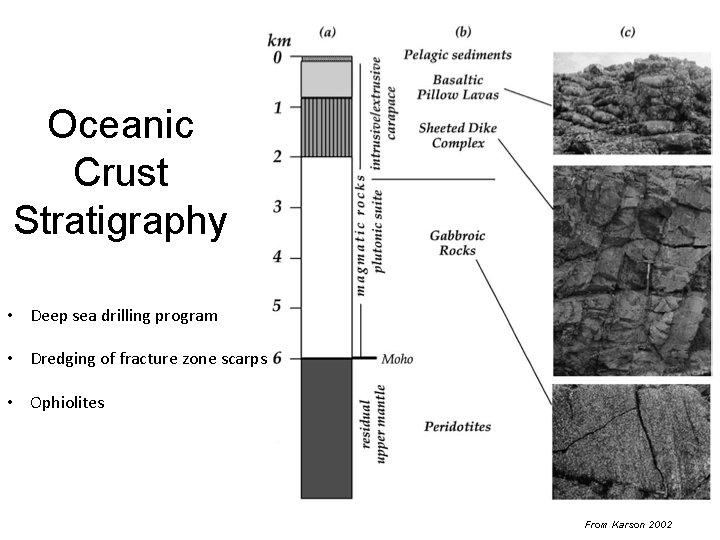
Oceanic Crust Stratigraphy • Deep sea drilling program • Dredging of fracture zone scarps • Ophiolites From Karson 2002
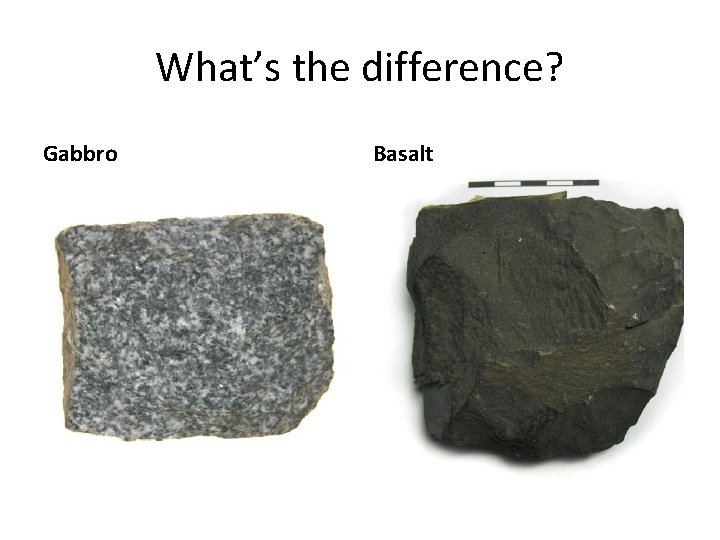
What’s the difference? Gabbro Basalt
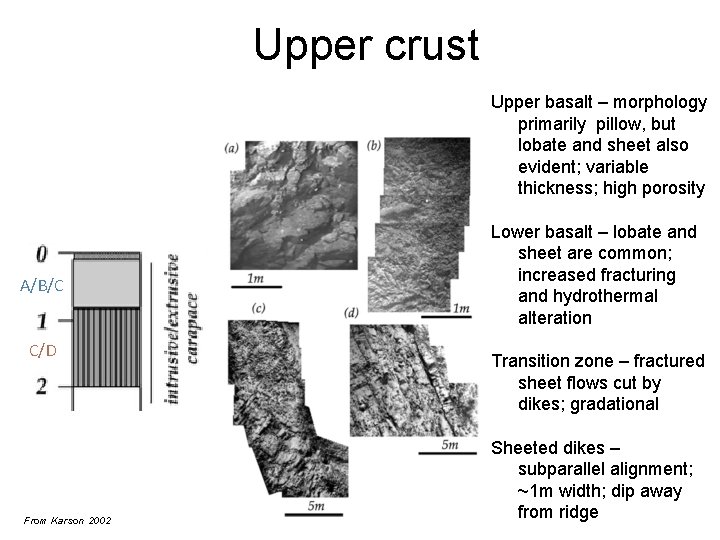
Upper crust Upper basalt – morphology primarily pillow, but lobate and sheet also evident; variable thickness; high porosity A/B/C C/D From Karson 2002 Lower basalt – lobate and sheet are common; increased fracturing and hydrothermal alteration Transition zone – fractured sheet flows cut by dikes; gradational Sheeted dikes – subparallel alignment; ~1 m width; dip away from ridge
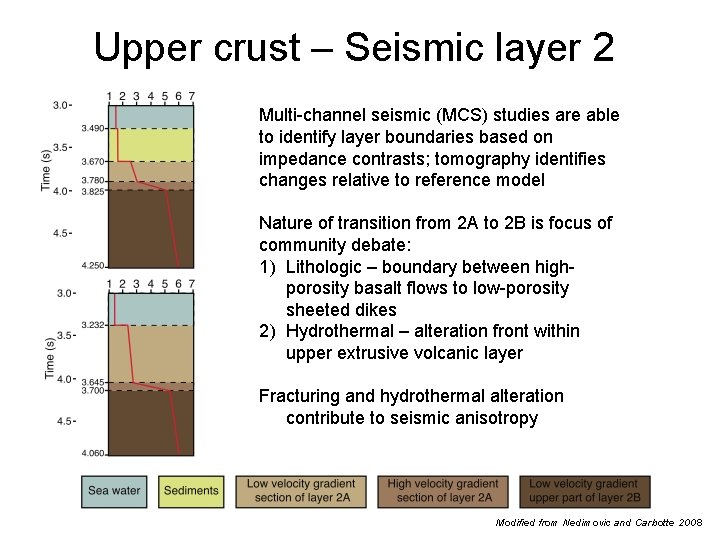
Upper crust – Seismic layer 2 Multi-channel seismic (MCS) studies are able to identify layer boundaries based on impedance contrasts; tomography identifies changes relative to reference model Nature of transition from 2 A to 2 B is focus of community debate: 1) Lithologic – boundary between highporosity basalt flows to low-porosity sheeted dikes 2) Hydrothermal – alteration front within upper extrusive volcanic layer Fracturing and hydrothermal alteration contribute to seismic anisotropy Modified from Nedimovic and Carbotte 2008
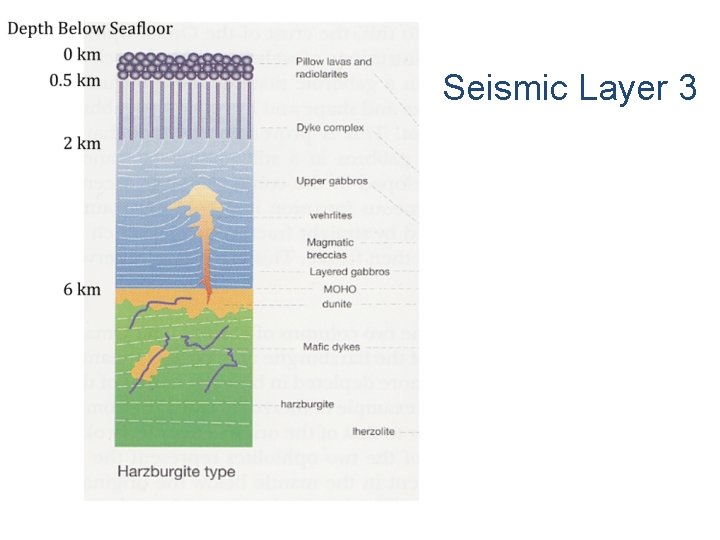
Seismic Layer 3
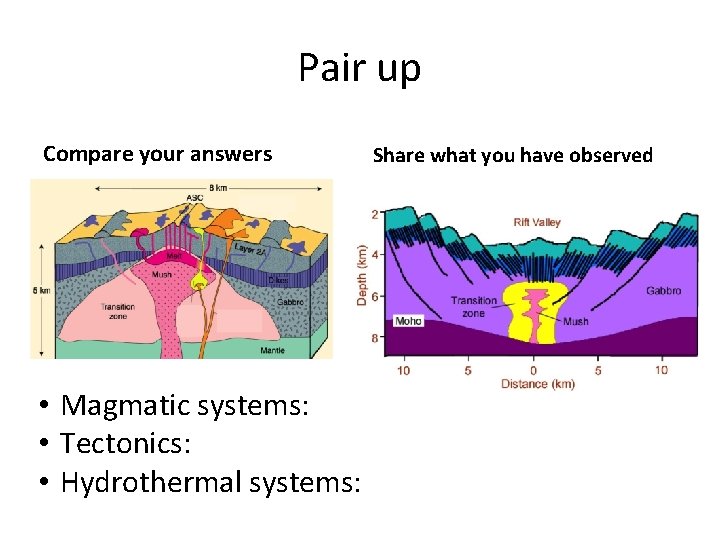
Compare and contrast • Examine these schematic drawings of fast and slow spreading mid-ocean ridges • List the ways in which the structure and across -axis bathymetry of slow and fast ridges differ in terms of magmatic, tectonic and hydrothermal processes that form the crust
Pair up Compare your answers • Magmatic systems: • Tectonics: • Hydrothermal systems: Share what you have observed
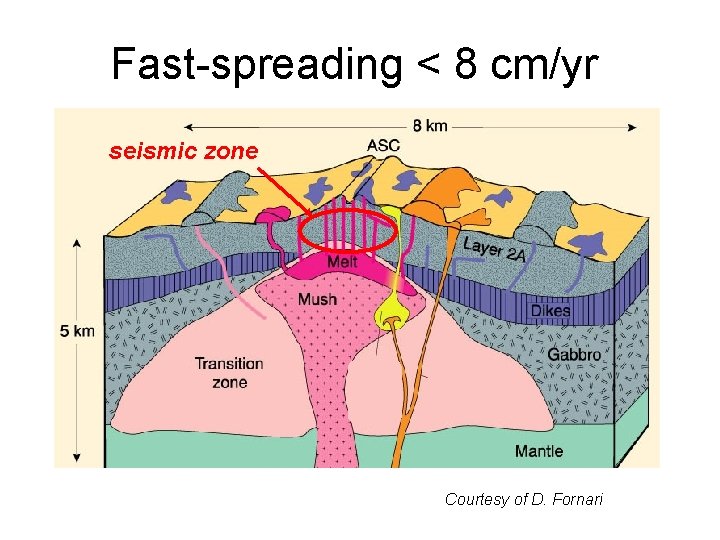
Fast-spreading < 8 cm/yr seismic zone Courtesy of D. Fornari
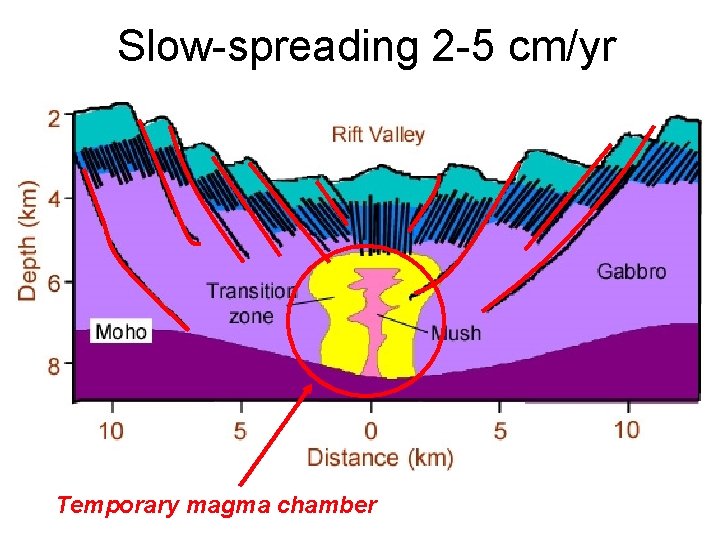
Slow-spreading 2 -5 cm/yr Temporary magma chamber
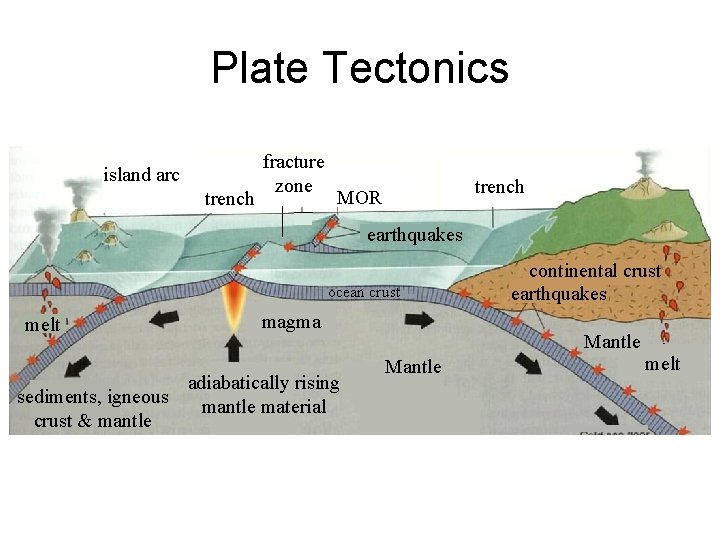
Plate Tectonics island arc trench fracture zone trench MOR earthquakes ocean crust melt sediments, igneous crust & mantle magma adiabatically rising mantle material continental crust earthquakes Mantle melt
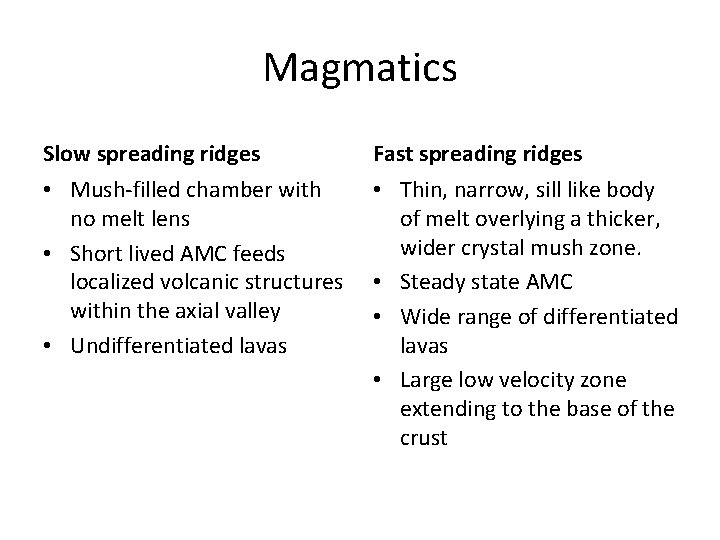
Magmatics Slow spreading ridges Fast spreading ridges • Mush-filled chamber with no melt lens • Short lived AMC feeds localized volcanic structures within the axial valley • Undifferentiated lavas • Thin, narrow, sill like body of melt overlying a thicker, wider crystal mush zone. • Steady state AMC • Wide range of differentiated lavas • Large low velocity zone extending to the base of the crust
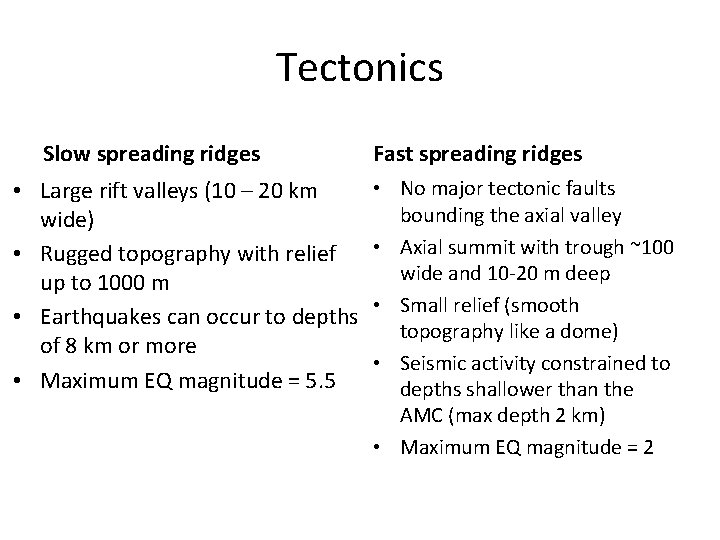
Tectonics Slow spreading ridges • Large rift valleys (10 – 20 km wide) • Rugged topography with relief up to 1000 m • Earthquakes can occur to depths of 8 km or more • Maximum EQ magnitude = 5. 5 Fast spreading ridges • No major tectonic faults bounding the axial valley • Axial summit with trough ~100 wide and 10 -20 m deep • Small relief (smooth topography like a dome) • Seismic activity constrained to depths shallower than the AMC (max depth 2 km) • Maximum EQ magnitude = 2
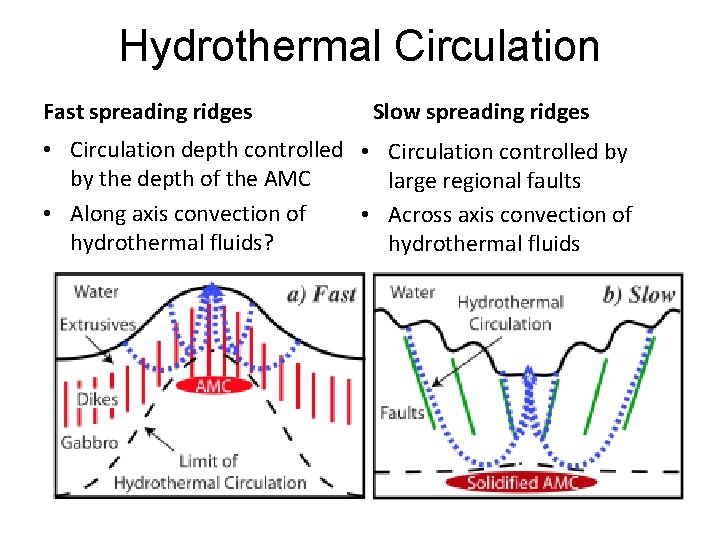
Hydrothermal Circulation Fast spreading ridges Slow spreading ridges • Circulation depth controlled • Circulation controlled by by the depth of the AMC large regional faults • Along axis convection of • Across axis convection of hydrothermal fluids? hydrothermal fluids
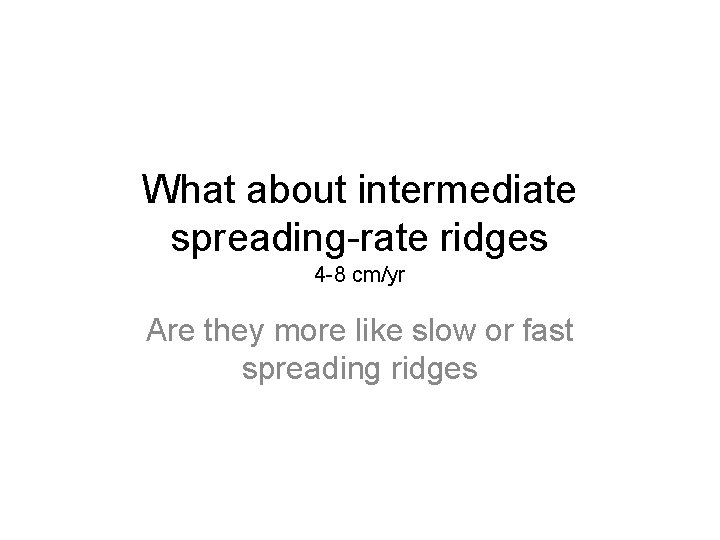
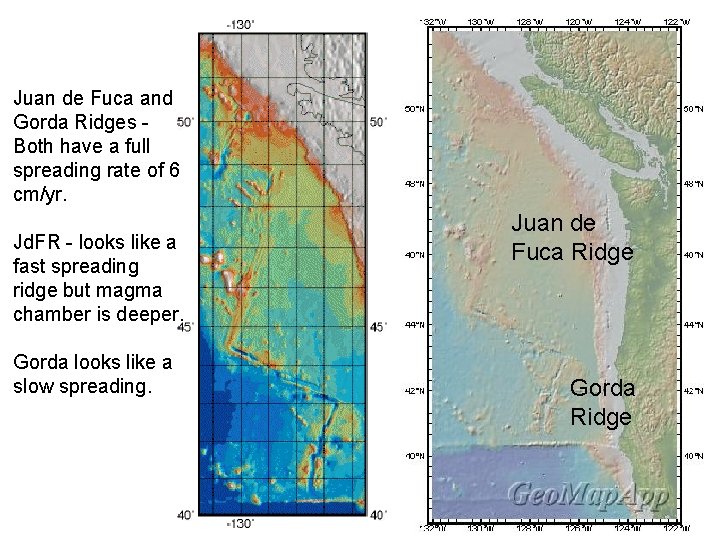
What about intermediate spreading-rate ridges 4 -8 cm/yr Are they more like slow or fast spreading ridges
Juan de Fuca and Gorda Ridges Both have a full spreading rate of 6 cm/yr. Jd. FR - looks like a fast spreading ridge but magma chamber is deeper. Gorda looks like a slow spreading. Juan de Fuca Ridge Gorda Ridge
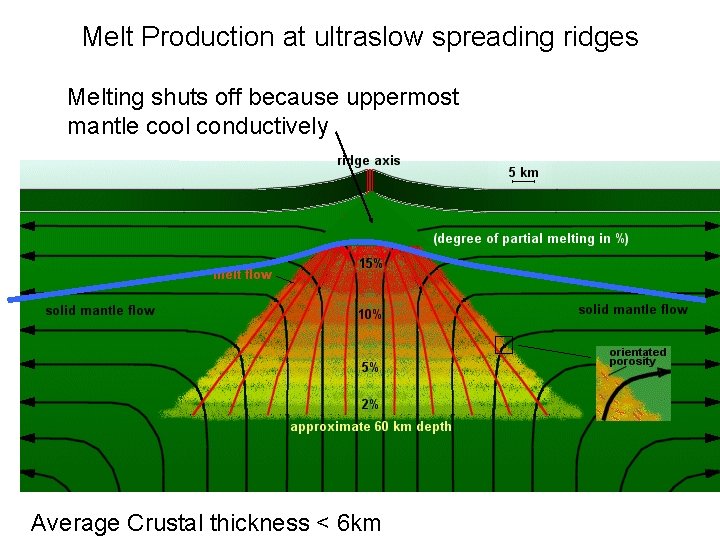
Melt Production at ultraslow spreading ridges Melting shuts off because uppermost mantle cool conductively Base of L ithospher e Average Crustal thickness < 6 km
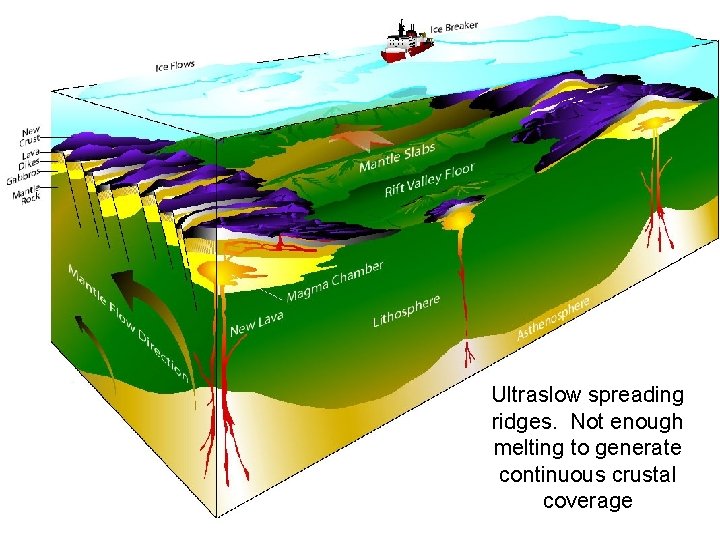
Ultraslow spreading ridges. Not enough melting to generate continuous crustal coverage
Exit Slip • Explain how slow and fast spreading centers differ in terms of the cause and intensity of seismic activity • Sketch your choice of: – A slow spreading center – A fast spreading center – A depth section showing seismic layers 1 – 3