
OceanAtmosphere Interaction Climate Variability Change ShangPing Xie Scripps
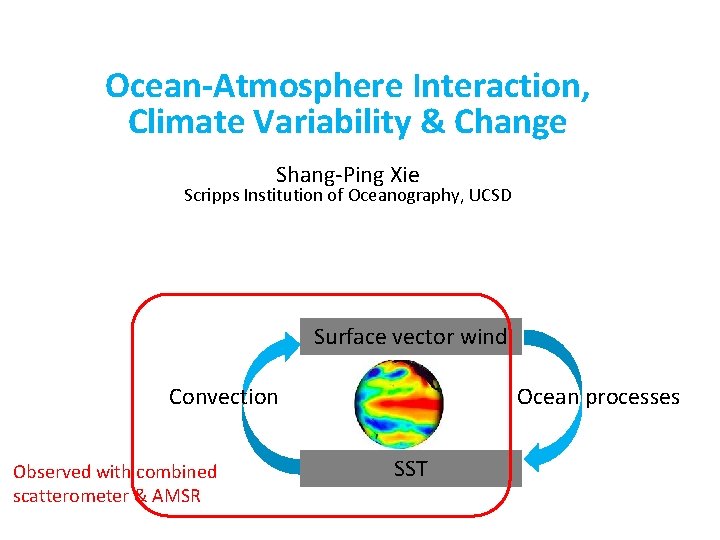
Ocean-Atmosphere Interaction, Climate Variability & Change Shang-Ping Xie Scripps Institution of Oceanography, UCSD Surface vector wind Convection Observed with combined scatterometer & AMSR Ocean processes SST
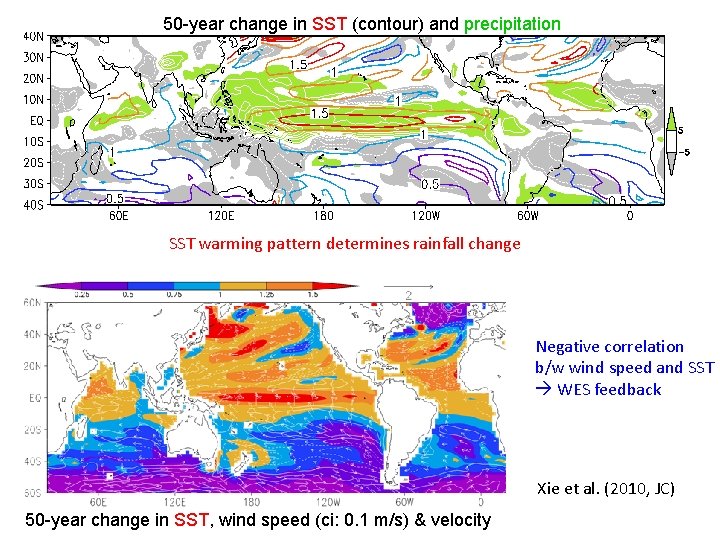
50 -year change in SST (contour) and precipitation SST warming pattern determines rainfall change Negative correlation b/w wind speed and SST WES feedback Xie et al. (2010, JC) 50 -year change in SST, wind speed (ci: 0. 1 m/s) & velocity
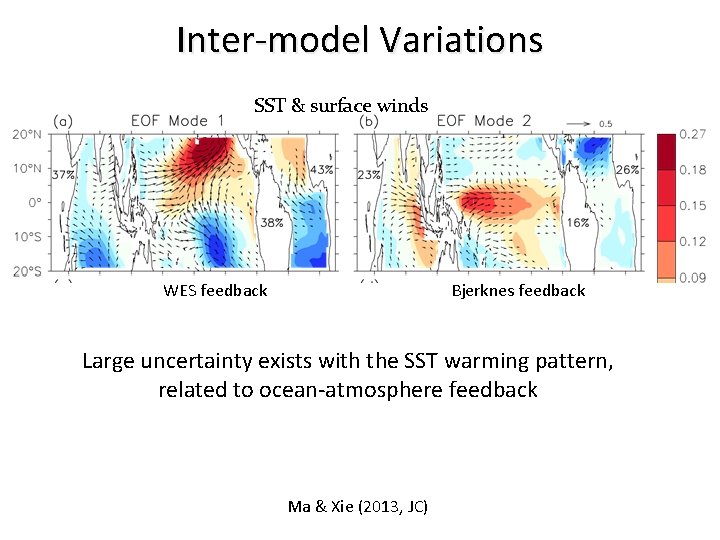
Inter-model Variations SST & surface winds WES feedback Bjerknes feedback Large uncertainty exists with the SST warming pattern, related to ocean-atmosphere feedback Ma & Xie (2013, JC)
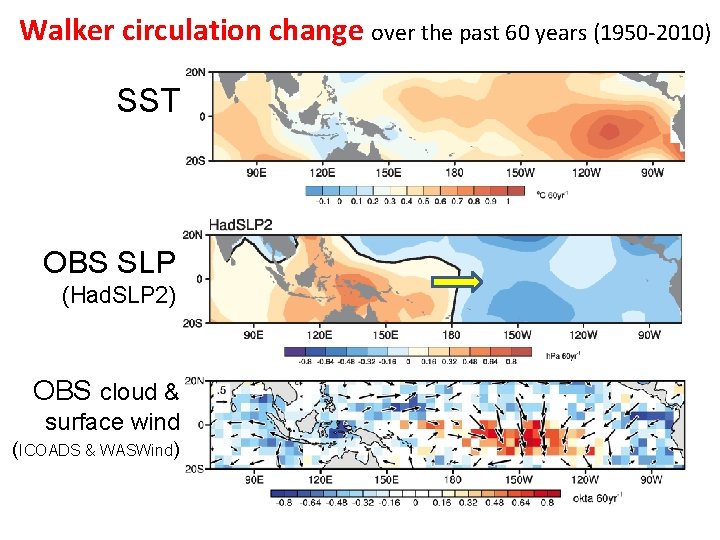
Walker circulation change over the past 60 years (1950 -2010) SST OBS SLP (Had. SLP 2) OBS cloud & surface wind (ICOADS & WASWind)
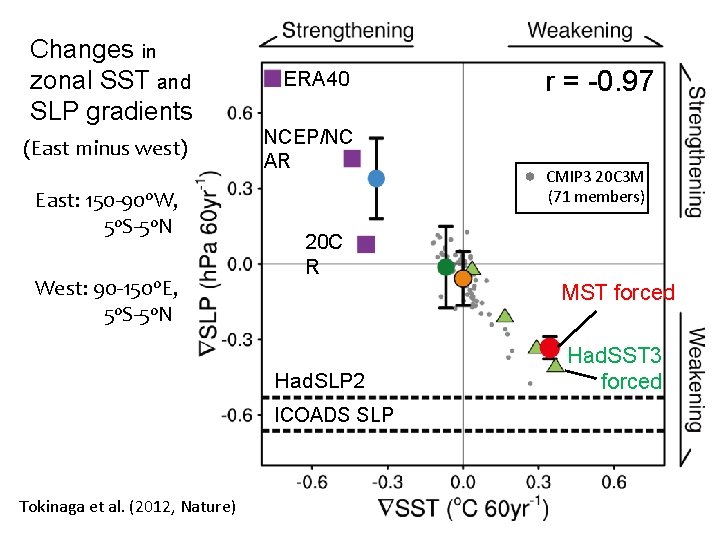
Changes in zonal SST and SLP gradients ERA 40 (East minus west) NCEP/NC AR East: 150 -90 o. W, 5 o. S-5 o. N West: 90 -150 o. E, 5 o. S-5 o. N CMIP 3 20 C 3 M (71 members) 20 C R MST forced Had. SLP 2 ICOADS SLP Tokinaga et al. (2012, Nature) r = -0. 97 Had. SST 3 forced
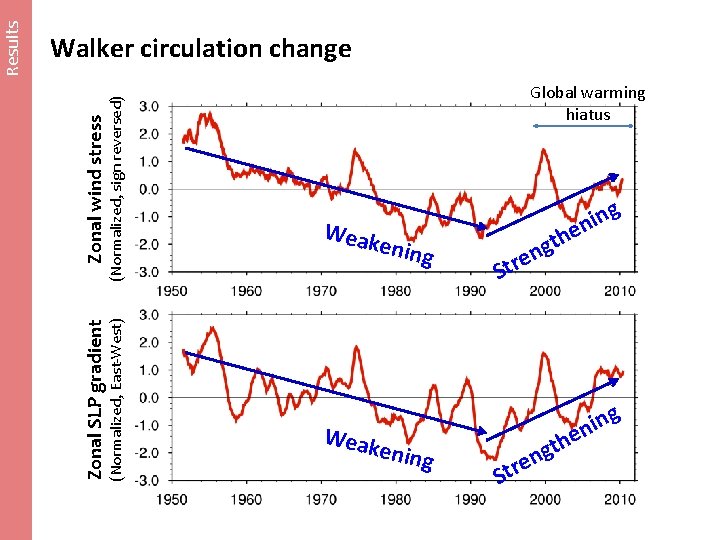
(Normalized, East-West) Zonal SLP gradient (Normalized, sign reversed) Zonal wind stress Results Walker circulation change Global warming hiatus Weak ening h t g n e r t S g n i en h t g n i en
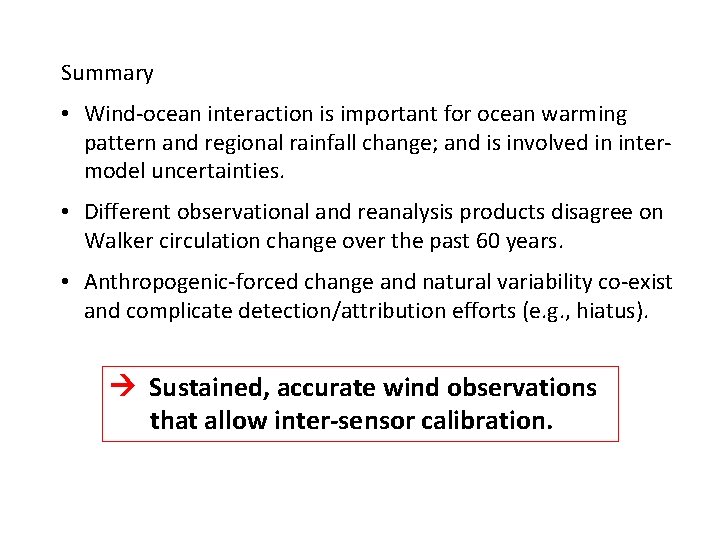
Summary • Wind-ocean interaction is important for ocean warming pattern and regional rainfall change; and is involved in intermodel uncertainties. • Different observational and reanalysis products disagree on Walker circulation change over the past 60 years. • Anthropogenic-forced change and natural variability co-exist and complicate detection/attribution efforts (e. g. , hiatus). Sustained, accurate wind observations that allow inter-sensor calibration.
- Slides: 7